
New York pay stub abbreviations are short payroll labels for earnings, taxes, deductions, and totals, so you can see what you were paid and what came out. Which lines appear depends on your benefits and where you live.
The tax lines follow 2026 rules, like Social Security’s $184,500 wage cap and New York’s 0.432% Paid Family Leave rate.
One odd code does not prove an error, and no guide covers every employer label.
Figures in this guide are for 2026 and were last checked in October 2026 against official SSA, NYS Department of Taxation and Finance, NYS DFS, NYS Department of Labor, and NYC sources. This is general information, not legal or tax advice.
What Do the Abbreviations on Your New York Pay Stub Mean?
Four codes cover most stubs: FIT (federal income tax), FICA (Social Security plus Medicare), NYS (New York State income tax), and YTD (year to date).
Common Pay Stub Abbreviations at a Glance
The table below shows the codes you will see most often in New York, and which group each one falls into.
| Abbreviation | Full form | What it means | Group |
|---|---|---|---|
| GROSS | Gross pay | Your pay before anything is taken out | Total |
| NET | Net pay | Your take-home pay | Total |
| FIT | Federal income tax | Federal tax withheld from your wages | Tax |
| FICA | Federal Insurance Contributions Act | Social Security plus Medicare | Tax |
| SS | Social Security | The 6.2% part of FICA | Tax |
| MED | Medicare | The 1.45% part of FICA | Tax |
| NYS | New York State | State income tax withheld | Tax |
| NYC | New York City | City resident income tax withheld | Tax |
| YTD | Year to date | Running total since January 1 | Total |
| DD | Direct deposit | Money sent to your bank account | Total |
How to Find an Abbreviation on Your Pay Stub
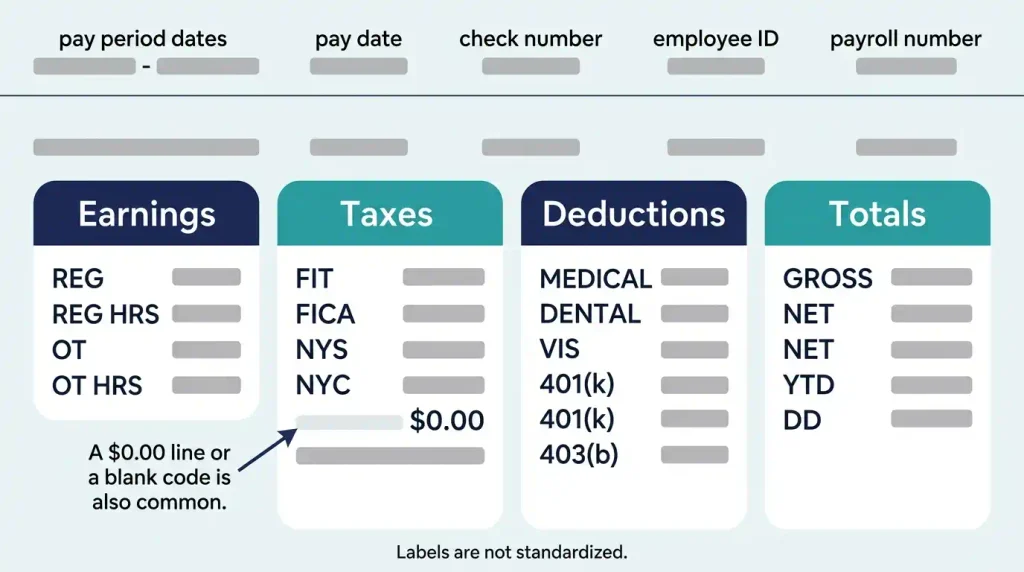
Start by finding the four blocks: earnings, taxes, deductions, and totals. Most payroll systems group them that way, so an unknown code is usually easy to place. A code under “Taxes” is a tax. A code under “Deductions” is something you or your employer set up.
Labels are not standardized. Payroll software has character limits, so it shortens words, and employers can rename lines. “NY WT” at one company may be “NYS TAX” at another. The same abbreviation can even mean different things at different employers.
Near the top of your New York wage statement, find the pay period dates, pay date, check number, employee ID, and payroll number. These identify the stub and help payroll pull it up fast. A $0.00 line or a blank code is also common. It usually means a benefit or deduction is set up but had no amount this period. Some codes show up only in a detailed earnings or deductions section. If a code is missing from every glossary you check, it is probably employer-specific, so ask payroll.
Earnings and Pay Rate Abbreviations
The earnings section shows what you were paid for. Each line usually has hours, a rate, and an amount, and the amount is hours times rate. If a rate looks low, compare it with the New York minimum wage for your region.
Regular Pay, Overtime, and Other Earnings
Here are the codes you will see most often.
- REG or REG HRS: regular pay and regular hours
- OT or OT HRS: overtime pay and overtime hours
- DT: double time
- BONUS: a bonus payment
- COMM: commission
- TIPS: reported tips
- HOL: holiday pay
You may also see OVT for overtime, HRS for hours, and RATE or HR for your hourly rate. UNITS counts things other than hours, like pieces or shifts. Time off appears as PTO (paid time off), VAC, or SICK. Our guide to New York paid sick leave explains how sick time builds up.
Some employers also add lines for shift differentials or other premium pay. These often look like “SHIFT DIFF,” “PREM,” or “PREMIUM.” In New York, most hourly workers must be paid overtime at 1.5 times their regular rate after 40 hours in a week, though some industries follow different rules. The federal Fair Labor Standards Act (FLSA) and New York Labor Law both set overtime rules, which our guide to New York State overtime laws explains in full. So if your REG rate is $30, your OT rate should usually be $45.
Hourly workers with more than one job or shift type may see several rates, and salaried employees may still see hours or an hourly equivalent. Some salaried employees are owed overtime, depending on the overtime salary threshold and their duties.
Gross Pay, Taxable Wages, and Net Pay
GROSS is the total of all your earnings lines. NET is what is left after taxes and deductions. In between, you may see TAXABLE GROSS or FED TAXABLE WAGES. Our breakdown of gross pay vs. net pay in New York goes deeper.
Those taxable figures can be lower than gross. Some deductions, like pre-tax health premiums, reduce the wages used for certain taxes. Gross pay minus taxes minus deductions equals net pay. If those numbers do not add up, check each line again.
When gross pay rises, take-home usually rises by less, because taxes apply to the extra money too. Net pay can also change with the same base salary. A new benefit election or a withholding change can shift it, and so can reaching the Social Security wage cap late in the year.
Federal, New York State, and Local Tax Abbreviations Explained
Tax lines usually come in layers. You may see federal, state, and sometimes city or Yonkers taxes on the same stub, and each is calculated separately. For the full list, see what taxes come out of a New York paycheck.
Federal Tax and FICA Abbreviations
FIT or FITW is federal income tax withholding. Some stubs print it as Fed Tax or Federal WT. It is based on your Federal Form W-4 and your pay. It is only an estimate of what you owe the Internal Revenue Service (IRS), so your final bill comes when you file your return. The IRS Tax Withholding Estimator can help you check your withholding.
FICA covers two taxes. SS (also written OASDI, short for Old-Age, Survivors, and Disability Insurance) is Social Security at 6.2%. In 2026, it applies to wages up to $184,500. MED is Medicare at 1.45% with no wage cap. Some stubs label it HI, for Hospital Insurance. If your wages pass $200,000, your employer also withholds the Additional Medicare Tax of 0.9% on the excess.
Your pay stub is not Form W-2, the Wage and Tax Statement you get after the year ends. The W-2 reports yearly totals in numbered boxes and letter codes, so its labels will not match your stub’s FIT, SS, and MED lines one for one.
New York State Income Tax Abbreviations
NYS, SIT, and NY WT all point to New York State income tax withholding. Some stubs simply say State Tax. The amount depends on your pay and on the choices you made on Form IT-2104, the Employee’s Withholding Allowance Certificate from the New York State Department of Taxation and Finance. Review it every year, and check that your New York withholding is right if you have two jobs. If you claim an exemption from withholding, you file Form IT-2104-E, the Certificate of Exemption from Withholding, instead. If you never filed a form, your employer withholds as a single filer with zero allowances, which is the highest rate.
Other versions cover special cases, such as Form IT-2104.1 for nonresident allocation and Form IT-2104-SNY, a certificate of exemption for Start-Up NY employees.
New York revised its 2026 state income tax rate schedules to reflect certain rate reductions, and the state’s withholding tables changed for paychecks on or after January 1, 2026. Your NYS line may differ from 2025 even if your pay did not. Yonkers resident and nonresident withholding tables were updated too, while the NYC wage bracket tables and methods did not change.
This tax is separate from FIT. Your federal and state withholding can differ a lot, because each has its own rules, as our comparison of Form W-4 vs. IT-2104 shows. For the state basics, see New York State tax withholding, or browse New York tax forms and withholding.
If you see NYS-1 or NYS-45 in payroll records, those are your employer’s filings with the state, not deductions from your pay. NYS-1 is the Return of Tax Withheld, and NYS-45 is the Quarterly Combined Withholding, Wage Reporting, and Unemployment Insurance Return. Employers file them on a set schedule, covered in New York payroll tax deadlines and our payroll and employer compliance category.
New York City and Yonkers Tax Abbreviations
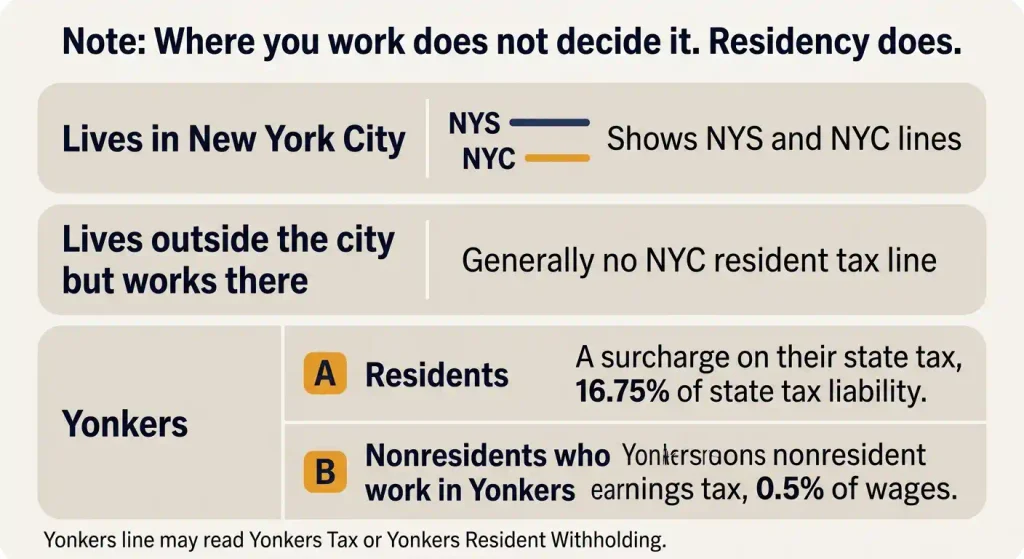
NYC is the New York City income tax charged to residents. Some stubs print NY City Tax or Local Tax. It is withheld only if you live in the city. Where you work does not decide it. Residency does. A state employee who lives in the city sees both NYS and NYC lines, while someone who lives outside the city but works there generally sees no NYC resident tax line. Whether you count as a resident follows the resident vs. nonresident income tax rules, and people living outside the state can read about NYS tax for nonresidents.
Yonkers income tax has its own rules, and its line may read Yonkers Tax or Yonkers Resident Withholding. Residents pay a surcharge on their state tax, which is 16.75% of state tax liability. Nonresidents who work in Yonkers may pay the Yonkers nonresident earnings tax, which is 0.5% of wages. These lines are separate from NYS, so seeing both is normal if the rules apply to you.
Pay Stub Deductions and Benefits Abbreviations
Deductions are amounts taken from your pay for benefits, savings, or legal obligations (see New York paycheck deductions for more). They fall into two groups based on when they come out.
Pre-Tax and Post-Tax Deductions
A PRE-TAX deduction comes out before certain taxes are figured, so it lowers your taxable wages. A POST-TAX deduction comes out after, and it does not. TAXABLE BENEFITS are benefits the IRS counts as income, like some fringe benefits.
Not every pre-tax deduction works the same way on every tax. For example, a 401(k) contribution usually lowers income tax wages but not Social Security and Medicare wages. A health premium through a cafeteria plan can lower both. Your taxable wage lines will show the difference.
Several tax code sections drive this. Cafeteria plan premiums fall under IRC 125, commuter benefits under IRC 132, and many government pension contributions under IRC 414(h). IMPUTED INCOME is different. It is the value of a taxable benefit, like employer-paid group life insurance above a set limit, added to your taxable wages without being paid to you in cash.
Insurance, Retirement, and Savings Codes
- MEDICAL, DENTAL, VIS: health, dental, and vision premiums
- HSA: health savings account contribution
- FSA: flexible spending account contribution
- 401(k), 403(b): retirement plan contributions
- PENSION: a pension plan contribution, common in public jobs
- RET: a general retirement contribution label
- LIFE, LTD, STD, AD&D: life, long-term disability, short-term disability, and accidental death and dismemberment (AD&D) insurance
An HSA (Health Savings Account) works with a high-deductible health plan. An FSA (Flexible Spending Account) usually has a use-it-or-lose-it rule, though some plans allow a short grace period or a limited carryover, so check your plan’s limits. You may see HCFSA for the Health Care Flexible Spending Account, and NYC government stubs may call the dependent care account DeCAP, the Dependent Care Assistance Program. A 403(b) is a Tax-Sheltered Annuity Plan used by schools and nonprofits, and a 457(b) is a Deferred Compensation Plan used in government jobs.
Most of these are employee contributions. Your employer may add its own contribution, usually shown separately as ER (more on that below). These amounts often change after open enrollment, a raise, or a life event like marriage or a new child. A new deduction after a plan change is normal.
Other Payroll Deductions
PFL stands for Paid Family Leave, and some stubs spell it out as NY Paid Family Leave. In 2026, employees pay 0.432% of gross wages, up to an annual maximum of $411.91. PFL is deducted from after-tax wages, and some employers choose to pay it for you. SDI is New York State Disability Insurance, capped at $0.60 per week for employees, so up to $1.20 on a biweekly stub.
You may also see union dues, GARN (garnishment), child support, or commuter benefits. These are common and usually authorized by you, a court, or an agency. Be careful with a vague line you never agreed to, such as “ADJ” or “MISC.” Find out what it is and why it was taken, using the steps under incorrect or unexplained deductions below.
What Do YTD, QTD, and Other Pay Stub Totals Mean?
Totals show the running amounts behind your current check. They help you track what you have earned, paid in taxes, and saved.
Current Pay Period vs. Year-to-Date Amounts
The current column covers only this pay period. YTD adds up everything since the start of the year. CYTD means calendar year to date. QTD is quarter to date, MTD is month to date, and PTD is period to date, though many stubs show only YTD. YTD GROSS is your total earnings so far this year.
To check your stub, compare the two columns. If you are paid biweekly and it is your tenth check, YTD should be about ten times a normal pay period. For payroll tax purposes, YTD generally resets on January 1.
Also check what each column holds. It may be a percentage (like a 5% retirement election), a dollar amount, an hourly rate, or a running balance, such as a loan payoff or leave balance.
Employee, Employer, and Direct Deposit Codes
EE means employee. ER means employer. So EE CONTRIB is money you pay, and ER CONTRIB is money your employer adds. Employer contributions usually do not reduce your take-home pay.
DD is direct deposit, and EFT is electronic funds transfer. Your net pay is what gets deposited. If you split your deposit between two accounts, the amounts should add up to your net pay.
How to Read a New York Pay Stub Step by Step
The easiest way to learn a stub is to follow one from top to bottom. Start with gross pay, subtract taxes and deductions, and end at net pay. For a full section-by-section tour, see our guide on how to read a New York pay stub.
Follow a Sample Pay Stub From Gross Pay to Net Pay
This is a hypothetical biweekly stub for a New York City resident. The tax withholding amounts for FIT, NYS, and NYC are made up for the example. The YTD column assumes ten identical pay periods.
| Line | Hours / Rate | Current | YTD |
|---|---|---|---|
| REG | 80 hrs x $30.00 | $2,400.00 | $24,000.00 |
| OT | 4 hrs x $45.00 | $180.00 | $1,800.00 |
| GROSS | $2,580.00 | $25,800.00 | |
| 401(K) (pre-tax) | $129.00 | $1,290.00 | |
| MEDICAL (pre-tax) | $85.00 | $850.00 | |
| DENTAL (pre-tax) | $12.00 | $120.00 | |
| FIT | $190.00 | $1,900.00 | |
| SS | $153.95 | $1,539.50 | |
| MED | $36.00 | $360.00 | |
| NYS | $105.00 | $1,050.00 | |
| NYC | $58.00 | $580.00 | |
| SDI | $1.20 | $12.00 | |
| PFL | $11.15 | $111.50 | |
| NET | $1,798.70 | $17,987.00 |
Here is the math. Gross is $2,580.00. Pre-tax deductions total $226.00. Taxes and other payroll charges total $555.30. So $2,580.00 minus $226.00 minus $555.30 equals $1,798.70.
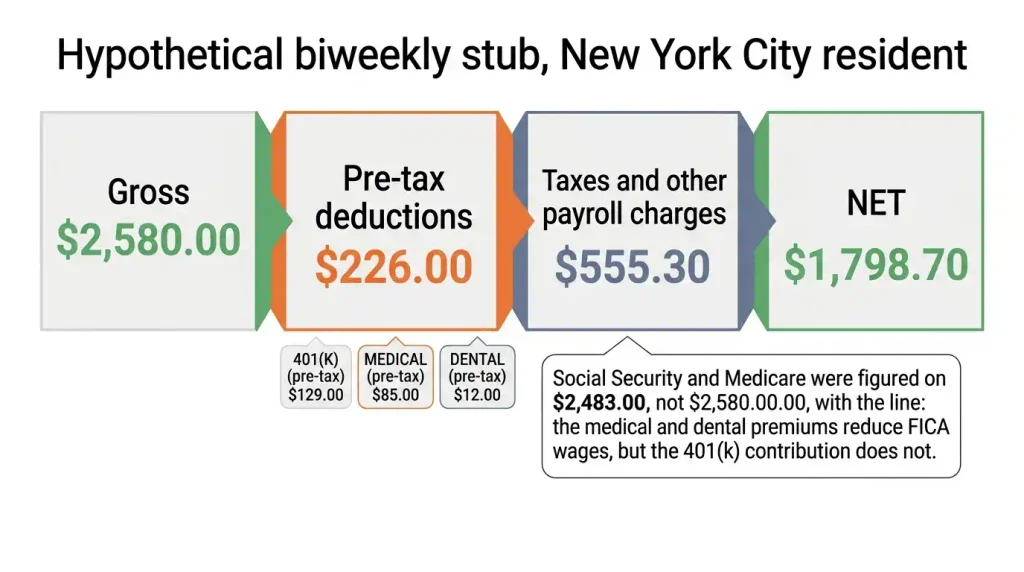
Notice that Social Security and Medicare were figured on $2,483.00, not $2,580.00. In this example, the medical and dental premiums reduce FICA wages, but the 401(k) contribution does not. PFL is figured on gross wages.
For more worked examples, see $80,000 after taxes in New York, $200,000 salary after taxes in New York State, and $20 an hour in New York, or browse New York paycheck scenarios. To test your own numbers, use the New York paycheck calculator, and read our calculation methodology to see how the math works.
Compare Your Pay Stub With Your Expected Pay
Check these in order: the pay period dates, your hours, your rate, gross pay, then each deduction. Then compare the NET on the stub with the amount that hit your bank account. They should match. If your paydays seem off, see New York pay frequency laws for how often you must be paid.
A gap often has a normal cause, like a new benefit election, a missed shift, or a bonus taxed at a higher withholding rate. If something still does not make sense, write it down and ask payroll for an explanation.
Lay two stubs side by side to spot what changed: hours, rate, taxes, or benefits. Then run the check that fits your problem:
- Gross pay is off: multiply your hours by your rate yourself first.
- Hours look wrong: check them against your own time records.
- Overtime looks off: confirm the OT HRS and that the OT rate is 1.5 times your regular rate. Our New York overtime laws category has the details.
- NET and your deposit differ: check for a split deposit across accounts, then ask payroll for the DD breakdown.
New York Pay Stub Rules and Common Payroll Problems
New York has specific rules about what a pay stub must show and what an employer can take out (see our New York wages and wage laws category). Knowing them helps you tell a normal line from a real problem.
What Information Must a New York Pay Stub Include?
Under New York Labor Law Section 195, employers must give employees a wage statement with every payment of wages. It must show the dates of work covered, the employee’s and employer’s names, and the employer’s address and phone number. It must also show your rate or rates of pay and how you are paid (hourly, salary, and so on), gross wages, deductions, any allowances claimed, and net wages. If you are paid on a 1099 instead, see 1099 vs. W-2 in New York, or check whether you were misclassified as an independent contractor.
For non-exempt employees, the statement must also show the overtime rate and the number of regular and overtime hours worked. The Wage Theft Prevention Act tightened these rules. The New York State Department of Labor has official guidance at dol.ny.gov, including a sample wage statement (LS49) that shows the required information under Section 195.3, and the Guidelines for Wage Statement Provisions (LS45). Compare your stub with the sample.
New York City adds one more item. NYC employers must report Earned Safe and Sick Time Act leave (called protected time off in the city’s amended rules, effective July 23, 2026) accrued, used, and available each pay period, with paid and unpaid hours shown separately. This can go on the stub or in a separate written record. Since February 22, 2026, it includes unpaid hours. In any pay period when you use paid prenatal leave, the amount used and the balance left must also be shown. Check the NYC Department of Consumer and Worker Protection (DCWP) for the details. Our NYC worker pay and labor rules category covers more.
What to Do About an Incorrect or Unexplained Deduction
First, ask payroll in writing what the code means and how the amount was calculated. A written request gives you a record. Keep every pay stub and your own time records. Have the pay date, the exact code, the dollar amount, and your employee ID ready, and ask for a written wage calculation.
New York Labor Law Section 193 generally limits deductions to those required by law or those that benefit you and that you authorized, like insurance premiums, retirement contributions, or union dues. Since a 2012 amendment (with state rules, 12 NYCRR 195-5.1, finalized in 2013), an employer may also recover a wage advance or an overpayment caused by a clerical or math error, but only with advance written notice to you. If an overpayment is larger than your next paycheck’s net pay, each deduction is capped at 12.5% of that pay period’s gross wages, and you can dispute it. If a deduction fits none of these, or you never agreed to it, it may be unlawful. In that case, you can file a wage theft complaint with the NYS Department of Labor.
Why Your Pay Stub May Look Different From Someone Else’s
Benefits, residency, and payroll elections change which lines show up. One coworker may have an NYC tax line, a pension line, or a garnishment, and another may not. So compare your stub to your own earlier stubs, not a friend’s.
NYC government employees get an electronic pay statement (EStub) through NYCAPS Employee Self-Service (ESS), and the NYC Office of Payroll Administration explains each line. It shows taxes, other deductions, and your leave under Balance Available. Pension and commuter lines depend on your agency and plan.
Some city workers who live outside the city, generally those hired on or after January 4, 1973, see a City Waiver line. Under Section 1127 of the New York City Charter, they pay an amount equal to the NYC resident income tax, and it takes the place of the NYC line a city resident would see. It does not apply to everyone, such as employees of the Department of Education, CUNY, District Attorneys’ offices, or NYCHA.
Common Myths About New York Pay Stub Abbreviations
A few wrong assumptions cause most of the panic over paychecks.
Misconceptions That Can Lead to Paycheck Confusion
- “Every employer uses the same codes.” They do not. Payroll software and company settings change labels.
- “Several tax lines mean I am being taxed twice.” No. Federal, state, city, Social Security, and Medicare are different taxes, so each gets its own line.
- “A bigger deduction or lower net pay means an error.” Not by itself. Raises, bonuses, new benefits, and withholding changes can all lower a check. Check the math before assuming a mistake.
Frequently Asked Questions About New York Pay Stub Abbreviations
What Does FIT Mean on a New York Pay Stub?
FIT means federal income tax withholding. It is separate from FICA, which covers Social Security and Medicare.
What Does FICA Mean on a Paycheck?
FICA stands for Federal Insurance Contributions Act. It is two taxes: Social Security (6.2%, up to $184,500 of wages in 2026) and Medicare (1.45%). Neither one is federal income tax.
What Do NYS and NYC Mean on a Pay Stub?
NYS is New York State income tax. NYC is New York City resident income tax. A separate NYC line usually appears only if you live in the city.
What Does YTD Mean on a Pay Stub?
YTD means year to date. It is the running total since the start of the year. Compare it to the current column to see how this check fits into your year.
Why Is My Net Pay Lower Than My Gross Pay?
Taxes, benefit premiums, retirement contributions, and other deductions come out of gross pay. What remains is net pay. Compare gross, total deductions, and net to see where the difference went. Our guide on why your New York paycheck is lower walks through the common causes.
What Should I Do If I Don’t Recognize a Pay Stub Abbreviation?
Check your employer’s payroll guide or ask HR or payroll what the code means. If a deduction is still unexplained, or the wages look wrong, ask for a written explanation and keep your pay stubs. You can then contact the NYS Department of Labor if needed. More explainers are in our New York paycheck basics category.

Meet Yasin Ali, Founder
Yasin built NY Paycheck Calculator in 2020 after getting fed up with calculators that treated New York like every other state. Most tools ignore the extra local tax NYC and Yonkers workers pay on top of state tax — or skip New York’s Paid Family Leave deduction entirely.
He keeps the numbers current, checking in regularly against the latest IRS, NY Department of Taxation and Finance, and Paid Family Leave rates.
All results here are estimates based on official sources. For advice specific to your situation, talk to a tax professional.