
The New York supplemental wage tax in 2026 is a flat 11.70% state withholding on most separately paid bonuses and other supplemental wages. It is a withholding rate, not your final tax.
That 11.70% comes from the Tax Department’s NYS-50-T-NYS (1/26) tables. The NYC and Yonkers rates were checked against their 2026 editions.
The catch: your actual check can differ, because payroll’s method, locality, and pre-tax deductions change the math.
New York Supplemental Wage Tax 2026: The Quick Answer
Beyond that 11.70%, NYC residents add 4.25% and Yonkers has its own rates, all before federal tax and FICA.
The 2026 New York State supplemental wage rate
The rate is 11.70% when tax is already withheld from your regular wages. The NYS-50-T-NYS tables apply to payrolls made on or after January 1, 2026, and reflect the state’s 2026 income tax rate reductions.
NYC and Yonkers use additional local rules
NYC and Yonkers withholding depends on where you live and work. NYC applies to residents, Yonkers residents see 1.95975%, and nonresidents working in Yonkers see 0.50%, so two coworkers with the same bonus can take home different amounts.
The most important distinction: withholding is not final tax
Your actual tax is figured once, on your return, from your full-year income and filing status. Too much withheld means a refund, and too little means you owe the difference.
2026 New York Supplemental Wage Rates: NYS vs. NYC vs. Yonkers
Each rate is withheld separately, and they stack.
| Where | 2026 supplemental rate | Who it applies to |
|---|---|---|
| New York State | 11.70% | Most New York State wages |
| New York City | 4.25% | NYC residents |
| Yonkers resident | 1.95975% | Yonkers residents |
| Yonkers nonresident | 0.50% | Nonresidents earning wages in Yonkers |
New York State: 11.70%
Per NYS-50-T-NYS (1/26), it applies when a bonus is paid on its own, or listed separately on the same check, and tax is already withheld from your regular wages. Payroll can use the aggregate method instead.
New York City: 4.25%
NYC withholding, set in NYS-50-T-NYC (1/26), is separate from state withholding. At the New York City supplemental withholding rate 4.25%, a NYC resident’s bonus loses 11.70% to the state and 4.25% to the city before federal tax and FICA. This is New York City income tax withholding, and it applies to city residents only.
Yonkers: resident vs. nonresident
Yonkers residents pay 1.95975%, the 16.75% Yonkers resident tax surcharge applied to the state’s 11.70% rate. Nonresidents who earn wages in Yonkers pay the Yonkers nonresident earnings tax, a flat 0.50%. Together these make up Yonkers income tax, collected through Yonkers withholding tax. Your home address and work location decide which applies.
What Counts as Supplemental Wages in New York?
Supplemental wages are pay beyond your normal salary or hourly pay. Payroll treats each such extra as a supplemental wage payment.
Payments New York treats as supplemental wages
They include bonuses, commissions, overtime pay, sales awards, severance, prizes, and back pay. Retroactive pay raises, accumulated sick leave payouts, and certain taxable fringe benefits count too, as can nonstatutory stock option income, some deferred compensation payouts, and expense allowances paid under a nonaccountable plan, where you do not have to document the spending. Regular wages are your base pay for the normal pay period.
Why the type of payment matters
These payments are irregular, so standard paycheck tables fit them poorly, and the type decides which withholding method payroll can use. “Supplemental” describes how the payment is withheld, not a separate kind of income. On your return, it is added to your other wages and taxed together. These rules cover W-2 employees. Independent contractors on a 1099 handle their own taxes, as covered in 1099 vs W-2 in New York and employee vs independent contractor.
How New York Calculates Tax Withholding on a Bonus
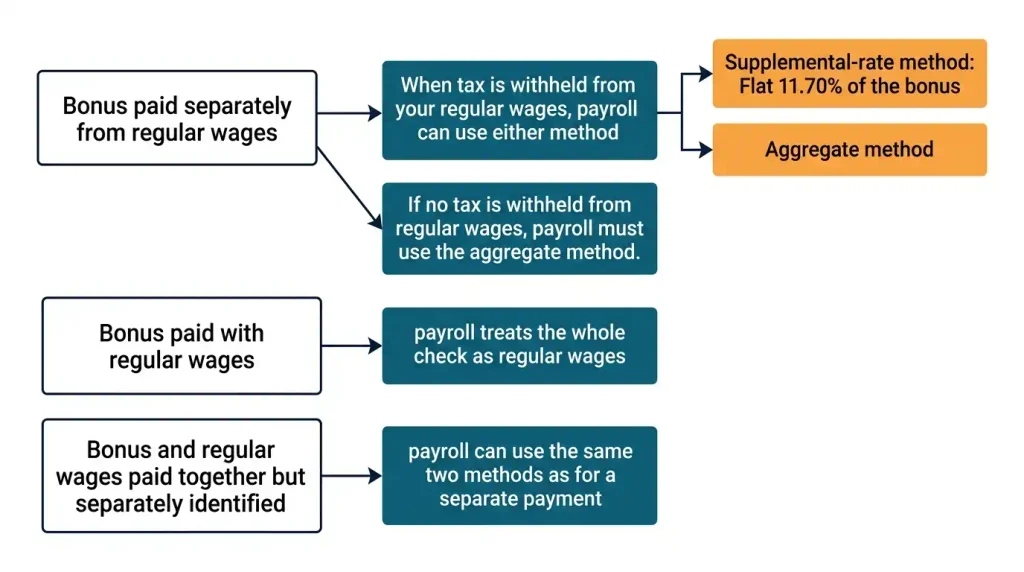
How much comes out depends first on how the bonus was paid: separately, with regular wages, or with regular wages but listed separately.
| Supplemental-rate method | Aggregate method | |
|---|---|---|
| How it works | Flat 11.70% of the bonus | Adds the bonus to regular wages for the most recent payroll period this year, figures withholding on the total, then subtracts the tax already figured on the regular wages alone |
| When payroll can use it | Only when tax is withheld from regular wages | Whether or not tax is withheld from regular wages |
| Required when | Never | No tax is withheld from regular wages |
| Result | Always 11.70% | Can land above or below 11.70% |
Bonus paid separately from regular wages
When tax is withheld from your regular wages, payroll can use either method in the table above. If no tax is withheld from regular wages, payroll must use the aggregate method.
Bonus paid with regular wages
If the bonus and regular pay come in one payment without separate amounts, payroll treats the whole check as regular wages. The withholding tables then act as if you earn that larger amount every pay period, which can take more or less than 11.70%.
Bonus and regular wages paid together but separately identified
If the check shows the bonus and regular wages as separate amounts, payroll can use the same two methods as for a separate payment. Listing them apart is what opens up the flat 11.70% option.
How Much Tax Will Be Withheld From a New York Bonus?
Multiply the bonus by each rate. These numbers use the flat method and show state and local withholding only. Federal tax (22% flat) and FICA (7.65%) come out on top.
Each cell shows total state and local withholding, then what is left before federal tax and FICA.
| Bonus | State only | NYC resident | Yonkers resident | Yonkers nonresident |
|---|---|---|---|---|
| $1,000 | $117.00 / $883.00 | $159.50 / $840.50 | $136.60 / $863.40 | $122.00 / $878.00 |
| $5,000 | $585.00 / $4,415.00 | $797.50 / $4,202.50 | $682.99 / $4,317.01 | $610.00 / $4,390.00 |
| $10,000 | $1,170 / $8,830 | $1,595 / $8,405 | $1,365.98 / $8,634.02 | $1,220 / $8,780 |
$1,000 bonus example
State withholding is $117.00. NYC adds $42.50, a Yonkers resident $19.60, and a Yonkers nonresident $5.00. All before federal and FICA.
$5,000 bonus example
The state takes $585.00. NYC adds $212.50 and a Yonkers resident $97.99. Your actual check can differ if payroll uses the aggregate method, applies pre-tax deductions, or has a different locality on file.
$10,000 bonus example
The state takes $1,170. NYC adds $425, a Yonkers resident $195.98, and a Yonkers nonresident $50. Federal withholding at 22% is $2,200, and Social Security plus Medicare is $765. Assuming the flat method and no pre-tax deductions, a NYC resident keeps about $5,440. If you already passed the 2026 Social Security wage base of $184,500, only Medicare (1.45%, or $145) applies, and the same worker keeps about $6,060.
Why Was So Much Tax Taken From My Bonus?
Several taxes hit the same payment at once, mostly at flat rates.
The bonus may have been withheld at a supplemental rate
New York’s income tax brackets run from 3.9% to 10.9% in 2026. The flat 11.70% withholding rate sits above every one of those bracket rates, and above the real rate for nearly all workers. A bonus can look heavily taxed even when your real rate is far lower.
Your paycheck may include several separate taxes
Federal income tax takes a flat 22% of most bonuses. New York State takes 11.70%, NYC or Yonkers adds its own piece, and Social Security (6.2%) and Medicare (1.45%) come out too. On a $5,000 bonus for a NYC resident, $2,280 (45.6%) is withheld, so you keep $2,720. The Social Security tax (capped at $184,500 of wages in 2026) and the Medicare tax (no cap) make up FICA taxes. Above $200,000 in wages, employers also withhold the Additional Medicare Tax of 0.9%. Pre-tax deductions, such as 401(k) contributions taken from the bonus, health premiums, and HSA or FSA contributions, can shrink the wages used for income tax withholding. For the full list, see what taxes come out of a New York paycheck.
New York unemployment insurance is different: employers pay it on wages up to the unemployment insurance wage base ($17,600 in 2026), and it is not withheld from your check. New York Paid Family Leave is employee-paid (0.432% of wages, capped at $411.91 for the year) and can show up as its own stub line.
Payroll may have used the aggregate method
Under the aggregate method, your bonus is stacked on your regular pay for that period and taxed like one large regular paycheck. The result can land above or below the flat rate. Two employees with the same $3,000 bonus can see different withholding if their regular pay, pay frequency, or IT-2104 settings differ.
New York Supplemental Wage Withholding vs. Your Actual Tax Bill
The 11.70% is a prepayment. Your real state tax comes from the brackets on your return.
Why the 11.70% withholding rate does not mean a 11.70% final tax
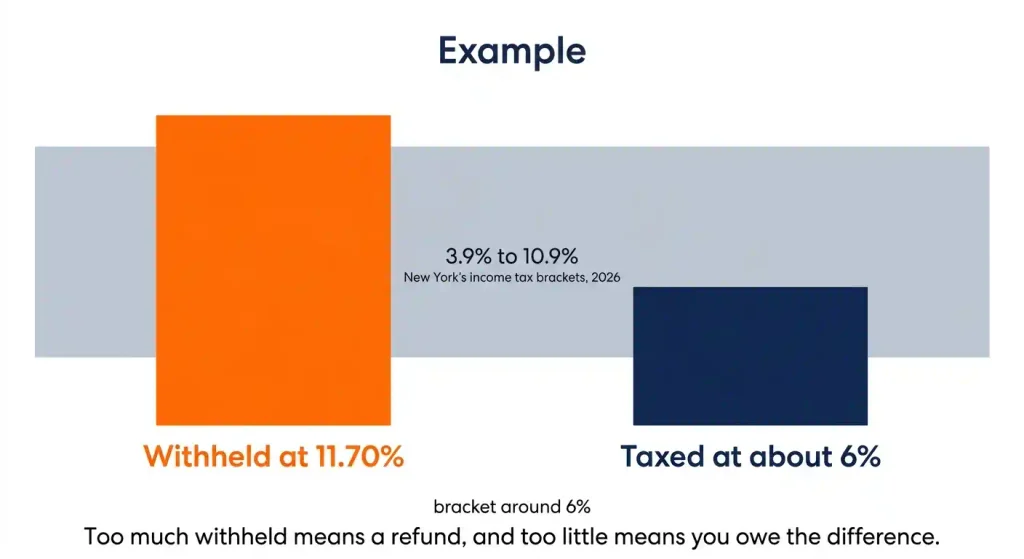
New York taxes your total taxable income in brackets, and your filing status shapes where they start. Your bonus is taxed at the bracket your income reaches, not the withholding rate. A bonus landing in a bracket around 6% is withheld at 11.70% but taxed at about 6%. That bracket rate is your marginal tax rate, and your effective tax rate (total tax divided by total income) is lower still. The annual calculation is New York State personal income tax, and NYC residents also owe New York City personal income tax on the same return, which the 4.25% withholding prepays.
Can you get money back if too much was withheld?
Yes. If total withholding for the year exceeds your final tax, the extra comes back as a refund. Your W-2 withholding is credited on your New York return, Form IT-201 for residents. A refund does not mean the bonus was tax-free. It means you prepaid more than you owed.
Can you owe more tax later?
It can happen. The aggregate method may withhold less than your real rate, a second job can leave gaps, and a big bonus can push income into a higher bracket. Payroll can be accurate and you can still owe at filing. To cover a gap, raise your withholding on Form IT-2104. That will not change a bonus already paid, only future paychecks. If you change jobs after a bonus, each employer sends a W-2, and withholding from all of them is credited on one return.
Does New York Tax Every Bonus the Same Way?
The same withholding rules cover most extra pay, but details vary by payment type.
Bonuses and commissions
Both are supplemental wages. Paid separately, they can be withheld at the flat 11.70% or by the aggregate method. Commissions paid on a regular schedule inside your normal check are often handled as regular wages, so ask payroll. Sign-on, retention, and holiday bonuses follow the same rules as any other bonus.
Overtime and sales awards
Overtime pay and sales awards are on the state’s supplemental wages list. Overtime paid on its own can be withheld at the flat rate, while overtime in your regular paycheck usually blends into the check. At tax time it is all income, with one federal twist for 2026: a new deduction of up to $12,500 ($25,000 if married filing jointly) covers the overtime premium, the extra half-time pay the Fair Labor Standards Act requires, under P.L. 119-21. It applies for tax years 2025 through 2028, phases out above $150,000 (single) or $300,000 (joint) of income, and from 2026 employers report it on Form W-2, box 12, code TT. It does not change the 22% flat withholding. New York handles it separately, so check the state’s treatment on your return. For the wage rules themselves, see New York overtime laws, overtime for salaried employees, and the overtime salary threshold.
Severance, back pay, and retroactive raises
These are supplemental wages and often arrive as one lump sum, so flat rates produce a large withholding number. The aggregate method on a very large payment can also push it into top withholding rates. Federal withholding stays at 22% until supplemental wages pass $1 million in a year, then 37% applies above that. Rules on when wages must be paid are in New York pay frequency laws, and the wider rules are in New York wages and wage laws.
New York Supplemental Wages for Residents and Nonresidents
Where you live and where you work decide whether and how much New York withholds.
New York State residents
New York residents owe state tax on all income, even for work done in another state, with a credit for taxes paid to that state. Your employer withholds based on the Form IT-2104 you gave them, where you set allowances or extra withholding. That form drives New York State income tax withholding on your regular pay, and on a bonus when payroll uses the aggregate method. Your federal Form W-4 does not replace it, because the W-4 controls only federal withholding.
New York nonresidents
Nonresidents owe New York tax on wages for services performed in New York, and withholding applies to that New York-source part. If a bonus relates to work done partly inside and partly outside New York, only the New York portion counts, usually allocated by workdays. Nonresidents file Form IT-203 to report this income and claim the withholding.
Form IT-2104.1 and wage allocation
Form IT-2104.1, officially the Certificate of Nonresidence and Allocation of Withholding Tax, lets a nonresident, or someone working both inside and outside New York, tell the employer what share of pay is New York-source. That keeps withholding closer to reality, including on bonuses. Remote and multistate workers should check that it is on file with payroll.
New York Supplemental Wage Tax Scenarios You May Actually Encounter
These five cases use the flat method, typical federal and FICA withholding, wages under the Social Security wage base, and no pre-tax deductions. The table covers the $5,000, $10,000 NYC, and $30,000 severance cases. More examples are in New York paycheck scenarios.
| Scenario | State | NYC | Federal | FICA | Total withheld | Take-home |
|---|---|---|---|---|---|---|
| $5,000 bonus, outside NYC and Yonkers | $585 | None | $1,100 | $382.50 | $2,067.50 | $2,932.50 |
| $10,000 bonus, NYC resident | $1,170 | $425 | $2,200 | $765 | $4,560 | $5,440 |
| $30,000 severance, NYC resident | $3,510 | $1,275 | $6,600 | $2,295 | $13,680 | $16,320 |
A New York employee receives a $5,000 year-end bonus
The employee lives outside NYC and Yonkers, so only state, federal, and FICA withholding apply. Take-home is about $2,932.50.
A NYC employee receives a $10,000 performance bonus
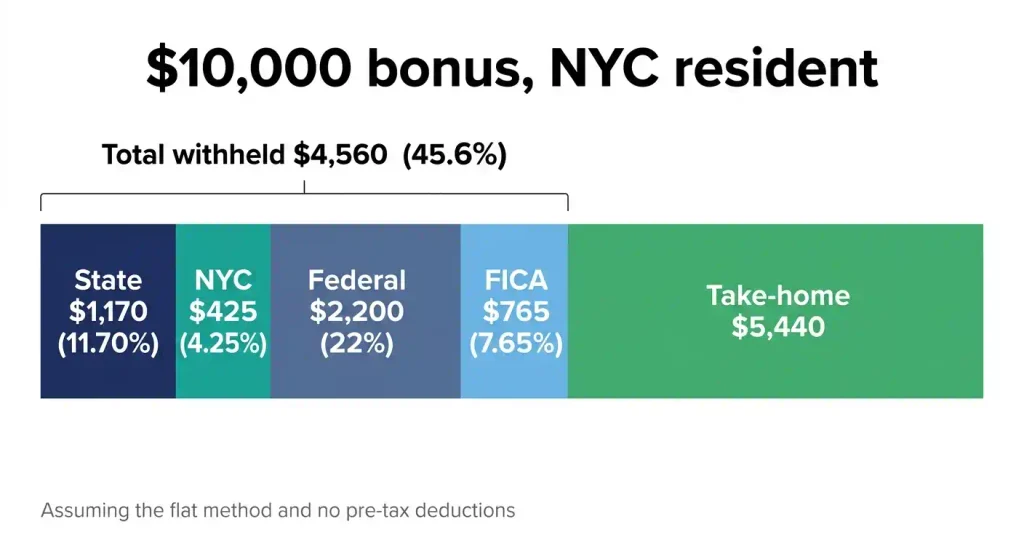
State, NYC, federal, and FICA withholding together take 45.6% of the bonus ($4,560 in total). Flat rates often exceed the real tax on the bonus, so a refund is possible but not guaranteed. For other city requirements, see NYC worker pay and labor rules.
A Yonkers resident receives a large commission
On an $8,000 commission, state withholding is $936 and Yonkers resident withholding is $156.78, totaling $1,092.78 and leaving $6,907.22 before federal and FICA. The Yonkers resident rate is the surcharge on state tax, while NYC uses its own 4.25%, which would be $340 on the same commission.
An employee lives outside New York but works in New York
New York withholds 11.70% on the New York-source part of the bonus. If some work was done elsewhere, wage allocation matters, and Form IT-2104.1 helps payroll split it. Your home state may also tax the bonus, usually with a credit for tax paid to New York.
A large severance payment creates an unexpectedly small net check
On a $30,000 severance for a NYC resident, total withholding is $13,680, leaving $16,320. The $2,295 for Social Security plus Medicare assumes the wage base is not already met. Ask payroll which method they used, whether the payment was separate, and which locality is on file.
2026 Forms and Official New York Resources for Supplemental Wages
Four official sources answer most 2026 bonus withholding questions. The New York State Department of Taxation and Finance withholding tax page, run by the New York Tax Department, hosts them all. Together they form the New York withholding tables and methods that payroll relies on, and employers must follow them under New York Tax Law. They sit alongside NYS-50, the Employer’s Guide to Unemployment Insurance, Wage Reporting, and Withholding Tax. Employer filing dates are in New York payroll tax deadlines, and the wider duties sit under payroll employer compliance.
The rates here match the January 2026 editions: NYS-50-T-NYS, NYS-50-T-NYC, and NYS-50-T-Y. Last verified October 6, 2026.
See our calculation methodology for how we apply them, and contact us if you spot something outdated. This is general information, not tax advice (see our disclaimer).
NYS-50-T-NYS (1/26)
Its full title is New York State withholding tax tables and methods. It includes the 2026 supplemental wage rate of 11.70% and the two accepted methods, and payroll relies on it for calculations.
NYS-50-T-NYC (1/26)
Its full title is New York City withholding tax tables and methods. It lists the 4.25% supplemental rate for NYC residents.
NYS-50-T-Y (1/26)
Its full title is Yonkers Withholding Tax Tables and Methods. It lists the 2026 supplemental rates of 1.95975% for residents and 0.50% for nonresidents, depending on where you live and work.
Form IT-2104 and Form IT-2104.1
IT-2104 is the Employee’s Withholding Allowance Certificate you give your employer. Update it after life changes, or before a big bonus if you want more or less withheld. The flat 11.70% method ignores allowances, but the aggregate method uses them. IT-2104.1 helps nonresidents and split-location workers allocate wages. If you had no New York tax liability last year and expect none this year, you can claim exemption on Form IT-2104-E, and payroll generally stops withholding New York income tax. File a new certificate each year you qualify. More form guides are in New York tax forms and withholding.
New York Supplemental Wage Tax Myths That Cause Confusion
Most bonus frustration comes from four wrong assumptions.
“New York taxes my bonus at 11.70%”
That is a withholding rate. It sits above the state’s top bracket rate of 10.9%, so for nearly everyone it is a prepayment, not your real rate. Your annual income decides the final liability.
“My bonus is taxed separately from my regular income”
Only the withholding is separate. On your return, the bonus is added to your other wages and taxed together, and your W-2 reports total wages, bonus included.
“A bigger withholding deduction means payroll made a mistake”
Usually not. Flat rates, the aggregate method, local taxes, and FICA all explain large cuts. Question it when the numbers match none of those, for example if NYC tax is withheld and you do not live in NYC. Check your gross amount, residency, and forms first. If the whole check looks low, see why your New York paycheck is lower.
“The federal bonus rate is the New York bonus rate”
They are separate. Federal withholding is 22% on most bonuses and New York State is 11.70%, and both come out of the same payment along with local tax and FICA. Federal rules come from IRS Publication 15 (Circular E), while the state’s come from the NYS-50-T publications.
How to Check Whether Your New York Bonus Withholding Looks Correct
Check it with your pay stub and a calculator. New to pay stubs? Start with New York paycheck basics.
Start with the payment details
Note the gross bonus, whether it was paid on a separate check or line, and whether regular wages were paid in the same payroll. These decide the method.
Check your location and withholding forms
Confirm payroll has you as a NYC resident, a Yonkers resident or nonresident, or neither, and that your current home address is on file. Check your Form IT-2104, and if you live or work across state lines, whether Form IT-2104.1 is on file. The Tax Department’s Jurisdiction/Rate Lookup by Address tool is for sales tax, so it will not confirm withholding.
Compare the pay stub with the correct 2026 method
Multiply the gross bonus by 11.70%, then by your local rate (4.25%, 1.95975%, or 0.50%). If the stub matches within pennies, payroll used the flat method. If not, it may have used the aggregate method. Then add federal withholding (22%) and FICA (7.65%). Look for separate stub lines for federal withholding, New York State, NYC or Yonkers, Social Security, and Medicare. Our guide on how to read a New York pay stub shows each section.
Frequently Asked Questions About New York Supplemental Wage Tax
Short answer: New York State withholds 11.70% from separately paid bonuses, and withholding is not final tax.
What is the New York supplemental wage tax rate for 2026?
New York State withholds 11.70%. NYC residents also have 4.25% withheld, Yonkers residents 1.95975%, and Yonkers nonresidents 0.50%. These are withholding rates, not final tax.
Is a bonus taxed differently in New York?
Withholding differs, final tax does not. A bonus is regular income on your return, taxed in your normal brackets. The supplemental rate only sets how much is prepaid.
How much tax is withheld from a $5,000 bonus in New York?
New York State withholds $585. A NYC resident adds $212.50, or a Yonkers resident adds $97.99 instead. Federal withholding adds $1,100 and FICA $382.50. For a NYC resident, the total is $2,280 and take-home is $2,720.
Does New York tax bonuses at 11.70%?
Not at tax time. 11.70% is the flat withholding rate for separately paid bonuses, and payroll may use the aggregate method instead. Your final tax depends on total annual income.
Does NYC have a separate bonus tax?
No. NYC residents have a 4.25% supplemental withholding rate applied to bonuses and similar pay, on top of the state’s 11.70%. It counts toward your NYC income tax when you file.
Why was my bonus withholding higher than my regular paycheck?
Flat supplemental rates exceed most people’s real rate, and FICA applies to the full bonus. The aggregate method can also tax the bonus at a higher rate when stacked on regular pay. Extra withholding is not your final bill, and you may get some back.
What to Do After Checking Your New York Supplemental Wage Withholding
What you do next depends on what you found.
If the withholding appears correct
Keep the pay stub and watch for your W-2 at year end, since you use it to file. On Form W-2, state withholding appears in box 17 and city withholding in box 19, with the bonus included in total wages. That withholding is credited against your final tax.
If the withholding appears unusually high
Recheck the payment type and your location, then compare your stub with the 2026 method. Ask payroll which method they used and which locality is on file. If either is wrong, ask for a corrected calculation. Whatever stays over-withheld still comes back through your return.
If you want a more accurate take-home estimate
Use the gross bonus, regular wages, filing status, and your IT-2104 details, plus federal tax, FICA, and the right state, NYC, or Yonkers treatment. A New York paycheck calculator or bonus tax calculator can run these steps. The same math works before accepting an offer: a promised $10,000 bonus works out to roughly $5,440 for a NYC resident (flat method, wages under $184,500, no pre-tax deductions), so compare the after-tax bonus, not the gross (see gross pay vs net pay in New York). For regular-pay context, see the 80k after taxes in New York and $200K salary after taxes in New York breakdowns. More guides are on the New York paycheck blog.
Key Takeaways About New York Supplemental Wage Tax in 2026
Main answer: 11.70% for the state, 4.25% for NYC, and withholding is a prepayment, not your final tax.
The rates and methods to remember
For 2026:
- New York State: 11.70%
- NYC: 4.25%
- Yonkers residents: 1.95975%
- Yonkers nonresidents: 0.50%
- The method depends on how the bonus was paid.
- Withholding is a prepayment, and your final tax comes from your return.
What to check when your bonus looks smaller than expected
Before assuming an error:
- Review the gross payment and each withholding line.
- Confirm your residency and local tax setup.
- Compare the stub with the 2026 New York guidance.

Meet Yasin Ali, Founder
Yasin built NY Paycheck Calculator in 2020 after getting fed up with calculators that treated New York like every other state. Most tools ignore the extra local tax NYC and Yonkers workers pay on top of state tax — or skip New York’s Paid Family Leave deduction entirely.
He keeps the numbers current, checking in regularly against the latest IRS, NY Department of Taxation and Finance, and Paid Family Leave rates.
All results here are estimates based on official sources. For advice specific to your situation, talk to a tax professional.