
New York State tax withholding is the amount employers deduct from wages and send to the state under the 2026 NYS-50-T-NYS tables, based on Form IT-2104 allowances and residency, prepaying tax rather than settling the final bill.
That prepayment follows the 2026 tables tied to Chapter 59 of the Laws of 2025, effective every paycheck from January 1, 2026.
The math gets messy fast: allowances, residency, and pay frequency mean no salary sees identical withholding.
What Is New York State Tax Withholding?
Every New York employer collects it separately from federal withholding and FICA, calculated off its own 2026 tables rather than folded into either.
What “NY State Tax Withholding” Means on Your Paycheck
Your employer pulls this from gross wages and sends it to the New York State Department of Taxation and Finance. It is separate from federal withholding and FICA. It is a prepayment, not your final tax bill.
How New York Withholding Works From Gross Pay to Take-Home Pay
Gross wages become taxable wages, the withholding tables apply, and what is left after federal tax and FICA lands as net pay. The full gross pay vs net pay in New York breakdown walks through each step. Two people on the same salary can see different withholding because their Form IT-2104 allowances, filing status, and residency differ.
Who Must Have New York Tax Withheld
Residents get New York withholding no matter where they work. Nonresidents owe it on wages earned for services performed in New York, part of the broader answer to what taxes come out of a New York paycheck. NYC or Yonkers residency adds another layer on top. Working in New York does not by itself make you a resident, residency depends on where you actually live. An out-of-state employer with an employee performing services in New York still must withhold New York tax on those wages.
New York State vs. New York City vs. Yonkers Withholding
New York taxes wages at up to three levels, state, city, and Yonkers, based on where you live, not just where you work.
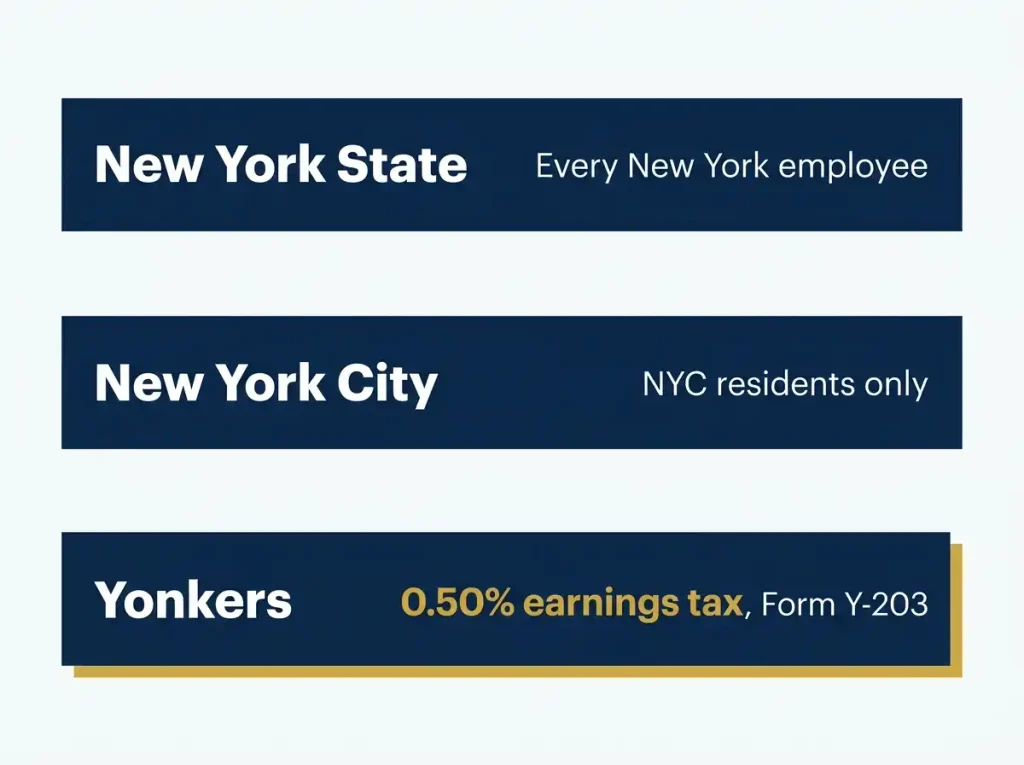
| Level | Who Owes It | Basis |
|---|---|---|
| New York State | Every New York employee | Residency or NY-source wages |
| New York City | NYC residents only | Residency |
| Yonkers | Yonkers residents (resident tax) or nonresidents earning wages there (0.50% earnings tax, Form Y-203) | Residency or workplace |
New York State Tax Withholding
Every New York employee has state income tax withholding taken out, a down payment on the return filed each spring. A small number of employers use the Employer Compensation Expense Program instead, a separate payroll tax structure most employees never notice.
New York City Tax Withholding
NYC resident tax withholding applies only if you actually live in NYC. Your employer determines this from Form IT-2104.
Yonkers Tax Withholding
Yonkers residents get resident tax withheld like NYC residents. Nonresidents earning wages in Yonkers instead owe a flat 0.50% Yonkers nonresident earnings tax, reported on Form Y-203. Employers use Publication NYS-50-T-Y for both, effective payrolls starting January 1, 2026.
Do You Owe NYC or Yonkers Tax if You Work There but Live Elsewhere?
A Long Island resident commuting into NYC does not pay NYC resident tax, since it is a residency tax. Yonkers differs: a nonresident earning wages there still owes the Yonkers nonresident earnings tax.
How New York State Calculates Your Withholding
Withholding is not a flat percentage. It depends on wages, pay frequency, and the information on file with your employer.
What Determines the Amount Taken From Each Paycheck
Gross wages, pay frequency, filing status, allowances, and any additional dollar amount, all from Form IT-2104, drive the calculation. It is an estimate, not your final tax bill.
How the 2026 New York Withholding Tables Work
Publication NYS-50-T-NYS, the New York State Withholding Tax Tables and Methods, applies to every payroll run on or after January 1, 2026. Employers use wage bracket tables or a percentage method, either lands close to the same result. Our own calculation methodology page walks through both methods step by step. These tables were revised for 2026 to reflect rate reductions enacted under Chapter 59 of the Laws of 2025.
Why Your Withholding Can Change Even if Your Salary Does Not
A switch from biweekly to weekly pay changes per-check withholding since tables run on pay frequency. Bonuses, overtime, and commissions count as supplemental wages, withheld differently. Requesting an extra $25 a week on IT-2104 becomes $50 every two weeks once you move to biweekly pay, since the amount is set per pay period.
Form IT-2104 Explained Step by Step
Form IT-2104 is New York’s version of the federal W-4, and it is the biggest factor in accurate state withholding.
What Form IT-2104 Is and When You Need It
Officially the Employee’s Withholding Allowance Certificate, with full instructions on the official Form IT-2104 page. Every new hire files one, and anyone whose situation changes should update it. Skip it, and the default depends on your federal W-4: a pre-2020 W-4 on file lets your employer copy those allowances, while a 2020-or-later W-4 with no IT-2104 means zero allowances. A narrow group, generally under 18, over 65, or a full-time student under 25 who owed no New York tax last year and expects none this year, can file Form IT-2104-E, the Certificate of Exemption from Withholding, each year instead.
What the Main IT-2104 Entries Control
The form sets your New York State withholding allowances, NYC allowances if applicable, additional dollar withholding, filing status, and residency. More allowances means less New York State withholding tax withheld, fewer means more. You cannot claim an allowance for yourself or, if married, your spouse. A negative number on the worksheet just means extra dollars need to be withheld.
When to Complete a New 2026 IT-2104
New York revised the IT-2104 instructions for 2026. If you used the older worksheet or allowance charts before January 1, 2026, pull up the 2026 Form IT-2104 to confirm your numbers still hold.
How Life Changes Can Affect Your IT-2104
Starting a New Job
New hires fill out IT-2104 with other onboarding paperwork. Review the allowance worksheet, and watch your first couple of paychecks for mistakes.
Getting Married or Divorced
A change in marital status often changes filing status, which changes what New York expects withheld.
Having a Child or Adding Dependents
A new dependent can change your allowances. Allowances are not the same as the tax credit you might get at filing time.
Changing Jobs or Income
A raise, new job, or income jump justifies a withholding review. Freelance or self-employment income gets no New York withholding at all, so that income often needs New York estimated income tax payments sent directly, using Form IT-2105.
How to Tell if Your New York Withholding Looks Correct
Most people never check until something looks off. A quick pay stub review settles it.
Check These Items on Your Pay Stub
Check gross wages, pay frequency, the New York State withholding line, and NYC or Yonkers if applicable, against your IT-2104 on file, the same lines covered in how to read a New York pay stub. A New York paycheck calculator gives a quick sanity check.
Why Your Paycheck May Not Match a Simple Salary Calculation
Dividing salary by pay periods will not match actual withholding. Pretax deductions lower taxable wages first, covered in more depth in New York paycheck deductions, and allowances or additional withholding shift the number further.
What to Do if Your Withholding Looks Too High
Check for outdated address, filing status, or residency information. If everything is accurate but withholding still feels high, submit a new IT-2104 with more allowances.
What to Do if Your Withholding Looks Too Low
Check for multiple jobs, the most common cause. Review allowances, and request additional withholding if needed.
2026 New York Withholding Changes You Need to Know
New York updated its withholding system for 2026, showing up on paychecks issued after January 1.
What Changed for Payrolls Starting January 1, 2026
New York revised its withholding tables and calculation methods for every payroll on or after January 1, 2026, reflecting rate reductions under Chapter 59 of the Laws of 2025. A table change is not a change to your final tax liability.
Why New York Updated Form IT-2104 for 2026
New York revised Form IT-2104 and its instructions for 2026. Employees using older worksheets or charts should pull the current form.
Which 2026 Publications Employers Use
| Code | Full Title | 2026 Status |
|---|---|---|
| NYS-50-T-NYS | New York State Withholding Tax Tables and Methods | Revised for 2026 |
| NYS-50-T-NYC | New York City Withholding Tax Tables and Methods | Unchanged for 2026 |
| NYS-50-T-Y | Yonkers Withholding Tax Tables and Methods | Revised for 2026 |
All three sit inside Publication NYS-50, the Employer’s Guide to Unemployment Insurance, Wage Reporting, and Withholding Tax, posted on the New York State Department of Taxation and Finance withholding pages at tax.ny.gov.
New York State Withholding vs. Federal Withholding
State and federal withholding run on separate systems, forms, and taxes.
Form IT-2104 vs. Federal Form W-4
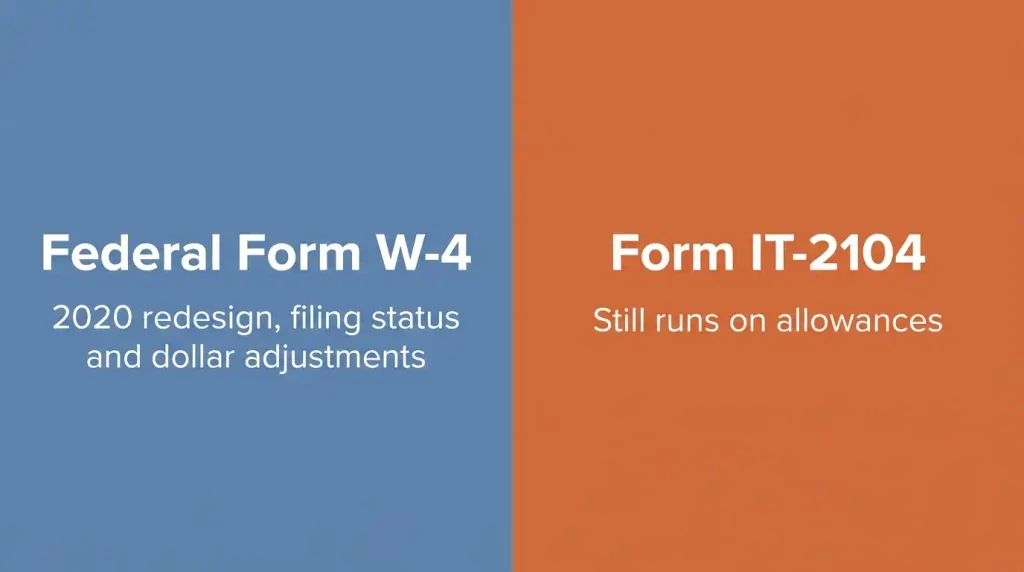
The federal W-4 tells your employer how to withhold for the IRS, IT-2104 for New York State, NYC, or Yonkers. Updating one does not update the other. The federal Form W-4 dropped allowances in its 2020 redesign and now runs on filing status and dollar adjustments. IT-2104 still runs on allowances. Form IT-2104-I walks through that worksheet line by line.
New York Income Tax vs. Social Security and Medicare
FICA covers Social Security, withheld at 6.2% up to the 2026 wage base of $184,500, and Medicare, withheld at 1.45% with no cap.
Withholding vs. Your Final Tax Bill
Withholding over what you owed brings a refund, under brings a balance due. It does not change what you owe, only when you pay it. The final number settles on Form IT-201 for full-year residents or Form IT-203 for nonresidents and part-year residents.
New York State Withholding Examples
These six examples show how salary, residency, and life changes each move the actual withholding number.
Example 1: Single Employee With One New York Job
A single filer earning $60,000 a year, paid biweekly, with standard allowances, sees withholding calculated off the wage bracket tables. Claim one more allowance and the per-check amount drops a little. Ask for $25 extra withholding and that flat amount adds on top.
Example 2: NYC Resident Working for a New York Employer
A Brooklyn resident working in Manhattan sees two withholding lines: New York State and NYC resident tax, added because of where they live.
Example 3: Yonkers Resident
A Yonkers resident gets Yonkers resident tax withheld in addition to state withholding, using the NYS-50-T-Y tables.
Example 4: Employee With Two Jobs
Two part-time jobs can each withhold correctly on their own wages yet leave the employee under-withheld once combined, fixed by requesting additional withholding on one or both IT-2104 forms. Add a working spouse and dependents, and claiming the same dependents on both spouses’ IT-2104 forms can stack up more allowances than the household qualifies for.
Example 5: Employee Gets a Raise and Bonus
A raise increases regular withholding gradually. A bonus, treated as a supplemental wage, is often withheld at a different rate, which is why bonus checks look more taxed.
Example 6: Employee Moves Into or Out of NYC
Moving from Queens to Westchester ends NYC residency, so the IT-2104 should be updated, or NYC resident tax keeps coming out.
New York Resident vs. Nonresident Withholding
Residency status is the biggest factor shaping how New York withholds wages.
How New York Residents Are Treated
Residents generally have full wages subject to New York withholding regardless of where the work happens.
How New York Nonresidents Are Treated
Nonresidents are taxed only on New York-source income, wages for services performed in New York.
What Happens When You Move Into or Out of New York
Moving mid-year makes you a part-year resident. Update your IT-2104 right away.
What Happens When You Work Remotely Outside New York
New York’s “convenience of the employer” rule can still treat remote wages as New York-source income if you work remotely for your own convenience rather than the employer’s necessity.
New York Withholding for Multiple Jobs
Two paychecks can quietly create one tax problem.
Why Having Two Jobs Can Cause a Withholding Problem
Each employer withholds as if that job were your only income, so combined wages can leave you under-withheld.
How IT-2104 Handles More Than One Job
IT-2104 includes worksheets for employees with more than one job or a working spouse, to split allowances, especially when one job pays much more.
What Changes When Your Spouse Also Works
A working spouse adds income. Using full “single job” allowances at both jobs is a common mistake. The combined-income worksheet, or extra withholding at the higher-earning job, closes the gap.
What Happens to Bonuses, Overtime, and Other Extra Pay?
Extra pay gets extra rules, which catches employees off guard.
How Supplemental Wages Can Be Withheld
Bonuses, commissions, overtime, and similar payments count as supplemental wages, withheld using a different method than regular pay.
Why a Bonus Can Have a Surprisingly Large Tax Deduction
Bonus withholding is not your final tax rate on that money. It gets sorted out on your return, with any over-withholding returned as part of your refund.
What to Check When Overtime Changes Your Paycheck
A heavy overtime week raises withholding for that period since tables run on what you are paid then, not your average.
New York State Withholding vs. Federal Withholding
Form IT-2104 vs. Federal Form W-4
Two separate systems. The W-4 speaks to the IRS, IT-2104 to New York State, NYC, or Yonkers. Employers keep both on file separately, since a payroll audit can request either one independently.
New York Income Tax vs. Social Security and Medicare
Social Security withholding stops at the 2026 wage base of $184,500. Medicare never stops and has no cap. Unlike FICA, New York State withholding has no employer match, it is purely what comes out of the employee’s own paycheck.
Withholding vs. Your Final Tax Bill
Withholding is a running estimate, settled once a year on your return as a refund or balance due. An updated IT-2104 only changes withholding on pay periods going forward, it does not retroactively fix amounts already withheld earlier in the year.
Common New York Tax Withholding Mistakes and Myths
A few misunderstandings show up again and again.
“My New York Withholding Is My Final New York Tax”
It is not. Your actual tax is calculated on your return, which is why refunds and balances due both happen.
“If I Work in NYC, I Automatically Pay NYC Resident Tax”
Working in NYC does not create the obligation. It is tied to where you live.
“Federal Form W-4 Controls All New York Withholding”
The W-4 has zero effect on New York State, NYC, or Yonkers withholding. Only IT-2104 does.
“More Withholding Means I Owe More Tax”
Withholding and liability are not the same. Extra withholding means a bigger refund, not a bigger bill.
“The Same Salary Always Produces the Same NY Withholding”
Allowances, residency, pay frequency, and bonuses or a second job all change the calculation, even at identical salaries.
What to Do If Your New York Withholding Is Wrong
Fixing it usually comes down to updating one form.
If Your Employer Is Withholding Too Much
Check your IT-2104 allowances and residency information for errors, then submit an updated IT-2104 with more allowances if needed.
If Your Employer Is Withholding Too Little
Check for multiple jobs or other income, review allowances, and request additional withholding if needed.
If Your Residency Changed
Moving into or out of New York State, NYC, or Yonkers needs an updated IT-2104, especially for part-year residents.
If You Are a Nonresident
Confirm wages are allocated to New York-source income only. Form IT-2104.1, the Certificate of Nonresidence and Allocation of Withholding Tax, covers nonresident and part-year resident withholding.
New York State Withholding FAQ
What is New York State tax withholding?
The portion of your paycheck sent to New York State as a prepayment toward income tax, not your final bill.
How is New York State withholding calculated?
Wages, pay frequency, and IT-2104 information run against the 2026 NYS-50-T-NYS tables, plus any additional withholding requested.
What is Form IT-2104 used for?
New York’s withholding allowance certificate, controlling state, NYC, and Yonkers withholding.
Does New York State withholding include NYC tax?
No, calculated separately. NYC resident tax applies only if you live in New York City.
Does New York State withholding include Yonkers tax?
No, a separate line using Publication NYS-50-T-Y for residents and nonresidents.
Why did my New York withholding change in 2026?
New York revised its withholding tables and IT-2104 instructions for payrolls on or after January 1, 2026, reflecting rate reductions under Chapter 59 of the Laws of 2025.
Can I change how much New York tax is withheld from my paycheck?
Yes, submit an updated IT-2104 with different allowances or an additional flat dollar amount.
Why is my New York withholding different from someone with the same salary?
Allowances, residency, pay frequency, and supplemental wages shift the calculation individually, the same variables that explain why your New York paycheck may look lower than expected even at an identical salary.
What happens if too little New York tax is withheld?
You may owe a balance at filing, not automatically a penalty. If the shortfall is large, New York can add interest and an underpayment penalty.
What happens if too much New York tax is withheld?
The excess comes back as part of your refund, meaning less money in your paycheck all year.
Your New York Withholding Checklist
Before Submitting Form IT-2104
- Confirm residency status, including NYC or Yonkers residency if applicable
- Review job, dependent, and additional-withholding details
- Keep a copy of what you submit, with the date
After Your First New York Paycheck
- Check the New York State withholding line
- Check NYC or Yonkers withholding if applicable
- Compare both against the IT-2104 you actually submitted
After a Major Life or Income Change
- Recheck withholding after marriage, divorce, or a new child
- Recheck after a new job or income change
- Recheck after moving between New York jurisdictions
Before the End of the Tax Year
- Compare year-to-date withholding against what you expect to owe
- Adjust remaining pay periods if there is a gap
Key Takeaways About New York State Tax Withholding
The Three Things to Check First
Your residency status, whether NYC or Yonkers rules apply, and your current IT-2104 information.
The 2026 Rule to Remember
New York’s withholding tables changed for every payroll issued on or after January 1, 2026. Use current forms and publications, not old worksheets.
What to Do Next
Compare your most recent paycheck against what is on file for you, and update your documentation now if anything looks off. For related topics like deductions, pay stubs, and take-home pay, browse the full New York paycheck basics category. You can also read more about how our figures are built on the about us page.

Meet Yasin Ali, Founder
Yasin built NY Paycheck Calculator in 2020 after getting fed up with calculators that treated New York like every other state. Most tools ignore the extra local tax NYC and Yonkers workers pay on top of state tax — or skip New York’s Paid Family Leave deduction entirely.
He keeps the numbers current, checking in regularly against the latest IRS, NY Department of Taxation and Finance, and Paid Family Leave rates.
All results here are estimates based on official 2026 sources. For advice specific to your situation, talk to a tax professional.