
A New York paycheck is reduced by federal payroll taxes and New York State income tax, plus a local tax for New York City or Yonkers residents. Your exact withholding depends on income, filing status, and residency under 2026 rates.
Those withholding figures reflect New York’s 2026 rate cuts and wage-base updates, verified against official state and federal tables.
Withholding is only an estimate, since your final tax bill depends on full-year income.
What Taxes Come Out of a New York Paycheck?
Multiple taxes usually reduce a New York paycheck. Some apply to every U.S. worker, others only if you live in New York City or Yonkers.
The 4 Main Taxes You May See on a New York Paycheck
Federal income tax withholding is based on your W-4. Social Security and Medicare, together known as your FICA tax, come out next. Then New York State income tax withholding applies. If your home address is in New York City or Yonkers, local income tax gets added as a fifth line, on top of state tax, not instead of it.
Which New York Paycheck Taxes Apply to You?
Your address decides most of this. New York State residents owe state tax regardless of employer location. New York City residents owe NYC resident tax on top of state tax. Yonkers residents pay a surcharge on their state tax. Nonresidents who work physically in New York still owe New York State tax on that income.
New York Paycheck Taxes at a Glance
Some taxes apply to every U.S. worker. Others only apply inside New York. Knowing which is which stops you from panicking over a normal line item, and it’s the starting point covered in our New York paycheck basics hub.
Federal vs New York vs Local Payroll Taxes
Federal income tax applies to every U.S. worker with no wage limit. Social Security is capped at $184,500 for 2026, Medicare has no cap. New York State income tax applies to residents and to nonresidents working in New York. NYC and Yonkers taxes only apply based on residency, so coworkers at the same company can see very different tax lines.
Taxes vs Other Paycheck Deductions
Required tax withholding is money you owe by law. Pre-tax benefit deductions, like a 401(k) or health premium, lower your taxable wages before tax is calculated. Post-tax deductions, like a Roth 401(k) or union dues, come out after tax. That’s why total deductions can look bigger than your tax bill alone.
Gross Pay vs Taxable Pay vs Take-Home Pay
Gross pay is your full paycheck. Taxable pay is usually lower, since pre-tax deductions reduce it first. Total deductions combine every tax and benefit deduction. What’s left is your net pay, the number that hits your bank account.
Federal Taxes Taken Out of a New York Paycheck
The federal side comes first and works the same regardless of state. Social Security and Medicare are withheld separately because they fund two different programs, even though together they make up your FICA tax.
Federal Income Tax Withholding
Your employer calculates this using the IRS withholding tables in Publication 15, also called Circular E, plus your gross wages, pay frequency, and Form W-4. Filing status and multiple jobs both shift the amount, and so does the federal standard deduction: $16,100 single, $24,150 head of household, $32,200 joint filers in 2026. That’s why federal withholding isn’t a flat percentage.
Social Security Tax
Social Security withholding is 6.2% of gross wages for 2026, up to the wage base of $184,500. The maximum an employee can have withheld is $11,439. Once you cross the wage base, withholding stops for the rest of the year.
Medicare Tax
Medicare withholding is 1.45% of gross wages with no wage cap, unlike Social Security. Medicare keeps coming out of every paycheck no matter how high your income climbs.
Additional Medicare Tax
Once wages from one employer cross $200,000 in a year, an extra 0.9% Medicare tax applies to the amount above that, a rule set by the Internal Revenue Code. A single filer earning $220,000 would see the extra 0.9% applied only to the $20,000 above the threshold.
New York State Income Tax on Your Paycheck
State tax is where New York paychecks look different from states with no income tax.
How New York State Withholding Works in 2026
New York State withholding uses the state’s 2026 withholding tables, your wages, pay frequency, filing status, and allowances. Outdated allowances or an unreported residency change are the most common reasons it drifts from your actual liability.
New York State Tax Rates and Brackets
New York uses a graduated, nine-bracket structure for 2026, from 3.9% to 10.9%, applied to taxable income. New York’s standard deduction, $8,000 single or $16,050 joint in 2026, reduces what actually gets taxed. Your marginal rate applies to your last dollar earned; your effective rate, the average, is always lower.
Form IT-2104 and New York Withholding
Form IT-2104, officially the Employee’s Withholding Allowance Certificate, is New York’s version of the W-4. Your allowances set how much is withheld. Form IT-2104-I has the instructions. You can request extra withholding on the form too.
Why Your New York Withholding May Look Different in 2026
New York cut its bottom five brackets by 0.1 point for 2026, with another 0.1-point cut coming in 2027, reflected in the updated NYS-50-T-NYS from the New York State Department of Taxation and Finance. A new job, raise, or dependent change can also shift withholding.
Does New York City Tax Come Out of Your Paycheck?
This is one of the most common points of confusion on a New York paycheck.
Who Pays New York City Resident Income Tax
If your home is in the five boroughs, you owe NYC resident income tax on top of state tax. Rates run 3.078% to 3.876% for 2026, with the top rate starting at $50,000 of taxable income for single filers. It’s calculated using its own New York City withholding tax tables, published as NYS-50-T-NYC.
Do You Pay NYC Tax If You Work in NYC but Live Elsewhere?
No. NYC resident tax depends on where you live, not where you work. Commuters into the city from outside it don’t owe it.
NYC Paycheck Example
For an NYC resident earning $80,000: federal tax and FICA come out first, then New York State tax, then NYC resident tax on top. That extra city line is the one difference from an otherwise identical paycheck earned outside the five boroughs.
Does Yonkers Tax Come Out of Your Paycheck?
Yonkers works differently than NYC.
Who Pays Yonkers Income Tax
Yonkers residents pay a surcharge of 16.75% on their New York State tax liability, not a separate bracket system. Nonresidents who work in Yonkers pay a separate earnings tax via Form Y-203.
2026 Yonkers Withholding Rules
Yonkers withholding for 2026 uses the updated NYS-50-T-Y tables: 16.75% surcharge for residents, a separate formula for nonresidents. Supplemental wages like bonuses use the applicable supplemental rate.
How Much Tax Comes Out of a New York Paycheck?
There’s no single number.
Why There Is No Single New York Paycheck Tax Percentage
Federal withholding depends on your W-4, state withholding on your IT-2104, and local tax on your address. Pre-tax deductions like a 401(k) also lower taxable wages first. Change any variable and the total shifts.
What Determines Your Take-Home Pay
Your salary or hourly rate sets the ceiling. Pay frequency slices it into checks. Your W-4 and IT-2104 tell your employer how much to withhold.
New York Paycheck Calculation Formula
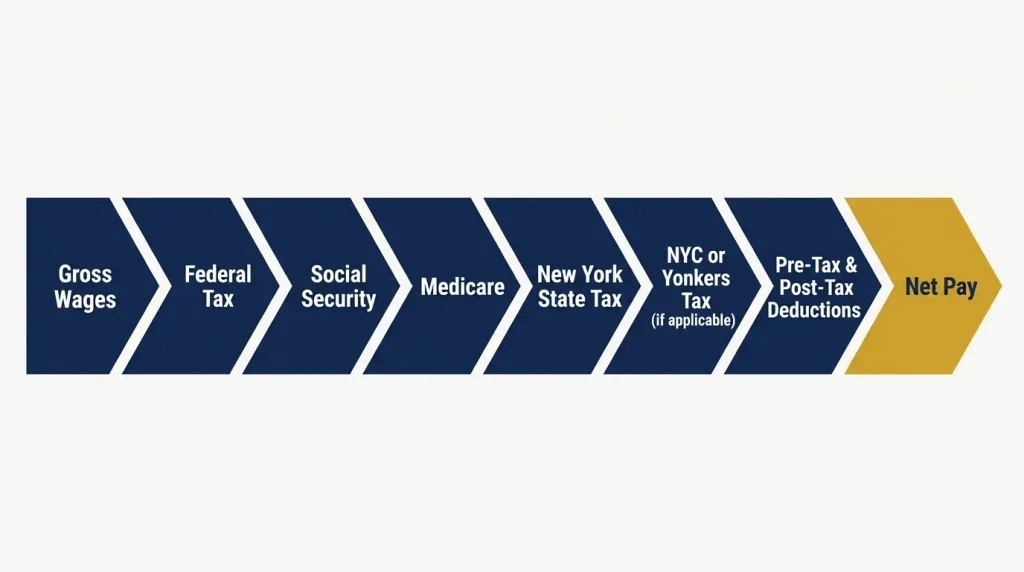
Start with gross wages, subtract federal tax, Social Security, Medicare, New York State tax, and any NYC or Yonkers tax, then subtract pre-tax and post-tax deductions. What’s left is net pay. This gross-to-net calculation is the same at any salary, so divide an annual net figure by 12 for a rough monthly estimate, by your actual pay periods for a more precise one, or run the numbers through the New York paycheck calculator directly.
New York Paycheck Examples for Common Salaries
Real numbers make this concrete.
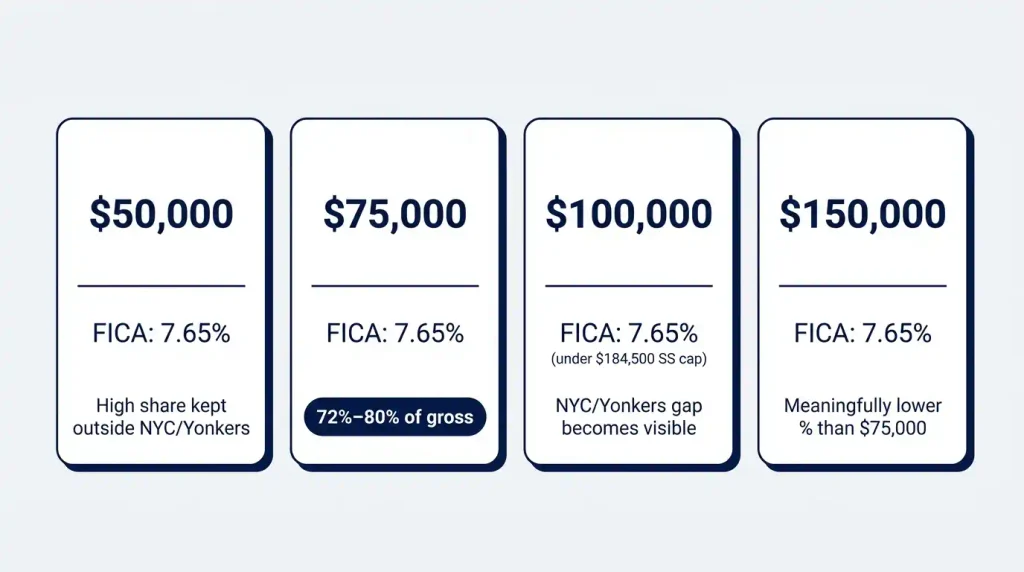
| Salary | FICA | Federal Tax | New York State Tax | Est. Take-Home |
|---|---|---|---|---|
| $50,000 | 7.65% | Modest, lower brackets | Added on top | High share kept outside NYC/Yonkers |
| $75,000 | 7.65% | Climbs into higher brackets | Increases with income | 72%–80% of gross |
| $100,000 | 7.65% (under $184,500 SS cap) | Bigger bite | Increases further | NYC/Yonkers gap becomes visible |
| $150,000 | 7.65% until near SS wage base | Upper-bracket impact grows | Higher marginal effect | Meaningfully lower % than $75,000 |
$50,000 New York Salary Paycheck
At this level, NYC or Yonkers residency is the main variable, since federal tax stays light.
$75,000 New York Salary Paycheck
This is where higher federal brackets start pulling more, alongside your filing status and W-4 choices.
$100,000 New York Salary Paycheck
The $184,500 Social Security wage base isn’t in play yet, so FICA stays flat while state and local tax do the differentiating.
$150,000 New York Salary Paycheck
New York’s upper brackets start affecting a bigger slice of your paycheck here.
Same Salary, Different Take-Home Pay
An NYC resident pays local tax a non-NYC New York resident doesn’t. Filing status, W-4 and IT-2104 choices, and pre-tax benefit elections all change the final number too.
How Pay Frequency Changes Your New York Paycheck
Same salary, different-looking checks depending on how often you’re paid.
Weekly Paycheck
Weekly pay divides annual wages into 52 periods, each withheld using a weekly table. Individual checks look small even with a solid salary.
Biweekly Paycheck
Biweekly pay means 26 paychecks a year. Two months get three paychecks instead of two, a normal calendar quirk, not an error.
Semimonthly and Monthly Paychecks
Semimonthly pay gives 24 checks a year, monthly gives 12. Both produce bigger checks than weekly or biweekly, with withholding tables adjusted accordingly.
Why Is My New York Paycheck Smaller Than My Salary?
Gross salary and take-home pay are not the same number.
Gross Salary Is Not Take-Home Pay
Your offer letter shows gross pay. Taxes and other deductions come out before it reaches you.
Your Pay Stub May Include More Than Taxes
Health insurance, 401(k) contributions, and HSA or FSA contributions can all reduce your paycheck. New York Paid Family Leave adds a small, mandatory Paid Family Leave employee contribution. New York Disability Benefits coverage can add another deduction, capped at 60 cents a week. Neither is an income tax. Other voluntary deductions can stack on top.
Why a First Paycheck Can Look Unexpected
New withholding forms, a partial pay period, and benefit deductions starting immediately can all make a first paycheck look smaller than expected.
What Happens to Bonuses, Overtime, and Other Extra Pay?
Extra income is often taxed differently than regular pay.
How Overtime Is Taxed
Overtime is fully taxable, counted as regular pay for federal and New York withholding, with no special overtime tax rate. A federal deduction for qualified overtime compensation can lower what you owe when you file, up to $12,500 single or $25,000 joint, phasing out above $150,000 or $300,000 in modified adjusted gross income, but it doesn’t change your withholding.
How Bonuses Are Withheld
Bonuses fall under supplemental wage rules, often withheld at a separate, higher flat rate than regular pay, whether paid alone or combined with a regular check.
Commissions and Other Supplemental Wages
Commissions and sales awards also count as supplemental wages, and employers can withhold them differently than base pay.
New York Paycheck Taxes for Special Situations
A few life situations change the standard math. Everything above assumes a W-2 employee. Self-employed New Yorkers and independent contractors have no paycheck withholding at all; they pay self-employment tax and estimated tax directly to the IRS and New York State each quarter.
Multiple Jobs or a Working Spouse
Combined household income can push you into a higher bracket. Skipping the multiple-jobs section on the W-4, or filing separate IT-2104 forms without accounting for combined income, risks underwithholding.
Moving Into or Out of New York City or Yonkers
A residency change affects local tax immediately. Update your withholding as soon as you move to avoid under- or overwithholding.
Working Remotely From New York
Living in New York generally means New York State residency applies for tax purposes, regardless of employer location. Nonresidents working for a New York employer face different rules.
Living in New York and Working Across State Lines
Under New York Tax Law, residents owe tax on all income regardless of where it’s earned. New York generally credits tax paid to another state to prevent double taxation.
Common Misconceptions About New York Paycheck Taxes
A few myths persist.
“My Salary Is Taxed at One Percentage”
New York uses progressive brackets. Marginal rate applies only to your top slice; effective rate is always lower. Federal, FICA, and state tax are calculated separately.
“Everyone Who Works in NYC Pays NYC Income Tax”
NYC resident tax depends on residency, not workplace.
“My Tax Withholding Is My Final Tax Bill”
Withholding is an estimate. Your annual return reconciles the real number, resulting in a refund or a balance due.
“A Higher Salary Means I Lose Money on Every Extra Dollar”
Higher rates apply only to the new, higher slice of income. A raise always increases take-home pay overall.
“All Paycheck Deductions Are Taxes”
Taxes are required by law. Retirement and insurance deductions are choices.
How to Read Taxes on a New York Pay Stub
Once you know what to look for, a pay stub is easy to read. Our full walkthrough on how to read a New York pay stub covers every line in more detail.
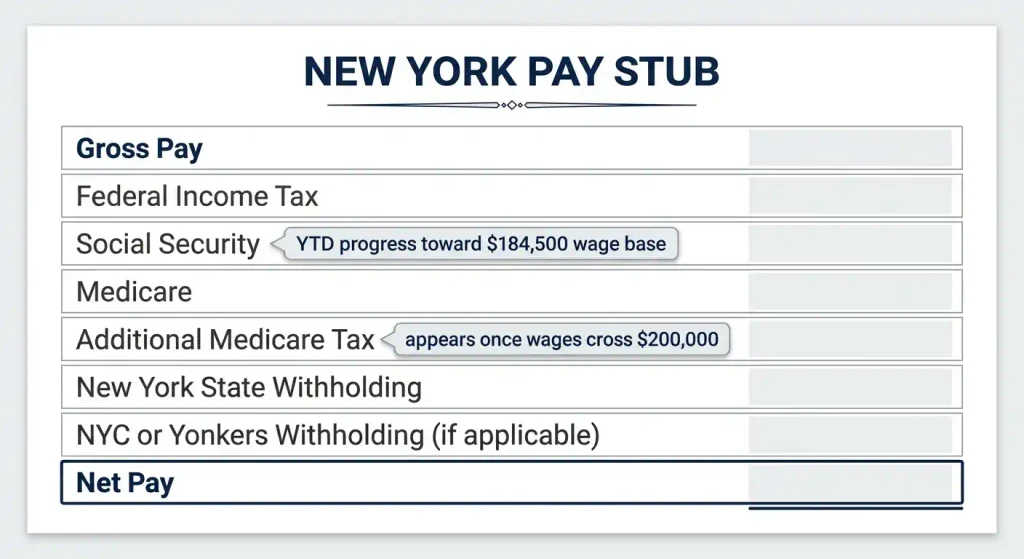
Find Your Gross Pay
Look for current-period and year-to-date gross wages, with supplemental wages like overtime or bonuses broken out separately.
Identify Each Tax Withholding
Federal income tax, Social Security, and Medicare usually appear as separate lines. New York State withholding gets its own line, with NYC or Yonkers withholding beneath it if applicable.
Identify Non-Tax Deductions
Pre-tax deductions appear before taxable wages are calculated; post-tax deductions after. Employer contributions, like a 401(k) match, are usually listed separately since they never come out of your paycheck. The same goes for unemployment insurance: employers report and pay it through the state’s NYS-50 guide and quarterly NYS-45 filings, but it’s never deducted from your paycheck. Net pay is the final number.
Check Year-to-Date Totals
Year-to-date Social Security withholding shows your progress toward the $184,500 wage base. Additional Medicare Tax shows as its own line once wages cross $200,000.
How to Fix Incorrect or Unexpected New York Tax Withholding
If a deduction still doesn’t make sense after checking your forms, ask payroll or HR directly what it’s for and when it started.
When to Review Form W-4
Marriage, divorce, a new dependent, or a new job for you or a spouse are all good reasons to revisit your W-4.
When to Update Form IT-2104
Starting or ending a job, moving into or out of NYC or Yonkers, or a significant wage or credit change all warrant an updated IT-2104.
What to Do If Too Much Tax Is Withheld
Compare year-to-date withholding to your expected liability, then adjust your W-4 and IT-2104 if needed. Overwithholding just means a bigger refund, not lost money; a large tax refund doesn’t mean your payroll taxes were lower than anyone else’s.
What to Do If Too Little Tax Is Withheld
Review your withholding elections against your actual income, and request additional withholding if needed. Consistent underwithholding can lead to tax due at filing, plus interest or penalties.
What Taxes Should You Expect on Your New York Paycheck?
It depends on residency type.
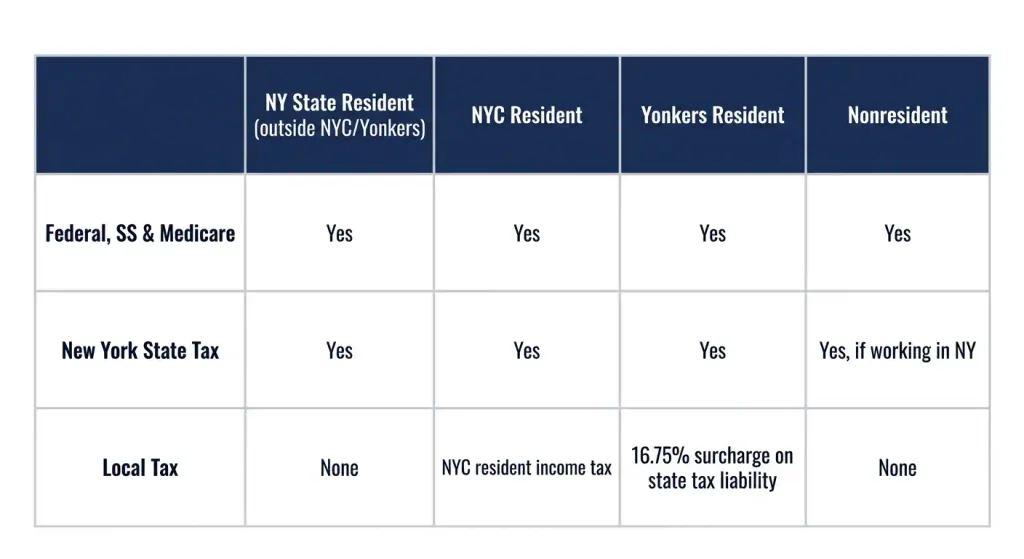
| Residency | Federal, SS & Medicare | New York State Tax | Local Tax |
|---|---|---|---|
| NY State resident (outside NYC/Yonkers) | Yes | Yes | None |
| NYC resident | Yes | Yes | NYC resident income tax |
| Yonkers resident | Yes | Yes | 16.75% surcharge on state tax liability |
| Nonresident | Yes | Yes, if working in NY | None |
New York State Resident Outside NYC or Yonkers
No local tax applies here, just federal, FICA, and state withholding.
New York City Resident
NYC resident income tax stacks on top of the same federal and state lines everyone else pays.
Yonkers Resident
Instead of a separate bracket, Yonkers residents pay that 16.75% surcharge on their state tax liability.
New York Nonresident
New York State withholding applies if you work physically in New York. Nonresidents who want withholding limited to New York-source wages typically file Form IT-2104.1, the Certificate of Nonresidence and Allocation of Withholding Tax.
Frequently Asked Questions About New York Paycheck Taxes
What taxes are taken out of a New York paycheck?
Federal income tax, Social Security, Medicare, New York State income tax, and NYC or Yonkers tax if your residency triggers it.
How much tax is taken out of a paycheck in New York?
It varies with salary, pay frequency, filing status, withholding forms, and whether you live in NYC, Yonkers, or elsewhere.
Does New York have local income tax?
Yes: NYC resident tax and a Yonkers surcharge, both separate from state tax and based on residency.
Do I pay NYC tax if I work in New York City but live outside the city?
No, NYC resident tax depends on where you live.
Why is my New York paycheck lower than expected?
Federal withholding, FICA, state or local tax, and elected benefits all reduce it.
How can I calculate my New York take-home pay?
Start with gross wages, subtract federal, FICA, state, and local taxes, then subtract payroll deductions. What’s left is net pay.
What is Form IT-2104 used for?
It tells your employer how to calculate New York State withholding, based on allowances, residency, and other information.
Why did my Social Security tax stop coming out?
Your year-to-date wages hit the 2026 Social Security wage base of $184,500, so withholding stops for the rest of the year. Medicare keeps going since it has no cap.
Key Takeaways: Understanding Your New York Paycheck
The Taxes That Usually Reduce Your Gross Pay
Federal income tax, FICA taxes, and New York State income tax apply to nearly everyone. NYC or Yonkers tax adds another layer for residents.
The Biggest Factors That Change Your Take-Home Pay
Salary, pay frequency, W-4 and IT-2104 information, residency, and pre-tax and post-tax deductions.
What to Check Before Trusting a Paycheck Estimate
Make sure any paycheck calculator you use for New York reflects current 2026 tables, and your W-4 and IT-2104 information and residency are accurate. Compare against your real pay stub, and verify current figures with the New York State Tax Department or the Internal Revenue Service if needed. This matters most when comparing job offers or budgeting rent, since take-home pay, not the number in your offer letter, is what lands in your bank account.
For every other New York paycheck topic covered on the site, browse the full site map.

Meet Yasin Ali, Founder
Yasin built NY Paycheck Calculator in 2020 after getting fed up with calculators that treated New York like every other state. Most tools ignore the extra local tax NYC and Yonkers workers pay on top of state tax — or skip New York’s Paid Family Leave deduction entirely.
He keeps the numbers current, checking in regularly against the latest IRS, NY Department of Taxation and Finance, and Paid Family Leave rates.
All results here are estimates based on official 2026 sources. For advice specific to your situation, talk to a tax professional.