
Gross pay is total earnings before taxes; net pay is what actually reaches your account after federal, New York State, and possible NYC or Yonkers withholding. In New York, that gap runs wider than in most states.
That gap becomes clear after reviewing hundreds of New York paystubs, where state and city withholding routinely surprise workers.
These are simplified estimates, not official wage bracket calculations, so actual paychecks may vary slightly.
Gross Pay vs Net Pay in New York at a Glance
What Is Gross Pay?
A $65,000 annual salary is $65,000 in gross pay for the year. It includes hours worked or sales closed. Hourly wages, overtime, bonuses, and commissions all count toward gross pay before withholding.
What Is Net Pay?
It’s the amount on your direct deposit or check. It depends on your withholding choices, benefits, and where you live in New York. Net pay differs from taxable income, which the Internal Revenue Service (IRS) calculates by starting from adjusted gross income, then subtracting the standard or itemized deduction.
Gross Pay vs Net Pay: The Simple Difference
Gross pay is what your offer letter promises. Net pay is what your landlord cares about. Gross pay minus taxes minus deductions equals net pay. For budgeting, net pay is the number that matters, since gross pay includes money you never see.
How New York Turns Gross Pay Into Net Pay in 2026
Your paycheck goes through a fixed order of subtractions: federal taxes, then New York taxes, then whatever you’ve elected through your employer, the same order broken down in our what taxes come out of a New York paycheck guide and our New York paycheck basics hub.
The Gross-to-Net Pay Formula
Every paycheck starts with gross wages for that period. Your employer subtracts federal, state, and possibly local taxes, plus any benefit or retirement contributions. What remains is net pay, the amount deposited into your account.
Federal Taxes That Reduce Your Paycheck
Federal income tax withholding follows your W-4 and the 2026 brackets, 10 percent to 37 percent. Social Security tax takes 6.2 percent, Medicare takes 1.45 percent. Together these are FICA taxes, short for the Federal Insurance Contributions Act, calculated separately from income tax. Social Security applies only up to the Social Security wage base, $184,500 for 2026. High earners also owe the Additional Medicare Tax, an extra 0.9 percent above $200,000 for a single filer or $250,000 for married couples filing jointly.
New York Taxes That Reduce Your Paycheck
New York State withholds its own tax, nine brackets from 4 percent to 10.9 percent for 2026. NYC residents pay an added city tax; Yonkers residents get different local withholding. Your address decides which applies. Nonresidents still owe tax on wages earned in New York, called New York source income, certified with a nonresident allocation on Form IT-2104.1. New York residents owe tax on all income even when working remotely for an out-of-state employer. The state uses your New York adjusted gross income, or NYAGI, which mirrors the federal calculation with New York’s own deductions.
Other Payroll Deductions
Paychecks also include deductions for health insurance, retirement accounts like a 401(k), an HSA (Health Savings Account), or an FSA (Flexible Spending Account), plus union dues or other voluntary items. Pre-tax deductions lower taxable wages before tax is calculated; post-tax deductions come out after. These deductions are not taxes. They’re amounts your employer withholds on your behalf, separate from what you actually owe in tax.
How Pay Frequency Changes Your New York Paycheck
The same salary looks different depending on pay frequency, which trips people up when comparing offers. The New York State Department of Labor sets rules on how often certain employees must be paid.
Weekly Pay
Weekly pay splits gross wages across 52 checks. Each check is smaller than a monthly one, but money arrives more often, which can ease week-to-week budgeting.
Biweekly Pay
Biweekly pay splits salary across 26 checks, one every two weeks. Two months a year bring three checks instead of two. Don’t confuse biweekly with twice-monthly pay; they land differently across the year.
Semimonthly Pay
Semimonthly pay splits salary across 24 checks, usually on fixed dates like the 1st and 15th. Each check is slightly larger than a biweekly one, since fewer, bigger periods divide the year.
Monthly Pay
Monthly pay divides salary across just 12 checks, each noticeably larger than a biweekly or semimonthly one. It works for budgeting as long as you plan around the longer gap between deposits.
New York State vs NYC vs Yonkers: Why Location Changes Net Pay
Where you live in New York matters as much as what you earn. The same salary can produce different take-home pay depending on zip code.
New York State Income Tax
New York State withholding follows the state’s 2026 tables, Publication NYS-50-T-NYS, New York withholding tax tables and methods, from the New York State Department of Taxation and Finance, alongside the broader guide, Publication NYS-50. Withholding is an estimate, not your final tax bill. Employers report withholding on forms NYS-45 and NYS-1. Some employers opt into the Employer Compensation Expense Program, or ECEP, an alternative payroll tax that changes how withholding appears.
New York City Income Tax
NYC residents pay an added resident tax, roughly 3.078 percent to 3.876 percent depending on income. It applies to residents only, not commuters; your home address decides. Payroll systems often confirm this with the Jurisdiction/Rate Lookup by Address tool.
Yonkers Income Tax
Yonkers withholding is separate from state and NYC systems, using the NYS-50-T-Y tables, formally Yonkers withholding tax tables and methods. Residents pay a surcharge; nonresidents working there get a smaller withholding. The City of Yonkers is the only other locality with its own resident surcharge. You may also see the Metropolitan Commuter Transportation District, or MCTD, which funds the Metropolitan Commuter Transportation Mobility Tax, an employer-side tax that doesn’t appear on an employee’s paycheck.
Same Salary, Different New York Take-Home Pay
Picture two people earning $80,000. One lives upstate, one in Manhattan. The Manhattan resident loses extra thousands a year to NYC tax the upstate worker never pays. The same gap separates a New York State resident from a Yonkers resident, since Yonkers adds its own surcharge.
How to Calculate Gross Pay and Net Pay From Your Paycheck
Your paystub has everything you need, and our full how to read a New York pay stub walkthrough covers every line. You just need to know the order to subtract things in.
Start With Gross Earnings
Find gross earnings first, including regular wages plus overtime or bonuses for that period. Confirm the pay period and frequency match what you expect.
Subtract Federal Withholding
Next, check federal income tax, Social Security, and Medicare, three separate lines. Compare year-to-date totals against what’s been withheld so far.
Subtract New York and Local Withholding
Subtract New York State withholding next, plus NYC or Yonkers withholding if it applies. Compare against your current Form IT-2104 elections.
Subtract Other Employee Deductions
Subtract remaining deductions, separating pre-tax items like retirement and HSA contributions from post-tax ones. What’s left is net pay, matching your direct deposit.
How Much Is Your Take-Home Pay After New York Taxes?
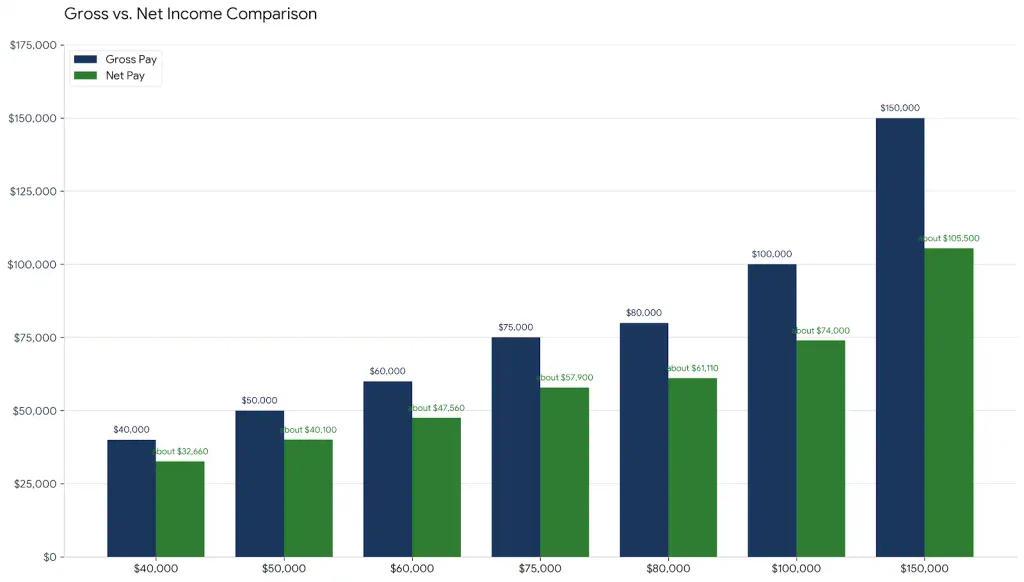
These estimates assume a single filer, standard deduction, living outside NYC and Yonkers, no extra pre-tax deductions. Actual numbers shift with filing status, benefits, and address. Figures use a simplified percentage method rather than employers’ official wage bracket method, so a calculator or payroll system may land slightly differently. See our full calculation methodology for exactly how these estimates are built.
| Annual Gross | Estimated Annual Net |
|---|---|
| $40,000 | about $32,660 |
| $50,000 | about $40,100 |
| $60,000 | about $47,560 |
| $75,000 | about $57,900 |
| $80,000 | about $61,110 |
| $100,000 | about $74,000 |
| $150,000 | about $105,500 |
$50,000 Gross Salary
| Frequency | Gross Pay | Estimated Net Pay |
|---|---|---|
| Annual | $50,000 | about $40,100 |
| Monthly | $4,167 | about $3,340 |
| Biweekly | $1,923 | about $1,545 |
| Weekly | $962 | about $770 |
Federal, state, and FICA together take roughly 20 percent here, assuming no health plan deduction, no retirement contribution, and no NYC or Yonkers tax.
$60,000 Gross Salary
A $60,000 salary is about $2,308 gross every two weeks, or roughly $5,000 a month gross. After federal tax of about $5,020, New York State tax of about $2,828, and FICA of about $4,590, net pay lands near $47,560 a year, about $3,963 a month, not $5,000.
$75,000 Gross Salary
At $75,000, part of your income hits the 22 percent federal bracket. Combined federal, state, and FICA withholding runs about $17,100, leaving an estimated $57,900 a year, about $4,824 a month. A 401(k) or health premium would lower this further, but also lower taxable income.
$100,000 Gross Salary
A $100,000 salary sits solidly in the 22 percent federal bracket. Expect about $26,000 withheld between federal, state, and FICA, for an estimated $74,000 net. NYC residency adds several thousand more in city tax, not included here.
$150,000 Gross Salary
At $150,000, part of your income crosses into the 24 percent federal bracket. Combined withholding runs close to $44,500, leaving about $105,500 net. Only income above each threshold gets the higher rate, not your whole salary.
Why Two New Yorkers With the Same Salary Can Have Different Net Pay
Coworkers earning identical salaries can take home different amounts. The differences trace back to a few personal choices.
Filing Status and Withholding Elections
Your Form W-4 and Form IT-2104 shape withholding. Claiming dependents or extra adjustments changes your paycheck versus a coworker on a default setup. Filing status matters too: single filing status, married filing jointly, married filing separately, and head of household each use different brackets and deductions.
Benefits and Retirement Contributions
An employee paying $400 a month for family coverage takes home less than one on a cheaper plan, same salary. A bigger 401(k) contribution lowers today’s paycheck but, being pre-tax, also lowers taxable income.
Location and Local Taxes
An NYC resident and a non-NYC resident on the same salary never take home the same amount, since only one owes city tax. Yonkers adds its own layer, so three New Yorkers at the same salary could see three different net pay figures.
Multiple Jobs and Other Income
A second job changes how withholding lines up with your real tax bill, since each employer withholds as if it’s your only income, which can leave you under-withheld. Freelance income creates the same mismatch, so individual circumstances matter more than any general rule.
Gross Pay vs Net Pay When Comparing a New York Job Offer
When weighing two offers, the salary on the page is only half the story.
Should You Compare Job Offers Using Gross or Net Pay?
Use gross pay to compare stated compensation. Use estimated net pay for actual spendable income. Factor in benefits and costs you’d cover, like a higher premium. A bigger paycheck isn’t automatically the better offer once you weigh benefits, retirement matching, and cost of living.
How Much of a Raise Reaches Your Bank Account?
A $5,000 raise doesn’t add $5,000 to your pocket. After federal, state, and FICA take their share at your marginal rate, expect closer to $3,500 to $3,800 extra for the year, depending on bracket.
How to Decide if a New York Salary Fits Your Budget
Start with estimated monthly net pay, not annual salary. Subtract rent or mortgage and other fixed expenses. What’s left, minus retirement and benefit contributions, shows whether the offer works. New York’s cost of living swings widely between upstate towns and Manhattan. If negotiating toward a target monthly net pay, add up expected federal, state, and FICA withholding, then ask for a gross salary high enough to clear that target.
What Can Make Your Actual Net Pay Lower Than Expected?
Sometimes salary hasn’t changed, but the paycheck shrinks anyway. Unpaid time off is a common cause, since fewer hours mean less gross pay for that period.
Higher Benefit Costs
Health premiums often rise at open enrollment even with a flat salary. A jump from $150 to $190 a month is a real hit unrelated to pay rate. The reverse happens too: losing or dropping employer coverage removes that deduction and can raise net pay.
Retirement Contributions
Raising your 401(k) contribution from 5 percent to 8 percent shrinks your paycheck right away. A Traditional 401(k) reduces your paycheck by less than the full contribution, since tax savings offset part of it; a Roth 401(k) reduces it by the full amount, with no upfront tax break.
Bonuses, Overtime, and Commissions
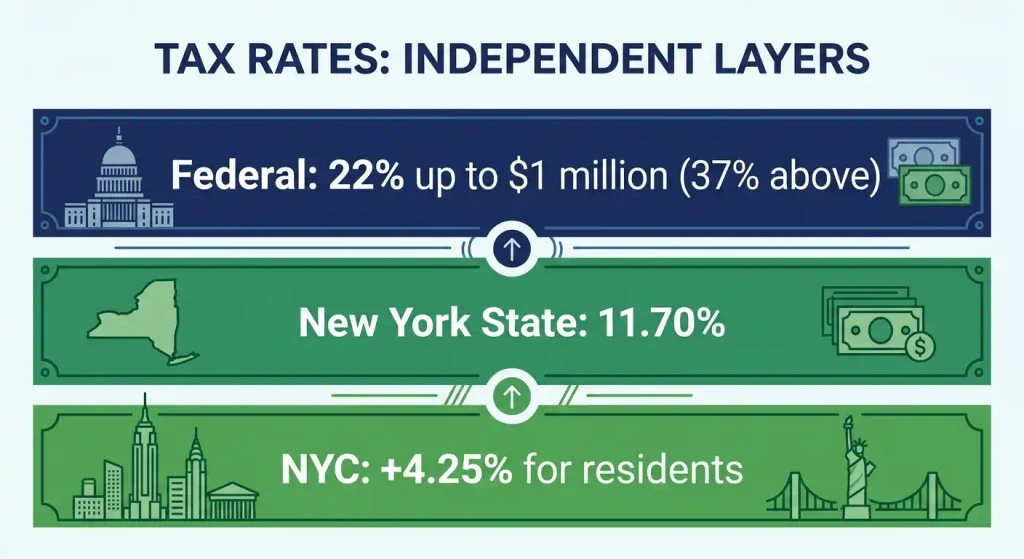
Bonuses get withheld at a flat federal rate of 22 percent, up to $1 million in cumulative supplemental wages per employer per year, then 37 percent above that. This is why a bonus check can look heavily taxed, though your final tax bill depends on total annual income, not that one check. New York adds its own flat supplemental rate on top, 11.70 percent for state tax, plus 4.25 percent more for NYC residents.
First Paycheck Differences
A first paycheck is often smaller, since it covers only a partial pay period. Benefit deductions may start late or all at once at enrollment. A new job also means starting fresh on withholding, calculated from the W-4 and IT-2104 you just submitted.
Gross Pay vs Net Pay Examples From Real-World Situations
Here’s how the math plays out in common scenarios.
You Receive a $70,000 New York Job Offer
At $70,000 annual gross, biweekly gross pay is about $2,692. After withholding, expect a net paycheck of roughly $2,150 to $2,250 every two weeks, about $4,600 to $4,850 a month in spendable income.
You Earn $30 an Hour and Work Overtime
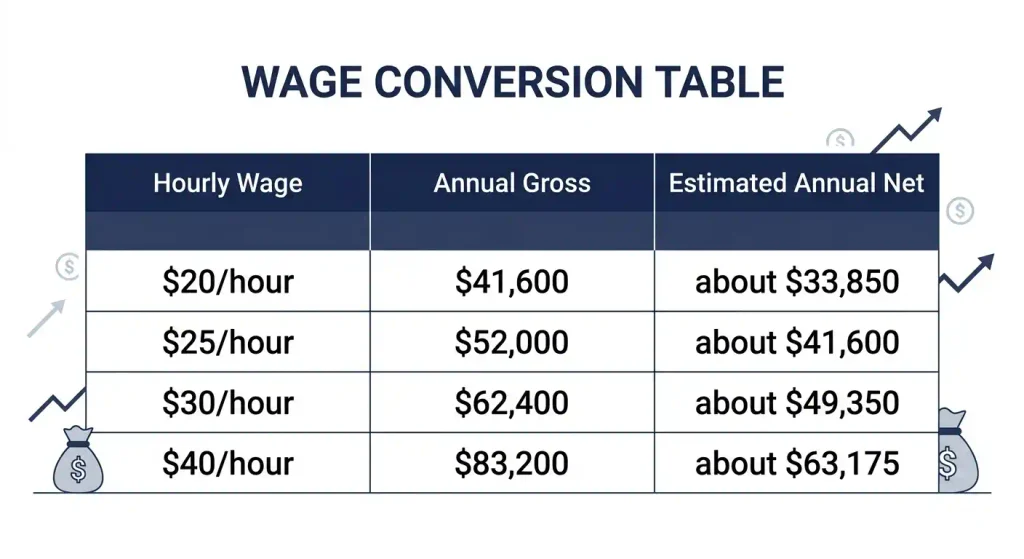
At $30 an hour working 45 hours, the first 40 pay $1,200 and 5 overtime hours pay $225 at time and a half, for $1,425 gross instead of $1,200. Overtime is taxed the same as regular wages; it just raises that week’s withholding. Common New York hourly wages, at 40 hours a week before overtime:
| Hourly Wage | Annual Gross | Estimated Annual Net |
|---|---|---|
| $20/hour | $41,600 | about $33,850 |
| $25/hour | $52,000 | about $41,600 |
| $30/hour | $62,400 | about $49,350 |
| $40/hour | $83,200 | about $63,175 |
You Move From Upstate New York to NYC
Same job, same $70,000 salary, but moving from Albany to Brooklyn adds NYC resident tax. That can mean a few thousand dollars less in annual take-home pay, purely from the address change.
Your Paystub Shows Less Net Pay Than Expected
Compare gross wages against every deduction on the stub. Look for an unfamiliar benefit deduction or a withholding change. If it still doesn’t add up, contact payroll directly.
Gross Pay vs Net Pay Mistakes That Can Cost You
A few common misunderstandings lead to bad budgeting. Here’s the fix.
Mistaking Gross Salary for Spendable Income
The salary on your offer letter isn’t your budget number. Taxes and deductions can take 20 to 30 percent before you see a dollar. Budgeting off gross pay is a fast way to come up short.
Assuming Every New York Worker Pays NYC Tax
New York State tax applies to every worker in the state, but NYC tax only applies to city residents. A commuter from New Jersey or Long Island pays no NYC resident tax. Yonkers is its own separate case.
Treating Withholding as Your Final Tax Bill
Withholding all year is an estimate, not your actual bill, which is why some get refunds and others owe in April. A refund means too much was withheld, not too little.
Applying One Tax Rate to the Entire Salary
New York and the federal government use progressive brackets, taxing each portion of income at its own rate. A higher bracket doesn’t tax your whole salary at that rate, only the income above each threshold.
Common Gross Pay vs Net Pay Myths
A few myths keep causing confusion. Here’s what’s actually true.
“My Gross Salary Is My Taxable Income”
Gross wages and taxable wages aren’t always equal. Pre-tax deductions, like a 401(k) or certain health premiums, lower taxable wages below gross pay. A traditional 401(k) lowers federal taxable wages, but not Social Security wages or Medicare wages, which are based on full gross pay.
“My Net Pay Is Just Gross Pay Minus Income Tax”
Income tax is only one piece. FICA taxes, New York State tax, possibly local tax, and benefit deductions all come out too.
“A Higher Tax Bracket Means I Lose More Money on My Entire Salary”
Marginal brackets apply only to income within that bracket, not the whole salary. Your effective tax rate, the average rate across all your income, always stays below your top marginal rate. A raise into a higher bracket never leaves you with less take-home pay than before.
“A Bonus Is Permanently Taxed at a Higher Rate”
Bonuses are usually withheld at a flat 22 percent federal rate, which can look harsh on that check. If your top marginal rate is below 22 percent, some of that withholding comes back as a refund; if it’s above 22 percent, you may owe more instead. Either way, the flat rate is not a permanent higher tax on that money.
2026 New York Withholding Rules and Official Sources
Here are the source documents behind these numbers.
2026 New York State Withholding Tables
Employers use Publication NYS-50-T-NYS for New York State withholding. The 2026 version applies to payrolls beginning January 1, 2026, based on wages and filing status. The 2026 rate adjustments trace back to the 2025 New York State budget. Employees can update withholding through the state’s Tax Department Online Services portal.
2026 NYC Withholding Tables
NYC resident withholding uses Publication NYS-50-T-NYC, formally titled New York City withholding tax tables and methods, separate from state withholding tables though both appear on one New York State tax return.
2026 Yonkers Withholding Tables
Yonkers withholding uses NYS-50-T-Y, formally Yonkers withholding tax tables and methods. Resident or nonresident status determines which portion applies.
Forms Employees Should Know
Form W-4 and Form IT-2104 control your withholding. Keep both current after a raise, move, or household change.
- Form W-4: formally the Employee’s Withholding Allowance Certificate, controls federal withholding.
- Form IT-2104: controls New York State withholding.
- IT-2104-I: the state form’s instructions, walks through each worksheet.
- Form IT-2105: used for New York estimated tax payments.
Overwithholding means filing an updated IT-2104 puts money back into regular paychecks instead of a refund. Underwithholding means increasing withholding, or making payments with Form IT-2105, helps avoid owing a large balance in April.
How to Check Whether Your New York Paycheck Is Correct
If your paycheck feels off, check it in this order.
Compare Gross Pay With Your Expected Earnings
Confirm your salary or hourly rate, hours worked, overtime, and any bonuses for that period.
Check Every Tax Withholding
Check federal income tax, Social Security, Medicare, and New York State withholding, plus NYC or Yonkers withholding if it applies.
Check Benefit and Retirement Deductions
Compare deductions against your actual enrollment elections, verify contribution amounts, and flag any unfamiliar post-tax deduction.
When the Numbers Do Not Match
Recheck your withholding elections and filing status first, then compare your paystub to employer payroll records. If it’s still unexplained, loop in payroll or a tax professional.
Gross Pay vs Net Pay FAQ
Is gross pay the same as salary?
Not exactly. Salary is your agreed annual figure; gross pay is what you actually earned in a pay period, including overtime, bonuses, or commissions.
How much is $60,000 after taxes in New York?
It depends on filing status, location, pay frequency, and deductions. For a single filer outside NYC taking the standard deduction, a reasonable 2026 estimate is $47,500 to $48,000 a year after federal tax, New York State tax, and FICA.
Is net pay the same as take-home pay?
Yes, in almost every context. Net pay is what’s deposited, though a payroll system can apply a further deduction, like a garnishment, after that calculation.
Do New York employees pay both state and city income tax?
Every New York worker pays state income tax. City tax only applies if you live in New York City, not simply because you work there, and Yonkers residents face a separate local surcharge instead.
Why is my net pay lower than my gross pay?
Federal and state withholding, FICA taxes, and benefit or retirement deductions all subtract from gross pay, usually 20 to 30 percent. Divide net pay by gross pay for your own percentage.
Why did my paycheck change even though my salary did not?
Usually a withholding change, a shift in benefit or retirement contributions, or a difference in hours, overtime, or bonus pay that period.
Does a raise increase gross pay more than net pay?
Yes, always. Taxes take a share of each additional dollar, so net pay rises by less than the gross raise, even though take-home pay still goes up.
How can I estimate my New York take-home pay?
Gather salary, pay frequency, location, filing status, and planned deductions, then run them against current withholding tables and compare to an actual paystub. With one paycheck in hand, multiply by pay periods a year, 52 weekly, 26 biweekly, 24 semimonthly, 12 monthly, to annualize it. Or run the numbers directly through our New York paycheck calculator for an instant estimate.
What to Do After You Know Your New York Net Pay
Once you have a realistic net pay number, here’s how to use it.
Use Net Pay to Build Your Monthly Budget
Base recurring expenses on take-home income, not salary. Account for benefit and retirement deductions up front. Budget rent, transportation, food, and debt payments around net pay, treating savings as a fixed line item.
Use Net Pay to Compare Job Offers
Compare estimated take-home pay side by side, not just salary. Factor in what you’d pay toward benefits, plus commute or other job-related costs.
Recheck Your Pay After Major Changes
Rerun your numbers after a raise, a job change, or a move within New York, and after any withholding or benefit change. A five minute check avoids a surprise on payday. For more New York paycheck guides, browse our blog.

Meet Yasin Ali, Founder
Yasin built NY Paycheck Calculator in 2020 after getting fed up with calculators that treated New York like every other state. Most tools ignore the extra local tax NYC and Yonkers workers pay on top of state tax — or skip New York’s Paid Family Leave deduction entirely.
He keeps the numbers current, checking in regularly against the latest IRS, NY Department of Taxation and Finance, and Paid Family Leave rates.
All results here are estimates based on official 2026 sources. For advice specific to your situation, talk to a tax professional.