
New York paycheck deductions are the federal, state, and city taxes, plus FICA and elected benefits, subtracted from gross pay to reach net pay. Every worker owes federal tax, Social Security, Medicare, and state tax; city tax depends on residency.
This breakdown reflects 2026 payroll rules, including a 7.65% FICA rate and the graduated withholding tables covered in our New York paycheck basics hub.
Withholding is only an estimate, so your final tax bill may differ.
Why Your New York Paycheck Is Smaller Than Your Salary
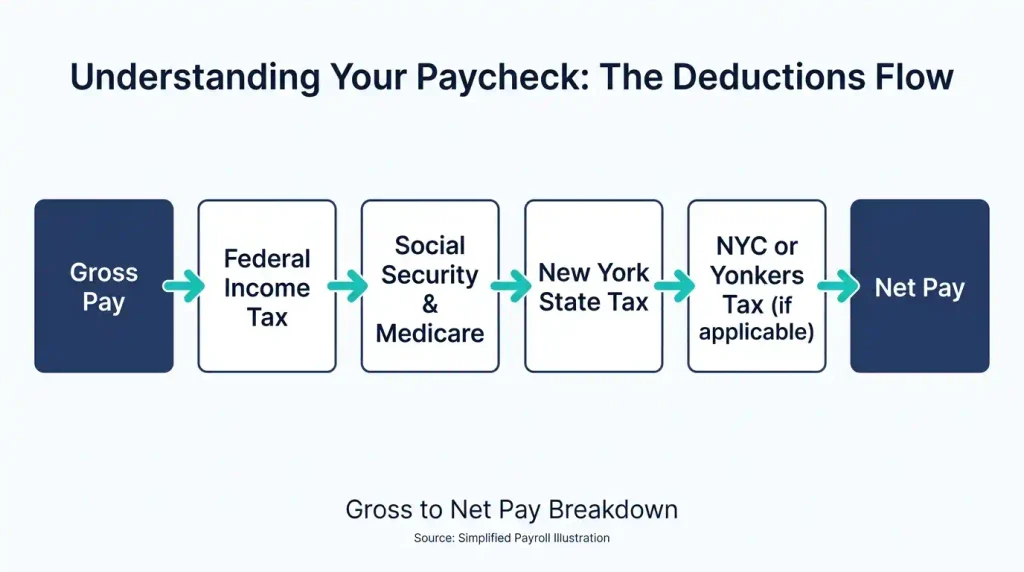
Gross Pay, Taxable Pay, and Net Pay Are Different
Gross pay is your full paycheck before deductions. Taxable wages are usually smaller, since pre-tax items like a 401(k) or health premium get pulled out first. Net pay, the last number on the stub, is what actually lands in your account.
The Main Deductions You May See on a New York Pay Stub
Your stub lists these as separate lines: federal income tax, Social Security, Medicare, and New York State tax. NYC or Yonkers tax may join in, along with health insurance and retirement contributions.
Why Two New York Employees Can Have Different Take-Home Pay
Two coworkers earning $80,000 can bring home different checks. One lived in Queens and had NYC tax withheld; the other lived in Westchester and did not. Different W-4 elections, 401(k) rates, or overtime change the math too.
New York Paycheck Deductions at a Glance
Some deductions are required by law, others you choose yourself.
Mandatory Tax Withholdings
These four come out of nearly every paycheck no matter what: federal income tax, Social Security, Medicare, and New York State income tax.
New York-Specific Payroll Deductions
State tax applies to everyone in New York. City tax applies only in the five boroughs, Yonkers has its own tax, and Paid Family Leave is deducted from most private paychecks.
Voluntary or Employer-Specific Deductions
Health insurance, dental and vision insurance, 401(k) or 403(b) contributions, HSA or FSA contributions, and union dues fall here. Skip them and your paycheck grows; add them and it shrinks, usually for good reason.
Federal Taxes Taken From a New York Paycheck
Federal deductions hit every U.S. paycheck the same way. For the full state-by-state breakdown, see our guide on what taxes come out of a New York paycheck.
Federal Income Tax Withholding
Your employer estimates your federal tax bill using your Form W-4 and withholds a slice each check. Changing filing status, adding a job, or claiming dependents moves that number.
Social Security Tax
This 6.2% deduction funds retirement, disability, and survivor benefits. In 2026 it applies to the first $184,500 you earn, up from $176,100 in 2025; the Social Security Administration sets that wage base yearly. Withholding stops once you cross that line, until January resets it.
Medicare Tax
Medicare takes 1.45% of every dollar, with no cap. Earn over $200,000 as a single filer and an extra 0.9% Additional Medicare Tax applies above that line, $250,000 for married filing jointly and $125,000 for married filing separately. Unlike income tax, Social Security and Medicare are flat-rate, not graduated.
Why Federal Tax Withholding Is Not Your Final Tax Bill
Withholding is an estimate, not a bill. Your real tax liability is set when you file; overwithheld means a refund, underwithheld means you owe more.
New York State Income Tax Withholding
New York layers its own income tax on top of the federal one.
How New York State Income Tax Is Withheld
Your employer uses tables from the New York State Department of Taxation and Finance, based on wages, pay frequency, and your Form IT-2104, the Employee’s Withholding Allowance Certificate. New York taxable income starts from your federal adjusted gross income, then applies the state’s own deductions. The form also lets you request additional withholding.
What Changed for New York Paychecks in 2026
New York’s 2026 budget cut the bottom five state tax brackets by 0.1 percentage point, effective for paychecks from January 1, 2026, per the updated NYS-50-T-NYS tables. This changes withholding only, not your total 2026 liability.
Why Your New York State Withholding Can Change
A raise pushes income into a higher bracket, so extra pay rarely shows up dollar for dollar. A new dependent, marriage, or a second job shifts withholding too, and updating your IT-2104 alone can move the number.
When New York State Withholding May Need Review
Check withholding when you start or leave a job, get a raise, marry, divorce, or move into or out of NYC or Yonkers. A five-minute form update now avoids a painful bill in April.
New York City Paycheck Tax: Who Pays It?
Two employees at the same company can end up with two very different tax lines just based on their home address.
When NYC Income Tax Appears on Your Paycheck
Live in one of the five boroughs, Manhattan, Brooklyn, Queens, the Bronx, or Staten Island, and NYC tax comes out regardless of where you work. Residency decides it, not workplace.
Why NYC Tax Is Separate From New York State Tax
NYC and New York State tax you separately, so your stub can show two lines instead of one. A resident outside the city, in Long Island or Westchester, never sees the NYC line. NYC’s authority comes from Article 30 of the New York Tax Law together with the New York City Administrative Code, administered by the New York State Department of Taxation and Finance.
2026 NYC Withholding Rules
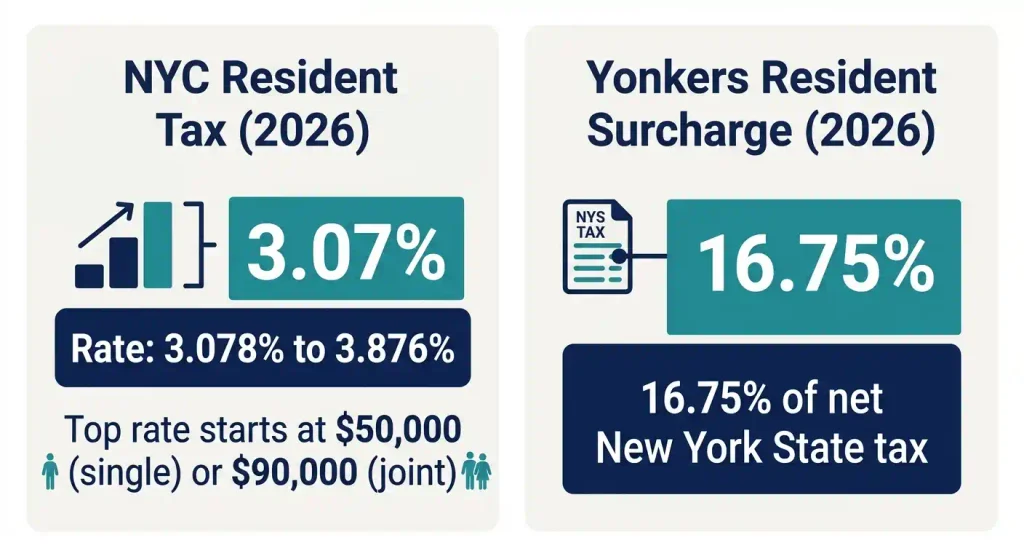
For 2026, NYC resident rates run 3.078% to 3.876%, with the top rate starting at $50,000 taxable income (single) or $90,000 (joint), from the NYS-50-T-NYC tables, separate from the state-level NYS-50-T-NYS tables.
Moving Into or Out of New York City
Moving into or out of the five boroughs changes your residency status, so update your Form IT-2104 right away rather than waiting for tax season.
Yonkers Income Tax Withholding Explained
Yonkers runs its own small but real tax.
Who May Have Yonkers Tax Withheld
Yonkers residents pay a surcharge equal to 16.75% of their net New York State tax. Nonresidents working in Yonkers pay a much smaller earnings tax instead.
What Changed for Yonkers in 2026
Yonkers updated its 2026 withholding tables, published as NYS-50-T-Y. Since the surcharge ties to the state formula, the 2026 state bracket cuts flow through to lower Yonkers withholding too.
Moving Into or Out of Yonkers
A move into or out of Yonkers changes your withholding category, so update your IT-2104 as soon as your address changes.
New York Paid Family Leave and Disability-Related Deductions
These two deductions fund different benefits.
Paid Family Leave Employee Contributions
New York State Paid Family Leave, or PFL, is deducted after tax to fund bonding, family care, or military family leave. The 2026 rate is 0.432% of gross wages, capped at $411.91 a year, up from 0.388%/$354.53 in 2025.
New York State Disability Benefits
Disability benefits, shown as NY SDI, cover non-work illness or injury. The employee contribution caps at $0.60 a week, about $31.20 a year at most.
How These Deductions Affect Take-Home Pay
Both PFL and SDI come out after tax, so they don’t lower taxable wages. A biweekly PFL deduction runs about $10 to $16; SDI barely registers.
Pre-Tax and After-Tax Paycheck Deductions
Where a deduction lands changes how much it actually costs you.
Common Pre-Tax Deductions
Health insurance, traditional 401(k) or 403(b), and HSA or FSA contributions, including dependent care FSA, usually come out before taxes, lowering taxable wages.
Common After-Tax Deductions
Roth 401(k) contributions, some supplemental insurance, and union dues typically come out after tax, since that income was already taxed.
Why a $100 Deduction Does Not Always Cost You $100
Put $100 into a traditional 401(k) on a $70,000 New York salary, and take-home pay may drop only $65 to $75 since it skips federal, state, and often FICA tax. A Roth contribution drops the full $100.
How to Read Every Line on a New York Pay Stub
A pay stub follows a set order. Our companion walkthrough on how to read a New York pay stub breaks down every line in more detail.
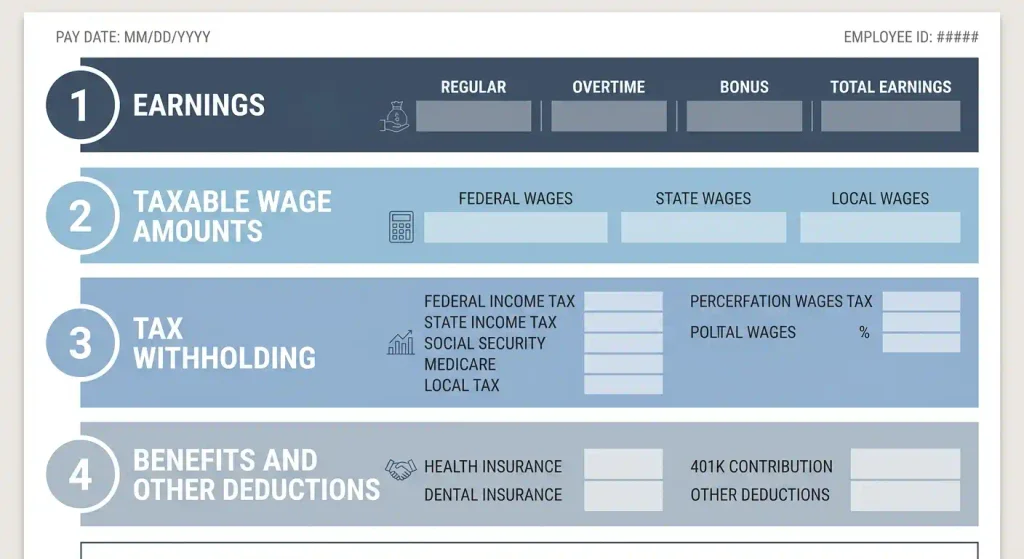
Start With Earnings
It opens with earnings: regular wages, overtime, bonus pay, and paid time off, your starting gross number.
Check the Taxable Wage Amounts
Next come taxable wages, federal, Social Security, Medicare, and New York, which can differ from gross pay depending on pre-tax deductions. These figures populate your Form W-2 each January.
Check Each Tax Withholding
Then come the tax withholdings: federal, Social Security, Medicare, and NYS, NYC, or Yonkers if they apply, each tied to the taxable wage it was calculated from.
Check Benefits and Other Deductions
Last come insurance, retirement, HSA or FSA, and anything else you authorized. A wage garnishment or court-ordered deduction is the exception: once a court, the New York State Department of Taxation and Finance, or a child support agency notifies your employer, it’s mandatory.
New York Paycheck Deduction Examples
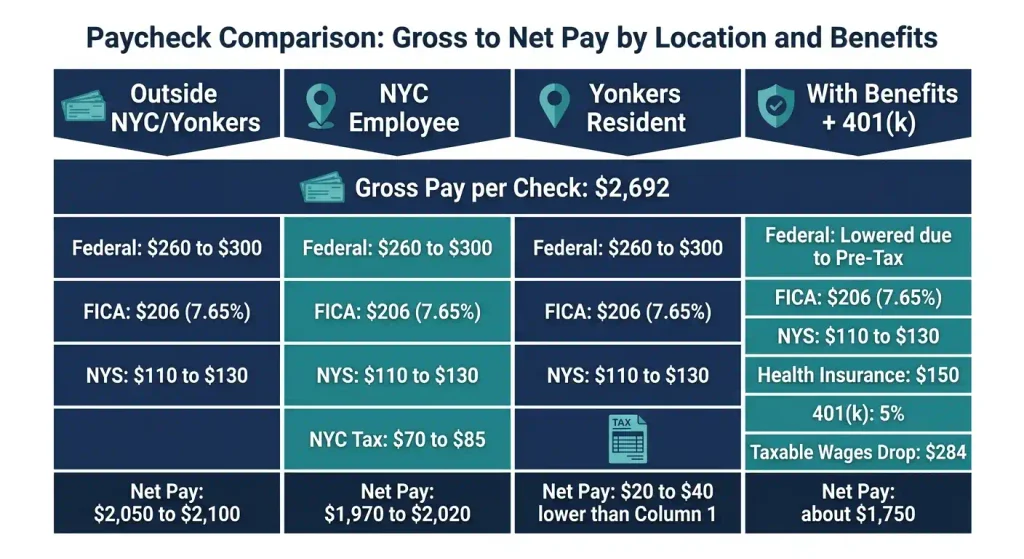
Four scenarios show the real numbers. Run your own salary through our New York paycheck calculator to see the exact breakdown.
Example: New York Employee Outside NYC and Yonkers
A single filer earning $70,000 outside the city, paid biweekly, gets $2,692 gross per check. Federal withholding runs $260 to $300, FICA about $206 (7.65%), and NYS withholding $110 to $130, for net pay near $2,050 to $2,100.
Example: NYC Employee
Same $70,000 salary and $2,692 gross check, but in Brooklyn: add $70 to $85 of NYC withholding, dropping net pay to about $1,970 to $2,020, roughly $80 lower per check.
Example: Yonkers Resident
A Yonkers resident on the same salary pays the state surcharge instead of a city bracket, landing net pay $20 to $40 lower per check than living outside both jurisdictions.
Example: Paycheck With Benefits and Retirement
Add $150 biweekly for health insurance and 5% to a 401(k) on that same $70,000 non-city salary: taxable wages drop about $284 per check, and net pay falls to around $1,750 with gross pay still at $2,692.
Why Your Paycheck Changed From the Previous Pay Period
Several things can shift a check even when salary stays the same.
Your Gross Pay Changed
Extra hours, overtime, a bonus, commission, or unpaid time off move gross pay first.
Your Tax Withholding Changed
A new W-4 or IT-2104, a reported life event, or crossing into a new bracket shifts withholding.
Your Benefits or Other Deductions Changed
New insurance, a changed retirement percentage, or a new HSA election shows up on the next check.
Your Paycheck Changed Even Though Your Salary Did Not
A 27-paycheck year instead of 26 changes the per-check math, benefit costs reset each January, and once you hit the $184,500 Social Security wage base for 2026, that 6.2% deduction stops for the year.
New York Paycheck Deductions: Special Situations
A few situations break the usual pattern.
Overtime and Extra Hours
A bigger overtime paycheck gets withheld at a higher rate because tables assume that pace continues; there’s no separate overtime tax rate.
Bonuses and Supplemental Pay
Bonuses are typically withheld at a flat 22% federal rate, so a $2,000 bonus can lose $440 to federal withholding alone. Above $1,000,000 in bonuses for the year, the rate jumps to 37%. New York adds its own flat supplemental rate of 11.70% on top, plus 4.25% more for NYC residents. That’s a withholding rate, not your final tax rate.
Two or More Jobs
Each employer only sees its own wages, which can cause underwithholding. Fix it by checking the multiple jobs box on your W-4 or using the Internal Revenue Service withholding estimator.
Remote Workers and Cross-State Employees
Work for a New York company from New Jersey or Connecticut, and New York’s convenience of the employer rule can still tax you as if you worked in-state. The Metropolitan Commuter Transportation Mobility Tax, or MCTMT, is separate: it’s paid by employers, not deducted from your check.
New York Paycheck Deductions vs. Final Tax Liability
Withholding and your actual tax bill are related but not the same.
What Your Employer Withholds During the Year
Your employer withholds federal, state, and local taxes all year, aiming to roughly match what you’ll owe.
What You Actually Owe When Filing
Real liability is set at filing, using full annual income, deductions like the 2026 federal standard deduction of $16,100 for single filers, and credits. Residents file Form IT-201; nonresidents and part-year residents use Form IT-203.
Why You Can Get a Refund or Owe More
Overwithhold and you get a refund; underwithhold and you owe in April. If you itemized the prior year, part of a state refund can be taxable, reported on Form 1099-G.
Common Myths About New York Paycheck Deductions
A few beliefs persist despite being wrong.
“Everyone Who Works in New York Pays NYC Income Tax”
False. NYC tax depends on where you live, not where you work.
“A Higher Tax Withholding Means I Am in a Higher Tax Bracket”
A bigger check from overtime or a bonus is withheld higher because the system assumes that pace all year, not because your bracket changed.
“Every Paycheck Deduction Is a Tax”
Health insurance, 401(k) contributions, and union dues are benefits you chose, not taxes.
“Changing Withholding Changes How Much Tax I Owe”
Adjusting your W-4 or IT-2104 changes cash flow, not your actual tax liability.
What to Check Before You Assume Your New York Paycheck Is Wrong
Run through a quick checklist before assuming a mistake.
Compare the Current Pay Stub With the Previous One
Line up gross pay, taxable wages, each deduction, and net pay. Start with the largest deductions, federal and FICA, and flag any new or missing line.
Verify Your Personal and Withholding Information
Confirm your address, filing status, and allowances, and recall any recent life changes.
Verify the 2026 New York Rules
Make sure the current 2026 NYS, NYC, or Yonkers tables, from the New York State Tax Department, are being used, not last year’s. Our calculation methodology explains exactly which sources and tables we cross-check every figure against.
Know When to Contact Payroll or a Tax Professional
If numbers still don’t add up, or you face multiple states or heavy underwithholding, loop in payroll or a tax professional.
Frequently Asked Questions About New York Paycheck Deductions
Quick answers to the most common questions.
Why are New York paycheck deductions so high?
Federal tax, FICA, state tax, and sometimes city or Yonkers tax stack together, plus benefits like insurance or retirement.
What taxes are taken out of a New York paycheck?
Federal income tax, Social Security, Medicare, and New York State income tax apply to nearly everyone; NYC or Yonkers tax adds on for residents.
Do all New York workers pay New York City income tax?
No, only residents of the five boroughs pay it, regardless of where they work.
How much tax should be taken out of my New York paycheck?
It depends on wages, pay frequency, filing status, and residence, set by current NYS-50-T tables and your W-4 and IT-2104.
Why did my New York paycheck decrease when my salary did not change?
Usually a withholding update, a benefit change, or a differently taxed supplemental payment like a bonus.
How do I change New York paycheck withholding?
Submit an updated Form IT-2104 to your employer; it usually applies to your next paycheck.
What is the difference between New York State tax and NYC tax?
State tax applies to every New York resident; NYC tax is a separate add-on only for the five boroughs.
Can I get back money that was over-withheld from my paycheck?
Yes, but through your tax return as a refund, not through payroll.
Why is my paycheck different from an online New York paycheck calculator?
Calculators assume general defaults; your real pay stub reflects your actual IT-2104 elections and benefits.
New York Paycheck Deduction Quick Reference
A short list of what reduces take-home pay and where to check it.
Taxes That May Reduce Your Take-Home Pay
| Tax | Applies To |
|---|---|
| Federal income tax | All employees |
| Social Security and Medicare (FICA) | All employees |
| New York State income tax | All NY residents and NY-source workers |
| NYC or Yonkers income tax | Residents of NYC or Yonkers |
Non-Tax Deductions That May Reduce Your Take-Home Pay
| Deduction | Tax Treatment |
|---|---|
| Health insurance | Usually pre-tax |
| Retirement contributions | Pre-tax (traditional) or after-tax (Roth) |
| HSA or FSA elections | Pre-tax |
| Union dues | After-tax |
Forms and Official Sources to Check
| Form / Source | Purpose |
|---|---|
| Form IT-2104 | Standard withholding |
| Form IT-2104-I | Line-by-line instructions |
| Form IT-2104-E | Exemption claim (no liability last year, none expected this year) |
| Form IT-2104.1 | Nonresident allocation |
| Publication NYS-50 / NYS-50-T tables | Current official rates, via NY.gov |

Meet Yasin Ali, Founder
Yasin built NY Paycheck Calculator in 2020 after getting fed up with calculators that treated New York like every other state. Most tools ignore the extra local tax NYC and Yonkers workers pay on top of state tax — or skip New York’s Paid Family Leave deduction entirely.
He keeps the numbers current, checking in regularly against the latest IRS, NY Department of Taxation and Finance, and Paid Family Leave rates.
All results here are estimates based on official 2026 sources. For advice specific to your situation, talk to a tax professional.