
A lower New York paycheck almost always traces to one of three changes: gross pay, tax withholding, or a benefit deduction. Comparing your current pay stub against your last one, line by line, usually reveals the exact cause in minutes.
That line-by-line comparison method, drawn from New York’s 2026 withholding tables and payroll deduction rules, reflects standard payroll troubleshooting practice.
Still, exact numbers vary by income, benefits, and residency, not one fixed rule.
Why Your New York Paycheck May Be Lower Than Expected
New York stacks federal tax, state tax, sometimes city tax, Social Security, Medicare, Paid Family Leave, and disability on one stub, more layers than most states use, which is why a Brooklyn worker can see seven tax lines where a Florida worker sees three. For the full rundown of how these layers work together, see our New York paycheck basics hub.
Gross pay is not the amount that reaches your bank account
Gross pay is what you earned; net pay is what survives. Taxes and deductions like health premiums and 401(k) contributions sit between them. Dividing your salary by 26 gives gross, not take-home. On $80,000 in New York City, each biweekly check starts at about $3,077 and lands near $2,265. The real question is not “where did my money go,” it is “which line moved?”
The fastest way to find where your money went
Start with gross wages: if they changed, taxes moved with them and nothing below is a mystery. If gross matches, work down the deductions, current and year-to-date, until one line breaks the pattern.
When a lower paycheck is completely normal
A smaller check is usually normal, not wrong. Withholding shifts with a threshold crossed, a raise, or a bonus in the same period. Open enrollment, a 401(k) auto-increase, an unpaid day, or a short first pay period all shrink net pay without any mistake. Missing wages are different: hours you worked simply are not on the stub.
New York paycheck: gross pay vs. common deductions vs. net pay
Here is the path for a single filer earning $80,000, living in New York City, paid biweekly in 2026.
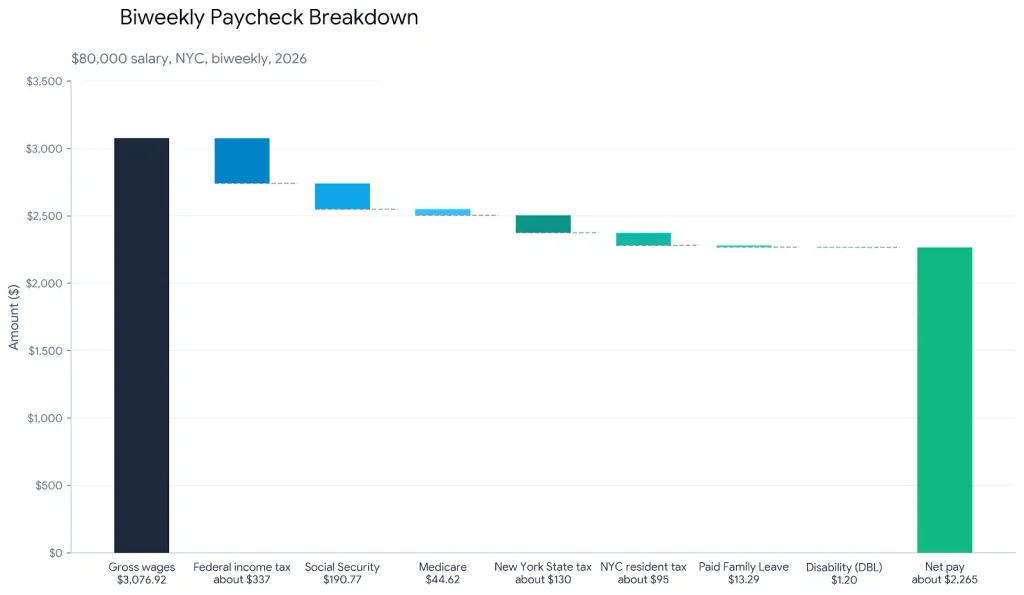
| Line | Amount per check | What it is |
|---|---|---|
| Gross wages | $3,076.92 | What you earned this period |
| Federal income tax | about $337 | Set by your W-4 |
| Social Security | $190.77 | 6.2% up to $184,500 in wages |
| Medicare | $44.62 | 1.45%, no wage cap |
| New York State tax | about $130 | Set by your IT-2104 |
| NYC resident tax | about $95 | Only if you live in the city |
| Paid Family Leave | $13.29 | 0.432% of gross in 2026 |
| Disability (DBL) | $1.20 | $0.60 per week |
| Net pay | about $2,265 | What hits your account |
Your numbers will not match exactly, and should not. Benefits, filing status, county, and retirement contributions move every line. Once you know which category changed, the fix takes minutes.
Takeaway: find the one line that moved, and the whole mystery disappears.
Check These 7 Lines on Your New York Pay Stub First
Seven lines explain almost every lower-than-expected paycheck. Work through them in order and stop at the first mismatch. For a full line-by-line walkthrough with a real pay stub example, see how to read a New York pay stub.
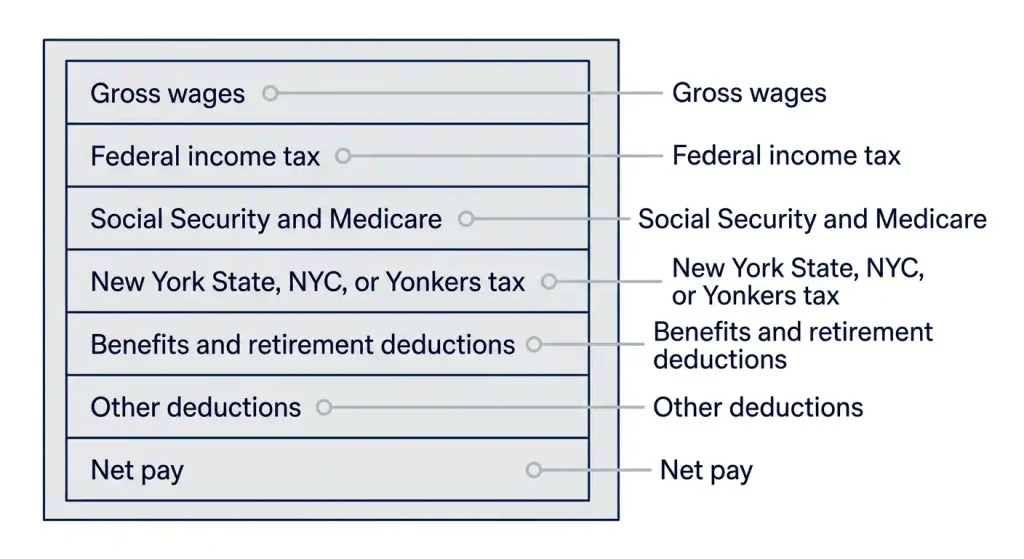
- Gross wages
- Federal income tax
- Social Security and Medicare
- New York State, NYC, or Yonkers tax
- Benefits and retirement deductions
- Other deductions
- Net pay
Gross wages
Start at the top: a wrong gross makes everything below it wrong. Check your pay rate against your offer letter or last raise notice, then count regular and overtime hours separately. Any bonus or commission should appear as its own line, not blended into base pay.
Federal income tax
This line is a prepayment toward your yearly tax bill, not the bill itself. It moves with a new W-4, a filing status change, or the multiple-jobs box. The 2026 federal standard deduction is $16,100 single and $32,200 joint filers; the seven rates still run 10% to 37%. The Internal Revenue Service taxes your adjusted gross income minus that deduction, not your gross paycheck. A bigger federal line this week just means more of the year’s tax is already paid.
Social Security and Medicare
These are fixed percentages, easy to verify. Social Security takes 6.2%, up to the $184,500 Social Security wage base for 2026; Medicare takes 1.45% with no cap. On $3,076.92 gross, that is $190.77 and $44.62 every time. Past $184,500, Social Security stops and checks grow.
New York State, NYC, or Yonkers tax
New York State tax appears on every stub. NYC tax applies only in the five boroughs; Yonkers tax only under Yonkers residency or nonresident work rules. All three flow from Form IT-2104, so one wrong box changes several lines. Check the residency code matches where you actually live.
Benefits and retirement deductions
These change more often than taxes, with no reminder. Premiums reset at open enrollment, usually January. A 401(k) auto-escalation from 5% to 6% on $80,000 pulls about $31 more per biweekly check. Pre-tax deductions like 401(k) or HSA lower taxable wages, so tax lines drop slightly too.
Other deductions
Scan for union dues, commuter or parking deductions, and anything with a case or order number. Garnishments and child support orders appear without warning since employers must follow them. Voluntary items should match something you signed; if not, ask payroll for the authorization.
Net pay
Net pay should match your deposit exactly. Subtract every deduction from gross wages; a few dollars off means a duplicate deduction or math error. Compare year-to-date net too, since some errors only show up there.
Takeaway: check these seven lines in order and stop at the first mismatch.
The New York Taxes That Can Reduce Your Paycheck in 2026
New York paychecks carry federal income tax, state income tax, sometimes city tax, plus Social Security and Medicare. In 2026 the state rates on lower and middle brackets went down, while the top rate stayed at 10.9%. See our full breakdown of what taxes come out of a New York paycheck for salary-by-salary examples.
Federal income tax withholding
Federal withholding is your employer’s estimate, built from your W-4, pay frequency, and gross pay. Since it annualizes each check, a big paycheck can look overtaxed. A single filer with $63,900 taxable income pays about 13.7% in federal tax, well under the 22% bracket they sit in.
New York State income tax withholding
New York State tax comes out of every check and is usually the second-largest tax line after federal. The New York Department of Taxation and Finance sets these New York withholding tables; employers use Publication NYS-50-T-NYS, the New York State withholding tax tables, reissued January 2026 under Chapter 59 of the Laws of 2025. Brackets run 3.9% to 10.9%; the standard deduction is $8,000 single, $16,050 joint. Your New York withholding allowances come from Form IT-2104: fewer allowances raise withholding now, more lower it but can leave you owing in April. Form IT-2104-I has the worksheet.
New York City income tax
Five-borough residents pay city income tax on top of the state’s, roughly 3.078% to 3.876%. Employers use Publication NYS-50-T-NYC, the New York City withholding tax tables, unchanged for 2026 even though state tables changed. This rides on the residency box of your IT-2104, so moving in or out of the city can shift the line a pay period later. On $80,000, that line runs about $2,470 a year.
Yonkers income tax
Yonkers residents pay a 16.75% surcharge on their New York State tax, not on income, so it’s smaller than it sounds. Nonresidents who work in Yonkers pay a flat 0.5% earnings tax instead. New York reissued the Yonkers withholding tax tables, Publication NYS-50-T-Y, effective January 1, 2026. Moving into or out of Yonkers switches you between these two, so update your IT-2104 when you move.
Social Security and Medicare taxes
Social Security is 6.2%, capped at $184,500 for 2026. Medicare is 1.45% with no cap. Past $200,000 year-to-date, employers must withhold an extra 0.9% Additional Medicare Tax regardless of filing status. That threshold hasn’t moved since 2013.
Takeaway: five tax layers, and 2026 changed two of them.
Why Your New York Withholding May Have Changed in 2026
If your gross pay is identical and your benefits are identical, your withholding changed. Four things cause that: new state tables, your IT-2104, your W-4, or your own life.
New York updated its 2026 withholding tables
New York revised state and Yonkers withholding for payrolls from January 1, 2026, reflecting rate cuts on lower and middle brackets, so most state lines dropped slightly. NYC wage bracket tables did not change for 2026. This is usually why January checks differ from December’s.
Your Form IT-2104 may affect the amount withheld
IT-2104 is New York’s version of the W-4, separate from the federal form. It carries your allowances, marital status, NYC/Yonkers residency, and any extra withholding amount. More allowances mean less tax now; New York gives no allowance just for existing, so allowances come mostly from dependents and credits.
Your federal W-4 may affect federal withholding
Form W-4, officially the Employee’s Withholding Certificate, controls only the federal line. Four parts matter: filing status, the multiple-jobs checkbox, W-4 Step 3 for dependents, and W-4 Step 4, covering W-4 other income and W-4 deductions. Married couples who both work and skip the multiple-jobs box under-withhold, since each employer ignores the spouse income elsewhere. Checking that box prevents an April surprise. The IRS Tax Withholding Estimator checks your numbers fastest.
Your personal situation may have changed
Life changes hit your paycheck fast: a second job, marriage, losing a dependent, moving across the city line. A new job often runs on default or incomplete withholding until your W-4 and IT-2104 finish processing, so don’t judge pay by the first stub or two. Changing jobs mid-year means filing a fresh W-4 and IT-2104, since history doesn’t carry over. Review the IT-2104 every January; a stale form quietly causes big refunds or balances due.
Takeaway: same pay, different tax, means a form or a table changed.
New York City vs. New York State vs. Yonkers: What Changes?
Where you live decides how many income tax lines you carry. Where you work does not, at least not for city tax.
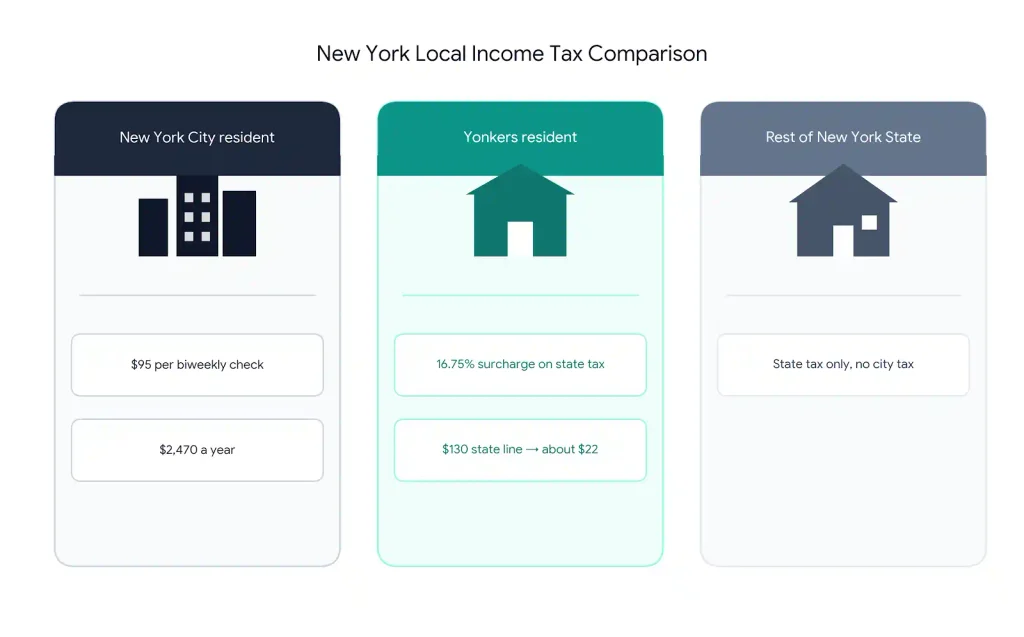
If you live in New York City
City residents pay NYC resident tax on top of state tax, so a Queens stub shows two lines. It’s set by the same IT-2104; check the residency box if the line is missing or wrong. On $80,000, living in the city instead of Nassau County costs roughly $95 per biweekly check.
If you live in Yonkers
Yonkers residents pay a 16.75% surcharge on their New York State tax; on a $130 state line, that’s about $22. Nonresidents who work in Yonkers pay a flat 0.5% earnings tax instead. Both come from the Yonkers section of your IT-2104.
If you live elsewhere in New York State
Live in Buffalo, Albany, or Suffolk County and you pay New York State tax only, no city tax, regardless of visits or clients there. A city line on your stub means the wrong residency on file. Send HR a corrected IT-2104.
If you work in one place but live somewhere else
Workplace and tax home differ. NYC tax follows residence, so a New Jersey commuter to Manhattan pays New York State tax but no city tax. Splitting days between states? Form IT-2104.1 tells your employer how much pay is New York sourced; skip it and 100% gets withheld. A New York remote worker living out of state faces a different trap: New York’s convenience of the employer rule can tax remote wages as if worked in-state, even from a home office, unless a narrow exception applies.
Takeaway: residence drives city tax, work location drives state sourcing.
Other Deductions That Can Make Your Paycheck Smaller
Taxes get the blame, but benefits change more often. Most deductions below come out before tax; Paid Family Leave and disability are post-tax deductions instead. Any of them can move without your salary changing.
Health and insurance deductions
Premiums reset at open enrollment, usually the first January check. A $60 monthly jump is $27.69 per biweekly check, which feels like an error but isn’t; compare your benefits confirmation to the stub. Adding a spouse or child mid-year does the same anytime. Most plans run through a Section 125 benefits plan, so premiums come out pre-tax. Exception: employer life insurance above $50,000 creates imputed income, counted among taxable fringe benefits, adding a small tax with no cash involved.
Retirement contributions
Retirement deductions are your money, just parked elsewhere. Auto-escalation raises your 401(k) percentage on an anniversary date without a new signature; going from 5% to 6% on $80,000 pulls another $30.77 per biweekly check. Here, a smaller paycheck is good news.
HSA, FSA, and commuter benefits
These elections run annually, often restarting in January. A $2,000 yearly FSA election is about $77 per biweekly check. Since HSA and FSA money comes out pre-tax, taxable wages and other tax lines shrink slightly too. Commuter benefits work the same way.
Union dues and other authorized deductions
Union dues are often a percentage of pay, so a raise raises dues too. Other authorized deductions include parking, gym memberships, or insurance you opted into, and under New York law all need your written authorization. If you don’t remember signing, ask payroll for it.
Garnishments and court-ordered deductions
Garnishments arrive with no warning; employers have no choice but to honor creditor garnishments, tax levies, and child support orders. New York limits how much can be taken, though the limit still hurts. Dispute it with the court or agency that issued it, not your employer.
Takeaway: benefits change quietly, taxes change loudly, both shrink net pay.
Could Your Paycheck Actually Be Wrong?
Sometimes it really is wrong. Four patterns separate a genuine payroll error from a normal deduction change.
Your gross pay is lower than it should be
No deduction can explain a wrong gross. Multiply rate by hours and compare; watch for a missing shift differential, an unupdated raise, or an unprocessed commission. If gross is short, everything below is short too.
Your overtime pay is missing
New York overtime law follows the federal rule of 1.5 times your regular rate past 40 hours a week. Overtime should show as its own line with its own hours. Check workweek boundaries too; averaging two weeks together isn’t allowed. A salaried title alone doesn’t exempt you.
An unfamiliar deduction suddenly appeared
Write down the code and amount, then ask what it is and what authorized it. Taxes and court orders need no signature; almost everything else does. No signed authorization or legal order means it shouldn’t be there.
Your pay stub does not add up
Subtract deductions from gross; if it doesn’t match net, something is duplicated or miscoded. Compare current and year-to-date figures, since a double deduction often shows an exactly doubled year-to-date total. New York requires every wage statement to list pay dates, hours, rates, gross wages, and each deduction by name and amount. New York also requires a New York pay rate notice at hire, worth comparing against today’s stub.
Takeaway: if gross is short or the stub does not add up, escalate.
Which New York Paycheck Deductions Are Legal?
New York Labor Law Section 193 governs New York wage deductions strictly: taxes, deductions you authorized in writing, and court orders are allowed. Business costs are not, and no deduction can push pay below minimum wage.
Taxes and legally required deductions
Federal income tax, Social Security, Medicare, and New York State tax are required by law, needing no permission. So are NYC or Yonkers tax for residents, and Paid Family Leave at 0.432% of gross, capped at $411.91 a year. New York disability (DBL) differs: employers may, but aren’t required to, collect up to $0.60 a week, so it appears on most stubs without being a true tax. These need no signature.
Employee-authorized deductions
Anything you elected needs revocable written authorization: health, dental, vision premiums, 401(k) and pension, HSA/FSA, union dues, commuter benefits, payroll giving. It must be specific and voluntary; a blanket handbook line doesn’t count.
Deductions employers generally cannot make
Employers can’t charge you for their own losses: no deductions for a cash shortage, broken plate, spoiled food, walkout, or business uniform. New York also blocks recovering ordinary business expenses from pay. That’s a wage claim, not a payroll question.
Takeaway: taxes, your signature, or a court order. Nothing else belongs there.
How to Compare Your Paycheck With Your Previous One
Four steps, two stubs, five minutes. This finds the answer faster than any phone call to HR.
- Step 1: Compare gross wages
- Step 2: Compare tax withholding
- Step 3: Compare other deductions
- Step 4: Find the exact dollar difference
Step 1: Compare gross wages
Compare gross numbers side by side. If they match, skip earnings entirely; if not, check rate, hours, overtime, and any bonus line. Nine times out of ten, a lower gross means fewer paid hours.
Step 2: Compare tax withholding
Compare each tax line separately: federal, then Social Security and Medicare, then New York State, then city or Yonkers. Social Security and Medicare are fixed percentages, so if they moved with flat gross, something’s miscoded. A state-only change in January is the 2026 table update.
Step 3: Compare other deductions
Run down insurance, retirement, HSA/FSA, commuter benefits, and dues, checking both current and year-to-date totals. A deduction appearing for the first time is the prime suspect.
Step 4: Find the exact dollar difference
Subtract the two net pay figures, then the two gross figures and deduction totals. Whichever gap matches your net pay gap is your answer. Net dropped $47 and only your premium moved by $47? Nothing’s broken.
Takeaway: two stubs, four subtractions, and the answer is unavoidable.
Real Examples of a Lower-than-Expected New York Paycheck
Numbers explain this better than theory. Five illustrative scenarios, built from realistic New York pay, not real individuals.
Example 1: Same salary, higher benefit deduction
A Bronx teacher’s aide earns $52,000, paid twice monthly, gross $2,166.67. Her family medical premium rose from $180 to $265 a month in January, $42.50 more per check. Net dropped about $36 after pre-tax savings; taxes never moved, and payroll did nothing wrong.
Example 2: Same gross pay, higher tax withholding
A Long Island sales rep earning $95,000 married in June, switched his W-4 to joint, then reverted to single in August. Gross never moved; his federal line jumped roughly $120 per biweekly check, since single withholds faster. Withholding is a dial, not a bill, and he’ll see the difference at filing time.
Example 3: Lower gross pay because of fewer paid hours
A Rochester hourly worker at $24 an hour normally logs 80 biweekly hours, $1,920 gross. One unpaid day dropped her to 72 hours and $1,728 gross. Taxes fell only about $55 while gross fell $192, since lower taxes never offset lower earnings.
Example 4: Higher income triggers Additional Medicare Tax
A Manhattan attorney earning $260,000 sees checks change twice yearly. Around late September, year-to-date wages pass $200,000 and her employer withholds an extra 0.9% Medicare tax, $90 more on a $10,000 biweekly check. Earlier, Social Security stopped at $184,500 and her checks grew by $620.
Example 5: NYC employee versus non-NYC New York employee
Two Midtown coworkers both earn $80,000. The Astoria resident carries a New York City resident tax line, roughly $95 per biweekly check, about $2,470 a year; the White Plains resident carries none. Same salary, different take-home, just from a home address.
Takeaway: identical salaries in New York rarely mean identical paychecks.
Why a Bonus or Overtime Check May Look Surprisingly Small
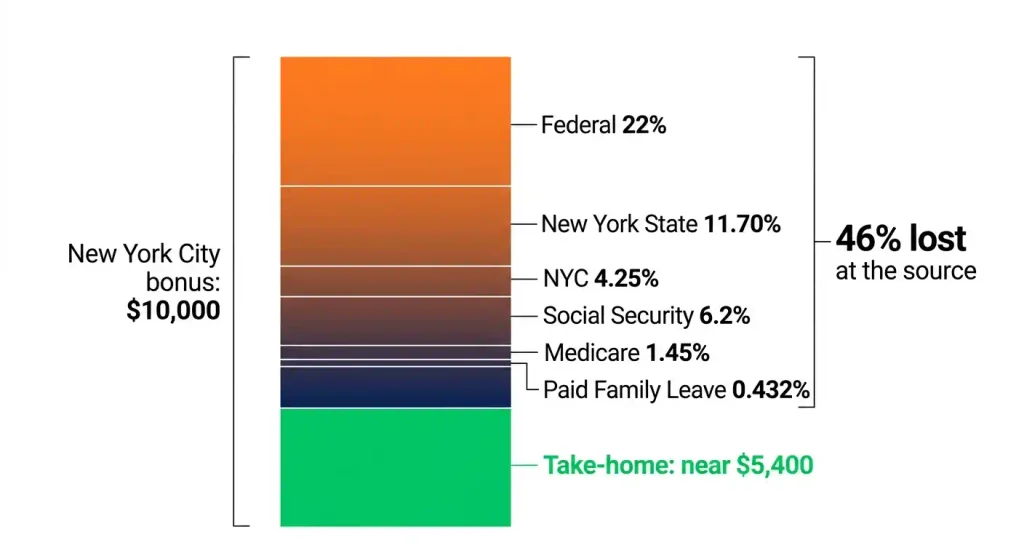
Bonuses get taxed at flat supplemental rates, not your normal rate. That is why a $10,000 bonus in New York City can land near $5,400.
Bonus or commission withholding
Supplemental wages follow flat rates: federal 22% up to $1 million, New York 11.70% for 2026, NYC residents add 4.25%, Yonkers residents add 1.95975%. With Social Security, Medicare, and PFL stacked on, a New York City bonus can lose 46% at the source. Since 11.70% beats most people’s true 5.4% to 6.85% bracket, a chunk comes back as a refund.
Overtime pay
Overtime isn’t taxed at a special rate; it just makes one check bigger, and withholding tables assume every check reflects normal pay. An extra $400 gets taxed as if earned every period, overstating that week’s bracket. Social Security and Medicare still take 7.65%. An overtime rate below 1.5 times regular pay is a real problem, not a withholding quirk.
A larger paycheck can still produce a smaller-than-expected increase in take-home pay
A raise never lowers take-home pay, just delivers less than the headline number. A $6,000 raise on an $80,000 New York City salary loses roughly 22% federal, 5.4% state, 3.8% city, and 7.65% FICA, leaving about $3,670. Add a 6% 401(k) contribution, another $360, and the visible gain drops to around $127 per biweekly check.
Takeaway: bonuses are over-withheld, not over-taxed. You get the difference back.
Common Myths About Lower New York Paychecks
Five beliefs cause most of the panic. All five are wrong, and knowing why saves you an unnecessary call to HR.
“My salary is $X, so my paycheck should be $X divided by the number of checks”
That formula gives gross pay, not net. Taxes alone take 25% to 35% of a typical New York salary before benefits; premiums, retirement, and PFL widen the gap further. Pay frequency matters too: 26 biweekly checks differ from 24 semimonthly ones, and weekly or monthly schedules divide the same salary differently again.
“A higher tax withholding means I owe that much more tax”
Withholding is a deposit toward a bill calculated in April; its size says nothing about the bill’s size. Over-withhold, get a refund; under-withhold, write a check. Your effective tax rate comes from your annual return, not any single paycheck.
“If I work in NYC, I automatically owe NYC resident tax”
NYC resident tax follows where you live, not your desk. Commuters from New Jersey, Connecticut, Westchester, or Long Island pay New York State tax but zero city tax. A city line without five-borough residency means fixing your IT-2104. Nonresidents splitting work between states should also file Form IT-2104.1.
“Every paycheck deduction is legal because it appears on my pay stub”
Appearing on the stub proves nothing except that someone coded it. Legal deductions are only required taxes, written authorizations, and court orders; breakage, cash shortages, spoilage, or business expenses fall outside all three. Verify anything unfamiliar instead of assuming it belongs.
“Changing my withholding is always the best way to increase take-home pay”
More allowances raise today’s paycheck but don’t lower what you owe. Under-withhold enough and New York generally applies a penalty once you owe over $1,000 and paid less than 90% of the current year’s tax. Adjust withholding for real life changes, marriage, a new dependent, a second job ending, not because one check felt light.
Takeaway: withholding is a deposit. Your April return is the real bill.
What to Do If Your New York Paycheck Is Still Wrong
The stubs still don’t add up. Escalate with paperwork in hand, and it gets fixed in one conversation instead of three.
Gather the information before contacting payroll
Print or screenshot the current stub and the last normal one. Pull your own hour records, a clock export, schedule, or notes. Find your most recent W-4 and IT-2104, since half of withholding disputes end there. Four documents turn a vague complaint into a specific question.
Ask payroll the right questions
Ask which specific line changed and why, not “why is my check low.” Ask what changed in gross wages, how the period was calculated, and when a correction will appear, and get it in writing. Payroll moves faster on a specific, dated request than a hallway chat.
When to update your withholding
Update your W-4 for filing status, dependent, or job-count changes. Update your IT-2104 when moving into or out of NYC or Yonkers, or when allowances no longer fit. Review both every January, when New York issues new tables. Don’t cut withholding just to ease this month, you’re borrowing from April.
When the issue may require New York Department of Labor help
Payroll handles mistakes; the New York State Department of Labor handles violations. File a wage claim for unpaid hours, missing or underpaid overtime, a deduction covering employer losses, or a missing wage statement. Bring your stubs and hour records; documentation carries real weight.
Takeaway: bring documents, ask specific questions, escalate only when wages are missing.
Quick New York Paycheck Troubleshooting Checklist
Run this list top to bottom on any check that feels wrong. Most people find their answer in the first two blocks.
- Check your earnings
- Check your taxes
- Check your deductions
- Decide what happens next
Check your earnings
Confirm the pay period dates match what you expect, since a short first period explains many small checks. Verify your rate, and hours split regular from overtime. Confirm any bonus or commission has its own line, then check total gross against your own math.
Check your taxes
Federal withholding should track your W-4 and gross pay. Social Security should be exactly 6.2% unless you’ve passed $184,500 for the year; Medicare exactly 1.45%. New York State tax appears on every stub; city or Yonkers tax only if you live there, or work in Yonkers as a nonresident.
Check your deductions
Match each insurance premium to your benefits confirmation, and your retirement percentage to what you elected, checking for an auto-increase. Confirm HSA, FSA, and commuter amounts against your annual elections divided by check count. Account for remaining lines too, including Paid Family Leave at 0.432% and disability at $0.60 a week.
Decide what happens next
A deduction or tax change explaining the gap? Move on. A stub that doesn’t add up, or an unauthorized deduction? Contact payroll with documents. Withholding the problem? Fix the W-4 or IT-2104. Missing wages or overtime? That’s a Department of Labor matter.
Takeaway: earnings, taxes, deductions, decision. In that order, every time.
Frequently Asked Questions About Lower New York Paychecks
Short answers to the questions New York workers ask most about smaller paychecks.
Why is my New York paycheck suddenly lower?
One of three things changed: gross wages, tax withholding, or deductions. January checks shift with new premiums or New York’s revised 2026 withholding tables; mid-year changes usually mean fewer hours, a new benefit election, or a garnishment. Compare two stubs and the source is obvious.
Why is my paycheck lower even though my salary did not change?
Salary sets gross pay only; everything below it can move independently. Health premiums reset, 401(k) percentages auto-escalate, and withholding shifts with a new W-4 or IT-2104. Paid Family Leave rose from 0.388% in 2025 to 0.432% in 2026, so your deposit shrinks while salary stays flat.
Why are New York taxes taking so much out of my paycheck?
New York layers a 3.9% to 10.9% state tax on top of federal, and city residents add 3.078% to 3.876%. Add Social Security’s 6.2% and Medicare’s 1.45%, and a New York City worker earning $5,000 monthly commonly loses $1,250 to $1,400 before the deposit. The 2026 rate cut on lower and middle brackets helped slightly.
Why is my first paycheck lower than expected in New York?
New hires almost always get a partial first check, since start dates rarely line up with payroll cutoffs. Benefits can double up if catching up a prior period, and withholding may default to the highest setting until your W-4 and IT-2104 process. Judge by your second full check.
Why is my paycheck lower after getting a raise?
A raise can’t lower take-home pay, since higher rates apply only to the new dollars at your marginal tax rate. A mid-year raise won’t look like the full annual increase either, since payroll applies it only from the effective date forward. Usually something else changed too, a percentage-based 401(k) contribution or union dues rising with pay, often timed to the same date as the raise. If gross rose while net fell, check your deductions.
Why is my NYC paycheck lower than my New York State paycheck?
Because New York City residents pay a city income tax the rest of the state doesn’t. On $80,000, that line runs about $95 per biweekly check, roughly $2,470 a year. Same job, same salary, same paycheck date, a Westchester resident just doesn’t carry it.
Can my employer legally deduct money from my New York paycheck?
Yes, for three categories only: required taxes, deductions you authorized in writing, and court or agency orders like garnishments and child support. New York Labor Law Section 193 blocks deductions for cash shortages, breakage, spoilage, and business expenses. Outside those three, ask for authorization, then contact the Department of Labor.
Should I change my W-4 or IT-2104 if my paycheck is too low?
Only if your situation actually changed, not because one check felt small. More allowances mean more cash now, a smaller refund, or a balance due later, and New York generally charges an underpayment penalty over $1,000 owed with less than 90% paid. Marriage, a new child, a second job, or a move in or out of the city are real reasons to refile.
What should I do if my paycheck is missing hours or overtime?
Pull your own time records: clock exports, schedules, or texts confirming shifts. Compare hours to the stub, calculate the exact shortfall, and email payroll with the numbers and a timeline. Unpaid? File a wage claim with the New York State Department of Labor.
Takeaway: most small paychecks are explainable. Missing wages are not.
Bottom Line: Find the Exact Reason Your New York Paycheck Dropped
You do not need to understand the whole tax code. You need to find one line that moved.
The three numbers to compare first
Gross pay, total deductions, and net pay from two stubs, six numbers, two subtractions. Gross fell? Earnings problem. Gross held but deductions rose? A tax or benefit line. A New York paycheck calculator, New York take-home pay calculator, New York withholding calculator, or New York paycheck tax calculator can sanity check the target ahead of payday. Any gap between the paycheck estimate and actual pay means check your stub, not blame the calculator or employer.
Know when the difference is normal
Higher January premiums, a 401(k) auto-increase, an unpaid day, a bonus in the same period, or New York’s 2026 table update are all normal, as is Paid Family Leave rising to 0.432% and capping at $411.91. Variable hours make every check different by design, don’t refile your W-4 over a normal fluctuation.
Know when to take action
Take action for an unauthorized deduction, missing hours or overtime, a stub that doesn’t add up, or wrong residency or filing status. Start with payroll and your documents; move to the New York State Department of Labor if wages are actually being withheld. Knowing which is which is the whole skill.
Figures in this guide are checked against the New York Department of Taxation and Finance, the Social Security Administration, and IRS Revenue Procedure 2025-32, following our own calculation methodology.

Meet Yasin Ali, Founder
Yasin built NY Paycheck Calculator in 2020 after getting fed up with calculators that treated New York like every other state. Most tools ignore the extra local tax NYC and Yonkers workers pay on top of state tax — or skip New York’s Paid Family Leave deduction entirely.
He keeps the numbers current, checking in regularly against the latest IRS, NY Department of Taxation and Finance, and Paid Family Leave rates.
All results here are estimates based on official 2026 sources. For advice specific to your situation, talk to a tax professional.