
Form IT-2104.1 is the certificate nonresident employees give their New York employer to certify residency status and report the percentage of work actually performed inside New York, so payroll withholds only on that share of wages.
That allocation percentage is exactly where I’ve watched nonresident filers stumble most, after years building payroll withholding tools.
It only sets withholding, not final tax liability, and a wrong percentage risks a $500 penalty.
What Is Form IT-2104.1?
You hand this certificate directly to your employer’s payroll department, never to the Tax Department itself, and it stays on file governing your withholding until your residency status or your work percentage actually changes.
What IT-2104.1 is used for
You certify nonresident status and hand your employer a percentage. That percentage drives New York State income tax withholding, New York City income tax withholding, or Yonkers withholding tax, whichever applies, alongside every other line covered in what taxes come out of a New York paycheck. New York can only tax wages earned from work actually performed within its borders.
Who uses Form IT-2104.1?
Employees who live outside New York but perform services inside it, whether full-time in Manhattan or hybrid across two states. It also covers partial work in Yonkers or NYC without living there. Residents do not file this; they use a different form.
What IT-2104.1 does not do
It is a withholding tool, not a tax return. It sets what comes out of each check now, not your final liability, which gets settled when you file your actual return. It has no effect on the gross pay vs net pay math, only on how much is held back.
IT-2104.1 vs. IT-2104 vs. W-4 vs. IT-203
Four forms, four different jobs: IT-2104.1 allocates wages, IT-2104 sets allowances, W-4 handles federal tax, and IT-203 is the actual return. Our Form W-4 vs. IT-2104 guide digs deeper into the federal-versus-state split specifically.
| Form | Purpose | Who Files It |
|---|---|---|
| Form IT-2104.1 | Certifies nonresidency and allocates wages by New York work percentage | Nonresident employees working in New York |
| Form IT-2104 | Sets New York State, City, and Yonkers withholding allowances | Residents, and nonresidents alongside IT-2104.1 |
| Form W-4 | Controls federal withholding sent to the IRS | Every employee, regardless of state |
| Form IT-203 | The actual nonresident tax return, filed the following spring | Nonresidents and part-year residents |
IT-2104.1 vs. IT-2104
IT-2104.1 allocates a nonresident’s wages by New York work percentage. IT-2104 sets withholding allowances, the way a federal W-4 used to. Residents only need IT-2104. Nonresidents often need both.
IT-2104.1 vs. federal Form W-4
Your W-4 controls federal withholding sent to the Internal Revenue Service (IRS). It has nothing to do with New York State, City, or Yonkers tax. Since 2020, the federal form dropped withholding allowances, which is why New York built its own paperwork, officially the Employee’s Withholding Allowance Certificate. Payroll often requests both in one new-hire packet, one for the IRS, one for Albany.
IT-2104.1 vs. Form IT-203
IT-2104.1 controls withholding during the year. Form IT-203, the New York Nonresident and Part-Year Resident Income Tax Return, is the actual return filed the following spring. Your IT-2104.1 percentage gets checked against IT-203 for whether the right amount was withheld.
Do You Need Form IT-2104.1?
You need it if you live outside New York and any part of your job happens inside it.
You may need IT-2104.1 if you live outside New York
If you live in New Jersey, Connecticut, or Pennsylvania and any part of your job happens inside New York State, City, or Yonkers, this form applies. What matters is where the work physically happens, not your mailing address.
You generally do not use it as a New York resident
New York State, NYC, and Yonkers residents do not file IT-2104.1, since it exists to prove nonresidency. They use IT-2104 instead, and full resident withholding applies regardless of where they sit that day.
Quick decision checklist
- Where is your legal state of residence
- Where do you physically perform your work
- How many of your workdays happen in New York
- Has your employer specifically requested this certificate
What if your situation is complicated?
Part-year residency, work spread across several states, or a mid-year location change make the math harder. A quick call with a tax professional saves you from an ugly bill in April.
New York Resident vs. Nonresident: Why It Matters
Residency and work location are separate questions, and both decide your withholding.
How New York residency affects withholding
Residents are taxed on every dollar earned anywhere. Nonresidents are taxed only on New York-sourced income, which is why the IT-2104.1 percentage matters so much.
Domicile and permanent place of abode
Domicile is your true, permanent home, the one you intend to return to. A permanent place of abode is a physical dwelling you maintain, a separate legal test. New York weighs both, plus days spent in the state.
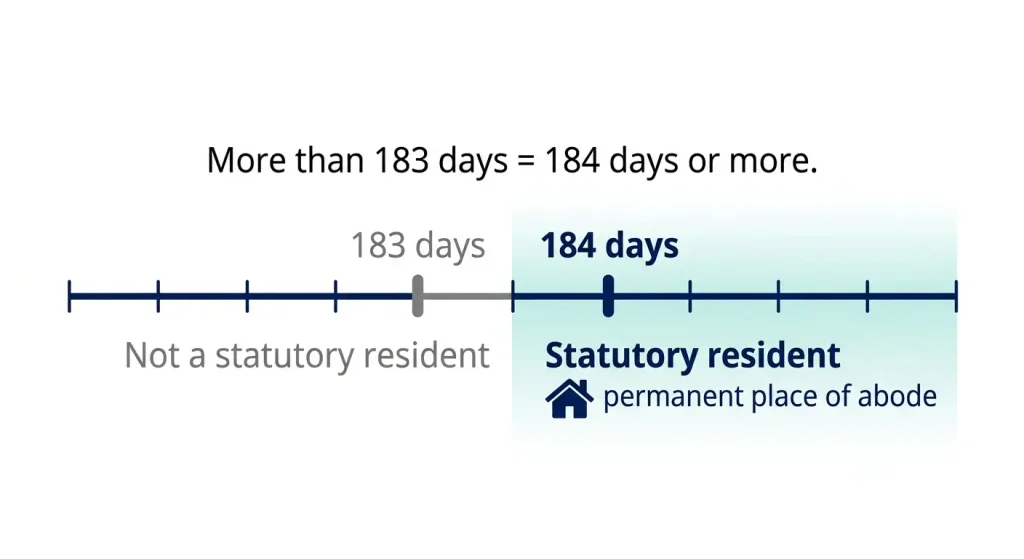
The 184-day rule
New York can treat you as a statutory resident if you keep a permanent place of abode there and spend more than 183 days in the state during the year, meaning 184 days or more, even if your domicile is elsewhere. Never assume a simple day count settles it alone.
How the New York Allocation Percentage Works
Your allocation percentage is the share of your real work performed physically inside New York.
What “percentage of services performed in New York” means
This is the share of your actual work happening physically inside New York State, City, or Yonkers. Work outside those borders does not count, even on a New York employer’s payroll. New York bases this on workdays, not on how salary is split between roles.
Basic workday allocation calculation
Divide New York workdays by total workdays for your percentage. Holidays, sick days, and vacation days you weren’t required to work generally drop out of the count; training and business travel get sorted by where you physically were. A normal commute into a New York office still counts as a New York workday. This method works for a steady schedule but breaks down once days vary week to week.
What compensation can be included
Your allocation covers vacation pay, bonuses, commissions, fringe benefits, deferred compensation, and nonstatutory stock options tied to your New York work, not just base salary. For how each of these actually gets taxed once it lands on your check, see our guide on New York paycheck deductions. Leaving these out is a common way people underreport New York income.
Can the percentage be estimated?
Yes, usually based on last year’s work pattern. A significant schedule change makes the old percentage inaccurate, and New York expects an updated figure once your real pattern shifts, not next January.
How to Calculate Your IT-2104.1 Percentage
Divide your New York workdays by total workdays, then adjust for special cases.
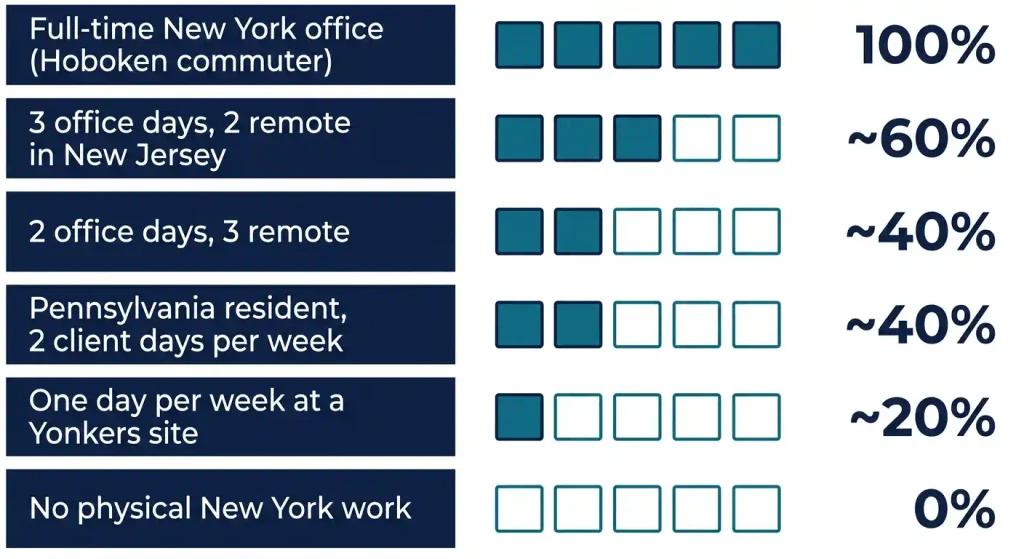
| Scenario | New York Days | Allocation |
|---|---|---|
| Full-time New York office (Hoboken commuter) | 5 of 5 | 100% |
| 3 office days, 2 remote in New Jersey | 3 of 5 | ~60% |
| 2 office days, 3 remote | 2 of 5 | ~40% |
| Pennsylvania resident, 2 client days per week | 2 of 5 | ~40% |
| One day per week at a Yonkers site | 1 of 5 | ~20% |
| No physical New York work | 0 of total | 0% |
Full-year employee working partly in New York
Take total annual workdays, subtract time off, then count days actually worked inside New York. That fraction applies to your full year of compensation.
Employee working 3 days in New York and 2 days elsewhere
Three New York office days out of a five-day week works out to roughly 60 percent. If the split flips to two and three, the percentage moves with it.
Employee working 100% in New York
Every workday inside New York means a 100 percent allocation, full stop. You can still be a nonresident at 100 percent allocation, since residence and work location are separate.
Employee working 0% in New York
A zero claim only fits if you truly never perform services physically inside New York, City, or Yonkers, including occasional travel into the state. Employers can and do question a zero claim.
Midyear job or midyear work-location change
A new job, relocation, or mid-year assignment shift blends two patterns into one annual number. Recalculate using actual days under each arrangement and update payroll promptly.
New York State vs. NYC vs. Yonkers: What Changes?
Each jurisdiction taxes nonresidents differently, so treat them separately.
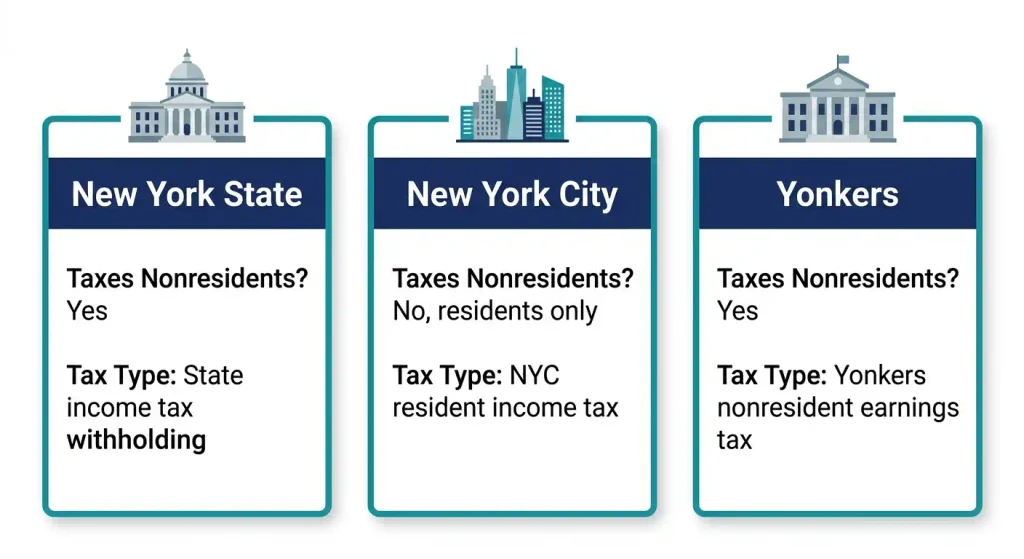
| Jurisdiction | Taxes Nonresidents? | Tax Type |
|---|---|---|
| New York State | Yes | State income tax withholding |
| New York City | No, residents only | NYC resident income tax |
| Yonkers | Yes | Yonkers nonresident earnings tax |
New York State nonresident withholding
New York State taxes nonresidents on New York-source wages, income from services physically performed in the state. Your allocation percentage sets how much of your pay falls into that category.
New York City nonresident situations
New York City income tax withholding applies to residents, not nonresidents who merely work in the five boroughs. A Long Island commuter working full-time in Midtown owes New York State withholding but no NYC resident tax. IT-2104.1 handles the state-level allocation only.
Yonkers nonresident situations
Yonkers runs its own Yonkers withholding tax, a nonresident earnings tax separate from state and NYC tax. Work inside Yonkers without living there can trigger the Yonkers nonresident earnings tax, using the same allocation logic as the state. A consultant at a Yonkers client site one day a week, working the rest in Westchester, would allocate roughly 20 percent of that week’s pay to Yonkers.
Why NYC and Yonkers should not be treated as the same
Two different taxing jurisdictions with their own rules and withholding publications. Treating them as one leads to under-withholding in one and over-withholding in the other.
2026 New York Withholding Rules You Should Know
New York refreshed its withholding instructions and tables for 2026. For the bigger picture beyond this form, see how New York State tax withholding works.
What changed for 2026
Form IT-2104-I, the instructions behind the allowance worksheets, was revised for tax years beginning on or after January 1, 2026. Anyone who filed an older IT-2104 using the old worksheet should complete a fresh 2026 version.
2026 withholding publications
Payroll runs the math using three official withholding tables, matched to your allocation percentage: NYS-50-T-NYS for state tax, NYS-50-T-NYC for New York City, and NYS-50-T-Y for Yonkers. Our own calculation methodology page walks through the same formulas step by step.
Does IT-2104.1 itself change every year?
The form’s structure stays stable, though the tables behind it update regularly. You do not need to refile every January; only a real change, like a new job, a move, or a shifted schedule, should trigger an update. Always use the current version from the Tax Department’s site.
How to Fill Out Form IT-2104.1 Step by Step
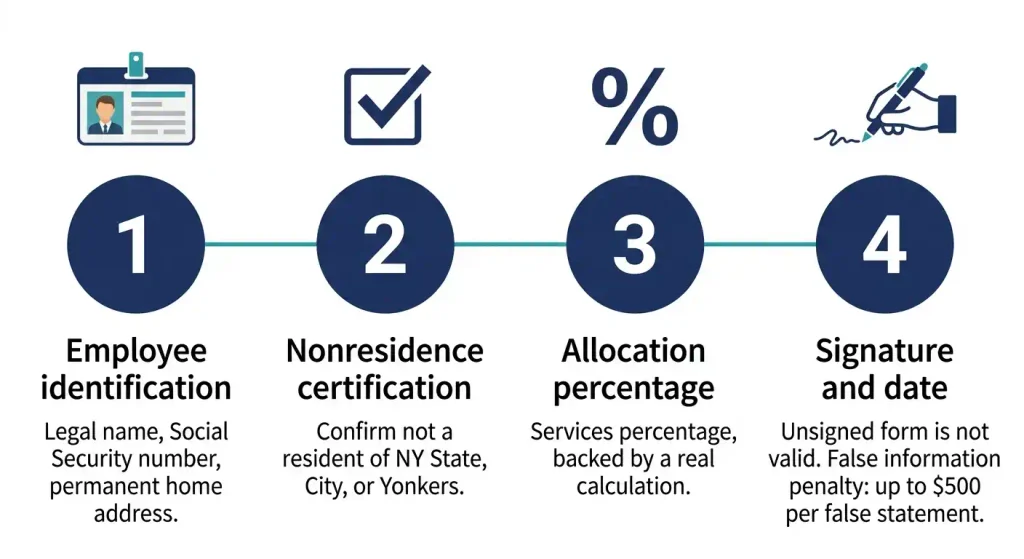
Fill in your info, certify nonresidence, enter your percentage, then sign.
Employee identification information
Enter your legal name, Social Security number, and permanent home address exactly as elsewhere on your tax paperwork. The employer section needs company name and address too, usually filled in by payroll. The form is fillable electronically before printing and signing, and many employers include it in onboarding.
Nonresidence certification
Check the boxes confirming you are not a resident of New York State, City, or Yonkers, whichever applies. Getting this wrong makes the allocation that follows meaningless.
New York allocation percentage
Enter your services percentage, backed by a real calculation, not a guess. Note any differences across jurisdictions so payroll applies the right number to the right tax.
Signature and date
Sign and date the certificate; an unsigned form is not valid. Keep a copy for yourself. Under New York Tax Law, false information that lowers your withholding without reasonable basis carries a penalty of up to $500 per false statement.
Remote and Hybrid Employees: The Tricky Cases
Physical location, not remote status, decides your New York allocation. This section matters most for any multi-state employee splitting real workdays between New York and somewhere else.
Living outside New York and working remotely
Days worked from a home office outside New York generally do not count toward your allocation. What matters is where you physically are, not the company server.
Hybrid employee working from New York and another state
Count actual days per location across a typical month or quarter for your split. A recurring pattern, like two city days and three remote, gives payroll a defensible number.
New York office plus out-of-state home office
New York’s “convenience of the employer” rule can tax home-office days as New York days if the remote work is for your own convenience rather than a real employer requirement. It is not automatic.
Work location changes during the year
A permanent shift, like three office days becoming five, or a full remote-work change, makes an earlier certificate unreliable. Update payroll as soon as the change is clear.
Real-World IT-2104.1 Examples
A few common scenarios show how the percentage plays out.
New Jersey resident commuting to New York
A Hoboken resident commuting into Manhattan five days a week is a nonresident at 100 percent New York allocation, even though federal and New Jersey tax still apply.
Pennsylvania resident working in New York
A Scranton resident at a New York client site two days a week, home the other three, allocates roughly 40 percent of wages to New York.
Employee working from home three days and New York office two days
A common 2026 setup. Two office days out of five is 40 percent, and it should be revisited whenever the split shifts.
Employee who works 100% in New York but lives elsewhere
Living in Connecticut while working entirely from a Manhattan office still means 100 percent New York allocation. Address never lowers that number.
Employee who moves into New York during the year
Moving into New York mid-year switches you from nonresident to resident on the move date; the allocation only covers the nonresident portion before that.
Employee who moves out of New York during the year
The reverse applies: the resident period is taxed under resident rules, and everything after the move runs through nonresident allocation.
Edge Cases That Can Change the Answer
A few situations shift the standard math.
Working in New York for 14 days or fewer
Very short-term New York assignments can qualify for special treatment, depending on your primary work location and employer’s setup. Confirm against current Tax Department guidance before assuming an exemption applies.
Yonkers earnings under $3,000
Nonresidents whose annualized Yonkers earnings stay under $3,000 for the year may not need the Yonkers portion of this certificate, separate from their New York State obligation. Someone covering a colleague’s Yonkers shift for a few weeks would likely qualify.
Bonuses, commissions, and overtime
Supplemental pay gets allocated using the same New York work percentage as regular wages, unless tied to a specific location. Base salary is not the only thing that counts.
Deferred compensation and stock options
Deferred compensation and nonstatutory stock options often get special sourcing treatment, tied to when they were earned rather than paid out. Large payments deserve a closer look.
Multiple employers
Each employer needs its own IT-2104.1 based on your actual pattern for that job. Update each separately when only one job’s pattern changes.
Common Form IT-2104.1 Mistakes and Myths
A few myths cause most of the errors on this form.
“I live outside New York, so I owe no New York withholding”
The most expensive myth. A New Jersey commuter working five days a week in New York still owes withholding on 100 percent of that income.
“My employer is in New York, so 100% of my wages are New York wages”
Employer address does not determine allocation; your actual work location does. A remote employee who never sets foot in New York can claim a very low or zero allocation, with documentation.
“IT-2104.1 is my New York tax return”
It is not. It only controls withholding. Form IT-203, filed the following spring, is where final liability gets calculated.
“IT-2104.1 and IT-2104 are the same form”
Different purposes. IT-2104.1 handles nonresident allocation; IT-2104 handles withholding allowances. Employers often need both.
“I can enter 0% because I work mostly outside New York”
Working mostly outside New York does not justify a zero claim if any real work happens inside the state. Employers can push back on a mismatched zero claim.
What Happens After You Submit IT-2104.1?
Payroll applies your percentage, and it’s worth double-checking the result.
What your employer does with the form
Payroll uses your certified percentage with the current official withholding tables to calculate each check. Employers can question or push back on a certificate that does not match your actual role.
What to check on your next paycheck
Confirm the New York State line, and any NYC or Yonkers line, reflect your expected allocation. If the total looks off, our guide on why your New York paycheck might be lower than expected covers the most common causes. Flag payroll immediately if something looks off or a jurisdiction that shouldn’t apply shows up.
When you need to update the form
Update it when residency status changes, your work assignment shifts significantly, or your work location moves in a way that makes the original allocation inaccurate. New York expects notice within 10 days of a substantial change.
What Records Should You Keep?
Keep workday and pay records that back up your allocation, the same habit covered in our New York Paycheck Basics collection.
Workday records
Keep a running log of New York versus out-of-state workdays, including temporary assignments. A simple calendar noting locations is usually enough.
Payroll and compensation records
Hold onto pay statements, bonus and commission documentation, and employer communications about work location. Learning how to read a New York pay stub makes this much easier to spot-check. Save a copy of every certificate you submit.
IT-2104.1 2026 Quick Checklist
Before completing the form
- Confirm your legal residency status
- Confirm your actual New York work locations
- Calculate your honest New York service percentage
- Identify whether NYC or Yonkers exposure applies
Before submitting the form
- Double-check your personal information for accuracy
- Verify your allocation percentage against real workdays
- Sign and date the certificate
- Save a personal copy before handing it over
After submitting the form
- Confirm payroll actually received and processed it
- Review your very next paycheck closely
- Keep watching for work-location changes
- Update payroll the moment your pattern shifts
Frequently Asked Questions About Form IT-2104.1
What is Form IT-2104.1 used for?
It certifies nonresident status of New York State, City, or Yonkers and reports your New York work percentage so your employer withholds correctly.
Who needs to fill out Form IT-2104.1?
Nonresidents performing any part of their job physically inside New York State, City, or Yonkers. Full residents do not.
Do I need IT-2104.1 if I live in New Jersey but work in New York?
Yes. New Jersey residence does not exempt your New York workdays from New York withholding.
How do I calculate my IT-2104.1 percentage?
Divide actual New York workdays by total workdays, adjusting for special pay or a mid-year location change.
Where do I submit Form IT-2104.1?
To your employer, not the Tax Department. Keep a personal copy.
What is the difference between IT-2104.1 and IT-2104?
IT-2104.1 allocates nonresident wages by New York work percentage. IT-2104 sets withholding allowances. Some employees need both.
Does IT-2104.1 affect my final New York tax?
It affects withholding, not final liability. That gets settled on Form IT-203.
Do remote workers need Form IT-2104.1?
Only if real work happens physically inside New York. A fully remote employee usually does not, though the convenience-of-the-employer rule can complicate hybrid cases.
Does IT-2104.1 apply to NYC and Yonkers?
Yes, one certificate covers all three jurisdictions, each with its own rules.
Is there a 2026 version of IT-2104.1?
The current form is available from the New York Tax Department, and the related IT-2104-I instructions were refreshed for tax years starting January 1, 2026.
Official New York Resources for Form IT-2104.1
Official IT-2104.1 form and instructions
Officially titled the New York State, City of New York, and City of Yonkers Certificate of Nonresidence and Allocation of Withholding Tax, available as a downloadable PDF directly from the New York State Department of Taxation and Finance, commonly called the New York State Tax Department.
2026 New York withholding publications
Publication NYS-50-T-NYS, the New York State Withholding Tax Tables and Methods, covers state tax. Publication NYS-50-T-NYC, the New York City Withholding Tax Tables and Methods, covers NYC. Publication NYS-50-T-Y, the Yonkers Withholding Tax Tables and Methods, covers Yonkers.
New York employer withholding guidance
Publication NYS-50, the Employer’s Guide to Unemployment Insurance, Wage Reporting, and Withholding Tax, covers general withholding obligations and New York State Tax Department withholding requirements, including nonresident and remote-work guidance. Employers handling multi-employee filings can also browse our New York Payroll & Employer Compliance resources for registration and filing rules.
Key Takeaways for Form IT-2104.1
Confirm status, calculate honestly, and keep it updated.
What to remember before completing the form
Confirm nonresident status first, then calculate your real allocation from actual workdays. Keep New York State, NYC, and Yonkers rules separate, and use current 2026 guidance.
What to remember after submitting it
Hand the signed certificate to your employer, keep your own copy, and check your next paycheck. Update the form the moment your work pattern changes.

Meet Yasin Ali, Founder
Yasin built NY Paycheck Calculator in 2020 after getting fed up with calculators that treated New York like every other state. Most tools ignore the extra local tax NYC and Yonkers workers pay on top of state tax — or skip New York’s Paid Family Leave deduction entirely.
He keeps the numbers current, checking in regularly against the latest IRS, NY Department of Taxation and Finance, and Paid Family Leave rates.
All results here are estimates based on official 2026 sources. For advice specific to your situation, talk to a tax professional.