
New York Paycheck Calculator 2026
Enter your pay once — your results update automatically as you type. See what you’ll actually take home after federal, New York State, NYC, or Yonkers taxes, with a clear breakdown of where your money goes.
How to Use the New York Paycheck Calculator
Step 1: Input your gross salary and pay frequency.
Type in your annual salary, or switch to hourly and enter your rate plus hours worked. Then pick how often you actually get paid: weekly, biweekly, semi-monthly, or monthly. This changes how your annual numbers get split into an actual paycheck amount.
Step 2: Select your filing status and location.
Choose Single, Married Filing Jointly, Head of Household, or Married Filing Separately. Then tell it where you live and work, NYC, Yonkers, or the rest of New York State. This one step decides whether you owe local tax on top of everything else.
Step 3: View your detailed paycheck breakdown in real time.
There’s no calculate button. Every number updates the second you type, from federal tax down to your final take-home pay, so you can tweak a number and instantly see what changes. If you want to match these numbers against your actual paystub, our guide on how to read a New York pay stub walks through each line.
Understanding Your New York Paycheck Deductions (2026)
Every line that comes out of your check falls into one of a few categories. For a full plain-English breakdown of each one, see our guide on New York paycheck deductions explained.
Federal Income Tax & FICA (Social Security & Medicare)
Your federal tax bill starts with taxable income after the standard deduction, which is $16,100 for single filers in 2026, based on IRS Revenue Procedure 2025-32. FICA takes a separate cut no matter what bracket you’re in: 6.2% for Social Security on wages up to the 2026 wage base of $184,500, and 1.45% for Medicare with no upper limit at all. Cross $200,000 in wages as a single filer and an extra 0.9% Medicare surtax kicks in on everything above that line. For the full picture of every line item, read what taxes come out of a New York paycheck.
NY State Income Tax Brackets
New York runs a nine-bracket system that starts at 3.9% and tops out at 10.9% for income past $25 million, under the schedule published by the New York State Department of Taxation and Finance. For a single filer, the first bracket covers up to $8,500, then rates climb at $11,700, $13,900, $80,650, and $215,400. Most people working a regular job in the state end up somewhere in the 5.4% to 5.9% range once their income clears the lower brackets. If you want the withholding side of this explained in more depth, see how New York State tax withholding works in 2026.
NYC Local Tax & Yonkers Withholding
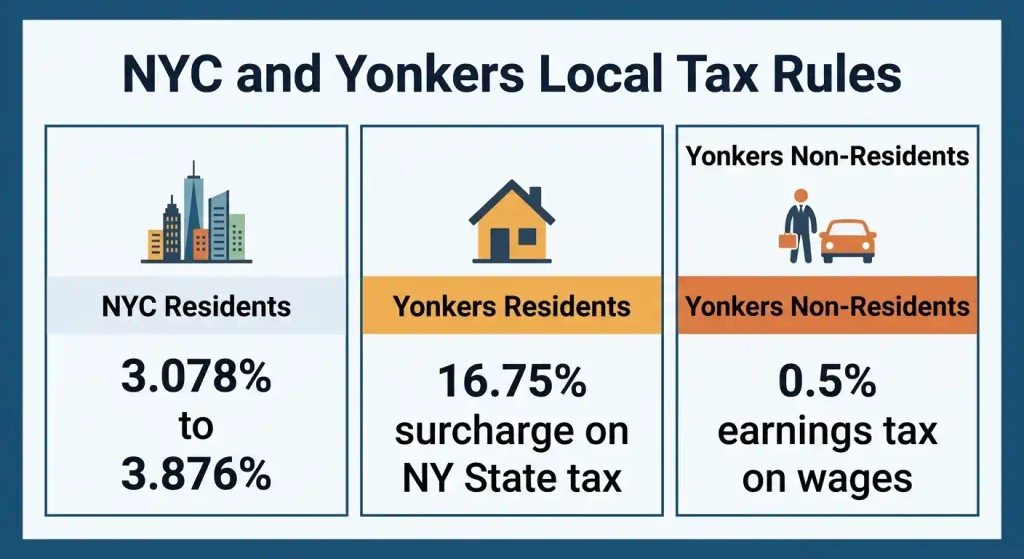
Living in any of the five boroughs adds a local tax on top of state and federal, running from 3.078% up to 3.876% depending on income. This is where most calculators get it wrong. NYC tax is based on where you live, not where you work. Commute in from Jersey City or Long Island and you skip it entirely, you just still owe NY State tax on income earned in New York. Yonkers runs on a completely different system. Residents pay a 16.75% surcharge calculated on top of their NY State tax bill, while non-residents who work in Yonkers pay a flat 0.5% tax on wages earned there instead.
Mandatory NY State Benefits: NY PFL (0.432%) & SDI
Two small mandatory deductions show up on every New York paycheck. Paid Family Leave takes 0.432% of gross wages, capped at $411.91 for the year, so once you’ve hit that cap it stops coming out of your check. State disability insurance adds a flat 60 cents a week, capping out around $31 a year. Neither is optional and neither depends on your income level beyond the cap.
Real Example: Calculating $75,000 Annual Salary in NYC
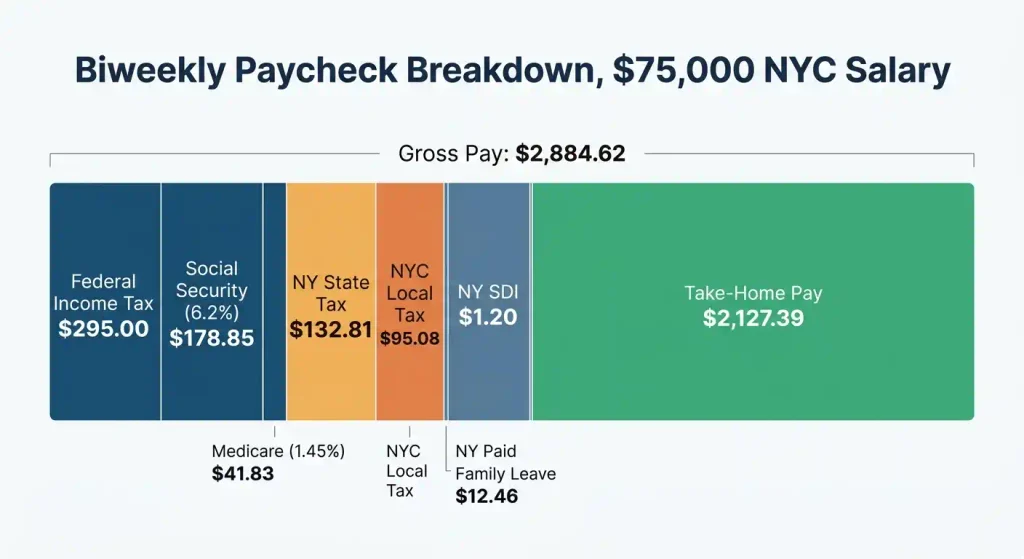
Here’s exactly what happens to a $75,000 salary for a single filer living in NYC, paid biweekly. This is the same gross pay vs net pay math that applies to any salary, just plugged in with real numbers.
| Item | Annual | Per Paycheck (Biweekly) |
|---|---|---|
| Gross Pay | $75,000.00 | $2,884.62 |
| Federal Income Tax | $7,670.00 | $295.00 |
| Social Security (6.2%) | $4,650.00 | $178.85 |
| Medicare (1.45%) | $1,087.50 | $41.83 |
| NY State Tax | $3,453.00 | $132.81 |
| NYC Local Tax | $2,472.09 | $95.08 |
| NY Paid Family Leave | $324.00 | $12.46 |
| NY SDI | $31.20 | $1.20 |
| Take-Home Pay | $55,312.21 | $2,127.39 |
Want the exact math behind each of those numbers? That’s what the next section breaks down, formula by formula. And if your own check doesn’t match a similar example, our guide on why your New York paycheck might be lower than expected covers the most common reasons.
🧮 How We Calculate Your Paycheck: Formulas & Methodology
Every number on this page comes from real formulas, not a black box. Here’s exactly what runs behind the scenes, using that same $75,000 NYC example so you can follow the math step by step. For the full technical writeup, see our calculation methodology page.
- Gross Pay Per Paycheck Annual salary gets split evenly across your pay periods for the year.
Gross Pay Per Paycheck = Annual Gross Salary ÷ Number of Pay Periods
Biweekly example: $75,000 ÷ 26 = $2,884.62
- FICA: Social Security & Medicare Two flat percentages come straight off gross pay, no brackets involved.
Social Security = Gross Pay × 0.062 $2,884.62 × 0.062 = $178.85
Medicare = Gross Pay × 0.0145 $2,884.62 × 0.0145 = $41.83
- Mandatory New York Payroll Deductions PFL is a percentage with a yearly cap. SDI is just a flat weekly charge.
NY PFL = Gross Pay × 0.00373 $2,884.62 × 0.00373 = $10.76 (Note: Updated using the 2026 NY PFL rate of 0.373%)
NY SDI = $0.60 × Weeks per Pay Period Biweekly covers 2 weeks: $0.60 × 2 = $1.20
- Federal, NY State, and NYC Progressive Taxes These three don’t use flat rates. Each one runs your taxable income through its own bracket schedule: federal follows IRS Publication 15-T withholding tables based on filing status, NY State applies its 2026 brackets (3.9% to 10.9%), and NYC applies its own local brackets (3.078% to 3.876%) if you live in any of the five boroughs.
Total Income Taxes = Federal Tax + NY State Tax + NYC Local Tax
- Net Take-Home Pay Add up every deduction, then subtract the total from gross pay.
Total Deductions = FICA + NY PFL + NY SDI + Income Taxes Take-Home Pay = Gross Pay – Total Deductions
Full calculation for our $75,000 single NYC resident, paid biweekly:
$2,884.62 – ($178.85 + $41.83 + $10.76 + $1.20 + $295.00 + $132.81 + $95.08) = $2,129.09
That final number matches the take-home pay in the table above, because it’s the exact same engine running behind this calculator.
Why Our Calculator Is More Accurate Than Others
A lot of paycheck calculators online are still running on rate tables from two or three years back. This one pulls the actual 2026 federal brackets straight from IRS Revenue Procedure 2025-32, the updated NY State schedule with this year’s rate cuts from the New York State Department of Taxation and Finance, and the current PFL cap of $411.91. It also handles all five NYC boroughs correctly, along with the separate Yonkers resident surcharge and non-resident earnings tax that plenty of tools either skip or mix up. Every rate here traces back to an official source, not a copied number from some other site’s spreadsheet. You can read more about our team and approach on our About Us page, and employers handling multi-employee filings can browse our New York Payroll & Employer Compliance resources for withholding registration and filing rules.
Frequently Asked Questions (FAQ)
How much tax is taken out of a paycheck in NY?
It depends on your income, filing status, and where you live, but a single filer earning $75,000 in NYC loses about 26% of gross pay to combined federal, state, local, and FICA taxes.
What is the NY Paid Family Leave rate for 2026?
It’s 0.432% of gross wages, capped at $411.91 for the year. Once your total contribution for the year hits that cap, it stops being deducted from your paycheck.
How does NYC local tax affect my take-home pay?
It adds an extra 3.078% to 3.876% on top of federal, state, and FICA taxes, but only if you actually live in the city. Working in NYC without living there means you skip this tax completely.
Do I pay NYC tax if I work in Manhattan but live in New Jersey?
No. NYC local tax runs on residency, not work location. You’d still owe NY State tax on income earned in New York, just not the city’s local tax on top of it.
What’s the difference between Yonkers resident and non-resident tax?
Residents pay a 16.75% surcharge on their NY State tax bill, calculated after the state tax itself is figured out. Non-residents who simply work in Yonkers pay a flat 0.5% tax on wages earned there, a completely separate and much simpler calculation.
For more on how a New York paycheck works from the ground up, browse our full New York Paycheck Basics collection.
NY Paycheck Calculator 2026: Complete Tool Documentation
1. Features List
Calculation Modes (4 tabs, no calculate button, everything updates live as you type):
- Salary: annual gross salary input, standard mode
- Hourly: hourly rate + regular hours/week + optional overtime (auto 1.5x rate)
- 1099 / Self-Employed: net self-employment profit, computes full self-employment tax
- Compare Offers: two salary + location scenarios shown side by side, with a verdict on which one nets more
Input fields per mode:
- Salary mode: annual gross salary
- Hourly mode: hourly rate, regular hours/week, overtime hours/week
- 1099 mode: annual net self-employment profit (after business expenses)
- Compare mode: Offer A salary + location, Offer B salary + location
- Shared across Salary/Hourly/1099: pay frequency (weekly/biweekly/semi-monthly/monthly), federal filing status (Single/MFJ/HoH/MFS), residency and work location (6 options, listed below)
- Deductions (Salary/Hourly/1099): 401(k)/403(b) contribution (toggle between dollar or percent of gross), health insurance/HSA/FSA pre-tax amount, other post-tax deductions
- Advanced, collapsed by default: one-time bonus this paycheck, extra federal withholding per paycheck (W-4 Step 4c), annual child/dependent tax credits (W-4 Step 3)
Outputs / results shown:
- Headline take-home number, per paycheck for Salary/Hourly, annual for 1099
- Color-coded stacked bar plus legend showing where each dollar goes
- Full itemized breakdown: gross pay, every tax line, every deduction line, final take-home
- Annual summary box: annual gross, annual taxes and deductions, annual take-home, effective tax rate
- Quarterly estimated tax payment (1099 mode only)
- Bonus-impact note showing the marginal tax hit on a bonus, kept separate from regular pay
- Compare mode: two result cards with the better offer highlighted, plus a plain-English dollar-difference verdict
Special features:
- Fully automatic, no calculate button, results update on every keystroke
- NY 2026 minimum wage validator, warns if the entered hourly rate is below the legal minimum for the selected region ($17.00 downstate, $16.00 upstate)
- 401(k) dollar-vs-percent toggle
- Progressive disclosure, advanced/less-common fields tucked behind an Advanced expander
- Mobile, tablet, and desktop responsive layout, with breakpoints down to very small phones
- Self-contained, scoped CSS/JS, safe to paste into a WordPress (Astra) Custom HTML block without conflicting with theme styles
2. Tax Calculations
Tax layers calculated:
- Federal income tax (2026 brackets, all 4 filing statuses)
- Social Security, 6.2%, capped at the 2026 wage base
- Medicare, 1.45% plus 0.9% Additional Medicare above the filing-status threshold
- NY State income tax, 2026 nine-bracket schedule
- NYC local income tax, residents only, four-bracket schedule
- Yonkers resident surcharge, 16.75% of NY State tax
- Yonkers non-resident earnings tax, 0.5% of wages, for commuters into Yonkers
- NY Paid Family Leave, 0.432%, capped
- NY State Disability/SDI, $0.60/week cap
- Self-employment tax in 1099 mode, 12.4% Social Security plus 2.9%/3.8% Medicare, both halves since there’s no employer to split it with
Special NY rules handled:
- NYC tax is residency-based, not work-location-based, so a commuter who works in NYC but lives elsewhere correctly pays no NYC tax
- Yonkers resident vs. non-resident are two entirely different tax mechanisms, a surcharge versus a flat earnings tax, and both are handled correctly
- Half of self-employment tax is deducted from taxable income before computing federal and NY tax, matching actual Schedule SE treatment
- 401(k) reduces federal and NY taxable income but not FICA/SE wages, while HSA/FSA/other pre-tax reduces federal, NY, and FICA, modeled as two separate fields because they behave differently
- Bonus is taxed at the marginal rate for the year instead of a flat guess, and shown as its own line so it doesn’t distort the regular paycheck number
Edge cases covered:
- Additional Medicare surtax kicking in mid-year at high incomes
- Social Security wage base cap for high earners
- Six distinct residency/commuter combinations: NYC resident, Yonkers resident, rest-of-state resident, and three commuter variants
- Overtime pay calculated at 1.5x and added before annualizing
- All filing statuses across every bracket table: federal, NY, and NYC
- Below-minimum-wage hourly entries flagged instead of silently computing a wrong number
3. What’s Missing / Could Be Added
High-value additions:
- W-2 vs. 1099 side-by-side comparison, same job offer as an employee vs. a contractor, showing the real net-pay difference
- Salary needed reverse calculator, user enters a target take-home number and the tool solves for the required gross salary
- PDF export or shareable result link, several competitors let users save or share their result for negotiation purposes
- Printable/shareable snapshot card, a clean summary useful for job-offer comparisons
- Programmatic salary landing pages, such as “$75,000 salary after taxes in NYC”, a content pattern rather than a tool feature
- Guides/FAQ content around the calculator, covering NYC local tax, Yonkers, and pay stub basics
Present in competitor sites but not in this tool:
- Cost-of-living/neighborhood comparison content
- Newsletter capture or embeddable widget for other sites
- NJ/CT commuter tax-credit modeling, currently the tool treats out-of-state commuters as owing NY tax on their full income, accurate for take-home purposes but not modeling the home-state credit they’d also get
- Full W-4 multiple-jobs (Step 2) withholding adjustment, currently only Steps 3 and 4(c) are supported
- Itemized deduction support, currently standard deduction only, a reasonable simplification since most filers take the standard deduction
4. Technical Details
Data sources / tax rates used, all verified against official 2026 sources:
- Federal brackets and standard deduction: IRS Revenue Procedure 2025-32
- NY State bracket schedule: NY Tax Law Section 601, cross-checked against tax.ny.gov
- NYC local tax brackets: tax.ny.gov, confirmed unchanged for 2026
- Yonkers resident surcharge (16.75%): City of Yonkers Local Law 11-2014, confirmed unchanged for 2026
- Yonkers non-resident rate (0.5%): NYS-50-T-Y publication (1/26)
- Social Security wage base ($184,500): Social Security Administration, 2026
- NY Paid Family Leave rate/cap (0.432% / $411.91): official 2026 NY PFL notice
- NY SDI cap ($0.60/week): standard, unchanged for years
- NY minimum wage ($17.00 downstate, $16.00 upstate): NY Department of Labor, 2026
Where future updates will be needed:
- Every rate above is set annually, federal brackets, NY brackets, PFL rate/cap, and minimum wage typically change January 1 each year and will need refreshing for 2027
- Social Security wage base changes annually, indexed to wage growth
- Yonkers rate is more stable, statutory and rarely changed, but still worth a yearly confirmation
- NYC brackets have historically stayed flat for years at a time, lowest priority to recheck, but not zero-risk
- If NY passes new legislation mid-cycle, state budget changes have altered brackets before, the NY State schedule specifically is the most likely one to need an off-cycle update