
A New York statutory resident maintains a year-round home in the state and spends 184 days or more there, even with a legal home elsewhere. New York then taxes all their income, not just in-state earnings.
This standard comes directly from New York Tax Law Section 605(b)(1)(B) and years of Tax Appeals Tribunal rulings on where people actually live.
The exact 184-day and abode rules can shift with your specific facts, so professional review helps.
Are You a New York Statutory Resident? The Quick Answer
Here is exactly how New York statutory resident tax rules break down, what counts toward each requirement, and what it means for your 2026 filing.
The Two Requirements You Must Meet
New York checks two things. First, do you maintain a year-round dwelling in the state, owned or rented? Second, did you spend 184 days or more physically present in New York during the tax year? Both must be true in the same tax year, not just one.
Quick Statutory Residency Qualification Table
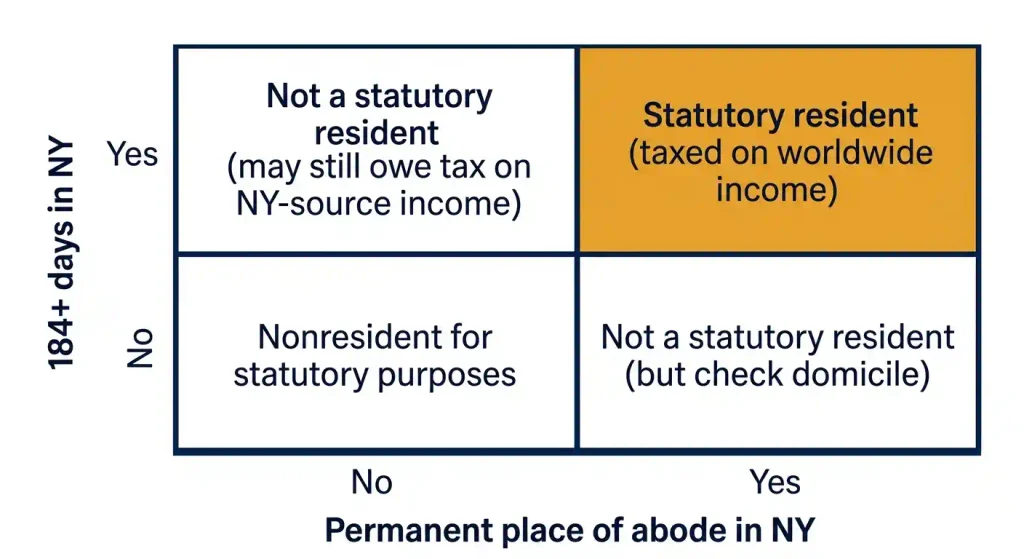
| Permanent place of abode in NY | 184+ days in NY | Result |
|---|---|---|
| Yes | Yes | Statutory resident (taxed on worldwide income) |
| Yes | No | Not a statutory resident (may still owe tax on NY-source income) |
| No | Yes | Not a statutory resident (but check domicile) |
| No | No | Nonresident for statutory purposes |
What Being Classified as a Statutory Resident Means
Cross both thresholds and New York treats you as a full-year resident. You file a resident return and report income from every source, no matter where it was earned. Get it wrong and you risk back taxes, interest, and an audit.
What Is New York Statutory Residency?
Statutory residency is a separate path to New York resident taxation, part of the broader New York state income tax system, unrelated to where you call home. It exists to catch people who live elsewhere on paper but spend most of their life in New York.
Meaning of a Statutory Resident
Under New York Tax Law Section 605(b)(1)(B) of the New York State Tax Law, you can be taxed as a resident even if your legal domicile is in another state. The permanent place of abode standard comes from New York State Income Tax Regulation Section 105.20(e), also cited as New York Income Tax Regulation Section 105.20, which the New York State Department of Taxation and Finance uses to apply New York State personal income tax regardless of domicile. A driver’s license or voter registration does not decide this; physical living and sleeping patterns do. Domicile and statutory residency are separate tests, and failing either one creates New York resident tax.
Statutory Resident vs. Domiciliary Resident vs. Nonresident
A domiciliary resident’s actual permanent home is in New York. A statutory resident keeps a different legal domicile but is taxed the same way because of abode and day count. A nonresident fails both tests and pays tax only on New York-source income, following the broader resident vs. nonresident income tax rules New York applies. Domiciliary and statutory residents owe tax on the same worldwide scope.
How New York Determines Your Residency Status
New York checks domicile first: family, job, and where your life is centered. If domicile is elsewhere, it checks for a permanent place of abode in New York, then counts your days. Cross 183 and you are a statutory resident regardless of your domicile paperwork. New York Tax Appeals Tribunal decisions have shaped how strictly both tests get applied.
The 184-Day Rule: How New York Counts Your Residency Days
More than 183 days in New York during the tax year means 184 or more. That is the number that matters, not 183.
What Does the 184-Day Rule Mean?
New York’s “more than 183 days” means 184 minimum. Any part of a day in New York counts as a full day. Days do not need to be consecutive, and they count even before you signed a lease or after you gave one up, since the day count and the permanent place of abode test run separately. New York counts every day of the year, including the extra day in a leap year, so weekends, business trips, vacations, and international trips through New York all add up. Tax Bulletin TB-IT-690 covers this standard in more detail.
Which Days Count Toward the 184-Day Threshold?
A business trip counts. A commute into Manhattan for one meeting counts. A weekend with family or a doctor’s appointment counts. Even a few hours in New York without visiting your apartment still counts, since the rule tracks physical presence, not residence use.
Which Days May Not Count?
A day spent entirely outside New York does not count, even if you flew out of a New York airport that morning. A layover or connecting flight through a New York airport can still count if you leave the secure area, so track travel connections carefully. Medical treatment and some travel circumstances can be excluded, but these are fact-specific.
How to Calculate Your New York Residency Days
Go from January 1 to December 31 and note whether you were physically present in New York for any part of each day, using real records instead of memory. Credit card charges, EZ-Pass logs, flight bookings, and calendar entries help reconstruct your days. A day-by-day spreadsheet is your best evidence if residency is ever questioned.
183 Days vs. 184 Days: Practical Examples
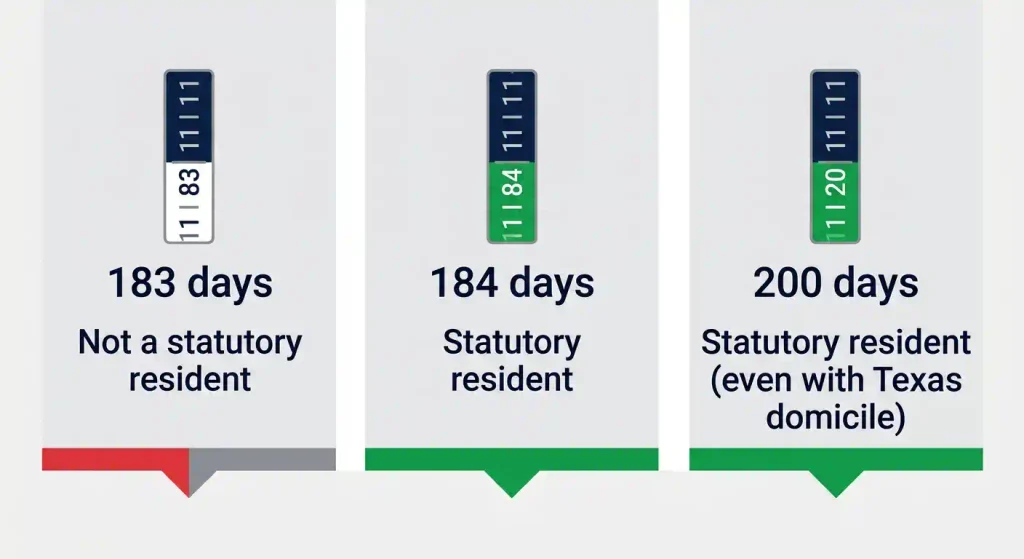
Someone with 183 days in New York and a year-round apartment is not a statutory resident. One more day, 184, crosses the line. Someone spending 200 days in New York while keeping a genuine Texas domicile still becomes a statutory resident too, since the day count and abode test work independently of domicile.
What Qualifies as a Permanent Place of Abode in New York?
A permanent place of abode is any dwelling you maintain in New York that is physically suitable for year-round living, owned, rented, or steadily accessible.
The Legal Definition of a Permanent Place of Abode
The place must be a residence, not a hotel room or an occasional couch. It must be capable of year-round use, and you need a real connection to it, paying for it, keeping belongings there, or otherwise maintaining it. An empty, unused property generally does not qualify.
Does Owning or Renting a New York Property Count?
Yes, both can count. An owned house, condo, co-op, or rented apartment qualifies if suitable for year-round living and maintained. Ownership alone is not enough. What matters is whether you keep the place available and usable, not whose name is on the title.
Does a Second Home or Vacation Property Qualify?
It depends on year-round livability, not seasonal use. A winterized lake house counts even if you only visit in July. An unheated summer cottage is a stronger argument against counting, though New York examines the property’s physical characteristics closely.
Does Someone Else’s Property Count as Your Residence?
A spouse-owned or spouse-leased New York home can count as your permanent place of abode if you have real access and treat it as your residence. Shared apartments and family homes work the same way. Employer-provided housing can count too, depending on your control and access.
What Does Maintaining a Residence for Substantially All the Year Mean?
Since tax year 2022, the New York State Nonresident Audit Guidelines treat “substantially all of the taxable year” as more than 10 months, down from the earlier 11-month standard. The 10-month standard is required specifically in years you acquire or dispose of the property, though this comes from audit guidance, not statute, so facts matter. Renting the place out for a few weeks usually does not defeat the test, but renting the entire home to an unrelated tenant for most of the year is a stronger case that it stopped being your permanent place of abode.
When Does a New York Property NOT Qualify?
A property unfit for year-round living, like an unheated summer shack, generally does not qualify. Temporary-duty lodging tied to a short work assignment can also fall short. Without real maintenance and control, the property likely fails the permanent place of abode test.
How the Two Statutory Residency Requirements Work Together
Both conditions must be met in the same tax year. Miss either one and the statutory residency test fails, no matter how far over the other threshold you are.
Permanent Place of Abode Without 184 Days
Keeping a year-round New York apartment but spending only 90 days there does not trigger statutory residency. The abode alone is not enough. You may still owe tax under New York’s nonresident tax rules on New York-source income, but you file as a nonresident.
Spending 184 Days Without a Permanent Place of Abode
Spending 200 days in New York for work but staying in hotels or with friends, with no home of your own, does not meet the test either. Physical presence alone is not enough. New York would need the domicile test instead, a separate and more subjective analysis.
Meeting Both Requirements
This is where statutory residency kicks in: a qualifying New York home for substantially all the year plus 184 days or more present. New York then taxes your full worldwide income, regardless of a genuine Florida or Texas domicile. If you are on track to meet both partway through the year, pull your records together and talk to a tax professional before you file.
Statutory Residency Decision Table
| Scenario | PPA maintained | Days in NY | Statutory resident? |
|---|---|---|---|
| Full-time NY apartment, frequent travel | Yes, substantially all year | 184+ | Yes |
| NY apartment, mostly works remotely out of state | Yes, substantially all year | Under 184 | No |
| Hotel stays only, heavy NY travel schedule | No | 184+ | No (check domicile separately) |
| Property disposed of mid-year | Partial year only | 184+ | Depends on exact timing, needs individual review |
New York Statutory Residency Examples and Real-Life Scenarios
Real situations make this click faster than definitions, whether filers commute from New Jersey, Connecticut, Pennsylvania, or farther.
New Jersey Resident Maintaining a Manhattan Apartment
A New Jersey domiciliary who keeps a Manhattan studio for late work nights can rack up 184 or more days in New York across the year. That makes them a statutory resident on top of their New Jersey domicile, taxed on full income despite their real home being across the river.
Connecticut Resident Working in New York
A daily Connecticut commuter is a classic nonresident, taxed only on New York wages, as long as they keep no place to stay in the city. Add an apartment near the office and start staying over, and both pieces of the test come into play.
Florida Resident Owning a Second Home in New York
Someone who moved their domicile to Florida but kept a year-round, livable second home in New York is in the danger zone. Seasonal visits, holidays, and trips adding up past 183 days mean the Florida move does nothing, since the test ignores domicile once abode and days are both met.
Remote Worker Living Outside New York
A remote worker who flies into New York occasionally for meetings is usually safe unless they also keep a qualifying residence. A small New York condo kept just for occasional business trips still counts toward the permanent place of abode test if it meets the year-round standard, regardless of how little it is used. This differs from the convenience of the employer rule, which concerns whether remote wages count as New York-source income.
Married Couple With Different State Residences
Each spouse is evaluated on their own facts. One spouse’s New York apartment and day count does not automatically pull the other spouse into the same classification. A spouse and minor children living full-time in New York while the taxpayer claims domicile elsewhere is a common audit red flag. The other spouse needs their own qualifying abode and day count to be a statutory resident too.
Moving Into or Out of New York During 2026
A genuine domicile change partway through 2026 usually means part-year residency, filed differently for each portion of the year. Statutory residency can still apply if you kept a New York residence and racked up enough days before or after the move, so check both rules together.
New York Statutory Resident Tax Consequences
The financial hit from statutory residency goes well beyond your New York paycheck.
Does New York Tax Your Income Earned Outside the State?
Yes. A statutory resident’s worldwide income is taxed like a lifelong domiciliary’s, at the same New York tax brackets everyone else pays. Wages, bonuses, investment gains, rental income, business income, and retirement income all land on your New York return. Nonresidents only report New York-source income, the core difference that makes statutory residency expensive.
Statutory Resident vs. Nonresident Tax Comparison
A statutory resident’s New York taxable income includes everything, everywhere. A nonresident’s includes only New York-tied money, like wages for days worked in the state. Statutory residents can sometimes claim a credit for tax paid elsewhere, which softens but rarely eliminates the hit.
Can You Be Taxed by New York and Another State?
Yes, and often. Your domicile state can tax your full income while New York taxes you as a statutory resident, creating two bills on overlapping income. New York’s resident credit reduces this double taxation, though it has its own rules on which income and states qualify.
Does Statutory Residency Affect Your Paycheck?
Not directly. Employer withholding follows New York State tax withholding rules based on work location and your state forms, not a legal residency determination. You can have New York tax withheld correctly as a nonresident all year and still owe more as a statutory resident when you file, since withholding and residency are calculated separately. Running your numbers through a paycheck calculator can show how much that gap might be.
New York State vs. New York City vs. Yonkers Residency
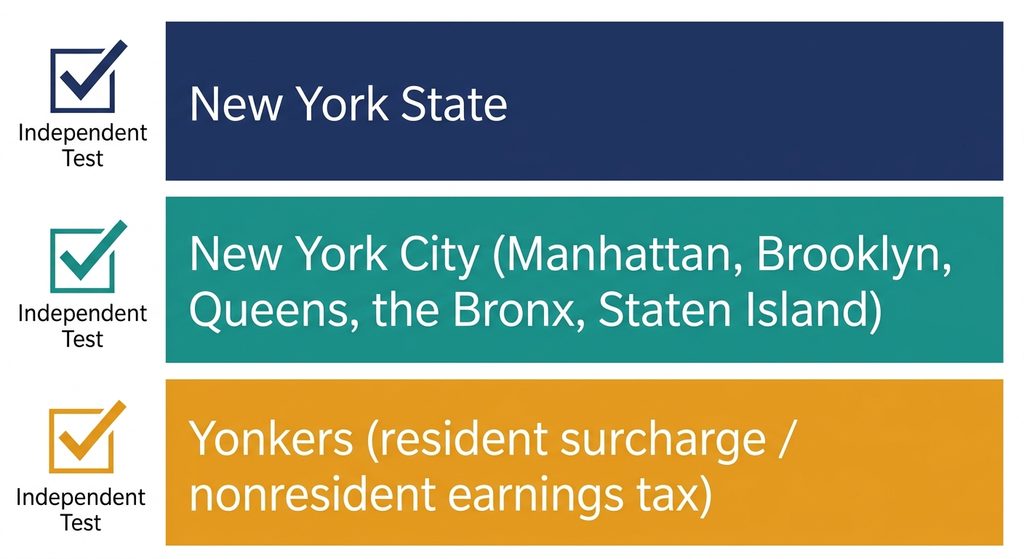
New York City runs its own domicile and statutory residency tests, separate from the state. You can be a New York State statutory resident without being a New York City resident, or the reverse, depending on your abode and day count. This applies the same whether your property is in Manhattan, Brooklyn, Queens, the Bronx, or Staten Island, since NYC treats all five boroughs as one jurisdiction. NYC adds a resident income tax on top of state tax, and the gap between the two shows up clearly when you compare NYC vs. Yonkers income tax rates side by side. Yonkers applies a resident surcharge as a percentage of state tax, plus a separate nonresident earnings tax for people who work there without living there.
Statutory Residency Exceptions and Special Situations
A handful of situations get special treatment under New York’s rules, worth knowing before you assume the worst.
Undergraduate Student Exception
New York narrows treatment for full-time undergraduate students living away for school. A dorm room or college apartment, maintained mainly for school while the student stays financially dependent on parents elsewhere, should not automatically count as a permanent place of abode. A student working full time or living independently may not qualify for this. TSB-M-09(15)I, which amended the permanent place of abode regulation for this situation, has the details.
Military Personnel and Their Spouses
Active duty service members get federal protections under the Servicemembers Civil Relief Act, generally letting them keep their home state of legal residence for tax purposes even while stationed in New York. Military spouses often get similar protection under the Military Spouses Residency Relief Act, as expanded by the Veterans Benefits and Transition Act of 2018. These protections are federal, not New York specific, and apply on top of New York’s own rules. New York State Publication 361 and bulletins TSB-M-10(1)I and TSB-M-19(3)I cover how New York applies them.
Temporary Work Assignments
Short-term lodging tied to a specific project is treated differently from an ongoing residence. The question is whether it looks like a real home you control, or is tied strictly to an assignment’s length. A hotel or corporate housing arrangement is a weaker candidate than a lease you keep renewing. A foreign business assignment does not erase the problem either, since a New York apartment you keep paying for can still count even while you work overseas.
Multiple Homes in Different States
Having more than one home is not a problem by itself. You can maintain a permanent place of abode in New York and elsewhere at once. What matters is whether the New York property independently meets the abode and day-count thresholds, which is exactly why the resident credit and careful tracking matter.
Part-Year Residents and Midyear Changes
A genuine domicile change during the year, in or out of New York, generally means part-year residency, following the New York part-year resident tax rules for splitting income between the two portions of the year. Changes to your New York housing, like ending a lease or buying a home, also affect whether the permanent place of abode test applies for part of the year.
Common Myths and Misconceptions About New York Statutory Residency
Plenty of bad advice circulates here. These are the common assumptions that break down.
Spending Fewer Than 184 Days Means I Never Owe New York Tax
Not true. Staying under 184 days only means no statutory residency. You can still owe New York tax as a nonresident on New York-source income, or as a resident under the domicile test if your real home is in New York.
Owning a New York Home Automatically Makes Me a Resident
Ownership alone does not trigger statutory residency, and renting does not protect you either. The test is about year-round suitability and maintenance for substantially all the year, not whose name is on a deed or lease. A rarely used, unmaintained property is a weak case for the permanent place of abode test.
Only Overnight Stays Count Toward 184 Days
Wrong, and a common trap. New York counts any part of a day spent in the state, not just overnight stays. A day trip into the city for a few hours counts the same as a full overnight visit.
My Permanent Home Is in Another State, So New York Cannot Tax Me as a Resident
Domicile and statutory residency are independent tests. A real, documented Florida or Texas domicile does not protect you from statutory residency if you also keep a New York home and hit the day threshold. New York only needs you to fail one test, and even a clean domicile change does not erase tax on New York-sourced income.
My Employer Withholds New York Tax, So I Must Be a Resident
Withholding reflects your work location and filed forms, not a legal residency determination. Plenty of nonresidents have New York tax withheld correctly. Actual residency is determined separately at filing, based on domicile and statutory residency rules, not your paycheck.
How to Determine Your New York Statutory Residency Status for 2026
Working through five steps, from domicile to final filing, keeps this analysis manageable instead of overwhelming.
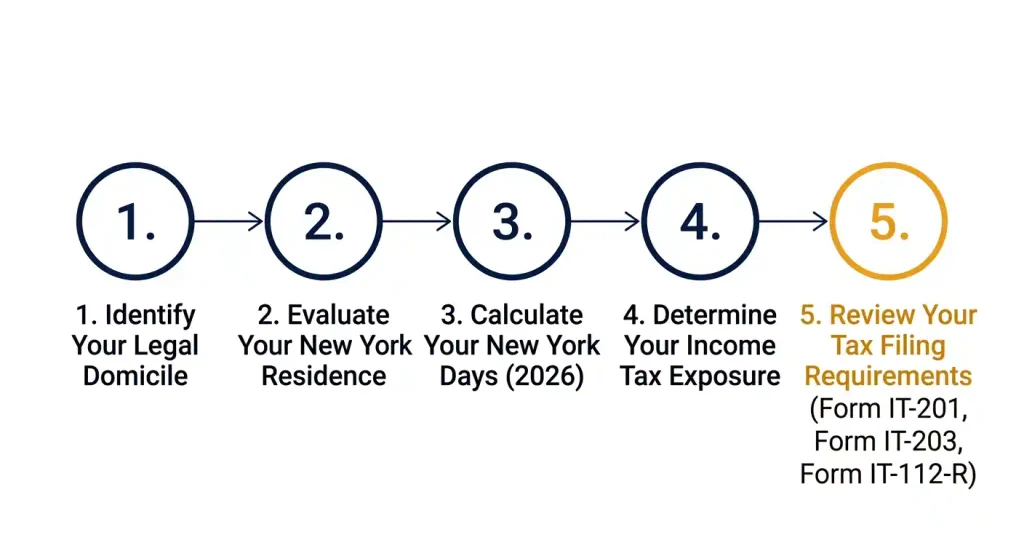
Step 1: Identify Your Legal Domicile
Figure out where your permanent home genuinely is: family, main job, voter registration, and the center of your life. Domicile and statutory residency are separate tests, so settle domicile first.
Step 2: Evaluate Your New York Residence
List any New York property you own, rent, or access regularly. Check whether each is suitable for year-round living and maintained for substantially all the taxable year. Run this check before signing a new lease or buying a second home, since the property can count the moment it becomes available to you.
Step 3: Calculate Your New York Days
Go through the full 2026 calendar and count every day you spent any part of in New York. Use real records, not memory, including partial days and travel days, since these get undercounted.
Step 4: Determine Your Income Tax Exposure
Meet both thresholds and you owe tax on worldwide income as a statutory resident. If not, work out nonresident tax on New York-source income and check for a resident credit. Also check New York City or Yonkers residency separately.
Step 5: Review Your Tax Filing Requirements
Statutory residents generally file Form IT-201, with the IT-201 Instructions covering how to report income from outside New York. Nonresidents and part-year residents use Form IT-203, with the IT-203 Instructions on allocating income. Form IT-112-R handles a credit for tax paid to another state, and a nonresident allocating New York City or Yonkers workdays may also need Form IT-2104.1 for withholding.
New York Statutory Residency Audits: How to Prove Your Status
New York runs some of the toughest residency audits in the country, and statutory residency is a favorite angle. Its New York Nonresident Audit Guidelines and New York Income Tax Definitions show exactly how examiners approach these cases.
What Triggers a New York Residency Audit?
A gap between reported nonresident income and New York property, employment, or business ties is a common trigger. Owning a New York home while filing as a nonresident, especially for a high earner, draws attention, as does inconsistent day-count history. Once an audit starts, the burden of proof is on you, so your records decide the outcome.
How New York Verifies Your Physical Presence
Auditors reconstruct your calendar from outside sources, not just your claims. Credit card and bank records, EZ-Pass and toll records, flight bookings, and phone records can all build a competing version of your days. If your log does not match, the auditor’s version tends to win.
How to Prove Your Domicile Is Outside New York
Strong evidence includes where your home and family actually live, your main job or business, and your community ties, like religious organizations or local healthcare providers. If you previously lived in New York, you need to show you actually abandoned that home, not just added a second address. New York expects clear and convincing evidence of a real domicile change, and updating a driver’s license or voter registration alone is not enough.
Documents to Maintain for Residency Verification
Keep a contemporaneous day-by-day travel calendar rather than reconstructing one later. Hold onto lease agreements, deeds, utility bills, and property records. Pair these with employment records and travel documentation like flight confirmations and toll statements, since outside records carry more weight than a self-reported log.
What Happens If You Cannot Support Your Residency Position?
New York can reclassify you as a resident and assess additional tax on previously reported nonresident income, often for multiple years, plus interest, potential penalties, and amended returns. You can appeal first through the New York State Division of Tax Appeals, then the New York State Tax Appeals Tribunal, and ultimately the New York State Supreme Court.
Frequently Asked Questions About New York Statutory Residency
Can I Be a New York Statutory Resident Without Living There Full-Time?
Yes. You just need a qualifying permanent place of abode and 184 days or more physically present in the state, even if another state is your real home.
Does Spending 184 Days in New York Automatically Make Me a Resident?
No. You also need a permanent place of abode maintained for substantially all the year. Without it, 184 days alone does not create statutory residency, though other New York tax obligations may still apply.
Does Renting an Apartment in New York Trigger Statutory Residency?
It can, if the apartment is suitable for year-round living and maintained for substantially all the year. A lease alone is not enough. You still need 184 days of physical presence.
Do Partial Days Count Toward the New York 184-Day Rule?
Yes. Any part of a day in the state counts as a full day. A few hours in Manhattan counts the same as a full day.
Can New York Tax My Out-of-State Income If I Am a Statutory Resident?
Yes. Statutory residents are taxed on worldwide income. A resident credit for tax paid to another state can reduce double taxation without eliminating it.
Does Owning a Vacation Home in New York Make Me a Statutory Resident?
Not automatically. The property must be physically suitable for year-round living, not just seasonal. A winterized home counts differently than an unheated summer cottage, and you still need 184 days.
What Is the Difference Between a Statutory Resident and a Domiciliary Resident?
A domiciliary resident’s actual home is in New York. A statutory resident’s legal domicile is elsewhere, but abode and day count still create resident taxation. Both owe tax on the same worldwide scope.
Do New York City and Yonkers Have Separate Statutory Residency Rules?
Yes. New York City runs its own domicile and statutory residency tests. Yonkers adds a separate resident surcharge and a Yonkers nonresident earnings tax, each on its own criteria.
Which Tax Form Does a New York Statutory Resident File?
Statutory residents file Form IT-201. Form IT-203 is for nonresidents and part-year residents, so classification matters before you pick a form.
Key Takeaways: What to Check Before Filing Your 2026 New York Taxes
The Three Questions That Matter Most
Ask three things. Do you maintain a permanent place of abode suitable for year-round living? Did you spend 184 days or more in New York during 2026? If both are yes, your entire worldwide income is now exposed to New York tax.
Your 2026 Residency Documentation Checklist
Confirm which New York properties you maintained and for how long. Reconcile your day count against real records, not memory. Then check which income and which form, IT-201, IT-203, or IT-112-R, applies before you file.

Meet Yasin Ali, Founder
Yasin built NY Paycheck Calculator in 2020 after getting fed up with calculators that treated New York like every other state. Most tools ignore the extra local tax NYC and Yonkers workers pay on top of state tax — or skip New York’s Paid Family Leave deduction entirely.
He keeps the numbers current, checking in regularly against the latest IRS, NY Department of Taxation and Finance, and Paid Family Leave rates.
All results here are estimates based on official sources. For advice specific to your situation, talk to a tax professional.