
New York taxes nonresidents only on income sourced to the state, such as wages for work physically performed there, New York rental income, or a New York business, using Form IT-203 rather than the full-year resident return.
After more than a decade reviewing New York nonresident filings, the workday allocation on Schedule A trips up most first-time filers.
The catch: New York’s convenience of the employer rule can still tax remote work days as if performed in-state.
New York State Tax for Nonresidents: The Quick Answer
This section breaks down what New York treats as source income, and how New York State income tax, city, and Yonkers taxes differ for someone living outside New York.
Do nonresidents have to pay New York State income tax?
Moving out of state does not end a New York tax bill if a paycheck, rental property, or business stays tied to New York, common for commuters and hybrid employees working for Manhattan employers while living in Connecticut or New Jersey. A New York mailing address or property in your name does not by itself make you a resident or create New York tax, unless the income itself is New York-source. Rental checks and business profits count just as much as a paycheck.
What income does New York tax for nonresidents?
A Manhattan commuter three days a week owes tax on those days; a Queens rental owned from Texas owes tax on the rent. Most out-of-state interest income and certain pension payouts fall outside this, covered later.
New York State, New York City, and Yonkers: What’s the difference?
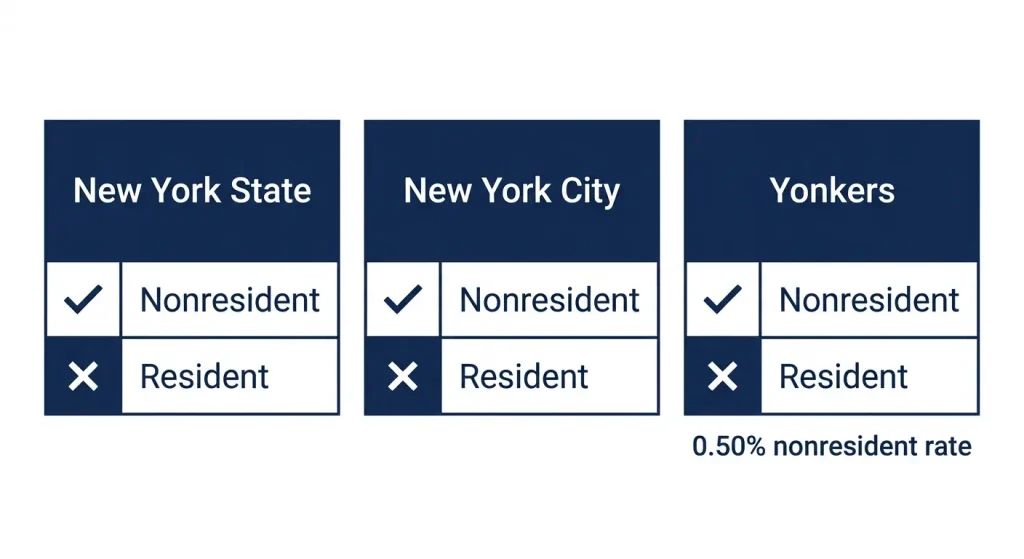
These are three separate taxes. New York State income tax applies based on New York-source income for nonresidents. New York City income tax and New York City personal income tax only apply to residents, so a New York City nonresident commuting into NYC pays nothing on the city side, while a New York City resident pays it on the same return. Yonkers runs its own nonresident earnings tax, a flat 0.50% on wages earned working there, separate from the state calculation. A Yonkers resident instead pays the Yonkers income tax surcharge added to their state return, while a Yonkers nonresident pays the flat rate. Check the label on your pay stub before assuming you owe something you do not.
Who Is a New York Nonresident for Tax Purposes?
Residency is a legal test, not a feeling. New York checks where you are domiciled and how many days you spend in the state.
New York resident vs nonresident vs part-year resident
A full-year nonresident is not domiciled in New York and does not keep a permanent home there for more than half the year with 184 or more days spent in the state. A part-year resident moves into or out of New York during 2026, taxed under different rules for each stretch: residents owe tax on income earned anywhere during resident months, nonresidents owe tax only on New York-source income during nonresident months. A New York State nonresident is anyone who fails both the domicile and day-count tests; a New York part-year resident straddles both. New York State residency turns on domicile and day count, not a quick visit, so a short trip to see family creates no tax liability on its own. For a closer look at how the day count itself works, see our guide to the 184-day statutory residency rule.
Does living outside New York mean you owe no NY tax?
No. This is the most common mistake I see. Living in Pennsylvania or Georgia says nothing about whether a paycheck, rental income, or business profit touched New York soil; if it did, you likely file Form IT-203. Most home states offer their own credit for taxes paid to another state, so this income is usually not taxed twice in practice, the same kind of resident tax credit New York offers its own residents under New York Tax Law Section 620.
What Counts as New York-Source Income?
This is the core concept of the entire nonresident system. Under New York Tax Law Section 631, it means income derived from New York sources, or income connected with New York sources: services performed within New York, property located in New York State, and any business carried on in New York State or trade, profession or occupation in New York. New York source income and New York-source income mean the same thing.
Wages for services performed in New York
Wages are sourced to where you physically work, not where your employer sits or you live. A daily commuter across the George Washington Bridge owes tax on every day worked inside New York. The same applies to a single trip: a Pennsylvania consultant flying in for a three-day New York assignment owes tax on those three days, with no ongoing job needed.
New York business, freelance, and self-employment income
If you run a business or work as an independent contractor and part of the work happens in New York, that portion of your profit is New York-source, whether you’re a freelance designer in an Ohio home office working from a New York coworking space or a business split across states allocating by sales, payroll, or property. Most of this starts on federal Schedule C. Sales commissions earned traveling to New York clients follow the same logic, taxed only for the New York-based portion. Worker classification changes the math too; our guide on employee vs independent contractor status in New York breaks down the difference.
New York real estate and property income
Rental income from a New York property is New York-source no matter where the landlord lives, and selling a New York condo makes the gain New York-source too. Property location decides the answer. This income usually starts on federal Schedule E before it reaches the New York return.
Partnership and S corporation income
If you hold an interest in a partnership or S corporation doing business in New York, your New York partnership distributive share or S corporation shareholder income flows through as New York-source, proportional to the entity’s New York activity, even without a single workday there. The entity reports it on a New York Schedule K-1, often from Form IT-204-IP, under New York Tax Law Section 632. A part-year resident splits this K-1 income between resident and nonresident periods.
Income that generally is not New York-source income
Most interest and dividend income, and gains on intangible property like stocks, stay outside New York’s reach for nonresidents, unless used in a New York business. Qualifying pension and annuity income is generally excluded too, under federal law barring states from taxing nonresidents’ retirement income. Military pay and interstate worker income carry their own exceptions, covered later.
How New York Taxes a Nonresident’s Income
New York does not simply tax your full paycheck. It runs a two-column math problem first.
Federal income vs New York State income
Form IT-203 has a Federal amount column and a New York State amount column side by side: your federal adjusted gross income in the first, your New York adjusted gross income, the New York-source slice only, in the second. These rarely match; federal AGI might be $110,000 while the New York State column shows $60,000. If separating what you actually earned from what a specific slice of it means for tax purposes still feels confusing, our gross pay vs net pay in New York breakdown walks through that same kind of distinction at the paycheck level.
How the New York income percentage works
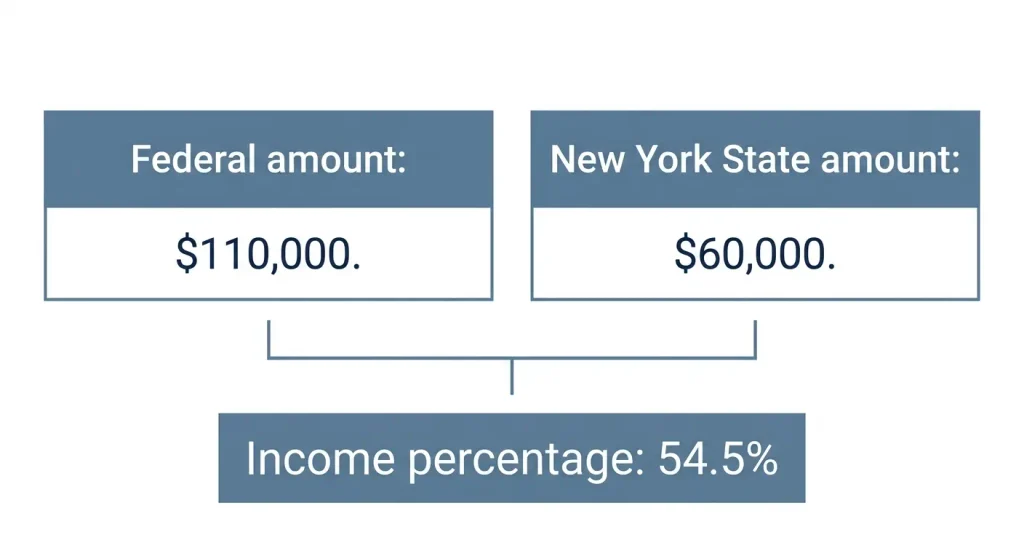
New York calculates tax as if you were a full-year resident on your entire federal income, then multiplies by an income percentage: New York State amount divided by Federal amount. At $60,000 of $110,000, that lands around 54.5%, the share of the full tax bill you actually owe. Some call this the New York source fraction; it is the same calculation.
What deductions, additions, and subtractions can change the calculation?
New York adds back certain federally excluded items and subtracts others it does not tax, then applies either the New York standard deduction or itemized deductions. For 2026, the standard deduction is $8,000 single or $16,050 married filing jointly, and rates run about 3.9% to 10.9%. These New York modifications, under New York Tax Law Section 612, go on Form IT-225 when they don’t fit the main form; a New York itemized deduction instead requires Form IT-196. See our full breakdown of the 2026 New York tax brackets for how these rates apply by filing status.
How to Allocate Wages Earned Inside and Outside New York
Not every nonresident job is fully inside or fully outside New York. Hybrid work made this section relevant to way more readers than it used to be.
When do you need to allocate your wages?
If your job spans inside and outside New York, hourly, salaried, or commission-based, you need to allocate wages rather than assume 100% or 0%. Schedule A of Form IT-203-B is the tool for this. Married couples still allocate each spouse’s wages separately by their own workday count, even on a joint federal return, and the same applies across several states beyond New York.
How New York workday allocation works
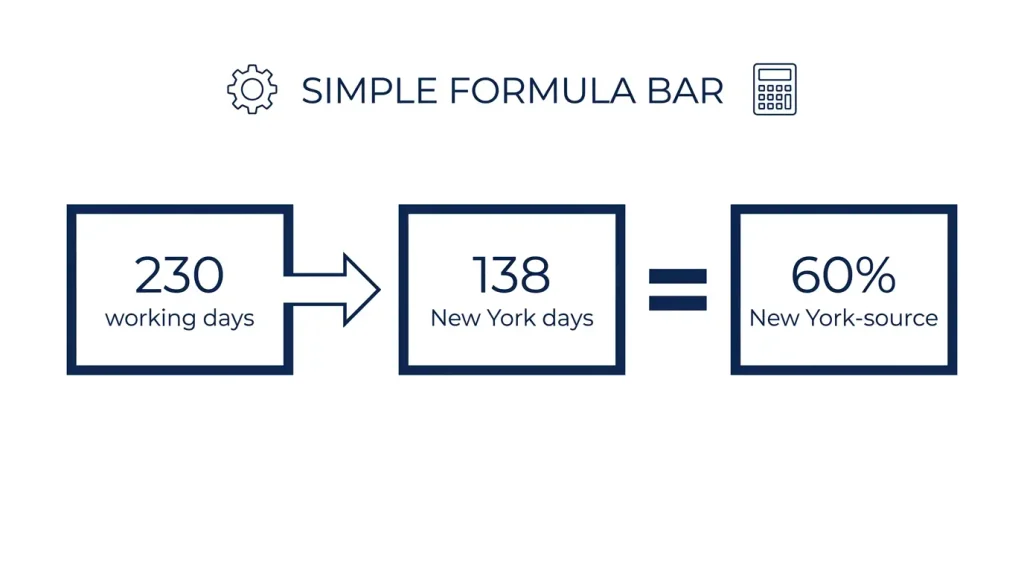
Start with total employment days, subtract weekends, holidays, vacation, and sick days to get working days, then divide New York workdays by total working days for your allocation percentage. A hybrid worker with 230 working days, 138 in a New York office, lands at 60%, so 60% of wages count as New York-source. This is formally Schedule A, Allocation of Wage and Salary Income to New York State, part of Form IT-203-B.
Why your W-2 may not tell the whole story
Employers sometimes report a flat New York wage figure that doesn’t reflect an accurate workday count, especially for remote or hybrid staff. That number is a starting point, not gospel; keep your own calendar of actual workdays, and file on your documented allocation if the W-2 figure looks off, with paperwork ready if questioned. Not sure what each box on your stub actually means? Our guide on how to read a New York pay stub walks through it line by line.
Remote Work for a New York Employer
This section causes the most confusion I see. New York’s rule here is unusual compared to most states.
I live outside New York but work remotely for a New York company
Working for a New York-based employer does not automatically make your wages New York-source, but New York applies a stricter rule than most states here. What matters is whether you have a legitimate reason for working outside the office, not where your employer is headquartered, so a remote Texas employee for a New York company needs to understand the convenience of the employer rule first.
What is the convenience of the employer rule?
If your primary office is in New York and you work from home for your own convenience, not genuine business necessity, those home days still count as New York workdays. The one escape hatch is the bona fide employer office exception: if your home office meets New York’s factor test, a job requirement, specialized equipment, or serving clients there, those days can count as non-New York instead. Document the arrangement in writing; this rule rewards paperwork and punishes assumptions.
What if my employer has an office in another state?
If you’re formally assigned to an employer’s office in another state, not the New York office, the convenience rule generally does not apply, since your primary work location sits outside New York. Keep your offer letter, assignment records, and HR documentation of your official work location; that’s what New York looks for if questioned.
Form IT-203: Who Needs to File and How It Works
This is the actual paperwork nonresidents deal with every spring.
When must a nonresident file Form IT-203?
File Form IT-203, officially the Nonresident and Part-Year Resident Income Tax Return, once your New York-source income exceeds the $8,000 or $16,050 standard deduction threshold, or if New York tax was withheld and you want it back. Filing also lets you claim credits and any refund owed, which people skip too often assuming their income is too small to matter.
What information goes on Form IT-203?
The form starts with taxpayer and filing status details, moves into the Federal amount and New York State amount columns, then works through New York’s additions and subtractions before calculating your income percentage. Following it top to bottom keeps the math straightforward.
What other forms may a nonresident need?
Form IT-203-B handles wage allocation. Form IT-203-A, the Business Allocation Schedule, covers nonresident business income split between states. Form IT-203-ATT covers other taxes and credits, and Form IT-196 covers itemized deductions. Most nonresidents need only one or two beyond the main IT-203.
| Form | Used for |
|---|---|
| IT-203-B | Wage allocation (Schedule A workday split) |
| IT-203-A | Business Allocation Schedule for nonresident business income |
| IT-203-ATT | Other taxes and credits that don’t fit the main form |
| IT-196 | Itemized deductions instead of the standard deduction |
2026 New York Nonresident Tax Calculation Example
Numbers make this click faster than explanations. Here are four 2026 scenarios; our New York nonresident tax calculator can run this math instantly, but doing it by hand once makes the logic stick.
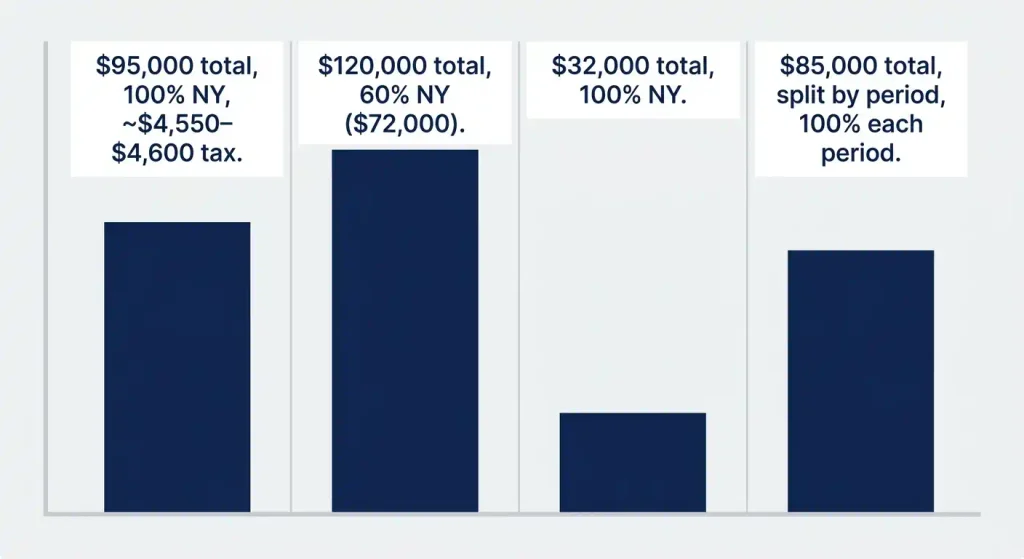
Example 1: All wages earned while working in New York
A New Jersey resident earning $95,000 working entirely from a Manhattan office has every workday count as New York-source, so the full $95,000 lands in the New York State column. After the standard deduction and bracket calculation, they owe roughly $4,550 to $4,600 in New York State tax before credits.
Example 2: Wages earned in New York and another state
A Connecticut resident earning $120,000 total, splitting time between a New York office and home, worked 138 of 230 total days in New York, a 60% allocation, putting $72,000 into the New York State column, not the full $120,000.
Example 3: New York rental income for an out-of-state resident
A Florida resident owning a Brooklyn rental generating $32,000 a year has the entire $32,000 count as New York-source, since property location controls the answer. This reports on Form IT-203 separately from wage income, backed by rent rolls and expense records.
Example 4: Moving into or out of New York during 2026
Someone living in New Jersey through June 2026, earning $40,000 commuting into a New York job, then moving to New York in July and earning $45,000 as a resident, is taxed as a nonresident on the New Jersey-period income and as a resident on all July-onward income. Form IT-203 handles both halves on one return.
| Example | Total income | NY-source income | NY income % | Result |
|---|---|---|---|---|
| 1: All NY wages | $95,000 | $95,000 | 100% | ~$4,550–$4,600 tax |
| 2: NY + CT split | $120,000 | $72,000 | 60% | Allocated, not full $120,000 |
| 3: NY rental | $32,000 | $32,000 | 100% | Reported on IT-203 |
| 4: Mid-year move | $85,000 | Split by period | 100% each period | Resident + nonresident portions on one IT-203 |
Special Situations That Can Change the Answer
A handful of situations do not follow the standard rules covered above.
Military members and military spouses
Active duty military pay is generally excluded from New York-source income for nonresident service members stationed there. Military spouses often qualify for similar protection under federal law, keeping their home state treatment. Other New York-source income, like a spouse’s separate New York civilian job, can still be taxable. Keep military orders and spousal documentation on hand.
Interstate transportation and airline workers
Federal law taxes rail workers, interstate motor carrier employees, and certain vessel workers only in their state of residence, not every state they pass through. Airline pilots and flight crew get similar protection tied to scheduled flight time per state. Ordinary workday allocation rules do not apply here.
Stock options and deferred compensation
Stock options or deferred compensation earned partly through New York services, even years ago, get taxed on the New York-tied portion when they pay out; Form IT-203-F handles this multi-year allocation. Keep records of when and where you worked during vesting. New York restricted stock income follows the same logic, as do New York termination agreement income and New York noncompete compensation tied to a New York job; Form IT-230 handles the separate tax on some lump-sum payouts.
U.S. nonresident noncitizens
Federal nonresident alien status filing Form 1040NR is separate from New York residency status. You can still owe a New York return, filed on Form IT-203, if you earned New York-source income. Double check how your federal filing status translates onto the New York form.
Special accruals and moving between states
When income is fixed and determinable before a residency change, New York’s special accrual rules can pull it into your final resident-period return even if unreceived, mostly affecting deferred compensation, installment sales, or bonuses timed around a move. Form IT-260, the surety bond form for a change of resident status, covers some of these situations. Income earned entirely before moving to New York, or entirely after leaving, stays taxed under whichever rules applied when you earned it.
New York net operating losses
Nonresidents with business losses calculate a separate New York net operating loss figure, based only on New York-source activity, which does not always match the federal NOL. These report on Form IT-203 in the year they apply, and carryback or amended returns follow their own rules if the loss shifts prior-year liability.
New York Nonresident Tax Withholding, Refunds, and Underpayment
Withholding is a prepayment, not the final word on what you owe.
Why is New York tax withheld from my paycheck?
Employers calculate New York State withholding tax on wages tied to New York, whether or not you live there, under New York Tax Law Section 671, as a prepayment toward your eventual liability. Withholding alone never determines your final tax bill; only your completed return does. Getting the input side right matters too; see our W-4 vs IT-2104 comparison for how the two withholding forms work together.
Can a nonresident get a New York tax refund?
Yes, and it happens constantly. If your employer withheld more than your actual liability, filing Form IT-203 refunds the difference, and refundable credits can push it even higher. Skipping filing can leave a four-figure refund unclaimed for years.
What if too little New York tax was withheld?
If withholding fell short, you owe the balance when you file, and a large shortfall may require estimated quarterly payments to avoid an underpayment penalty. Interest and penalties stack on unpaid balances, so a large gap is worth a tax professional’s review before the next estimated deadline. Our guide to New York State tax withholding covers how to adjust your withholding to avoid this situation going forward.
Common New York Nonresident Tax Mistakes and Myths
I hear the same four myths on repeat, every filing season.
Myth: “I live outside New York, so I do not owe New York tax”
Residency and source income are separate questions this myth conflates. A Colorado remote worker whose company assigns her to a New York office on paper can still owe New York tax under the convenience rule, despite never living there.
Myth: “My New York employer means all my wages are taxable in New York”
Your employer’s address is not the test; actual physical work location is. Someone splitting time between a New York office and remote work needs proper wage allocation, not a blanket assumption that every dollar is New York income.
Myth: “I can simply copy my W-2 New York wages”
The state wage box on your Form W-2 is sometimes wrong, especially for hybrid and remote employees. Running your own workday-based calculation on Schedule A protects against both overpaying and underpaying, with documentation ready if questioned.
Myth: “New York State tax and NYC tax are the same”
They are entirely separate systems. A daily Manhattan commuter pays New York State tax but owes zero New York City personal income tax, since NYC tax only applies to residents. Yonkers runs its own separate nonresident earnings tax, unrelated to both. New York City residency and New York State residency are not the same test; living in a New York State county outside the five boroughs creates no city tax even if you meet state residency rules.
What Records Should a Nonresident Keep?
Good records turn a stressful audit into a five-minute conversation.
Documents needed to support New York-source income
Keep W-2s, pay statements, employment contracts showing your assigned work location, rental agreements, business ledgers, and partnership K-1s where relevant. Keep prior year federal and New York returns too; your federal Form 1040 ties directly to the Federal amount column on Form IT-203.
Records needed for mixed-state wage allocation
Track total employment days, New York workdays, and non-New York workdays all year, not just at tax time; a simple calendar is often enough. Claiming a bona fide employer office exception needs written documentation from your employer.
What If You Filed the Wrong New York Return?
Mistakes happen, and New York has a fix for both directions.
You filed Form IT-201 instead of Form IT-203
If you filed a full-year resident return by mistake as an actual nonresident, use Form IT-203-X to amend it. This is a residency classification error, not just a math mistake, so keep documentation proving your actual residency status ready.
You allocated too much or too little income to New York
Wrong workday counts or a missed exclusion are the most common allocation errors. Fixing a filed return means recalculating the allocation percentage with accurate records and submitting an amended return, which can lead to a refund, a balance due, or interest on a long-unnoticed underpayment.
New York Nonresident Tax Filing Checklist for 2026
A short checklist beats a long explanation every time you actually sit down to file.
Before you calculate your tax
- Confirm your residency status for the year
- List every item of New York-source income: wages, rental, business
- Gather your federal return, W-2s, and New York documents
- Decide early whether wages need allocation, since that changes which forms you need
Before you submit Form IT-203
- Double check the Federal amount and New York State amount columns
- Confirm every required schedule is attached: IT-203-B for wages, IT-203-A for business
- Verify withholding and filing status before submitting
- Note the deadline lines up with the federal deadline, typically April 15
After filing
- Keep a full copy of your return and supporting documents
- Track refund or balance due status through the New York State Tax Department’s online system
- Hold allocation records for at least three years
- Remember an amended return is always an option
New York Nonresident Tax FAQ
Quick, direct answers to the questions nonresidents ask most often.
Do nonresidents pay New York State income tax?
Yes, on New York-source income only. A remote employee whose job is officially based in a New York office, for example, can owe New York tax even while living in another state entirely.
How much New York tax do I pay as a nonresident?
It depends entirely on how much of your income is New York-source, not your total income. New York calculates your full tax as if you were a resident, applies your deductions, then multiplies by your income percentage to find your actual bill.
Do I need to file Form IT-203 if I live in another state?
Yes, if you had New York-source income or had New York tax withheld from your pay. Filing is also how you claim a refund if your employer withheld more than you actually owed.
Does New York tax remote workers who live in another state?
Sometimes, depending on the convenience of the employer rule. If your primary office is in New York and you work from home for your own convenience rather than employer necessity, those days still count as New York workdays unless your home office qualifies as a bona fide employer office.
Does New York tax income earned outside New York?
No, not for nonresidents. New York only taxes the New York-source portion of your income. Mixed-state employees need to allocate wages between New York and non-New York work to find that exact portion.
Do nonresidents pay New York City income tax?
No, because NYC personal income tax is a residency-based tax, not a workplace-based one, unlike the state’s source-income rule. The distinction trips people up since state tax and city tax run on completely different triggers.
How do I allocate wages between New York and another state?
Use Schedule A of Form IT-203-B, the official worksheet for this exact split. The result should match your own workday calendar, not just whatever number your employer put on the W-2.
Can I get a refund of New York tax withheld as a nonresident?
Yes, if your withholding exceeded your actual New York tax liability. Filing Form IT-203 is how you claim that refund, and refundable credits can add to it beyond just the over-withheld amount.
Official 2026 New York Tax Resources and Forms
Where to check current 2026 forms and rules directly from the source.
New York Department of Taxation and Finance resources
The New York State Department of Taxation and Finance publishes Form IT-203, its instructions, the IT-203-B worksheet, and telecommuting guidance on the convenience of the employer rule, operating under New York State Tax Law, specifically New York Tax Law Article 22, rate schedules under New York Tax Law Section 601, filing requirements under New York Tax Law Section 651. Check for current 2026 updates before filing; using a prior year’s rules is a common, avoidable mistake. For more on the paperwork side, browse our New York tax forms and withholding category.
Forms and records to check before filing
Pull together Form IT-203, Form IT-203-B if you need wage allocation, W-2 forms, and any relevant schedules or modifications. Having it all ready prevents hunting for missing documents mid-filing.
Key Takeaways for New York Nonresidents
The short version, if this is all you read.
The rules to remember
Residency alone never decides your New York tax bill; New York-source income does, whether from wages, rental property, or a business. Mixed-state wages need allocation by real workday count, not a guess, and Form IT-203 is the return nearly every nonresident with New York ties ends up filing. Run your own numbers with our New York paycheck calculator to see exactly where you land.

Meet Yasin Ali, Founder
Yasin built NY Paycheck Calculator in 2020 after getting fed up with calculators that treated New York like every other state. Most tools ignore the extra local tax NYC and Yonkers workers pay on top of state tax — or skip New York’s Paid Family Leave deduction entirely.
He keeps the numbers current, checking in regularly against the latest IRS, NY Department of Taxation and Finance, and Paid Family Leave rates.
All results here are estimates based on official sources. For advice specific to your situation, talk to a tax professional.