
In New York, live-in domestic employees earn overtime once their workweek passes 44 hours, not the standard 40, paid at 1.5 times their regular hourly rate under the state’s Domestic Workers’ Bill of Rights.
That 44-hour threshold comes directly from New York Labor Law Section 170, part of the 2010 Domestic Workers’ Bill of Rights protections.
Federal law still exempts many live-in workers, so confirming your classification under New York’s rule matters.
Do Live-In Employees in New York Get Overtime After 44 Hours?
Yes, that’s the short version of New York overtime for live-in employees. The sections below cover thresholds, pay math, and exceptions in full.
The New York 44-Hour Overtime Rule
New York sets live-in overtime at 44 hours a week, paid at time and a half, versus 40 hours for non-live-in domestic workers like a commuting nanny. This comes from the Domestic Workers’ Bill of Rights, written into Article 5 of New York Labor Law, Section 170.
Who Qualifies as a Live-In Domestic Employee?
You qualify as live-in only if you actually reside at the employer’s home, not just work occasional overnight shifts; nannies, caregivers, housekeepers, and personal attendants can all qualify. Federal law, 29 CFR 785.23, calls this a live-in domestic service employee: living on the premises five days a week or more, or at least 120 hours over an extended period, per Fact Sheet #79B: Live-in Domestic Service Workers Under the FLSA. A separate permanent home elsewhere doesn’t disqualify you. New York Labor Law Section 2(16) defines ‘domestic worker,’ the definition that triggers the 44-hour threshold.
Does the 44-Hour Rule Apply to Every Live-In Worker?
Not always. Some live-in workers fall under a narrow federal exemption requiring overtime only after 40 hours. But a federal exemption never cancels New York’s overtime protections: when the two conflict, the stronger rule wins, so the 44-hour threshold can still apply.
New York Live-In Overtime Rules: 40 Hours vs. 44 Hours
The gap comes down to where you sleep. Live-in domestic workers get the 44-hour threshold; everyone else, including domestic workers who go home each night, gets the standard 40 hours.
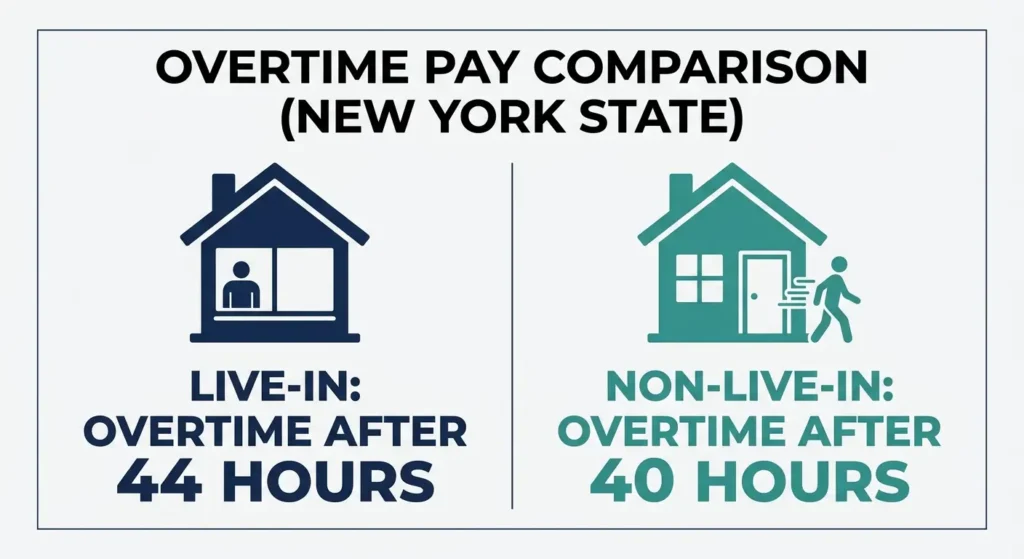
Live-In vs. Non-Live-In Domestic Worker Overtime
Live in, and your overtime starts at 44 hours a week. Live out, and it starts at 40. The living arrangement decides this, not your job title or usual hours.
Household Employer vs. Home Care Agency
Federal law exempts household employers, like a family hiring a live-in nanny directly, from overtime under Section 13(b)(21) of the Fair Labor Standards Act (FLSA), detailed in 29 CFR 552.102 under 29 CFR Part 552. Agencies don’t get that exemption: since 2015, federal rules require home care agencies to pay overtime, even to live-in aides. A worker jointly employed by a family and an agency can still claim overtime against the agency under joint employment under FLSA rules. New York’s 44-hour threshold applies either way, and that same agency must combine your hours across every client household you work for in the same week.
When Federal and New York Overtime Rules Differ
The FLSA sets the federal floor; New York’s overtime laws set a higher one for live-in domestic workers. When the two conflict, the stronger protection wins, so a federal exemption doesn’t erase New York’s 44-hour rule. As covered above, agencies can’t claim that exemption, so their caregivers get federal and state protections stacked together.
Do Sleeping Hours, Meal Breaks, and Overnight Duties Count as Work?
Sometimes. It depends on whether you’re truly off duty or just on standby, ready to be called back. New York law pays for standby time, not genuine rest.
When Can Employers Exclude Sleeping Hours?
Employers can exclude sleep time only if it’s genuine, uninterrupted rest with you completely off duty, under a reasonable agreement and adequate sleeping facilities. Federal rules generally require at least five hours of uninterrupted sleep for that exclusion, per Fact Sheet #79D: Hours Worked Applicable to Domestic Service Employment Under the FLSA. Employers must keep accurate records; if your actual routine differs from the agreement, your actual hours worked get paid instead.
What Happens When an Employer Interrupts Your Sleep?
Any wake-up for work, like helping a patient or child, becomes paid time. Repeated interruptions can make your entire sleep period compensable, pushing your total hours past the 44-hour overtime line faster than you’d expect.
Are Meal Breaks and Personal Time Paid?
A true meal break, free of duties, usually isn’t paid under New York’s meal break laws; an interruption makes the whole period compensable. The law calls this a bona fide meal period: real time off duty, not just a label. Short personal breaks stay unpaid as long as you’re not expected to stay available.
Does Waiting for Your Employer Count as Working Time?
This comes down to ‘engaged to wait’ versus ‘waiting to be engaged.’ Required to stay put and ready to respond? That’s paid time. Genuinely free to leave? It isn’t, even if you happen to be on the premises.
How Much Overtime Pay Should a Live-In Employee Receive?
Overtime pays 1.5 times your regular hourly rate for every hour past 44 in a week. Start by finding your true regular rate.
How to Calculate Time-and-a-Half Overtime
Your regular rate of pay is your normal hourly pay, or effective hourly rate if salaried. Multiply it by 1.5 for your overtime rate, and count every compensable hour, including interrupted sleep or meals, past 44. This is calculated fresh for each single workweek; New York doesn’t allow averaging across two weeks. Different hourly rates for different duties get blended into one weekly overtime calculation, the same approach behind our paycheck calculation methodology.
2026 New York Minimum Wage and Overtime Rates
New York minimum wage 2026 figures vary by region: the New York City minimum wage 2026 rate also covers Long Island minimum wage 2026 and Westchester County minimum wage 2026, while a separate Upstate New York minimum wage 2026 rate applies everywhere else. Here’s the breakdown:
| Region | Minimum Wage | Overtime Rate (1.5x) | Home Care Aide Wage |
|---|---|---|---|
| NYC, Long Island, Westchester | $17.00 | $25.50 | $19.65 |
| Rest of New York State | $16.00 | $24.00 | $18.65 |
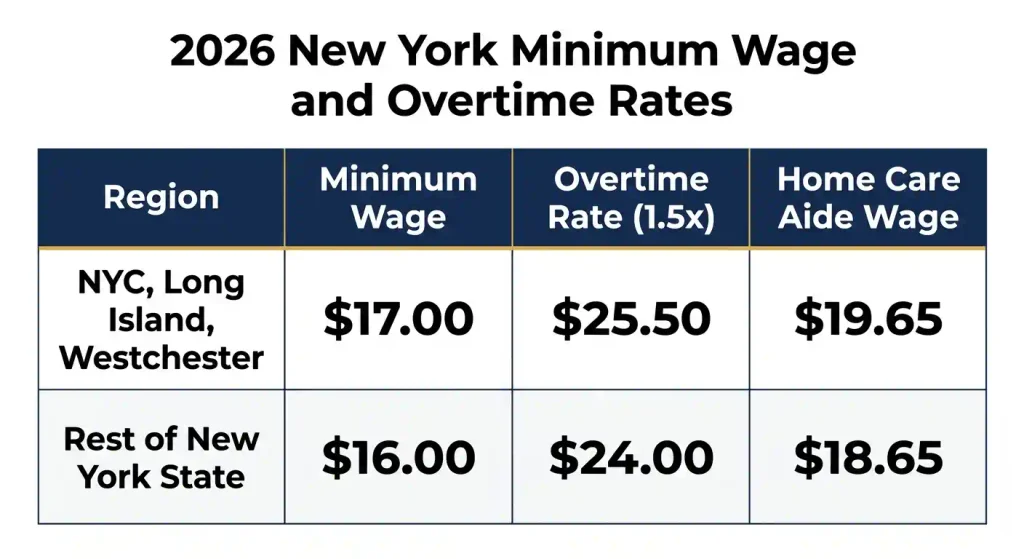
Home care aide rates sit $2.65 above the regional minimum wage, a separate schedule from general domestic worker pay.
Real-World Live-In Overtime Pay Examples
Here’s the math for a live-in caregiver earning New York City’s $17.00 minimum wage, and you can run your own numbers with our New York paycheck calculator.
| Weekly Hours | Regular Pay (44 hrs) | Overtime Pay | Total Weekly Pay |
|---|---|---|---|
| 45 | $748.00 | $25.50 | $773.50 |
| 48 | $748.00 | $102.00 | $850.00 |
| 50 | $748.00 | $153.00 | $901.00 |
| 55 | $748.00 | $280.50 | $1,028.50 |
| 60 | $748.00 | $408.00 | $1,156.00 |
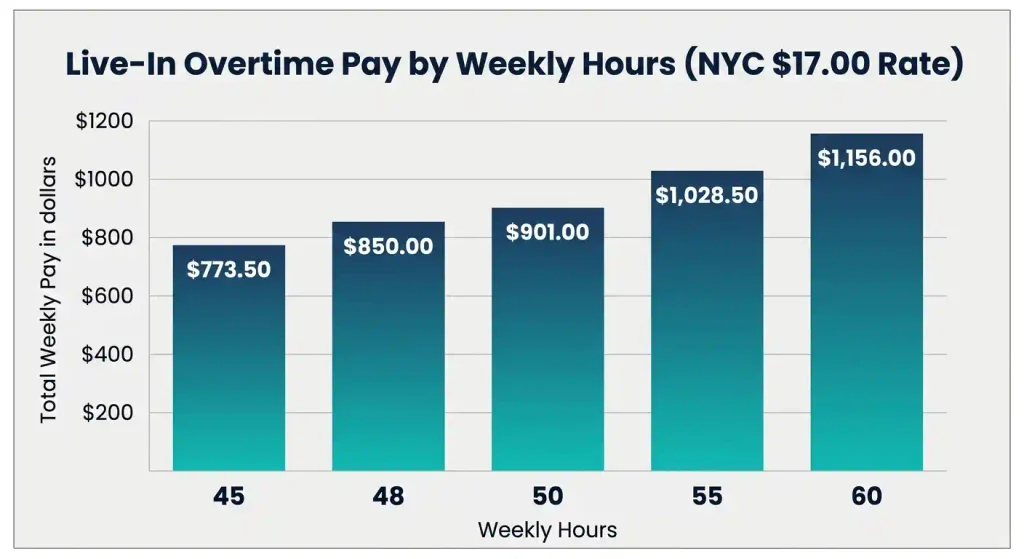
At the $16.00 rate outside NYC, Long Island, and Westchester, 50 hours earns $704 regular pay plus $144 overtime, $848 total, $53 less than the NYC total for the same hours.
Does a Weekly Salary Include Overtime?
No, not automatically. A flat salary doesn’t cover overtime unless it separately identifies that portion; otherwise your employer must calculate your effective hourly rate and pay 1.5 times it past 44, the same math covered in our guide to overtime for salaried employees. The same applies to flat-rate shift payments and cash wages: a nanny working 50 hours for a flat $900 cash payment, with no wage statement, is still owed overtime on top.
Special Overtime Rules for 24-Hour Home Care Shifts
Home care aides on 24-hour shifts, live-in or not, fall under the 13-hour rule: specific sleep and meal exceptions for those extended shifts.
The 13-Hour Pay Rule for Certain Home Care Aides
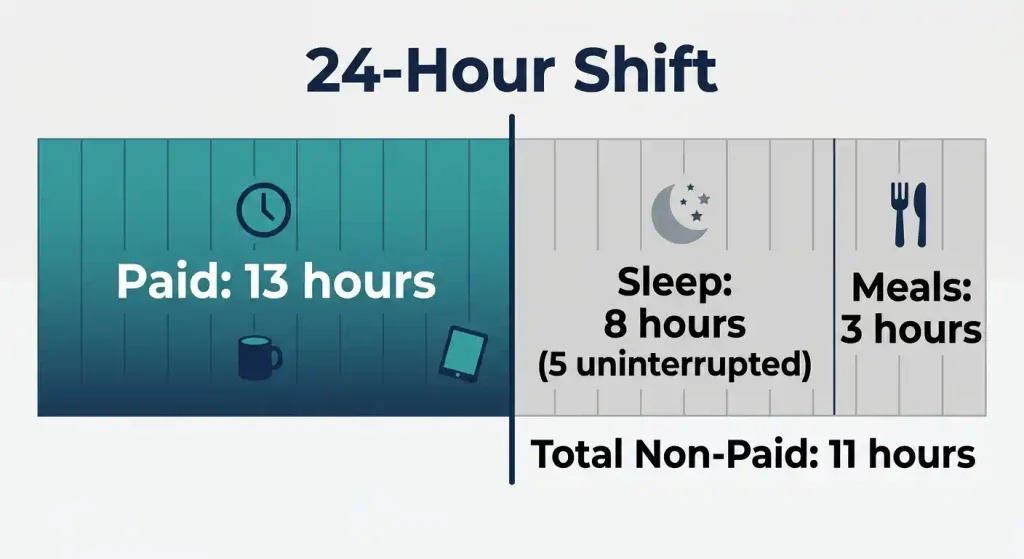
Under NYSDOL policy, upheld in the 2019 case Andryeyeva v. New York Health Care, employers can pay home care aides for 13 hours of a 24-hour shift instead of all 24, provided the aide genuinely gets:
- Eight hours for sleep, with at least five hours uninterrupted
- Three hours set aside for meals
Those 11 hours stay unpaid only if the aide actually gets that rest.
When Must a Home Care Aide Be Paid for More Than 13 Hours?
Interrupted sleep below five uninterrupted hours, or cut meal breaks, convert to paid time. Two interruptions losing two hours push that day’s paid total from 13 to 15 hours; enough of these across a week can push compensable hours past 44, triggering overtime too.
Does the 13-Hour Rule Apply to Live-In Nannies and Housekeepers?
No. The 13-hour rule is specific to home care aides on 24-hour shifts, not general domestic workers like nannies or housekeepers, who keep the standard 44-hour threshold based on actual hours and genuine rest and meal periods.
Other New York Rights That Live-In Domestic Workers Should Know
Overtime isn’t the only protection under New York’s wage laws. The Domestic Workers’ Bill of Rights also guarantees a weekly day of rest, paid time off after a year, and basic wage documentation.
Your Weekly 24-Hour Day of Rest
You get 24 consecutive hours off each calendar week under New York’s day of rest law. Work that day instead, and your employer owes overtime pay for it, calculated the same as any other overtime.
Three Paid Days of Rest After One Year
After a full year with the same employer, you’re entitled to three paid days of rest annually, separate from any vacation or sick leave your employer chooses to add.
Minimum Wage, Meal Breaks, and Pay Statements
You’re owed at least minimum wage for non-overtime hours, with limited credits for meals and lodging, and a right to spread of hours pay if your workday runs long. Shifts over six hours get a 30-minute meal period. Employers must also provide written wage notices and weekly wage statements, plus accurate time records.
Common Myths About New York Live-In Overtime
Several myths cost live-in workers real pay.
Living in Your Employer’s Home Means You Are Not Entitled to Overtime
False. Living in costs you nothing; it just moves your overtime threshold from 40 to 44 hours. State law applies regardless of any federal exemption.
Employers Can Deduct Every Hour You Spend Sleeping
False. Employers can only exclude genuine, uninterrupted sleep time. Interrupted sleep becomes compensable, no matter how the shift is labeled.
A Weekly Salary or Free Room and Board Replaces Overtime
False. A flat salary or free lodging doesn’t replace overtime; meal and lodging credits are legally limited, and going over those limits counts as an illegal paycheck deduction. Neither erases the duty to pay time and a half past 44 hours.
Working on Your Day of Rest Automatically Replaces Overtime
These are separate. Your day of rest and your overtime pay don’t cancel out. Working your rest day earns overtime on top of any other overtime owed that week, not instead of it.
How to Recover Unpaid Overtime as a New York Live-In Employee
If your pay looks off, or your paycheck hasn’t arrived at all, there’s a clear process to check it and recover what you’re owed.
Signs Your Employer May Be Underpaying You
Watch for these red flags:
- Sleep hours deducted even though your rest was interrupted
- Overnight duties missing from your time records
- Overtime absent from your pay stub despite working past 44 hours
- Lodging or meal deductions larger than the law allows
Being misclassified as an independent contractor is another red flag: it doesn’t change your actual domestic worker employment classification or erase your overtime rights, and left unpaid, it’s a form of wage theft. Quietly gather your own records before raising any of this with your employer.
How to Calculate Your Potential Unpaid Overtime
Reconstruct your actual weekly hours, including interrupted sleep or meals that should count as work. Compare what you were paid against 1.5 times your regular rate for every hour past 44, minus overtime already paid. Missing employer records don’t block your claim; New York lets you reconstruct hours from your own evidence, shifting the burden to your employer. Beyond the unpaid wages, wage recovery and liquidated damages can double what you’re owed, plus interest.
What Evidence Should You Keep?
Hold onto:
- Schedules, timesheets, and pay statements
- Text messages about your hours
- Records of interrupted sleep or cut meal periods, with dates
- Your employment agreement and any wage notices
How to File a New York Wage Complaint
File a wage complaint with the New York State Department of Labor (NYSDOL), through the New York Division of Labor Standards, online or by mail. On the federal side, the U.S. Department of Labor (DOL) enforces wage law through its Wage and Hour Division (WHD); contact it too if agency employment is involved. If your employer withholds payroll records, investigators at either agency can compel them. See the official NYSDOL Domestic Workers Bill of Rights page and NYSDOL Wages and Hours Frequently Asked Questions for more detail.
Can Your Employer Fire You for Claiming Unpaid Overtime?
No. New York law bars retaliation for filing a wage complaint or asserting your rights under the Domestic Workers’ Bill of Rights. Document any retaliation and contact the Department of Labor or a legal aid group for help.
Frequently Asked Questions About New York Live-In Overtime
Quick answers to the questions live-in domestic workers ask most.
Do live-in domestic workers in New York get overtime after 40 or 44 hours?
After 44 hours; non-live-in domestic workers hit overtime at 40.
Does a live-in nanny qualify for overtime in New York?
Yes, if she genuinely resides in the employer’s home. Her threshold is 44 hours, paid at 1.5 times her regular rate.
Can my employer deduct eight hours of sleep from a 24-hour shift?
Only if that sleep is genuine and mostly uninterrupted, under the 13-hour rule for certain home care aides. Interrupted sleep must be paid.
Does a live-in caregiver employed by an agency get overtime after 40 hours?
No. Agencies can’t claim the federal household exemption, so agency caregivers get both federal overtime protection and New York’s 44-hour live-in threshold.
Can my employer pay me a fixed weekly salary without overtime?
No, unless the agreement separately identifies an overtime portion. Otherwise your effective hourly rate still gets calculated, and overtime paid past 44.
Can I recover unpaid overtime from previous years?
Generally yes, up to six years back, longer than the federal recovery window.
Do live-in domestic workers get one day off every week?
Yes, 24 consecutive hours each calendar week. Working it instead requires overtime pay for that time.
What should I do if my employer refuses to pay overtime?
Gather your records, calculate what you’re owed, and file with the New York State Department of Labor. Retaliation is illegal.
Final Takeaway: Know Your Live-In Overtime Rights in New York
Remember 44 hours: that’s when live-in domestic workers earn overtime in New York, not 40, and federal exemptions don’t erase that state protection. Keep honest records of interrupted sleep and meals. If the math doesn’t add up, you have the right to be paid what the law says you’re owed.

Meet Yasin Ali, Founder
Yasin built NY Paycheck Calculator in 2020 after getting fed up with calculators that treated New York like every other state. Most tools ignore the extra local tax NYC and Yonkers workers pay on top of state tax — or skip New York’s Paid Family Leave deduction entirely.
He keeps the numbers current, checking in regularly against the latest IRS, NY Department of Taxation and Finance, and Paid Family Leave rates.
All results here are estimates based on official sources. For advice specific to your situation, talk to a tax professional.