
New York day of rest laws give covered workers at least 24 consecutive hours off every calendar week. Coverage depends on your industry, and exceptions or approved variances can change the outcome.
That 24-hour rule and its exceptions come from the statute text in NYS DOL’s LS 611 (12/25 edition), and the 2026 farm overtime threshold comes from NYS DOL notices.
The catch: Section 161 requires rest but does not require pay for it, and some roles fall outside coverage.
New York Day of Rest Laws at a Glance
The rule comes from Section 161 of the New York Labor Law, officially cited as Labor Law § 161 under NYS Labor Law. A day off and the legal day of rest are not always the same thing.
Does New York Require a Day Off Every Week?
Yes, for covered workers. New York requires at least 24 consecutive hours of rest each calendar week, in jobs like factories, hotels, restaurants, and mercantile stores. If your job is not covered, Section 161 might not apply.
Can You Legally Work 7 Days in a Row in New York?
Sometimes. Seven straight workdays can be legal if they span two calendar weeks, each with its own 24 hour rest period. Coverage and approved variances can also change the answer.
What Should You Check on Your Schedule Right Now?
Mark every day worked in one calendar week, then find one clean 24 hour block with no work in it. Note your job title, business type, and whether your employer holds a posted variance. If you work multiple jobs, each employer must satisfy this rule on its own.
What New York Labor Law Section 161 Actually Requires
Section 161 sets a minimum rest period, ties it to the calendar week, and lets employers schedule Sunday work under specific conditions.
The 24 Consecutive Hours Rule
Rest must be 24 hours in a row, not hours added up across short breaks. A shift in the middle breaks it, even if total rest hours still reach 24. This is about weekly rest, not daily hours worked or lunch breaks, and it does not have to run midnight to midnight, just be one uninterrupted block inside the calendar week.
The Calendar Week Rule
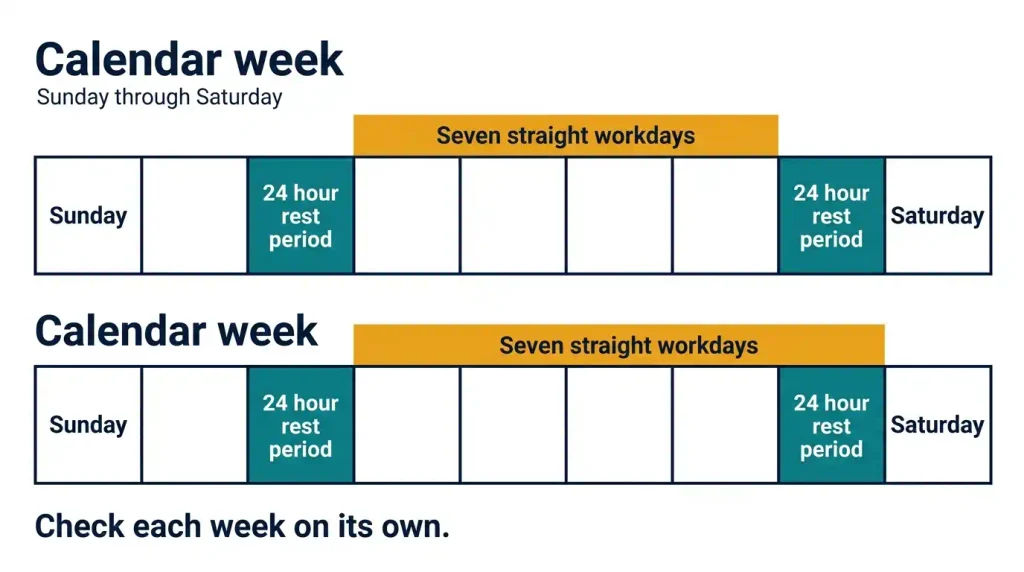
New York counts a calendar week as Sunday through Saturday, which is not always the same as payroll week. An eight day stretch can look like a violation but actually cross two separate calendar weeks. Check each week on its own to avoid a wrong conclusion.
The Employer’s Sunday Operating Requirement
Covered employers do not have to close on Sunday, though Section 161 does not authorize any Sunday work that other laws prohibit. They can stay open if they designate a different rest day and give advance notice. What matters is a full 24 hour rest period somewhere in that calendar week.
What Section 161 Does Not Automatically Mean
Not every New York employee is covered. Section 161 requires a rest day, not pay for it, and working seven days straight does not automatically trigger overtime, since that comes from a different rule. Overtime pay also never replaces the day of rest requirement. An unpaid rest day is one reason a weekly check can look smaller, so see why your New York paycheck may be lower and our New York paycheck basics section.
Who Is Covered by New York’s Day of Rest Law?
Coverage follows the type of establishment and occupation, not just employee status.
| Worker group | Covered | Key point |
|---|---|---|
| Factory employees and elevator operators | Yes | 24 consecutive hours of rest each calendar week |
| Mercantile, hotel, and restaurant staff | Yes | Same rule, except the resort and seasonal exception |
| Building staff (watchmen, engineers, firemen, janitors, superintendents) | Yes | Supervisors and managers included when the role matches |
| Motion picture and theater employees | Yes | Cast and crew covered, except at places running motion pictures, vaudeville, or incidental stage shows all week, where engineers and firemen stay covered |
| Domestic workers | Yes | Voluntary rest day work pays overtime, plus three paid rest days a year after one year |
| Farm laborers | Yes | Employer’s immediate family excluded, voluntary rest day work pays the overtime rate |
| Office and remote workers | Depends | Covered inside a listed establishment or in a named building role, generally not otherwise |
| Independent contractors | No | Genuine contractors only, misclassified workers may still be covered |
Employees in Factories
Factory employees are directly named in Section 161, including those who maintain or operate equipment, not just assembly line staff. Freight and passenger elevator operators share this same subdivision. Office staff inside a factory are covered, since the statute reaches every person employed there, while desk and remote workers for employers outside the listed industries are generally not. Continuous manufacturing processes have their own exception, covered later. Factory employees also have separate payday rules, covered in our guide to New York pay frequency laws.
Employees in Mercantile Establishments
A mercantile establishment covers retail and commercial stores of any size, and Section 161 covers workers inside them, including Sunday shifts. Section 161 covers every person employed in the establishment, so the type of establishment decides coverage, not the job title.
Hotel and Restaurant Employees
Hotel and restaurant staff, including servers, cooks, front desk, and housekeeping, are named specifically in the statute. Resort and seasonal properties get a separate exception, covered below. Outside that, hospitality workers keep the full 24 hour rest right.
Building Employees
Building service staff get their own mention in Section 161, covering watchmen, engineers, firemen, janitors, and superintendents. Supervisors and managers are included when their actual role matches the statute.
Domestic Workers
Domestic workers get a 24 hour weekly rest requirement, with one twist: they can voluntarily work that day if paid overtime for every hour worked. That rest day should coincide with religious worship where possible. After one year with the same employer, they also earn three paid rest days each calendar year, separate from the weekly rule.
Farm Laborers
Farm laborers get the same 24 hour weekly rest requirement, except for the employer’s parent, child, spouse, or other immediate family. Weather or crop conditions forcing a day off can satisfy it, and farm laborers can voluntarily work the rest day if paid accordingly. This connects to the 2026 farm overtime changes below.
Motion Picture and Theater Employees
Projectionists, machine operators, engineers, and firemen at movie theaters get 24 consecutive hours of rest. Legitimate theater productions extend this to all employees, including cast members, except at places that regularly show motion pictures, vaudeville, or incidental stage presentations throughout the week, where only engineers and firemen keep the right.
Who May Not Be Covered?
Six statutory exceptions exist, including the foreman in charge, small milk processing establishments, and certain continuous industrial processes, with every condition listed in the exceptions table below.
Does Your Schedule Violate the New York Day of Rest Law?
Each schedule below is judged by one test: is there a 24 hour block with no work inside the calendar week?
Example: Working Monday Through Sunday
Working every day of one calendar week with zero rest looks like a clear violation for a covered worker. The next week still needs its own check, and coverage still depends on the job and business type.
Example: Working Six Days With One Full Day Off
Six days on with one full, uninterrupted day off is the compliant pattern. Coverage still depends on job and workplace type.
Example: Working Sunday but Taking Tuesday Off
Working Sunday and resting Tuesday is legal, since Sunday is not the required day off. An employer can designate any other day with advance notice and a genuine 24 hour break.
Example: Working Saturday and Sunday
Working both Saturday and Sunday does not break the law by itself. What matters is a full 24 hour rest period elsewhere in that same calendar week, such as Monday.
Example: Overnight or Late-Night Shifts
Overnight shifts need careful tracking. Section 161 counts 24 consecutive hours of rest, so the rest block starts only after the shift ends, even if that is past midnight. This weekly rest analysis stays separate from meal period rules.
Example: Rotating Work Schedules
Rotating schedules can change the designated rest day week to week, which is legal as long as advance notice happens each time. Watch for changes made without proper notice.
New York Day of Rest Law vs Overtime and Meal Breaks
People mix up three separate protections here.
| Protection | What it gives you | When it applies |
|---|---|---|
| Day of rest | 24 consecutive hours off | Each calendar week, for covered workers |
| Overtime | Higher pay | Generally after 40 hours in a work week (farm workers: 52 hours in 2026) |
| Meal period | A break during the shift | Depends on shift length, often 30 minutes (60 for factory workers) |
Day of Rest vs Overtime
Weekly rest and overtime solve different problems, and New York state overtime laws cover the pay side. Covered employees generally earn overtime after 40 hours in a work week, based on total hours, not days worked. The federal Fair Labor Standards Act, or FLSA, enforced by the U.S. Department of Labor’s Wage and Hour Division, sets national overtime rules but creates no federal day of rest requirement, making Section 161 unique to New York.
Day of Rest vs Meal Periods
The 24 hour weekly rest rule and daily meal periods come from different sections, and our New York state meal break laws guide covers the meal side. Meal periods depend on shift length, often a 30 minute break for longer shifts (60 minutes for factory workers), and can never substitute for weekly rest.
Day of Rest vs Paid Time Off
Legal rest under Section 161 is not vacation, sick leave, or company holidays. PTO is a separate, voluntary benefit layered on top of the legal requirement.
Day of Rest vs Weekend Off
This law does not promise a free weekend. A weekday can serve as the legal rest day.
Does Salaried or Part-Time Status Change the Rule?
Pay structure changes less than most people assume.
Salaried Employees
Being salaried is not an automatic exemption from Section 161. Overtime exemption tests, explained in our guide to New York overtime for salaried employees, are a separate legal question, and exempt employees still keep Section 161 coverage unless a specific exception applies.
Part-Time Employees
Working fewer days does not remove coverage. Someone working three or four days can still be entitled to a full 24 hour rest period if their job and industry are covered.
Temporary and Seasonal Employees
Temporary status does not strip coverage. Seasonal establishments carry their own specific exception, but a seasonal label alone does not settle the question.
Independent Contractors
True independent contractors sit outside Section 161 entirely, though many workers are mislabeled as contractors while functioning as employees. Our guide to New York employee vs independent contractor and the worker classification section cover the tests. Union employees may have added rest day terms in a collective bargaining agreement, and the statute itself contains no union exception, so check both. New York is largely an at-will employment state, but at-will status has nothing to do with Section 161 coverage.
Special 2026 Issues New York Workers Should Check
A few moving pieces in 2026 affect this law, especially in agriculture.
Farm Worker Overtime Changes in 2026
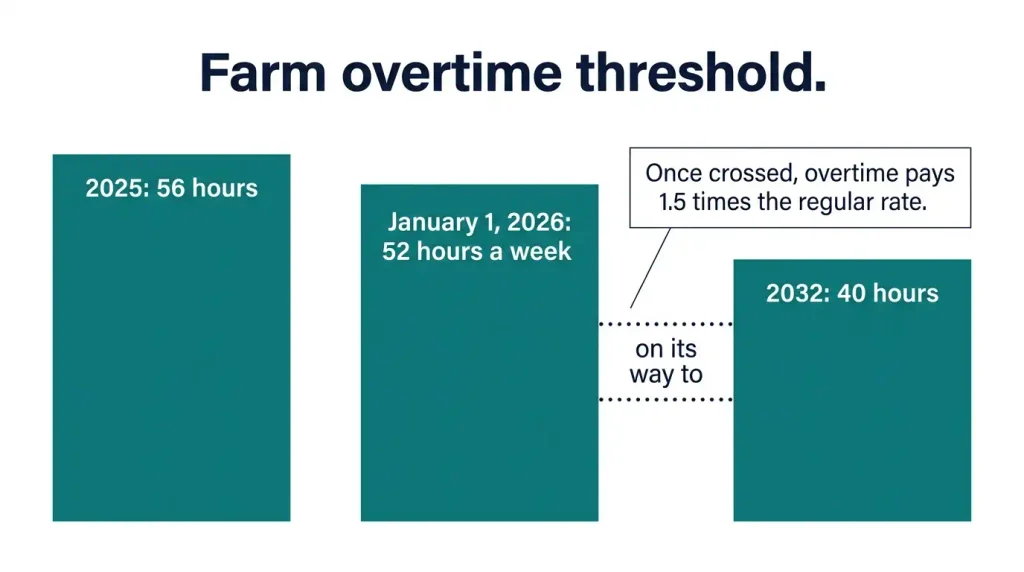
As of January 1, 2026, the farm overtime threshold is 52 hours a week, down from 56 hours in 2025, on its way to 40 hours by 2032. Once crossed, overtime pays 1.5 times the regular rate. Separately, a farm laborer who volunteers to work the day of rest must be paid at least 1.5 times the regular rate for all hours worked that day, whatever the weekly total. More farm and general overtime rules sit under New York overtime laws.
Current Day-of-Rest Variances
Employers can apply for a variance, but it must be approved first. Applications are filed online through MPWR, the NYS DOL’s portal for day of rest variance and meal period permit applications. The commissioner of labor can grant one when strict compliance would create practical difficulties or unnecessary hardship. The New York State Department of Labor keeps a list of approved variances, which its Day of Rest page showed as updated 09/08/2026, so check for a newer update.
What a Variance Can Change
An approved variance can permit employees to work seven days in a calendar week without the 24 hour break, but only under the conditions it lists for that employer, such as a maximum number of consecutive workdays. Always check the specific employer and location named.
How to Verify a 2026 Variance
Find the current NYS DOL approved variance list, match the employer and location, confirm the effective period, and check which worker categories it covers.
Common Myths About New York Day of Rest Laws
Most myths mix up Sunday, overtime, or salary with the 24 hour rest rule, so each one is corrected below.
Myth: Every New York Employee Must Have Sunday Off
False. Employers can designate a different day with proper advance notice.
Myth: Nobody Can Work Seven Days in a Row
False. Calendar week boundaries mean seven consecutive calendar days can straddle two legal weeks, each satisfying its own rest requirement, and approved variances add more flexibility.
Myth: Overtime Pay Makes Seven-Day Scheduling Legal
False for most employees. Domestic workers and farm laborers have a narrow voluntary work exception tied to overtime pay, but overtime never replaces the day of rest requirement generally.
Myth: Salaried Workers Have No Day-of-Rest Rights
False. Salary status alone does not remove coverage, and overtime exemption is a separate legal test.
Myth: Any 24-Hour Gap Between Shifts Is Automatically Enough
Not quite. Calendar week placement still matters, and overnight or split schedules can make a gap look sufficient when it is not.
Myth: A Lunch Break Counts as the Weekly Day of Rest
No. Meal periods and weekly rest come from different sections, and the duration difference alone rules this out.
What Employers Must Do Under Section 161
Employers carry specific obligations here too, and more of them sit under New York payroll and employer compliance.
Designate the Day of Rest
Employers must designate a specific day as the required rest day, commonly called the designated day of rest, and give advance notice, especially when operating on Sunday. That day must run a full uninterrupted 24 hours. Once designated, an employee cannot be permitted to work it, except domestic workers and farm laborers who volunteer and are paid the overtime rate.
Keep Required Time Records
Employers must keep accurate time records, sometimes called an employer time book, including employee names, addresses, and daily hours worked. These records matter most when a dispute arises. They also sit alongside other filing duties, such as New York payroll tax deadlines.
Follow Approved Variance Conditions
A variance only protects an employer once approved, and its exact conditions and effective dates must be followed. Relying on an unapproved or expired variance is a real legal risk.
New York Day of Rest Exceptions and Exemptions
The statute carves out several narrow exceptions.
| Exception | Condition |
|---|---|
| Foreman in charge | Real responsibility for operations, not just a title |
| Small milk processing | Seven or fewer employees |
| Continuous industrial process | No employee works more than eight hours in any calendar day, with state board approval |
| Bakery | Three hours of Sunday work, for setting sponges, maintaining fires, and necessary repairs |
| Resort or seasonal hotel or restaurant | Rural community, or city or village under fifteen thousand inhabitants, and either open no more than four calendar months and fifteen days a year (resort) or staffing up at least 100 percent from slack to busiest season (seasonal) |
| Dry dock ship repair | Ship repair work only |
Foreman in Charge Exception
A genuine foreman in charge of operations can fall outside Section 161, but this depends on actual responsibility, not a supervisor sounding title.
Small Milk Processing Establishment Exception
Small milk processing operations, such as condenseries or bottling plants, are excluded when they employ seven or fewer people. This exception is tied to the establishment, not the industry generally.
Continuous Industrial or Manufacturing Processes
Continuous industrial processes can be excluded, but only where no employee works more than eight hours in any calendar day, and only with state board approval.
Limited Sunday Work in Bakeries
Bakeries get a narrow three hour limit on permitted Sunday work, covering setting sponges, maintaining fires, and necessary boiler or machinery repairs only.
Resort and Seasonal Hotels and Restaurants
Resort or seasonal hotels and restaurants in rural communities, and in cities and villages under fifteen thousand inhabitants, are excepted. An establishment is a resort if it operates no more than four calendar months and fifteen days a year, and seasonal if staffing rises at least 100 percent (doubles) from the slack to the busiest season.
Dry Dock Ship Repair Employees
Workers doing dry dock ship repairs get their own specific exception, distinct from ordinary manufacturing.
What to Do If You Think Your Employer Violated the Law
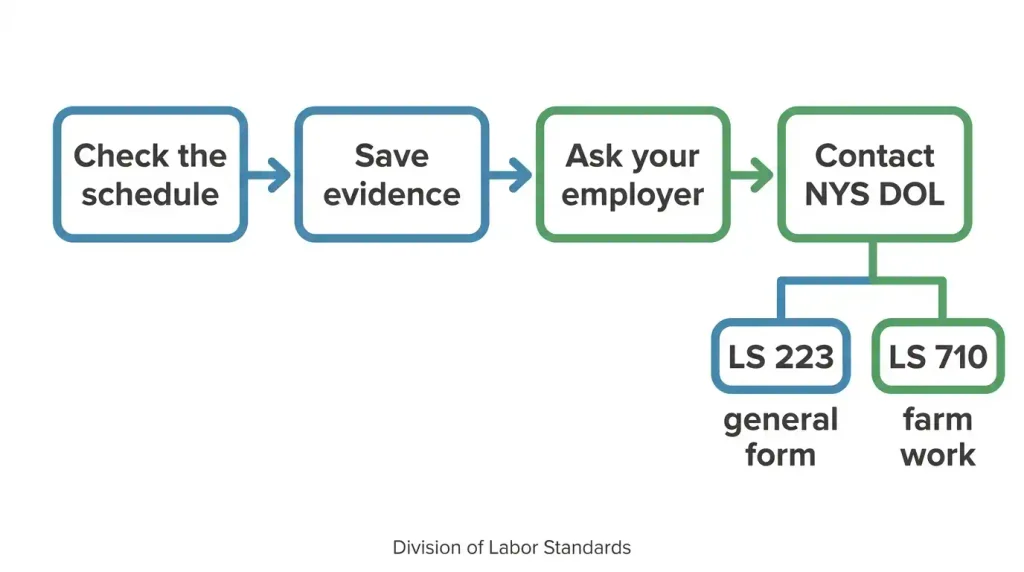
Work through these steps in order: check the schedule, save evidence, ask your employer, then contact NYS DOL.
Check Your Schedule Before Making a Complaint
Map the calendar week from Sunday through Saturday, record every start and end time, find the actual 24 hour rest period if one exists, and confirm your job and workplace type.
Save Evidence of the Schedule
Keep posted schedules, time clock records, manager texts or emails about scheduling, and pay records showing overtime or rest day pay, which are easier to check once you know how to read a New York pay stub.
Ask Your Employer the Right Questions
Ask which day is your designated rest day, whether an exception applies to your role, and whether the company holds an approved variance. Request written clarification when answers feel vague.
When to Contact the New York State Department of Labor
The Division of Labor Standards, part of New York labor standards enforcement, handles these complaints. The Labor Standards Complaint Form LS 223 is the general form most workers use. New York Labor Law Section 215 protects you from retaliation, so an employer cannot legally punish you for raising a Section 215 retaliation issue. You can report it as a non-wage complaint on LS 223, with LS 223.2 as the instructions to read first, or through the NYS DOL’s dedicated NYS Retaliation Complaint Form.
What to Include With a Complaint
Include the employer’s name and workplace location, specific dates and schedule worked, total hours, and any supporting records.
Farm Worker Complaint Forms
Farm workers use a separate process. LS 710 applies specifically to farm labor rest day disputes, not the general LS 223 process.
New York Day of Rest Law Questions Workers Ask
Short answers to the ten questions readers ask most, each tied to Section 161.
Does New York require one day off every week?
Yes, for covered workers, New York requires at least 24 consecutive hours of rest each calendar week, under Section 161, though exceptions and variances can change the details.
Can an employer make you work 7 days straight in New York?
Sometimes, if those seven days span two calendar weeks, each with its own valid rest period, and Section 161 coverage applies to that job.
Does New York law require Sunday off?
No. Employers can designate a different day with advance notice.
What counts as 24 consecutive hours of rest?
One truly uninterrupted 24 hour block with zero work, placed somewhere in the calendar week, separate from ordinary meal breaks.
Does overtime pay replace a required day of rest?
No, not for general employees. Domestic workers and farm laborers have a narrow voluntary work exception tied to overtime pay.
Do salaried employees get a day of rest?
Yes. Salary status alone does not remove Section 161 coverage, since coverage depends on job and industry, not pay structure.
Can a domestic worker voluntarily work on the day of rest?
Yes, if paid overtime for every hour worked. They also earn three paid rest days annually after one year with the same employer.
Can a farm worker work on the designated day of rest?
Yes, voluntarily, if paid the overtime rate, connected to New York’s 2026 farm overtime threshold changes.
Can an employer get permission for a different schedule?
Yes, through an approved day of rest variance from the New York State Department of Labor, with conditions attached to each approval.
What can I do if my employer does not give me a day of rest?
Document your schedule and records, ask your employer for clarification, and file a complaint using LS 223, or LS 710 for farm work.
New York Day of Rest Law: Practical Schedule Checklist
A short, practical checklist to review before assuming a violation.
Five Things to Check Before Deciding There Is a Violation
- Your exact job title and daily duties
- Your employer’s establishment type, like factory, hotel, or retail store
- The full Sunday through Saturday calendar week in question
- Whether one true 24 hour rest block exists somewhere in that week
- Whether any statutory exception or approved variance applies
Records to Keep
- Posted work schedules
- Clock in and clock out records
- Pay stubs showing hours and any overtime
- Messages from a manager about scheduling changes
Questions to Ask Before Filing a Complaint
- Is my specific job covered under Section 161 at all?
- Does a statutory exception apply to my establishment?
- Does my employer hold an approved variance?
- Is there genuinely no 24 hour rest period anywhere in my calendar week?
Official New York Sources for Day of Rest Rules
Where this law’s text and current guidance live, straight from the state.
New York Labor Law Section 161
This is the statutory text creating the one day rest in seven requirement, listing covered establishments, occupations, and exceptions.
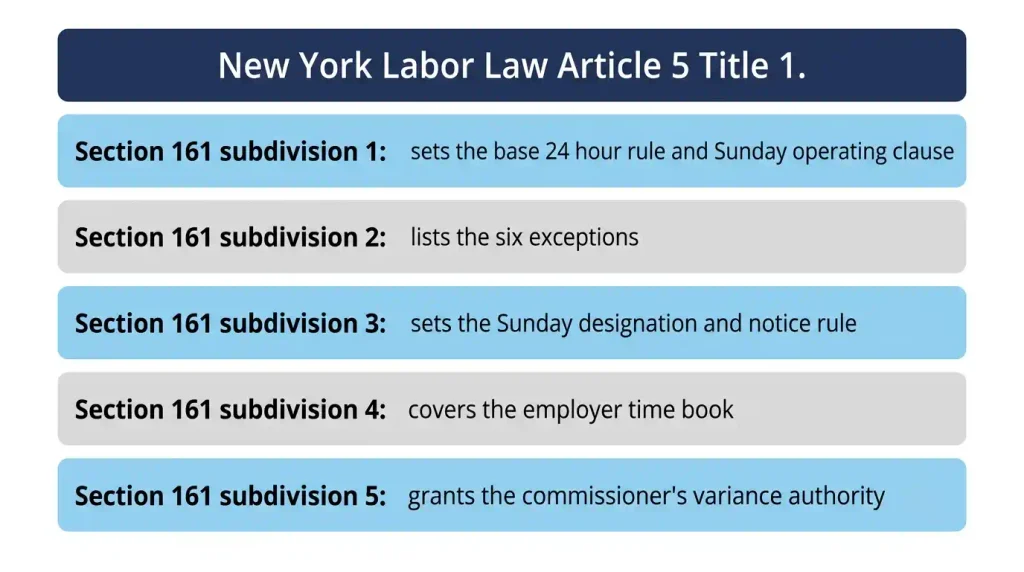
Section 161 sits inside New York Labor Law Article 5 Title 1, the General title of the Hours of Labor article. Section 161 subdivision 1 sets the base 24 hour rule and Sunday operating clause, covering factories, mercantile stores, hotels, restaurants, elevators, motion picture and theater workers, building staff, and domestic and farm workers. Section 161 subdivision 2 lists the six exceptions covered in the exceptions section above. Section 161 subdivision 3 sets the Sunday designation and notice rule, Section 161 subdivision 4 covers the employer time book, and Section 161 subdivision 5 grants the commissioner’s variance authority. Find the exact text through NY Senate Open Legislation on the New York State Senate’s official site, part of NY.gov. Some categories also fall under New York Wage Orders, the same framework behind New York minimum wage rules: the Hospitality Industry Wage Order, Farm Workers Wage Order, Building Service Industry Wage Order, and Miscellaneous Industries Wage Order.
New York State Department of Labor Day of Rest Guidance
The NYS DOL publishes plain language guidance on this rule, referenced as LS 611, including current variance information and complaint instructions.
Current 2026 Variance Information
The NYS DOL approved variance list is the definitive source for current exceptions. Match it to your specific employer and check effective dates and covered workers.
Key Takeaways for a New York Worker
Check coverage first, then find your 24 hour block, then act if it is missing.
The Rule in One Sentence
Covered New York employees get at least 24 straight hours of rest every calendar week under Section 161, though coverage and exceptions vary by job and industry.
What to Check on Your Own Schedule
Confirm your workplace and job category, locate the 24 hour rest block, check for exceptions or a variance, and keep your records saved.
What to Do When the Schedule Still Looks Wrong
Ask your employer which day is your designated rest day, document everything, contact the New York State Department of Labor if needed, and file through LS 223, or LS 710 for farm work.
To see how extra or missed hours change your take-home, use our New York paycheck calculator. For related guides, browse the blog or our New York wages and wage laws section. This guide is general information, not legal advice, so see our disclaimer.

Meet Yasin Ali, Founder
Yasin built NY Paycheck Calculator in 2020 after getting fed up with calculators that treated New York like every other state. Most tools ignore the extra local tax NYC and Yonkers workers pay on top of state tax — or skip New York’s Paid Family Leave deduction entirely.
He keeps the numbers current, checking in regularly against the latest IRS, NY Department of Taxation and Finance, and Paid Family Leave rates.
All results here are estimates based on official sources. For advice specific to your situation, talk to a tax professional.