
New York overtime laws require non-exempt employees to earn 1.5 times their regular rate after 40 hours in a single workweek, with narrower exceptions for farm, residential, and a few other specialized roles.
That 40-hour standard comes from Section 651 of the New York Labor Law, layered with 2026 salary thresholds up to $66,300 for exempt roles.
Exemptions and industry-specific rules mean the headline rate does not apply to everyone.
New York Overtime Laws in 2026 at a Glance
| At a Glance | 2026 Rule |
|---|---|
| Farm worker threshold | 52 hours per workweek |
| Residential/live-in threshold | 44 hours per workweek |
The sections below cover exemptions, calculations, and industry-specific rules in detail.
The basic overtime rule for most New York workers
Non-exempt employees earn time and a half for every hour past 40 in a workweek, based on their regular rate, which can exceed their posted wage. Scheduling long weeks is legal. Not paying the eligible hours at the higher rate is not. This rule is one piece of the wider New York paycheck basics every worker should understand.
Who is covered and who may be exempt
Non-exempt employees get overtime, exempt employees do not. Classification depends on duties and pay, not title, under the Fair Labor Standards Act and New York Labor Law, with New York often stricter. Executive, administrative, professional, outside sales, and some computer roles can be exempt. Independent contractors fall outside overtime law, but misclassifying an employee as one does not erase what is owed. Part-time, temporary, seasonal, and probationary workers all qualify under the same 40-hour rule. Minors follow separate child labor hour limits on top of overtime rules. For more on employer duties in this area, our New York payroll and employer compliance hub covers related rules in depth.
The 2026 rules that changed or deserve special attention
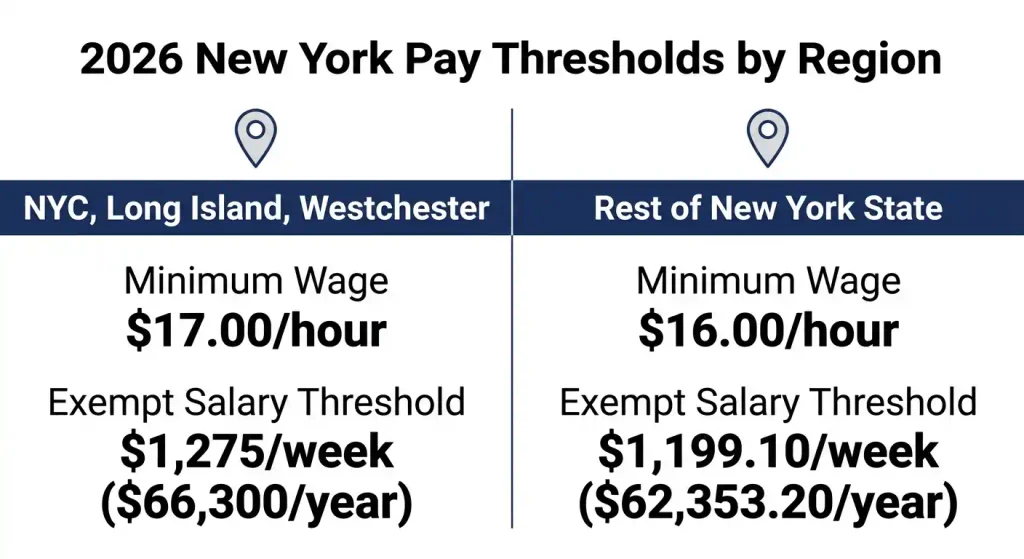
Farm workers hit a new 52-hour threshold starting January 1, 2026. Executive and administrative salary thresholds rose to $66,300 a year in New York City, Long Island, and Westchester, and $62,353.20 elsewhere. Location sets both minimum wage and exemption threshold. Hospitality and building service employees also follow their own wage orders.
Quick 2026 overtime examples
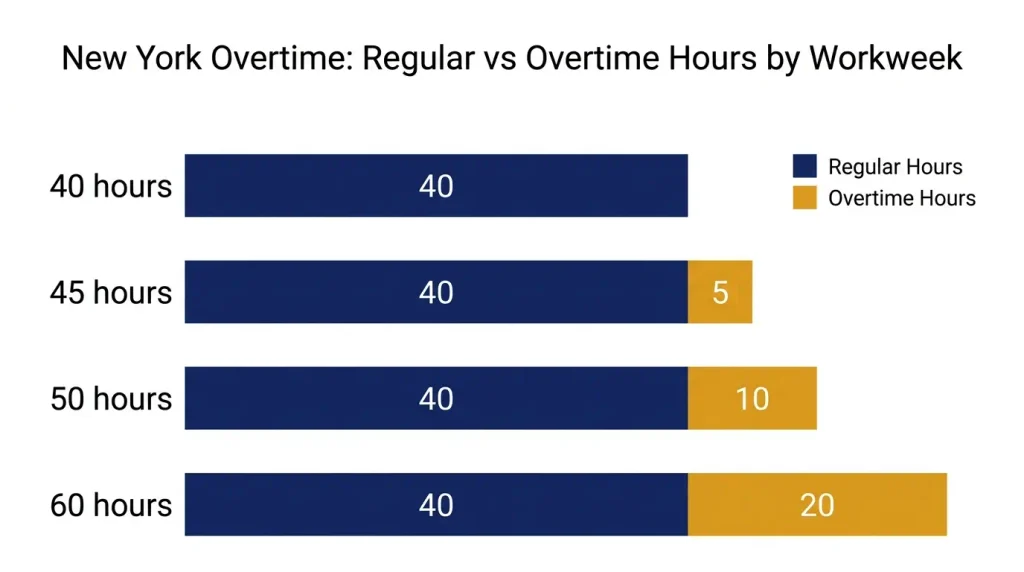
40 hours: straight pay only. 45 hours: 40 regular plus 5 overtime. 50 hours: 40 regular plus 10 overtime. 60 hours: 40 regular plus 20 overtime, nearly doubling those extra hours’ value. Non-exempt workers get paid for every overtime hour. Properly classified exempt workers get none.
When Does Overtime Start in New York?
Overtime starts after 40 hours in a workweek for covered employees. There is no daily trigger, and the count resets weekly.
Does overtime start after 40 hours?
Yes, for most employees. It runs on a fixed, recurring seven-day workweek and only covers non-exempt employees. Actual hours worked count, not scheduled hours.
Does New York require overtime after 8 hours a day?
No. Overtime is weekly, not daily. A 12-hour shift owes nothing extra if the week stays under 40 hours. A narrow exception applies to some prevailing-wage building service contracts. A double shift in one day also does not trigger overtime unless the week passes 40 hours.
What counts as a workweek?
A fixed, recurring seven-day period the employer sets. It need not run Sunday to Saturday. Overtime never averages across weeks: a 38-hour week followed by a 42-hour week still owes 2 overtime hours for the second week alone. Changing the workweek without good reason can draw NYSDOL scrutiny.
Do Saturday, Sunday, holidays, or night shifts automatically create overtime?
No. Only total weekly hours past 40 trigger overtime, regardless of the day. Some employers pay weekend or holiday premiums voluntarily. Separately, New York’s day of rest law requires many factory and mercantile employers to give 24 consecutive hours of rest each calendar week, a scheduling rule, not an overtime rule.
How Much Is Overtime Pay in New York?
Overtime pay is 1.5 times your regular hourly rate for hours past 40 in a workweek. That rate is not always your posted wage.
How to calculate overtime at 1.5 times your regular rate
Multiply your regular rate by 1.5 for the overtime rate. Pay the first 40 hours at your regular rate and the rest at the overtime rate, then add both for gross weekly pay. For an exact figure, run your hours through our New York paycheck calculator.
New York overtime examples by hourly wage
| Regular Rate | Overtime Rate (1.5x) |
|---|---|
| $15/hour | $22.50/hour |
| $20/hour | $30/hour |
| $25/hour | $37.50/hour |
| $30/hour | $45/hour |
That extra half sits on top of your straight-time hourly rate. It is owed, not a bonus.
Example: Working 45 hours at $20 per hour
40 hours at $20 is $800. 5 overtime hours at $30 add $150. Total: $950, not $900.
Example: Working 50 hours at $25 per hour
40 hours at $25 is $1,000. 10 overtime hours at $37.50 add $375. Total: $1,375, versus $1,250 at straight time, a $125 gap. That $1,375 is your gross number; see gross pay vs net pay in New York for how deductions bring it down to what actually hits your bank account.
What happens when your regular rate is not simply your hourly wage?
Multiple hourly rates, commissions, piece rates, or certain bonuses raise your true regular rate. New York and federal law require a blended, weighted rate based on total earnings divided by hours worked, a common source of employer error.
What Is the Regular Rate of Pay for Overtime?
Your regular rate, not just your posted wage, is what overtime should be based on.
Why the regular rate matters
Commissions, bonuses, shift differentials, and multiple rates can raise your true regular rate above your advertised wage. This differs from minimum wage, a legal floor. Get the regular rate wrong, and overtime is wrong too.
Employees paid at different hourly rates
Working $18 an hour and $22 an hour tasks in the same week requires a weighted regular rate. At 30 hours at $18 and 15 hours at $22 in a 45-hour week, that blended rate exceeds $18 and should set the overtime rate. Two jobs for the same employer combine toward the same 40-hour threshold. Two separate employers generally calculate overtime independently unless they are joint employers.
Bonuses and overtime calculations
Discretionary bonuses generally do not affect the regular rate. Nondiscretionary ones, like a production bonus, do, and get folded into earnings before recalculating the rate. A $200 weekly production bonus should raise your overtime rate.
Commissions, piece rates, day rates, and other pay methods
Commission, piece-rate, day-rate, shift-rate, and flat weekly-rate pay do not exempt you from overtime. New York requires a calculated regular rate from total earnings divided by hours worked, with exceptions for some commissioned salespeople. Pay method alone never decides exemption. Duties and total pay do.
Are Salaried Employees Entitled to Overtime in New York?
Yes, in most cases. Salary alone does not make you exempt.
Does being salaried automatically mean no overtime?
No. Exemption needs both a salary threshold and a duties test. Employers sometimes wrongly assume salary equals exempt, costing workers thousands. Employers also cannot substitute comp time for overtime wages, and a flat salary “including” overtime only works if the math hits at least time and a half for every qualifying hour. Any deduction taken from that pay still has to follow standard New York paycheck deduction rules.
New York 2026 salary thresholds for executive and administrative exemptions
As of January 1, 2026:
| Region | Weekly Threshold | Annual Threshold |
|---|---|---|
| Most of the state | $1,199.10 | $62,353.20 |
| NYC, Nassau, Suffolk, Westchester | $1,275 | $66,300 |
Work location decides which applies. Meeting the salary number alone does not complete the exemption.
Executive, administrative, and professional exemptions
Executive exemption: managing a department or team as primary duty. Administrative exemption: office or non-manual work tied to business operations, with real independent judgment. Titles like “manager” prove nothing. Actual duties do. The professional exemption has no separate New York minimum salary, so the federal salary threshold of $684 a week, or $35,568 a year, along with the federal duties test, controls that category instead.
Federal FLSA exemptions versus New York exemptions
When federal and state rules disagree, the stronger protection applies. A $900-a-week NYC manager could be exempt under lower federal thresholds but not under New York’s higher one, so overtime is still owed. A valid FLSA overtime exemption still requires meeting the federal duties test regardless of the salary threshold.
Which New York Workers Have Special Overtime Rules?
Some industries and roles follow thresholds different from the standard 40-hour trigger.
Farm workers and the 2026 52-hour overtime threshold
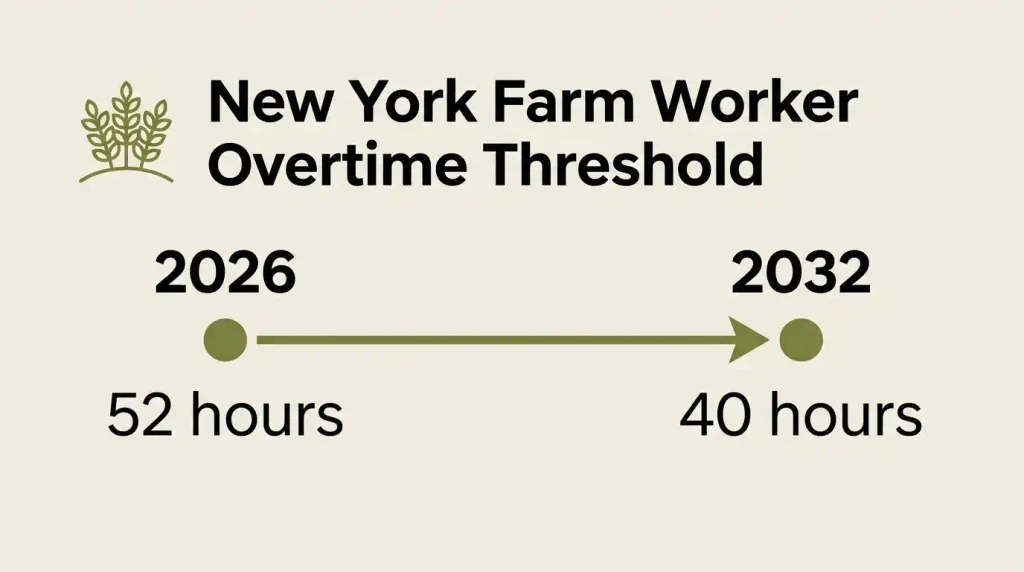
Since January 1, 2026, farm workers earn overtime after 52 hours, not 40, under the Farm Laborers Fair Labor Practices Act, passed by the New York State Legislature in 2019, phasing down to 40 hours by 2032, as tracked on the NYSDOL Farm Laborers Wage Board page. They also earn overtime for hours worked on their designated day of rest.
Residential and live-in employees
Live-in employees earn overtime after 44 hours, not 40. A live-in aide working 48 hours is owed 4 overtime hours at 1.5 times their rate. Domestic workers who do not live in, like most nannies and home care aides, follow the standard 40-hour rule.
Restaurant and hotel employees
Covered under the Hospitality Industry Wage Order, with overtime after 40 hours. Tips do not remove the overtime requirement. Workers may also get spread-of-hours pay, also called spread of hours pay, an extra hour at minimum wage when a workday exceeds 10 hours, plus call-in pay for cut shifts. A split shift with an unpaid gap can also trigger spread-of-hours pay if the total span passes 10 hours.
Tipped employees
Tipped workers earn overtime after 40 hours, calculated on the full minimum wage before the tip credit, not the lower cash wage. In 2026, tipped food service workers in New York City, Long Island, and Westchester earn at least $11.35 an hour cash with a $5.65 tip credit. Upstate, $10.70 cash with a $5.30 credit. Tipped service employees, like hairstylists, earn at least $14.15 an hour cash downstate or $13.30 upstate. Tip rules come from New York Labor Law Section 196-d. Tips never replace overtime.
Fast-food workers
Fast-food employees at covered chains earn overtime after 40 hours. New York’s rules for Fast Food Workers cover chains with 30 or more locations nationally. Since January 1, 2025, fast-food minimum wage matches the standard regional rate, so in 2026 it is the same $17.00 or $16.00, with no tip credit. Spread-of-hours and call-in pay can also apply.
Building-service employees
Building service workers fall under the Building Service Industry Wage Order and generally earn overtime after 40 hours. Some public-building prevailing wage contracts can add daily overtime provisions.
Public employees, union workers, and workers covered by special agreements
Public sector employees generally fall outside New York’s state overtime law but often keep federal FLSA protections. Union contracts can offer more generous terms but cannot legally waive overtime rights.
What Counts as Hours Worked for New York Overtime?
Hours worked covers more than your scheduled shift, including waiting time and on-call time when you are too restricted to use it freely.
Work performed before clocking in or after clocking out
Prep work, closing duties, and other required tasks before or after your shift count, even without formal authorization, if your employer knew. Rounding time records in small, consistent increments is allowed. Shaving hours or altering records is not, and being told off-the-clock work is “your responsibility” does not make it legal.
Meal breaks and short breaks
Unpaid meal periods do not count if you are genuinely relieved of duty. Working through one does count. Short breaks under 20 minutes are typically paid. Watch for automatic meal deductions that do not match reality.
Training, meetings, and required work activities
Mandatory meetings and required training count as compensable time, even outside your normal shift, if attendance was required.
Travel, remote work, and after-hours messages
Commuting is not paid. Work-related travel during the day usually is. Required or expected remote work after hours, like answering emails or calls, counts and often goes untracked.
Can Your Employer Require You to Work Overtime?
Yes. New York does not stop employers from requiring overtime, as long as it is paid correctly.
Can an employer require overtime?
Most employers can require overtime with no general cap on hours. Scheduling and pay are separate: employers can require extra hours but must pay the correct rate. Nursing is an exception. New York generally bars healthcare employers from forcing mandatory nurse overtime beyond a scheduled shift except in genuine emergencies. Outside protected categories, refusing required overtime can bring discipline, and no advance notice is required.
Does unauthorized overtime still have to be paid?
Yes, if the employer knew or should have known. Discipline for unapproved work is separate from the legal duty to pay for it.
Can your employer average your hours over two weeks?
No. Overtime runs workweek by workweek. 35 hours one week and 45 the next still owes 5 overtime hours, even at a two-week average of 40. Biweekly pay does not change the underlying weekly math.
New York Overtime vs Federal Overtime Rules
Both laws apply to most workers. Whichever protects the employee more controls.
What New York law requires
Requirements come from Section 651 of the New York Labor Law and several wage orders. State thresholds run higher than federal in 2026. Farm and residential workers follow separate state thresholds.
What the FLSA requires
The Fair Labor Standards Act requires overtime after 40 hours for covered non-exempt employees nationwide, with its own exemptions and regular-rate rules. The U.S. Department of Labor’s Wage and Hour Division enforces it federally.
When state and federal rules overlap
Most workers are covered by both. The stronger protection wins, usually New York’s higher thresholds. Some occupations and wage orders exist only under state law.
New York Minimum Wage and Its Effect on Overtime in 2026
Work location sets your minimum wage and your exemption threshold. The New York State minimum wage is not one flat number. It is regional.
2026 minimum wage by New York region
As of January 1, 2026, minimum wage varies by region:
| Region | 2026 Minimum Wage |
|---|---|
| New York City | $17.00/hour |
| Long Island | $17.00/hour |
| Westchester | $17.00/hour |
| Rest of state | $16.00/hour |
The $17 minimum wage NYC 2026 rate covers those three regions, and the $16 minimum wage New York 2026 rate covers everywhere else. Regional differences carry over to taxes too; see New York state tax withholding for how that plays out on a paycheck.
How minimum wage interacts with overtime
Minimum wage is the floor. Overtime is a multiplier on the regular rate. A $17-an-hour NYC worker earns $25.50 an hour overtime, and tipped workers calculate overtime on the full minimum wage before the tip credit, as confirmed on the official NYSDOL minimum wage page.
That overtime figure is still gross pay before deductions. See what taxes come out of a New York paycheck for what is actually left after withholding.
Why the minimum wage matters for exemption thresholds
New York’s executive and administrative exemption thresholds run roughly 75 times the state minimum wage, which is why 2026 landed at $66,300 downstate and $62,353.20 elsewhere. As minimum wage rises, so does the exemption bar.
New York Overtime Rules for Common Work Situations
Here is how a few real situations play out.
You worked 45 hours but your employer paid straight time
You are owed 40 regular hours plus 5 at 1.5 times your rate. Compare against your pay stub, gather time records, ask payroll, and escalate to the state if unresolved.
You worked 50 hours but your manager said overtime was not approved
Approval does not affect pay owed. 50 real hours means 10 overtime hours owed regardless. Keep evidence. Discipline for unapproved hours is separate from your right to be paid.
You are salaried and worked 55 hours
Check your salary against the 2026 threshold for your location, then your duties against the exemption tests. If non-exempt, your effective hourly rate is lower than it looks, plus overtime is separately owed. If your take-home still feels off after that, see why your New York paycheck might be lower for other common causes.
You work in a restaurant and receive tips
Confirm Hospitality Industry Wage Order coverage, identify your cash wage and tip credit, calculate overtime on the full minimum wage, and check spread-of-hours pay if your shift passed 10 hours.
You are a farm worker and worked 55 hours
Only 3 of 55 hours qualify as overtime under the 52-hour threshold. Check separately whether any hours fell on your designated day of rest.
You worked 35 hours one week and 45 the next
Each week is calculated separately: no overtime week one, 5 overtime hours week two. At $20 an hour, those 5 hours pay $150 total, which is $50 more than straight time would have paid, and that premium does not shrink just because the two weeks average out to 40 hours.
Common New York Overtime Myths That Can Cost You Money
A few widely believed myths cause unpaid overtime.
“I’m salaried, so I cannot get overtime.”
False. Salary is a pay method, not an exemption. Both a salary threshold and duties test must be met. A $45,000-a-year rep with no management duties is likely still owed overtime.
“My employer didn’t approve overtime, so they don’t have to pay it.”
False. If the employer knew or should have known, the time is owed. Discipline and pay obligation are separate.
“Overtime starts after 8 hours a day.”
False for most workers. The rule is weekly at 40 hours, with a narrow building-service exception.
“Sunday and holiday work automatically means overtime.”
False. Only total weekly hours past 40 trigger overtime. The calendar date does not matter.
“My employer can average two weeks of hours.”
False. A 30-hour week and a 50-hour week still owe 10 overtime hours for the second week, even at a 40-hour two-week average.
“I signed an agreement giving up overtime.”
False in almost every case. Overtime is a statutory right. Most waivers, including union contracts, cannot erase it.
“Managers never receive overtime.”
False. The executive exemption depends on actual duties, authority, and salary, not title. A “shift manager” doing hourly-staff work may still be owed overtime.
How to Check Whether Your New York Overtime Pay Is Correct
Five quick steps confirm accuracy.
Step 1: Find your employer’s workweek
Identify the actual fixed seven-day period used, not an assumed Monday-to-Sunday default, and compare it to your pay period.
Step 2: Add your actual hours worked
Count all real hours, including required off-shift tasks, meal break discrepancies, and remote work. Track regular and overtime hours separately.
Step 3: Identify your pay method and regular rate
Confirm your base rate, any multiple rates, bonuses, commissions, or tips affecting your true regular rate.
Step 4: Check whether an exemption or special rule applies
Review classification against salary and duties tests, industry wage orders, and special thresholds like the 52-hour farm rule or 44-hour residential rule.
Step 5: Compare the calculation with your pay stub
Line up your hours, rate, and expected gross wages against what your pay stub actually shows. Not sure what each line on that stub means? Our guide on how to read a New York pay stub breaks down every section.
What Should You Do If Your New York Overtime Is Missing?
There is a clear path forward.
Check your paycheck and wage statement
Compare hours, rates, and gross wages against your own math and flag gaps. New York’s Wage Theft Prevention Act, under New York Labor Law Section 195, requires written notice of pay rate at hiring and on changes: Form LS 54 for a single hourly rate, Form LS 55 for multiple hourly rates, Form LS 56 for a weekly rate or salary covering 40 or fewer hours, Form LS 57 for a non-exempt salary, day rate, piece rate, or flat rate covering varying hours, Form LS 58 for prevailing rate and public work jobs, or Form LS 59 for salaried exempt employees. These are separate from your withholding paperwork; see New York W-4 vs IT-2104 for the difference between those forms.
Keep evidence of hours worked
Save schedules, personal time logs, texts, emails, and pay stubs.
Ask payroll or your employer to explain the discrepancy
Point to the specific workweek and numbers in dispute, ask for a written explanation, and keep records of the response.
Filing a wage complaint with New York State
The New York State Department of Labor handles wage complaints and can investigate and pursue recovery. Some workers can also file with the federal Wage and Hour Division, and either route can lead to a lawsuit.
When an unpaid-overtime dispute may require legal advice
Significant or long-running unpaid overtime, suspected misclassification, retaliation, or complex pay situations often warrant an employment attorney.
New York Overtime Penalties, Wage Recovery, and Retaliation
Unpaid overtime is recoverable, and violations carry real consequences.
Can employees recover unpaid overtime?
Yes, through a state wage complaint or lawsuit. Accurate records strengthen the case. Many issues resolve through a simple payroll correction.
What penalties can apply to employers?
New York allows liquidated damages that can double the amount owed, plus interest, under New York Labor Law Section 198. Employers who repeatedly underpay or misclassify workers face escalating exposure, and severe, willful cases can be prosecuted as larceny under New York State Penal Law Section 155.
Can an employer retaliate after an overtime complaint?
No. Wage complaints are protected activity. Retaliation, like termination or demotion, is illegal, and New York’s whistleblower protections cover reporting wage violations even before a formal complaint.
How long can you recover unpaid overtime?
New York allows a six-year lookback for unpaid wages, longer than the two or three years under federal FLSA claims. Filing sooner still matters.
New York Overtime FAQ
Quick answers to the most common New York overtime questions.
How many hours is overtime in New York in 2026?
40 hours generally, 44 for residential employees, and 52 for farm workers as of 2026.
Is overtime after 8 hours or 40 hours in New York?
40 hours for nearly everyone, with a narrow building-service exception.
Is overtime always time and a half in New York?
Yes, 1.5 times the regular rate, calculated for tipped workers on the full minimum wage before the tip credit.
Can a salaried employee get overtime in New York?
Yes, unless both the salary threshold and duties test are met. The 2026 threshold is $1,199.10 per week, or $62,353.20 a year, outside NYC, Long Island, and Westchester, and $1,275 per week, or $66,300 a year, within them.
What is the 2026 overtime threshold for farm workers in New York?
52 hours a week, plus overtime for hours on the designated day of rest, phasing down to 40 hours by 2032.
Does working on Sunday or a holiday mean overtime in New York?
No. Only total weekly hours past 40 trigger it.
Does an employer have to pay unauthorized overtime?
Yes, if the employer knew or should have known.
Can an employer average hours between two weeks?
No. Each workweek is calculated independently.
Official New York Overtime Resources and 2026 Sources
Official sources to confirm New York and federal overtime rules.
New York State Department of Labor overtime resources
The NYSDOL publishes overtime FAQs, wage orders, minimum wage schedules, and complaint instructions through its New York Division of Labor Standards, sometimes called New York Labor Standards. Its official overtime FAQ page is the most direct primary source for confirming current rules.
New York wage orders and industry-specific rules
Key wage orders: the Miscellaneous Wage Order, Hospitality Industry Wage Order, Farm Laborers Wage Order, and Building Service Industry Wage Order, codified under 12 NYCRR, with Hospitality at 12 NYCRR Part 146 and Farm Laborers at 12 NYCRR Part 190.
Federal overtime resources
The U.S. Department of Labor’s Wage and Hour Division administers the Fair Labor Standards Act federally and publishes U.S. Department of Labor overtime guidance on exemptions and regular-rate calculations.
Key New York Overtime Rules to Remember
The essential facts to remember about New York overtime in 2026.
The general rule
Overtime starts after 40 hours in a workweek at 1.5 times regular pay, for non-exempt employees only. Farm and residential workers follow separate thresholds.
The 2026 exceptions worth checking
Farm workers: 52 hours. Residential and live-in employees: 44 hours. Salary and minimum wage thresholds differ by region. Hospitality and building service jobs carry added wage order rules.
What to check before disputing your paycheck
Confirm your workweek, real hours worked, regular rate, and exempt or non-exempt classification against your pay stub.

Meet Yasin Ali, Founder
Yasin built NY Paycheck Calculator in 2020 after getting fed up with calculators that treated New York like every other state. Most tools ignore the extra local tax NYC and Yonkers workers pay on top of state tax — or skip New York’s Paid Family Leave deduction entirely.
He keeps the numbers current, checking in regularly against the latest IRS, NY Department of Taxation and Finance, and Paid Family Leave rates.
All results here are estimates based on official 2026 sources. For advice specific to your situation, talk to a tax professional.