
New York’s call-in pay law guarantees non-exempt employees a minimum payment when they report for a scheduled shift, even if sent home early. General workers get four hours; hospitality workers follow separate 3/6/8-hour minimums.
That minimum comes from 12 NYCRR Part 142 and Part 146, set at $17.00 or $16.00 per hour for 2026 depending on region.
These minimums don’t guarantee full scheduled hours, cover independent contractors, or override stronger union contract terms.
Does New York Require Employers to Pay Employees Sent Home Early?
Yes, under what’s also called reporting pay or show-up pay. The exact amount owed depends on your industry and your regularly scheduled shift length, covered section by section below.
What Is New York Call-In Pay?
Call-in pay is the minimum money owed for showing up to work, even without finishing the shift. It covers wages for hours actually worked, plus extra pay to reach the minimum.
When Does an Employer Have to Pay Call-In Wages?
Call-in pay applies once you report because your employer asked or allowed it, whether or not they give you work. It also applies if your employer calls you in early or on a scheduled day off. Showing up uninvited doesn’t count.
New York’s 4-Hour Call-In Pay Rule Explained
Under the general Wage Order, reporting for any shift means at least four hours of pay, or your scheduled shift length if shorter. This is the default for most non-hospitality workers.
How the General 4-Hour Rule Works
You get four hours of pay, or your normal shift length, whichever is smaller, paid at the basic minimum hourly wage. This comes from 12 NYCRR Part 142, covering most industries outside hospitality, building services, and a few others.
What Does Regularly Scheduled Shift Mean?
It’s the shift you normally work that day of the week. A shorter regular shift lowers your call-in minimum. A three-hour regular Tuesday shift means three hours owed, not four.
Who Is Covered and Who May Follow Different Rules?
Most workers fall under the Miscellaneous Industries and Occupations Wage Order (CR 142), part of New York’s broader wage and hour laws. Hospitality, building services, and agriculture have separate wage orders. Temporary, seasonal, probationary, and newly hired employees are covered the same as long-term staff. Exempt salaried employees generally fall outside call-in pay; for 2026, exempt status requires at least $1,275 per week in New York City, Long Island, and Westchester County, or $1,199.10 per week elsewhere, under the state’s overtime salary threshold rules. Non-exempt salaried workers still qualify. This guide covers the general and hospitality wage orders only; construction workers follow the separate 2026 Construction Reporting Pay Act.
New York Call-In Pay Rules by Industry: General Workers vs. Hospitality
General workers follow the 4-hour rule under 12 NYCRR §142-2.3. Restaurant and hotel employees follow the Hospitality Industry Wage Order instead, with minimums based on shifts worked.
General Employees: The 4-Hour Rule
Workers under 12 NYCRR §142-2.3 get four hours of pay, or their regular shift length if shorter, at the basic minimum hourly wage.
Restaurant and Hotel Employees: The 3/6/8-Hour Rules
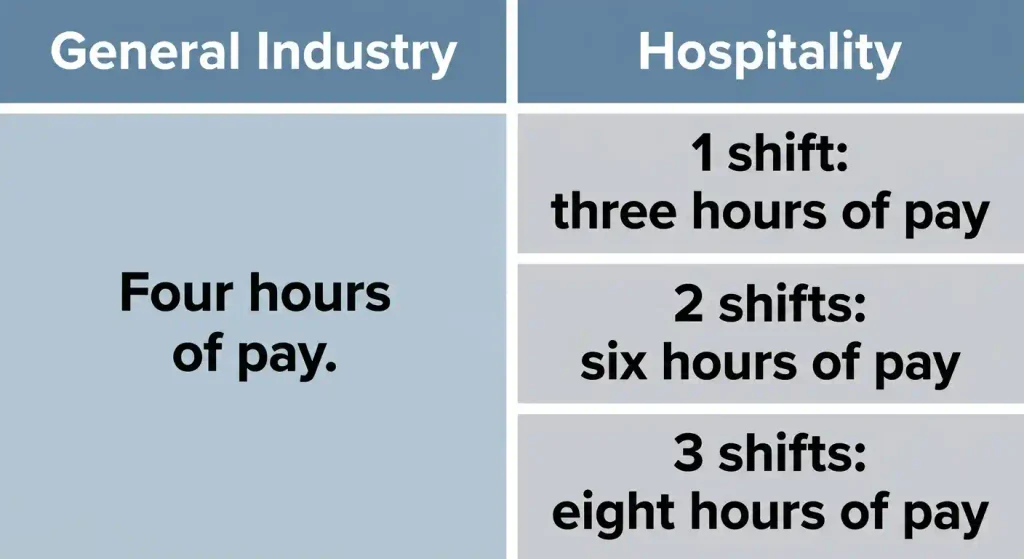
- One shift: three hours of pay, or the scheduled length, whichever is less
- Two shifts totaling six hours or less: six hours of pay
- Three shifts totaling eight hours or less: eight hours of pay
Bars, catering companies, and fast-food restaurants follow this same structure under the Hospitality Industry Wage Order (CR 146).
How Hospitality Call-In Pay Is Calculated
Hours worked are paid at the regular or overtime rate, minus any tip credit. Unworked call-in hours are paid at the full basic minimum hourly wage, with no tip credit and no meal or lodging deduction.
What Is the Difference Between the Two Wage Orders?
The Miscellaneous Industries and Occupations Wage Order (CR 142) uses the flat 4-hour minimum. The Hospitality Industry Wage Order (CR 146), at 12 NYCRR Part 146, uses the 3/6/8-hour tiers. Call-in pay sits at 12 NYCRR § 146-1.5; spread-of-hours sits at 12 NYCRR § 146-1.6. Tip credits and meal credits interact differently with unworked call-in hours between the two orders.
New York Call-In Pay Calculations Using 2026 Minimum Wage Rates
New York’s 2026 minimum wage varies by region, which changes your call-in pay.
What Is New York’s Minimum Wage in 2026?
The New York State minimum wage 2026 schedule, effective January 1, 2026, is set under the New York State Minimum Wage Act (NY Labor Law § 652):
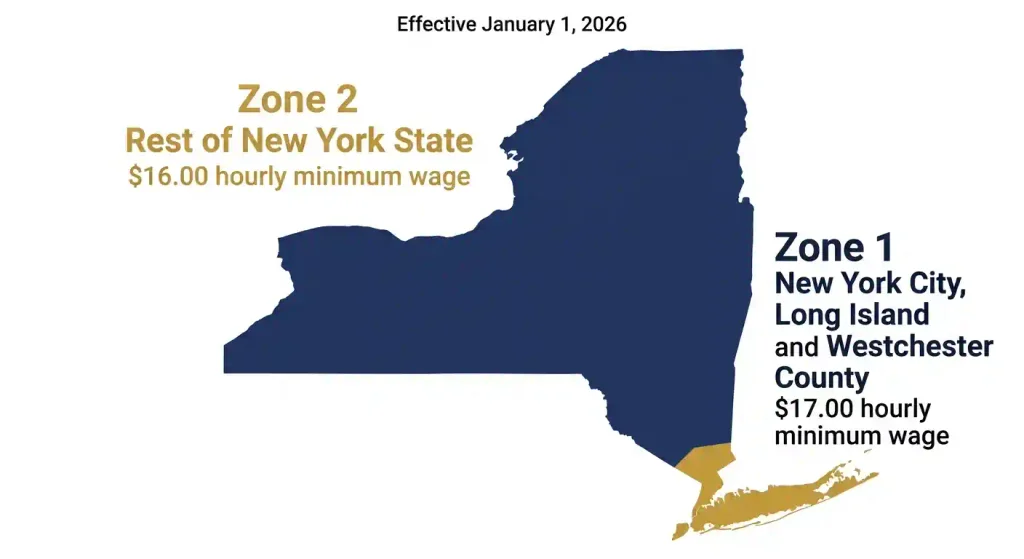
| Region | 2026 Rate |
|---|---|
| New York City minimum wage 2026 | $17.00 hourly minimum wage |
| Long Island minimum wage 2026 | $17.00 hourly minimum wage |
| Westchester County minimum wage 2026 | $17.00 hourly minimum wage |
| Rest of New York State minimum wage 2026 | $16.00 hourly minimum wage |
Hospitality minimum wage rates follow this same split. For the full regional breakdown, see the New York minimum wage guide, or check the official rates on the New York State minimum wage page. Call-in pay for unworked hours always uses this basic minimum wage, never a tipped rate.
General Industry Call-In Pay Examples
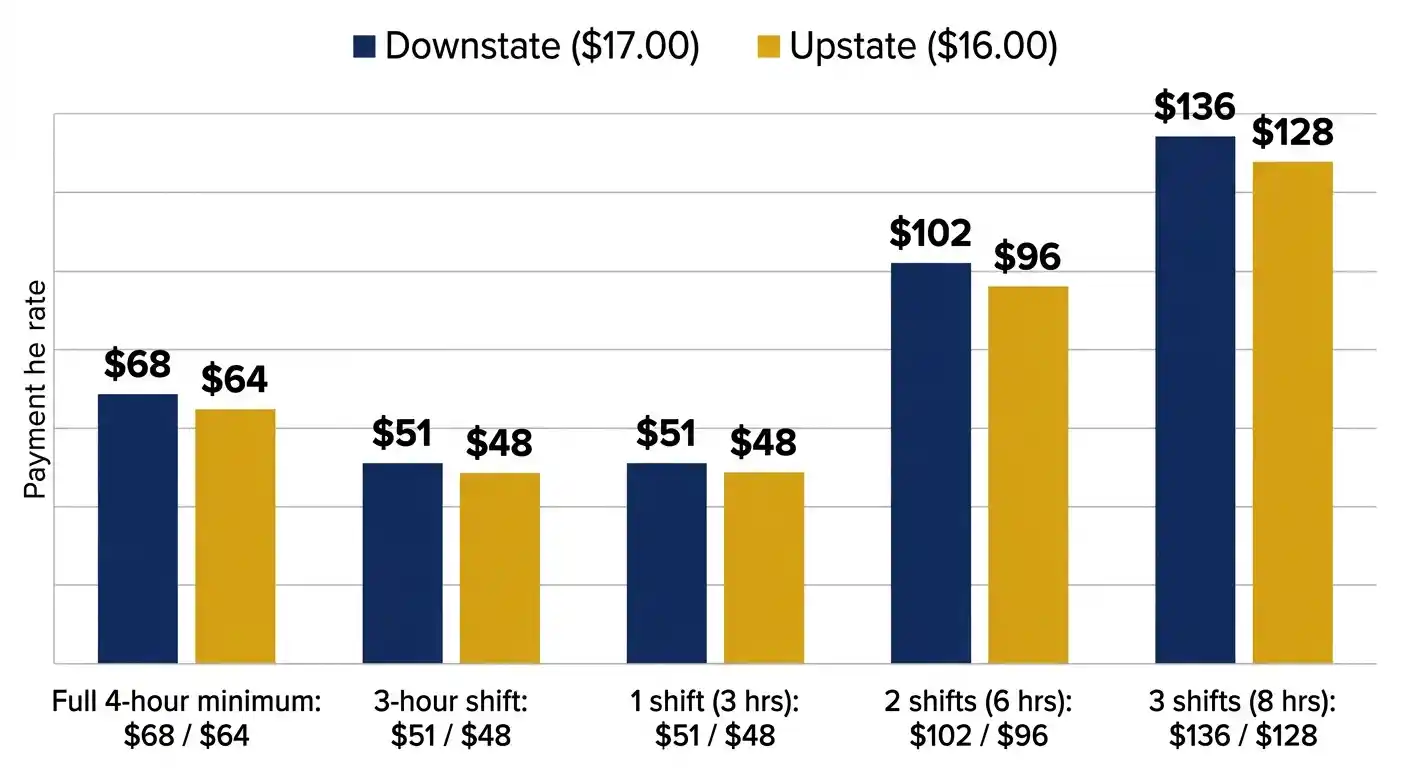
| Scenario | Downstate ($17.00) | Upstate ($16.00) |
|---|---|---|
| Full 4-hour minimum | $68 | $64 |
| 3-hour regular shift | $51 | $48 |
Hospitality Call-In Pay Examples
| Shifts Worked | Downstate ($17.00) | Upstate ($16.00) |
|---|---|---|
| 1 shift (3 hours) | $51 | $48 |
| 2 shifts (6 hours) | $102 | $96 |
| 3 shifts (8 hours) | $136 | $128 |
How Much Should You Receive When You Work Part of a Shift?
Add your actual worked wages to the remaining call-in balance, using the applicable wage rate for each portion. Run the numbers through a New York paycheck calculator and compare the total to your paycheck to spot a shortfall.
What Happens If Your Employer Sends You Home Early?
How much you’re owed depends on hours worked and which wage order applies.
Sent Home After 15 or 30 Minutes
General industry: still triggers the full 4-hour minimum. Hospitality: triggers the 3-hour minimum for one shift.
Sent Home After One or Two Hours
Add actual wages for hours worked to the remaining balance needed to reach your industry’s minimum, then compare to your paycheck.
Sent Home After Three Hours
General industry: one more hour owed, unless your regular shift is exactly three hours. Hospitality, single shift: three hours worked already satisfies the minimum.
Employer Gives You No Work After You Arrive
You’re still owed the full minimum, even with zero hours worked, including when your employer blames low customer demand.
Employer Cuts Your Scheduled Shift Short
Cutting an eight-hour shift to four still satisfies the 4-hour minimum. Cutting a six-hour shift to two still only guarantees four hours total, not six.
Do Tipped Employees Receive New York Call-In Pay?
Yes. Tipped hospitality workers qualify under the same 3/6/8-hour structure, calculated a bit differently.
Call-In Pay Rules for Restaurant Servers and Bartenders
Hours worked are paid at the regular or overtime rate minus tip credit. Unworked call-in hours are paid separately at the full basic minimum wage.
Can Employers Subtract a Tip Credit?
A tip credit applies only to hours actually worked, never to unworked call-in hours, which get the full basic minimum wage. See the tipped employee minimum wage breakdown for exact cash wage and credit amounts. This applies to tipped food service workers and tipped service employees alike. The customary and usual tip credit only offsets actual worked time.
Can Employers Deduct Meals or Lodging?
No. Meal or lodging allowances cannot offset call-in pay, regardless of other wage credits in play.
When Does New York Call-In Pay Not Apply?
Call-in pay has real limits worth knowing.
Your Employer Cancels the Shift Before You Arrive
If cancelled before you report, standard state call-in pay usually doesn’t apply. NYC retail or fast-food workers may still have Fair Workweek protections.
You Voluntarily Visit the Workplace
Showing up without being asked or permitted doesn’t trigger call-in pay.
Your Regularly Scheduled Shift Is Shorter Than the Minimum
A fixed two- or three-hour shift lowers the minimum to match, in both general industry and hospitality.
Your Employer Changes Your Schedule Every Week
With irregular or rotating schedules, the full 4-hour or 3/6/8-hour minimums usually apply, since there’s no fixed shorter shift to fall back on.
Other Situations That Need Separate Legal Analysis
Emergencies, severe weather, power outages, equipment failures, unexpected shutdowns, collective bargaining terms, and other industry-specific wage orders can change the outcome and need a closer look.
New York Call-In Pay Laws vs. NYC Fair Workweek Laws
NYC scheduling laws, covered in detail in our NYC Fair Workweek Law guide, apply alongside state call-in pay rules, not instead of them.
NYC Retail Employee Scheduling Protections
The New York City Fair Workweek Law for Retail Employers, covering retail employers with 20 or more employees, requires schedules at least 72 hours in advance, restricts on-call shifts, and penalizes last-minute cancellations.
NYC Fast-Food Employee Scheduling Protections
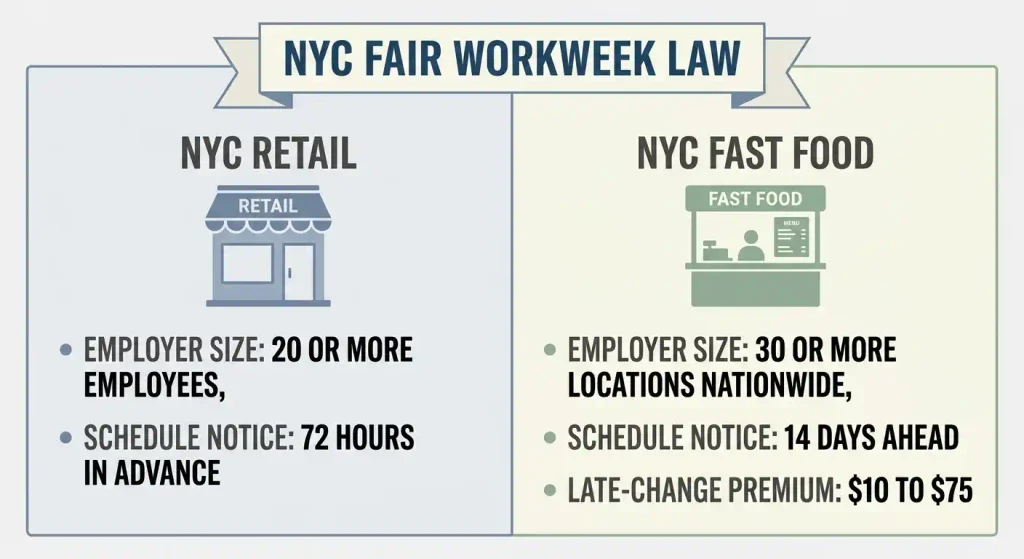
The New York City Fair Workweek Law for Fast Food Employers, covering chains with 30 or more locations nationwide, requires schedules posted at least 14 days ahead, per the NYC Department of Consumer and Worker Protection, with premiums of about $10 to $75 for late changes, plus clopening protections.
Does Fair Workweek Pay Replace Call-In Pay?
No. Fair Workweek premiums are separate from state reporting pay. Both can apply to the same situation.
What About Employees Outside New York City?
Geographically, state call-in pay protections apply statewide, but NYC’s Fair Workweek laws, part of the city’s worker pay and labor rules, don’t reach outside the five boroughs.
Call-In Pay vs. Other New York Wage and Scheduling Protections
Call-in pay is one piece of a larger wage and hour framework.
Call-In Pay vs. Spread-of-Hours Pay
Spread-of-hours pay (also known as spread of hours pay) pays an extra hour at minimum wage when your workday spans more than 10 hours. It’s different from a New York minimum daily pay guarantee or a union contract’s guaranteed weekly hours. Both can apply to the same workday.
Call-In Pay vs. Overtime Pay
Overtime applies once you’ve actually worked over 40 hours a week, under New York’s own overtime laws. Unworked call-in hours don’t count toward that threshold, but worked hours during a call-in shift still earn overtime if they push you past 40.
Call-In Pay vs. On-Call Pay
On-call pay covers staying available without reporting; call-in pay requires actually reporting. The federal Fair Labor Standards Act (FLSA) doesn’t require reporting time pay at all; this protection exists only under New York State law.
Common Myths About New York Call-In Pay Laws
Confusion usually comes from applying one wage order’s rule to a job covered by another.
Does Every Employee Automatically Receive Four Hours of Pay?
No. Four hours applies only to general industry under Part 142. Hospitality follows 3/6/8-hour tiers instead.
Does an Employer Have to Pay Four Hours Whenever a Shift Is Cancelled?
Not automatically. State call-in pay generally requires that you actually reported. NYC Fair Workweek rules may still apply for retail or fast food.
Does an Employee Have to Work Four Hours to Receive Four Hours of Pay?
No. You can work zero hours and still be owed the full minimum for your industry.
Can Employers Use Tip Credits to Reduce All Call-In Pay?
No. Tip credits apply only to hours worked, never to the unworked call-in portion.
What to Do If Your Employer Does Not Pay Required Call-In Wages
Check Your Work Schedule and Pay Stub
Compare your scheduled shift to actual attendance and your pay stub. Under the New York Wage Theft Prevention Act, wage statements must meet specific wage statement requirements that break down hours and rates clearly enough to spot a shortfall.
Collect Evidence of Your Reporting and Dismissal
Save schedules, timecards, clock-in records, texts or emails about cancellations, pay stubs, and any employer communication.
Ask Your Employer for the Missing Wages
Point to the specific call-in pay provision and your calculation, ideally in writing, and keep a record of the response. If wages stay unpaid, our paycheck not received guide covers the next steps in more depth.
How to File a Wage Complaint in New York
- File with the New York State Department of Labor, specifically the New York State Division of Labor Standards, using their wage complaint forms
- Attach your documentation, such as schedules, pay stubs, and employer communications
- NYC workers can also file with the NYC Department of Consumer and Worker Protection (DCWP) for Fair Workweek issues, a separate process from a standard NYSDOL claim
This article is for general information only and isn’t legal advice. Confirm current figures with the New York State Department of Labor or an employment attorney before acting on them.
Can You Recover Unpaid Call-In Wages?
Yes, plus liquidated damages that can match the unpaid amount dollar for dollar. New York law gives you six years to file a claim, well beyond the two to three years allowed under the federal FLSA. Serious or repeated violations may also draw in the New York State Attorney General. Retaliation for filing is illegal.
New York Call-In Pay Laws: Frequently Asked Questions
Does New York Have a 4-Hour Minimum Pay Law?
Yes, for general industry under Part 142 (12 NYCRR § 142-2.3): four hours, or your regular shift length if shorter.
Does My Employer Have to Pay Me If I Am Sent Home After One Hour?
Usually yes, up to four hours in general industry, or up to three, six, or eight hours in hospitality depending on shifts worked.
Do Restaurants Have a 4-Hour Call-In Pay Rule in New York?
No. Restaurants follow the 3/6/8-hour structure under the Hospitality Industry Wage Order.
Does My Employer Have to Pay Me If My Shift Is Cancelled Before I Arrive?
Generally no under state rules, since you didn’t report. NYC retail and fast-food workers may have separate Fair Workweek protections.
Is Call-In Pay Calculated at My Regular Hourly Rate?
For hours worked, yes. For unworked call-in hours, it’s the basic minimum wage, with no tip credit in hospitality.
Do Part-Time and Tipped Employees Qualify for Call-In Pay?
Yes, regardless of full-time or part-time status, with tip credit rules applying only to hours actually worked.
Can My Employer Refuse Call-In Pay Because There Is No Work?
No, as long as you reported at your employer’s request or permission.
How Do I Report Unpaid Call-In Pay in New York?
File a wage complaint with the New York State Department of Labor, with your schedule records, pay stubs, and communications attached. NYC Fair Workweek issues also go to the Department of Consumer and Worker Protection.

Meet Yasin Ali, Founder
Yasin built NY Paycheck Calculator in 2020 after getting fed up with calculators that treated New York like every other state. Most tools ignore the extra local tax NYC and Yonkers workers pay on top of state tax — or skip New York’s Paid Family Leave deduction entirely.
He keeps the numbers current, checking in regularly against the latest IRS, NY Department of Taxation and Finance, and Paid Family Leave rates.
All results here are estimates based on official sources. For advice specific to your situation, talk to a tax professional.