
In New York, the tipped employee minimum wage lets eligible workers earn a reduced cash wage, $10.70 to $14.15 an hour in 2026, with a tip credit covering the rest, if tips make up the gap.
These figures track the state’s official 2026 wage order (P717, 12 NYCRR Part 146), which sets rates by region and job.
The catch: if tips fall short or notice requirements aren’t met, you’re owed full minimum wage instead.
What Is the Tipped Minimum Wage in New York for 2026?
The exact rate depends on your region, whether that’s New York City (NYC), Long Island, and Westchester County, or the rest of the state, and on your job category, broken down below. These are New York State Minimum Wage rates effective January 1, 2026, well above the federal floor under the Fair Labor Standards Act (FLSA), which allows a $2.13 cash wage in states without their own rules. Job title alone doesn’t decide eligibility, and getting it wrong costs real money.
2026 Tipped Minimum Wage Rates by Region
Here’s the full breakdown for 2026.
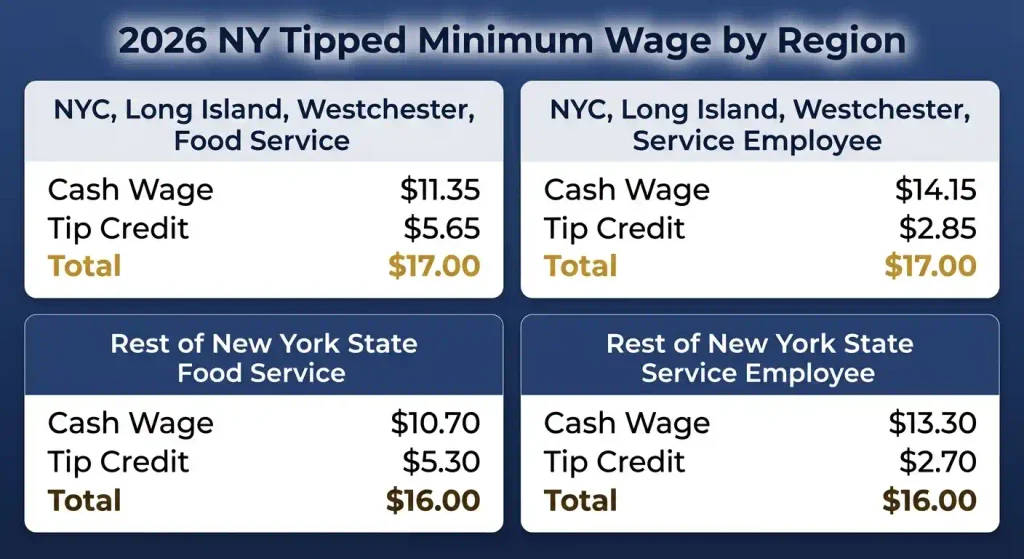
| Region | Worker Type | Cash Wage | Max Tip Credit | Total (Min. Wage) |
|---|---|---|---|---|
| NYC, Long Island, Westchester | Food Service | $11.35 | $5.65 | $17.00 |
| NYC, Long Island, Westchester | Service Employee | $14.15 | $2.85 | $17.00 |
| Rest of New York State | Food Service | $10.70 | $5.30 | $16.00 |
| Rest of New York State | Service Employee | $13.30 | $2.70 | $16.00 |
Long Island here means Nassau County and Suffolk County. Tipped food service workers get a deeper tip credit since restaurant tipping runs heavier. Tipped service employees get a smaller credit and a higher cash floor instead.
Which Tipped Minimum Wage Applies to Your Job?
Servers, bartenders, and bussers usually fall under food service workers. New York looks at what you actually do, not your title. Hotel housekeepers and delivery workers generally don’t qualify for a tip credit at all and are owed full minimum wage in cash, since neither is classified as tip-generating work. Car wash, retail, and transportation jobs typically don’t qualify either, since the credit mostly lives inside hospitality. A tip credit must match your actual duties, not a flat rate by title, and if you work in more than one region, the rate follows where you’re actually clocked in. Unclear cases are spelled out in the New York State Department of Labor’s wage order for the hospitality industry.
How Does the New York Tip Credit Work?
The tip credit isn’t money taken from your tips. It lets your employer count part of your tips toward their minimum wage obligation. Instead of paying the full $17.00 or $16.00 an hour in cash, they pay a lower direct wage and the credit fills the rest, assuming your tips actually cover the gap.
Cash Wage vs. Tip Credit vs. Full Minimum Wage
Take a NYC food service worker. Full minimum wage is $17.00 an hour. The employer pays $11.35 in cash, and the remaining $5.65 tip credit only counts if the worker actually earns that much in tips. Cash wage plus tip credit always equals the applicable minimum wage, never more or less, though the maximum credit shifts by region and job category.
Can Your Employer Pay Less When You Earn Tips?
Yes, but only if several conditions hold at once: you regularly receive tips in an eligible role, your employer gave written notice of the cash wage and tip credit, accurate tip records exist, and your tips plus cash wage hit the full minimum wage every week. If any piece fails, your employer owes the full minimum wage instead.
How to Calculate Your Tipped Paycheck
Separate three things: your cash wage, your actual tips, and your hours worked. Multiply cash wage by hours, add tips, then divide by hours, or run the numbers through a New York paycheck calculator for a quicker check. If that falls short of the minimum wage for your region and job type, something is off.
Example: A NYC Food-Service Worker
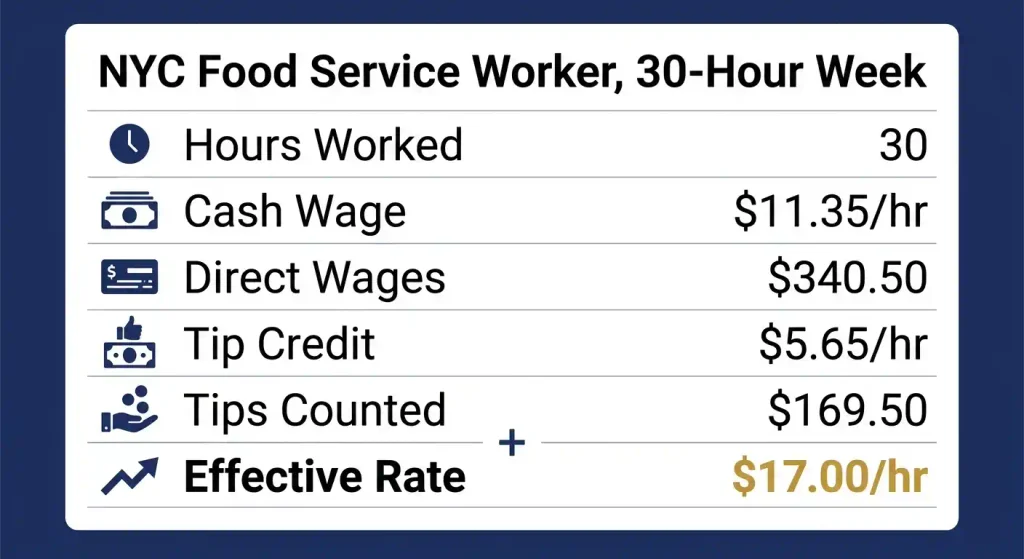
Work 30 hours at the 2026 NYC cash wage of $11.35, that’s $340.50 in direct wages. With the full $5.65 tip credit, your employer treats you as earning $169.50 in tips that week, for an effective $17.00 an hour. This assumes you’re eligible and genuinely earning that much. If real tips come in lower, your employer owes the difference up to full minimum wage.
Example: A Tipped Worker Outside NYC
A service employee in Buffalo, outside the NYC, Long Island, and Westchester zone, earns a 2026 cash wage of $13.30 with a max $2.70 tip credit, for $16.00 total. Working 25 hours gets $332.50 in cash wages. If tips that week don’t reach $67.50, the employer covers the gap. This credit is smaller than food service workers get, so less pay depends on tips.
How to Check Your Pay Stub
Line up hours worked, cash rate, and reported tips, and compare them to your written wage notice from hire. No notice, or a tip credit that doesn’t match your region and job category, is worth flagging. Keep your pay stubs: they’re your easiest proof if numbers stop adding up.
When Is Your Employer Not Allowed to Take a Tip Credit?
The tip credit comes with strings attached, enforced closely in New York’s hospitality industry. Losing eligibility for a shift or week doesn’t change your job, it means your employer owes full minimum wage for that time.
Cleaning, Opening, Closing, and Other Side Duties
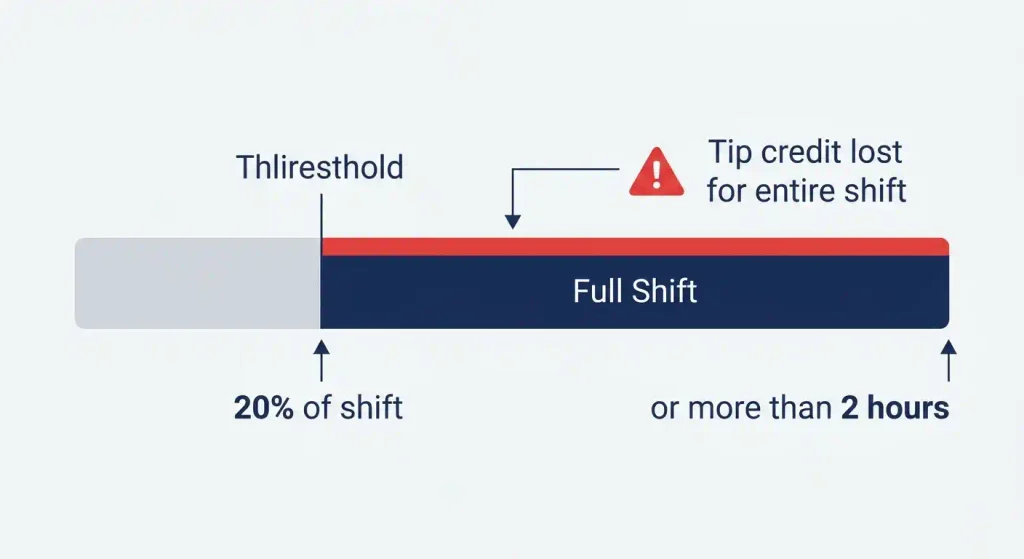
This is the 80/20 rule, or two-hour rule: spend more than 20% of a shift, or more than two hours, on non-tipped work like deep cleaning, food prep, rolling silverware, restocking, or closing, and your employer loses the tip credit for that day. New York’s version is strict: losing eligibility means full minimum wage for the entire shift, not just the extra time. This comes from state law, not federal rules, so it stayed in place after a 2024 court decision loosened the federal version.
When Tips Fall Below the Required Threshold
New York sets a minimum weekly average service employees must hit in tips to keep the credit. Fall short, and the employer owes full minimum wage for that week instead. The threshold differs by establishment type: restaurants and year-round hotels follow one standard, resort hotels follow another.
Missing Notice or Inadequate Tip Records
Under New York Labor Law and 12 NYCRR Part 146, your employer must give written notice of the cash wage and tip credit, and keep accurate tip records. Skip either step and the tip credit isn’t valid. A low cash wage alone doesn’t prove a problem since many workers legitimately earn good tips. Real red flags are missing paperwork, missing notice, or a pay stub mismatch. If your duties change and tips stop, your employer must reassess, and staying on a reduced wage in a non-tipped role is its own red flag.
New York Rules for Overtime, Tip Pooling, and Credit-Card Tips
A few more rules shape what tipped workers take home each week, and they trip people up more than the base rates do.
Overtime Pay for Tipped Employees
Past 40 hours a week, overtime is 1.5 times the full minimum wage, with the tip credit subtracted afterward, not 1.5 times your cash wage.
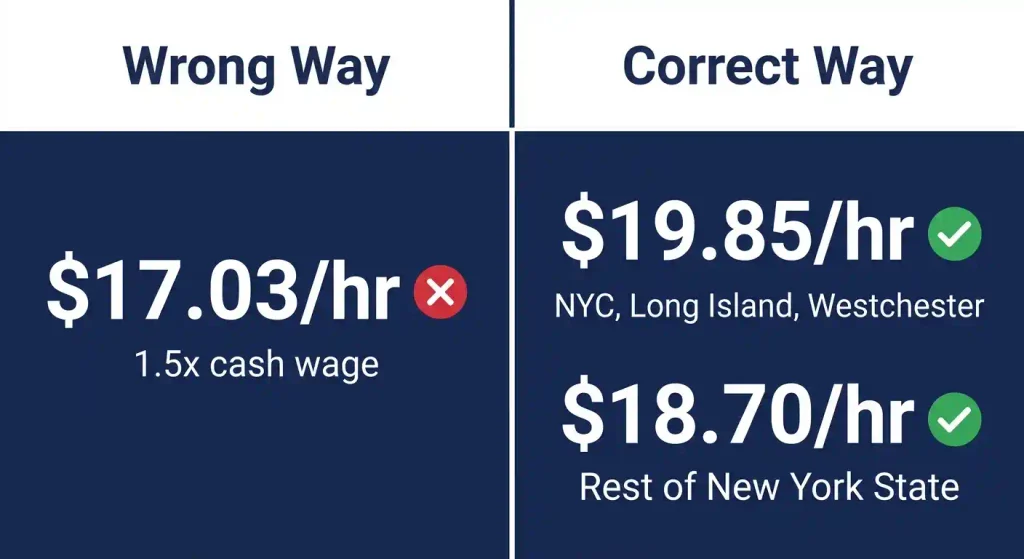
| Region | 2026 Overtime Cash Wage (Food Service) |
|---|---|
| NYC, Long Island, Westchester | $19.85/hr |
| Rest of New York State | $18.70/hr |
If your overtime looks like a simple 1.5x of your cash wage ($17.03), it’s likely wrong.
Tip Pooling and Tip Sharing
Tip pooling and tip sharing are both legal in New York. Owners, managers, and supervisors can never take a cut, even a small one, or the employer loses the tip credit entirely. Pooling doesn’t change the baseline rule: cash wage plus pooled tips still must hit the full minimum wage.
Cash Tips, Credit-Card Tips, and Tip Deductions
Cash and credit card tips are treated the same under the law. Employers can deduct the card processing fee, basically the only allowed deduction, and tips must reach you by your next scheduled payday. Beyond that, employers generally cannot keep your tips or use them to cover business costs, a pattern covered in more detail in our guide to illegal paycheck deductions in New York.
Common Tipped Wage Myths That Can Cost Workers Money
A few common beliefs about tipped pay are wrong often enough to cost workers real money.
“My Tips Always Count Toward Minimum Wage”
Not automatically. Tips only count once your employer qualifies for the tip credit: proper notice, accurate records, and tips meeting the required threshold. Skip any of that, and your employer owes the full minimum wage regardless.
“Every Tipped Worker Can Be Paid the Same Cash Wage”
Food service workers and service employees are paid differently, plus region adds another layer. A NYC bartender and a Rochester nail technician are both tipped workers but fall under different wage tables. Assuming one flat rate applies is how underpayment slips through.
“My Employer Can Keep Tips or Deduct Any Shortfall”
Your tips belong to you. An employer can’t pocket them, cover register shortages with them, or offset a bad night. The only standard deduction is the credit card processing fee. Anything else taken from your tips is a separate problem from the tip credit rules.
What to Do If Your Employer Is Paying You Too Little
Finding a possible shortfall is stressful, but there’s a clear path forward. These protections apply no matter your immigration status: undocumented workers have the same minimum wage and tip credit rights as anyone else.
How to Document a Possible Wage Violation
Keep records that cover these:
- Pay stubs, schedules, and time records
- Messages from a manager
- Any written wage notice you received
- Actual hours, duties, and pay, including tips
Compare that against the official 2026 wage table for your region and job category. Specific records matter more than a general feeling.
How to File a New York Wage Complaint
The New York State Department of Labor handles wage complaints directly through its official process, similar to the steps covered in our guide on what to do when a New York paycheck is missing or wrong. For larger or repeated violations, the New York Attorney General’s Labor Bureau can also investigate. A confirmed violation may recover unpaid wages going back further than expected, and your case strength usually comes down to your records.
What Employers and Payroll Staff Should Verify
If you manage payroll, verify these before applying a tip credit:
- Every tipped worker is classified under the correct region and job category
- Tip-credit eligibility is audited regularly
- Overtime uses the full minimum wage, not the cash wage
- Written notices and tip records are actually on file, not assumed
Getting this wrong brings real consequences, even unintentionally.
Frequently Asked Questions About New York Tipped Minimum Wage
What is the minimum wage for servers in NY in 2026?
Servers typically fall under food service worker rules: an $11.35 cash wage in NYC, Long Island, and Westchester in 2026, or $10.70 in the rest of the state, with the remainder made up through tips.
Can a NYC restaurant pay servers $11.35 an hour?
Only if the server earns enough tips to reach the full $17.00 minimum wage, and the restaurant gave proper written notice and kept accurate tip records. Without that, it owes the full minimum wage.
What is the tipped minimum wage for bartenders in New York?
Bartenders are generally classified as food service workers, on the same schedule as servers: $11.35 in NYC, Long Island, and Westchester, or $10.70 elsewhere.
Does New York require employers to make up for low tips?
Yes. If cash wage plus actual tips falls below the full minimum wage for any week, your employer pays the difference. The tip credit only works when real earnings support it.
Can my employer use a tip credit for cleaning and closing duties?
Only up to a point. Once non-tipped work like cleaning or closing crosses 20% of your shift or two hours, whichever comes first, the tip credit can’t be used that day.
Do tipped employees in New York get overtime?
Yes. Overtime is 1.5 times the full minimum wage, with the tip credit subtracted after, not 1.5 times your cash wage, so it’s higher than most tipped workers expect.
Where can I report tipped wage violations in New York?
The New York State Department of Labor accepts wage complaints directly, with official forms and guidance for submitting a claim.
Official New York Tipped Wage Resources
For current rates and other New York wage law requirements, go straight to the source, not secondhand summaries.
New York State Department of Labor Resources
The NYSDOL publishes the official Minimum Wage for Tipped Workers fact sheet (P717) with current rates by region. Their Hospitality Industry Wage Order lays out the full legal framework, and the Minimum Wage Lookup Tool lets you check rates by location. If underpaid, their wage complaint guidance walks through how to file.

Meet Yasin Ali, Founder
Yasin built NY Paycheck Calculator in 2020 after getting fed up with calculators that treated New York like every other state. Most tools ignore the extra local tax NYC and Yonkers workers pay on top of state tax — or skip New York’s Paid Family Leave deduction entirely.
He keeps the numbers current, checking in regularly against the latest IRS, NY Department of Taxation and Finance, and Paid Family Leave rates.
All results here are estimates based on official sources. For advice specific to your situation, talk to a tax professional.