
New York employees are protected from illegal paycheck deductions whenever an employer takes wage money without legal authorization or written consent. The deduction is unlawful if it does not benefit the employee, no matter who was at fault.
This protection comes from New York Labor Law Section 193 and NYSDOL guidance, confirmed against verified 2026 wage and deduction figures.
This is general 2026 information, not legal advice; exceptions and deadlines vary by case.
What Counts as an Illegal Paycheck Deduction in New York?
What New York Labor Law Section 193 Protects
New York Labor Law Section 193 bars any deductions from wages unless the deduction follows a law, rule, or government order, or it is for your benefit and you authorized it. Examples include:
- Insurance premiums
- Pension and health benefits
- Charity gifts
- U.S. bonds
- Union dues
It also bars an employer from charging you on the side for something it could not deduct. Since the 2021 No Wage Theft Loophole Act, there is no exception for simply failing to pay wages you earned.
Quick Answer: Is Your Paycheck Deduction Illegal?
Ask three things: why the money was taken, whether you agreed in writing, and whether the charge covers your benefit or the employer’s cost. The same deduction can be lawful for one worker and unlawful for another, depending on authorization and which wage order applies.
| Usually illegal | Usually legal |
|---|---|
| Cash register shortage | Federal and New York income tax |
| Broken dishes, damaged goods, spoiled food | Social Security and Medicare |
| Fines for lateness or “misconduct” | Court-ordered garnishments |
| Uniform costs or cleaning fees | Health insurance you approved in writing |
| Fee to replace a lost check | Retirement contributions you approved in writing |
| Paid Family Leave charges above the allowed amount | Union dues under a collective bargaining agreement |
| Repayment of overpay or advances done outside Part 195 rules | Overpay or advance repayment done under the Part 195 rules |
The details below show where each one fits.
Which Paycheck Deductions Are Illegal in New York?
The New York State Department of Labor (NYSDOL) names these as illegal: deductions for breakages, cash shortages, fines, losses to the business, anything not allowed by Section 193, check replacement, and Paid Family Leave overcharges, whether taken from your paycheck or collected on the side.
Cash Shortages, Register Errors, and Missing Money
An employer cannot charge you for a short register, no matter who was working it. Say a cashier’s drawer is $32 short on Friday and the manager takes $32 from the next check “because it was your drawer.” That is an illegal deduction. The employer can investigate or discipline you, but it cannot recover the loss from your wages.
Broken Equipment, Damaged Merchandise, and Spoilage
Broken plates, damaged stock, and spoiled food are business losses, not yours to pay, even if you caused them. A signed form saying “employee is responsible for damages” does not fix that. The same rule covers lost or stolen merchandise. Your employer may still warn or write you up, just not bill your wages.
Fines, Penalties, and Charges for Workplace Mistakes
A fine is a charge for behavior, not pay for work, so it cannot come out of earned wages. Examples: a $25 fee for being late, a $50 penalty for missing a shift, or a $100 charge for quitting without notice. Discipline (a warning, schedule change, or firing) is allowed; taking extra money is not.
Uniforms, Laundry, Tools, and Business Expenses
Employers cannot make you pay for required uniforms, cleaning, tools, or supplies, including background checks, drug tests, or required training. NYSDOL lists uniform costs and maintenance as illegal deductions, and wage orders require employers to launder required uniforms or pay a maintenance allowance, with limited exceptions like wash-and-wear clothing. If a work expense pushes pay below minimum wage, that’s a second violation. The 2026 minimum is $17.00 an hour in New York City, Long Island, and Westchester, and $16.00 elsewhere. An ordinary dress code isn’t the same as a required uniform; check NYSDOL’s wage FAQ if unsure.
Check Replacement Fees and Paid Family Leave Overcharges
NYSDOL lists check-replacement fees, bounced-check charges, and general payroll processing fees as illegal. Paid Family Leave premium overcharges work differently: employers can collect a contribution only up to the state’s allowed rate and cap. For 2026, that’s 0.432% of gross wages per pay period, capped at $411.91 a year, per the official Paid Family Leave 2026 update. Check your stub for PFL lines, total the year-to-date amount, and keep records to show any difference. For a full breakdown of how the program works, see our guide to New York Paid Family Leave.
Which Paycheck Deductions Are Legal in New York?
Legal deductions fall into a few groups: taxes required by law, benefits you approved in writing, union dues under a collective bargaining agreement, overpayment or advance repayment under Part 195, and meal or lodging credits some wage orders let certain employers, like farms, count toward minimum wage. Size doesn’t decide legality; the reason does. For a broader rundown of what typically comes out of a paycheck here, see our guide to New York paycheck deductions.
Taxes and Other Deductions Required by Law
Federal income tax, New York income tax, and Social Security and Medicare deductions come out of nearly every paycheck. Court-ordered garnishments, like child support, are also lawful. A big drop between gross and net pay isn’t automatically illegal; match each line to a tax or an approved benefit first.
Insurance, Retirement, Union Dues, and Employee Benefits
Deductions for health insurance, retirement plans, day care, charitable contributions, and similar benefits are allowed when you authorized them in writing. Under NYSDOL’s Part 195 rules, the authorization must be clear, in at least 12-point type, and kept on file for six years. Union dues can be deducted under a collective bargaining agreement without each person’s separate consent. A signature alone isn’t enough; the deduction must still fit Section 193, and the Court of Appeals says “similar payments” must actually benefit the worker.
Payroll Overpayments and Wage Advances
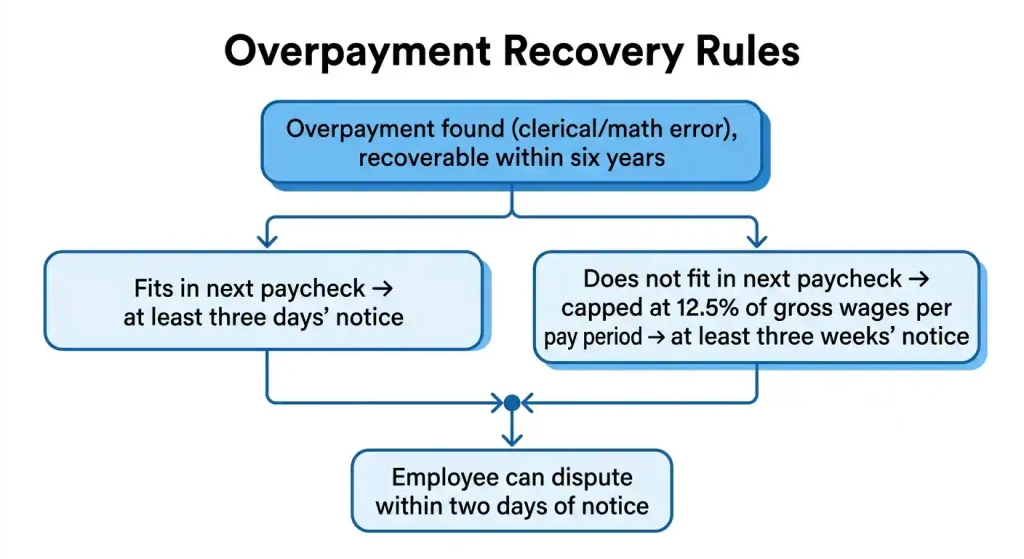
An employer can recover an overpayment caused by a math or clerical mistake by following Part 195, within six years, no more than once per paycheck. If the full amount fits in your next net pay, the employer can take it all at once with at least three days’ notice. Otherwise, the deduction is capped at 12.5% of gross wages for that pay period and can’t drop you below minimum wage, with at least three weeks’ notice. You can dispute it, generally within two days of a one-time recovery notice. Wage advances need written terms up front, no interest or fees, and no new advance until the old one is repaid. These permitted-deduction categories come from a 2012 law, extended again in 2025 through December 31, 2028.
Can an Employer Deduct Money If You Agreed to It?
Yes, but only for deductions that benefit you and that you agreed to voluntarily in writing. If the amount changes, the employer should notify you, and you can withdraw authorization in writing; the employer must then stop within 4 pay periods or 8 weeks, whichever comes first. Consent on paper doesn’t override the statute, so a form allowing deductions for shortages, breakage, or uniforms still doesn’t make those lawful.
How Illegal Deductions Affect Minimum Wage and Overtime
A deduction can break two rules at once: it can be illegal under Section 193 and also push pay below minimum wage or cut into overtime. Both can be claimed.
When a Deduction Reduces Your Effective Pay
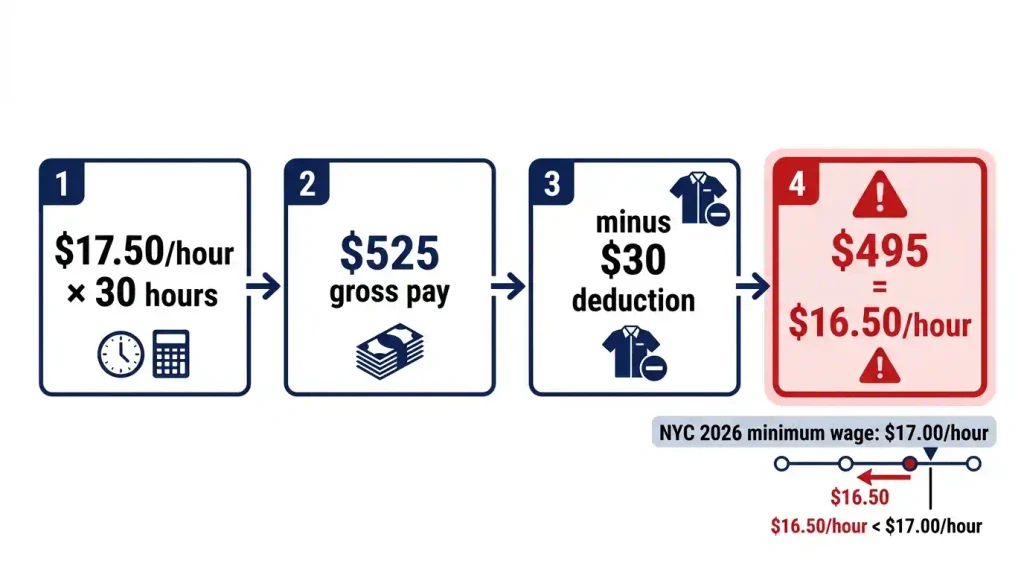
Hypothetical example: you work in NYC, earn $17.50 an hour, and work 30 hours, for $525 gross pay. Your employer takes $30 for a required uniform, leaving $495, or $16.50 an hour. Since the 2026 NYC minimum is $17.00, you’re now below it. The $30 is illegal on its own; falling under minimum wage is a separate violation. If your take-home pay looks off for reasons beyond a single deduction, this guide to why your New York paycheck might be lower than expected walks through the other common causes.
Overtime, Tipped Employees, and Restaurant Workers
Check that hours over 40 a week got the right overtime rate. The tip credit only works if tips actually reach full minimum, and employers can’t keep any part of your tips.
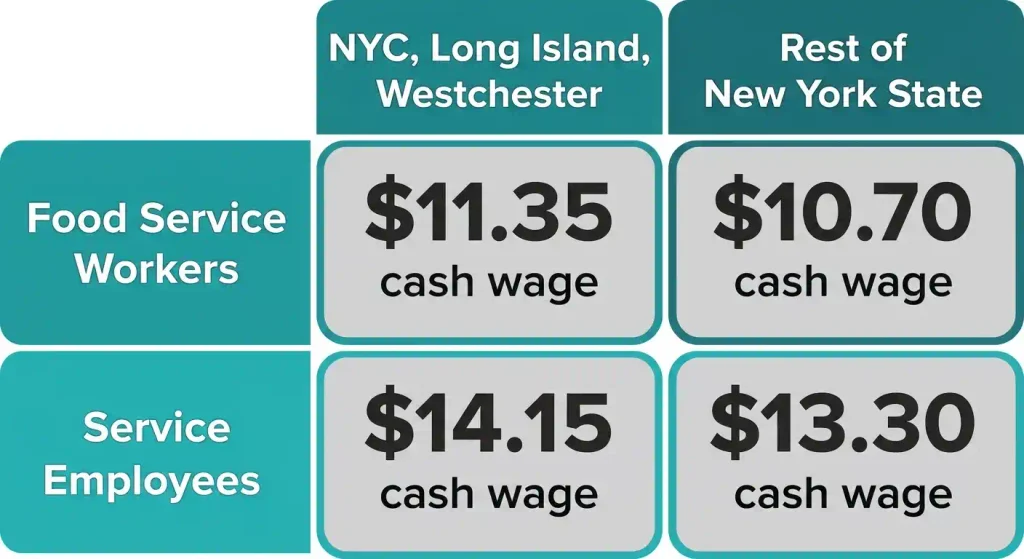
| Tipped role | NYC, Long Island, Westchester | Rest of New York State |
|---|---|---|
| Food service workers | $11.35 cash wage | $10.70 cash wage |
| Service employees | $14.15 cash wage | $13.30 cash wage |
Tipped overtime is time and a half of full minimum wage minus the tip credit, for example $25.50 minus $5.65, or $19.85 an hour for a NYC food service worker. Short tips, kept tips, or wrong overtime are separate wage and tip claims you can report on the same complaint form. Domestic workers and farmworkers follow their own wage orders for overtime, day of rest, and meal or lodging credits. For the full 2026 rate tables, see our guide to New York minimum wage.
How to Check Your Pay Stub and Calculate the Money Owed
Compare gross pay, each deduction, net pay, hours worked, and your bank deposit, then total the questionable charges across pay periods. For a refresher on what those two totals should reflect, see gross pay versus net pay in New York.
Find and Verify the Suspected Deduction
Taxes, Social Security, and Medicare are normal; check lines labeled “shortage,” “damage,” “uniform,” or “adjustment” against anything you signed. Confirm your deposit matches net pay on the stub. New York law requires every deduction to appear on your pay stub, so an unexplained line, or a charge you never saw in writing, is worth questioning. For a general walkthrough of what each line on a stub means, see how to read a New York pay stub.
Calculate Your Total Potentially Illegal Deductions
List each disputed charge by date and amount, then add them up without double-counting (if $40 was taken and $10 later returned, the disputed amount is $30). These are your own estimates, not an official finding, but they give you a clear number for your employer or complaint.
Example: An Employee Charged for a Cash Shortage
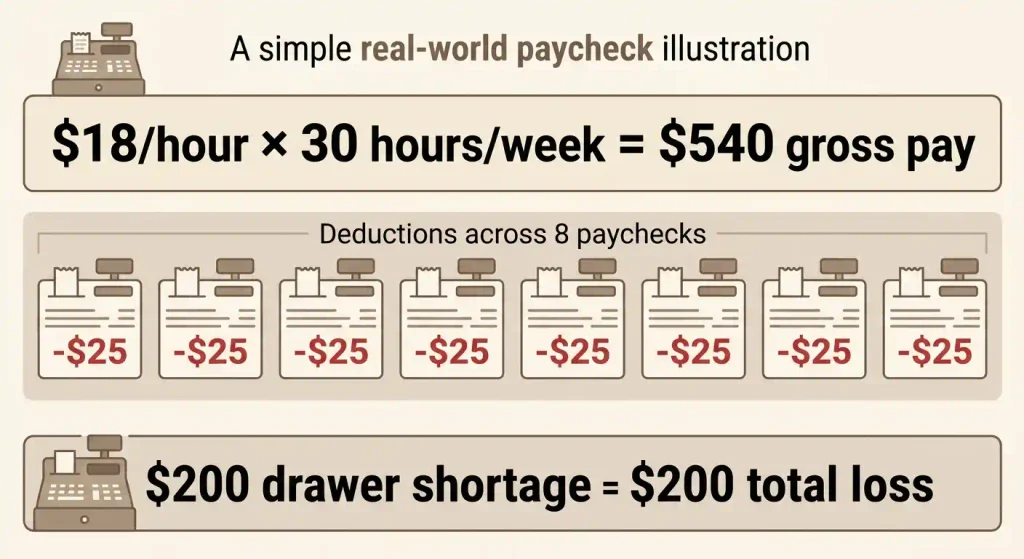
Hypothetical: a cashier earns $18 an hour, works 30 hours a week ($540 gross pay), and after a $200 drawer shortage the manager takes $25 from each of eight paychecks, a $25 weekly, $200 total loss. The stubs, time records, and any texts about the shortage support the claim. Other facts, like a union contract or a valid overpayment recovery, could change the picture.
Can Your Employer Take Money Outside Your Paycheck?
No, not if the charge would be illegal as a deduction. Section 193 blocks an employer from making you pay on the side for something it couldn’t deduct, and NYSDOL treats charges for breakage, uniforms, shortages, and business costs as illegal whether paid by payroll or “on the side.”
Cash Payments, Payment Apps, and Separate Charges
A manager asking for cash, a payment app transfer, or “pay it back later” for a shortage, damage, or a uniform is still a prohibited charge. New York Labor Law Section 198-b, the “kick-back” of wages law, separately makes it illegal to require employees to hand back wages already paid. Keep screenshots, receipts, transfer confirmations, and texts, since the charge may never appear on your stub.
Can an Employer Require You to Pay for Damages?
Being at fault for an incident doesn’t let your employer charge your wages for it. If a server drops a tray and the manager asks for $60 by payment app, that’s the same illegal charge in another form. A genuinely separate transaction, like buying something from an employer-run shop at the price the public pays, is different. NYSDOL looks at what the payment really is, not what it’s called.
Common Myths About Illegal Paycheck Deductions
Four ideas cause most of the confusion, and each is wrong or incomplete.
“I Signed the Form, So the Deduction Must Be Legal”
A signature only works for deductions the law allows. A form letting your employer deduct for breakage or shortages doesn’t change that those are business losses, not valid benefits like health premiums or retirement plans.
“My Employer Can Charge Me Because I Made a Mistake”
Fault doesn’t decide it. The cost of breakage, shortages, or damaged merchandise stays with the business even when you caused it. The employer can discipline you, just not take the cost from your pay.
“A Separate Cash Payment Is Not a Wage Deduction”
It can still be illegal. Section 193 covers separate-transaction payments an employer requires when the same charge couldn’t be deducted. What matters is whether the money is tied to your job, not which pocket it came from.
“Only Hourly Workers Can Challenge Illegal Deductions”
Section 193 protects employees generally, not just hourly workers. Salaried employees can challenge unlawful deductions too, though docking an exempt employee’s salary can also raise separate exempt-status questions.
How to Get Your Money Back for Illegal Paycheck Deductions
Collect proof, ask your employer to explain the charge, and file a complaint with NYSDOL if unpaid. If the problem is a paycheck that never showed up at all rather than a deduction, see our guide on a paycheck not received for the steps that situation calls for. A lawsuit is also an option and can add damages.
Step 1: Collect Evidence Before Challenging the Deduction
Gather:
- Pay stubs and time sheets
- Your wage notice and written policies
- Any authorization forms you signed
- Texts, emails, and receipts
- Any payment requests made off the books
List each disputed deduction with its date and amount before records can disappear.
Step 2: Ask the Employer for an Explanation
Ask in writing for an itemized explanation and the legal basis, and keep copies of every reply. You don’t have to confront your employer first; getting advice or filing directly with the state is fine too.
Step 3: File a New York State Department of Labor Complaint
Use the Labor Standards Complaint Form LS 223, which covers unpaid wages, illegal deductions, uniforms, minimum wage, and overtime. Fill in your employer’s details, how you were paid, and each deduction amount, and attach pay stubs or checks. NYSDOL’s Instructions for Filing a Labor Standards Complaint LS 223.2 walks through each section; see also NYSDOL’s Illegal Deductions page.
Step 4: Understand the Investigation and Possible Recovery
NYSDOL’s Division of Labor Standards investigates claims for unpaid and withheld wages, including illegal deductions, and tries to collect them, though recovery isn’t guaranteed. You may also have a claim under New York Labor Law Section 198, covering full wages, liquidated damages, and attorney’s fees for six years back. The federal Fair Labor Standards Act (FLSA) can apply too, through the U.S. Department of Labor Wage and Hour Division, though New York’s rules usually protect workers more. For large or contested amounts, talk to an employment lawyer or the Attorney General’s Labor Bureau (labor.bureau@ag.ny.gov).
How Far Back Can You Claim Illegal Deductions?
Section 198 generally allows recovery of wages from the six years before a lawsuit is filed, though deadlines depend on the specific claim. Leaving the job doesn’t erase it; former employees can still pursue deductions taken while employed, if they file in time. Keep old records and act early.
Can Your Employer Retaliate if You Report Illegal Deductions?
No. Labor Law Section 215 protects workers who complain about wage violations, and employers may not punish workers for asserting wage rights.
Your Rights When Challenging Unpaid Wages
You’re protected when you raise a wage complaint with your employer, NYSDOL, or another agency. Retaliation includes:
- Firing
- Threats
- Cut hours
- Worse shifts after a complaint
See the Attorney General’s workers’ rights guide for more.
What to Do if Your Employer Threatens or Punishes You
Write down dates, statements, and any schedule or discipline changes. Keep your own pay stubs and messages somewhere your employer doesn’t control, like a personal email. Report it to NYSDOL or the Attorney General’s Labor Bureau, and speak with a lawyer if your job or hours were affected.
Official New York Resources for Wage Deduction Complaints
Everything you need to file is on official state sites.
New York Labor Law and Department of Labor Guidance
- New York Labor Law Section 193
- NYSDOL Illegal Deductions
- Labor Standards Complaint Form LS 223
- NYSDOL Wages and Hours FAQ (uniforms and final pay)
- 12 NYCRR Part 195, overpayments and advances
- Labor Law Section 215, retaliation
- New York Labor Law Section 196-a, complaints by employees to the Commissioner of Labor
- New York Labor Law Section 198-d, posting regulations on illegal wage deductions
- Attorney General’s workers’ rights guide
For more on this topic, browse our New York wages and wage laws category.
Frequently Asked Questions About New York Illegal Deductions
Can my employer deduct money from my paycheck without permission?
Yes, if the law requires it, like taxes and garnishments. Other deductions need your written authorization and must benefit you. Overpayment recovery follows its own notice rules under Part 195.
Can my employer charge me for a cash-register shortage?
No. NYSDOL lists cash shortages as illegal; that loss is the business’s, whether charged through payroll or directly.
Can my employer deduct uniform or laundry costs?
No. NYSDOL treats uniform costs and upkeep as illegal, and wage orders require laundering or an allowance in most cases. If it drops pay below minimum wage, that’s a separate violation.
Can my employer take money from my final paycheck?
Only lawful deductions like taxes, authorized benefits, or a valid Part 195 overpayment recovery. Shortages, damage, fines, earned commissions, and unused promised benefits can’t be withheld. Final wages are due by your next regular payday. For the full deadlines and rules, see our guide to New York final paycheck laws.
Can my employer recover a payroll overpayment?
Yes, for math or clerical errors, under Part 195: written notice first (three days for a full next-check recovery, three weeks otherwise), a 12.5% cap on gross wages when it can’t recover it all at once, and a way to dispute it.
Where do I report illegal paycheck deductions in New York?
File with NYSDOL’s Division of Labor Standards using the LS 223 form, or contact the Attorney General’s Labor Bureau.
How can I recover money my employer already deducted?
Collect your stubs and messages, total the disputed amount, and ask your employer in writing for the legal basis. If unpaid, file an LS 223 complaint or consider a Section 198 lawsuit, which can add liquidated damages and attorney’s fees.
What if my employer retaliates after I file a complaint?
Retaliation is illegal under Labor Law Section 215. Record the details, keep what records you’re allowed to, and report it to NYSDOL or the Attorney General’s Labor Bureau. Speak with a lawyer if your job or hours were affected.
Final Checklist: What to Do if Money Was Illegally Taken From Your Paycheck
Confirm, Document, and Pursue Your Claim
- Identify the charge and check it against Section 193.
- Add up the disputed amount and keep every stub, message, and payment record. A paycheck calculator can help you confirm whether a deduction actually dropped your pay below minimum wage.
- Ask your employer in writing for the legal basis.
- If it’s not fixed, file an LS 223 complaint with NYSDOL or talk to a lawyer about a Section 198 claim.
- Document any retaliation as it happens.
This is general 2026 information, not legal advice; for a large or complicated claim, consult a lawyer who handles New York wage cases.

Meet Yasin Ali, Founder
Yasin built NY Paycheck Calculator in 2020 after getting fed up with calculators that treated New York like every other state. Most tools ignore the extra local tax NYC and Yonkers workers pay on top of state tax — or skip New York’s Paid Family Leave deduction entirely.
He keeps the numbers current, checking in regularly against the latest IRS, NY Department of Taxation and Finance, and Paid Family Leave rates.
All results here are estimates based on official sources. For advice specific to your situation, talk to a tax professional.