
The New York minimum wage in 2026 is $17.00 an hour in New York City, Long Island, and Westchester County and $16.00 elsewhere, depending on where you work.
Both rates were checked against New York State Department of Labor sources in September 2026, along with tipped food service cash wages of $11.35 in the $17.00 areas and $10.70 elsewhere.
The 2027 rate is due by October 1, 2026, so these figures apply to 2026 only.
What Is the New York Minimum Wage in 2026?
Your job pays $16 an hour, your cousin in Brooklyn says $17, and you are both right. Your county decides which rate applies.
New York Minimum Wage Rates by Location
New York City, Long Island (Nassau and Suffolk counties), and Westchester County pay $17.00. Every other county pays $16.00. Both rates run from January 1 through December 31, 2026.
New York Minimum Wage at a Glance
Use this table to check a job offer or pay stub.
| Job type | NYC, Long Island, Westchester | Rest of New York |
|---|---|---|
| General minimum wage | $17.00 | $16.00 |
| Overtime rate (1.5 times) | $25.50 | $24.00 |
| Tipped food service cash wage | $11.35 | $10.70 |
| Tipped service employee cash wage | $14.15 | $13.30 |
| Home care aide | $19.65 | $18.65 |
Tips must lift tipped workers to the full $17.00 or $16.00, or the employer pays the gap.
Why Does New York Have Different Minimum Wage Rates?
New York sets separate regional rates, with the downstate floor $1.00 an hour higher, a gap generally tied to higher living costs there. After a bigger jump in 2024, both rates rose $0.50 in 2025 and 2026, and from 2027 raises follow inflation.
Your work location sets your rate, and $1.00 separates the two.
Which New York Minimum Wage Rate Applies to You?
Your rate depends on the county where you physically do the work, not where you live or where your boss sits. When unsure, use the state’s lookup tool.
The New York State minimum wage covers part-time, temporary, and seasonal workers, with narrow exceptions such as most government employees. Outside farm work, teenagers and new hires get no lower rate, and farm employers can get a state certificate to pay workers under 18 a youth rate. Otherwise only a tip credit or a small meal or lodging allowance can lower the cash wage.
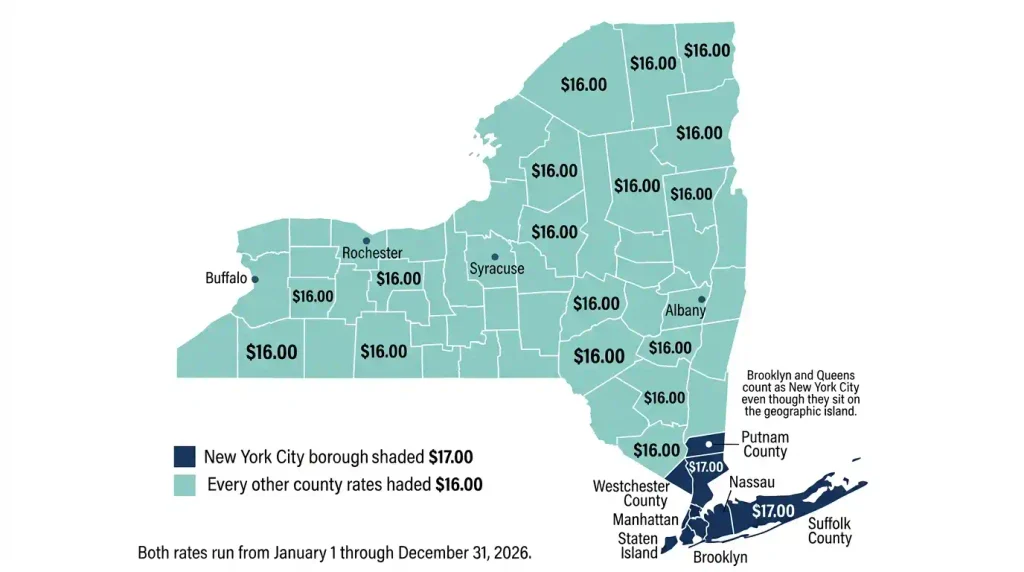
Your Work Location Determines the Minimum Wage
NYSDOL says the rate follows where you perform the work, not where the employer’s main office sits. A Manhattan company owes an Albany employee $16.00, and if you split your week between places, track hours at each.
What Counts as New York City for Minimum Wage?
All five boroughs count and pay $17.00: Manhattan (New York County), Brooklyn (Kings County), Queens, the Bronx, and Staten Island (Richmond County). The minimum wage follows where you work, while city income tax follows where you live, so commuters may need New York Form IT-2104.1.
What Counts as Long Island and Westchester?
Long Island means Nassau and Suffolk counties only, and Westchester is a separate third area. All three pay $17.00, and Brooklyn and Queens count as New York City even though they sit on the geographic island.
What Is the Remainder of New York State?
Every other county pays $16.00, including Albany, Buffalo, Rochester, Syracuse, and the rest of the Hudson Valley. Even Putnam County, which touches Westchester, pays $16.00.
Find your county first, and your rate follows.
New York Minimum Wage 2026 by Region
The general rate is $17.00 in New York City, Long Island, and Westchester, and $16.00 everywhere else. Tipped and special jobs have their own rates.
New York City Minimum Wage
New York City workers earn at least $17.00 an hour from January 1 through December 31, 2026, or $680 for a 40-hour week before taxes. Tipped and home care rates are in the table above.
Long Island Minimum Wage
Nassau and Suffolk counties match the city on every rate, from the $17.00 general minimum to the tipped and home care rates in the table above.
Westchester County Minimum Wage
Westchester matches the city and Long Island at $17.00, with the same tipped and home care rates shown in the table above.
Minimum Wage in the Rest of New York State
The rest of the state pays $16.00, or $640 for a full-time Buffalo worker before taxes. Its tipped and home care rates are in the table above.
Tipped and home care jobs follow their own rates, not the $17.00 or $16.00 base.
How Much Is Minimum Wage for a 40-Hour Week?
At $17.00 an hour, a 40-hour week pays $680 before taxes. At $16.00, it pays $640.
| Hourly rate | Weekly (40 hours) | Monthly (about) | Annual |
|---|---|---|---|
| $17.00 | $680 | $2,947 | $35,360 |
| $16.00 | $640 | $2,773 | $33,280 |
$17 Per Hour: Weekly, Monthly, and Annual Gross Pay
Gross pay before deductions at $17.00 is $680 a week. Social Security and Medicare take 7.65%, about $52 a week, and the other taxes that come out of a New York paycheck take more.
$16 Per Hour: Weekly, Monthly, and Annual Gross Pay
Gross pay at $16.00 is $640 a week. Social Security and Medicare take about $49 a week, and federal and New York State income tax withholding takes more, following the New York tax brackets for 2026.
What Happens When You Work More Than 40 Hours?
New York pays overtime after 40 hours in a workweek at 1.5 times your regular rate: $25.50 at $17.00 and $24.00 at $16.00. There is no daily overtime. Residential employees, meaning live-in workers, get overtime after 44 hours, and farm workers after 52 hours in 2026, dropping toward 40 by 2032.
Irregular schedules use the same math, since pay follows hours actually worked. A workday stretching past 10 hours may earn one extra hour of pay at the minimum wage, and being sent home early can trigger call-in pay.
Why Your Paycheck May Not Equal Your Hourly Rate
Federal and New York State tax withholding, Social Security, Medicare, and benefits you pay for shrink the check, while overtime and tips can raise it. Tipped workers see a low cash wage on the stub because tips make up the rest. For a full breakdown, see why your New York paycheck is lower, or start with New York paycheck basics.
For a single filer with no dependents, net pay is roughly $540 a week at $17.00 in New York City and $530 at $16.00 upstate, assuming the $16,100 federal standard deduction for 2026, New York City income tax for the city worker, and state disability and paid family leave deductions. Your Form W-4 and IT-2104 choices can also move them, and more help sits in our New York tax forms and withholding guides. These figures are estimates, not official NYSDOL numbers. For your exact take-home pay, use our New York paycheck calculator, and see our calculation methodology for how it works.
Multiply your rate by your hours for gross pay. Taxes come out after.
New York Minimum Wage vs. Federal Minimum Wage
The federal minimum wage is $7.25 an hour under the Fair Labor Standards Act, and states can go higher. New York requires $16.00 or $17.00, so New York law governs your paycheck.
New York State Minimum Wage vs. Federal Rate
When rules differ, you get the higher one, which in New York is always the state rate. In New York City that is $9.75 more per hour than the federal floor, or $390 a week.
New York Minimum Wage vs. Other States
Washington State edges just above the New York City rate, while New York’s neighbors all pay less. Always check the year on comparisons.
| Place | 2026 minimum wage |
|---|---|
| New York City, Long Island, Westchester | $17.00 |
| Rest of New York State | $16.00 |
| Washington State | $17.13 |
| Connecticut | $16.94 |
| New Jersey | $15.92 |
| Massachusetts | $15.00 |
| Vermont | $14.42 |
| Pennsylvania | $7.25 |
| Federal minimum wage | $7.25 |
New York beats the federal floor by $8.75 to $9.75 an hour.
New York Minimum Wage for Tipped Workers in 2026
Tipped workers in hospitality can be paid a lower cash wage. Cash wage plus tips must reach the full $17.00 or $16.00, and the employer covers any shortfall.
Tipped Service Employee Rates
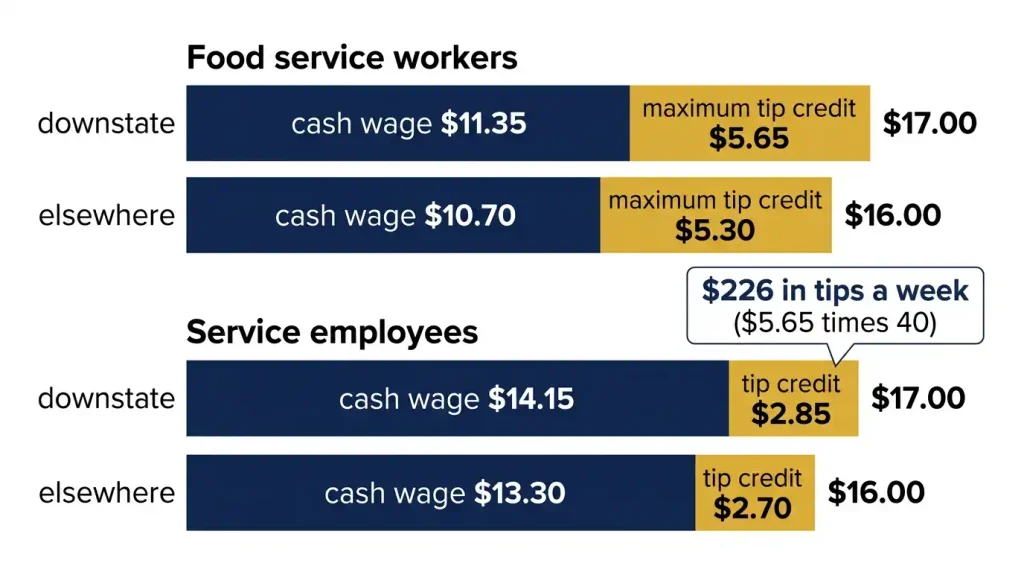
A service employee is a hospitality worker other than a food service worker who regularly earns tips, such as hotel bell staff. The cash wage is $14.15 with a $2.85 tip credit in the city, Long Island, and Westchester, and $13.30 with a $2.70 credit elsewhere. Only hospitality employers can use a tip credit.
Tipped Food Service Worker Rates
Food service workers include servers, bartenders, and bussers. Per NYSDOL’s tipped workers page, the cash wage is $11.35 downstate with a maximum tip credit of $5.65, and $10.70 elsewhere with a maximum credit of $5.30. A New York City server working 40 hours needs at least $226 in tips a week ($5.65 times 40).
When an Employer Cannot Take a Tip Credit
An employer generally cannot take a tip credit in three cases:
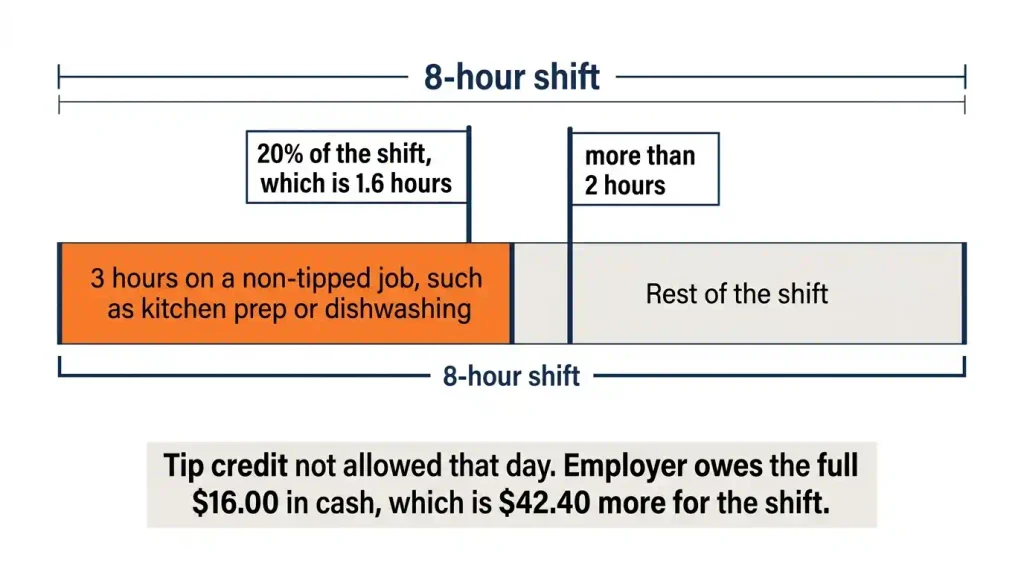
- The worker spends more than two hours, or 20% of a shift, in a non-tipped occupation, which costs the credit for that day.
- Weekly tips for service employees average below the required amount per hour: $3.65 in restaurants and all-year hotels or $9.55 in resort hotels downstate, and $3.40 or $9.00 elsewhere.
- The industry bars it, such as fast food, building service, and nail salons.
A tip credit has limits: check the two-hour, 20%, and average-tip rules.
Special Minimum Wage Rates by Job or Industry
Some jobs have their own rates. Home care aides earn more than the general rate, and fast food matches it.
Fast Food Worker Minimum Wage
In 2026, fast food workers earn the general rate: $17.00 in New York City, Long Island, and Westchester, and $16.00 elsewhere. Coverage applies to chains with 30 or more locations nationwide, per NYSDOL’s fast food fact sheet, and employers cannot take a tip credit.
Home Care Aide Minimum Wage
Home care aides earn $19.65 an hour in New York City, Long Island, and Westchester and $18.65 elsewhere, a higher floor set by state law than the general $16 and $17 rates. A covered aide is a home health aide, personal care aide, or home attendant whose main job is in-home help with daily living, and casual workers and some relatives paid through government programs are excluded. The Home Care Aide Minimum Wage Fact Sheet (P105) lists extra pay they may be owed, including overtime, call-in pay, and spread of hours pay.
Nail Salon Worker Minimum Wage
Nail salon workers fall under the Miscellaneous Industries wage order and earn the full $17.00 or $16.00 in cash, with tips extra because no tip credit is allowed. Common problems are pay by the service and unpaid waiting time between clients, and pay must still add up to the hourly minimum. NYSDOL publishes guidance for nail salon workers.
Farm and Agricultural Worker Rules
Farm workers are covered by a separate wage order and earn the regional minimum rate. Their overtime line is 52 hours a week in 2026, per NYSDOL’s Farm Laborers Fair Labor Practices Act page, dropping four hours every two years to 40 in 2032. Employers must keep hours and pay records, so ask for pay stubs and keep your own log.
Other Industries With Different Wage Rules
Building service workers cannot have a tip credit taken from their pay, and airport workers at some New York City area airports may have separate, higher wage rules. Everyone else, from retail to offices, falls under Miscellaneous Industries and earns the general rate. NYSDOL posts a fact sheet for each industry.
Find your industry first. A special rate can beat the general one.
Real-World New York Minimum Wage Examples
Five cases show the rules at work: location first, then job type, then math.
Example: NYC Worker Paid $16 Per Hour
A Queens stockroom worker earns $16.00, $1.00 below the $17.00 city rate. That is $40 a week on 40 hours, or about $2,080 a year, so she should check her job type and then contact NYSDOL if no special rule applies.
Example: Upstate Worker Paid $16 Per Hour
A Syracuse cashier earns $16.00, which meets the remainder-of-state minimum. He should still confirm his job has no special rate, since a home care aide would need $18.65, and check that every hour is paid.
Example: NYC Restaurant Worker Paid $11.35 Plus Tips
A Manhattan server paid $11.35 in cash is legal only if tips add at least $5.65 an hour, bringing the total to $17.00. If tips fall short, the restaurant owes the difference, and she should also check the non-tipped duty limits.
Example: Worker Splitting Time Between Two Regions
A warehouse worker spends 20 hours in Yonkers (Westchester, $17.00) and 20 hours in Albany ($16.00) in one week. His minimum pay is $340 plus $320, or $660, unless the employer pays the higher rate for all hours, which would be $680.
Example: Worker Performing Non-Tipped Duties
A Buffalo server works an 8-hour shift and spends 3 hours on a non-tipped job, such as kitchen prep or dishwashing. The limit is more than 2 hours or 20% of the shift, which is 1.6 hours here. She passed both, so the employer cannot take the tip credit that day and owes the full $16.00 in cash, which is $42.40 more for the shift.
A $1.00-an-hour shortfall adds up to about $2,080 a year.
What Employers Must Tell New York Workers About Pay
Employers must give a written pay notice at hire and a pay statement every payday, showing your rate, overtime rate, and how you are paid.
Notice of Pay Rate Requirements
At hire, your employer must give you a written notice listing your regular rate and overtime rate, how you are paid (hourly or by the shift), and your regular payday. Keep a copy as your first proof if pay goes wrong.
The Wage Theft Prevention Act sets these rules, and employers generally must give written notice at least seven days before lowering your pay rate, which can never fall below the minimum wage. Employers must also post the state’s minimum wage poster, and hospitality employers use the Hospitality Industry Minimum Wage Poster (LS207.3). Employers can find withholding and filing guidance in our New York payroll and employer compliance guides.
Allowances That Can Affect the Minimum Wage Calculation
In some jobs, employers can count tips, meals, or lodging toward part of your minimum wage, but each allowance must appear on your written notice and stay within what the law allows. New York State Labor Law also sharply limits wage deductions, so cash shortages, breakage, and uniform costs generally cannot come out of your pay, and signing an agreement does not waive your right to the minimum wage.
What to Check on Your Pay Stub
Check four things on every stub:
- Rate of pay
- Hours worked
- Overtime hours
- New York paycheck deductions and allowances
A stub that hides hours or blends rates is a red flag, and our guide on how to read a New York pay stub walks through every line.
A clear wage notice and an honest pay stub protect you. Keep both.
Does Your New York Paycheck Meet the 2026 Minimum Wage?
Check in about ten minutes with five steps: find your location and job type, check your real pay, compare it to the right rate, and match it to your notice.
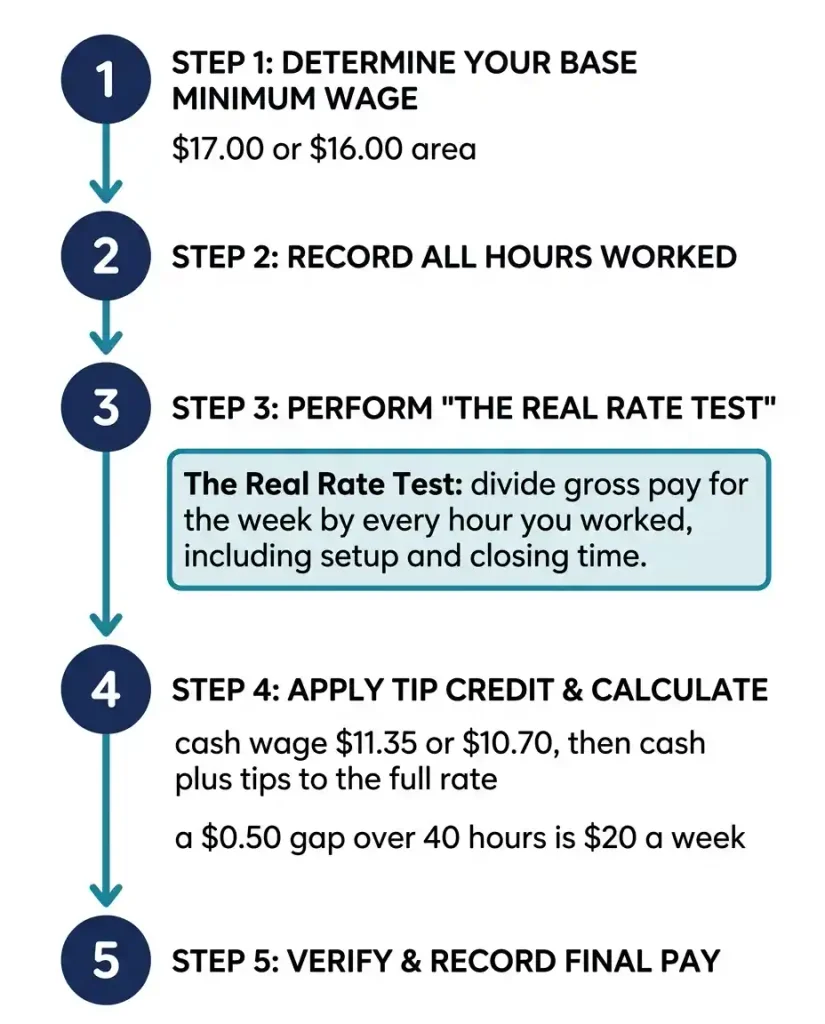
Step 1: Identify Where You Actually Worked
Write down where you worked each day, match the county to the $17.00 or $16.00 area, and list hours by site if your job sites change.
Step 2: Identify Your Job or Industry
Decide if you are a general employee, tipped server, fast food worker, or home care aide, which picks your row of the rate table. Hospitality jobs can use a tip credit, and fast food jobs cannot.
Step 3: Check Your Actual Hourly Pay
Find your pay stub rate and total hours, adding tips only if your job allows a tip credit. The Real Rate Test: divide gross pay for the week by every hour you worked, including setup and closing time, which exposes the unpaid minutes a stub rate hides.
Step 4: Compare Your Pay With the Applicable Rate
Put your Real Rate next to $17.00, $16.00, or your job’s special rate. Tipped workers compare cash wage to $11.35 or $10.70, then cash plus tips to the full rate. Multiply any gap by your hours, since a $0.50 gap over 40 hours is $20 a week.
Step 5: Check Your Notice of Pay Rate
Match your notice to your pay stub: regular rate, overtime rate, pay frequency, and any tip, meal, or lodging allowances. If something differs, ask your employer to fix it in writing.
Five steps and one page of notes tell you if you are paid right.
What If Your Employer Pays Less Than the New York Minimum Wage?
You can file a complaint with the New York State Department of Labor, and the law bans payback for doing so. Start by gathering your records.
Signs You May Be Underpaid
Watch for these signs:
- An hourly rate below your region’s minimum
- Hours missing from your stub
- An improper tip credit
- Unexplained wage cuts
- Off-the-clock work
A Real Rate from Step 3 below the floor is also a warning sign.
Required training, staff meetings, and setup or closing tasks count as hours worked and must be paid. An unpaid meal break is fine only when you are fully free of duties, and short rest breaks generally count as paid time.
What Records Should You Keep?
Save your pay stubs, hours log, schedules, written wage notice, and any texts or emails about pay, with copies at home rather than only in a work app.
How to File a New York Wage Complaint
File with NYSDOL online or call 1-888-469-7365 or 833-910-4378, with your employer’s name and address, dates of work, hours, pay rate, and pay received. NYSDOL handles minimum wage and overtime claims. You can also consult a wage and hour lawyer, since state law generally allows claims going back six years and may add extra damages. This guide is general information, not legal advice, and rules can change, so confirm details with NYSDOL.
The NYS Department of Labor may contact your employer while it reviews your claim. If it succeeds, back pay can include the unpaid wages plus interest.
Can an Employer Retaliate for a Wage Complaint?
No. New York Labor Law bans firing, cutting hours, or threatening you for a wage complaint. Write down dates and details of any change, save your schedules from before and after, and report retaliation to NYSDOL.
Keep records first. Then file. The law protects you from payback.
New York Minimum Wage History and 2027 Changes
Rates rose $0.50 in 2025 and 2026 after a bigger step in 2024, and from 2027 they follow inflation.
How the New York Minimum Wage Reached the 2026 Rates
The rate climbed $0.50 a year in 2025 and 2026, as set by the 2023 state budget deal.
| Year | NYC, Long Island, Westchester | Rest of New York |
|---|---|---|
| 2024 | $16.00 | $15.00 |
| 2025 | $16.50 | $15.50 |
| 2026 | $17.00 | $16.00 |
What Changes After 2026?
Starting January 1, 2027, raises follow the three-year average of the Consumer Price Index for Urban Wage Earners and Clerical Workers, Northeast Region, a price tracker for everyday costs. The state rounds to the nearest five cents and must post the new rate by October 1 each year. An off-ramp lets the state pause raises under certain economic or budget conditions, such as a negative yearly CPI-W change, a half-point rise in unemployment, or falling non-farm jobs.
Why You Should Check the Rate Again for 2027
The 2026 rates do not carry over on their own, and the downstate gap and special tipped and home care rates may shift too. Check NYSDOL after the October 1, 2026 posting, before you sign a job offer or plan a budget. The New York State minimum wage history on the state’s website shows how each past rate moved.
Check the new 2027 rate as soon as the state posts it.
Common New York Minimum Wage Myths and Misconceptions
Five myths follow: the $17 rule, the head office rule, the tips rule, the salary rule, and the one-number rule.
“Every Worker in New York Must Earn $17 an Hour”
False. Workers in the rest of the state legally earn $16.00, tipped hospitality workers can get a lower cash wage, and home care aides get more. Location and job decide the number.
“The Employer’s Office Location Determines the Rate”
Not true. NYSDOL ties the rate to where the work is performed, so a Manhattan company owes a Rochester employee $16.00, and hybrid workers should track hours by location.
“Tips Always Count Toward the Minimum Wage”
Only in hospitality jobs with a tip credit, and only up to the credit amount. The employer must still pay the full cash wage, such as $11.35 or $10.70 for food service. Fast food, nail salons, and retail get no tip credit.
“A Salary Means Minimum Wage Rules Do Not Apply”
A salary does not erase minimum wage or overtime rules. Executive and administrative roles are exempt only with the right duties and these minimum salaries in 2026:
| Region | Weekly | Annual |
|---|---|---|
| NYC, Long Island, Westchester | $1,275 | $66,300 |
| Rest of New York | $1,199.10 | $62,353.20 |
A “manager” earning $50,000 in Manhattan is usually still owed overtime.
“New York Uses One Minimum Wage Everywhere”
New York runs on a grid, not a single number: location gives the column and job type gives the row. The NYSDOL lookup tool finds your exact cell.
Location, job type, and tips set your rate. Titles and salaries do not.
How to Check Your Exact New York Minimum Wage
Use the Minimum Wage Lookup Tool on the New York State Department of Labor website. Enter where you work and what you do, and it shows your rate.
Use the New York Department of Labor Minimum Wage Lookup
Pick your work region on the map, choose your industry, and answer the tips question if it applies. The tool shows whether the general rate or a special rate applies. Confirm the effective date, January 1 through December 31, 2026, and screenshot the result. The New York State Department of Labor Minimum Wage page also links the General Minimum Wage Fact Sheet (P700), plus industry fact sheets and posters.
Verify Your Rate Before Accepting a Job or Challenging a Paycheck
Compare a job offer with the lookup result before you say yes, and negotiate or walk if it sits below. If challenging a paycheck, review your written notice, count tips only where a tip credit applies, and keep the screenshot with your records.
Two minutes on the NYSDOL tool can save you real money.
Frequently Asked Questions About New York Minimum Wage 2026
Quick answers to eight common questions, each driven by where you work and what you do. The New York State minimum wage FAQs on the state’s website go deeper.
What is the minimum wage in New York in 2026?
It is $17.00 an hour in New York City, Long Island, and Westchester County, and $16.00 in the rest of the state, effective January 1, 2026. Your work location sets your rate.
Is the minimum wage $17 in New York City in 2026?
Yes, for most workers. Tipped food service workers get an $11.35 cash wage and tipped service employees $14.15, with tips covering the rest, while home care aides earn $19.65 and fast food workers earn the full $17.00 in cash.
What is the minimum wage in upstate New York in 2026?
It is $16.00 in every county outside New York City, Long Island, and Westchester. Tipped food service workers get a $10.70 cash wage, and home care aides earn $18.65.
What is the minimum wage on Long Island in 2026?
Nassau and Suffolk counties both pay $17.00, matching New York City, including the same tipped and home care rates.
What is the minimum wage in Westchester County in 2026?
It is $17.00 across the whole county, with the same tipped and home care rates as New York City.
Can my employer pay me less than minimum wage if I receive tips?
Only in hospitality jobs. Cash plus tips must reach the full $17.00 or $16.00, or the employer pays the gap. Fast food, nail salon, and retail employers get no tip credit.
Does New York minimum wage depend on where I work?
Yes. The county where you do the work sets the rate, not the employer’s head office. If you split hours between two places, your employer must pay at least each site’s rate, or the higher rate for all hours.
What should I do if I am paid less than minimum wage?
Save your pay stubs and hours log, check your rate with the NYSDOL lookup tool, then file a complaint with NYSDOL or talk to a wage and hour lawyer. Write down anything that changes after you speak up.
Most answers start with two questions: where do you work, and what is your job?
Key Takeaways: New York Minimum Wage 2026
Remember three rates and three checks to judge almost any New York paycheck.
The Three General 2026 Rates to Remember
New York City pays $17.00 an hour. Long Island and Westchester County also pay $17.00. The remainder of New York State pays $16.00.
The Three Checks to Make Before Judging Your Pay
- Check where the work is performed.
- Check if your job has a special minimum.
- Check your tips, hours, deductions, and overtime.
The Official Source for Future Rate Changes
The New York State Department of Labor is the official source, and its Minimum Wage Lookup Tool gives your exact rate. The 2027 inflation-based rate will appear there first, so check again this fall. Browse more payroll guides on the NY Paycheck Calculator blog. Questions or corrections? Visit our contact page or see who built this tool.
Know your location, know your job, and check the rate every January.

Meet Yasin Ali, Founder
Yasin built NY Paycheck Calculator in 2020 after getting fed up with calculators that treated New York like every other state. Most tools ignore the extra local tax NYC and Yonkers workers pay on top of state tax — or skip New York’s Paid Family Leave deduction entirely.
He keeps the numbers current, checking in regularly against the latest IRS, NY Department of Taxation and Finance, and Paid Family Leave rates.
All results here are estimates based on official 2026 sources. For advice specific to your situation, talk to a tax professional.