
Under New York meal break laws, most employees get a meal period on shifts longer than six hours. It lasts at least 30 minutes, but the length depends on your start time and whether you work in a factory.
Those rules come from Section 162 and Department of Labor guidance, checked against its meal period page in September 2026.
Exceptions like permits and one-person shifts can change this, so check your own schedule.
Last reviewed September 2026.
What Are the Meal Break Laws in New York State?
New York Labor Law Section 162 sets the exact times. Non-factory workers get 30 minutes between 11 a.m. and 2 p.m., or 45 minutes midway through shifts starting between 1 p.m. and 6 a.m. Factory workers get 60.
Does New York require employers to provide meal breaks?
Yes. Section 162 requires meal periods, and federal law does not. It covers every employee in New York, public or private, hourly or salaried, including managers. The state does not require short rest breaks. The current Senate text of Section 162 matches the Department of Labor’s meal period page.
How long is a required meal break in New York?
Most workers get 30 minutes. Shifts starting between 1 p.m. and 6 a.m. and running over six hours get 45 minutes, midway through the shift. Factory workers get 60 in both cases. Days that start before 11 a.m. and run past 7 p.m. add at least 20 minutes between 5 p.m. and 7 p.m.
Insider tip: The Department of Labor lets a 45 or 60 minute meal shrink to 30 minutes without a permit if it causes no hardship. Only meals under 30 minutes need a special state permit.
Are 15-minute breaks required by New York law?
No. New York does not require rest breaks. If your employer offers a 15-minute break, it must be paid, because the state treats breaks of about 5 to 20 minutes as work time. It never replaces your meal period. One exception: employees who are nursing get a paid 30-minute break each time they need to pump, for up to three years after childbirth.
Takeaway: Meal periods are required. Short rest breaks are a bonus, not a right.
New York Meal Break Requirements at a Glance
Your rule depends on your shift’s start time and length, and factory status only changes the length.
New York meal break rules by shift
Find your row below.
| Your shift | Non-factory worker | Factory worker |
|---|---|---|
| More than 6 hours, crossing 11 a.m. to 2 p.m. | 30 minutes, taken between 11 a.m. and 2 p.m. | 60 minutes, taken between 11 a.m. and 2 p.m. (the factory rule has no six-hour test) |
| More than 6 hours, starting between 1 p.m. and 6 a.m. | 45 minutes, midway through the shift | 60 minutes, midway through the shift |
| Starts before 11 a.m. and runs past 7 p.m. | Extra 20 minutes between 5 p.m. and 7 p.m. | Extra 20 minutes between 5 p.m. and 7 p.m. |
| 6 hours or less, no meal window crossed | No meal period required | No meal period required |
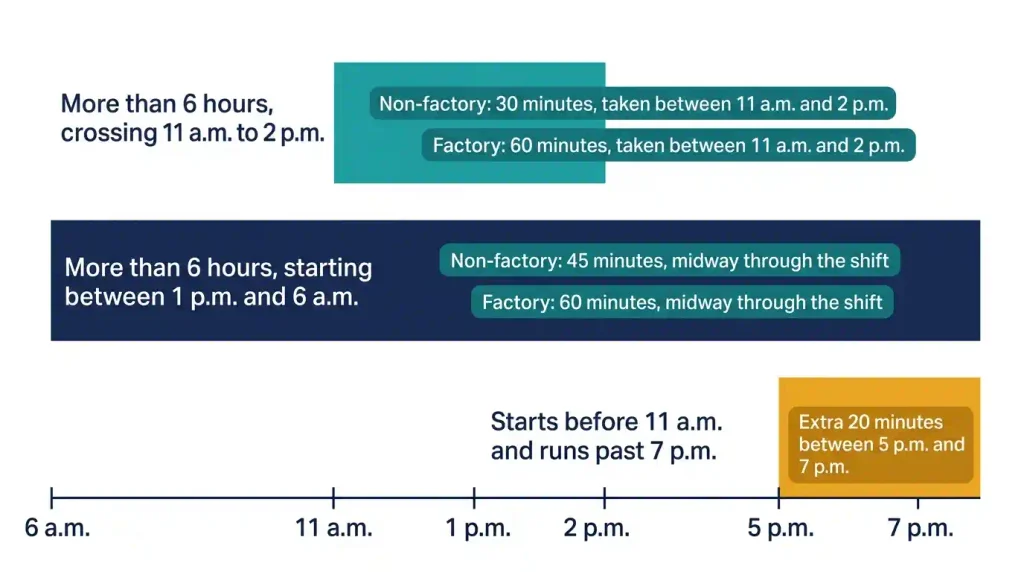
Quick examples of common New York work schedules
These examples assume a non-factory job. Factory workers get 60 minutes where you see 30 or 45.
| Schedule | What the law gives you |
|---|---|
| 9 a.m. to 5 p.m. | One 30-minute meal between 11 a.m. and 2 p.m. |
| 2 p.m. to 10 p.m. | One 45-minute meal around 6 p.m. |
| 10 p.m. to 6 a.m. | One 45-minute meal around 2 a.m. |
| 8 a.m. to 8 p.m. | 30 minutes between 11 a.m. and 2 p.m., plus 20 minutes between 5 p.m. and 7 p.m. |
Takeaway: Find your start time and shift length first. The rest follows.
When Does a New York Employee Get a 30-Minute Meal Break?
You get at least 30 minutes off when your shift is longer than six hours and runs across 11 a.m. to 2 p.m. Your break must land inside that window.
Shifts of more than 6 hours crossing the noon meal period
The law calls 11 a.m. to 2 p.m. the noon day meal period. If your workday is longer than six hours and runs across it, your 30 minutes must fall inside it. A 9 a.m. to 5 p.m. shift qualifies, and so does 7 a.m. to 3 p.m. Your boss cannot push lunch to 3 p.m.
What if my shift is exactly 6 hours?
The statute says more than six hours. On that wording, a 9 a.m. to 3 p.m. shift is exactly six, so no meal period is required, though some older Department of Labor wording says six hours or longer. Run it to 3:15 p.m. and the break is owed. A union contract or company policy may still give you one.
Can my employer decide when I take the required meal break?
Your employer picks the time, but only inside the legal window: between 11 a.m. and 2 p.m. for a 30-minute meal, and the middle of your shift for a 45-minute meal. Your employer cannot cancel the break or move it outside the window, whatever the policy says.
Takeaway: Over six hours across noon means 30 minutes, taken between 11 and 2.
When Does New York Require a 45-Minute or 60-Minute Meal Period?
Shifts starting between 1 p.m. and 6 a.m. and running over six hours need a longer break: 45 minutes for non-factory workers, 60 for factory workers, midway through the shift.
Shifts starting between 1 p.m. and 6 a.m.
This covers afternoon, evening, and overnight starts. The shift must run longer than six hours, and the meal falls at the halfway point. A 3 p.m. to 11 p.m. shift and a 10 p.m. to 6 a.m. shift both qualify.
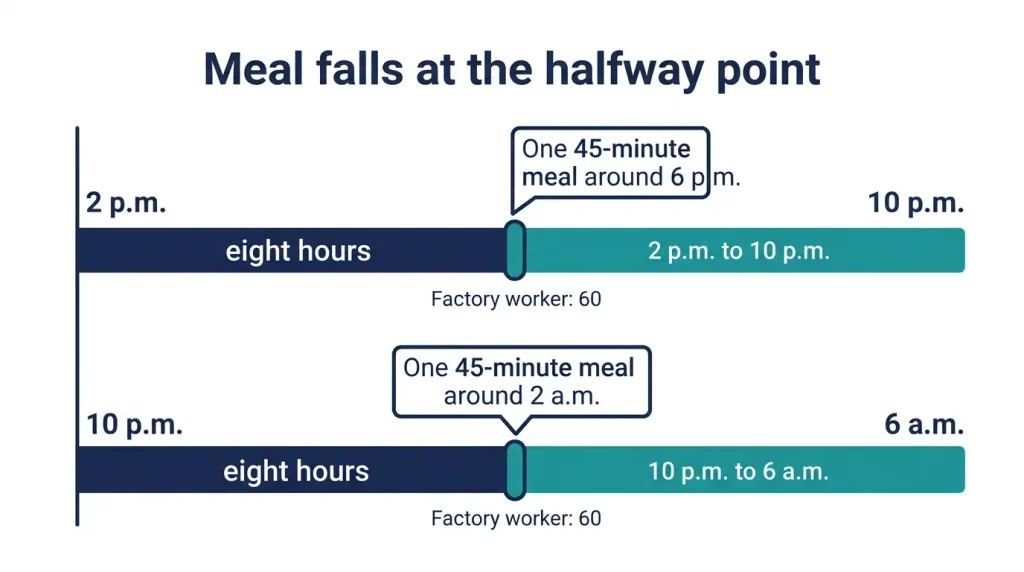
When is a 45-minute meal period required?
Non-factory workers get 45 minutes when a shift starts between 1 p.m. and 6 a.m. and lasts more than six hours. A nurse working 3 p.m. to 11 p.m. is owed 45 minutes around 7 p.m. Many employers schedule 30 instead, which the state accepts when it causes no hardship.
When is a 60-minute meal period required?
Factory workers get 60 minutes on those same shifts. A machine operator working 2 p.m. to 10 p.m. is owed an hour around 6 p.m. On day shifts, they get 60 minutes between 11 a.m. and 2 p.m. The state usually accepts 30 minutes when it causes no hardship to employees.
Takeaway: Afternoon and overnight shifts get 45 minutes. Factory workers get 60.
What If Your Shift Runs From Before 11 a.m. to After 7 p.m.?
You get a second meal period of at least 20 minutes between 5 p.m. and 7 p.m., on top of your midday meal. It applies to every worker, factory or not.
The additional 20-minute evening meal period
Two things trigger it: a start before 11 a.m. and a finish after 7 p.m. Your day then has two required meals: your regular midday meal between 11 a.m. and 2 p.m., and the 20-minute evening meal. One long lunch does not cover both.
Example: 8 a.m. to 8 p.m. shift
You are owed 30 minutes between 11 a.m. and 2 p.m. and 20 minutes between 5 p.m. and 7 p.m. A single 45-minute lunch at noon still leaves the evening break missing.
Example: 10 a.m. to 7 p.m. shift
You start before 11 a.m., but you finish at 7 p.m., not after it. The extra 20 minutes applies only when a shift continues later than 7 p.m., so it is not triggered here, though your midday meal still is. Stay until 7:15 p.m. and the evening break is owed.
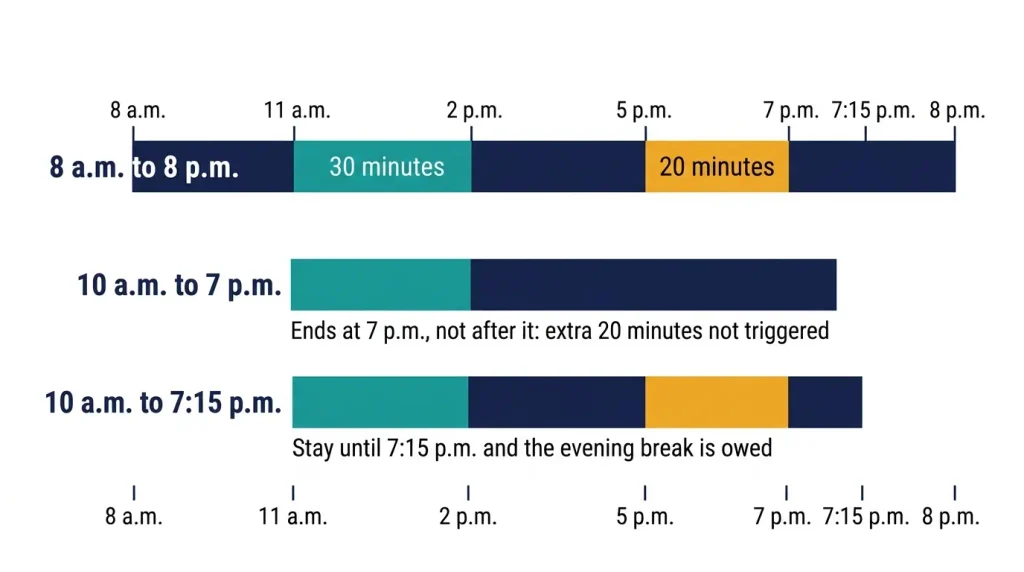
Takeaway: Start before 11 a.m. and end after 7 p.m. to earn the extra 20 minutes.
Are New York Meal Breaks Paid or Unpaid?
A real meal period is usually unpaid, but only if you are fully off duty. If you work during it, that time is paid. Breaks of about 5 to 20 minutes are paid too.
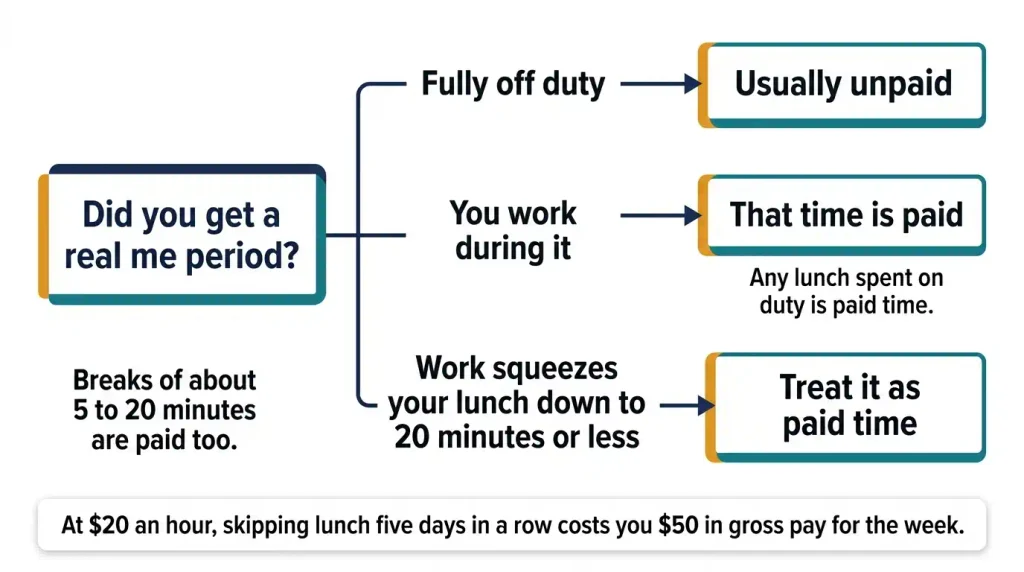
When is a meal period normally unpaid?
A meal period that meets the law does not count as hours worked, as long as you are completely free from duties. You can stay at your desk, but you cannot answer calls or watch the counter. Clock out and back in so your records show it.
What happens if you work during an unpaid lunch?
Any lunch spent on duty is paid time. The Department of Labor says you are not off duty if you must handle any duties, active or inactive. If those minutes push you past 40 hours in a week, you may be owed overtime.
Section 162 does not require you to clock out, but your employer’s policy may. If you clock out and keep answering customers, you are still working and should be paid. Under New York overtime law, most workers earn time and a half after 40 hours in a week.
What if my employer automatically deducts 30 minutes?
An automatic deduction is fair only when you actually got the break. If you worked through lunch, that half hour is unpaid wages. At $20 an hour, skipping lunch five days in a row costs you $50 in gross pay for the week. Save timecards, texts, and emails showing you were working. Your employer may round your clock times, but only if rounding does not, over time, cost you meal time. A short check can have other causes too, as our guide on why a New York paycheck is lower than expected explains.
Takeaway: A real lunch is unpaid. A working lunch is paid.
Does a New York Meal Break Have to Be Uninterrupted?
Yes. The Department of Labor says you must be completely relieved of duty during a meal period. If work interrupts it, it is not a real meal period. The time is paid, and you may still be owed a proper break.
What counts as an interrupted meal period?
Any duty counts, even a small one. Answering a customer, watching a phone line, or finishing a task all break the meal. The Department of Labor says staying at your desk generally does not count as being relieved.
What if I get less than 20 minutes because of work?
The Department of Labor follows the federal rule that rest breaks of about 5 to 20 minutes count as paid work time. It also says a meal is not a real meal if you must handle any duty during it. So treat a lunch that work squeezes down to 20 minutes or less as paid time. That lunch also falls short of the 30 minutes the law requires. If a manager pulls you back at minute 12, you worked that lunch.
Can I eat lunch while continuing to work?
You can, but it does not count as your meal period. Eating at your station while you work is work time, and so is a required working lunch or brown bag meeting. A talk you choose to attend does count as a meal. The exception is a one-employee shift, where you agree to eat on the job.
Takeaway: If you do any job duty during lunch, it is not a real break.
How New York Meal Break Laws Apply to Different Work Schedules
Your hours and start time tell you the rule. Here are five common setups.
Typical 9 a.m.–5 p.m. employee
You work eight hours, start before 1 p.m., and cross noon, so you get one 30-minute meal between 11 a.m. and 2 p.m. If you sit down at 12:30 p.m. and your manager pulls you into a call at 12:45 p.m., that lunch was interrupted and the time is paid.
8 a.m.–4 p.m. employee who is told to skip lunch
Your shift is eight hours and crosses the noon window, so you are owed 30 minutes off between 11 a.m. and 2 p.m. Lunch is not optional because your boss says so. The Department of Labor says an occasional swap for leaving early is fine, but a regular one is not. Note each skipped day and who told you.
2 p.m.–10 p.m. employee
You start between 1 p.m. and 6 a.m. on an eight-hour shift, so the halfway point is 6 p.m. A non-factory worker gets 45 minutes then, and a factory worker gets 60. The noon window does not apply because your shift starts after it.
Overnight employee
A 10 p.m. to 6 a.m. shift is eight hours and starts inside the 1 p.m. to 6 a.m. range. You get 45 minutes near 2 a.m., or 60 in a factory.
Employee working alone
If you are the only person on duty, you may be asked to eat on the job, but only if you agree. Your employer must explain that the industry needs one-person shifts and that meals may be interrupted. If you work through the meal, you are paid for it. Ask for a proper break before you agree, and the employer must give it.
Takeaway: Match your start time and length to a row, then check your break.
New York Meal Break Exceptions and Special Situations
Three situations change the basic rules: one-person shifts can eat on the job with consent, shorter meals are allowed in limited cases, and factory work means longer meals.
What is the one-employee shift exception?
When only one employee is on duty, the Department of Labor accepts eating on the job if you consent. Think of a lone night clerk at a gas station, or the only person in a specific job on that shift, like a sole cook. Your employer must explain the setup and get your acknowledgment, ideally in writing. Taking the job or staying on is not consent, and once you agree, you cannot take it back unless your circumstances change.
Can an employer legally provide a meal break shorter than 30 minutes?
Only with a special permit. The Department of Labor allows a meal of not less than 20 minutes only in special or unusual cases, after an investigation. The permit must be in writing, posted at your workplace’s main entrance, and it can be revoked at any time. Your boss saying so is not enough.
Employers apply to the Commissioner of Labor through the state’s online MPWR system. The NYS Department of Labor keeps a list of employers permitted to have shorter meal periods. A 15-minute lunch is too short, and a 20-minute lunch is legal only with a permit.
What is a factory worker under New York meal-break law?
A factory is a mill, workshop, or other manufacturing place, including its buildings and sheds. You are a factory worker if you work in one or your main duties involve running or maintaining it. A cashier in a store or an accountant in an office building is non-factory, and that difference changes your meal from 30 or 45 minutes to 60.
The law describes non-factory workplaces as a mercantile or other establishment. A store is the classic mercantile establishment, but restaurants, hotels, offices, and hospitals count as non-factory too. A warehouse is different. If it serves a manufacturing operation, the factory rules may apply, so ask the Department of Labor if you are unsure.
Takeaway: Exceptions exist, but most need your consent or a written state permit.
Who Is Covered by New York State Meal Break Laws?
Almost every employee in New York. Section 162 covers private and public employers and all categories of workers, including managers. Hourly, salaried, and part-time staff all count.
Private-sector employees
Pay type and job title do not remove your rights. Hourly, salaried, and part-time workers follow the same shift-based rules, and the Department of Labor says even white-collar management staff are covered. A non-factory part-timer gets a meal period only when the shift passes six hours.
New York meal break laws protect employees, not independent contractors, but the label does not decide it. If your boss controls your hours and how you work, you may really be an employee. Workers under 18 also fall under New York child labor rules, which have their own meal and hour limits, so check the Department of Labor’s employment of minors page.
Public-sector employees
State, city, and local government workers are covered too. A union contract or agency policy may add more than the law gives you, but it can only trade away your meal if it meets the court’s waiver test, which requires operational need, open good-faith bargaining, and a real benefit in return. Ask HR for the written policy and compare it to your shift times.
Remote and hybrid employees
Working from home in New York does not switch off Section 162. You must still get the meal period and be free of duties. Log your break start and end times, and keep any messages sent during it.
Takeaway: If you work in New York, Section 162 covers you.
New York Meal Break Law Examples: Is Your Break Legal?
Test any break with four facts: start time, end time, job type, and what happened at lunch. Match your case to one of the five below.
“I worked 8 hours and got no lunch.”
This is likely a violation. If your shift crossed 11 a.m. to 2 p.m., you were owed 30 minutes off. A one-person shift with your consent, a permit, or a union deal could change the answer. Write down the dates, then talk to your employer or file a complaint.
“My employer deducted lunch even though I worked through it.”
You worked that time, so you should be paid for it. Compare your New York pay stubs to your own log and ask payroll to correct it in writing. If nothing changes, file a complaint with the Department of Labor.
“My 30-minute lunch was interrupted by work.”
If you had to do any duty, you were not fully off. Time on duty is paid, and a lunch cut to about 20 minutes or less should be treated as paid time. Note the time, the task, and who asked, then ask for a full break next time.
“I work from 2 p.m. to 10 p.m.”
This is the midpoint rule. You are owed 45 minutes around 6 p.m., or 60 in a factory. The Department of Labor usually accepts a 30-minute meal if it causes no hardship.
“I work from 8 a.m. to 8 p.m.”
You need two breaks: 30 minutes between 11 a.m. and 2 p.m., and 20 minutes between 5 p.m. and 7 p.m. One long lunch at noon does not cover both.
Takeaway: Check your start time, end time, and what happened during the break.
Common Myths About New York Meal Break Laws
Five myths cause most of the confusion: 15-minute breaks, a flat 30-minute lunch, working during unpaid lunch, automatic deductions, and waivers.
Myth: Everyone is legally entitled to two 15-minute breaks
False. That is a company perk, not state law. New York requires meal periods, not short rest breaks. If your employer offers 15-minute breaks, they must be paid, and they never replace your lunch.
Myth: Every New York employee gets exactly a 30-minute lunch
False. Thirty minutes is the most common length, not the only one. Some shifts get 45 or 60 minutes, and long days add a 20-minute evening meal. Many employers give 30 anyway, which the state usually accepts.
Myth: An unpaid lunch means you can be required to work
False. Unpaid time only works when you are fully off duty. A lunch with duties is paid work time.
Myth: Employers can always deduct 30 minutes automatically
False. A deduction is fair only when you got a full break. Missed or interrupted lunches must be paid, so log any lunch you worked through.
Myth: Employees can always waive their meal break
False. You cannot simply sign your lunch away, and a manager’s verbal okay to skip lunch does not make it lawful either. A waiver holds only in narrow cases, like a union contract that trades the meal for real benefits. Trading lunch for leaving early is a different matter: the Department of Labor says an occasional swap is fine, but a regular one is not.
Takeaway: Most break myths fail because the law is about real time off duty.
What Should You Do If Your Employer Does Not Provide Your Required Meal Break?
Follow four steps in order: check your shift, document what happened, raise it with your employer in writing, then file a complaint with the New York State Department of Labor if that fails.
Check whether your shift actually triggers the requirement
Write down your start time, end time, and total hours, and decide whether you are factory or non-factory. Then look for a posted permit at the entrance, a one-employee consent form, or a union contract. If none applies and you missed the meal, you have a real issue.
Document missed or interrupted meal periods
Records win these cases, so start a log today.
- Save your timecards and pay stubs.
- Write down the real start and stop time of each meal.
- Screenshot any work messages sent during lunch.
- Keep a dated list of repeated incidents.
Raise the issue with your employer
Keep it calm and factual. Name the date, the shift, and the meal that was missed or cut short, and ask them to fix inaccurate time records. Send it by email for a paper trail.
The New York State Labor Law bars retaliation against workers who complain in good faith about pay or meal periods, whether to the employer, the Department of Labor, or the attorney general. A retaliation claim has a two-year window.
When can you file a complaint with the New York Department of Labor?
File when the problem continues or your employer will not fix it. Use the Labor Standards Complaint Form LS 223 from the Division of Labor Standards. It has a spot for a missed meal period, and you can mail it or file online. Wage complaints, such as unpaid lunch time, are generally due within three years, though the Department may accept one up to six years back, while a court claim is generally six years. For a missed meal with no lost pay, ask the Department about timing. Attach your timecards and log.
After you file a Labor Standards complaint, New York Labor Standards staff review it and decide whether to open an investigation, and may contact you for details. If the state finds you were owed pay for time worked through lunch, it can order your employer to pay it. The state’s fiscal year 2026 budget also lets the Department levy liens, seize assets, and issue stop work orders after an unpaid wage judgment, as the Labor Standards Complaint Process page explains. The form also covers other kinds of wage theft, such as illegal deductions and New York minimum wage violations.
Takeaway: Check, document, ask in writing, then file with the state if needed.
New York Meal Break Laws vs. Federal Break Rules
Federal law does not require meal or rest breaks. New York does. Section 162 is your main meal period rule, and federal rules mostly decide whether break time is paid.
What does New York law require?
Labor Law Section 162 sets the meal periods above: 30, 45, or 60 minutes, plus an extra 20 minutes on long days. It also sets timing rules, like the 11 a.m. to 2 p.m. window and the shift midpoint. The Department of Labor enforces it, and you do not need a lawyer to start a complaint.
You will often see it written as Labor Law § 162. The NYS Department of Labor also explains how it applies the law in its Guidelines for Meal Periods, form LS 443. Search Section 162 time allowed for meals in the official New York Labor Law to read the statute itself.
What does federal law require?
The Fair Labor Standards Act does not require meal or rest breaks. It only sets pay rules for the ones you get: breaks of about 5 to 20 minutes are paid, and a meal of 30 minutes or more can be unpaid if you are fully relieved of duty.
Which rule should a New York employee check?
Match your question to the rule that answers it.
| Your question | Rule that answers it |
|---|---|
| Do I get a meal break? | New York Section 162. Federal law requires none. |
| How long is it? | New York, based on your start time, hours, and factory status. |
| Is it paid? | Federal pay rules, which the New York Department of Labor follows for short breaks. |
| Can it be shorter than 30 minutes? | New York, only with a Commissioner of Labor permit. |
The FLSA sets a national floor, and New York wage and hour laws can go higher. Where the two overlap, your employer must follow the rule that protects you more.
Takeaway: New York sets your meal break. Federal rules mostly set the pay.
New York Meal Break Law: What to Check Before You Act
Five details decide your rule. Write them down before you talk to your boss or file anything.
The five details that determine your meal-break rule
- Shift start time: before 11 a.m., or between 1 p.m. and 6 a.m.
- Shift end time and total hours: more than six hours, and later than 7 p.m.
- Factory or non-factory: 60 minutes, or 30 and 45 minutes.
- Actual break length and interruptions: any duties, calls, or tasks during it.
- Permit or exception: a posted permit, a one-employee consent, or a union waiver.
What to record if you believe your break rights were violated
Each shift, write down four things: your scheduled hours, the real start and end of your meal, any work you did during it, and what your timecard and pay stub show. Do it the same day, because details from that day carry more weight than memory. Then run your hours through our New York paycheck calculator to see what the missing pay adds up to. Our calculation methodology shows how it works.
When the situation needs closer review
Repeated missed meals, automatic deductions for lunches you did not take, work during unpaid breaks, and unclear exceptions or permits all need closer review. This guide is general information, not legal advice, so talk to an employment lawyer or the Department of Labor about big or long-running cases. For more on what New York employers must follow, browse our New York payroll and employer compliance guides.
Takeaway: Know your five facts, and you will know your rights.
New York Meal Break Laws FAQ
Short answers follow. The core rule: meal periods are required, and short rest breaks are not.
Does New York State require a lunch break after 6 hours?
Only if your shift is longer than six hours and crosses 11 a.m. to 2 p.m. Then you get 30 minutes. Under the statute, exactly six hours does not trigger it. Shifts starting between 1 p.m. and 6 a.m. that pass six hours get 45 minutes, even without crossing noon.
Are lunch breaks paid in New York?
Usually not. A lunch that meets the law is unpaid if you are fully off duty, and paid if you work during it. Breaks of about 5 to 20 minutes are paid too. Paid meal time is taxed like your other wages, so see what taxes come out of a New York paycheck.
Can my employer make me work through lunch?
Not without pay, and rarely at all. You are owed the meal period unless a narrow exception applies, like a one-employee shift with your consent or a valid union waiver. Any interruption means it was not a real break.
Are 15-minute breaks required in New York?
No. The state does not require rest breaks. If your employer gives them, they are paid and do not replace your meal period.
What if my employer automatically deducts 30 minutes for lunch?
They can deduct it only when you truly got the break. If you worked through lunch, tell payroll in writing and ask for the pay. Check each line of your pay stub against New York paycheck deductions. Keep your log and timecards. If it continues, you can file an LS 223 complaint.
Do New York meal-break rules apply to salaried employees?
Yes. Section 162 covers all categories of workers, including white-collar managers. Salary status may affect overtime, which is a separate rule.
Do New York meal-break rules apply to remote workers?
Yes. If you work in New York, your home office counts, and you must still be fully off duty during your meal. Log your break times, since your employer cannot see them.
Where can I complain about a missed New York meal break?
File with the New York State Department of Labor, Division of Labor Standards. Use the Labor Standards Complaint Form LS 223. Mail it to Harriman State Office Campus, Building 12, Room 185B, Albany, NY 12226, or file online. Call (888) 469-7365 with questions.
Takeaway: When in doubt, count your hours and check your start time.
New York Meal Break Laws: Key Takeaways
Meal breaks in New York come down to timing, not job title. Know your start time, shift length, and whether you were truly off duty.
The core rules to remember
More than six hours across 11 a.m. to 2 p.m. means 30 minutes. Starts between 1 p.m. and 6 a.m. mean 45 minutes at the midpoint. Factory workers get 60 instead. A day that runs from before 11 a.m. to after 7 p.m. adds 20 minutes. Any work during a meal makes it paid time.
What to check in your own situation
- Check your start and end times.
- Check how long your meal really lasted.
- Check whether you did any work during it.
- Check whether a permit or exception applies.
If something looks off, raise it in writing. File a complaint if it continues. For more paycheck questions, start with New York paycheck basics.
Takeaway: Your shift times decide your meal. Your records protect it.

Meet Yasin Ali, Founder
Yasin built NY Paycheck Calculator in 2020 after getting fed up with calculators that treated New York like every other state. Most tools ignore the extra local tax NYC and Yonkers workers pay on top of state tax — or skip New York’s Paid Family Leave deduction entirely.
He keeps the numbers current, checking in regularly against the latest IRS, NY Department of Taxation and Finance, and Paid Family Leave rates.
All results here are estimates based on official 2026 sources. For advice specific to your situation, talk to a tax professional.