
New York Paid Family Leave gives eligible employees up to 12 weeks of job-protected, partially paid leave to bond with a child, care for a seriously ill family member, or support a deployed relative, after meeting a work-history requirement.
That 12-week limit and the 2026 weekly cap of $1,228.53 come from the official PaidFamilyLeave.ny.gov 2026 update, not estimates.
Still, it replaces only part of your pay (67%), so expect a smaller paycheck than usual.
New York Paid Family Leave at a Glance (2026)
The New York State Paid Family Leave program is funded by employees, not employers. Your work history and your reason for leave decide whether you qualify.
What New York Paid Family Leave Covers
Bonding leave applies to birth, adoption, and foster placement. Family care applies to a serious health condition, and military leave applies to deployment abroad on active service. It does not cover your own non-work illness, which falls under disability benefits.
2026 Benefits and Contribution Limits
You can take up to 12 weeks at 67% of your average weekly wage, capped at $1,228.53 a week. The maximum total benefit is $14,742.36. What you pay in is a separate number: 0.432% of gross pay, capped at $411.91 a year.
Quick Eligibility Checklist
You likely qualify if you have worked 26 consecutive weeks (20 or more hours a week) or 175 days (under 20 hours), your reason is one of the three above, and your employer is covered. You must also be an employee, not a contractor. The next sections explain each point.
Who Qualifies for New York Paid Family Leave?
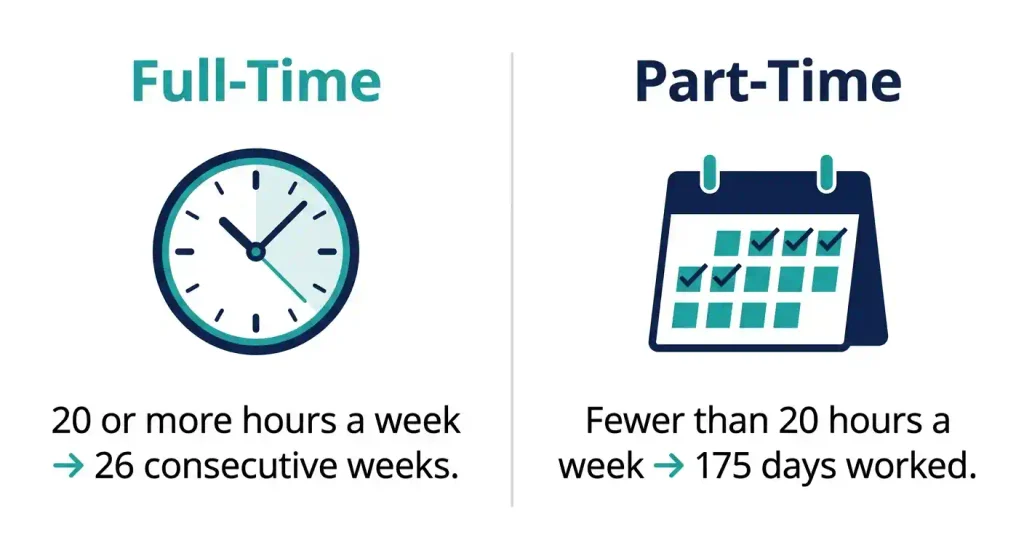
Most private-sector employees qualify after 26 consecutive weeks (20 or more hours weekly) or 175 days (under 20 hours). Independent contractors generally do not.
Full-Time Employee Eligibility
If you regularly work 20 or more hours a week, you qualify after 26 consecutive weeks. The clock starts on your first day, so someone hired January 5 can usually claim around early July. New hires cannot claim sooner. If your schedule changes, the rule that fits your new regular schedule applies.
Part-Time Employee Eligibility
If you regularly work fewer than 20 hours a week, you need 175 days worked. The days do not have to be consecutive. At three days a week, that takes about 58 weeks. If your hours vary, keep pay stubs and count the days you actually worked.
Which Employers and Workers Are Covered?
Every private employer in New York must provide coverage, including out-of-state employers with at least one employee working in New York. Public employers can opt in, and public-sector unions can opt in through collective bargaining. State employees can check with New York State Civil Service. Temporary, seasonal, and probationary employees qualify if they meet the same 26-week or 175-day rule. Independent contractors and self-employed people are generally not covered, but they can opt in by buying a Paid Family Leave and disability policy. A waiting period applies before they can take leave.
Special Eligibility Situations
With two jobs, each employer’s records count separately, so ask the insurer how wages from both are combined. Changing employers restarts the waiting period. Where you work decides coverage, not where you live or where your employer is based. Working from home in New York counts. Telecommuting from another state for a New York employer generally does not. Citizenship and immigration status do not affect eligibility. Deductions are mandatory for eligible employees. Those not expected to meet the 26-week or 175-day rule can waive coverage and skip the deduction. A deduction alone does not prove you qualify.
What Reasons Qualify for Paid Family Leave?
Three reasons qualify: bonding with a new child, caring for a family member with a serious health condition, and military family needs. Your own illness does not.
Bonding With a Newborn, Adopted, or Foster Child
You can take bonding leave in the first 12 months after a child’s birth or placement. Proof includes a birth certificate or adoption or foster placement papers. Each eligible parent can take their own 12 weeks, together or separately, with limits if both work for the same employer. If the baby arrives early, tell your employer as soon as you can. Leave starts after the child arrives, so pregnancy complications before birth are not bonding leave.
Caring for a Family Member With a Serious Health Condition
A serious health condition means inpatient care, or ongoing treatment or supervision by a health care provider. Routine checkups for a healthy relative do not qualify. Eligible family members are your spouse, domestic partner, child, parent, stepparent, parent-in-law, sibling, grandparent, or grandchild. A health care provider must certify the condition. The family member can live outside New York, even outside the U.S.
Military Family Assistance
PFL applies when your spouse, domestic partner, child, or parent is deployed abroad on active military service. You will need documentation, such as deployment orders. Routine local training or regular domestic duty does not count.
Situations That Usually Require a Different Leave Benefit
Your own illness falls under New York Disability Benefits Law (DBL) benefits or New York Paid Sick Leave. Recovery from childbirth typically goes through disability, often about six weeks after a vaginal birth and eight after a cesarean. Bonding leave under PFL can follow. Prenatal appointments have separate help: 20 hours of paid prenatal leave since January 1, 2025.
How Much Does New York Paid Family Leave Pay in 2026?
It pays 67% of your average weekly wage, capped at $1,228.53 a week and $14,742.36 over 12 weeks. Most people receive less than the cap.
How the 67% Benefit Calculation Works
The insurer averages your last eight weeks of wages and takes 67%. It then caps the result at 67% of the 2026 New York State Average Weekly Wage (NYSAWW) of $1,833.63. Average weekly wage (AWW) of $1,833.63 or more, about $95,349 a year, reaches the cap. Everyone below that gets less.
Paid Family Leave Examples by Weekly Salary
These are estimates. Your actual benefit depends on your wage calculation and eligibility.
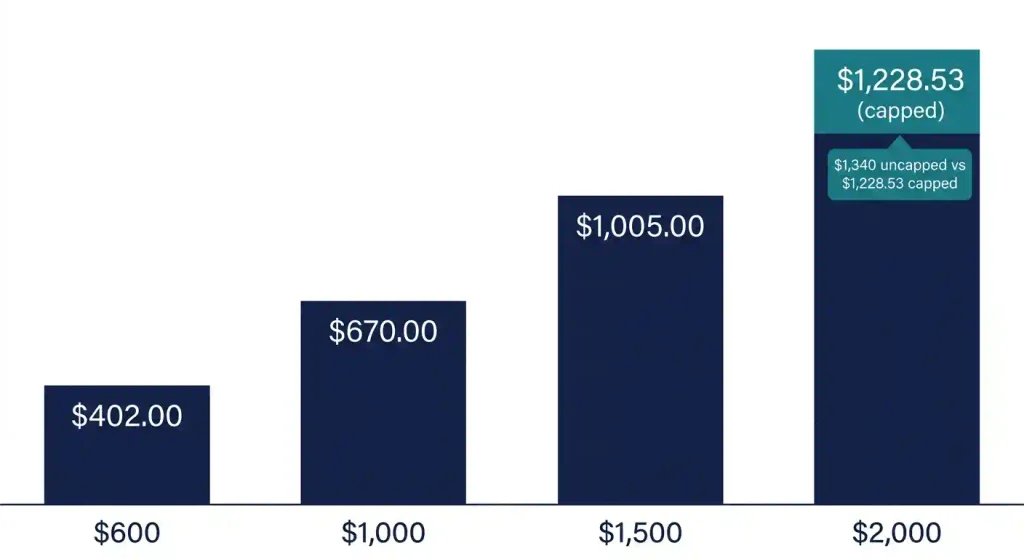
| Average weekly pay | Weekly PFL benefit | 12-week total |
|---|---|---|
| $600 | $402.00 | $4,824.00 |
| $1,000 | $670.00 | $8,040.00 |
| $1,500 | $1,005.00 | $12,060.00 |
| $2,000 | $1,228.53 (capped) | $14,742.36 |
The $2,000 earner would get $1,340 at 67%, but the cap holds it to $1,228.53. Someone earning $1,000 a week gives up $330 a week before taxes.
How Much Will Paid Family Leave Cost You in Payroll Deductions?
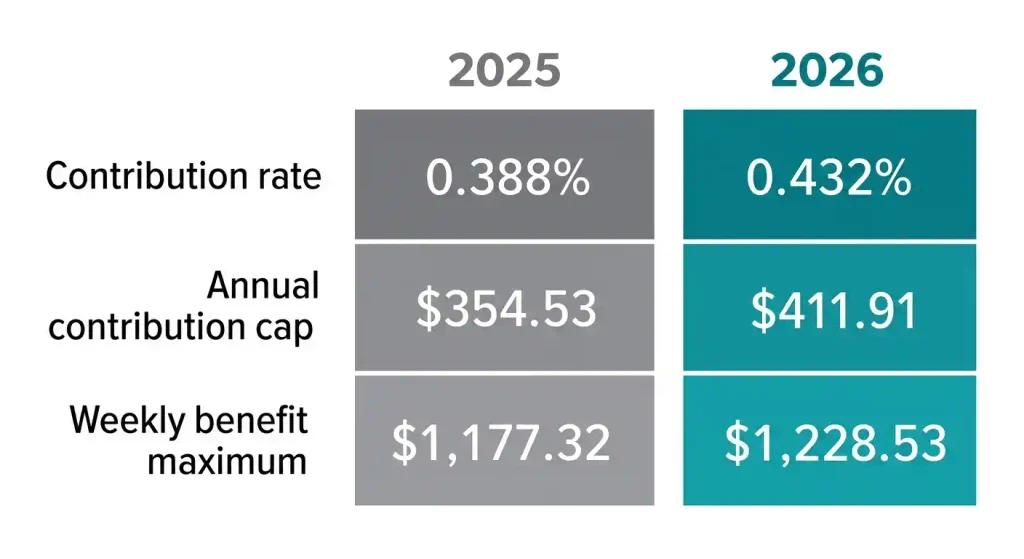
You pay 0.432% of gross wages each pay period, up to $411.91 a year. That is $4.32 on a $1,000 weekly paycheck, $8.64 on $2,000 biweekly, and $12.96 on $3,000 semimonthly. You hit the cap at about $95,349 in yearly wages. The cap is the most you pay, not what you get back. Deductions come from after-tax pay, and the New York State Department of Financial Services sets the rate each year. In 2025, the rate was 0.388%, the cap was $354.53, and the weekly maximum was $1,177.32.
What Can Change Your Actual Benefit?
Raises, unpaid weeks, and reduced hours change the eight-week average. Bonuses and commissions count as wages, so swings in them matter too. If your leave starts in one year and runs into the next, you get the benefit rate in effect on your first day of leave. Gross wages are what you earn before deductions. AWW is the eight-week figure used for your claim. Take-home is what you actually receive. For a personal estimate, use the official 2026 Wage Benefits Calculator on PaidFamilyLeave.ny.gov.
What Job and Health Insurance Protections Do You Get?
Your job and your health insurance are both protected during leave. PFL does not replace your full salary.
Job Protection and Return to Work
You are entitled to the same job or a comparable one. Your employer cannot retaliate against you for requesting or taking leave. The protection does not stop lawful layoffs or discipline unrelated to your leave. Other workplace problems, such as unpaid wages, go to the New York State Department of Labor or the New York State Office of the Attorney General.
Health Insurance While on Leave
Your employer must keep your health insurance going on the same terms as before. You still pay your normal share of premiums. If your leave pay is too small to cover them, the missed amount may be deducted from your paycheck when you return. Ask HR how premiums will be collected before you go.
What Happens to Your Pay and Taxes?
PFL replaces only part of your wages. The benefits are taxable income at the federal level. Taxes are not withheld automatically, but you can request voluntary withholding. Withholding is only a prepayment, and your final bill depends on your total income for the year. Budget around the benefit amount. Someone getting $670 a week should plan for less after taxes.
How Long Can You Take Leave, and Can You Split It Up?
You can take up to 12 weeks in a rolling 52-week period, all at once or in separate days. Unused weeks do not carry over, and PFL does not pay past 12 weeks.
Taking All 12 Weeks at Once
Continuous leave works best for a new baby, a long recovery, or full-time care. Bonding leave can start any time in the first 12 months. If your baby is due in March, confirm start dates with your employer and the insurer early. If medical timelines shift, tell both right away.
Intermittent Paid Family Leave
You can split your 12 weeks into separate periods, but only in full-day increments. Your maximum is 12 times your usual workweek. That is 60 days on a five-day schedule and 36 days on a three-day schedule. If more than three months pass between leave days, the next leave counts as a new claim, so ask the carrier before you split your leave.
Combining Paid Family Leave With Other Benefits
PFL can run at the same time as the federal Family and Medical Leave Act (FMLA), but each has its own eligibility rules. FMLA requires 12 months with the employer, 1,250 hours worked, and a worksite with 50 or more employees within 75 miles. DBL benefits and PFL cannot be collected at the same time. Together they are limited to 26 weeks in a 52-week period. Some employers also offer paid time off or paid parental leave. Your employer cannot require you to use vacation or sick time for PFL. Ask HR whether paid time off or parental leave runs alongside PFL or stacks on top.
Common Paid Family Leave Myths and Mistakes
Four problems cause most trouble: assuming everyone gets the maximum, assuming everyone qualifies, assuming PFL covers your own illness, and paperwork errors.
Myth — Everyone Receives the Maximum Weekly Benefit
Only people averaging $1,833.63 a week or more reach $1,228.53. A worker earning $1,000 a week gets $670. The $14,742.36 total also assumes all 12 weeks at the weekly maximum. Treat both as ceilings.
Myth — Every Worker Qualifies Automatically
Employment length, employer coverage, and worker status all matter. A contractor is generally out, a new hire may be too early, and a public employer may not have opted in. A payroll deduction does not settle any of that.
Myth — Paid Family Leave Covers Your Own Illness
It does not. For your own illness, look at disability benefits or paid sick leave. Pregnancy shows the split: recovery from birth usually goes through disability, and time with the baby afterward is PFL bonding leave. Picking the right benefit up front avoids a denial.
Mistakes That Can Delay or Jeopardize a Claim
The big ones are filing late, sending incomplete paperwork, and skipping notice to your employer. If your employer is slow with its part, file anyway and tell the carrier. A claim is not treated as incomplete only because the employer missed its deadline. If your claim is denied, you can ask a neutral arbitrator to review it. The denial notice explains how. If you face retaliation, ask for reinstatement using Form PFL-DC-119. If your employer does not act within 30 days, file a complaint with the New York Workers’ Compensation Board. Its Paid Family Leave Statement of Rights summarizes these protections.
How to Apply for New York Paid Family Leave
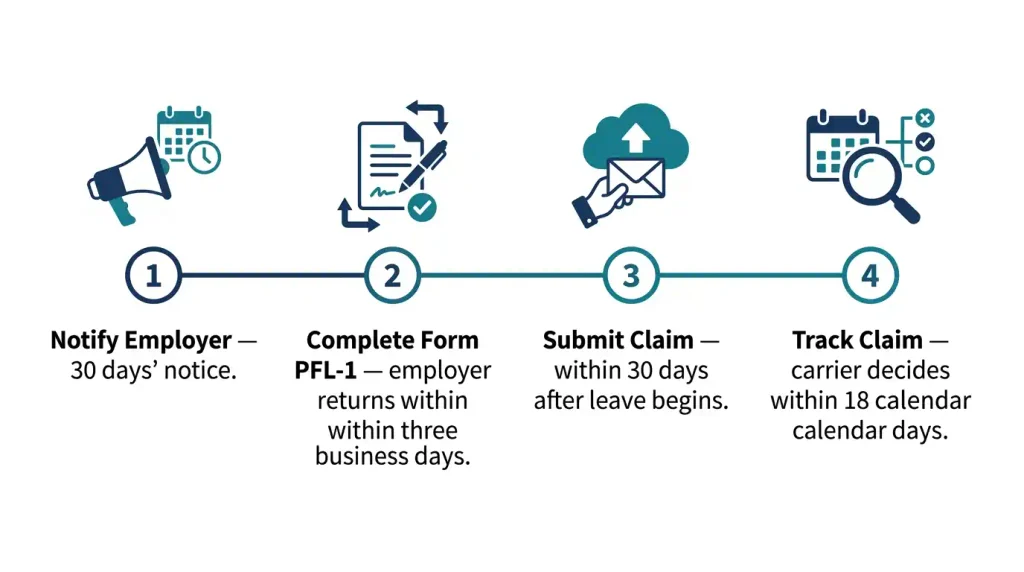
Notify your employer, complete Form PFL-1, send it with your documents to the insurance carrier, and track the claim.
Step 1 — Notify Your Employer
If your leave is foreseeable, give at least 30 days’ notice. If it is not, such as a sudden hospital stay, tell them as soon as you can. Ask HR who the insurance carrier is, who completes the employer section, and how health premiums will work.
Step 2 — Complete Form PFL-1
Fill out Part A of the Request for Paid Family Leave (Form PFL-1), then give it to your employer to complete Part B within three business days. Add the form your reason requires: PFL-2 for bonding, PFL-3 and PFL-4 for family care (a health information release and a medical certification), or PFL-5 for military leave. The carrier is listed on Part B. You can also look it up using the employer coverage search on wcb.ny.gov.
Step 3 — Submit Your Claim and Supporting Documents
Send the full package to the insurance carrier within 30 days after your leave begins, or you risk losing benefits. You can also submit it before leave starts. Missing signatures, blank fields, and absent proof cause most delays. Keep copies of everything.
Step 4 — Track Your Claim and Payment
The carrier generally has 18 calendar days to pay or deny, counted from receiving your completed request or your first day of leave, whichever is later. If it asks for more information, answer fast. If the deadline passes, call the carrier, then the Paid Family Leave Helpline. Payment disputes can also go to arbitration.
Official New York Paid Family Leave Resources and Next Steps
The official source is PaidFamilyLeave.ny.gov. Use it to confirm numbers and forms before you plan your leave.
Where to Find Official Forms, Calculators, and Help
PaidFamilyLeave.ny.gov has the claim forms, the 2026 Wage Benefits Calculator, and the 2026 payroll deduction calculator. For questions, call the NYS Paid Family Leave Helpline at 844-337-6303. If your employer and the carrier give you conflicting information, call it.
What to Confirm Before Your Leave Begins
Check your eligibility, benefit estimate, insurer, documents, and notice dates. Ask HR how health premiums will be paid and when your first payment should arrive. Keep copies of every form and message with your employer and insurer.
Frequently Asked Questions About New York Paid Family Leave
How much does New York Paid Family Leave pay in 2026?
It pays 67% of your average weekly wage, up to $1,228.53 a week. Most people get less than the cap.
How many weeks of Paid Family Leave can I take?
Up to 12 weeks in a 52-week period, all at once or in separate full days.
Can I qualify for Paid Family Leave after starting a new job?
Not right away. You need 26 consecutive weeks (20 or more hours a week) or 175 days worked (fewer than 20 hours). Your employer must also be covered.
Can I take Paid Family Leave and FMLA at the same time?
Often, yes. The programs frequently run together, but each has its own eligibility rules.
Can I take Paid Family Leave to care for a parent in another state?
Yes, if your parent has a qualifying serious health condition and you provide care. The parent does not have to live in New York. Expect to provide a health care provider’s certification.
What if my Paid Family Leave claim is denied?
Read the denial notice. It explains how to ask a neutral arbitrator to review it. Keep your forms, medical certification, and emails, and call 844-337-6303 if you need guidance.
Is New York Paid Family Leave taxable?
Yes, federally. Withholding is not automatic, but you can request it. It is only a prepayment, so your final tax depends on your total income.

Meet Yasin Ali, Founder
Yasin built NY Paycheck Calculator in 2020 after getting fed up with calculators that treated New York like every other state. Most tools ignore the extra local tax NYC and Yonkers workers pay on top of state tax — or skip New York’s Paid Family Leave deduction entirely.
He keeps the numbers current, checking in regularly against the latest IRS, NY Department of Taxation and Finance, and Paid Family Leave rates.
All results here are estimates based on official sources. For advice specific to your situation, talk to a tax professional.