
If you earn 1099 income in New York, you owe federal income tax, self-employment tax, and New York State tax on your net profit, plus NYC, Yonkers, or MCTMT tax if those apply, usually totaling 30% to 45% of profit.
That range starts with self-employment tax, which runs 15.3% on 92.35% of net profit before any state tax.
No single percentage fits everyone, since income, deductions, and location change the real total.
How Much Tax Do You Pay on 1099 Income in New York in 2026?
Which federal, state, and local taxes actually hit you, and how hard, depends on your income level and where you live or work.
The Taxes That Can Apply to Your 1099 Income
Your bill breaks down into four tax categories: federal income tax, federal self-employment tax, New York State income tax, and local tax. The first two apply to almost everyone with a profit. Local tax depends on where you live or work. A freelancer in Buffalo and one in Manhattan can owe very different totals on the same $70,000 profit, because one lives inside New York City and the other does not. If you are weighing 1099 work against a salaried role, comparing 1099 vs. W-2 pay in New York side by side makes the tradeoff clearer.
1099 Taxes at a Glance: Federal, State, and Local
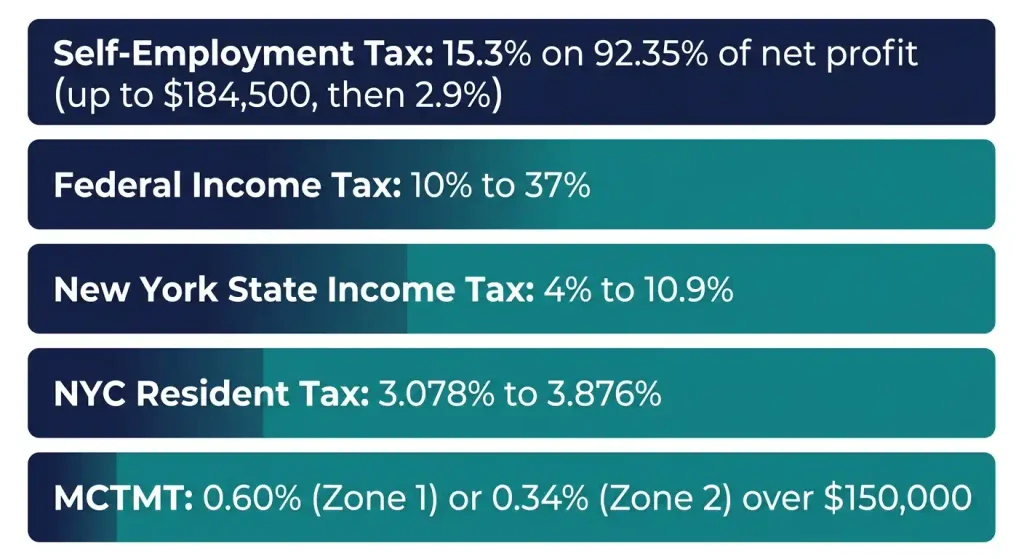
Self-employment tax runs 15.3% on 92.35% of your net profit, up to the Social Security wage base of $184,500 for 2026, then 2.9% Medicare-only above that. Federal income tax runs 10% to 37%. New York State income tax runs 4% to 10.9% across nine brackets. NYC residents also owe city income tax of 3.078% to 3.876%, Yonkers residents owe a surcharge, and self-employed people in the MCTD may owe the MCTMT past a set threshold.
| Tax | Rate | Applies To |
|---|---|---|
| Self-employment tax | 15.3% on 92.35% of net profit (up to $184,500 wage base, 2.9% above) | Nearly all 1099 workers |
| Federal income tax | 10% to 37% | Nearly all 1099 workers |
| New York State income tax | 4% to 10.9% (nine brackets) | NY residents and NY-source income |
| NYC resident tax | 3.078% to 3.876% | NYC residents |
| Yonkers surcharge / nonresident earnings tax | Varies | Yonkers residents or workers |
| MCTMT | 0.60% (Zone 1) or 0.34% (Zone 2) | Self-employed net earnings over $150,000 per zone |
How Much of Your 1099 Income Can You Keep?
Gross payments are what clients send you. Business profit is what is left after expenses. Taxable income is profit minus deductions. Take-home income is what remains after every tax layer, a progression explained in more detail in this breakdown of gross pay vs. net pay in New York. Setting aside a flat percentage of every invoice is a useful budgeting habit, but not a substitute for a real calculation. Your actual liability depends on your expenses, filing status, and any other income.
How to Calculate Your 1099 Taxes and Take-Home Pay
Calculating your real tax bill takes five steps.
Step 1: Calculate Your Net Business Profit
Subtract every ordinary and necessary business expense from your total receipts. What is left is your net profit, the number the IRS actually taxes, not your gross revenue. A 1099-NEC or 1099-K shows what a client or platform paid you, not your taxable income. If your real income exceeds what those forms show, report the full amount.
Step 2: Estimate Federal Self-Employment Tax
Self-employment tax is calculated on IRS Schedule SE. Multiply your net profit by 92.35%, then apply 15.3% (12.4% Social Security up to the wage base, plus 2.9% Medicare on all of it). You can deduct half of this tax on your federal return, which softens your income tax bill.
Step 3: Estimate Federal Income Tax
Your net profit, minus the deduction for half your self-employment tax and any other deductions, becomes taxable income. It is taxed at the same 10% to 37% federal brackets as W-2 wages. Other income, like a part-time job, gets added in, and tax credits can lower what you owe.
Step 4: Estimate New York State and Local Taxes
New York State taxes your net profit at the same 4% to 10.9% brackets it applies to wages. NYC residents add the city’s resident tax. Yonkers residents owe the Yonkers surcharge instead, and running the numbers through a Yonkers paycheck calculator helps estimate that piece. Self-employed workers whose MCTD net earnings pass the MCTMT threshold owe that as a separate line item.
Step 5: Calculate Estimated After-Tax Income
Add your estimated federal income tax, self-employment tax, New York State tax, and any local or MCTMT amounts, without double counting a deduction already applied. Subtract that total from your net profit for a rough after-tax number. This is your annual liability, not what you owe today. Estimated payments already made reduce the remaining balance.
1099 Tax Examples for Different Income Levels
Real numbers make this easier to picture than percentages alone.
Example: $30,000 in Annual Net Business Profit
A freelancer with $30,000 in net profit owes self-employment tax of roughly $4,239, plus federal income tax in the low thousands after the standard deduction, since most of that income falls in the 10% to 12% brackets. New York State tax lands in the low hundreds to low thousands depending on filing status, NYC residency, and Yonkers residency.
Example: $60,000 in Gross Income With Business Expenses
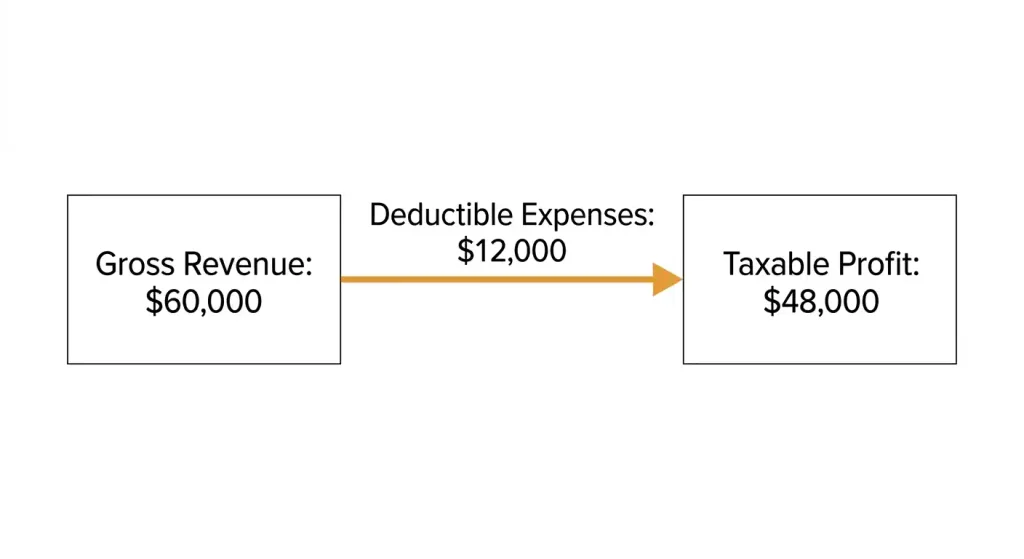
Gross revenue and taxable profit differ. A worker who bills $60,000 but deducts $12,000 in software, supplies, and home office costs is taxed on $48,000, not $60,000. That $12,000 saves tax at both the self-employment rate and the income tax rate, which is why tracking expenses matters more for 1099 workers than employees.
Example: A New York City Freelancer With a W-2 Job
W-2 wages and freelance profit combine on one tax return. Paycheck withholding already covers part of your total tax bill, which can reduce or eliminate the need for separate quarterly payments, depending on how much your employer withholds versus how much your side income adds.
Example: A Freelancer Who Starts Earning Midyear
If your 1099 income only started in August, spreading estimated tax evenly across four quarters does not match how it arrived. New York and the IRS both allow the annualized income installment method, which bases each quarter’s payment on income earned in that period instead of a flat one-fourth of the annual total.
New York 1099 Tax Rates: State, NYC, Yonkers, and MCTMT
Where you live changes your total tax bill more than almost anything else, across the New York State income tax rules that apply to every resident, 1099 or not.
New York State Income Tax Rates for 2026
New York State uses nine brackets for 2026, from 4% up to 10.9% on income above $25 million. See the full 2026 New York tax brackets for every threshold by filing status. The middle brackets were trimmed slightly for 2026, so most working freelancers see a small rate reduction. Your marginal rate, on your last dollar earned, is always higher than your effective rate, the average across all your income.
New York City Income Tax for Freelancers
NYC residents owe New York City income tax of 3.078% to 3.876% on net self-employment profit, on top of state tax. This is based on where you live, not where your clients are. A freelancer in Westchester working only with NYC clients owes no NYC resident tax, because residency, not client location, triggers it.
NYC also imposes a separate Unincorporated Business Tax (UBT) of 4% on self-employed income above an exemption amount, though UBT paid generates a credit against NYC resident income tax. In 2026, New York City retroactively reduced the UBT credit for higher-income residents, so freelancers in that range should revisit any 2026 estimated payments made under the old credit.
Yonkers Resident and Nonresident Taxes
Yonkers residents pay a surcharge added to their state tax bill. People who live outside Yonkers but work there can owe the Yonkers nonresident earnings tax instead, a different calculation based on where the work happens. Confirm which rule applies if you live or work in Yonkers.
Metropolitan Commuter Transportation Mobility Tax (MCTMT)
Self-employed individuals in the Metropolitan Commuter Transportation District owe the MCTMT once net earnings allocated to a zone exceed $150,000 for the year, a threshold that tripled starting in 2026. Zone 1, the five NYC boroughs, is taxed at 0.60%. Zone 2, covering Dutchess, Nassau, Orange, Putnam, Rockland, Suffolk, and Westchester counties, is taxed at 0.34%. Most freelancers under the threshold owe nothing here.
| Zone | Counties | 2026 Threshold | Rate |
|---|---|---|---|
| Zone 1 | NYC’s five boroughs | $150,000 net earnings | 0.60% |
| Zone 2 | Dutchess, Nassau, Orange, Putnam, Rockland, Suffolk, Westchester | $150,000 net earnings | 0.34% |
New York Residents Who Work for Out-of-State Clients
Your New York tax obligation depends on where you live, not where your clients are. A New York resident working entirely for California or Texas clients still owes full New York tax, since New York taxes residents on income from anywhere. If you also work physically in another state, that state may tax part of your income too, and New York typically offers a credit to prevent paying full tax twice.
When Are 1099 Estimated Taxes Due in 2026 and 2027?
Missing these dates is one of the most common, and most avoidable, mistakes freelancers make.
Federal Estimated Tax Payment Deadlines
The 2026 federal installments are due April 15, 2026, June 15, 2026, September 15, 2026, and January 15, 2027. Each payment generally covers income from the preceding period, not an even quarter. A due date on a weekend or holiday shifts to the next business day.
New York Estimated Tax Payment Deadlines
New York follows the same four dates on Form IT-2105. You owe New York estimated tax if you expect to owe $300 or more in combined state, city, or Yonkers tax for 2026 after withholding and credits, well below the federal $1,000 threshold.
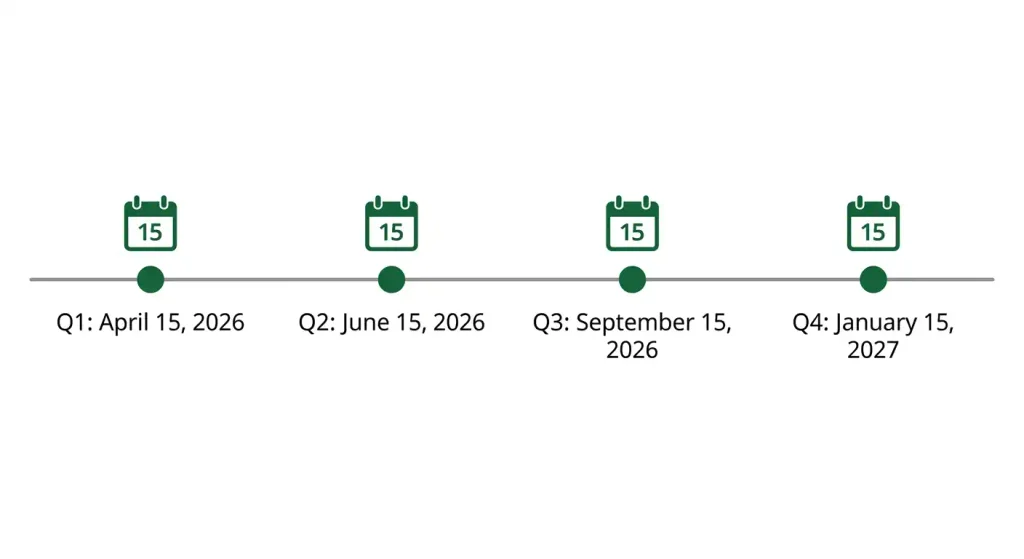
| Installment | Due Date |
|---|---|
| Q1 | April 15, 2026 |
| Q2 | June 15, 2026 |
| Q3 | September 15, 2026 |
| Q4 | January 15, 2027 |
How Much Should You Pay Each Quarter?
Your required payment depends on expected annual tax, existing withholding, and your prior-year bill. Both the IRS and New York offer safe harbor rules: pay roughly 90% of current-year liability or around 100% of last year’s tax (110% for higher income) to generally avoid underpayment penalties. A sudden income jump usually means your estimates need updating.
What If You Missed an Estimated Tax Payment?
Missing a quarter does not erase the penalty for that period, even if you catch up later. The IRS and New York calculate underpayment penalties based on how much was owed and how late. Review what you have paid, estimate the remaining balance, and pay it as soon as possible to stop the penalty clock.
How to Pay Federal and New York Estimated Taxes Online
Pay federal estimated taxes through IRS Direct Pay or EFTPS, and New York taxes through New York State Online Services. Select the correct tax year and payment type, since a misapplied payment can cause confusion later. Save your confirmation number for every payment.
Which Business Expenses Can Reduce Your 1099 Taxable Profit?
Every dollar of expense lowers both income tax and self-employment tax, making deductions worth more to a freelancer than a W-2 employee.
Common Deductible Freelance Business Expenses
Software, supplies, professional fees, contractor payments, and work equipment all qualify, as long as they are ordinary and necessary for your business. The line between a business cost and a personal purchase matters: a laptop used only for client work is a business expense, the same laptop used mainly for streaming and gaming is not.
Home Office and Business Mileage Deductions
If you use part of your home regularly and exclusively for business, you may qualify for a home office deduction, either the simplified square footage method or actual expenses. For vehicles, deduct business mileage using the IRS standard mileage rate, which averages around 74 cents per mile for 2026, or track actual costs instead. Keep a mileage log either way.
Self-Employed Health Insurance and Retirement Deductions
If you pay your own health insurance and have no employer plan through a spouse, you may deduct those premiums against your income. Self-employed retirement accounts like a SEP-IRA or solo 401(k) let you set aside a share of net profit while lowering current-year taxable income. Check current contribution limits and eligibility before contributing.
Records to Keep in Case of an IRS or State Review
Keep invoices, receipts, mileage logs, bank statements, and payment confirmations for every expense claimed. These let you reconcile your 1099 forms against what you actually earned and spent. If you receive cash payments or income with no 1099, your own records are the only proof, so consistent bookkeeping is a necessity.
How to File Your 1099 Taxes in New York
Filing as a 1099 worker involves more forms than a W-2 employee files, but the order is predictable, and each one sits under New York tax forms and withholding if you need the underlying rules.
Federal Tax Forms for Independent Contractors
Business income and expenses go on Schedule C, feeding into Form 1040. Schedule SE calculates self-employment tax separately. Form 1040-ES handles quarterly estimated payments. Estimated payments and withholding already made get credited on your annual return.
New York State Tax Forms for 1099 Workers
Full-year residents file Form IT-201. Nonresidents and part-year residents file Form IT-203, which allocates income between New York and elsewhere. Form IT-2105 handles New York estimated payments, and additional forms may apply if you owe NYC UBT or MCTMT.
Federal and State Filing Deadlines for 2026 Income
Your annual return for 2026 income is generally due in April 2027, with extensions available. An extension gives more time to file, not more time to pay. Interest and penalties on unpaid tax can still apply after the original deadline, even with an approved extension.
How to Correct an Incorrect or Missing 1099
If a client issues a 1099 with the wrong amount, ask them for a corrected form. If a client never sends one, you still must report that income from your own records, since reporting does not depend on receiving a form. An amended return can fix an already-filed error.
Special Situations That Can Change Your 1099 Tax Bill
Not every freelancer fits the standard scenario.
A Side Hustle Alongside W-2 Employment
W-2 wages and freelance profit both show up on the same return. Your employer’s withholding already applies toward your total tax, and you can ask for extra withholding, including an adjustment to your New York withholding, to cover side income instead of making separate quarterly payments. Social Security wages from your job count toward the same wage base used for your self-employment tax calculation.
Low Income, Business Losses, or Irregular Earnings
A loss year does not necessarily eliminate your filing requirement, and a net loss on Schedule C can offset other income. Self-employment tax rules differ from income tax filing thresholds, so a small profit can still trigger self-employment tax even when overall income tax liability is low. A deduction reduces taxable income, but rarely erases every type of tax.
Moving Into or Out of New York During the Year
Moving into or out of New York partway through the year means filing as a part-year resident on Form IT-203, following the same New York part-year resident tax rules that apply to W-2 movers, which separates income earned during your resident period from income earned afterward. Keep clear dates and documentation, since the state can challenge an unsupported residency claim.
Worker Misclassification and Multiple Clients
A 1099 alone does not make you a legitimate independent contractor under the law, and this guide to worker misclassification in New York walks through the warning signs. How much control a client has over your schedule, methods, and tools matters more than the form issued, a distinction covered in this New York worker classification overview. Working with several clients generally supports independent contractor status, but a classification dispute can affect taxes plus unemployment and labor protections.
Common 1099 Tax Mistakes and Misconceptions
A few wrong assumptions cause more tax trouble than anything else here.
“I Only Pay Taxes on the Amount Reported on My 1099”
Taxable business income includes everything you earned, not just what shows on a 1099. Clients who paid under $600 are not required to issue a 1099-NEC, but that income is still fully taxable. Reconciling your records against every 1099 received protects you from underreporting.
“My Self-Employment Tax Is My Only Tax”
Self-employment tax covers Social Security and Medicare, nothing more. You still owe federal income tax, New York State income tax, and potentially local tax on the same profit. Deductions and credits lower each separately, none cancel out another.
“I Can Wait Until Filing Season to Pay Everything”
The federal and New York systems are both pay-as-you-go. Quarterly estimated payments exist because tax is expected throughout the year, not just at filing time. Waiting until April can trigger underpayment penalties for each quarter you fell behind, even if the full amount is paid by the deadline.
“Every 1099 Worker Pays the Same Percentage”
Filing status, deductions, net profit, and location all change your final percentage. Someone upstate with modest income and no local tax pays a very different effective rate than an NYC resident earning six figures. Marginal rates apply to your last dollar earned, while your effective rate is almost always lower than your top bracket.
Your 1099 Tax Checklist: What to Do Next
A short checklist turns this into something you can act on.
Gather Your Income, Expense, and Payment Records
Pull together every 1099, your invoices, receipts, bank statements, and estimated payments already made this year. Reconciling gross receipts against deductible expenses now, not in April, gives an accurate running total and an easier filing season.
Estimate Your Tax and Check the Next Due Date
Using current official guidance, calculate your expected federal and New York liability, including whether NYC, Yonkers, or MCTMT rules apply. A New York paycheck calculator can help estimate that liability, and you can check your next estimated payment deadline and confirm how much of your projected bill is already covered.
Prepare for Filing and Future Payments
Keep records organized year-round and revisit your estimate when income changes significantly. Residency changes, multistate income, or a classification dispute are moments to bring in a qualified tax professional.
Frequently Asked Questions About 1099 Taxes in New York
How much should I set aside for 1099 taxes in New York?
Main answer: around 30% of every payment for most freelancers, closer to 35% to 40% for higher-income NYC residents. This is a budgeting estimate, not a personalized calculation.
Do I have to pay quarterly taxes on 1099 income?
Main answer: yes, if you expect to owe $1,000 or more federally or $300 or more combined New York tax after withholding and credits. Sufficient W-2 withholding can remove the need for separate payments.
Do I pay New York City tax if my client is in NYC?
Main answer: no. NYC resident tax depends on where you live, not your client’s location. Living outside the five boroughs means no NYC resident tax, even with Manhattan-based clients.
Do I owe taxes if I did not receive a Form 1099?
Main answer: yes. Taxable income must be reported whether or not a client issues a 1099. The reporting responsibility is yours, not the payer’s.
Can I deduct expenses from my 1099 income?
Main answer: yes. Ordinary and necessary expenses, like software, supplies, equipment, and a portion of home office or vehicle costs, reduce taxable profit. Keep records to support every deduction.
What happens if I cannot afford my estimated tax payment?
Main answer: review what you owe and consider an IRS or New York payment plan instead of skipping it. Paying something on time beats paying nothing, since penalties generally track how much stayed unpaid and for how long.

Meet Yasin Ali, Founder
Yasin built NY Paycheck Calculator in 2020 after getting fed up with calculators that treated New York like every other state. Most tools ignore the extra local tax NYC and Yonkers workers pay on top of state tax — or skip New York’s Paid Family Leave deduction entirely.
He keeps the numbers current, checking in regularly against the latest IRS, NY Department of Taxation and Finance, and Paid Family Leave rates.
All results here are estimates based on official sources. For advice specific to your situation, talk to a tax professional.