
In New York, you are an employee, not an independent contractor, when the company controls how you work, whatever your 1099 says. New York weighs the whole relationship. Employee status brings overtime, unemployment insurance, and workers’ compensation.
That control test comes from New York State Department of Labor guidance and Appeal Board rulings, checked against 2026 sources.
Federal rules differ and may change, since the final Department of Labor rule is unpublished.
Think You’re a Contractor? Check These Signs First
You get a 1099, but your boss sets your hours, assigns your tasks, and checks your work. Start there. The signs below show who really runs the job.
You may be an employee if your employer controls how you work
Ask who sets your schedule, decides what you work on and how, and gives daily instructions. Those are employee signs. Your real workday matters more than your contract title, though no single fact settles it.
Quick employee vs. independent contractor comparison
Ask who is running the business. A contractor runs one. An employee works inside someone else’s. Our New York employee vs. independent contractor guide goes deeper on pay and taxes.
| What to look at | Looks like an employee | Looks like a contractor |
|---|---|---|
| Control | Company sets your schedule, methods, and supervision | You decide how and when the work gets done |
| Pay | Fixed pay set by the company | You set or negotiate your rate and quote jobs |
| Tools and expenses | Company supplies tools and covers costs | You buy your own equipment and pay your own costs |
| Clients | One main company | Several clients you find yourself |
| Business activity | No business name, ads, or insurance | Own business, advertising, insurance, and workspace |
| Profit or loss | Same pay however you work | You can earn more, or lose money, based on your choices |
A 1099 is not proof of contractor status.
What Is Worker Misclassification in New York?
It means a company treats you as a contractor when New York law says you are an employee. You pay for it in lost pay, lost coverage, and a bigger tax bill.
What misclassification means
The New York State Department of Labor (NYSDOL) says some employers use the contractor label to avoid unemployment insurance, workers’ compensation, Social Security, tax withholding, temporary disability, and minimum wage and overtime rules.
New York worker misclassification is an enforcement priority. The Joint Enforcement Task Force on Employee Misclassification includes the NYSDOL, the New York Attorney General, the New York State Department of Taxation and Finance, the New York State Workers’ Compensation Board, the Workers’ Compensation Fraud Inspector General, and the New York City Comptroller. A bill allowing stop-work orders against employers who knowingly misclassify workers (S1514, with penalties of $1,000 to $5,000 per day for ignoring an order) has passed the Senate but, as far as public records show, is not law.
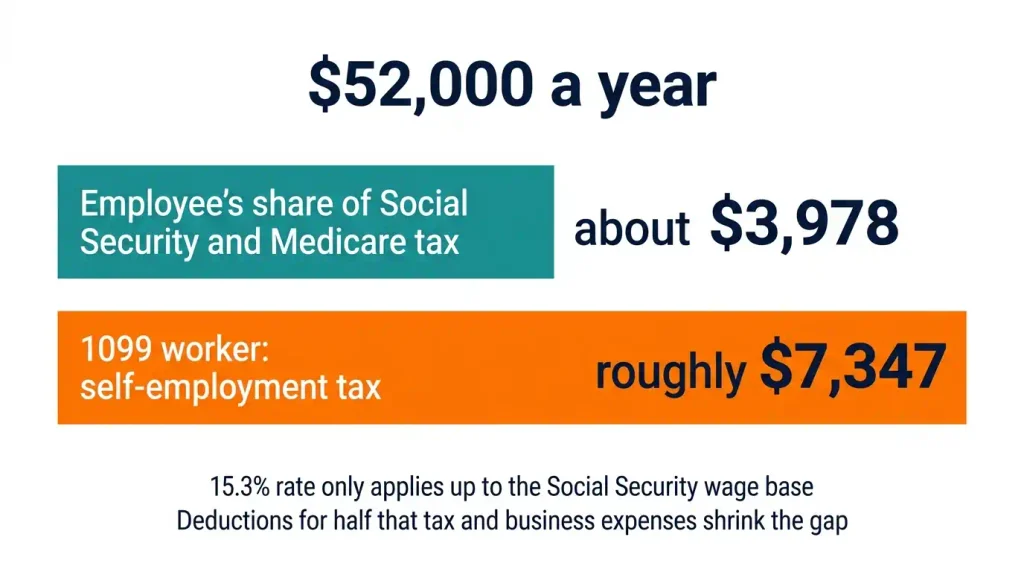
On $52,000 a year, an employee’s share of Social Security and Medicare tax is about $3,978. A 1099 worker pays both halves, roughly $7,347 in self-employment tax, though deductions for half that tax and business expenses shrink the gap, and the 15.3% rate only applies up to the Social Security wage base. Real self-employment is different. A plumber with her own shop, customers, and prices is a genuine contractor. To see how these taxes change your net pay, try our New York paycheck calculator. The calculation methodology explains how we estimate withholding.
Why your job title or contract may not settle the issue
Companies often use 1099s, contractor agreements, waivers, or a request to form an LLC or file an assumed business name (a DBA). None of it is final. When paperwork and the workday disagree, the workday usually wins.
How New York Decides Whether You Are an Employee
New York asks who controls the work. The Department of Labor says the answer depends on the level of supervision, direction, and control, weighing all factors together.
Supervision, direction, and control
Control over how you work counts more than control over results. “Finish the logo by Friday” controls the result. “Be here at 9, use this template, and send every draft through me” controls the work. Other signs include who handles client contact, billing, and pay; approval for basic decisions or time off; evaluation, discipline, or firing like staff; required meetings, training, reports, and procedures; and being barred from working for competitors. The more the company directs the details, the more you look like an employee.
Signs you may actually be operating an independent business
Real contractors have their own clients, advertising, insurance, equipment, and workspace. They set or negotiate rates, choose their hours, turn down jobs, and can send someone else. One Appeal Board decision on telemarketers noted that a true contractor would simply hire a replacement. That is what a legitimate New York independent contractor looks like. Owning your tools does not settle it if the company still sets your schedule. The Department’s Independent Contractors Fact Sheet (IA 318.14) lists many of these signs. If you can do none of this, that points toward employee.
Why professionals and skilled workers can still be employees
Being good at your job does not make you a contractor. Skill, a professional license, or project-based pay does not settle it either. In one case, New York’s Unemployment Insurance Appeal Board found computer support workers to be employees even after they signed 1099 agreements, because the company controlled their work.
New York Employee vs. Independent Contractor: What the Tests Actually Mean
There is no single test. New York uses a control-based approach for most state purposes, construction has its own statute, and federal wage law uses a different test. Which one applies depends on the right you are claiming.
New York’s common-law approach
New York’s common-law approach, often called the common law test, weighs facts pointing to employee against facts pointing to contractor. The Appeal Board looks at the reality, not the label. Control over the means of the work usually weighs more than loose control over the final result.
Federal FLSA classification in 2026
The Fair Labor Standards Act (FLSA) sets federal minimum wage and overtime rules, and the Department of Labor Wage and Hour Division enforces it. It uses the economic reality test, which some courts call the economic realities test: do you depend on the company for work, or are you in business for yourself? Courts weigh control, profit or loss, skill, permanence, and whether your work is core to the company.
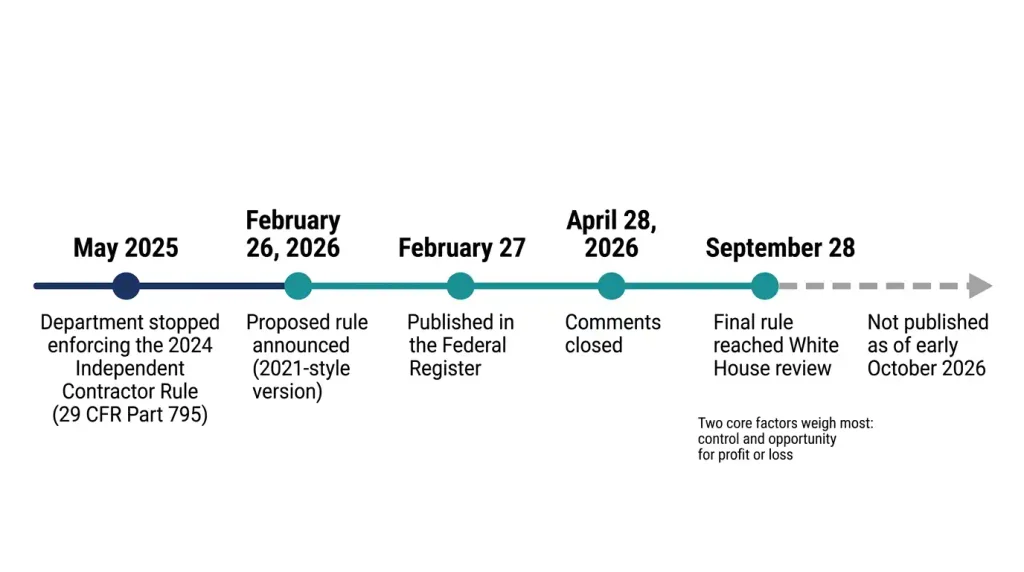
The U.S. Department of Labor announced a proposed rule on February 26, 2026 (published in the Federal Register on February 27) to replace the 2024 Independent Contractor Rule (29 CFR Part 795) with a 2021-style version. It weighs two core factors most, control and opportunity for profit or loss, and would also cover the Family and Medical Leave Act and the Migrant and Seasonal Agricultural Worker Protection Act. The 2026 Notice of Proposed Rulemaking is only the first step in the 2026 independent contractor rulemaking.
Comments closed April 28, 2026, and the final rule reached White House review on September 28 but is not published as of early October 2026. Until it is, the 2024 rule stays on the books and courts still apply it in private lawsuits, though the Department stopped enforcing it in May 2025. Check the Department’s rulemaking page.
Why New York and federal classification rules are not identical
Different laws protect different rights and can use different tests. A federal result does not automatically answer a New York unemployment, workers’ compensation, or construction question, and a proposed federal rule does not change New York law.
| Test | Used for | What it asks |
|---|---|---|
| Common law test (New York) | Most state purposes, including unemployment insurance | Who controls how the work is done |
| ABC test (construction) | Construction work under the Fair Play Act | Whether all three conditions or the 12-criteria business-entity test are met; if neither, you are an employee |
| Economic reality test (federal) | Federal minimum wage and overtime under the FLSA | Whether you depend on the company or run your own business |
Are You Misclassified? Real New York Workplace Examples
Facts decide these cases. The four examples below are made up to show how facts line up.
A 1099 worker with a fixed schedule and daily supervision
Maria, an office assistant in Buffalo, is paid $22 an hour on a 1099. She works 9 to 5, Monday through Friday, on the company’s laptop, and a manager assigns and reviews her work daily. Nearly every fact points to employee, and the 1099 changes nothing. She should keep her schedule, instruction texts and emails, invoices, pay records, and every 1099.
A freelancer who works for several clients
Dev, a Brooklyn graphic designer, has four clients, sets his own $75 hourly rate, uses his own software, and turns down jobs. That supports a real independent business. Several clients help but do not settle it, since one company can still control you. The New York Freelance Isn’t Free Act (General Business Law Article 44-A) gives genuine freelancers a written contract and timely payment on jobs worth $800 or more (counting work for the same client over the past 120 days), with payment due by the contract date or within 30 days of finishing if none is set. It does not make anyone an employee.
A construction worker paid as a subcontractor
Luis, a drywall hanger in Albany, is paid $250 a day as a “subcontractor.” Construction has a special rule: he is presumed an employee unless the company can prove otherwise, as the next section explains.
A worker required to create an LLC or DBA
A delivery company tells a driver to “become your own business” and form an LLC. The entity settles nothing. If the company still sets routes, schedules, and pay, and the driver works only for it, the driver may still be an employee.
Special New York Rules for Construction Workers
Under the Construction Industry Fair Play Act, a construction worker is presumed to be an employee. The company can overcome that only with a three-part test or by showing a separate business entity under a 12-point test.
The Construction Industry Fair Play Act
The law applies to all construction contractors, and employers must post a notice about it. The company, not the worker, carries the burden. A company that willfully misclassifies can face civil penalties of up to $2,500 per misclassified worker for a first violation and up to $5,000 for a second within five years, plus criminal charges in serious cases. The Act sits in Labor Law Article 25-B. A separate law, the Commercial Goods Transportation Industry Fair Play Act, creates a similar presumption for drivers of certain commercial vehicles.
The three-part construction test
The company must show all three conditions. Lawyers call this the ABC test.
- You are free from direction and control, in your contract and in fact.
- Your service is outside the usual course of the hiring company’s business.
- You are customarily engaged in an independently established trade, occupation, profession, or business.
A drywall hanger working for a drywall company often fails the second, because hanging drywall is that company’s regular business.
Separate business entities in construction
An LLC or corporation counts as a separate business only if it meets all 12 criteria in Labor Law § 861-c. They include a substantial capital investment beyond ordinary tools and a personal vehicle, owning its capital goods and bearing its own profits and losses, working under its own name, supplying its own tools, hiring helpers without the contractor’s approval, and being free to do similar work for others. Forming an entity is not enough. In Matter of Truax & Hovey (2022), a New York appeals court upheld an employee finding because one criterion was missing: owning the capital goods and bearing the profits and losses.
What You Could Lose If You Were Misclassified
A lot: wage rights, insurance coverage, and an employer who pays half your payroll taxes.
Overtime and minimum wage protections
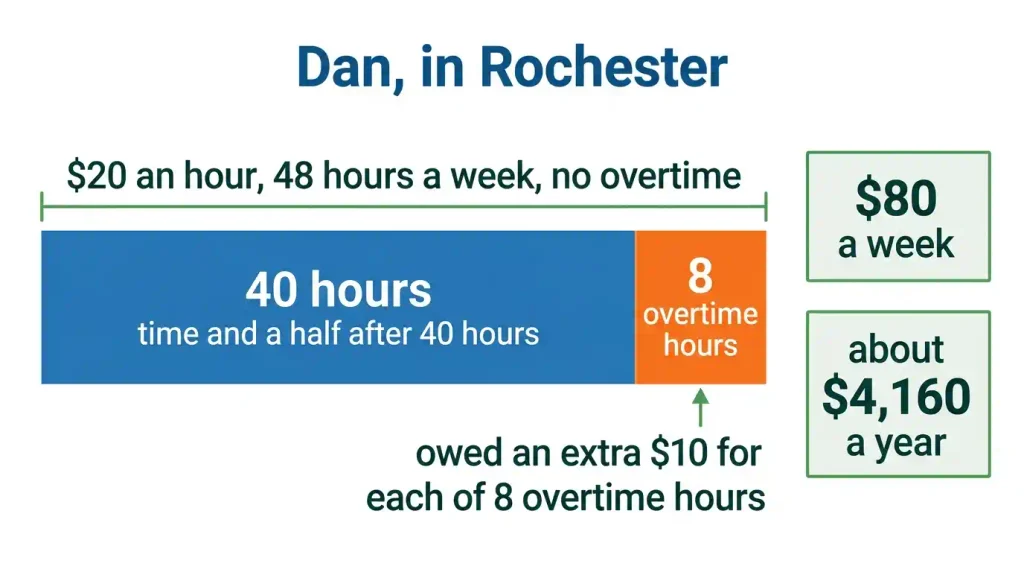
In 2026, New York’s minimum wage is $17.00 an hour in New York City, Long Island, and Westchester, and $16.00 in the rest of the state. Most employees also get time and a half after 40 hours. Say Dan, in Rochester, is paid a flat $20 an hour for 48 hours a week with no overtime. As an employee, he would be owed an extra $10 for each of 8 overtime hours, which is $80 a week, or about $4,160 a year. Unpaid overtime like this is a common form of wage theft. Proving your hours is the hard part. New York generally gives you up to six years to sue over state wage claims (see this decision applying Labor Law § 198(3)), but a Labor Standards complaint to the Department covers only wages earned in the last three years. Employees are also covered by pay frequency laws that set how often wages must be paid.
Unemployment insurance
A contractor label does not automatically bar you from unemployment. When you file, the Department of Labor decides whether you were an employee. The Appeal Board has held in some cases that workers with 1099s and contractor agreements were still employees, which let them file valid claims, though they still had to meet the usual eligibility rules. Tell the Department what the work was really like, even if you only spot the problem after the job ends. Employers also owe unemployment insurance contributions on employees, and a misclassifying employer often skips them. Nothing is guaranteed, but the label alone does not end your claim.
Workers’ compensation and other protections
Employers must carry workers’ compensation for employees. If you were hurt on the job while labeled a contractor, you may still be able to file a claim. An employer should also withhold income tax and pay half of your Social Security and Medicare tax, while a misclassified worker often pays the full 15.3% self-employment tax. Temporary disability coverage and similar protections can be lost too, including Paid Family Leave, which New York employers generally must cover. Employees also get protections like paid sick leave, meal breaks, and a day of rest in many jobs.
1099 vs. W-2: What the Tax Form Really Tells You
A 1099 is a tax reporting form, not a legal ruling on your status. Companies report employee pay on a Form W-2 and contractor pay on a Form 1099, but which form they pick is a payroll choice. Our 1099 vs. W-2 guide for New York compares pay and taxes side by side.
Does receiving a 1099 mean you are an independent contractor?
No. The form only shows how the payer chose to report your pay, not how much control it had over your work. Treat it as one factor among many. Being moved from a W-2 to a 1099 with the same duties is also a warning sign. As a W-2 employee, you would also fill out a federal W-4 and Form IT-2104; see W-4 vs. IT-2104 for the difference.
What if you signed an independent-contractor agreement?
The agreement matters but does not control the outcome. Compare what it promises with what actually happens: a contract may say you set your own hours while a manager posts your schedule every week. A signed waiver does not automatically wipe out employee rights, and in unemployment cases New York says those waivers are not valid.
What to Do If You Think You Were Misclassified
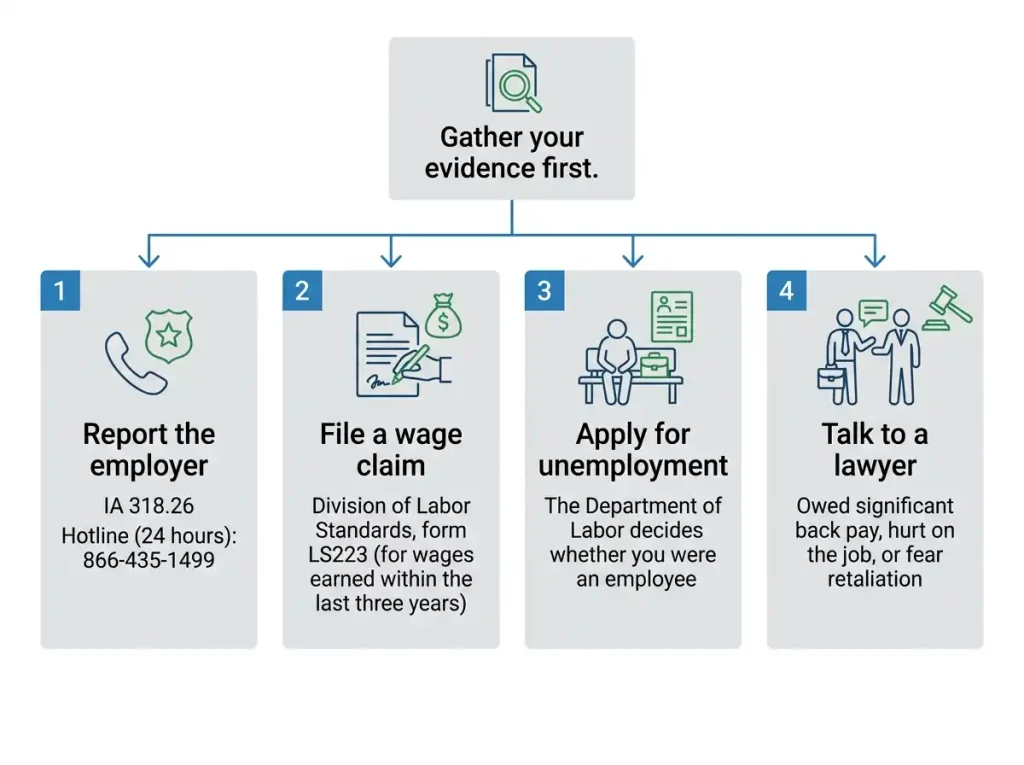
Gather your evidence first. Then choose a route: report the employer, file a wage claim, apply for unemployment, or talk to a lawyer.
Document your actual working relationship first
Save these before you raise the issue, while you still have access:
- Your contract and every 1099
- Invoices and pay records (not sure what a pay stub shows? See how to read a New York pay stub)
- Schedules
- Texts and emails with instructions
Then write down who set your hours, assigned your work, decided your pay, found your clients, and chose your methods.
Decide whether you need a formal determination or complaint
Reporting misclassification asks the State Department of Labor to investigate the employer. It is not a claim for your unpaid wages. Wage claims go through the Division of Labor Standards on form LS223 (for wages earned within the last three years), explained on the Department’s FARE Grant pages. For federal tax questions, the IRS has Form SS-8. If you suspect years of unpaid employment taxes (see employer payroll tax deadlines) or lost benefits, a tax professional can help, since you may have paid self-employment tax an employer should have shared. A lawyer can help if you are owed significant back pay, were hurt on the job, or fear retaliation.
New York’s IA 318.26 misclassification reporting form
IA 318.26 is the Department of Labor’s tip sheet for reporting suspected employer fraud, including misclassification and workers paid off the books (under-the-table pay). Reports go to the Employer Fraud Unit. Fill in what you know about the owner and company, including the Federal Employer ID Number and Employer Registration Number if you have them. You can report four ways:
- Fax: 518-457-0024
- Mail: Liability and Determination Fraud Unit, Albany
- Email: dol.misclassified@labor.ny.gov
- Hotline (24 hours): 866-435-1499
You do not need to identify yourself, and the Department keeps information confidential to the extent the law allows. You can also use the Report UI Employer Fraud option online. The Department can then investigate the employer and share data with partner agencies.
Can Your Employer Retaliate If You Report Misclassification?
The Department of Labor says New York Labor Law imposes significant penalties on employers who discharge, penalize, or otherwise retaliate against someone for giving the Department information. Still, protect yourself.
What retaliation can look like
Retaliation can be a firing, a sudden cut in hours, worse assignments, threats, or new punishments. A bad day with your boss is not retaliation by itself. It matters when it follows protected activity, such as reporting to the Department or filing a wage complaint, and timing is the clue. If your hours drop days after you report, write it down.
What to document if retaliation happens
Record dates, messages, schedule changes, disciplinary notices, and witnesses. Keep this separate from your classification evidence, and build a timeline from the day you raised the issue to each action your employer took after. If your employer threatens to fire you after a complaint, save the threat in writing, do not argue it out, and talk to an employment attorney quickly.
Common Myths About New York Independent Contractors
Five beliefs trip up workers. None settles your status by itself.
“I signed a contract, so I cannot be an employee.”
False. The actual relationship still matters, and a contractor label is only one fact. A signed waiver does not settle it either.
“I get a 1099, so I am definitely self-employed.”
False. A 1099 is a tax form, not a finding about who controlled your work.
“I created an LLC, so I am automatically a contractor.”
False. Forming a business does not erase employee-like control. If the company still directs your work and you serve only it, the entity may change little. A DBA is a business name, not a change in who controls your work. In construction, the entity must also meet all 12 statutory criteria.
“I choose my own hours, so I cannot be an employee.”
False. Flexible hours are one factor. A company can still control your assignments, methods, pay, and clients.
“I work from home, so I am an independent contractor.”
False. Location does not decide status. In one decision, the Appeal Board found work-from-home telemarketers to be employees because the company controlled how the work was done.
New York Worker Misclassification FAQ
Short answers to common questions: a 1099 does not decide your status, and you can report misclassification anonymously.
Can I be an employee if I receive a 1099?
Yes. A 1099 is only one fact. What matters is who controlled your schedule, assignments, methods, and pay, and whether you ran a real business.
How do I prove I was misclassified as an independent contractor?
Evidence of control is strongest: posted schedules, written instructions, supervisor messages, and proof the company supplied your tools or training. Add anything showing you had no other clients or could not turn down work. The documentation steps above list what to save.
Can a misclassified worker get unemployment benefits in New York?
Possibly. A contractor label does not automatically end your eligibility. When you file, the Department of Labor decides whether you were an employee based on the real working relationship.
Can I recover unpaid overtime if I was treated as a contractor?
If you were legally an employee and worked over 40 hours without overtime pay, you may be owed it. First prove your status, then your hours and pay, so keep time records, messages, and invoices. Salaried workers should also check the overtime salary threshold and how overtime works for salaried employees.
Where do I report worker misclassification in New York?
Report to the New York State Department of Labor, which handles suspected employer fraud through its Employer Fraud Unit. Use the IA 318.26 tip sheet or the 24-hour hotline at 866-435-1499. You can report anonymously.
Should I talk to a lawyer about worker misclassification?
Yes, if you are owed meaningful back pay, were injured, lost your job, or face retaliation. Bring your contract, 1099s, pay records, schedules, and messages. This guide is general information, not legal advice.
What to Do Next If Your “Contractor” Job Looks Like Employment
Check the facts, protect your evidence, then pick one route.
Use this final classification checklist
Run your job through the comparison table above: control, pay, tools and expenses, clients, and business independence. Strong evidence is your daily reality, not your job title or a 1099. Then match the rule: New York’s control test for most state purposes, the Fair Play Act for construction, and the federal economic reality test for wage questions. More guides are in our New York worker classification section.
Know your next step before confronting your employer
Do not confront your employer first. Preserve your evidence, then choose a report to the Department of Labor, a wage claim, an unemployment application, or a lawyer. Classification depends on the facts. No single detail, whether a 1099, a contract, or an LLC, decides it alone.

Meet Yasin Ali, Founder
Yasin built NY Paycheck Calculator in 2020 after getting fed up with calculators that treated New York like every other state. Most tools ignore the extra local tax NYC and Yonkers workers pay on top of state tax — or skip New York’s Paid Family Leave deduction entirely.
He keeps the numbers current, checking in regularly against the latest IRS, NY Department of Taxation and Finance, and Paid Family Leave rates.
All results here are estimates based on official sources. For advice specific to your situation, talk to a tax professional.