
New York Paid Sick Leave lets most private-sector employees take paid time off for their own illness, family care, or safe leave. Your hours and pay depend on employer size.
Those hours build at one hour for every 30 hours worked, per NYSDOL guidance checked against 2026 figures.
The catch: employers with 4 or fewer employees may owe only unpaid leave.
New York Paid Sick Leave 2026 at a Glance
The rules come from New York Labor Law Section 196-b, the law behind New York State Paid Sick Leave. Employers with 5 to 99 employees owe 40 hours paid sick leave, and those with 100 or more owe 56 hours paid sick leave.
How Many Paid Sick Leave Hours Do New York Employees Get?
The table below shows each tier. Employers with 4 or fewer give 40 hours, set by a $1 million net income in the prior tax year. Above it, they owe 40 hours paid sick leave. At or below it, they owe 40 hours unpaid sick leave.
| Employer size | Hours per year | Paid? |
|---|---|---|
| 100 or more employees | 56 | Paid |
| 5 to 99 employees | 40 | Paid |
| 4 or fewer, net income over $1M | 40 | Paid |
| 4 or fewer, net income $1M or less | 40 | Unpaid |
Who Is Covered by New York Paid Sick Leave?
Almost every private-sector worker is covered, including full-time, part-time, seasonal, and overtime-exempt employees. Nonprofit and charter school staff, domestic workers, and farm workers count too. Westchester County gives domestic workers up to 40 paid hours at any employer size. Government employees are excluded. The law covers employees, so confirm whether you are an employee or independent contractor.
The Quickest Way to Find Your Leave Entitlement
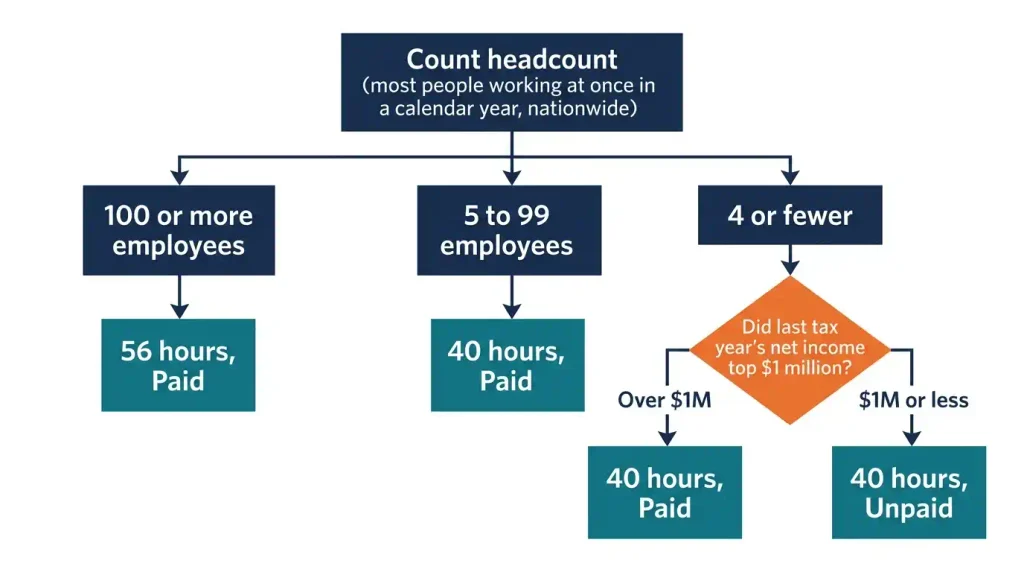
Use these four steps.
- Count headcount. That is the most people working at once in a calendar year, nationwide.
- Check net income if the count is 4 or fewer. Did last tax year’s net income top $1 million?
- Check your balance of accrued, unused hours.
- Read your handbook. It can only add more.
How New York Sick Leave Accrues
You earn one hour for every 30 hours worked. You can use it as you earn it, and some employers give the full year up front. A full-timer earns about 1.3 hours a week.
The 1 Hour for Every 30 Hours Worked Rule
You earn 1 hour per 30 hours worked, starting day one. Overtime hours count. Bonuses and pay for time not worked do not. A 40-hour schedule earns about 69 hours a year.
How to Calculate Your Accrued Sick Leave
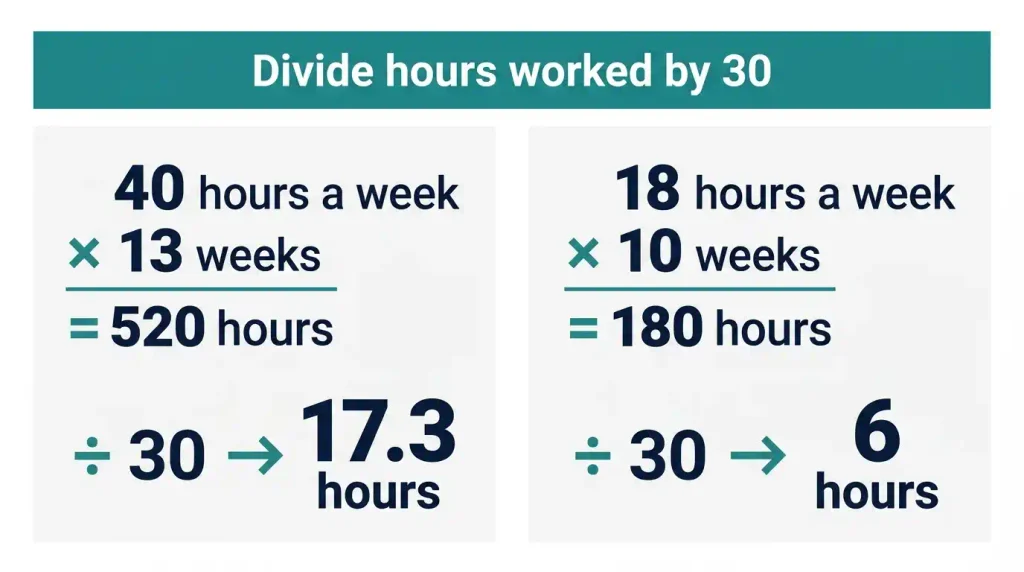
Divide hours worked by 30. At 40 hours a week for 13 weeks, that is 520 hours, so 17.3 hours. At 18 hours a week for 10 weeks, that is 180 hours, so 6 hours.
When Can You Start Using Accrued Sick Leave?
Right away, as you earn it. There is no minimum time on the job and no need to bank a full day. Carried-over hours are usable on January 1.
Can Your Employer Front-Load Sick Leave?
Yes. An employer can give you the full 40 or 56 hours at the start of the year. You can use all of it right away, and it cannot be cut later because you worked fewer hours.
What Can You Use New York Paid Sick Leave For?
Use it for your own illness or care, a covered family member’s illness or care, and safe leave. No diagnosis or medical details are required.
Your Own Illness, Injury, or Health Condition
Any physical illness, mental illness, injury or health condition counts, even without a diagnosis. Mental health care counts like a bad flu. Recovery time counts too.
Medical Diagnosis, Treatment, and Preventive Care
Doctor visits, tests, treatment, checkups, and other preventive medical care qualify. NYSDOL guidance covers recovery from COVID-19 vaccine side effects. Pregnant workers also get 20 paid prenatal hours per 52 weeks, separate from sick leave. Tip: employers can set a minimum use increment of up to 4 hours, so ask before booking a short visit.
Caring for a Family Member
You can use sick leave to care for a family member who is sick, hurt, or getting care. That includes your child, parent, spouse, domestic partner, sibling, grandparent, and grandchild, plus a spouse’s or partner’s child or parent.
Safe Leave Under New York Law
Safe leave covers domestic violence, a family offense, a sexual offense, stalking, or human trafficking, for you or a family member. Uses include police reports, safety planning, moving, and court dates. It comes from the same hours as sick leave, and your employer cannot ask for details.
How Much Sick Leave Can You Actually Use?
Employers with 100 or more employees can cap use at 56 hours a year. Others can cap it at 40. Unused hours carry over, so your balance can exceed the cap.
Annual Usage Limits by Employer Size
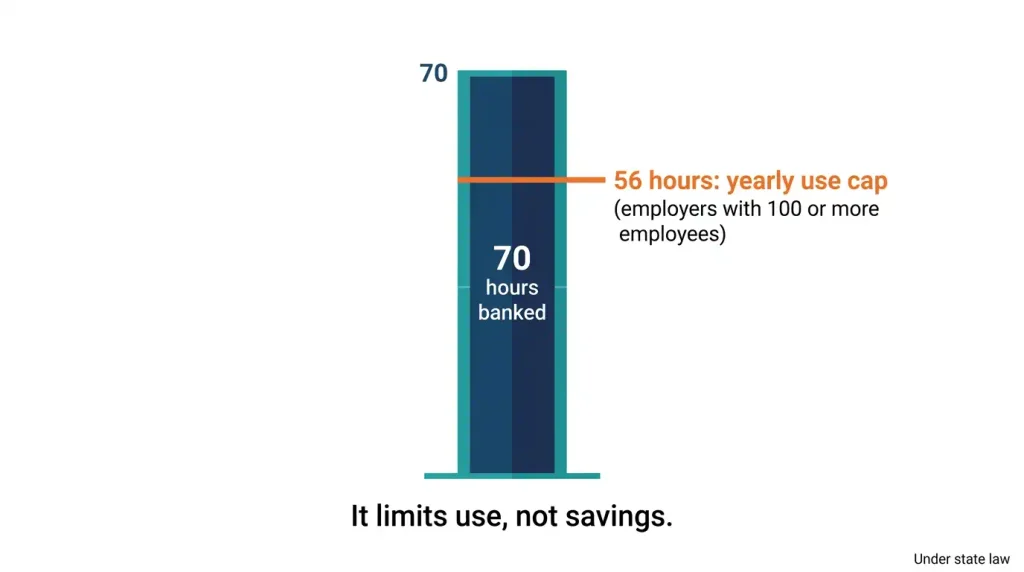
The cap is 56 hours at employers with 100 or more employees and 40 hours at others. It limits use, not savings. Under state law, you can have 70 hours banked and use only 56 this calendar year. Employers may run a different 12-month year if their policy says so.
Does Unused Sick Leave Carry Over?
Yes. Unused sick leave carries into the next calendar year. If you earned 69 hours and used 20, you start with 49. Your balance can exceed 40 or 56, but yearly use stays capped. NYC caps carryover itself at 40 or 56 hours.
Does Sick Leave Expire?
No. Required sick leave does not vanish on December 31, and no midyear use-it-or-lose-it deadline is allowed. A front-loading employer can skip carryover but must give the full amount again next year.
What Happens to Sick Leave When You Change Jobs?
Leaving an employer does not trigger a payout of unused sick leave unless your policy or contract says so. Moving to a new role or location with the same employer keeps your balance. A new employer starts you at zero.
New York Paid Sick Leave Notice and Documentation Rules
No fixed notice period applies. You can ask orally or in writing. Proof can be required only after three or more consecutive scheduled workdays, and never your diagnosis.
How Much Notice Must You Give Your Employer?
Ask orally or in writing. Tell your boss when you know a planned date, or as soon as you can for a sudden illness. A call-out routine is fine if it does not block your leave.
Can Your Employer Require a Doctor’s Note?
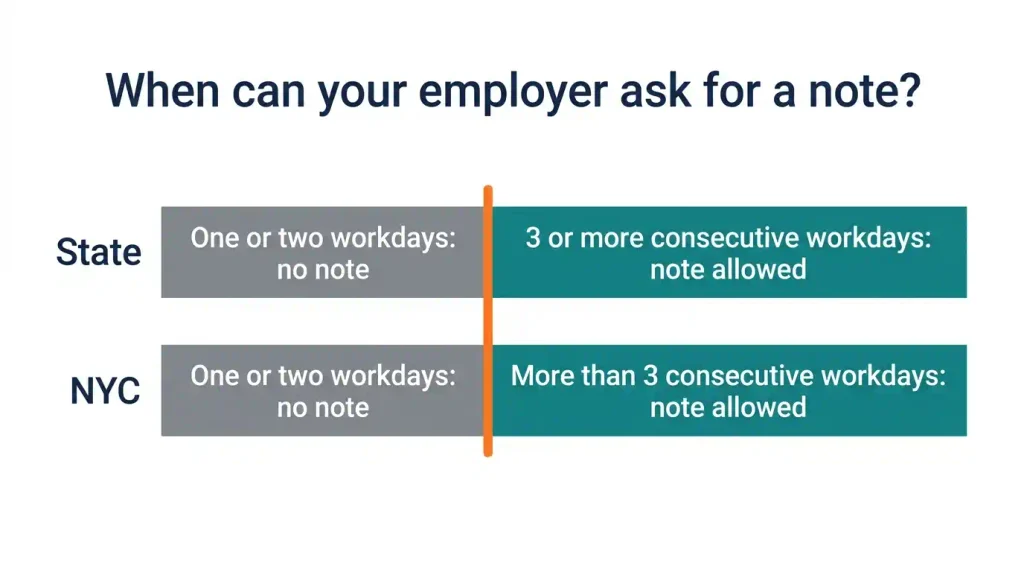
Not for one or two workdays. For three or more consecutive previously scheduled workdays, an employer can ask for documentation, such as an attestation from a licensed medical provider or, in some cases, your own written statement. It cannot reveal confidential details. Your employer pays any fee, and NYC requires more than three consecutive workdays.
Can Your Employer Ask for Your Diagnosis?
No. Your employer can confirm a covered reason but cannot ask about the illness, prognosis, or treatment. For safe leave, it cannot ask for any details.
Can Your Employer Make You Find Someone to Cover Your Shift?
No. Your employer cannot make you find a replacement worker. Telling your manager you are out is enough, and any demand is worth saving as proof.
How Is New York Paid Sick Leave Paid?
Sick leave pays your regular rate of pay or the state minimum wage, whichever is higher, with no tip credit. It should arrive by the next regular payday, as explained in our New York pay frequency laws guide.
What Rate of Pay Applies to Sick Leave?
In 2026 the state minimum wage is $17.00 an hour in New York City, Long Island, and Westchester, and $16.00 elsewhere. Our New York minimum wage guide covers tipped rates. At $28 an hour, an 8-hour sick day pays $224.
When Should Sick Leave Appear in Your Pay?
Check the paycheck for your leave period for paid sick hours at the right rate. Compare them with your balance, and see how to read a New York pay stub if the lines confuse you. If a line is missing, ask payroll for time records, then request a fix in writing. If the whole check looks short, see why your New York paycheck is lower.
Can an Employer Substitute PTO for Sick Leave?
Yes, if the policy gives at least as much leave for the same reasons, including unlimited PTO. It never overrides state law. A union contract works if it gives comparable benefits and names Labor Law Section 196-b.
New York Paid Sick Leave vs. Other Types of Leave
Sick leave covers short health absences. Paid Family Leave covers longer family needs. FMLA protects your job without pay. Disability benefits pay part of your wage for long absences.
| Leave | Pay | Length | Best for |
|---|---|---|---|
| Paid sick leave | Regular pay (unpaid at some tiny employers) | 40 or 56 hours a year | Short illness, family care, safe leave |
| Paid Family Leave | 67% of average weekly wage, max $1,228.53 a week in 2026 | Up to 12 weeks | Bonding, serious family illness, military deployment |
| FMLA | Unpaid | Up to 12 weeks | Job protection for serious conditions |
| DBL | 50% of average weekly wage, max $170 a week | Up to 26 weeks | Your own long illness or injury |
New York Paid Sick Leave vs. New York Paid Family Leave
New York Paid Family Leave is separate insurance. It pays up to 12 weeks at 67% of your average weekly wage, capped at $1,228.53 a week in 2026, per the official 2026 rates. Employees fund it through a 0.432% payroll deduction. It covers bonding, caring for a seriously ill family member, and military deployment. You can use sick leave during Paid Family Leave only if your employer allows it.
New York Paid Sick Leave vs. FMLA
The Family and Medical Leave Act, or FMLA, gives up to 12 weeks of unpaid, job-protected leave. Your employer needs 50 or more employees within 75 miles, and you need 12 months and 1,250 hours. It can run at the same time as sick leave.
New York Paid Sick Leave vs. Disability Benefits
New York short-term disability, called DBL, pays 50% of your average weekly wage, up to $170 a week, for up to 26 weeks, starting on the eighth day. It does not replace your sick leave hours. You cannot get DBL and Paid Family Leave at the same time, and together they max out at 26 weeks in a 52-week period.
New York State Sick Leave vs. New York City Sick Leave
In New York City, New York City paid sick leave and state law run together, so you do not get both banks. Since February 22, 2026, the NYC Earned Safe and Sick Time Act (now also called the Protected Time Off Law) also gives 32 hours of unpaid safe and sick time each calendar year. Those hours apply only if you have not accrued enough paid hours, have hit the annual cap, or ask to use them. The New York City Department of Consumer and Worker Protection enforces it, and our NYC worker pay and labor rules section covers more. You get whichever rule helps you more.
| State | NYC | |
|---|---|---|
| Paid hours | 56 or 40 by employer size | Same tiers (small employers: paid at $1M or more net income) |
| Extra unpaid hours | None | 32 a year |
| Note allowed after | 3 or more consecutive workdays | More than 3 consecutive workdays |
| Enforced by | NYSDOL | New York City Department of Consumer and Worker Protection |
New York Paid Sick Leave Rules for Different Employees
Part-time, seasonal, and exempt workers all earn sick leave. Small employers follow a net income test. Each employer tracks your hours separately.
Part-Time Employees
You earn on hours actually worked. At 20 hours a week, that is about 35 hours a year. Keep your own tally, since irregular weeks make partial hours.
Seasonal and Overtime-Exempt Employees
Seasonal workers earn from their first hours. Exempt salaried employees earn too, usually counted at 40 hours a week unless their normal week is shorter. Our guide to overtime for salaried employees explains who is exempt.
Employees of Small Businesses
Employers with 4 or fewer employees owe 40 hours, paid only if last tax year’s net income was over $1 million. Unpaid leave is still job-protected.
Employees With More Than One Job
Each job stands alone. Hours do not transfer between employers, and each sets its own tier, so you might have 40 hours at one job and 56 at the other.
New York Paid Sick Leave Examples for 2026
These five examples use 2026 numbers. Pay figures are gross, before taxes, so see our calculation methodology for how take-home pay is estimated.
Example: Full-Time Employee at a 150-Person Company
At a 150-person company you are in the 56-hour tier. After 13 weeks at 40 hours, you have 17.3 hours. One 8-hour day at $28 an hour pays $224 and leaves 9.3 hours.
Example: Part-Time Employee at a 25-Person Company
At a 25-person company you are in the 40-hour tier. Weeks of 10, 30, 36, and 20 hours total 96 hours, so you accrued 3.2 hours. The 40-hour use cap does not change.
Example: Employee With a Doctor Appointment
A 2-hour checkup is preventive medical care, so it qualifies. Tell your boss when you book it. No note is needed, and your balance drops by 2 hours, or up to 4 under a minimum increment.
Example: Parent Caring for a Sick Child
Your 6-year-old has the flu and you stay home 2 days. That is a covered use, and no note can be required. You need 16 accrued hours, which pays $400 at $25 an hour. With only 10 banked, the other 6 may be unpaid unless PTO covers them.
Example: Employer Demands a Replacement Worker
Your manager texts, “Find someone to cover your shift or you will be written up.” That is not allowed. Reply that you are out for a covered reason, save the text, and tell HR. If it continues, contact the New York State Department of Labor.
What If Your Employer Denies Your Sick Leave?
Check your balance and reason, then ask in writing for a fix. If that fails, file with the New York State Department of Labor at 888-469-7365 or 888-525-2267, or with Labor Standards Complaint Form LS223.
Signs Your Employer May Be Violating New York Sick Leave Rules
Warning signs are a flat no to qualifying leave, no pay for approved leave, and a note demand for 1 or 2 days. Also watch for replacement demands, or being told you have no sick leave after months on the job.
What to Do Before Filing a Complaint
Read your policy. Ask for your balance and a written correction. Keep schedules, pay stubs, texts, and emails. Union workers should check their contract’s grievance process first.
How to Request Your Sick Leave Record
Ask orally or in writing for a summary of accrued and used sick leave. Your employer must give it within three business days, for this or earlier calendar years. Employers keep these payroll records six years, and our New York payroll and employer compliance section covers employer duties. Tip: email the request so the clock has a timestamp.
How to File a New York Labor Complaint
File with the New York State Department of Labor, through its New York State Labor Standards division.
- Say whether the problem is denied leave or unpaid leave. Unpaid sick pay can also be filed as a wage claim, in the form’s paid sick leave section. See New York wages and wage laws for more.
- Gather pay stubs, schedules, and leave records.
- Call 888-469-7365 or 888-525-2267, or send Labor Standards Complaint Form LS223 (printed as LS 223 on the form).
Farm workers use form LS 710 instead, and our New York day of rest laws guide walks through LS 223 and LS 710 complaint steps. The New York Attorney General also takes workplace complaints about paid leave and wages.
Can Your Employer Retaliate for Using Sick Leave?
No. New York Labor Law bars firing, threatening, or penalizing you for protected sick leave, including attendance points. Save proof if it happens.
What Counts as Retaliation?
Firing, threats, write-ups, cut hours, lower pay, worse shifts, or docked points or time banks after you used leave. Since February 2023, Labor Law Section 215 covers any legally protected absence. If fired, you can ask to be restored to your prior position or get front pay.
What Should You Do If You Suspect Retaliation?
Save texts, emails, and schedules, and note dates. Report it to the New York Department of Labor’s Anti-Retaliation Unit at 888-52-LABOR. You can also sue within two years under Labor Law Section 215.
Common New York Paid Sick Leave Myths and Misconceptions
Myths cost workers real hours. Here are six fixes.
Myth: Only Full-Time Employees Get Paid Sick Leave
Not true. Part-time workers are covered, and they earn on hours worked.
Myth: Every Employer Must Provide 56 Paid Hours
Not true. Employers with 5 to 99 employees owe 40 paid hours, tiny employers can owe unpaid leave, and only employers with 100 or more owe 56.
Myth: Unused Sick Leave Disappears at the End of the Year
Not true. Unused sick leave carries over, so your balance can top 40 or 56 hours. Only yearly use is capped.
Myth: Your Employer Can Always Require a Doctor’s Note
Not true. Documentation can be required only after three or more consecutive scheduled workdays, and never your diagnosis.
Myth: You Must Find Someone to Cover Your Shift
Not true. Your employer cannot require a replacement. Telling your manager you are out is enough.
Myth: Paid Sick Leave and Paid Family Leave Are the Same
Not true. Sick leave covers short health needs. Paid Family Leave is separate insurance for longer family needs.
What to Check Before You Request New York Paid Sick Leave
Check your employer’s category, balance, reason, and what to tell your boss.
Confirm Your Employer Category
Headcount is the highest number of employees working at once in a calendar year, counted nationwide. If it is 4 or fewer, check last year’s net income. Confirm whether state rules, NYC rules, or both apply, and read your PTO policy. A growing employer’s tier can move up that same year.
Confirm Your Available Hours
Check your accrued balance, carried-over hours, and hours used this calendar year. If your pay stub or leave portal does not show them, ask for the written summary within three business days.
Confirm That Your Reason Qualifies
Your reason should be your own illness, injury or health condition, medical or preventive care, a covered family member, or safe leave.
Confirm What You Need to Tell Your Employer
Say you need sick leave and when. You owe no diagnosis. Send a short text or email and save the reply.
Frequently Asked Questions About New York Paid Sick Leave
Quick answers to the most common questions. Each one starts with the answer.
How many hours of paid sick leave do you get in New York in 2026?
Up to 56 hours with 100 or more employees, and up to 40 hours with fewer. Employers with 4 or fewer owe paid hours only above a $1 million net income. Yearly hours are a use cap, not a balance limit.
How many hours of sick leave do you earn for every 30 hours worked?
One hour. A 40-hour week earns about 1.3 hours.
Can my employer deny my paid sick leave in New York?
Not if your reason qualifies and you have accrued hours. Extra conditions beyond notice, and documentation after three or more consecutive workdays, may be unlawful.
Can my employer require a doctor’s note for one sick day?
No. Documentation can be required only for three or more consecutive scheduled workdays.
Can my employer make me find someone to cover my shift?
No. Replacement requirements are not allowed. Keep the message and report it to NYSDOL if it continues.
Does unused New York sick leave carry over?
Yes. Unused hours roll into the next calendar year, but yearly use stays capped at 40 or 56 hours.
Can I use New York paid sick leave for a doctor’s appointment?
Yes. Treatment, diagnosis, and preventive medical care qualify. An employer’s minimum increment can be up to 4 hours.
Can I use New York paid sick leave to care for my child?
Yes. A child is a covered family member. No note can be required under three consecutive workdays.
What happens if my employer does not pay my required sick leave?
Ask in writing for a fix, then file with the New York State Department of Labor using Labor Standards Complaint Form LS223. Unpaid sick pay can also be filed as a wage claim.
Is New York paid sick leave different from New York City sick leave?
Yes. NYC adds 32 unpaid hours since February 22, 2026. State and city leave run together, so you get the better rule, not both banks.
Key Takeaways for New York Paid Sick Leave in 2026
Know these four numbers and four rights to spot problems fast. To see take-home after taxes, use our New York paycheck calculator.
The Four Numbers to Remember
- 56 hours paid for employers with 100 or more employees
- 40 hours paid for employers with 5 to 99 employees
- 40 hours for employers with 4 or fewer employees, paid only above a $1 million net income
- 1 hour earned for every 30 hours worked
The Four Rights Employees Should Know
- Use leave as you earn it, with no waiting for a full year
- Carry unused hours into the next calendar year
- Refuse a replacement demand, because your employer cannot require one
- Stay protected from retaliation for using your sick leave
The Next Step If You Need Sick Leave Today
- Check your current balance.
- Confirm your reason qualifies.
- Tell your employer, using their request routine.
- Keep a record of your request and their reply.

Meet Yasin Ali, Founder
Yasin built NY Paycheck Calculator in 2020 after getting fed up with calculators that treated New York like every other state. Most tools ignore the extra local tax NYC and Yonkers workers pay on top of state tax — or skip New York’s Paid Family Leave deduction entirely.
He keeps the numbers current, checking in regularly against the latest IRS, NY Department of Taxation and Finance, and Paid Family Leave rates.
All results here are estimates based on official sources. For advice specific to your situation, talk to a tax professional.