
$20 an hour in New York is $41,600 a year before taxes at 40 hours a week. A single filer keeps about $33,700 a year outside New York City and about $32,600 in the city.
Those take-home figures use 2026 federal brackets, New York State and city tax rates, FICA, and New York payroll deductions.
They are single-filer estimates. Filing status, deductions, hours, and where you live can change them.
$20 an Hour Is How Much a Year in New York?
$41,600 a year at full-time hours, or $3,466.67 a month before tax.
$20 an Hour at 40 Hours a Week
The math is $20 × 40 hours × 52 weeks = $41,600. Payroll calculators use 2,080 paid hours a year (40 × 52), which assumes pay for every week, including holidays and time off. Without that, your real number is lower.
$20 an Hour Pay Breakdown
Gross pay is what you earn. Take-home is what reaches your account after taxes and deductions. Pay frequency changes only the size of each check.
| Pay period | Gross pay at $20/hour |
|---|---|
| Hourly | $20.00 |
| Daily (8 hours) | $160.00 |
| Weekly | $800.00 |
| Biweekly (26 checks) | $1,600.00 |
| Semimonthly (24 checks) | $1,733.33 |
| Monthly (average) | $3,466.67 |
| Annual | $41,600.00 |
Quick $20-an-Hour Salary Table
Dropping from 40 to 30 hours costs $10,400 a year. The $41,600 full-time number is the benchmark.
| Hours per week | Weekly gross | Annual gross |
|---|---|---|
| 20 | $400 | $20,800 |
| 25 | $500 | $26,000 |
| 30 | $600 | $31,200 |
| 35 | $700 | $36,400 |
| 40 | $800 | $41,600 |
How Much Is $20 an Hour After Taxes in New York?
You keep roughly 78% to 81% of gross pay, which is about $2,700 to $2,800 a month. The lower end applies if you pay New York City tax.
Taxes That Can Come Out of a $20-an-Hour Paycheck
Four taxes hit almost everyone. Social Security (6.2%) and Medicare (1.45%) together take 7.65%, or $3,182 a year on $41,600. Federal income tax is roughly $2,800 after the 2026 standard deduction for a single filer. New York State income tax is the fourth. Rates run from 3.9% to 10.9% across nine brackets, but at this income a single filer pays about $1,650 a year after the $8,000 New York standard deduction.
Two small New York payroll deductions are not income taxes. Paid Family Leave is 0.432% of gross pay in 2026, capped at $411.91 a year, or $3.46 a week at this pay. Disability insurance (SDI) is 0.5% of weekly wages, capped at $0.60 a week.
New York City residents also pay city income tax at roughly 3% to 3.9%, about $1,190 a year at this income (our estimate from the city’s rates). Yonkers residents pay a surcharge equal to 16.75% of their state tax. People who work in Yonkers but live elsewhere pay a separate 0.5% earnings tax on wages earned there. Live in Buffalo, Albany, or Rochester and you skip these local taxes. That is why a Brooklyn worker takes home a few hundred dollars less a year than a Syracuse worker on the same pay, before rent.
Here is how $41,600 breaks down for a single filer:
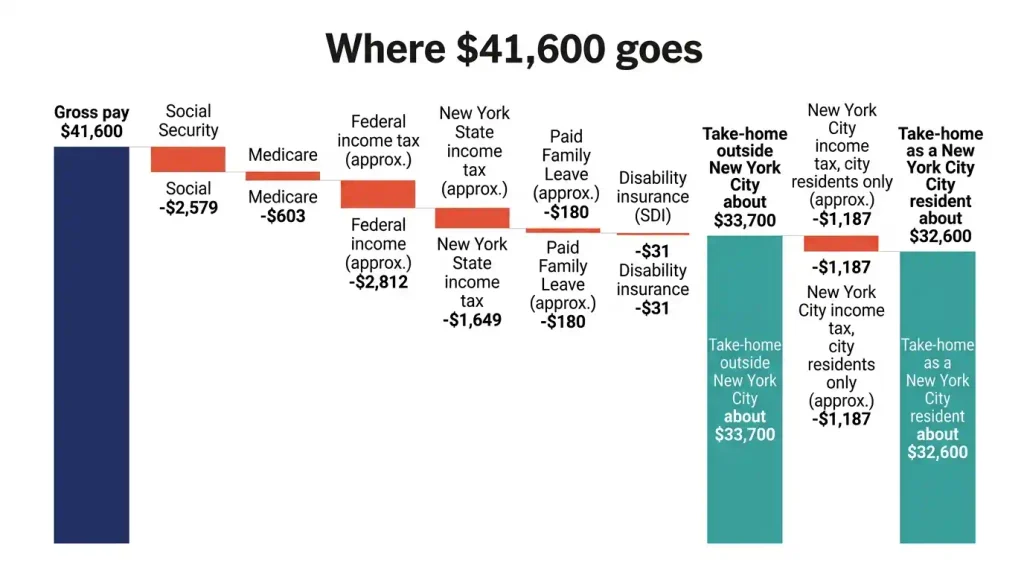
| Item | Per year |
|---|---|
| Gross pay | $41,600 |
| Social Security | -$2,579 |
| Medicare | -$603 |
| Federal income tax (approx.) | -$2,812 |
| New York State income tax (approx.) | -$1,649 |
| Paid Family Leave (approx.) | -$180 |
| Disability insurance (SDI) | -$31 |
| Take-home outside New York City | about $33,700 |
| New York City income tax, city residents only (approx.) | -$1,187 |
| Take-home as a New York City resident | about $32,600 |
These figures are estimates. Our calculation methodology explains how we work them out.
Why Your Take-Home Pay Can Be Different
Filing status and dependents change withholding. A married worker filing jointly gets a larger standard deduction than a single filer, so less tax usually comes out, especially when a spouse earns little or nothing. Each dependent can lower it further. Your federal Form W-4 and New York form drive this, and employers turn them into dollars using IRS Publication 15-T from the Internal Revenue Service.
Payroll deductions also shrink your check. Health insurance, a 401(k), and commuter benefits cut net pay, though pre-tax ones also lower taxable income (gross pay minus pre-tax deductions and the standard deduction). A 5% 401(k) contribution is $2,080 a year, about $40 a week, but your net check drops by less because that money is taxed later.
Withholding is an estimate, not your final tax bill. Too much withheld means a refund. Too little means you owe.
New York Form IT-2104 and Paycheck Withholding
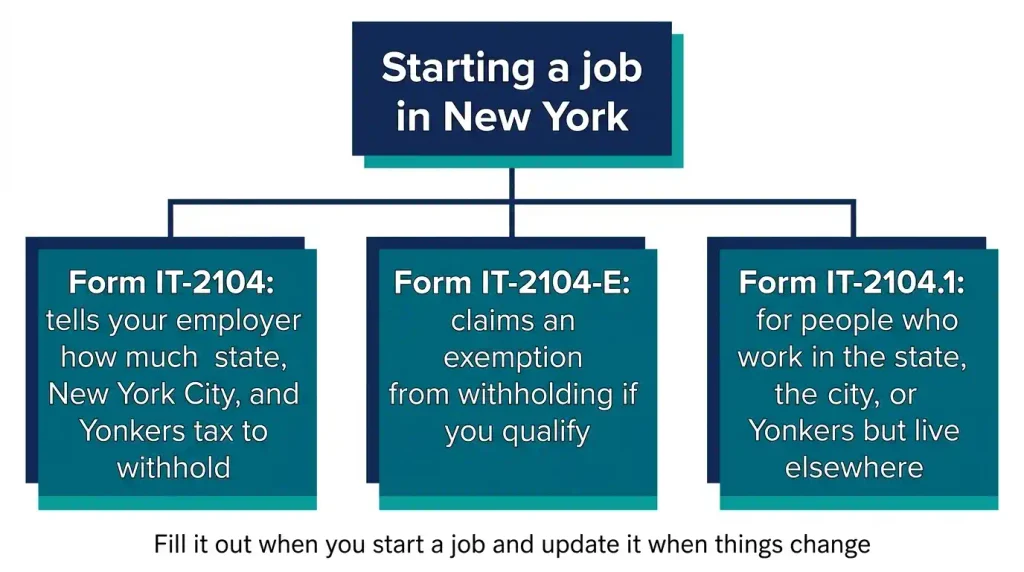
Form IT-2104 tells your employer how much state, New York City, and Yonkers tax to withhold. Fill it out when you start a job and update it when things change. Filing status, allowances, and extra withholding all feed in. If you never file one, your employer may withhold as if you are single with zero allowances, which usually takes more than needed. New York updated the form’s instructions for tax years starting January 1, 2026, so file a new Form IT-2104 if you submitted yours before 2026 and used the worksheet or charts.
New York Tax Law requires employers to withhold, and the New York State Department of Taxation and Finance publishes Form IT-2104 (PDF) and the rules. Employers use the 2026 New York State tax withholding tables, published separately: NYS-50-T-NYS for the state, NYS-50-T-NYC for the New York City wage bracket tables, and NYS-50-T-Y for Yonkers.
Form IT-2104-E claims an exemption from withholding if you qualify. Form IT-2104.1 is for people who work in the state, the city, or Yonkers but live elsewhere. For other withholding forms, see our tax forms and withholding guides.
$20 an Hour Weekly, Biweekly, and Monthly Take-Home Pay
As a single-filer estimate, $20 an hour nets about $625 to $650 a week, $1,250 to $1,300 biweekly, and $2,700 to $2,800 a month.
Weekly and Biweekly Pay
Gross is $800 weekly or $1,600 biweekly. Net checks land in the ranges in the answer above. More frequent checks are smaller, not extra money.
Monthly Take-Home Pay
Average monthly gross is $3,466.67, and take-home runs roughly $700 less than gross. A month is not exactly four weeks, so biweekly pay brings 26 checks a year and two months with three checks. Save that third check.
A common rule keeps housing near 30% of gross, about $1,040 on $3,467 a month. Compare that with asking rents in your area before you commit.
What You Should Actually See on a Pay Stub
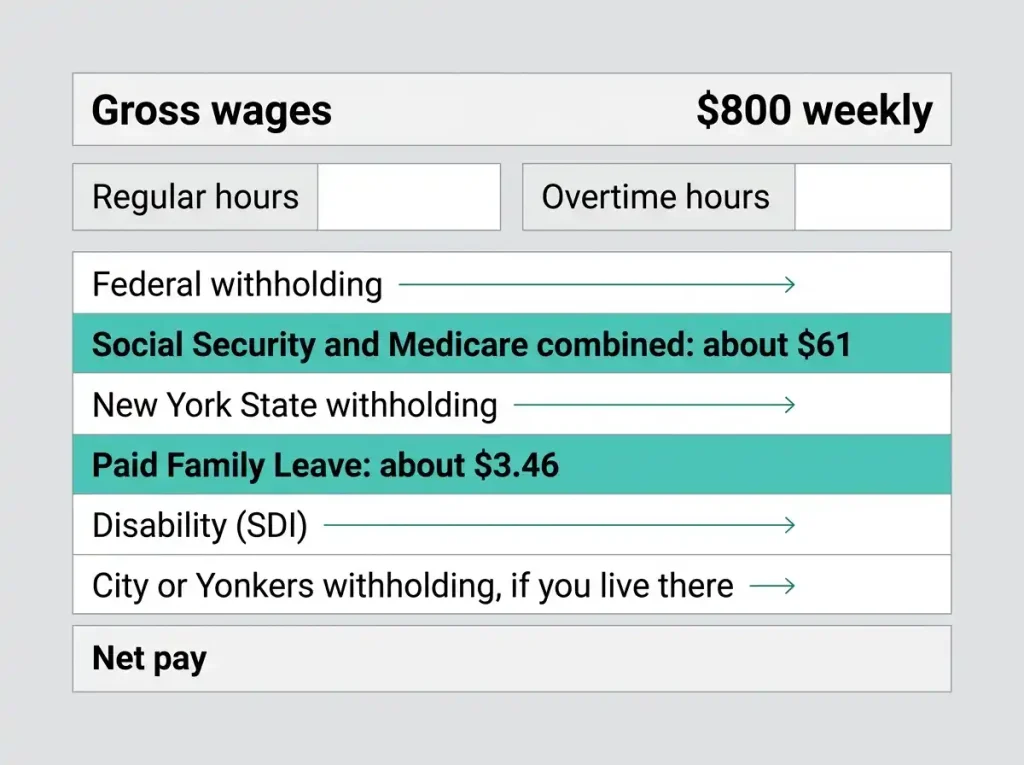
A pay stub shows gross wages, taxes, deductions, then net pay, with regular and overtime hours on separate lines. Expect these tax and deduction lines:
- Federal withholding
- Social Security
- Medicare
- New York State withholding
- Paid Family Leave
- Disability (SDI)
- City or Yonkers withholding, if you live there
An $800 weekly check shows about $61 in Social Security and Medicare combined, plus about $3.46 for Paid Family Leave. A New York paycheck calculator shows what to expect. If a line is missing or too high, ask payroll. A Form IT-2104 update often fixes it.
What Does $20 an Hour Look Like at Different Work Schedules?
$20 an hour is $20,800 a year at 20 hours a week, $41,600 at 40, and more with overtime.
Part-Time Work
At 20, 25, and 30 hours a week, you earn $20,800, $26,000, and $31,200 a year. The rate does not guarantee full-time income. If hours swing, such as 32 one week and 18 the next, budget from your lowest normal week.
Full-Time Work
Full-time is 40 hours a week for all 52 weeks, which gives the $41,600 figure. Scheduled hours are not paid hours. An unpaid 30-minute lunch makes an 8-hour shift 7.5 paid hours, $150 a day instead of $160. Two unpaid weeks cost $1,600 and leave you at $40,000.
Overtime at $20 an Hour
Under federal and New York law, most hourly workers get time and a half after 40 hours a week, so $30 an hour at $20. Five overtime hours every week adds $150 a week, or $7,800 a year, for $49,400. Do not count on it, since overtime depends on workload.
For tax years 2025 through 2028, you can deduct the overtime premium (the extra $10 an hour, not the full $30) from federal taxable income, up to $12,500 for a single filer. Five weekly overtime hours is about $2,600 of premium a year. It covers only overtime required by the federal Fair Labor Standards Act, and only your federal return. New York does not follow it, so the state still taxes full overtime pay. Your employer reports it on your W-2 (Box 12, code TT), and withholding will not drop unless you file a new W-4.
Is $20 an Hour a Good Wage in New York in 2026?
$20 an hour clears the minimum wage everywhere in the state. It is tight in New York City and more workable elsewhere.
How $20 Compares With New York’s Minimum Wage
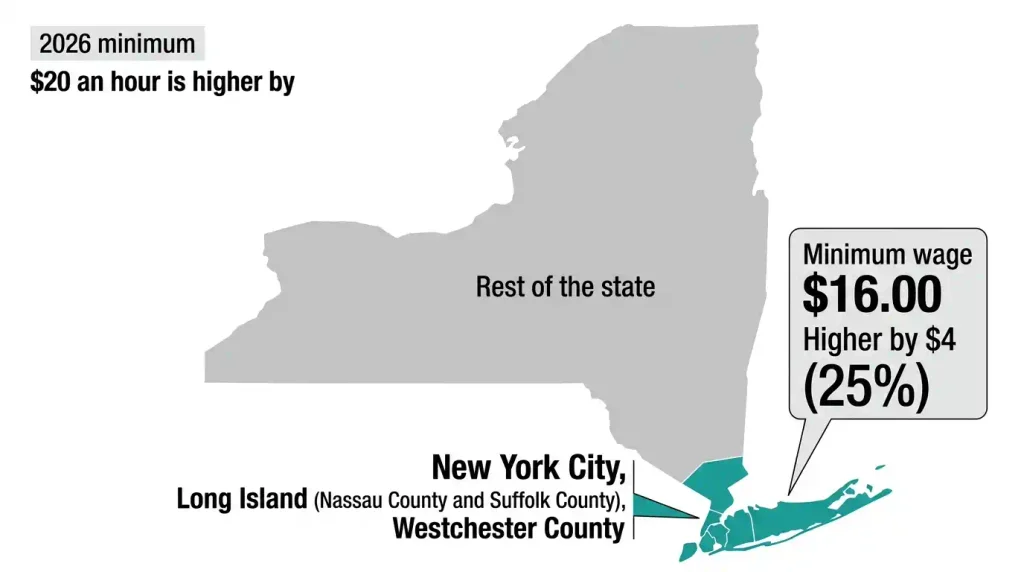
In 2026, the New York minimum wage depends on where you work:
| Region | 2026 minimum | $20 an hour is higher by |
|---|---|---|
| New York City, Long Island (Nassau County and Suffolk County), Westchester County | $17.00 | $3 (about 18%) |
| Rest of the state | $16.00 | $4 (25%) |
The New York State Department of Labor publishes these New York minimum wage rates, and its New York Department of Labor minimum wage page lists rules by industry, including tipped work and home care. Rates are indexed to inflation starting January 1, 2027, unless an economic off-ramp pauses the increase. For other wage rules, see our New York wages and wage laws guides.
Is $41,600 Enough to Live on in New York?
For one person in a lower-cost area, yes, with careful budgeting. Lower rents outside the New York City area can leave room for food, transportation, and utilities on about $2,800 a month if rent stays near that 30% guideline.
In New York City it is harder. Compare $41,600 with your county on the MIT Living Wage calculator, which estimates what a single adult needs for basic costs. A roommate or second income helps. Your wage is one income, not your household budget.
$20 an Hour in New York City vs. Other Areas
The paycheck looks nearly the same on paper, but costs differ. Housing is the biggest gap, then transportation. Outside the city you may need a car. In it you may not, which removes gas and car insurance but adds transit fares.
$20 an Hour Compared With Other Hourly Wages
Each extra dollar an hour adds $2,080 a year at full-time hours.
$20 vs. $22, $25, and $30 an Hour
| Hourly rate | Annual gross | Difference from $20 |
|---|---|---|
| $18 | $37,440 | -$4,160 |
| $20 | $41,600 | n/a |
| $22 | $45,760 | +$4,160 |
| $25 | $52,000 | +$10,400 |
| $30 | $62,400 | +$20,800 |
A $2 raise is worth $4,160 a year before taxes. To see how a bigger paycheck holds up, read our guide to $80,000 after taxes in New York.
What Hourly Wage Equals $50,000 a Year?
$50,000 equals about $24.04 an hour ($50,000 ÷ 2,080), which is $4.04 more than $20, or $8,400 more per year. At $20, you would need 2,500 paid hours, about 48 hours a week all year.
$20 an Hour vs. a $40,000 or $45,000 Salary
$40,000 is about $19.23 an hour and $45,000 is about $21.63. So $20 an hour beats $40,000 by $1,600 and falls $3,400 short of $45,000. Compare offers on the same 2,080 hours, then weigh benefits. A salaried job with paid time off and health insurance can beat a higher hourly rate with none. Some salaried jobs are overtime-exempt, so check whether overtime applies.
Real-Life $20-an-Hour Scenarios
Four workers at $20 an hour can have very different years. For other salaries, browse our paycheck scenarios.
| Worker | Hours per week | Annual gross | What changes it |
|---|---|---|---|
| Maria | 40 | $41,600 | Full-time, all 52 weeks |
| Dev | 30 | $31,200 | $10,400 below full-time |
| Sam | 40 | $39,200 | Three unpaid weeks off |
| Priya | 45 | $49,400 | 5 overtime hours a week at $30 |
A Full-Time Worker Earning $20 an Hour
Maria works 40 hours a week. She grosses $800 a week and $41,600 a year. Outside the city she keeps roughly $650 a week. Her biweekly check is $1,600 gross and about $1,300 net.
A Worker With 30 Hours a Week
Dev works 30 hours a week, earning $600 a week and $31,200 a year, which is $10,400 less than full-time. Ask about hours first. A $20 job with 30 hours can pay less than an $18 job with 40.
A Worker With Unpaid Time Off
Sam works full-time but takes three unpaid weeks off. That is 120 hours, or $2,400, so his year is $39,200, not $41,600. Every unpaid week costs $800.
A Worker Who Earns Overtime
Priya works 45 hours most weeks. She earns $800 for 40 hours plus $150 for 5 overtime hours, $950 a week and $49,400 a year. If overtime is cut, her pay drops. Her regular $41,600 is the safe number.
New York $20-an-Hour Edge Cases That Can Change the Answer
Some situations break the simple math. Check them before budgeting on a number you will not earn.
Variable or Unpredictable Work Hours
If hours change weekly, use your average. At 32 hours, you earn $640 a week and $33,280 a year. Seasonal work works the same way. Paid for 40 weeks instead of 52, $20 an hour comes to $32,000.
Paid Holidays, Vacation, and Sick Time
Paid time off keeps your income whole. Unpaid time off does not. Policies vary, so ask how much paid leave you get.
New York paid sick leave accrues 1 hour per 30 hours worked. The yearly amount depends on employer size: up to 56 paid hours at 100 or more employees, up to 40 paid hours at 5 to 99 employees, and 40 hours at smaller employers (paid only if net income topped $1 million).
Bonuses, Tips, Commissions, and Shift Differentials
These sit on top of base pay. A shift differential, such as night pay, can raise your effective hourly rate. Tips and commissions can swing month to month. Compare base pay separately and count only what you can reasonably expect.
Multiple Jobs or Household Income
One $20 job is not household income. A partner’s pay or a second job changes your budget and taxes. Each employer withholds as if that job is your only income, so you may owe at tax time. Adjust your W-4 and IT-2104 when you add a job.
Common Misconceptions About Earning $20 an Hour
The common mistake is treating $20 an hour as a guaranteed annual amount. It is not.
“$20 an Hour Always Means $41,600 a Year”
No. It assumes 40 hours a week for 52 weeks. Variable hours and unpaid time off bring it down.
“$41,600 Is What I Will Take Home”
No. $41,600 is gross. After federal tax, Social Security, Medicare, and New York State tax, expect around $32,600 to $33,700 as a single filer, depending on city tax. Pre-tax deductions like health insurance lower it further.
“Everyone in New York Pays the Same Taxes”
No. New York State tax applies statewide, but New York City and Yonkers add their own. Where you live shapes your local tax. A nonresident who works in New York still pays state tax on pay earned there. Withholding choices make your number different from a coworker’s.
“Biweekly Pay Means 24 Paychecks a Year”
No. Biweekly means every two weeks, or 26 checks. Semimonthly means twice a month, usually the 15th and last day, or 24 checks. Biweekly checks are smaller ($1,600 gross) than semimonthly ones ($1,733 gross), but the annual total is the same.
Should You Accept a $20-an-Hour Job in New York?
Accept it if the real annual number fits your budget. Run the math on paid hours first, not the rate.
Calculate the Real Annual Compensation
Start with the hours you will actually be paid and multiply by $20. Add overtime or bonuses only if they are regular. Subtract unpaid time off and benefits you pay yourself.
Compare the Complete Job Offer
Health insurance, retirement matching, and paid leave can be worth thousands of dollars a year. Commutes cost transit fares, gas, and time. Check what similar roles near you pay, since $20 may be competitive or below market. Steady 40 hours often beats higher pay with unreliable shifts. Also check whether you are paid as a W-2 employee or a 1099 contractor, since contractors cover their own payroll taxes.
Questions to Ask Before Accepting the Offer
- How many hours a week are guaranteed?
- Is overtime regularly available, and how is it paid?
- What health, retirement, and paid-leave benefits do I get, and when do they start?
- How often am I paid, and what is the typical schedule?
Frequently Asked Questions About $20 an Hour in New York
Short answers below cover gross pay, monthly and after-tax pay, living costs, overtime, and the $25 an hour comparison.
Is $20 an hour $41,600 a year?
Yes, before taxes. It is $20 × 40 hours × 52 weeks, assuming you are paid every week.
How much is $20 an hour per month?
About $3,467 gross. Take-home is roughly $2,700 to $2,800. Actual paychecks vary because months have different numbers of pay dates.
How much is $20 an hour after taxes in New York?
There is no single answer. A single filer with no pre-tax deductions takes home roughly $32,600 to $33,700 a year. Filing status, dependents, deductions, local taxes, and New York’s Paid Family Leave and disability deductions all change it.
Can you live on $20 an hour in New York?
In lower-cost areas, often yes, with a careful budget. In New York City, it is difficult for one person without shared housing or a second income.
How much is $20 an hour with overtime?
Under New York overtime laws, overtime pays $30 an hour. Five overtime hours a week brings you to about $49,400 a year before taxes.
What salary is $25 an hour in New York?
$52,000 a year at 40 hours a week, which is $10,400 more than $20 an hour.
$20 an Hour in New York: Key Takeaways
$20 an hour is $41,600 a year gross. Your real take-home depends on paid hours and where you live.
The Numbers to Remember
Gross benchmark and rough take-home for a single filer:
- $41,600 a year, $800 a week, $1,600 biweekly, about $3,467 a month gross
- Take-home of roughly $32,600 to $33,700 a year, depending on your deductions and taxes
The Most Important Reality Check
Base your budget on hours you are actually paid. Weigh where you live. Compare the full offer, including benefits and time off, before you accept.

Meet Yasin Ali, Founder
Yasin built NY Paycheck Calculator in 2020 after getting fed up with calculators that treated New York like every other state. Most tools ignore the extra local tax NYC and Yonkers workers pay on top of state tax — or skip New York’s Paid Family Leave deduction entirely.
He keeps the numbers current, checking in regularly against the latest IRS, NY Department of Taxation and Finance, and Paid Family Leave rates.
All results here are estimates based on official sources. For advice specific to your situation, talk to a tax professional.