
Yonkers income tax works as two separate charges: residents pay a 16.75% surcharge on their New York State tax, while nonresidents working in Yonkers owe a 0.5% tax on their Yonkers earnings, effective for the 2026 tax year.
Both figures are confirmed in New York’s official Publication NYS-50-T-Y, updated under Chapter 59 of the Laws of 2025.
Still, paycheck withholding is only an estimate, not your final Yonkers tax liability.
Yonkers Income Tax 2026: Quick Answer
Residents owe a surcharge on their New York State tax, and nonresidents working in Yonkers owe a smaller flat earnings tax. The table shows who owes what.
| Yonkers Tax Type | Who Owes It | 2026 Rate | Based On |
|---|---|---|---|
| Resident income tax surcharge | Yonkers residents | 16.75% | Net New York State tax |
| Nonresident earnings tax | Nonresidents working in Yonkers | 0.5% | Wages and self-employment earnings from Yonkers work |
What Yonkers income tax is in 2026
Yonkers does not run its own income tax like New York City. If you live there, the state adds the Yonkers resident income tax surcharge, 16.75% of what you already owe in New York State tax. If you work in Yonkers but live elsewhere, you pay the Yonkers nonresident earnings tax, just 0.5% on the wages and net self-employment earnings tied to that Yonkers work. Article 22 of the New York Tax Law governs personal income tax generally. Article 30-A of the New York Tax Law authorizes the resident surcharge and Article 30-B authorizes the nonresident earnings tax, and the Code of the City of Yonkers imposes both. Employers build both into paycheck withholding using the 2026 state tables, effective for payrolls dated January 1, 2026 or later.
2026 Yonkers tax rate at a glance
Both rates are unchanged for 2026: 16.75% of net state tax for residents (since 2014) and 0.5% for nonresidents. What changed is the New York State tax schedule underneath, since Part A of Chapter 59 of the Laws of 2025 trimmed the five lowest brackets, and that ripples into your Yonkers number. Confirm both figures in Publication NYS-50-T-Y.
Yonkers tax vs. New York State and NYC tax
New York State tax applies statewide. NYC income tax applies only to the five boroughs, with four brackets from 3.078% up to 3.876%:
| NYC Resident Tax Bracket | Rate |
|---|---|
| Lowest bracket | 3.078% |
| Second bracket | 3.762% |
| Third bracket | 3.819% |
| Top bracket (above $50,000 taxable income, single) | 3.876% |
Yonkers is a surcharge on state tax, not its own bracket system, so living in Yonkers never means owing NYC tax.
Who Has to Pay Yonkers Income Tax?
Whether you owe the resident surcharge or the nonresident tax comes down to where you actually live. Living near Yonkers, or spending time there, has no bearing on it.
Yonkers residents
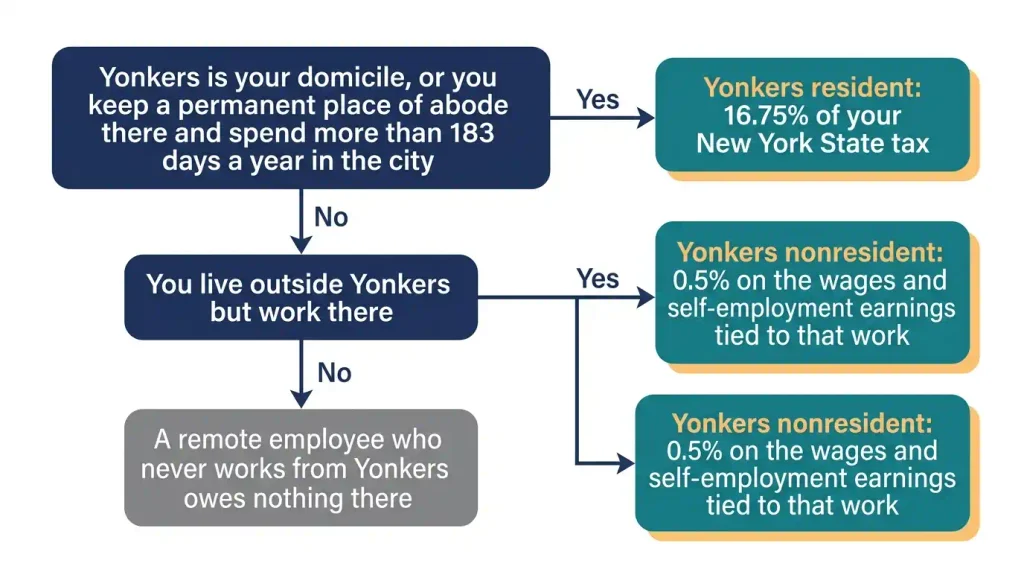
You are a resident if Yonkers is your domicile, or if you keep a permanent place of abode there and spend more than 183 days a year in the city. Domicile means the place you consider home. Renting there briefly does not make you a resident. Where you work is a separate question from where you live.
Yonkers nonresidents
If you live outside Yonkers but work there, you are a Yonkers nonresident who owes the 0.5% nonresident earnings tax on the wages and self-employment earnings tied to that work. It only touches income for services performed inside Yonkers, so remote days elsewhere don’t count. It also doesn’t matter if your employer’s office sits in Yonkers, since the tax follows where the work is done, not the company’s location. Form Y-203 has nonresidents allocate wages between work done in and out of Yonkers, so a remote employee who never works from Yonkers generally owes nothing there. For the state side of this, see how New York State taxes nonresidents.
Part-year Yonkers residents
Move into Yonkers partway through 2026? You owe the surcharge only for the period you lived there, figured on Form IT-360.1. Same in reverse for moving out. Only your Yonkers-resident period gets the 16.75% treatment.
How the 2026 Yonkers Income Tax Is Calculated
Residents multiply their net New York State tax by 16.75%. Nonresidents pay 0.5% of Yonkers wages and self-employment earnings.
How the Yonkers resident surcharge works
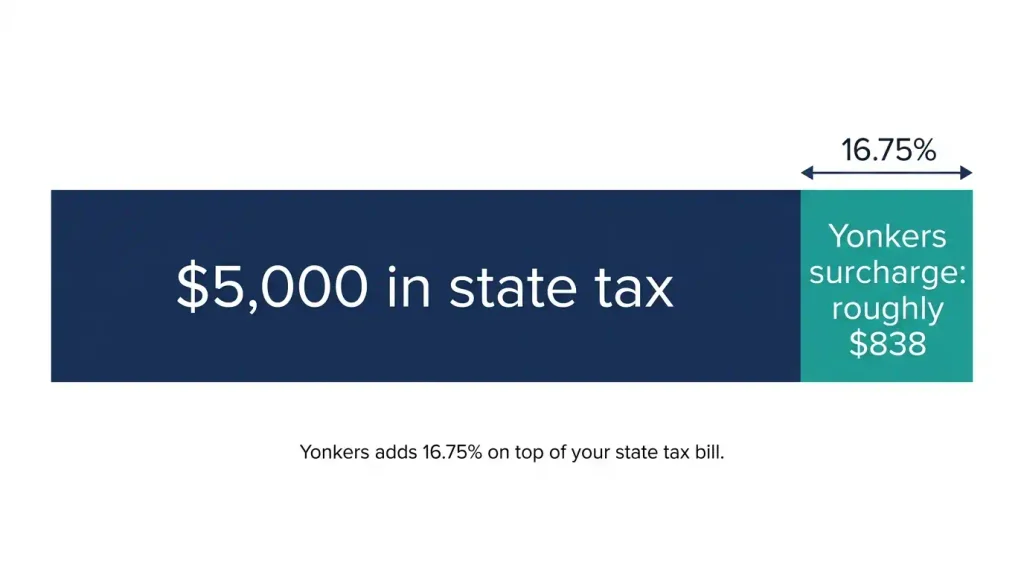
Yonkers adds 16.75% on top of your state tax bill. Owe $5,000 in state tax, and your Yonkers surcharge is roughly $838. This holds even if part of that income was earned outside New York, since your full New York State return still drives the number.
What income and tax amounts matter
What matters is New York State taxable income, after deductions like the $8,000 standard deduction for single filers in 2026. Your state tax liability then follows the bracket system, and credits shrink it further before the surcharge applies. Your net state tax combines wages, self-employment, business, and investment income, and multiple jobs combine into the same total. Self-employed Yonkers residents may also see the Metropolitan Commuter Transportation Mobility Tax, MCTMT, tied to the Metropolitan Commuter Transportation District. If your state tax is zero, your Yonkers surcharge is zero too. Whether you are an employee or an independent contractor decides how that pay is reported.
Why you cannot calculate Yonkers tax from salary alone
New York State tax is progressive, from 3.9% on the first slice up to 10.9% at the top. Filing status shifts the brackets, and credits shrink the final number. Find your real state liability first, then apply the surcharge. The 2026 New York tax brackets and an $80,000 New York paycheck example show the full math.
2026 Yonkers Withholding From Your Paycheck
Your employer withholds Yonkers tax using Publication NYS-50-T-Y and the details on your Form IT-2104, with updated 2026 tables.
How employers calculate Yonkers withholding
Employers use Publication NYS-50-T-Y, applying the wage bracket method, the exact calculation method, or the other methods it lists, such as a top-rate method for high earners and an annualized method for nonresidents. Payrolls dated January 1, 2026 or later use the updated tables. Withholding is an estimate, not your final tax bill. Employers also need to track New York payroll tax deadlines.
How Form IT-2104 affects Yonkers withholding
Form IT-2104 sets your residency, filing status, and allowances, all feeding your Yonkers number. Review a new 2026 version after marriage, a child, a job change, or a move in or out of Yonkers.
How much Yonkers tax should appear on a paycheck?
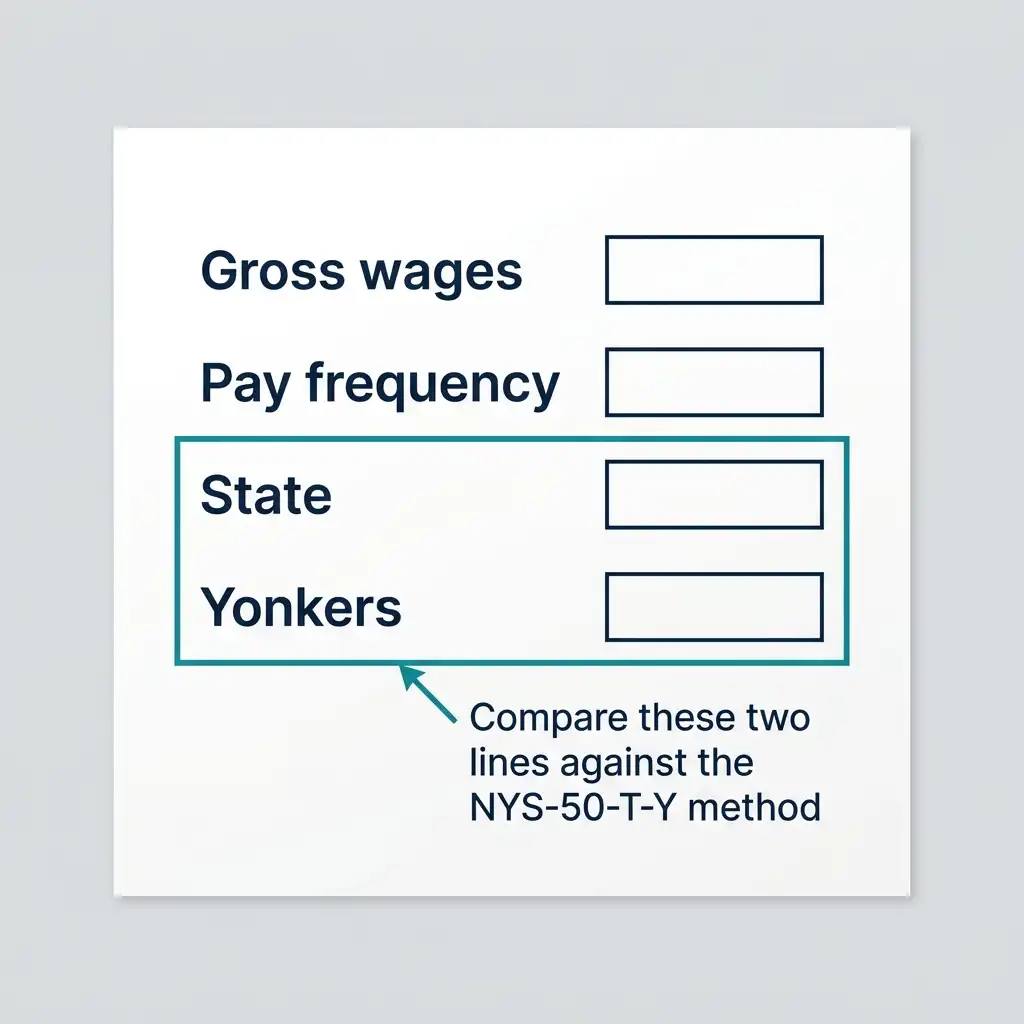
Check gross wages and pay frequency, then compare the state and Yonkers lines on your stub against the NYS-50-T-Y method. Two coworkers on the same salary can see different Yonkers withholding if their IT-2104 details differ.
Why your 2026 paycheck may look different
New York trimmed its five lowest brackets, lowering the base the surcharge sits on, so your actual state tax and Yonkers surcharge drop slightly for income in those brackets. Withholding tables were revised for 2026 payrolls to match, so each check reflects the lower rates.
2026 Yonkers Withholding Tables and Forms
Employers use Publication NYS-50-T-Y for the tables, and employees set their withholding on Form IT-2104, or Form IT-2104.1 if they are nonresidents. Browse more New York tax forms and withholding guides.
Publication NYS-50-T-Y
This is what employers use to run Yonkers withholding, with separate sections for resident surcharge and nonresident earnings tax. The 2026 version reflects the updated rate schedule. Employers can find more in New York payroll and employer compliance.
Form IT-2104
The Employee’s Withholding Allowance Certificate drives your state and Yonkers withholding. Its instructions were revised for 2026, so use the 2026 version.
Form IT-2104.1
This is the certificate of nonresidence and allocation of withholding, for nonresidents who work in New York State or Yonkers, including New York residents who live outside Yonkers and work there. It allocates your withholding by the estimated percentage of services performed in Yonkers rather than setting general allowances. The official Form IT-2104.1 is on the Tax Department site.
Other New York forms relevant to Yonkers taxpayers
| Form | Purpose | Instructions |
|---|---|---|
| IT-201 | Full-year resident return; where the Yonkers surcharge is reported | IT-201-I |
| IT-203 | Part-year resident and nonresident return | IT-203-I |
| Y-203 | Yonkers nonresident earnings tax return, filed with your state return; each spouse files their own | Y-203-I |
| IT-360.1 | Change of city residency status during the year | IT-360.1-I |
You can skip Form Y-203 only if you have no New York State filing requirement, were a Yonkers nonresident all year, had only wages, and those wages totaled $3,000 or less (or came from one employer that withheld the correct tax).
Yonkers Income Tax vs. Other New York Taxes
Yonkers tax is a surcharge on state tax and is separate from NYC tax. Nonresidents who work in Yonkers pay a different, smaller tax.
Yonkers vs. New York State income tax
New York State income tax is the foundation. The Yonkers surcharge is 16.75% of that number, layered on top, not a competing tax. Both reconcile on Form IT-201 or IT-203. Neither touches your federal return, Yonkers tax is a state and local matter only. See which taxes come out of a New York paycheck for the full stack.
Yonkers vs. New York City income tax
Yonkers and NYC are separate jurisdictions. NYC runs its own brackets for residents; Yonkers charges a surcharge on state tax. A Yonkers resident commuting into NYC still pays only Yonkers tax, since NYC tax is based on residence, not workplace. For other city rules, see New York City worker pay and labor rules.
Yonkers resident tax vs. Yonkers nonresident earnings tax
The resident surcharge applies if Yonkers is your home, based on full state tax liability. The nonresident earnings tax applies if you just work there, based only on wages and self-employment earnings tied to that job.
Yonkers Income Tax Examples for Real 2026 Situations
These examples show how where you live and where you work decide which Yonkers tax applies. More salary scenarios are in New York paycheck scenarios.
Example: Yonkers resident with one W-2 job
Live in Yonkers, work one job nearby: your employer withholds state tax, then adds the Yonkers surcharge from your IT-2104 details. Your stub should show both as separate paycheck deductions.
Example: Yonkers resident who works outside Yonkers
Live in Yonkers, commute elsewhere: the surcharge still applies, since it follows residence, not job location.
Example: Nonresident who works in Yonkers
Live in the Bronx, work in Yonkers: you owe the 0.5% nonresident earnings tax only on the wages tied to that job, not on income from elsewhere.
Example: Married couple with different residency situations
One spouse lives and works in Yonkers, the other lives in Connecticut and commutes in to work: the first is subject to the resident surcharge, the second owes the 0.5% nonresident earnings tax on Yonkers wages and files their own Form Y-203. Joint filing doesn’t merge their Yonkers statuses.
What to Do If Your Yonkers Withholding Looks Wrong
Confirm your residency, compare your pay stub to the NYS-50-T-Y method, and file a new IT-2104 if something is off. If your take-home is lower than expected, see why your New York paycheck is lower.
Check your residency status first
Confirm domicile and the 183-day rule. Check if residency changed in 2026, and that payroll has your correct address.
Compare your paycheck with the 2026 withholding method
Compare the state and Yonkers lines on your pay stub against the current NYS-50-T-Y method. If they don’t match, ask payroll to recheck your residency, address, and pay frequency, and confirm the IT-2104 on file is current.
Update your withholding information
File a new IT-2104 after any move, job change, marriage, or income change. Keep copies of every version submitted.
What happens if too little tax was withheld?
You could owe a balance, plus interest, and possibly penalties. If too much was withheld instead, you get it back as a refund when you file. Your New York State return, which settles Yonkers tax too, is due April 15, 2026 for the 2025 tax year, or October 15, 2026 with a valid extension. The return for the 2026 tax year is due April 15, 2027. Expecting a big bill? Quarterly estimated tax payments help avoid an underpayment penalty.
Yonkers Income Tax 2026: Key Takeaways
Confirm your residency, then check that your paycheck’s Yonkers line matches the 16.75% surcharge or the 0.5% nonresident tax that applies to you. New to paycheck terms? Start with New York paycheck basics.
The five numbers and facts to check
- Your Yonkers residency status
- Which 2026 calculation applies to you, resident surcharge or nonresident earnings tax
- Your New York State withholding on your pay stub
- Your Yonkers withholding line on your pay stub
What to do after reading this guide
- Check your latest paycheck against the 2026 rules
- Run your numbers in the New York paycheck calculator
- Review your current Form IT-2104 information
- Keep records for filing
Yonkers Income Tax 2026 FAQ
Residents pay 16.75% of their state tax and nonresidents working in Yonkers pay 0.5%, so neither is a flat cut of your salary.
What is the Yonkers income tax rate for 2026?
Residents pay 16.75% of their New York State tax liability. Nonresidents pay 0.5% of Yonkers wages and self-employment earnings. Both come from Publication NYS-50-T-Y. Never multiply salary directly by 16.75%.
Do Yonkers residents pay New York State income tax too?
Yes. The Yonkers surcharge is a percentage of that state tax, reported together on Form IT-201 or IT-203.
Do Yonkers residents pay NYC income tax?
No. Yonkers and NYC are separate cities. Working in NYC while living in Yonkers doesn’t change this, since NYC tax follows residence.
Does working in Yonkers mean I owe Yonkers income tax?
It means the smaller 0.5% nonresident earnings tax on wages tied to that job, not the 16.75% resident surcharge, which depends on where you live.
How is Yonkers tax withheld from my paycheck?
Employers use Publication NYS-50-T-Y with your Form IT-2104 details and pay frequency. Your final liability is settled when you file.
Why did my Yonkers withholding change in 2026?
New York revised withholding tables for payrolls from January 1, 2026, and trimmed its five lowest brackets. The lower rates reduce your actual state tax and Yonkers surcharge slightly, and the new tables bring your per-check withholding in line.
Do I need a new Form IT-2104 for 2026?
Yes, if you filed before January 1, 2026 using the worksheet or charts, since the IT-2104 instructions were revised for 2026. Our New York W-4 vs IT-2104 guide explains the difference. Also review it after any change in residency, job, income, or dependents, to avoid withholding based on outdated information.
How to Verify Your 2026 Yonkers Tax With Official Sources
Confirm rates and forms with the New York State Department of Taxation and Finance, using Publication NYS-50-T-Y and Form IT-2104-I.
New York State Department of Taxation and Finance
The New York State Department of Taxation and Finance hosts current withholding publications, plus a Jurisdiction/Rate Lookup tool that confirms whether an address falls inside Yonkers or NYC for withholding purposes.
Official 2026 Yonkers withholding publication
Publication NYS-50-T-Y has separate resident and nonresident withholding sections, updated for 2026’s rate schedule. See how our calculator’s estimates work on the calculation methodology page.
Official 2026 employee withholding instructions
Form IT-2104-I explains allowances and additional withholding, and when to file a new form.

Meet Yasin Ali, Founder
Yasin built NY Paycheck Calculator in 2020 after getting fed up with calculators that treated New York like every other state. Most tools ignore the extra local tax NYC and Yonkers workers pay on top of state tax — or skip New York’s Paid Family Leave deduction entirely.
He keeps the numbers current, checking in regularly against the latest IRS, NY Department of Taxation and Finance, and Paid Family Leave rates.
All results here are estimates based on official sources. For advice specific to your situation, talk to a tax professional.