
Yonkers nonresident tax is a 0.5% earnings tax in 2026 on pay and business income earned in Yonkers by people who live outside it. You file Form Y-203 with your state return.
That rate and filing rule were checked in October 2026 against Publication NYS-50-T-Y (1/26), the Y-203-I instructions, and TSB-M-12(5)I.
Limit: the posted Y-203-I is the 2025 edition, so figures rely on it and the 1/26 tables.
Do You Owe Yonkers Nonresident Tax?
Yes, if any of your work happens in Yonkers. Some remote days count too, depending on your assigned office.
The Short Answer
Only pay tied to Yonkers work days is taxed, and some home days count as Yonkers days. Earn $72,000 working full time in Yonkers and your tax is $360.
Quick “Does This Apply to Me?” Decision Table
| Your situation | Yonkers nonresident tax? | What to do |
|---|---|---|
| You live in Yonkers | No. You pay the resident surcharge instead | Figure the surcharge on your state return |
| You live outside Yonkers and work there full time | Yes | File Form Y-203 with your state return |
| You live outside Yonkers and work from home, and your assigned office is outside Yonkers | Usually no, except for days you actually work in Yonkers | Keep a record of your work location |
| You live outside Yonkers and work from home, and your assigned office is in Yonkers | Usually yes. Normal home days often count as Yonkers days | File Form Y-203 and check the home office rule below |
| You live outside Yonkers and split required work between Yonkers and other places | Yes, on the Yonkers share | Give your employer Form IT-2104.1 and use Schedule A on Y-203 |
Yonkers Nonresident Tax vs. Yonkers Resident Tax
A Yonkers resident pays the Yonkers resident income tax surcharge, which equals 16.75% of their New York State tax. On $3,000 of state tax, that is $502.50. A nonresident pays 0.5% of Yonkers earnings instead. Your home address decides which applies.
What Is the Yonkers Nonresident Earnings Tax?
It is a flat local tax charged by the City of Yonkers, with no brackets. The state’s January 2026 withholding tables kept the rate at 0.5%.
Who Counts as a Yonkers Nonresident?
You are a Yonkers nonresident if you fail both Yonkers residency tests, the same two the New York State Tax Law uses for the state. One is domicile, the place you treat as your permanent home. The other is keeping a permanent place of abode in Yonkers for substantially all of the year (more than 11 months) and spending 184 or more days there, where part of a day counts as a day. Form Y-203 also asks about living quarters in Yonkers. Working in Yonkers does not make you a resident, and living outside it does not erase the tax if you work inside it.
What Income Can Be Subject to the Tax?
Wages count: salary, overtime, bonuses, tips, commissions, and severance for work done in Yonkers. Taxable noncash pay counts at its cash value, and so do 414(h) public pension contributions shown on your federal Form W-2. Net earnings from self-employment count too, including your share of a partnership doing business there. Unemployment pay, interest, dividends, and capital gains do not.
What Does Not Automatically Create Yonkers Tax?
An employer’s Yonkers address alone does not make your whole paycheck taxable. The tax follows where you work, and days your job sends you elsewhere stay outside Yonkers. The home office rule below is the catch.
How Yonkers Determines Which Wages Are Taxable
Yonkers taxes the share of your pay earned on work days in Yonkers: all of it if you work only there, otherwise the share Schedule A on Form Y-203 sets. Sales pay that depends on volume uses a sales ratio instead.
Working Entirely in Yonkers
Your full wages count. Put your gross wages on line 1 of Form Y-203.
Working Partly in Yonkers and Partly Elsewhere
Start on Y-203 Schedule A. Count your work days, removing weekends, holidays, vacation, and sick leave, which are nonworking days. Every commuting day to a Yonkers worksite is a Yonkers day. Days worked elsewhere count as outside days only if your employer needed you there, not for your convenience. Divide Yonkers days by total work days and apply that percentage to your wages. Dan’s example below shows the math.
Working From Home Outside Yonkers
The state looks at your assigned office, under its convenience of the employer test for telecommuting. If it is in Yonkers, your normal home work days count as Yonkers days, unless your home is a true employer office the job requires. If it is outside Yonkers, those home days count as outside days. Home days that are not normal work days count as nonworking days.
Multiple Jobs or Changing Work Locations
Handle each job separately, with its own Yonkers wage allocation Schedule A, counting only days worked while a Yonkers nonresident. If your work site changed mid-year, count the days at each place.
How to Calculate Yonkers Nonresident Tax in 2026
Your tax is 0.005 times your Yonkers wages and self-employment earnings after any exclusion, and most full-time workers get no exclusion. The exclusion table is unchanged for 2026.
The Basic Calculation
Enter Yonkers wages on line 1 and Yonkers self-employment earnings on line 2. Add them on line 3 and remove any START-UP NY wages. Subtract the exclusion from the Form Y-203 table, then multiply the rest by 0.5%. For a full year, the exclusion depends on your Yonkers earnings:
| Yonkers earnings (full year) | Exclusion |
|---|---|
| $10,000 or less | $3,000 |
| Over $10,000, up to $20,000 | $2,000 |
| Over $20,000, up to $30,000 | $1,000 |
| Over $30,000 | $0 |
If you moved in or out of Yonkers, or had a short tax year, the exclusion is prorated by months. See our calculation methodology for how we source our figures.
Simple Full-Year Example
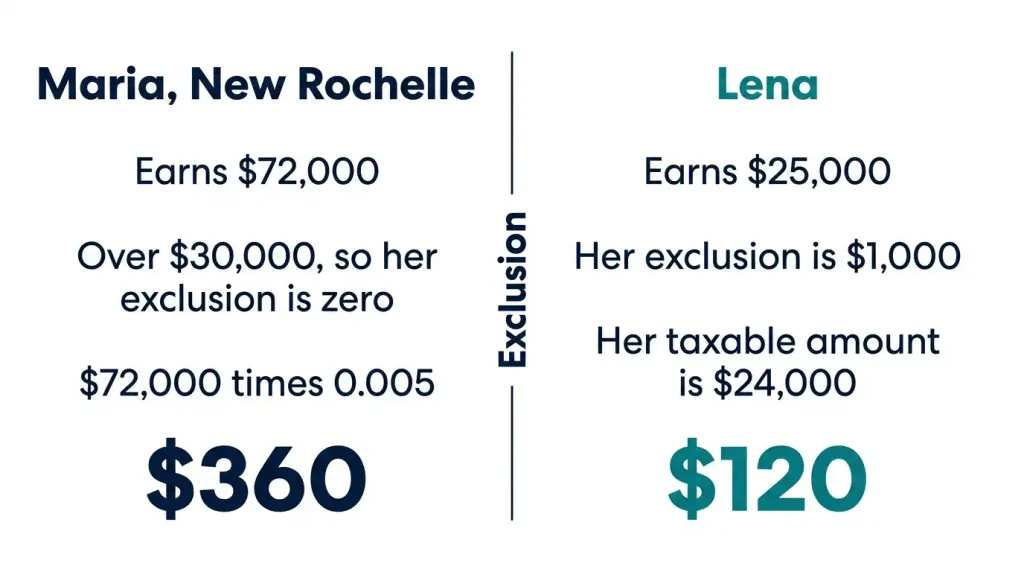
Maria lives in New Rochelle and earns $72,000 working in Yonkers all year, the case from The Short Answer. That is over $30,000, so her exclusion is zero. Her tax is $72,000 times 0.005, or $360, about $14 per biweekly paycheck. Lena earns $25,000 in Yonkers, so her exclusion is $1,000. Her taxable amount is $24,000, and her tax is $120.
Part-Year or Mixed-Location Example
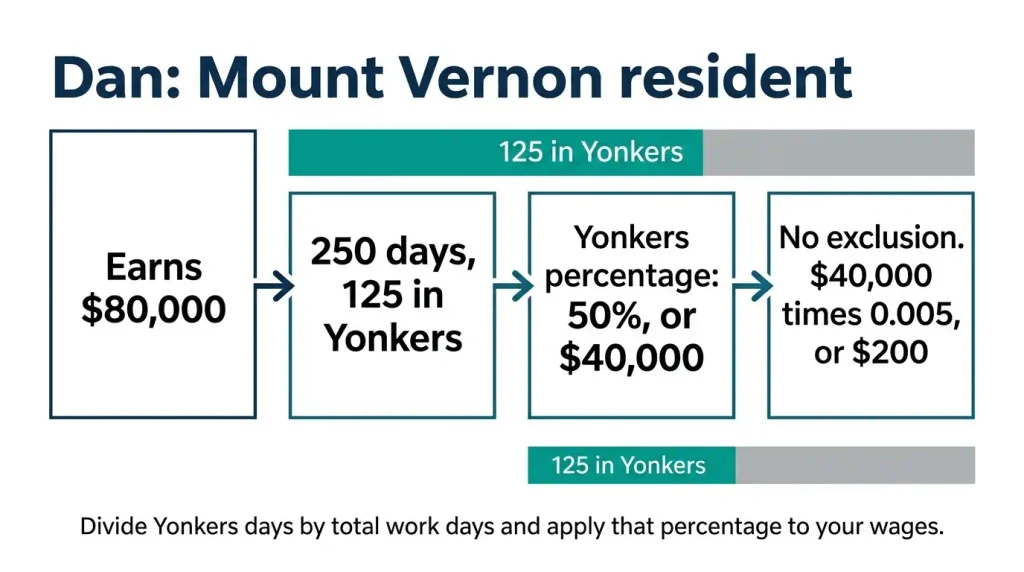
Dan lives in Mount Vernon and earns $80,000. He works 250 days, 125 in Yonkers, so his Yonkers percentage is 50%, or $40,000. Over $30,000 means no exclusion, so his tax is $40,000 times 0.005, or $200. Had Dan moved out of Yonkers in June, he would count only his nonresident days on line 7 of Schedule A. For the full take-home picture at that pay, see $80k after taxes in New York.
Why the Final Tax Can Differ From Your Paycheck Withholding
Withholding is an estimate of what comes out of your paycheck during the year. Your return is the real bill. If your employer withheld $300 and your true tax is $360, you owe $60. If they withheld too much, you get it back only if you file Form IT-201 or IT-203. To estimate your take-home pay, try our New York paycheck calculator.
What Forms Do Yonkers Nonresidents Need?
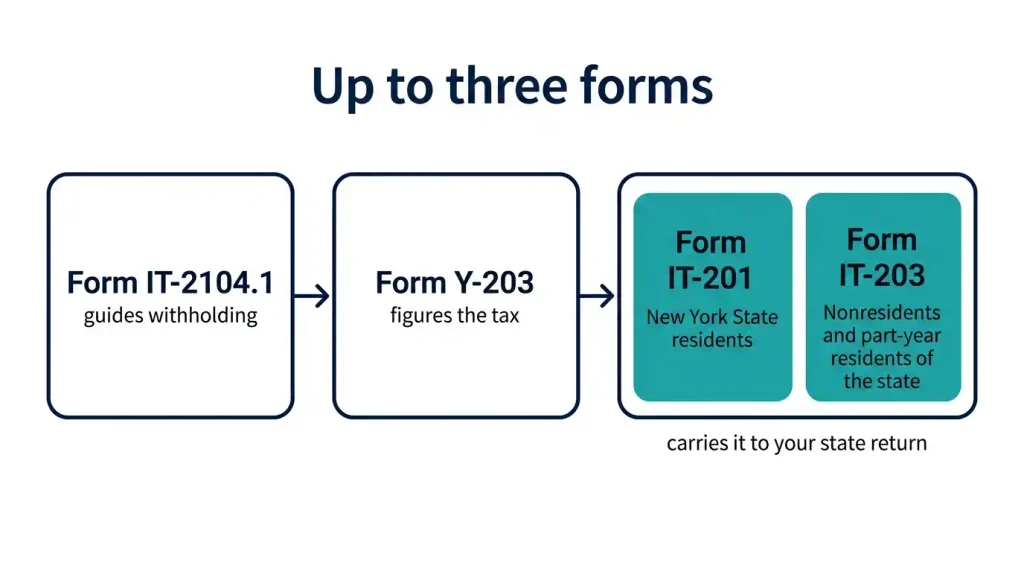
Most people need up to three New York tax forms. Form IT-2104.1 guides withholding, Form Y-203 figures the tax, and Form IT-201 or IT-203 carries it to your state return.
Form IT-2104.1: Certificate of Nonresidence and Allocation
Give this to your employer if you live outside Yonkers and want withholding to match your real Yonkers work. Its full name is New York State, City of New York, and City of Yonkers Certificate of Nonresidence and Allocation of Withholding Tax. For help filling it out, see our Form IT-2104.1 guide. You certify you are a nonresident and estimate your Yonkers share, Yonkers workdays divided by all workdays, so three of five days is 60%. Residents use Form IT-2104, the Employee’s Withholding Allowance Certificate, with instructions in IT-2104-I, and the W-4 vs. IT-2104 guide shows how it differs from the federal W-4. Tell your employer within 10 days if your share changes a lot or you move into Yonkers. False information that lowers withholding can bring a $500 penalty.
Form Y-203: Yonkers Nonresident Earnings Tax Return
File Y-203 if you must file a New York State return and are a Yonkers nonresident who earned wages or ran a business there. It goes in with your state return and does not replace it. Spouses cannot file jointly. Each spouse with Yonkers earnings files their own, and the totals combine on a joint state return.
Form IT-201 vs. Form IT-203
New York State residents, such as someone from Westchester County or Long Island, file Form IT-201. Nonresidents and part-year residents of the state, such as someone from New Jersey or Connecticut, file Form IT-203. Either way, copy your Y-203 total onto that return and enter your Yonkers withholding and estimated payments there.
When a Separate Y-203 May Not Be Required
You can skip Y-203 only if you need not file a state return, were a Yonkers nonresident all year, had only Yonkers wages, and either had $3,000 or less in total Yonkers wages or had one employer who withheld the right amount. To claim a refund, you must still file a state return. The $3,000 test decides filing, not withholding. Withholding has two separate limits. Employers need not withhold if you are expected to earn $3,000 or less in Yonkers for the year. Separately, the 2026 withholding tables show no tax on annualized pay under $4,000.
How Yonkers Tax Withholding Works on Your Paycheck
Your employer must withhold Yonkers nonresident tax on wages you earn for work in Yonkers. It appears as its own line among your paycheck deductions, a down payment on your Y-203 bill, not the final number.
What “Yonkers” on a Pay Stub Means
A Yonkers line on your pay stub is local tax withheld for the city, separate from federal and New York State tax. For the full gross-to-net picture, see gross pay vs. net pay in New York. For a nonresident, it prepays the 0.5% earnings tax. For a resident, it is the surcharge.
How Employers Determine Yonkers Withholding
Employers follow Publication NYS-50-T-Y, Yonkers Withholding Tax Tables and Methods. The 1/26 edition covers 2026, and its revised tables apply to residents, not nonresidents. State tables are in Publication NYS-50-T-NYS, New York State Withholding Tax Tables and Methods, and Publication NYS-50 is the employer’s guide to withholding. If all your work is in Yonkers, the employer withholds on all your wages. If you split your work, it withholds on the share on your Form IT-2104.1. With no form, it may withhold on all your wages or use last year’s workday share, and it must adjust during the year.
If your main work location is outside Yonkers and you are expected to work there 14 days or fewer, the employer is not penalized for skipping withholding. Any part of a day in Yonkers counts as a full day, and the rule does not cover pay that depends entirely on sales volume or deferred pay. After the 14th day, it must withhold on all Yonkers wages paid. You owe the tax and file either way. For the state side of withholding, read the New York State tax withholding guide. Employers can find more in our New York payroll and employer compliance guides, including payroll tax deadlines.
What to Check if the Amount Looks Wrong
Count your actual Yonkers days and compare them to the percentage your employer has. Confirm your IT-2104.1 is on file and current, and hand in a new one when your schedule changes. Also check the line says Yonkers, not New York City. If your paycheck still looks lower than expected, see why your New York paycheck is lower, or browse our New York paycheck basics.
Yonkers Nonresident Tax vs. Other New York Taxes
Yonkers nonresident tax is a separate local tax stacked on top of state tax, and it is unrelated to New York City’s tax. Each has its own rules.
Yonkers Nonresident Tax vs. New York State Income Tax
You pay both New York State income tax and the Yonkers tax, and one does not cancel the other. Yonkers tax is figured on Y-203 and added to your IT-201 or IT-203, alongside the state tax figured from the 2026 New York tax brackets. Filers who live outside New York can also check the New York nonresident tax guide. The state’s optional Employer Compensation Expense Program (ECEP) taxes employers on pay above $40,000 and gives covered employees a state credit, which is separate from the Yonkers earnings tax, so check the Form Y-203 instructions if your employer opted in.
Yonkers Nonresident Tax vs. New York City Income Tax
New York City income tax is a New York City resident tax, so it applies only to city residents. The top rate is 3.876%. The old commuter tax on nonresidents was repealed in 1999, so commuters owe state tax on city wages but no city tax. Yonkers still taxes nonresident workers. Yonkers also sits in Westchester County, part of the Metropolitan Commuter Transportation District, where employers and self-employed people with net earnings over $50,000 in a zone may owe the MCTMT. That is a separate tax from the Yonkers earnings tax.
Yonkers Nonresident Tax vs. Yonkers Resident Surcharge
Residents pay the 16.75% surcharge on their state tax. Because it scales with state tax, higher earners pay more, so see a high-earner example in the $200K salary after taxes in New York State guide. Nonresidents pay 0.5% on Yonkers earnings. A nonresident never pays more than a resident would. If the surcharge would be lower, you can pay that amount and attach a schedule showing the math.
Special Situations That Can Change the Answer
Moves, self-employment, partnerships, extra jobs, and bonuses each change how much of your income ties to Yonkers.
You Moved Into or Out of Yonkers During 2026
You are a part-year resident, not a plain nonresident. File Form IT-360.1 for the months you lived in Yonkers and Form Y-203 for the months you lived outside and still earned there. Your exclusion is prorated by months, and more than half a month counts as a full month.
You Are Self-Employed
Net earnings from self-employment tied to Yonkers are taxed at 0.5%, and independent contractors count. Start with the net earnings on Schedule SE of your federal Form 1040, then remove business done wholly outside Yonkers. With no regular place of business outside Yonkers, all of it counts as Yonkers income. If you work both in and out of the city, use your books if they fairly show the Yonkers share. Otherwise use the Yonkers self-employment allocation Schedule C, which averages property, payroll, and gross income percentages. If you also have a Yonkers job, add wages and self-employment earnings together, because the exclusion works off the total.
You Are a Partner in a Business Operating in Yonkers
If the partnership does business in Yonkers, your share of its earnings can be taxed even if you live elsewhere, whether or not it was paid out to you. Use the partnership’s property, payroll, and income numbers on Y-203 Schedule C. Limited partners count only guaranteed payments for services. Unlike wages, this is not based on your work days.
You Have Multiple Employers
Track each job separately. Each job with split work gets its own Schedule A, and the totals roll into line 1 of your first Y-203. Add the Yonkers withholding from every employer when you file. For the state side, see New York withholding with multiple jobs.
You Received a Bonus or Other Compensation
Bonuses, commissions, severance, and vacation pay are wages. A bonus for work done in Yonkers is taxable there. Commissions based on sales volume use your Yonkers sales divided by total sales, not work days.
Real-World Yonkers Nonresident Tax Scenarios
These numbers are examples, not your exact bill. For more worked cases, see our New York paycheck scenarios.
| Setup | Pay counted as Yonkers | Tax |
|---|---|---|
| Live in White Plains, work full time in Yonkers ($65,000) | $65,000 | $325 |
| Assigned office outside Yonkers, 3 Yonkers days a week ($85,000) | $51,000 (60%) | $255 |
| Assigned office in Yonkers, 2 home days by choice ($85,000) | $85,000 | $425 |
| Assigned office outside Yonkers, 20 Yonkers days a year ($100,000) | $8,000 (8%), $5,000 after exclusion | $25 |
| Two Yonkers employers ($40,000 and $35,000) | $75,000 | $375 |
| Self-employed, hypothetical 40% share ($90,000) | $36,000 | $180 |
You Live in White Plains and Work Full-Time in Yonkers
Yes, the tax applies. On $65,000, with no exclusion at that level, your tax is $65,000 times 0.005, or $325. File Y-203 with your state return.
You Live Outside Yonkers and Work Three Days in Yonkers and Two Days at Home
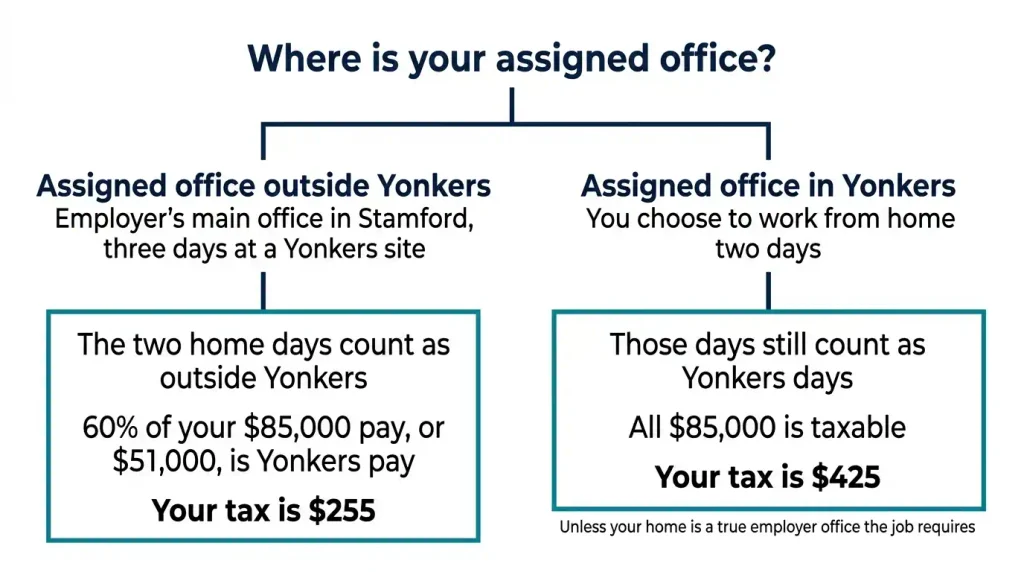
It depends on your assigned office. Say your employer’s main office is in Stamford and your job requires three days at a Yonkers site. The two home days count as outside Yonkers, so 60% of your $85,000 pay, or $51,000, is Yonkers pay, and your tax is $255. If your assigned office is in Yonkers and you simply choose to work from home two days, those days still count as Yonkers days. Then all $85,000 is taxable, and your tax is $425.
You Live Outside Yonkers but Work Entirely From Home
Your assigned office decides. If it is outside Yonkers, your home days stay outside days, even if your employer has a Yonkers branch. If it is in Yonkers, the home office rule above makes those home days Yonkers days. Say your assigned office is in Stamford and you visit a Yonkers site 20 days out of 250. Only 8% of your $100,000 pay, or $8,000, ties to Yonkers. The $3,000 exclusion leaves $5,000 taxable, so your tax is $25. Because 20 days is more than 14, your employer cannot use the 14-day no-withholding rule.
You Work for Two Employers With Yonkers Locations
Each employer withholds on its own, and you add them together on your return. Say you earned $40,000 at one job and $35,000 at the other, all in Yonkers. Your combined Yonkers earnings are $75,000, and your tax is $375. Keep both W-2s, because you need the Yonkers withholding from each.
You Are Self-Employed and Serve Clients in Yonkers
Where your business operates is what counts, using the Schedule C average described under You Are Self-Employed. Say your net earnings are $90,000 and that average is a hypothetical 40% for Yonkers. Then $36,000 is Yonkers income, and your tax is $180. If your business runs both in and out of Yonkers, list every place on Schedule B. Report the result on Y-203. Not sure self-employment fits your job? Check whether you were misclassified as an independent contractor, and browse New York worker classification guides.
What to Do If Yonkers Tax Was Underwithheld or Overwithheld
Your return settles it. Figure the true tax on Form Y-203, compare it to what was withheld and paid, and the gap is what you owe or get back.
If Too Much Yonkers Tax Was Withheld
Enter your total Yonkers withholding on your state return. If it exceeds your Y-203 tax, the difference is a refund, but you must file Form IT-201 or IT-203 to claim it. Keep your W-2s and workday records to support the numbers.
If Too Little Yonkers Tax Was Withheld
You pay the difference when you file. You may also owe estimated tax if you expect to owe at least $300 for 2026 after withholding, and your withholding will be under 90% of your 2026 tax and under 100% of your 2025 tax. The 100% test is 110% if your New York adjusted gross income was over $150,000 ($75,000 if married filing separately). Pay on the New York State Department of Taxation and Finance website or with Form IT-2105. Paying too little by the due dates can bring an estimated tax penalty plus interest.
If Your Employer Used the Wrong Workday Allocation
Compare your calendar to the percentage on your IT-2104.1. If it is wrong, give your employer a new form right away. If the year is over, ask payroll to fix the Yonkers amounts on your W-2. Either way, your Y-203 uses your real workdays.
Yonkers Nonresident Tax Filing Checklist for 2026
Gather first, check second, file last.
Before You Calculate
- Collect your W-2s, pay stubs, and employer work location details.
- Build a calendar of your Yonkers and non-Yonkers work days.
- Decide whether you are a New York State resident, which picks your state return.
Before You File
- Check that your Yonkers wages and withholding match your Form W-2, in the local wages, local income tax, and locality name boxes, where Yonkers should be named.
- Confirm you need Form Y-203, and file one for each spouse with Yonkers earnings.
- Use the right state return, IT-201 or IT-203.
Before You Pay or Claim a Refund
- Compare your final Yonkers tax to your withholding and estimated payments, then pay the gap or claim the refund on your state return.
- Pay by the state return due date, normally April 15, 2027 for tax year 2026.
- Keep your workday records in case the state asks.
- If the Internal Revenue Service (IRS) changes your income, or you amend your federal return, report it to the state within 90 days on an amended return that includes Form Y-203.
- If you repaid income you reported on an earlier Y-203, Form IT-257 may give you a refundable claim of right credit, carried to Form IT-201-ATT or Form IT-203-ATT.
Frequently Asked Questions About Yonkers Nonresident Tax
Short version: your work location decides who owes the tax.
Do I owe Yonkers tax if I live outside Yonkers but work there?
Yes, in most cases. Yonkers taxes earnings from services you perform in the city at 0.5%, even if you live elsewhere.
Does working remotely from home eliminate Yonkers nonresident tax?
Not always. If your assigned office is in Yonkers, your normal home work days still count as Yonkers days unless your home is a required employer office. Outside Yonkers, they count as outside days.
What is the Yonkers nonresident earnings tax rate?
It is 0.5% (0.005), applied to your Yonkers-allocated earnings after any exclusion. Above $30,000 in full-year Yonkers earnings, there is no exclusion.
What is Form Y-203 used for?
It figures your Yonkers nonresident earnings tax. Nonresidents with Yonkers wages or business income file it with their IT-201 or IT-203.
Do I need Form IT-2104.1 if I work partly outside Yonkers?
Yes, if you want withholding to match your real Yonkers share. Your employer withholds on the share you certify, or uses last year’s share if you give no form. It does not replace Y-203, your yearly return.
Can I get a refund if my employer withheld too much Yonkers tax?
Yes. Enter your Yonkers withholding on your state return and file Form IT-201 or IT-203 to claim the refund.
The Bottom Line: Check Your Work Location, Allocation, and Forms
Three checks fix most Yonkers tax problems: work location, allocation, and forms.
The Three Questions That Resolve Most Yonkers Tax Problems
First, do you live in Yonkers or outside it? Second, how much of your pay came from work in Yonkers, by work days or sales volume? Third, did your employer withhold the right amount, and have you handled Form Y-203 and your state return?
Your Next Step
Pull your W-2 and a calendar of where you worked this year, and compare them with your pay stub’s Yonkers line before calling payroll or starting your return. Then read the current Form Y-203 instructions (Y-203-I) and Form IT-2104.1 on the New York State Tax Department website. This guide is general information, not tax advice, as our disclaimer explains. Learn who writes these guides on our about us page, and browse more on our blog. Spot an error or have a question? Contact us.

Meet Yasin Ali, Founder
Yasin built NY Paycheck Calculator in 2020 after getting fed up with calculators that treated New York like every other state. Most tools ignore the extra local tax NYC and Yonkers workers pay on top of state tax — or skip New York’s Paid Family Leave deduction entirely.
He keeps the numbers current, checking in regularly against the latest IRS, NY Department of Taxation and Finance, and Paid Family Leave rates.
All results here are estimates based on official sources. For advice specific to your situation, talk to a tax professional.