
New York’s wage notice requirement means most private employers must give new hires written notice of their pay rate, overtime rate, and payday before work begins, with a signed copy kept on file for six years.
That six-year retention rule and every required field below come straight from New York Labor Law Section 195 and NYSDOL’s own templates.
Picking the wrong NYSDOL template for your pay structure remains a common, costly mistake.
New York Wage Notice Requirements at a Glance
| Item | Detail |
|---|---|
| Who’s covered | Nearly all private-sector employers |
| Full list of required fields | Pay rate, overtime rate, payday, employer legal name, DBA, address, phone number, and any wage allowances |
| Penalty for violation | $50 per workday, up to $5,000 (Labor Law Section 198(1-b)) |
Who Must Receive a Wage Notice?
Nearly every private-sector employer must provide this notice, no matter the size, including private nonprofits and private schools. Federal, state, and local government employers are excluded. Temporary help firms follow modified rules set by the Commissioner of Labor. Farm employers are covered too, though agricultural workers get their own dedicated notice form.
When Must Employers Provide the Notice?
The notice must go out at hiring, before work starts, under Labor Law Section 195(1), sometimes cited as NYLL § 195(1). A separate statutory damages provision references a 10-business-day window after hiring, but that’s about calculating damages, not the notice deadline. The employee signs and dates an acknowledgment, the employer keeps a copy, and the employee gets a copy too.
What Must the Notice Include?
At minimum: pay rate and basis, overtime rate if eligible, regular payday, and employer legal name, DBA, address, and phone number. These fields overlap with the broader New York paycheck basics every worker should understand. Allowances like tips or meals must be listed too. Home care aides and prevailing-wage workers need extra disclosures. The New York State Department of Labor (NYSDOL) publishes official templates for these situations. Employers can build their own notice instead, as long as it covers every field the official templates cover.
What Information Must a New York Wage Notice Include?
The notice is a snapshot of how an employee is paid, who’s paying them, and what allowances apply. Get these pieces right and you’ve covered the core of what the law requires.
Pay Rate, Pay Basis, and Overtime Rate
The notice must state the pay type: hourly, weekly salary, day rate, shift rate, piece rate, or commission. Overtime-eligible employees need their overtime rate listed too, usually time and a half under New York’s overtime laws. Employees working multiple roles at different rates need each rate spelled out separately. New York’s overtime rules work alongside the federal Fair Labor Standards Act (FLSA), and whichever standard protects the employee more is the one that applies.
Regular Payday and Employer Information
The notice must name the actual payday, set under New York’s pay frequency laws, along with the employer’s legal name and any “doing business as” name, the physical address of the main office, a separate mailing address if different, and a phone number.
Minimum-Wage Allowances and Special Compensation
Tip, meal, or lodging allowances counted toward minimum wage must be disclosed with their dollar value, since this affects whether the worker is actually being paid at least the New York minimum wage. Claiming an allowance that isn’t properly disclosed can shade into illegal paycheck deductions, so the dollar amounts need to match what actually comes off the paycheck. Home care aides get benefit disclosures through NYSDOL’s LS 62 form. Prevailing-wage workers need the applicable rate, supplement type, and provider listed.
Wage Notice Checklist
Here’s a quick way to check a notice for completeness:
- Pay rate and pay basis clearly stated
- Overtime rate listed if the employee is non-exempt
- Payday identified
- Employer’s legal name, DBA, address, and phone number present
- Any tip, meal, or lodging allowances disclosed with dollar amounts
- Home care or prevailing-wage disclosures included if applicable
A missing field on the notice is its own violation. Whether the employee was actually paid correctly is a different question entirely.
When Must Employers Provide or Update a Wage Notice?
Notice at Hiring
New employees need this notice before they start working, not after their first paycheck. Offer letters and onboarding packets often miss required fields, so check them against the statutory list. The 10-business-day reference is about how damages are calculated, not a grace period for giving notice.
Pay-Rate Changes and the Seven-Day Rule
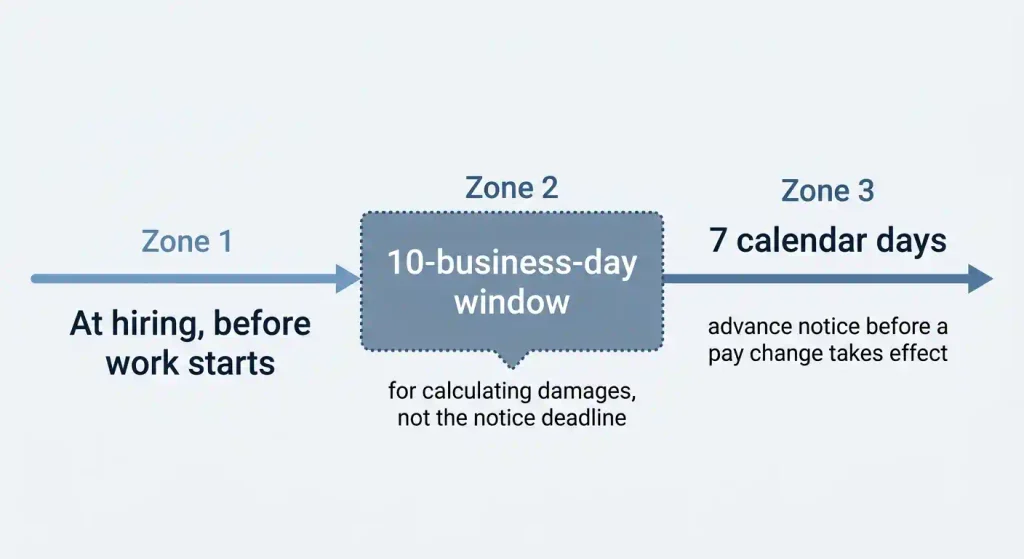
When something on the notice changes, like a raise or a new payday, employers generally must give written notice at least seven calendar days before it takes effect. If the change is already reflected accurately on the employee’s wage statement, separate notice isn’t always required. Hospitality employers often need notice for every rate change regardless.
Real-World Pay-Change Scenarios
Here’s how common pay changes play out:
- Raise: needs an updated notice or an accurate pay stub
- Pay cut: needs the same seven-day notice, and pay must stay at or above minimum wage
- Commission plan change: counts as a change to covered information, same seven-day notice applies
- Shift differential adjustment, like added pay for nights or weekends: same seven-day notice applies
- Payday change: also triggers the notice requirement
- Promotion or transfer: only triggers the rule if pay, allowances, or payday actually changes; a location change alone usually doesn’t
For complicated cases, like a hybrid pay structure, get a second opinion from an employment attorney.
Which Wage Notice Rules Apply to Different Employees?
Not every worker gets the same notice. The right template depends on how someone is actually paid.
Hourly and Multiple-Rate Employees
Hourly workers need their regular rate and overtime rate listed, with each rate shown separately if they work at more than one rate. NYSDOL’s LS 54 template covers standard hourly employees, while LS 55 is built for employees paid more than one hourly rate, like someone who earns one rate for day shifts and another for nights.
Salaried and Overtime-Exempt Employees
Being salaried doesn’t automatically mean someone is exempt from overtime; those are separate things, and the exemption itself depends on New York’s overtime salary threshold. NYSDOL has templates built around this distinction:
- LS 56: weekly rate or salary for a fixed number of hours of 40 or fewer
- LS 57: salary for varying hours, day rate, piece rate, flat rate, or other non-hourly basis
- LS 59: employees who are actually exempt from overtime
Mixing up these three forms is one of the most common paperwork errors employers make.
Tipped, Commission-Based, and Other Workers
Tipped employees need their tip credit disclosed. Commission-based, piece-rate, flat-rate, and day-rate workers each need their specific pay structure explained clearly. Home care aides and prevailing-wage workers need the extra disclosures covered earlier.
Temporary Help Firms and Other Special Cases
The Commissioner of Labor can modify or waive certain notice requirements for temporary help firms, since staffing agencies place workers across assignments and employers more often than typical businesses. Getting this classification wrong is closely related to being misclassified as an independent contractor, which carries its own separate set of problems. For less common arrangements, check NYSDOL’s current guidance instead of assuming a standard template applies.
Language, Signatures, Electronic Delivery, and Recordkeeping
Primary-Language Requirements
Employers have to give the notice in English and in the employee’s primary language, if NYSDOL has published a template in that language. New York currently offers templates in Spanish, Chinese, Korean, Haitian Creole, Polish, and Russian. If NYSDOL hasn’t created a template in an employee’s primary language, English alone satisfies the requirement.
Employee Acknowledgment and Copy
The employee has to sign and date an acknowledgment confirming they received the notice, including a line confirming they understand it in their primary language. The employee is also entitled to their own copy. Employers should keep a clear record of when the notice was delivered and signed.
Electronic Notices and Six-Year Retention
Employers have to keep wage notices and signed acknowledgments on file for six years, even after an employee leaves. Electronic delivery is allowed, but the system needs to let the employee acknowledge receipt and access a printable copy, including through payroll onboarding systems with built-in digital signature tools. Store the signed notice, proof of delivery, and any later updates, organized by employee, for the full six-year window.
Wage Notice vs. Pay Stub, Offer Letter, and Termination Notice
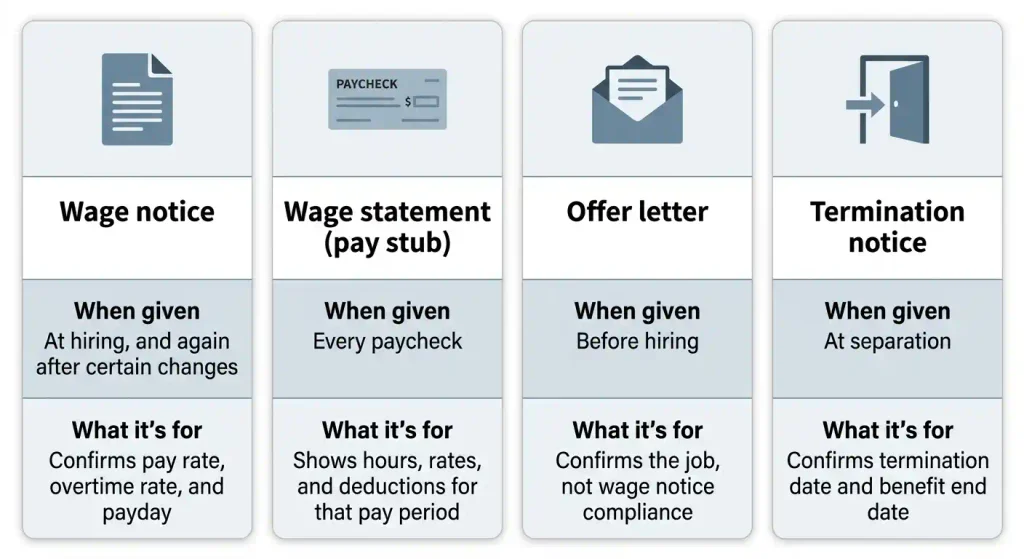
| Document | When given | What it’s for |
|---|---|---|
| Wage notice | At hiring, and again after certain changes | Confirms pay rate, overtime rate, and payday |
| Wage statement (pay stub) | Every paycheck | Shows hours, rates, and deductions for that pay period |
| Offer letter | Before hiring | Confirms the job, not wage notice compliance |
| Termination notice | At separation | Confirms termination date and benefit end date |
Wage Notice vs. Wage Statement
The wage notice is given once at hiring and again if certain details change. The wage statement, or pay stub, comes with every paycheck and shows hours worked, rates applied, and deductions for that pay period; knowing how to read a New York pay stub makes it easier to catch a mismatch. That requirement comes from New York Labor Law Section 195(3), separate from the hiring notice rule in Section 195(1). An accurate pay stub doesn’t erase a missing or incomplete hiring notice.
Wage Notice vs. Offer Letter or Employment Contract
An offer letter might mention a salary or hourly rate, but that alone rarely satisfies the statutory notice requirement, since offer letters usually skip the overtime rate, allowance disclosures, and acknowledgment language. Signing an offer letter confirms a job, not compliance with Labor Law Section 195.
Wage Notice vs. Termination Notice
New York also requires a separate written notice when someone’s employment ends, covering the exact termination date and when benefits end. This ties directly into New York’s final paycheck laws, which set their own deadline for paying out what’s owed. It’s a different document with a different deadline than the hiring wage notice.
Common Myths About New York Wage Notice Requirements
A Pay Stub Always Replaces the Hiring Notice
A pay stub shows what happened during one pay period. It doesn’t replace the original hiring notice and only partly covers later pay changes, since the wage-statement exception applies in specific situations.
Salaried Employees Never Need Wage Notices
Salary is just a pay basis, not an overtime classification. Salaried employees entitled to overtime pay still need a notice listing their overtime rate, just like hourly workers.
Signing a Notice Means the Employer Paid Correctly
An acknowledgment proves the employee received the notice, not that every paycheck since has matched it. Compare actual pay stubs against what the notice promised. If the notice, offer letter, and paycheck all show different numbers, raise it with payroll first since it’s sometimes a clerical error.
Every Missing Notice Automatically Means $5,000 in Damages
The statutory damages framework has real conditions attached, including dollar caps and timing requirements. A missing notice doesn’t automatically mean a guaranteed maximum payout; the actual amount depends on the facts.
What Happens If an Employer Fails to Provide a Wage Notice?
Missing, Late, or Incorrect Notice
If a notice never showed up, showed up late, or left out required information, document what you have: pay stubs, written pay communications, and your hire date. A missing notice is a distinct issue from a paycheck that never arrived or being underpaid, even though both sometimes happen together.
Potential Damages and Legal Remedies
Under New York Labor Law Section 198(1-b), employees who don’t receive a proper hiring notice may be entitled to statutory damages of $50 per workday the violation continues, up to a maximum of $5,000, separate from any claim for unpaid wages. A bill pending in the New York legislature, S4473/A5000, would clarify that these damages are compensatory rather than punitive, but as of now it hasn’t been signed into law and the existing $50-per-workday, $5,000 cap still applies. Most wage claims in New York, including notice violations, generally need to be filed within six years. New York’s 2026 fiscal year budget also expanded NYSDOL’s enforcement authority, letting it issue warrants to levy the assets of employers found responsible for wage theft.
How to Report a Suspected Violation
Many pay discrepancies turn out to be simple payroll errors, so it’s often worth raising the issue with HR or payroll directly first. When a direct conversation doesn’t resolve it, employees can contact the Division of Labor Standards at NYSDOL or start the NYSDOL wage complaint process by filing Form LS223. Useful evidence includes the wage notice, pay stubs, work schedules, the offer letter, and any pay-change communications.
Retaliation Concerns
New York law protects employees who raise good-faith complaints about suspected labor law violations. Retaliation can look like a sudden schedule cut, a demotion, or termination shortly after a complaint. Document dates and any change in treatment right away.
Official New York Wage Notice Resources and Compliance Checklist
Official Laws, Forms, and Guidance
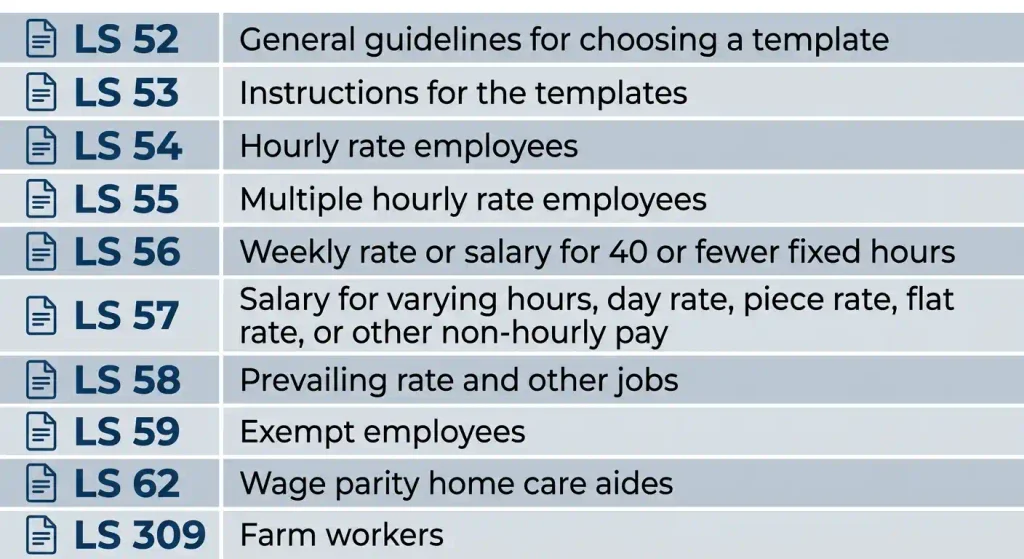
The core legal requirements live in New York Labor Law Section 195 and Section 198, both part of New York’s wage and hour laws. NYSDOL maintains official New York Notice of Pay Rate templates for each pay type, all available at dol.ny.gov as NYSDOL sample pay notices:
| Form | Covers |
|---|---|
| LS 52 | General guidelines for choosing a template |
| LS 53 | Instructions for the templates |
| LS 54 | Hourly rate employees |
| LS 55 | Multiple hourly rate employees |
| LS 56 | Weekly rate or salary for 40 or fewer fixed hours |
| LS 57 | Salary for varying hours, day rate, piece rate, flat rate, or other non-hourly pay |
| LS 58 | Prevailing rate and other jobs |
| LS 59 | Exempt employees |
| LS 62 | Wage parity home care aides |
| LS 309 | Farm workers |
NYSDOL also publishes the New York Wage Theft Prevention Act fact sheet P715. The Labor Standards complaint process, including Form LS223, is also available through NYSDOL.
Final Employee and Employer Checklists
Employees should check that their notice matches their actual pay rate (our New York paycheck calculator can help confirm the math), confirm they signed and received a copy, and flag any mismatch early. Employers should confirm the correct template, complete every required field, keep signed acknowledgments on file, and retain everything for six years. When something’s unclear, use official NYSDOL guidance or a qualified employment attorney.
Frequently Asked Questions
Is a New York wage notice required for every new employee?
Yes, for nearly all private-sector employees. Government employers are generally excluded, and temporary help firms are subject to adjusted requirements under the Commissioner of Labor’s authority.
How soon must an employer provide a wage notice?
Before the employee starts working, at the time of hire. The 10-business-day window in the statute relates to how damages are calculated, not the deadline for giving notice.
Does an employer have to provide a new notice after a raise?
Generally yes, at least seven calendar days before the change takes effect, unless the new rate is already shown on the employee’s next wage statement. Hospitality employers often face stricter rules.
Can a New York employer provide a wage notice electronically?
Yes, as long as the employee can acknowledge receipt and access a printable copy whenever needed. Employers should keep clear records of delivery and acknowledgment.
What if the wage notice is in the wrong language?
Employers must provide the notice in English and the employee’s primary language if NYSDOL has published a template for that language. If no template exists, English alone satisfies the requirement.
Can an employee sue for not receiving a wage notice?
Yes, under specific statutory conditions, employees may recover damages of up to $5,000 for notice violations, separate from any claim for unpaid wages.
Where can I find an official New York wage notice template?
NYSDOL’s Notice of Pay Rate page at dol.ny.gov hosts all current templates. Match the form to your actual pay structure rather than defaulting to whichever one is easiest to find.

Meet Yasin Ali, Founder
Yasin built NY Paycheck Calculator in 2020 after getting fed up with calculators that treated New York like every other state. Most tools ignore the extra local tax NYC and Yonkers workers pay on top of state tax — or skip New York’s Paid Family Leave deduction entirely.
He keeps the numbers current, checking in regularly against the latest IRS, NY Department of Taxation and Finance, and Paid Family Leave rates.
All results here are estimates based on official sources. For advice specific to your situation, talk to a tax professional.