
New York pay frequency laws set minimum payment schedules by job type: manual workers must be paid weekly, clerical workers at least twice monthly, and commission salespeople at least monthly, with narrow exceptions.
That split confuses most workers, since the exact 7-day deadline and authorization rules rarely appear in casual explanations.
Few employers qualify for the biweekly exception, so most manual workers get weekly pay by default.
New York Pay Frequency Laws at a Glance
The table below adds the exact deadlines and exceptions the short version above leaves out.
| Employee type | Minimum pay frequency | Main exceptions |
|---|---|---|
| Manual worker | Weekly, within 7 calendar days after the workweek ends | Nonprofit employers (at least semimonthly); employers authorized by the Commissioner of Labor |
| Clerical and other worker | Semimonthly, on regular paydays set in advance | Qualifying executive, administrative, and professional employees are excluded from this category |
| Commission salesperson | At least monthly, under a written agreement | Substantial extra or incentive pay can be paid less often if agreed |
| Railroad worker | Weekly, on or before Thursday | Railroad-specific provisions |
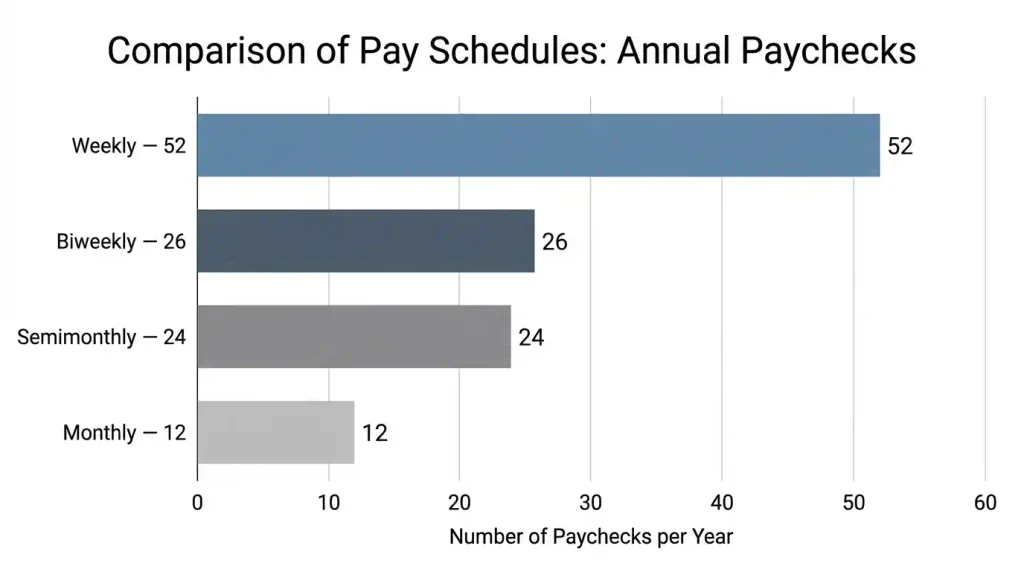
Weekly means every 7 days (52 paychecks a year). Biweekly means every other week (26 paychecks). Semimonthly means twice a month (24 paychecks). Monthly means 12. If your schedule does not match your row, look closer.
Is Biweekly Pay Legal in New York?
It depends on who you are. An office worker paid every other Friday is fine, since 26 paychecks beats the required 24. A warehouse worker paid the same way at a for-profit company is not, unless the employer has state authorization. Getting paid in full does not fix a late schedule.
Which Employees Must Be Paid Weekly, Biweekly, or Semimonthly?
Four groups have their own rules: manual workers, clerical and other workers, commission salespeople, and railroad workers. Most people fall into the first two.
Manual Workers and the Weekly Pay Requirement
Manual workers must be paid weekly, within seven calendar days after the workweek ends (weekends count). This includes construction workers, warehouse employees, cleaners, mechanics, cooks, and laborers. A Queens warehouse worker earning $17 an hour (New York City’s 2026 minimum wage) for 40 hours earns $680 that week, due within seven days. Your actual duties decide this, not your title.
Clerical and Other Workers
Clerical and other workers must be paid under their agreed terms, but at least twice a month, on regular paydays set in advance. This covers office employees, administrative support staff, and most non-manual workers. Paying on the 15th and last day of the month works, and so does every other Friday. Once a month does not.
Commission Salespeople
Commission salespersons need a written agreement explaining how commissions are figured and when they are paid, at least monthly; earned commissions are due no later than the last day of the following month. A recoverable commission draw (an advance against future commissions) should have its reconciliation spelled out in the agreement. Bonuses follow the written agreement, and substantial extra incentive pay, meaning pay above the $1,300-a-week executive, administrative, and professional threshold, can be paid less often if agreed. A rep earning a $4,000 commission in March should see it by April 30.
Railroad Workers
Railroad workers must be paid weekly, on or before Thursday, for the seven-day period ending the prior Tuesday. This is separate from the rules covering everyone else. Check Section 191’s railroad provisions directly if this applies to you.
How Does New York Define a Manual Worker?
The law uses the old phrase “mechanic, workingman, or laborer,” which the Department of Labor reads broadly. Spend more than 25% of your working time on physical labor, and you are a manual worker, whatever your title says.
Does Physical Labor Matter More Than Your Job Title?
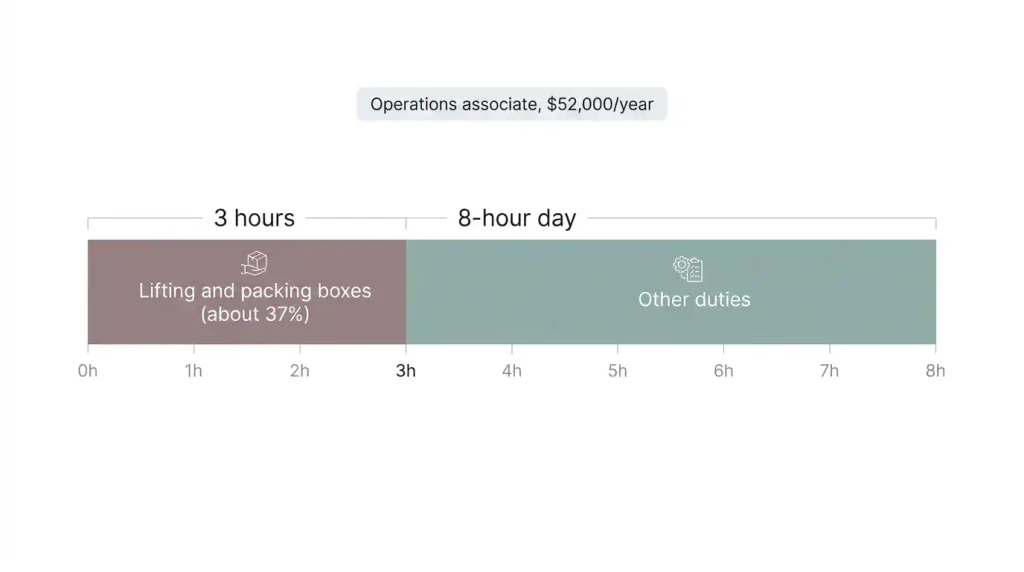
Yes. Your duties decide it, not your title, salary label, or contract. An “operations associate” earning $52,000 a year who spends 3 hours of an 8-hour day lifting and packing boxes (about 37%) is doing manual work, so weekly pay applies. Mixed jobs need a closer look at how the time actually splits.
Which Jobs Have Borderline Classifications?
Gray areas include warehouse supervisors who also load trucks, drivers and delivery workers, restaurant staff, maintenance workers, and retail employees who stock shelves. Line cooks and dishwashers are clear; even hosts and servers can get pulled in, since the state reads physical labor broadly. If your status is in doubt, log your daily tasks, hours per task, and who assigned them, and keep your written job description.
Weekly vs. Biweekly vs. Semimonthly Pay: What Is the Difference?
Weekly pay comes every 7 days, biweekly every other week, and semimonthly twice a month on fixed dates. They sound close, but the law treats them differently.
How the Three Pay Schedules Work
Manual workers need weekly pay, so neither biweekly nor semimonthly works without an exception. Clerical workers can use either, since both pay at least twice a month, but they are not interchangeable: biweekly gives 26 paychecks, semimonthly gives 24. On a $52,000 salary, that is about $2,000 per biweekly check versus $2,166.67 per semimonthly check. For your own exact numbers, run them through a free New York paycheck calculator.
Real-World Pay Schedule Examples
Two cooks earn $17 an hour for 40 hours. One, paid every Friday for the week ending the prior Sunday, is lawful. The other, at a for-profit restaurant paid every other Friday with no state authorization, is not. An office administrator paid on the 15th and last day of the month is lawful; paid only once a month, they would not be, unless the executive, administrative, or professional exclusion applies. The same every-two-weeks pattern can be fine for the administrator and wrong for the cook.
What Exceptions Allow Manual Workers to Be Paid Less Frequently?
There are two main exceptions: nonprofit employers, and employers authorized by the Commissioner of Labor. Neither one comes from an employee saying yes.
Nonprofit Employers
Manual workers at qualifying nonprofits can be paid under agreed terms, as long as it is at least semimonthly, so biweekly works but monthly does not. Nonprofit status does not excuse anything else: wages must still be paid in full, on time, and on a regular payday.
Employers Authorized to Pay Manual Workers Biweekly
An employer applies to the Commissioner of Labor using the LS138 application for authorization to pay manual workers less frequently than weekly. The review looks at the employer’s financial stability and compliance history, and a union, if one represents the workers, must consent. The Department of Labor publishes a list of authorized employers, which has included Costco, Best Buy, and GlobalFoundries. Check the list for your employer’s name and confirm it is current; it is informational only, so an authorized employer should be able to produce the Commissioner’s letter granting it.
Can a Small Business Obtain the Same Exception?
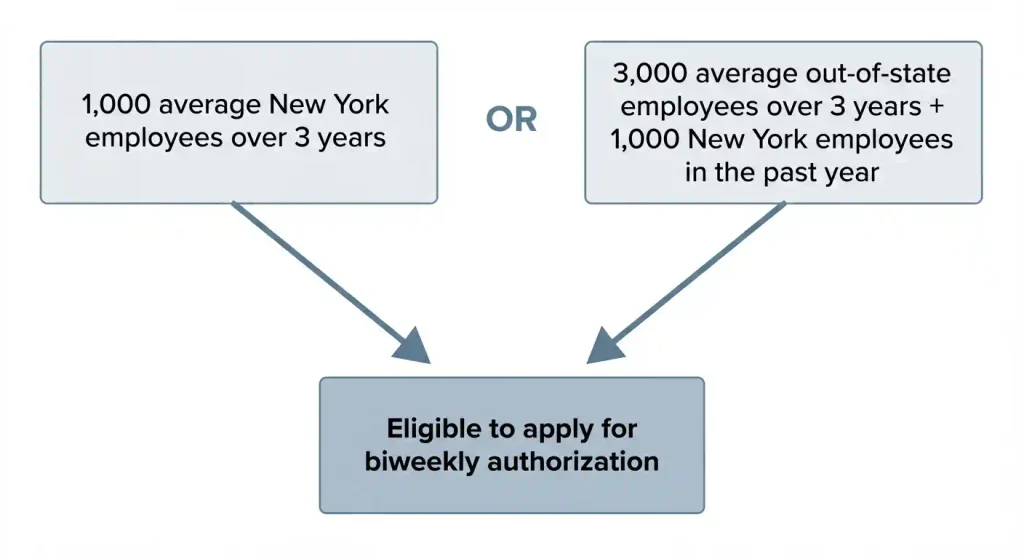
The law sets size and history requirements most small businesses cannot meet: generally an average of 1,000 New York employees over three years, or 3,000 out-of-state employees over three years plus 1,000 in New York in the past year. Being eligible to apply is not the same as being authorized, and no payroll policy or signed employee consent substitutes for it. A small business wanting biweekly pay for manual workers should pay weekly or contact the Department of Labor first.
Does Being Salaried or Overtime-Exempt Change Your Pay Frequency Rights?
Usually not. Being salaried and being overtime-exempt are separate ideas from the pay frequency rules. Only a narrow group is excluded.
Salaried Employees and Section 191
A salary is how you are paid, not a category under Section 191. A salaried warehouse lead doing more than 25% physical work is still a manual worker needing weekly pay, and overtime-exempt status alone does not remove you from the law. The real exclusion covers bona fide executive, administrative, and professional employees paid above $1,300 a week (up from $900 in March 2024); both the duties and the pay must fit, so confirm the current threshold with the Department of Labor.
Part-Time, Temporary, and Seasonal Workers
Fewer hours do not change your category: a part-time cook is still a manual worker. For temporary workers placed through a staffing agency, the agency is often the employer of record, but your actual duties still decide which rule applies. A seasonal landscaper is a manual worker and needs weekly pay.
Private-Sector Versus Government Employees
New York State Labor Law Section 191 covers private employers, including private schools, charter schools, and nonprofits. Federal, state, and local government employees fall outside it; their pay comes from other laws, civil service rules, or union contracts. If you work for a government agency, start with your contract or union.
What Happens If an Employer Pays You Late or Uses an Unlawful Schedule?
You can file a wage complaint with the New York Department of Labor. What you can recover for a pure pay frequency violation changed in 2025, and for a first offense it is now mostly interest.
When a Pay Frequency Violation Occurs
A frequency violation means you were paid too late for your category, even if you got every dollar; missing or underpaid wages are a separate problem. To judge one, you need your category, the workweek dates, your agreed payday, and the date you were actually paid, usually shown in pay stubs, timesheets, and bank deposit records.
Can Employees Recover Damages for Biweekly Pay?
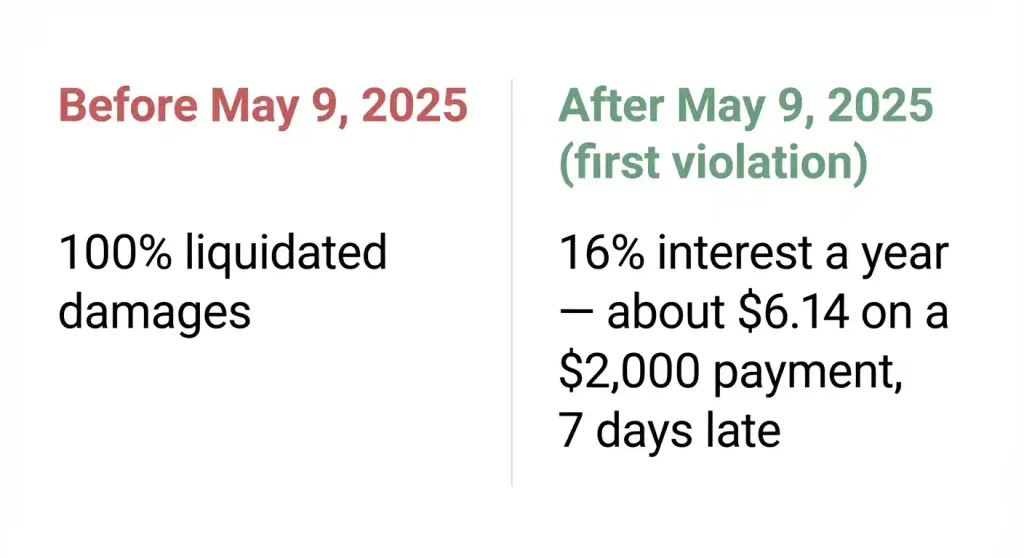
On May 9, 2025, New York changed the damages rules. Before that, manual workers could claim 100% liquidated damages even when paid in full but late: the First Department allowed such claims in Vega v. CM & Associates Construction Management (2019), the Second Department rejected them in Grant v. Global Aircraft Dispatch, Inc. (2024). Now a first violation, paid in full and at least semimonthly, is limited to lost interest at 16% a year, about $6.14 on a $2,000 payment seven days late. A repeat offender with a prior finding or order can face full liquidated damages. Whether workers have a private right of action under Section 191 at all is still unresolved (the Vega-Grant split remains open at the Court of Appeals), though a federal court upheld the amendment’s constitutionality in 2026 in Bryant v. Buffalo Exchange. The weekly pay requirement itself did not change.
What Happens When an Employer Changes Its Pay Schedule?
New York law bars employers from forcing workers to accept a pay interval the statute does not allow; moving manual workers from weekly to biweekly is a problem even with a signed form. Before changing payroll, confirm each worker’s category, check for authorization, update the written pay notice, and give at least seven calendar days’ written notice unless the change already shows on the wage statement. When in doubt, consult a qualified employment lawyer.
What Are the Rules for Regular Paydays and Final Paychecks?
Employers must pay on regular paydays set in advance. Final wages are due by the next regular payday after you leave. These are separate from your ordinary pay frequency.
When Must Wages Be Paid After Each Workweek?
For manual workers, wages are due within seven calendar days after the workweek ends. You earn wages when you work, but the payment date decides timeliness, shown on your pay stub and confirmed by your bank deposit. If the week ends Sunday, a manual worker’s pay is due by the following Sunday.
When Must Final Wages Be Paid After Resignation or Termination?
Final wages are due no later than the payday on which your next regular pay would have been due, whether you quit or were fired. If your last day is Wednesday and your next payday would have been Friday, Friday is the deadline, and your employer must mail your final wages if you ask. Earned commissions follow your commission agreement; unused vacation depends on your employer’s written policy.
What If Payday Falls on a Weekend or Holiday?
The seven-day rule for manual workers counts calendar days, so a weekend or holiday does not extend it; most employers pay the business day before instead. Before calling a payment late, check your designated payday, category, and whether the deadline has truly passed. A company habit is not the law.
Common Myths About New York Pay Frequency Laws
Four wrong ideas cause most of the confusion.
Myth: Every New York Employee Must Be Paid Weekly
No. Weekly pay is only for manual and railroad workers. Clerical and other workers need pay at least twice a month, commission salespeople at least monthly, with a few exceptions on top.
Myth: Biweekly Pay Is Always Legal If Employees Agree
No. A signed form cannot override the statute. Biweekly pay for manual workers needs state authorization or the nonprofit exception, and even nonprofits must pay at least semimonthly. A collective bargaining agreement does not override Section 191 either, though union consent is part of an employer’s authorization request.
Myth: Salaried or Overtime-Exempt Workers Are Automatically Excluded
No. Salary is a payment method, not a legal category; the exclusion is limited to qualifying executive, administrative, and professional employees above the pay threshold. Overtime exemption alone does not decide it.
Myth: Paying All Wages Eventually Eliminates Every Legal Problem
Not quite. Full payment now limits damages for a first violation, but late payment is still a violation: interest can still be owed, and a repeat offender can face full liquidated damages. It also does not make the schedule lawful going forward.
How Can You Check Whether Your Employer’s Pay Schedule Is Legal?
Four steps will tell you: pin down your category, list your paydays, compare them to the rule, and check for exceptions.
A Step-by-Step Employee Compliance Check
- Identify your employer, your real duties, and your regular payday.
- Line up your pay stubs, timesheets, workweek dates, and bank deposits.
- Compare that pattern against the rule for your category.
- If you are a manual worker paid less than weekly, check the Department of Labor’s authorization list and whether your employer is a nonprofit.
How to File a New York Pay Frequency Complaint
File the New York wage complaint Form LS223 with the New York Department of Labor Division of Labor Standards, by mail or online. Include:
- Your employer’s name and address
- Your dates worked
- Copies of pay stubs, timesheets, your wage notice, and bank records
New York law bars retaliation for filing. Late payment goes in the non-wage section; the Department does not accept sales commission claims. A confirmed violation can bring an Order to Comply from the Commissioner of Labor. For help, call 888-525-2267.
What Employers Should Audit Before Changing Payroll
- Review every worker’s classification against the pay frequency rule for that group.
- Confirm any authorization, written agreements, payroll records, and required insurance.
- Do not trust payroll software defaults; keep computerized payroll records and employee wage statements to prove when each payment went out.
- Fix schedules that do not fit, and bring in a qualified employment lawyer when classification is unclear.
Frequently Asked Questions About New York Pay Frequency Laws
Can a New York employer pay manual workers every two weeks?
Only with an exception: state authorization from the Commissioner of Labor, which generally requires an average of 1,000 or more New York employees to qualify, or nonprofit status paying at least semimonthly. Check the Department of Labor’s published list to see if your employer is authorized.
Is twice-monthly pay the same as biweekly pay?
No. Semimonthly pay lands on fixed dates and gives 24 paychecks; biweekly lands every two weeks and gives 26. Both satisfy Section 191 for clerical workers, but neither does for manual workers without an exception.
Do salaried employees have to be paid weekly in New York?
It depends on the job, not the salary: a salaried manual worker needs weekly pay, a salaried office worker needs pay at least twice a month, and only qualifying executive, administrative, and professional employees above the pay threshold are excluded.
Can an employer change from weekly to biweekly pay without permission?
Not for manual workers, who need state authorization or the nonprofit exception first. For clerical workers it is fine, since biweekly still pays at least twice a month, but the employer should give seven calendar days’ written notice, unless the change already shows on the wage statement.
Does New York pay frequency law cover part-time employees?
Yes. Part-time workers are covered, and their duties decide the category: a part-time cook is a manual worker needing weekly pay. Government employees fall outside Section 191.
Where can I report an employer for paying me late?
File Form LS223 with the New York Department of Labor. Bring pay stubs, timesheets, bank deposit records, and any wage notice so the Division of Labor Standards can see your pay dates.
Key Takeaways: Know Your Pay Frequency Rights in New York
New York ties your pay schedule to your job category: manual workers get weekly pay, clerical workers at least twice a month, commission salespeople at least monthly. Exceptions come from the state or nonprofit status, never from a signed form.
The Three Checks That Matter Most
First, work out which category fits what you actually do. Second, compare your paydays to the required interval and check for a valid exception. Third, if something is off, use official state resources: the Department of Labor’s authorization list, Form LS223, and the Division of Labor Standards.
Sources: New York Department of Labor, Frequency of Pay FAQ; New York Labor Law Sections 190, 191, and 195; Bryant v. Buffalo Exchange, Ltd., 2026 WL 1240054 (S.D.N.Y. May 6, 2026).

Meet Yasin Ali, Founder
Yasin built NY Paycheck Calculator in 2020 after getting fed up with calculators that treated New York like every other state. Most tools ignore the extra local tax NYC and Yonkers workers pay on top of state tax — or skip New York’s Paid Family Leave deduction entirely.
He keeps the numbers current, checking in regularly against the latest IRS, NY Department of Taxation and Finance, and Paid Family Leave rates.
All results here are estimates based on official sources. For advice specific to your situation, talk to a tax professional.