
New York final paycheck laws require employers to pay all earned wages by the regular payday for the pay period you worked in, whether you quit or were fired, not necessarily on your last day.
That rule comes from state labor law and Department of Labor guidance, and each figure below was checked against 2026 sources.
One catch: vacation and severance depend on your employer’s policy, so they are not guaranteed.
When Is Your Final Paycheck Due in New York in 2026?
New York Labor Law Section 191(3) sets this deadline, and it is current law in 2026. Your check can arrive days after you leave, depending on your employer’s pay schedule.
New York’s Final Paycheck Deadline
New York has no “last day” rule. Your employer may pay you on your last day but only must pay by the normal payday for that pay period. If you ask, your employer must mail the wages. Federal law adds no faster deadline.
How to Calculate Your Expected Final Paycheck Date
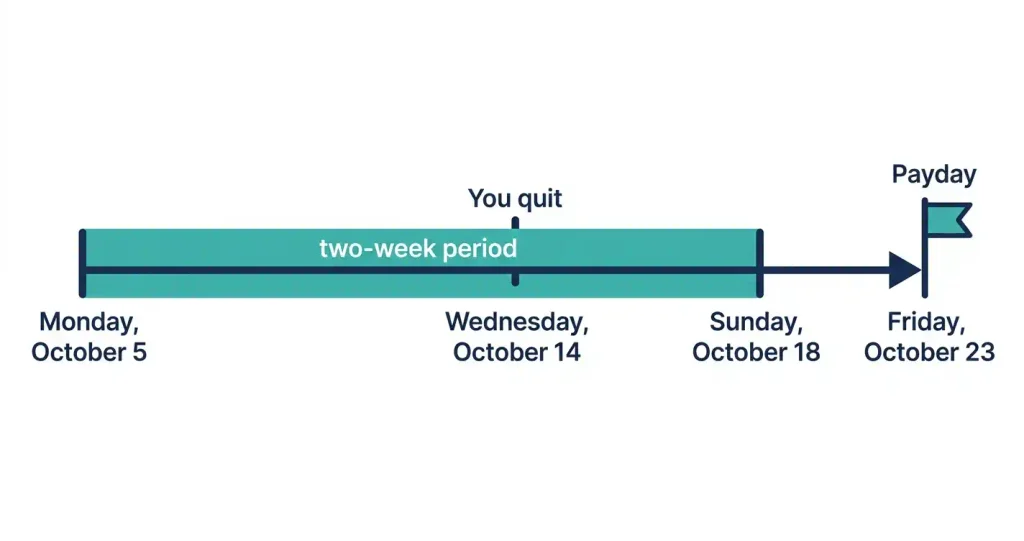
Find the pay period that includes your last day, then that period’s payday. If your company pays the Friday after each two-week period ends, a period running Monday, October 5 to Sunday, October 18 pays Friday, October 23, even if you quit Wednesday, October 14. Under New York’s pay frequency laws, manual workers must be paid weekly, and clerical and other workers at least twice a month, so the wait is usually short. If payday passes unpaid, send a written request that day, then follow the steps below.
Does the Final Paycheck Deadline Change if You Quit, Get Fired, or Are Laid Off?
No. The deadline is the same however the job ends. Only what goes into the check changes.
Final Paycheck After Resigning
Resigning gives the same deadline. Two weeks’ notice or walking out that afternoon does not move it.
Final Paycheck After Being Fired or Laid Off
Firing, with cause or without, and layoffs follow the same rule. Misconduct does not let an employer hold back earned wages. Within five working days, your employer must give you written notice of your termination date and when benefits end, under New York Labor Law Section 195, plus the Record of Employment (Form IA 12.3), which explains how to apply for unemployment insurance.
A company shutting down does not erase what it owes you, and in some cases the largest owners can be held personally liable. A proposed bill, S4611, which was still in Senate committee when this was written, would make that easier. If the employer files for bankruptcy, you generally must file a claim in that case. Under 11 U.S.C. Section 507(a)(4), wages earned in the 180 days before the filing get priority over many other debts, up to $17,150 per person.
Final Paycheck After Job Abandonment or an Unplanned Departure
Your employer cannot keep wages you already earned because you left without notice. Benefits differ. A written policy can set conditions on vacation payout, and if it says you lose payout when you quit without notice, that usually stands and the Department of Labor will not take that claim.
What Must Your Final Paycheck Include?
Everything you earned through your last day: hours, salary, overtime, and earned commissions and bonuses.
Unpaid Hours, Salary, and Overtime
Every hour you worked counts, including approved extra shifts, and salaried employees are paid through their last day. Nonexempt employees, most hourly workers, earn 1.5 times their regular rate after 40 hours in a week under New York overtime laws. At $24 an hour, 6 overtime hours pay $36 each, or $216. Compare your last stub with your own record of hours, rate, and overtime, including any paid or unpaid meal breaks. Pay must also meet the 2026 minimum wage, $17.00 in New York City, Long Island, and Westchester and $16.00 elsewhere in the state, per the New York State Department of Labor (NYSDOL).
Commissions, Bonuses, and Incentive Pay
Commissions and bonuses are wages once earned under the promised terms. Commission salespeople should have a written agreement, and earned commissions follow its schedule. A bonus whose target you hit is owed, but a truly discretionary bonus is not. Bonus plan conditions, like being employed on the payout date, can matter, so reread the plan. The Wage Payment Integrity Act (S2236A/A2222), which passed both houses in 2026, would count bonuses and other pay that is not purely discretionary as wages. When this was written it awaited the Governor, who previously vetoed a similar, broader bill, so confirm its status. Either way, bonuses you receive are taxed under New York’s supplemental wage tax rules.
Unused Vacation, PTO, and Sick Leave
New York does not require employers to offer vacation. If yours does, accrued time is generally owed at exit unless a written policy clearly says it is forfeited. The paid sick leave law, New York Labor Law Section 196-b, does not require payout of unused sick time unless your policy promises it. Full vacation rules are in the PTO section below.
Severance Pay and Other Benefits
New York law does not require severance. It is owed only if an agreement, written policy, or layoff package promises it, and then it follows that agreement’s terms, not the payday rule. Health coverage and other benefits also follow plan terms. Continuing health coverage falls under the Consolidated Omnibus Budget Reconciliation Act (COBRA), and the Employee Benefits Security Administration (EBSA) answers questions about it. Pay for missed notice under the New York State Worker Adjustment and Retraining Notification (WARN) Act, which can apply to large layoffs and closings, is a separate claim from final wages. Severance often comes with a release of claims, but earned wages are owed whether or not you sign, so employers should not tie them to a release. Severance that starts within 30 days of your last day and is large enough can delay unemployment insurance benefits, while vacation payouts do not count as severance for that purpose. A pending bill, the No Severance Ultimatums Act, would add rules for how severance offers are presented.
Can Your Employer Withhold or Deduct Money From Your Final Paycheck?
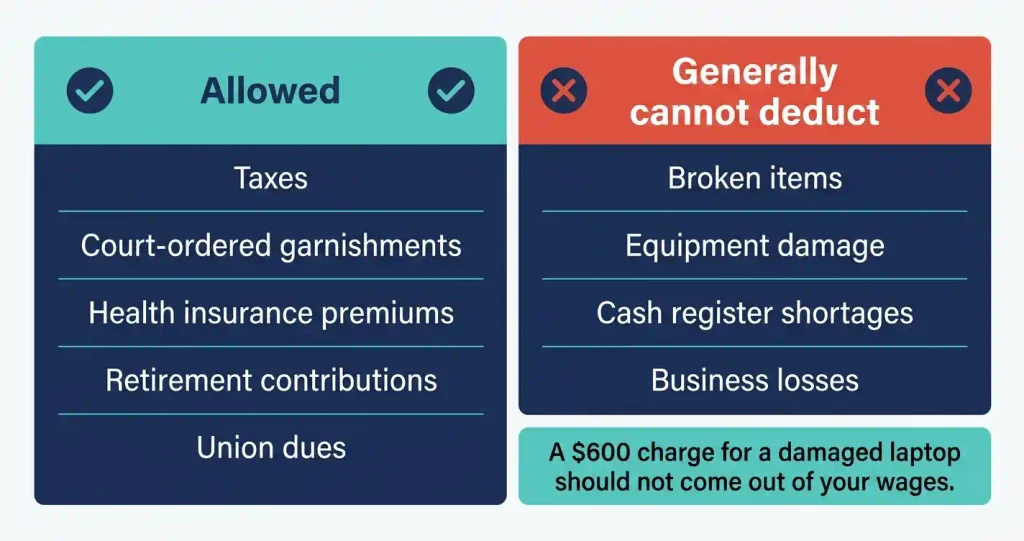
Mostly no. Employers may deduct only what the law requires or what you authorized for your benefit, and cannot hold pay over a dispute. New York Labor Law Section 193 sets these limits.
Deductions New York Employers May Legally Make
Taxes and court-ordered garnishments are allowed, like other standard paycheck deductions in New York. So are deductions you agreed to in writing that benefit you, such as health insurance premiums, retirement contributions, or union dues. If the law does not require a deduction, your employer should have your written authorization. Depending on where you live and work, taxes withheld can cover New York state tax withholding, New York City income tax, and Yonkers income tax.
Deductions That May Violate New York Law
Employers generally cannot deduct for broken items, equipment damage, cash register shortages, or business losses, or hold back pay to force something from you. Uniform charges can raise separate issues, and some employers owe extra pay when you clean your own uniform, so check your industry’s rule. New York’s Trapped at Work Act, which limits some repayment agreements for training costs, takes effect on December 19, 2026 or February 13, 2027 (sources disagree), so check your agreement if your employer wants money back.
Can an Employer Withhold Pay for Missing Equipment or Unreturned Property?
Not by deducting its value from your wages. Your employer can ask for the property back and pursue other legal routes, but pay and property are separate issues. A $600 charge for a damaged laptop should not come out of your wages. Return items with a dated receipt or photo, and ask for any claim in writing.
How to Calculate Your Final Paycheck in New York
Add up everything you earned, then subtract only lawful deductions to get from gross pay to net pay. Keep vacation and severance on separate lines, since eligibility can differ.
Final Paycheck Calculation Example
Maria earns $24 an hour as a nonexempt employee and quits midweek in her second week.
| Item | Hours | Rate | Amount |
|---|---|---|---|
| Week one, regular | 40 | $24 | $960 |
| Week one, overtime | 4 | $36 | $144 |
| Week two, regular | 20 | $24 | $480 |
| Gross wages | $1,584 | ||
| Taxes (illustrative estimate) | about $400 | ||
| Health premium she signed up for | $45 | ||
| Net pay | about $1,140 | ||
| Vacation payout, if her written policy pays it | 16 | $24 | $384 before taxes |
Withholding depends on the 2026 New York tax brackets, your W-4, and Form IT-2104, so the tax figure is only an estimate. Our New York paycheck calculator estimates your own take-home pay, and the calculation methodology explains how. Keep vacation on its own line, since it applies only if her policy pays unused hours out.
Final Paycheck Examples for Common Employment Situations
Dan quits on a Thursday mid-period. His 28 hours at $22, or $616 gross, are due on that period’s regular payday, not Thursday. Priya is fired with 6 overtime hours at $39 ($234) and 24 vacation hours at $26 ($624) that her written policy pays out. That is $858 gross on top of regular wages. The overtime is due by the regular payday, and the vacation pay is owed under her policy. Tom is laid off. His wages arrive on the regular payday, but his $4,000 severance follows the schedule in his agreement and may land on another date. Jordan’s 8 overtime hours were paid at the regular $20 an hour rate instead of $30, an $80 gap that counts as unpaid wages. Sam is owed $1,200 in earned commissions after being let go, so Sam’s route is court (see Step 3 below).
New York Vacation Pay Law in 2026: What Happens to Unused PTO?
Current law does not force employers to offer vacation or pay out every accrued hour. Your employer’s policy decides, and if it promises vacation with no written forfeiture rule, accrued time is generally owed. A bill pending in 2026 would make payout mandatory but is not law.
When Must an Employer Pay Accrued Vacation?
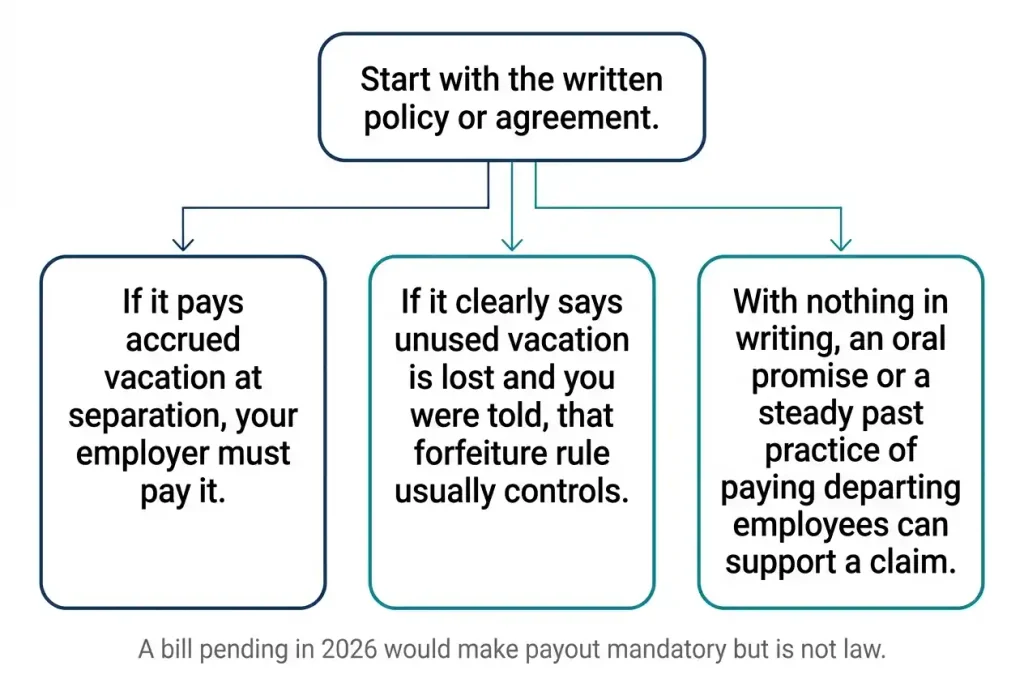
Start with the written policy or agreement. Under New York Labor Law Section 195.5, employers must tell employees their vacation policy in writing or by posting it, so ask for a copy. If it pays accrued vacation at separation, your employer must pay it. If it clearly says unused vacation is lost and you were told, that forfeiture rule usually controls. With nothing in writing, an oral promise or a steady past practice of paying departing employees can support a claim. Failing to pay a promised benefit within 30 days can be a misdemeanor under New York Labor Law Section 198-c. That section does not cover executive, administrative, or professional employees earning over $1,300 a week, who may have to go to court. NYSDOL’s own materials disagree on the threshold: its 03/25 claim information sheet (LS 223.2) lists $900, while another copy on its website lists $1,300, so confirm with the Department before filing.
New York Assembly Bill A11198: Proposed Changes to PTO Payout
A11198 would amend Labor Law Section 191 to require payment of accrued but unused vacation, paid time off, or other paid leave when a job ends, including after resignation or retirement. It would void any employment term blocking that payout, so a written forfeiture policy would no longer protect employers. It would not require employers to offer vacation. Assemblymember Eachus introduced it in the New York State Assembly on May 1, 2026, and it was referred to the Assembly Labor Committee, where it was still pending in the latest record available when this was written. It is a proposal, not law. People often search “New York State Senate Bill A11198 status,” but A11198 is an Assembly bill. Under New York’s two-year session rules, bills that do not pass by the end of 2026 expire, so check the official bill page linked below.
Special Final Paycheck Rules and Situations
The core rule covers nearly every employee: earned wages by the regular payday. Overtime, tips, commissions, and employee status are what vary.
Hourly, Salaried, Part-Time, and Temporary Employees
Every employee is owed earned wages by the deadline, whatever the schedule. Classification affects overtime eligibility, not whether you get paid. Exempt employees, usually salaried managers and professionals, do not earn overtime, and nonexempt employees do. The overtime salary threshold is one test for who counts as exempt. Temporary workers usually look to the staffing agency that issued their paychecks, and seasonal workers are covered the same way.
Restaurant Workers, Tipped Employees, and Commission Salespeople
Tips belong to you, so any tips owed, including credit card tips, belong in your final pay. Commission salespeople should have a written agreement, and earned commissions follow it. The Department of Labor will not take sales commission claims, so unpaid commissions usually mean a court claim. Keep your agreement and sales records.
Remote Workers, Independent Contractors, and Union Employees
New York wage law can cover work done in New York even for an out-of-state employer. The Department of Labor will not take claims for work done outside New York State. Tax rules differ too, so see New York tax for nonresidents and resident vs nonresident income tax rules. Genuine independent contractors, paid on a 1099 instead of a W-2, are not covered by final paycheck rules. Freelancers have separate rights under the state’s Freelance Isn’t Free Act, and someone labeled a contractor who is really an employee may be misclassified. Union members should tell their steward right away, since the contract may add pay rules and a grievance process.
Direct Deposit Failures, Lost Checks, Weekends, and Holidays
If a deposit fails or a check goes missing, tell payroll in writing the same day and ask for a replacement. The wages are still owed. A bounced check counts as unpaid wages. Direct deposit requires your consent, so if your account closed, give payroll new details or ask for a mailed check. When payday falls on a weekend or holiday, employers usually pay the business day before, so check your schedule.
Common Myths About New York Final Paycheck Laws
Most myths come from other states’ rules. Here is what holds in New York.
Myth: Your Final Paycheck Must Arrive on Your Last Day
Not in New York. The deadline is the regular payday for the pay period you left in. Some other states require same-day pay.
Myth: Employers Must Always Pay Unused Vacation
No. A clear written policy that removes unused vacation when you leave usually controls. Without one, accrued vacation is generally owed.
Myth: Employers Can Withhold Wages Until Company Property Is Returned
No. Wages and property are separate. Your employer can ask for items back but cannot hold your pay until it gets them.
Myth: You Lose Your Final Paycheck if You Quit Without Notice
No. Earned wages are owed however you leave. Only policy-based extras, like vacation payout, can be affected.
Myth: Federal Law Requires Immediate Final Payment
No. The federal Fair Labor Standards Act (FLSA) sets no final paycheck deadline. New York State Labor Law supplies the rule: the regular payday. The FLSA sets a federal floor, and New York can give workers more.
What to Do If Your Final Paycheck Is Late, Missing, or Incorrect
Check the payday and stub, gather proof, ask payroll in writing, then file with the Department of Labor if you are still unpaid.
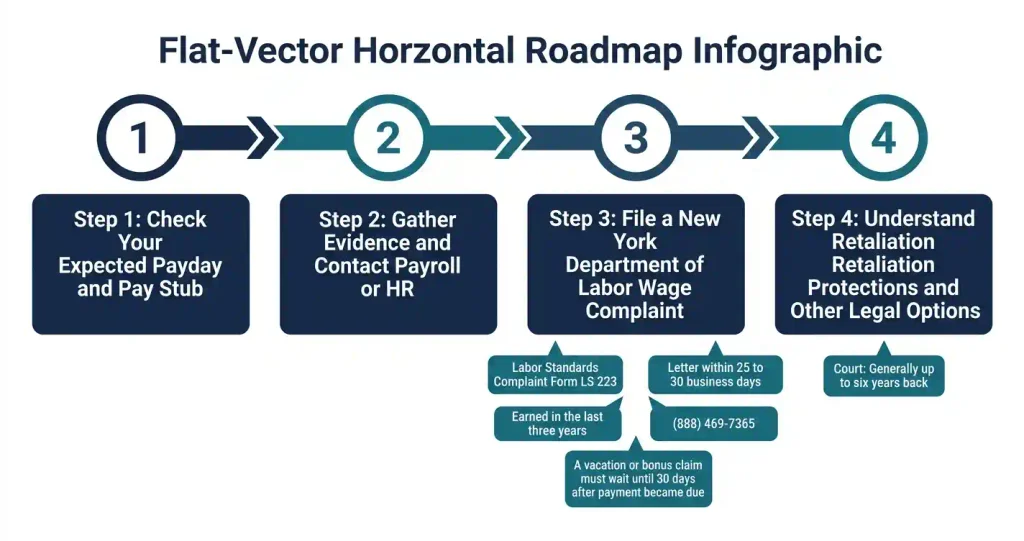
Step 1: Check Your Expected Payday and Pay Stub
Count to the regular payday for your last pay period. Then check the stub’s hours, pay rate, overtime, and deductions (here is how to read a New York pay stub), and compare the rate with your offer letter and the written pay notice from hiring. New York Labor Law Section 195 requires a wage statement with every payment of wages, including your final pay. If the total looks low, see what taxes come out of a New York paycheck and why a New York paycheck is lower.
Step 2: Gather Evidence and Contact Payroll or HR
Collect pay stubs, timesheets, schedules, your offer letter or commission plan, and texts or emails about pay. Decode unfamiliar lines with these pay stub abbreviations and codes. Email payroll or HR with your last day worked, the payday you expected, the missing items and amount, and the payment date you want. Email gives you a dated record. If you lack records, ask for copies of your wage statements and time records, since employers must keep payroll records for at least six years. Starting November 8, 2026, a new law, S3460, also gives former employees broad access to their personnel records, which may help you gather evidence, though it may not cover every payroll document.
Step 3: File a New York Department of Labor Wage Complaint
File the Labor Standards Complaint Form LS 223 with the Division of Labor Standards at the New York State Department of Labor (NYSDOL), after reading the Instructions About Filing Form LS 223.2 (titled “Information About Filing a Claim”). It covers unpaid wages, illegal deductions, overtime, and promised wage supplements like vacation pay. Send copies of supporting papers, never originals.
The Department does not accept every claim. These do not fit:
- Public work claims (use form PW-4)
- Farm worker claims (use LS 710)
- Sales commission claims
- Wages earned more than three years ago
- Claims already filed in court
- Claims covered by a union grievance and arbitration process
- Claims from high-earning executive, administrative, and professional employees
- Wages owed by a government agency, town, county, or city
For those, an employment attorney or a court, including small claims court, may be your route. A vacation or bonus claim must wait until 30 days after payment became due. For form questions, call (888) 469-7365. Expect a letter with your case number within 25 to 30 business days. The investigation takes longer, depending on the case.
Step 4: Understand Retaliation Protections and Other Legal Options
New York Labor Law Section 215 bars retaliation against workers who complain about wage violations. You can file with the Department or sue. Under New York Labor Law Section 198, a court can award unpaid wages, liquidated damages equal to 100% unless the employer proves a good-faith basis, interest, and attorney’s fees.
| Department of Labor | Court | |
|---|---|---|
| Wages covered | Earned in the last three years | Generally up to six years back |
| Sales commission claims | Not accepted | Usual route |
| Criminal referral | Possible, to a district attorney | Not part of a civil suit |
That referral is how wage theft in New York can become a criminal case. Results and timelines vary, so consult an employment lawyer for large amounts.
Frequently Asked Questions About New York Final Paycheck Laws
Short answers to the most common follow-up questions.
How long does an employer have to pay you after termination in New York?
By the regular payday for the pay period in which you were terminated, the same as for quitting. It is not a same-day rule.
Can an employer delay your final paycheck if you quit without notice?
No. Earned wages are due on the same payday. Only policy-dependent benefits, like vacation payout, can be affected.
Does New York require employers to pay unused PTO when you leave?
Not by a flat rule. Your employer’s policy decides, and promised vacation is generally owed unless a written policy says it is forfeited. Bill A11198 would change this but is not law.
Can my employer deduct money for damaged equipment from my last paycheck?
Generally no. Deductions must be required by law or authorized by you for your benefit.
What should I do if my final paycheck is late in New York?
Email payroll with the amount you think is owed. If still unpaid, file Form LS 223 with the Department of Labor.
Can I file a wage complaint if my former employer refuses to pay me?
Yes, for most claims on wages earned in the last three years. Commission and public work claims go through court or other forms, and a court claim can generally reach back six years.
Do New York final paycheck laws apply to part-time employees?
Yes. Part-time and temporary employees have the same wage protections as full-time workers.
Is severance pay required when an employer lays me off?
No, unless an agreement, policy, or contract promises it, in which case your employer must pay it under those terms.
Official New York Final Paycheck Laws and Resources
Use these official sources to confirm a rule or file a claim. For more guides, browse New York wages and wage laws.
New York State Department of Labor
The NYSDOL unpaid and withheld wages guidance covers unpaid wages and wage supplements claims, and the Department hosts the Labor Standards Complaint Form LS 223 with filing instructions. For quick answers, see the NYSDOL Wages and Hours Frequently Asked Questions.
New York Labor Law and Federal Wage Guidance
Read Labor Law Section 191 for payment timing and Section 198-c for benefits and wage supplements. The U.S. Department of Labor (DOL) publishes U.S. Department of Labor Last Paycheck guidance through its Wage and Hour Division.
2026 Legislative Updates
Track the official Assembly record for A11198. The New York State Senate legislation database also has bills and law text. A bill is only a proposal until both houses pass it and the governor signs it.
Final Paycheck Checklist: What to Do Before and After Payday
Confirm your payday, check every earned dollar, save records, and escalate: payroll first, then the Department of Labor.
Confirm Your Payment and Protect Your Rights
Before payday, work out your due date and expected amount, including overtime and any vacation your policy pays. After payday, compare the stub to your records. If it is short, save the stub and timesheets, email payroll the exact amount, and file a Department of Labor complaint if it stays unpaid. Before concluding your employer broke the law, confirm you were an employee, which pay period your last day fell in, what your written policy says, and whether the missing money is wages or a policy-based benefit. For more guides, browse New York paycheck basics. This is general information, not legal advice.

Meet Yasin Ali, Founder
Yasin built NY Paycheck Calculator in 2020 after getting fed up with calculators that treated New York like every other state. Most tools ignore the extra local tax NYC and Yonkers workers pay on top of state tax — or skip New York’s Paid Family Leave deduction entirely.
He keeps the numbers current, checking in regularly against the latest IRS, NY Department of Taxation and Finance, and Paid Family Leave rates.
All results here are estimates based on official sources. For advice specific to your situation, talk to a tax professional.