
New York wage statement requirements mean every employer must give employees a paycheck stub listing pay, hours, and deductions with each payment. Missing one required detail counts as a violation, regardless of region or industry.
That obligation comes from New York Labor Law Section 195(3), which lists nine required fields plus extra rules for tipped pay, part of New York’s broader wage laws.
Exact rules vary by industry, so confirm which wage order applies before relying on this alone.
What Are New York Wage Statement Requirements in 2026?
This applies whether you pay weekly, biweekly, or on another schedule, and it covers every paycheck, not just the first one. The required fields don’t change from payment to payment, even when nothing else does.
Who Must Provide a Wage Statement?
Private employers must give a wage statement under Section 195(3), regardless of payment method. Government employers are largely exempt, and temporary help firms have modified rules. Staffing agencies, not client businesses, cover temporary workers. Independent contractors aren’t covered, though being misclassified as an independent contractor doesn’t settle the question on its own.
Why New York Pay Stub Requirements Matter
A wage statement lets employees verify their hours, rate, and deductions against their pay. For employers, it’s the paper trail in any wage dispute. Skipping fields or guessing numbers creates risk for both sides.
What Information Must a New York Pay Stub Include?
Under Section 195(3), a compliant pay stub needs nine items:
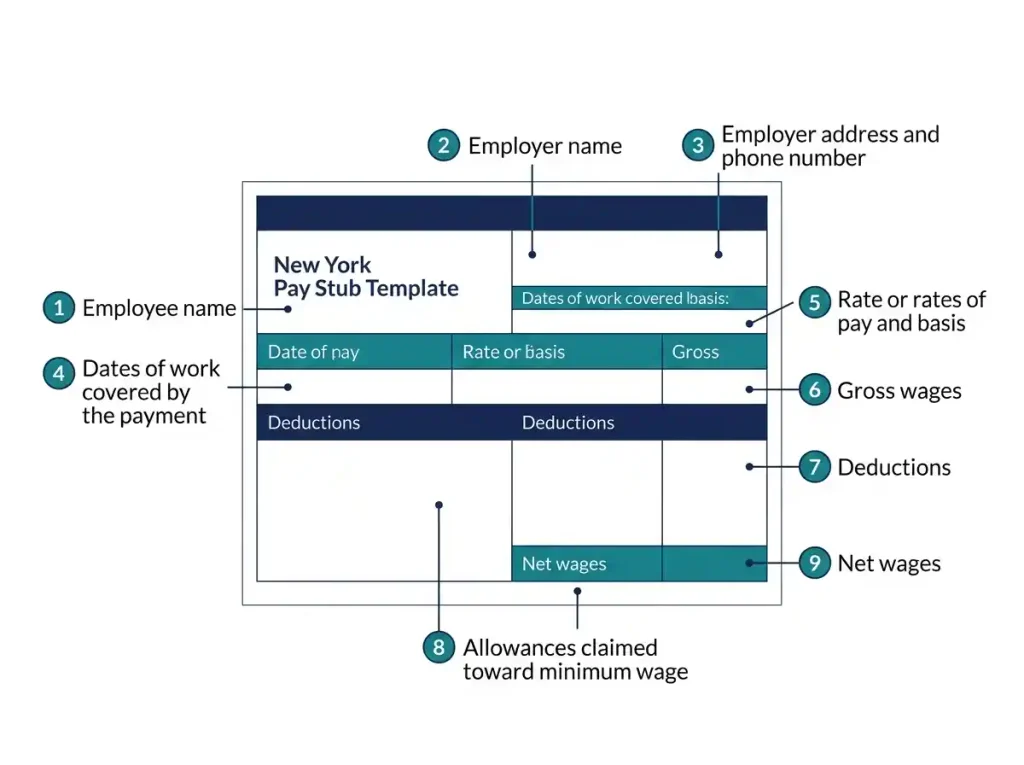
- Employee name
- Employer name
- Employer address and phone number
- Dates of work covered by the payment
- Rate or rates of pay and basis
- Gross wages
- Deductions
- Allowances claimed toward minimum wage
- Net wages
Some employees need extra fields.
Required Information on Every Applicable Wage Statement
The pay period’s start and end dates are what the statute requires, not a separate line for the actual payment date, though most payroll systems show both. “Basis of pay” can mean hourly, salary, shift, day, week, piece, or commission, and the statement must name which one applies. Not every field in the list above applies to every worker; which ones show up depends on how that person is paid, a foundational part of New York paycheck basics.
Regular Pay Rates, Overtime Rates, and Hours Worked
Non-exempt employees’ statements must show the regular hourly rate, overtime rate, regular hours, and overtime hours. New York overtime is 1.5 times the regular rate after 40 hours a week. Multiple pay rates in one period must be broken out separately, not blended. Piece-rate workers need the rate per piece and number of pieces completed.
Minimum-Wage Allowances and Special Compensation
Allowances like a tip credit or meal and lodging credit must appear clearly, not folded into gross wages. The same applies to home care aide benefits under the Public Health Law and prevailing wage supplements under Article 8. Either must show the type and dollar value, or point to where that’s available. Hiding these details makes a statement non-compliant even if the totals are correct.
New York Pay Stub Example: How to Check Each Field
The New York State Department of Labor publishes a sample form, LS49, showing exactly how a compliant statement looks for a basic hourly employee. For a line-by-line walkthrough, see our guide on how to read a New York pay stub.
Sample Wage Statement With Illustrative Figures
Picture an hourly worker in Albany paid $16.00 an hour from January 1, 2026, the new upstate minimum wage. She works 38 regular hours and 4 overtime hours in a week. Her statement also shows itemized deductions and the resulting net wages.
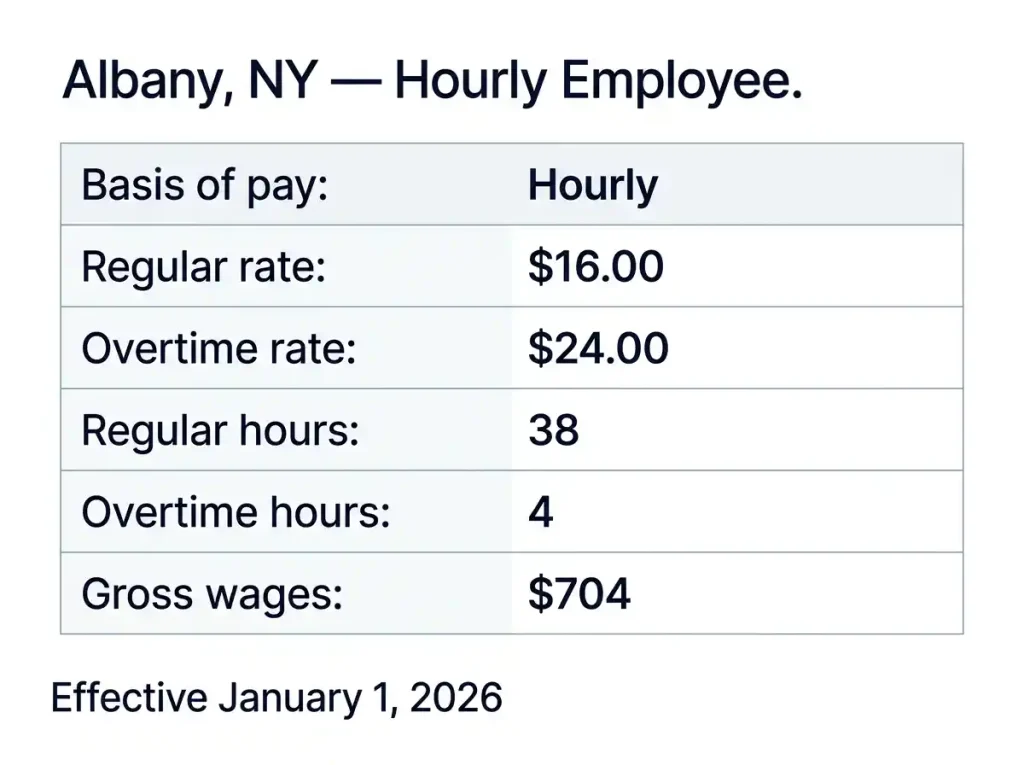
| Field | Value |
|---|---|
| Basis of pay | Hourly |
| Regular rate | $16.00 |
| Overtime rate | $24.00 |
| Regular hours | 38 |
| Overtime hours | 4 |
| Gross wages | $704 (38 x $16 plus 4 x $24) |
These figures are illustrative only, not an official rate for a specific job. A salaried employee’s statement uses a flat rate with no overtime fields if exempt. A tipped worker’s statement adds a tip credit line. A piece-rate worker’s statement shows piece rate and units completed instead of hours. To check your own numbers against examples like these, a New York paycheck calculator can help confirm your gross and net pay.
How to Verify Gross Pay, Deductions, and Net Pay
Regular hours times the regular rate, plus overtime hours times the overtime rate, equals gross wages. Deductions should be itemized: federal income tax withholding, New York State income tax withholding, New York City income tax withholding if applicable, FICA deductions, disability insurance deductions, Paid Family Leave deductions, and wage garnishment deductions, since New York Labor Law Section 193 only allows deductions authorized by law or written employee consent. Subtract deductions from gross wages to get net wages. If it doesn’t reconcile, something’s wrong.
Common Pay Stub Errors and What They Mean
Common mistakes: missing employer information, missing pay period dates, blended or missing overtime rates, and deductions that don’t add up to net pay. A missing field violates Section 195(3) on its own, even if pay itself was correct. Underpayment is a separate, often more serious issue. Both can happen together but aren’t the same thing. If the codes or abbreviations on your own statement are confusing, our pay stub abbreviations guide breaks each one down.
New York Pay Stub Requirements by Employee Type
The core nine items apply to everyone, but some employee types need extra fields based on how they’re paid.
Hourly and Overtime-Eligible Employees
Hourly, non-exempt workers need regular rate, overtime rate, regular hours, and overtime hours spelled out. This is the easiest statement to self-check: multiply hours by rate and compare.
Salaried and Exempt Employees
Salaried or exempt status doesn’t exempt anyone from getting a wage statement every pay period, only from needing overtime fields if properly classified against the New York overtime salary threshold. Misclassification is a separate legal issue worth checking.
Tipped Employees and Restaurant Workers
Hospitality statements must show any tip credit or allowance claimed toward minimum wage, not as optional disclosure. The hospitality wage order limits how much tip credit an employer can claim, and the stub must reflect what’s actually claimed.
Piece-Rate, Home Care, and Prevailing-Wage Employees
Piece-rate workers need rate per unit and units completed. Home care aides need their Public Health Law benefit portion identified. Prevailing-wage construction workers under Article 8 need supplements identified by type. These categories need more detail because flat hourly math doesn’t capture their pay.
Wage Statements vs. Notice of Pay Rate and Payroll Records
The wage statement, new hire notice, and payroll records serve different purposes under different parts of the law.
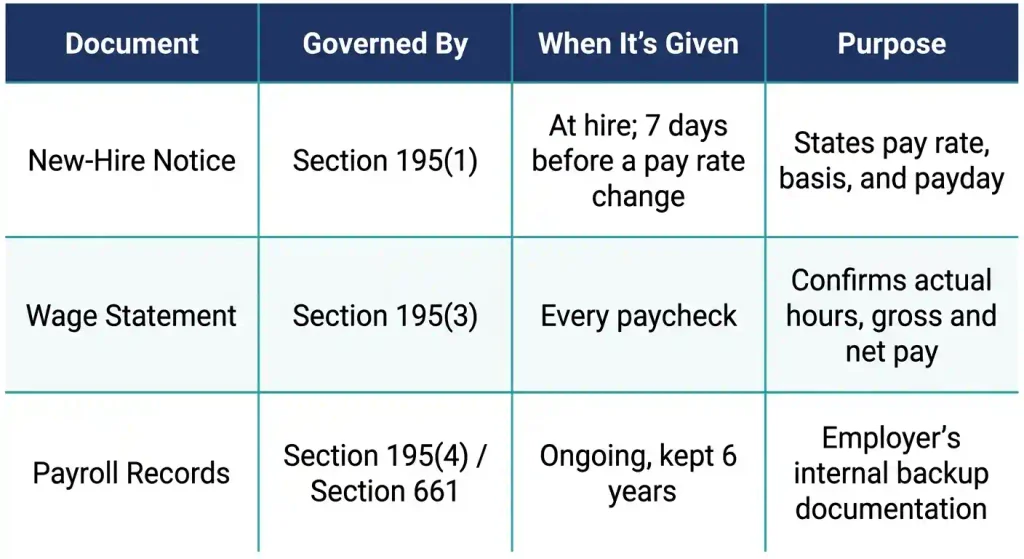
| Document | Governed By | When It’s Given | Purpose |
|---|---|---|---|
| New-Hire Notice | Section 195(1) | At hire; 7 days before a pay rate change | States pay rate, basis, and payday |
| Wage Statement | Section 195(3) | Every paycheck | Confirms actual hours, gross and net pay |
| Payroll Records | Section 195(4) / Section 661 | Ongoing, kept 6 years | Employer’s internal backup documentation |
Wage Statement vs. New-Hire Wage Notice
New York Labor Law Section 195(1), sometimes called the Notice of Pay Rate, requires written notice at hire, in English and the employee’s primary language, covering pay rate, basis, payday, and employer details. NYSDOL’s Guidelines for Written Notice of Rates of Pay and Regular Payday (LS52) spells out the requirements. Section 195(3) is the ongoing wage statement given each paycheck.
Payday frequency, weekly for manual workers and twice a month for most others, is set under New York Labor Law Section 191; a 2025 amendment narrowed liquidated damages for late weekly-pay violations there. A pay rate change needs written notice at least seven calendar days before it takes effect, unless already reflected on the wage statement, under New York Labor Law Section 195(2).
Payroll Recordkeeping Requirements
Section 195(4) requires accurate payroll records kept six years, covering hours, rates, wages, deductions, allowances, sick leave, and supplemental compensation. New York Labor Law Section 661 sets a similar duty for employees under separate wage orders. Employees or NYSDOL investigators can request this history going back the full six years.
Are Electronic Pay Stubs Legal in New York?
Yes. New York allows electronic wage statements as long as employees can access and print them.
Electronic Versus Paper Wage Statements
Paper isn’t required. An online portal works if employees can access and print their statement without hassle, even after leaving the job. New York doesn’t require advance consent to electronic pay, but access must be real, not just technically possible.
What Employers Should Check Before Using Payroll Software
Before rolling out payroll software, confirm it captures every Section 195(3) field, that employees can log in and print without IT help, and that industry-specific wage orders like hospitality tip credits are configured correctly, not left as defaults. This falls under broader New York payroll employer compliance, not just this one rule.
New York City and Industry-Specific Pay Stub Rules
New York City has no separate general pay stub format. State rules apply statewide.
Do New York City Employees Have Different Requirements?
No blanket NYC-specific wage statement law exists beyond Section 195(3). What varies is whether an occupation has its own wage order, based on the job, not the location. New York minimum wage as of January 1, 2026 is regional, but that’s a pay-rate grouping, not a separate pay stub rule:
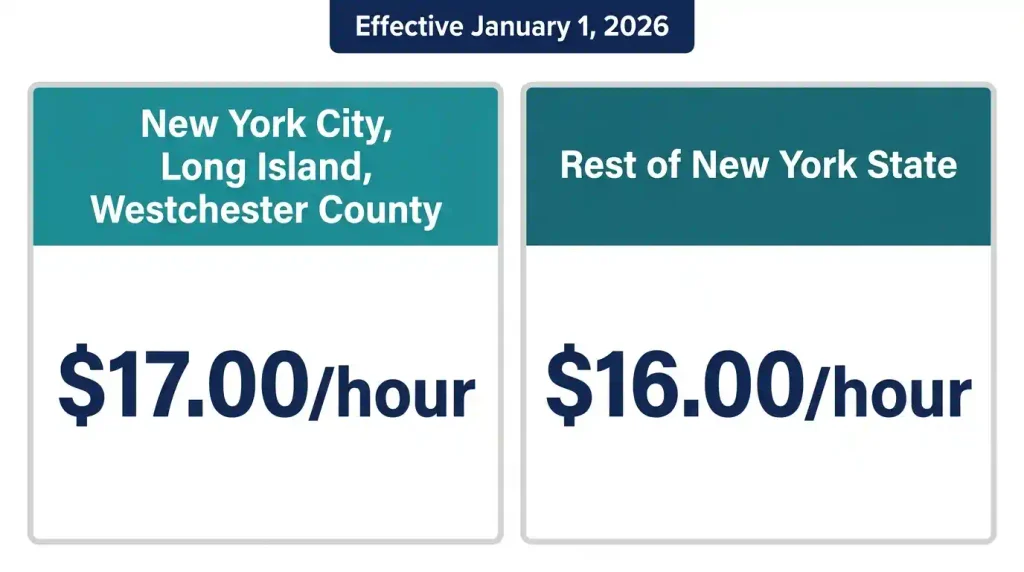
| Region | Minimum Wage (Jan 1, 2026) |
|---|---|
| New York City, Long Island, Westchester County | $17.00/hour |
| Rest of New York State | $16.00/hour |
Check the occupation, not the zip code.
Special Rules for Regulated Industries
Hospitality, agriculture, home care, and prevailing wage work each fall under a New York minimum wage order. Restaurants follow the Hospitality Industry Wage Order (12 NYCRR Part 146). Farmworkers follow the Minimum Wage Order for Farm Workers (12 NYCRR Part 190). Retail and most other jobs fall under the Miscellaneous Wage Order (12 NYCRR Part 142). Home care aides’ benefit info ties to the Public Health Law. Check the relevant NYSDOL wage order if unsure.
New York Wage Statement Penalties and Legal Consequences
Under Labor Law Section 198(1-d), an employee can recover $250 per workday that a violation continued, capped at $5,000 per employee.
Penalties for Failing to Provide a Proper Pay Stub
Section 198(1-d) sets damages at $250 per workday, capped at $5,000 per employee, through an NYSDOL administrative complaint or a private civil lawsuit, either path available without choosing one over the other. The $5,000 cap applies to this claim alone; related wage violations can carry separate damages.
Missing Information vs. Incorrect Wages
As covered earlier, a missing field is a documentation violation on its own, separate from whether pay itself was correct. Incorrect gross wages or deductions point to an underlying pay error instead. A technical error doesn’t automatically mean full statutory damages; courts look at the facts. The two issues often travel together.
What Employers Should Do After Discovering a Violation
Pull affected statements and payroll records to see how far back it goes. Fix the problem immediately, and fix the payroll template itself if that’s the root cause. Address any actual underpayment directly. Keep every record, and involve a labor attorney if the violation spans multiple employees or a long period.
What Should Employees Do About a Missing or Incorrect Pay Stub?
Start by comparing what the statement says against your own records before assuming the worst.
Steps to Take Before Filing a Complaint
Compare your own time records against the statement’s hours and pay period dates. Ask your employer for a correction or written explanation if something’s off, including a missing employer name, address, or phone number, since that’s a required field. If your paycheck is missing entirely, or the amount is wrong, the same documentation steps apply. Keep copies of everything.
How to File a New York Wage Complaint
The New York State Department of Labor Labor Standards Division, often shortened to NYSDOL, handles wage complaints. Pick the right complaint category to avoid delays. For larger or systemic issues, the New York Attorney General’s Labor Bureau is another option. Retaliation or misclassification disputes are worth an employment attorney’s input.
New York Pay Stub Myths and Common Misconceptions
A lot of bad assumptions lead employers or employees to skip something they shouldn’t.
Misconceptions Employees and Employers Should Avoid
Salaried or overtime-exempt status doesn’t exempt anyone from getting a wage statement, only from fields that don’t apply. Not every field on a sample stub is mandatory for every worker. An error doesn’t automatically entitle an employee to the full $5,000 statutory cap; that depends on the facts.
Other Frequently Misunderstood Rules
Direct deposit doesn’t eliminate the wage statement requirement. A new-hire notice under Section 195(1) isn’t a substitute for the ongoing statements under Section 195(3). Year-to-date earnings, tax totals, and leave balances are common additions, not legal requirements. A correct net pay number doesn’t prove the statement itself is compliant.
Frequently Asked Questions About New York Wage Statement Requirements
Is an employer required to provide a pay stub every payday?
Yes. Section 195(3) requires a wage statement with every wage payment, not just on request.
Can an employer provide pay stubs electronically?
Yes, as long as employees can access and print their statement without difficulty.
Must salaried and exempt employees receive pay stubs?
Yes. Exemption from overtime only affects which fields apply, not the requirement itself.
What should I do if my pay stub has incorrect hours or deductions?
Compare it to your own time records, then ask your employer for a written correction. File a complaint with the NYSDOL if that doesn’t work.
How long must New York employers keep payroll records?
Six years, under Section 195(4), covering hours, rates, wages, deductions, and allowances.
Can I sue my employer for not providing a pay stub?
Yes. Section 198(1-d) allows a private civil claim for $250 per workday, capped at $5,000 per employee, separate from an administrative complaint.
Where can I find an official New York pay stub template?
The NYSDOL publishes a sample wage statement, Form LS49, showing the required fields for a basic hourly employee.
Official New York Wage Statement Resources
Laws, Forms, and Government Guidance
New York Labor Law Section 195: https://www.nysenate.gov/legislation/laws/LAB/195
NYSDOL guidance, Wage Statement (pay stub): Required Information under Section 195.3 (LS49), also known as the Sample Wage Statement LS49, Form LS49: https://forms.labor.ny.gov/WP/LS49.pdf
NYSDOL Guidelines for Written Notice of Rates of Pay and Regular Payday, Form LS52: https://forms.labor.ny.gov/WP/LS52.pdf
NYSDOL Wage Theft Prevention Act FAQs: https://dol.ny.gov/wage-theft-prevention-act-frequently-asked-questions
Final Compliance Checklist
Confirm every required field: employer details, employee name, pay period, rate and basis, hours, gross wages, deductions, allowances, net wages. Check the math reconciles, and that employees can access and print electronic statements. Fix errors immediately, and check industry-specific wage orders for tipped, piece-rate, home care, or prevailing wage employees.

Meet Yasin Ali, Founder
Yasin built NY Paycheck Calculator in 2020 after getting fed up with calculators that treated New York like every other state. Most tools ignore the extra local tax NYC and Yonkers workers pay on top of state tax — or skip New York’s Paid Family Leave deduction entirely.
He keeps the numbers current, checking in regularly against the latest IRS, NY Department of Taxation and Finance, and Paid Family Leave rates.
All results here are estimates based on official sources. For advice specific to your situation, talk to a tax professional.