
New York part-year resident tax applies if you lived in New York for only part of the year. Form IT-203 taxes your resident-period income plus New York-source income, using income share, not months.
That income-share rule comes from the official Form IT-203 instructions (tax year 2025), cross-checked against the Tax Department’s residency definitions.
Limit: 2026 forms are not yet posted (October 2026), and remote work or equity pay can change the result.
New York Part-Year Resident Tax: The Quick Answer
The tax comes in two steps. New York figures a full-year base tax on all your income, then multiplies it by your income percentage (New York income divided by federal income).
Who Qualifies as a Part-Year Resident?
You are a part-year resident if your residency changed during the tax year, like leaving Ohio for Albany in March or Brooklyn for Florida in August. A full-year resident lived in New York all twelve months. A nonresident never lived there but may owe tax on New York income, as our guide to NYS tax for nonresidents explains. Whether you must file depends on your income and residency dates. Moving does not erase New York State income tax for the months you lived there.
Which Income Does New York Tax?
As a resident, New York taxes all your income, wherever earned. As a nonresident, it taxes only New York-source income, such as wages for work done in the state or rent from New York property. Income earned outside New York is not automatically exempt. Your move date and income type decide which rule applies. For the full list of what taxes come out of a New York paycheck, start there.
Which Tax Form Should You File?
File Form IT-203, the Nonresident and Part-Year Resident Income Tax Return. Full-year residents file Form IT-201, the Resident Income Tax Return. Use the forms for the year the income was earned: a 2026 move goes on the 2026 IT-203, filed in early 2027. The New York State Department of Taxation and Finance posts them on its part-year and nonresident forms page, with the IT-203 instructions in Form IT-203-I. As of October 2026, the newest posted instructions cover tax year 2025, so check for the 2026 versions. More help is in our New York tax forms and withholding guides.
New York Part-Year Resident vs. Full-Year Resident vs. Nonresident
Your status depends on when you lived in New York, and it decides what the state can tax.
Key Differences at a Glance
| Your situation | Status | What New York taxes | Main form |
|---|---|---|---|
| Lived in New York all year | Full-year resident | All income, from anywhere | IT-201 |
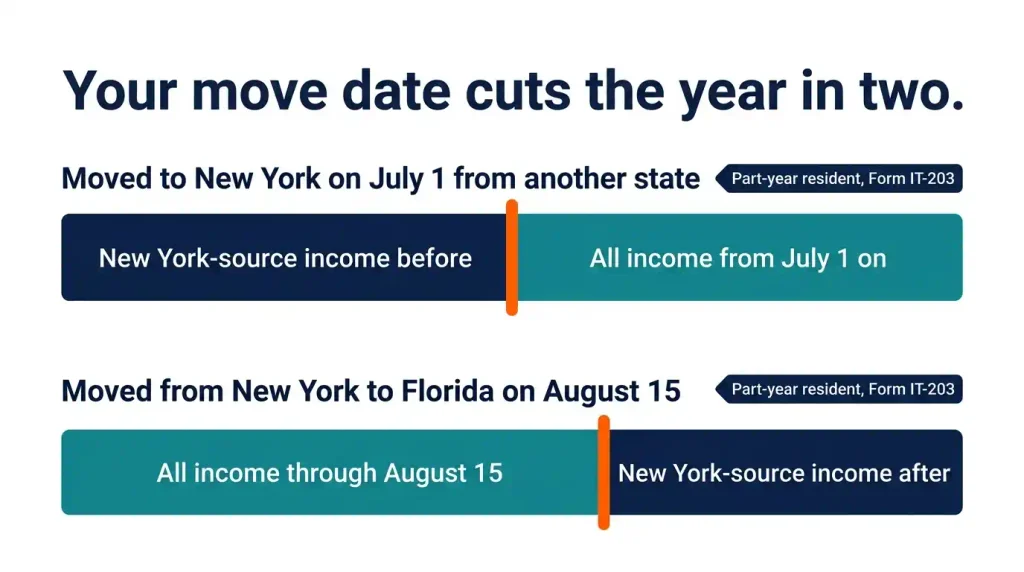
| Moved to New York on July 1 from another state | Part-year resident | All income from July 1 on, plus New York-source income before | IT-203 |
| Moved from New York to Florida on August 15 | Part-year resident | All income through August 15, plus New York-source income after | IT-203 |
| Live in New Jersey, work in Manhattan all year | Nonresident | New York-source income only | IT-203 |
| Moved from Brooklyn to Buffalo | Full-year state resident, part-year city resident | All income for the state; city tax only for the months in the city | IT-201 plus IT-360.1 |
State, city, and Yonkers residency can change on different dates, so check each separately.
How New York Determines Your Residency Status
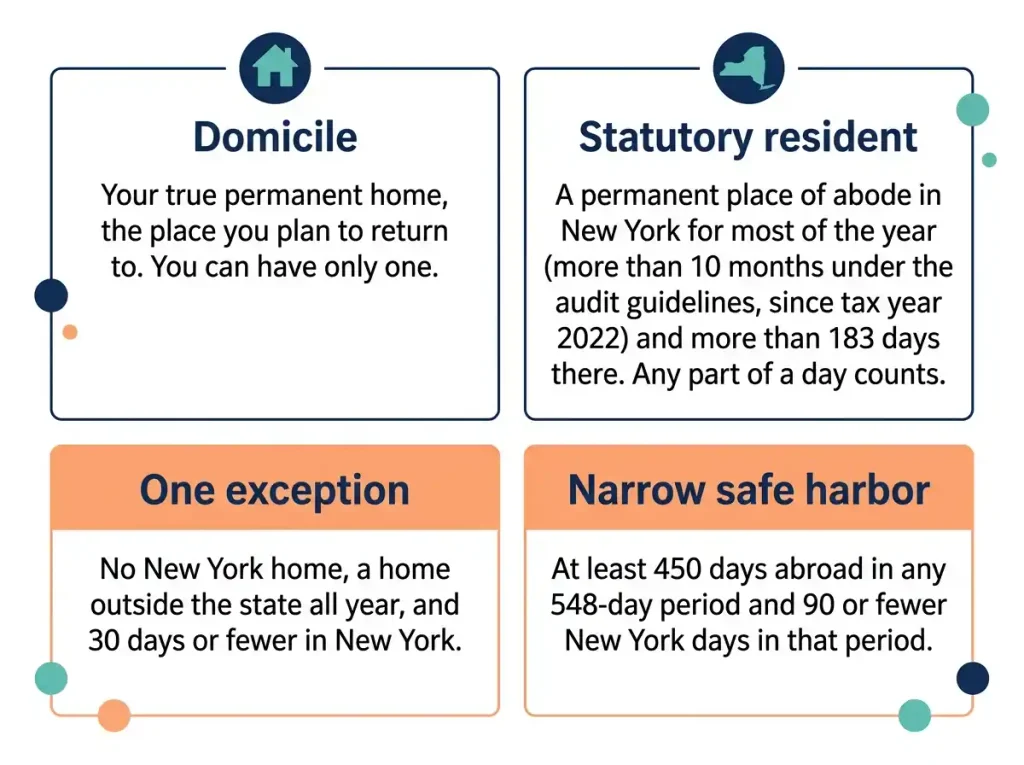
Two tests apply. Domicile is your true permanent home, the place you plan to return to, and you can have only one. You are a statutory resident if you keep a permanent place of abode in New York for most of the year (more than 10 months under the audit guidelines, since tax year 2022) and spend more than 183 days there. Any part of a day counts. A New York permanent place of abode is a home you permanently maintain, owned or not, suitable for year-round use. A spouse’s home usually counts. A vacation-only cabin or lodging for a temporary work assignment does not. Fewer than 183 days does not make you a nonresident if New York is still your domicile, since domicile follows your intent and ties, not a day count. A new mailing address or move date alone does not settle it. Auditors weigh where your home is, where you spent your days, where you work, where your family lives, and where your most valued belongings sit, as described in the New York nonresident audit guidelines. For the full test, see our New York resident vs nonresident income tax rules.
How Moving Into or Out of New York Changes Your Taxes
Your move date cuts the year in two. On one side New York taxes everything you earn. On the other it taxes only New York-source income.
Moving Into New York During the Tax Year
From the day you become a resident, all your income is taxable, even from an out-of-state job. Before that, only New York-source income counts, so pay from a New York employer before your move is still taxable. Keep proof of the move: a signed lease, closing statement, new driver’s license, and voter registration.
Moving Out of New York During the Tax Year
Everything received up to your move date is taxable. After that, only New York-source income is, such as wages for days you still work in New York and income from New York property. Keeping a New York apartment or a New York employer can keep part of your income taxable.
Choosing the Correct Residency Change Date
Your moving date and domicile change date can differ. Domicile changes when you have moved and plan to stay long term, and New York weighs your housing, job, family ties, and where your important belongings went. Keep lease or sale papers, moving receipts, a new license, voter registration, utility bills, and employer records showing your new work location.
Which Income Is Taxable Before and After Your Move?
Wages, investments, business income, and stock pay each follow their own rules.
| Income type | Resident months | Nonresident months |
|---|---|---|
| Wages | Taxable, wherever earned | Taxable only for days worked in New York |
| Bonuses and commissions | Taxable | Split by when and where the work was done |
| Interest, dividends, capital gains | Taxable | Taxable only if tied to New York property or a New York business |
| Rental income | Taxable | New York real property rent is taxable; other rent is not |
| Business income | Taxable | Taxable if it comes from a New York business |
| Stock options, RSUs, deferred pay | Taxable | Partly taxable, based on how much of the earning period you worked in New York |
| Retirement income | Generally taxable | Generally shielded |
Wages, Salaries, Bonuses, and Commissions
Regular wages are usually taxed by where and when you worked. A bonus follows when and where you did the work behind it, not its payment date. If you moved out July 1 and got a $12,000 bonus in December for the full year, part belongs to your resident months. Commissions and severance pay work the same way. A December mover paid in January can still owe New York tax on the part tied to New York work, since that is New York-source income whenever paid. If you move mid pay period, split that paycheck by workdays. Withholding on a bonus works differently, as the New York supplemental wage tax guide explains.
Employer relocation payments are generally taxable wages, counted when received. Starting in tax year 2026, New York excludes up to $25,000 of qualifying tips (enacted in the 2026-27 state budget), following the federal tips rules and limits. Keep pay stubs, Form W-2, and an employer letter explaining the bonus, and ask for a corrected W-2 if state wages look wrong.
Remote Work and New York Employers
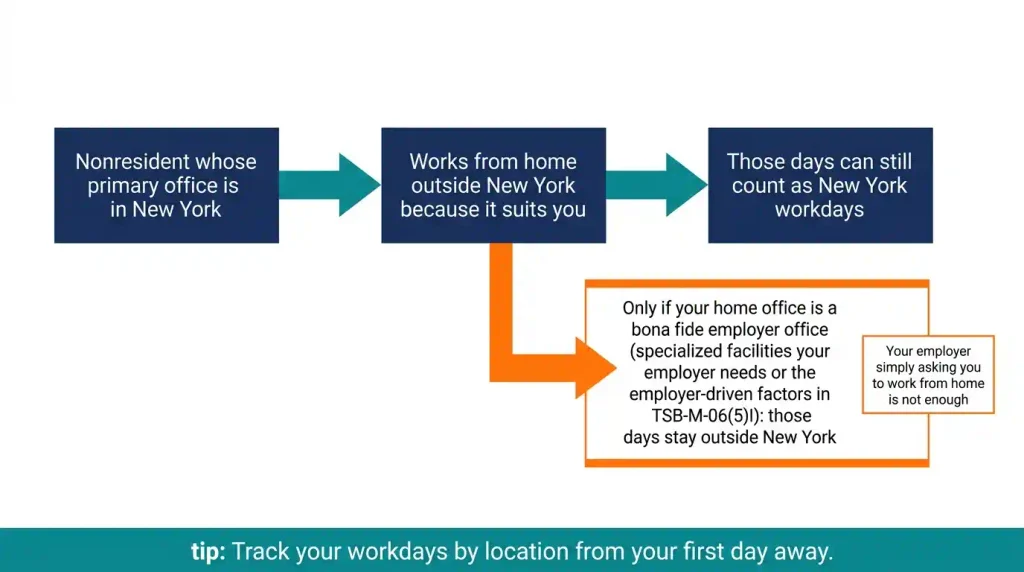
Nonresidents owe New York tax on wages for days worked in the state. Under the New York convenience-of-the-employer rule, if you are a nonresident whose primary office is in New York and you work from home outside New York because it suits you, those days can still count as New York workdays. Those days stay outside New York only if your home office is a bona fide employer office, meaning specialized facilities your employer needs or the employer-driven factors in TSB-M-06(5)I. Your employer simply asking you to work from home is not enough (see the Tax Department’s nonresident telecommuting FAQ). New Jersey and Connecticut have mirror rules, and New York’s remains in force in 2026 despite court challenges. That is why moving away does not always end New York tax on a New York job, and why your employer may keep withholding. Nonresidents report their New York work percentage to payroll on Form IT-2104.1. If you left but kept the job, track your workdays by location from day one.
Investment Income, Capital Gains, and Retirement Distributions
As a resident, interest, dividends, and capital gains are taxable. As a nonresident, investment income is taxable only if it ties to New York property or a New York business, such as selling a New York rental after you move. Nonresidents’ retirement income is generally shielded from New York tax, but lump-sum distributions and deferred pay have special rules, so use Form IT-230 for a lump sum received during your resident months. Unemployment benefits received during your resident months are taxable.
Self-Employment, Rental, and Business Income
Income from a New York business, including independent contractor income, can stay New York-source after you move. Rent from New York real property is always New York-source. Rent from a Texas property is not New York-source once you are a nonresident, though during resident months all of it counts. Split business profit between New York and elsewhere on Form IT-203-A, backed by books, invoices, and records of where work was done.
Stock Options, Restricted Stock Units, and Deferred Compensation
Pay earned over several years but paid at once, like stock options, stock appreciation rights, RSUs, and deferred bonuses, may be partly New York income, based on how much of the earning period you worked in the state. Form IT-203-F handles this multi-year allocation. With equity pay and a move in the same year, read its instructions or ask a tax pro.
How to Calculate New York Part-Year Resident Tax
Find your income, turn it into a percentage, then apply that percentage to a full-year tax bill.
Understand the Two Income Columns on Form IT-203
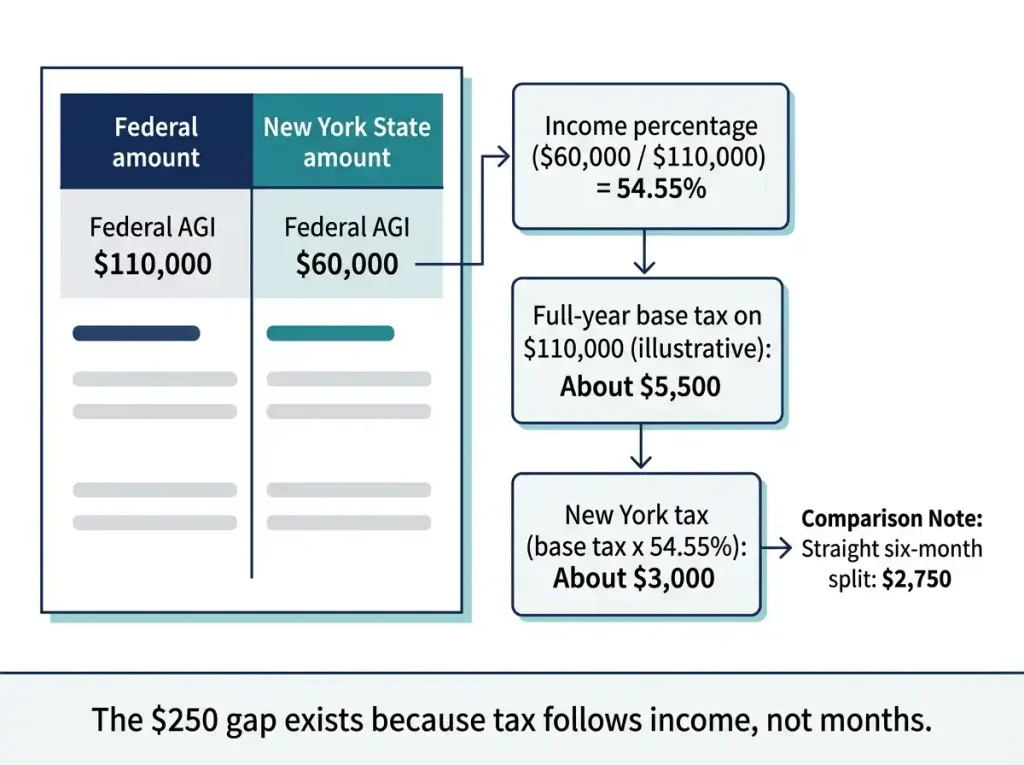
The IT-203 has two columns. The Federal amount column shows your whole-year income, starting from the federal adjusted gross income on your Form 1040. The New York State amount column shows only what New York can tax and builds your New York adjusted gross income. The first covers everything, while New York source income is only a slice of it. Divide the second by the first to get your income percentage, which drives the final tax.
Calculate Your Resident-Period and Nonresident-Period Income
Start with everything you received as a resident, then add New York-source income you received as a nonresident. Wages may be split by workdays or pay records. Business, rental, and equity income each have their own method, so handle each separately.
Understand the Final Tax, Withholding, and Refund
New York first figures a base tax as if you lived there all year on your full income. For 2026, the five lowest rates drop by 0.1 point (4% to 3.9%, 4.5% to 4.4%, 5.25% to 5.15%, 5.5% to 5.4%, and 6% to 5.9%), while the top rate stays 10.9% (see the 2026 New York tax brackets and the Tax Department’s 2026 rate notice). It then multiplies the base tax by your income percentage. The base tax uses the New York State standard deduction, or your itemized deductions from Form IT-196 if higher, and credits reduce the result.
New York withholding and estimated payments count toward the bill. If they exceed the final tax, the return claims the refund. If not, you owe the difference. To estimate take-home pay, use our New York paycheck calculator, and read gross pay vs net pay in New York for how it adds up.
How to File Form IT-203 Step by Step
Gather your papers, complete the IT-203, add any supporting forms, then check and send it.
Gather Your Tax Documents
Collect these before you start:
- W-2s and 1099s (1099 vs W-2 in New York)
- Year-end pay stubs (how to read a New York pay stub)
- Proof of your move date, like a lease or closing statement
- For business, rental, or equity income: books, workday calendars, and grant and vesting records
- The forms and instructions that match your tax year
Complete Form IT-203
Enter your filing status, move dates, and whether you lived in New York on the last day of the year. Then enter income and adjustments in both the federal and New York columns, which the form uses to find New York’s share of the tax.
Determine Which Supporting Forms You Need
Most filers need only a few of these.
| Form | Use it when |
|---|---|
| Form IT-203-B, the Nonresident and Part-Year Resident Income Allocation and College Tuition Itemized Deduction Worksheet | You need to allocate income between New York and elsewhere. Its Schedule A splits wages earned inside and outside the state, usually by workdays. |
| Form IT-203-A, the Business Allocation Schedule | You have business income |
| Form IT-203-F, the Multi-Year Allocation Form | You have multi-year pay |
| Form IT-203-ATT, Other Tax Credits and Taxes | You claim credits or owe extra taxes |
| Form IT-360.1 | You were a part-year New York City resident |
| Form Y-203 | You are a Yonkers nonresident earner |
Review, Submit, and Track Your Return
Check move dates, income split, withholding, and attached forms. The IT-203 instructions require you to e-file if your tax software allows it, and say e-filing gets a refund up to two weeks sooner than paper. A 2026 return is generally due April 15, 2027. An extension (Form IT-370) extends the time to file, not to pay, so send an estimated payment by the due date. Track refunds with the Tax Department’s online status tool.
Worked Example: Moving Into New York on July 1
A July 1 move does not mean half a year’s tax.
Allocate Income Before and After the Move
Say you lived in Ohio, then moved to Albany on July 1. Only pay earned as a New York resident counts as New York income. The base tax below is an illustration; real figures come from the tax tables. New York adjusted gross income above $107,650 also triggers a small high-income recapture, which this rounded figure allows for. Our calculation methodology shows how we estimate New York taxes.
| Item | Amount |
|---|---|
| Ohio pay, January to June | $50,000 (not New York income) |
| New York job pay, July to December | $60,000 (New York income) |
| Federal income | $110,000 |
| Income percentage ($60,000 / $110,000) | 54.55% |
| Full-year base tax on $110,000 (illustrative) | About $5,500 |
| New York tax (base tax x 54.55%) | About $3,000 |
| Straight six-month split | $2,750 |
The $250 gap exists because tax follows income, not months.
Worked Example: Moving Out of New York Midyear
The hard part is deciding which income counts as New York income.
Calculate Resident-Period and Nonresident-Period Income
Say Maya earned $50,000 in Albany from January to June. On July 1 she moved to Texas and kept working remotely for her Albany employer, earning another $50,000 by December plus a $12,000 bonus. The $50,000 from her resident months is New York income. The other $62,000 depends on the facts. If she worked from home in Texas by choice, New York may still count those days as New York workdays. They may fall outside New York only if her Texas home office is a bona fide employer office. The bonus is split by when and where the work behind it was done. Her New York income lands somewhere between $50,000 and $112,000. To estimate it, she needs her workday calendar, pay records, bonus terms, and her employer’s written reason for the remote setup.
New York City and Yonkers: Separate Local Tax Rules
City and Yonkers taxes run on their own residency clocks, so your state move date does not automatically set them.
| Tax | Who pays | Rate | Form |
|---|---|---|---|
| New York City personal income tax | City residents | About 3.1% to 3.9% | IT-360.1 if part-year |
| Yonkers resident income tax surcharge | Yonkers residents | 16.75% of New York State tax | IT-360.1 if part-year |
| Yonkers nonresident earnings tax | Nonresidents who work in Yonkers | 0.5% of wages earned there | Y-203 |
Moving Into or Out of New York City
State and city residency are separate. A part-year city resident owes the New York City personal income tax only for those months, reports the dates on the return, and adds Form IT-360.1 (see the 2025 instructions). City or Yonkers tax withheld shows on your Form W-2 and is credited against your final bill.
Pay stub lines for those taxes use short codes, decoded in New York pay stub abbreviations.
Moving Into or Out of Yonkers
Where you live and where you work both matter. Residents owe the Yonkers resident income tax surcharge, and nonresidents who work there owe the Yonkers nonresident earnings tax. The IT-203 has places for the part-year surcharge and the nonresident earnings tax (Form Y-203). If your Yonkers residency changed, also complete Form IT-360.1 to work out the part-year surcharge.
Moving Between New York Localities
A move within New York, like Brooklyn to Buffalo or Yonkers to Albany, does not end state residency, so you stay a full-year resident and file the IT-201. Local tax changes on the move date, so you owe city or Yonkers tax only for the months you lived there, reported in separate places on the return.
Special Situations That Can Change Your Filing Result
Several situations bend the normal rules.
Married Couples With Different Residency Statuses
If one spouse is a New York resident and the other is a part-year resident or nonresident, New York generally expects separate returns. You can instead file jointly by reporting all income as if you were both full-year residents, which can raise or lower your bill, so run both ways. Some couples have no choice. If you file a joint federal return and both spouses are part-year residents, both are nonresidents with New York income, or one is a part-year resident and the other a nonresident with New York income, you must file a joint New York return on Form IT-203. When only one spouse has New York source income or is the only part-year resident, only that spouse signs, and the return includes Form IT-203-C, the Nonresident or Part-Year Resident Spouse’s Certification. A marriage or divorce during the year sets your federal filing status as of December 31, and New York follows it.
Students, Military Families, and Temporary Relocations
Living in New York for school does not make you a resident, and leaving for school does not end your domicile. A temporary stay is one you plan to end, like a one-year work assignment. Service members generally keep their home state residency when stationed elsewhere, and federal law gives spouses some protection, so read the official military guidance. A temporary move abroad does not end New York domicile unless you plan to make your home overseas long term. A narrow safe harbor covers New Yorkers who spend at least 450 days abroad in any 548-day period and keep their New York days to 90 or fewer in that period.
Keeping a New York Home After Moving Away
If you keep a place available to you and spend more than 183 days in New York, the state can tax you as a full-year resident even after you changed your domicile. Every part of a day counts, so keep a day log and proof of your new home. One exception: if you keep no New York home, keep a home outside the state all year, and spend 30 days or fewer in New York, you are not a New York resident even if New York is still your domicile.
Income Received After a Residency Change
Special accrual rules can pull income you earned before your move into your resident period, even if you are paid after you leave. This often affects deferred pay and installment payments. Partnership, S corporation, and trust income may also need splitting between your resident and nonresident periods. For accrued income, moving in works the other way: income that accrued before you arrived generally stays out of your resident period unless it is New York-source. Check the instructions for any income that crosses your move date.
Income Taxed by New York and Another State
Two states can claim the same income, such as wages earned in New Jersey while you were a New York resident. New York may allow a resident credit for tax paid to the other state on Form IT-112-R, but only for income taxed during your resident period and with limits. Keep the other state’s return and proof of payment. Moves between New York and New Jersey, Connecticut, or Pennsylvania can raise this, and each state has its own residency rules, so you may need a part-year return in both.
Common New York Part-Year Resident Tax Mistakes and Myths
Four wrong ideas cause most errors on these returns.
“I Only Pay New York Tax on Income Earned While I Lived There”
Not true. After you move away, New York still taxes New York-source income. If you moved to Florida in June but still work in your Manhattan office two days a week, those workdays are New York income.
“Changing My Address Automatically Changes My Tax Residency”
A new address on your license or bank account does not change your tax residency by itself. New York looks at where you live, work, spend your days, and keep your family and belongings. Trouble starts when you update an address but keep a New York apartment, keep voting there, and spend half the year in the city. The usual gap is missing proof, like no new lease or no record of days spent elsewhere.
“I Can Divide My Annual Income by the Number of Months I Lived in New York”
That is a rough guess, not a calculation. Tax follows the type and source of income, so a $20,000 bonus, a Buffalo rental, and vesting stock all land differently, and workday or multi-year allocation can move the result far from a month count.
“My Employer Withheld New York Tax, So My Return Is Correct”
Withholding is only a down payment. Your employer may have withheld as if you were a full-year resident, or kept withholding after you left. The IT-203 sets the real bill. If your W-2 withholding does not match your residency period, ask your employer to fix it going forward, ideally with a new Form IT-2104 (the W-4 vs IT-2104 guide explains how it differs from the federal form), and sort it out on your return.
If your paycheck dropped after the move, see why your New York paycheck may be lower.
What to Do If You Filed the Wrong Return or Made an Allocation Error
Fix it with an amended return, and do it early to keep penalties and interest small.
Correcting an Incorrect Residency Classification
If you filed an IT-201 but should have filed an IT-203, or the reverse, file an amended return. Use Form IT-203-X to amend an IT-203, or to correct an IT-201 filed when you were a part-year resident or nonresident. If you filed an IT-203 but were a full-year resident, use Form IT-201-X. The official instructions for your tax year show what to attach. A refund claim generally must be filed within three years of filing (a return filed early counts as filed on the due date) or two years of payment, whichever is later. The refund is capped at tax paid in the three years (or two years) before the claim, and withholding and estimated payments count as paid on the due date.
Correcting Income, Withholding, or Supporting Schedules
Common errors include the wrong move date, a bonus allocated by payment date, missed remote-work days, and wrong withholding entries. Gather corrected W-2s, pay records, and workday logs before amending. The result may be extra tax or a refund. The late-payment penalty is generally 0.5% per month, up to 25%, and a separate late-filing penalty is 5% per month, up to 25% (reduced by the late-payment penalty for months when both apply), plus interest. Omitting New York-source income can also bring extra tax, penalties, and interest.
Frequently Asked Questions
Short answers to the most common midyear-move questions.
Do I Have to File a New York Tax Return If I Moved Midyear?
Not always. File Form IT-203 if you have New York-source income and your New York adjusted gross income exceeds the New York standard deduction (for example, $8,000 single, $16,050 married filing jointly, $11,200 head of household). You also file to claim a refund of withheld tax or certain credits, or if you owe tax on a lump-sum distribution. Check the standard deduction table for your tax year, or see the Tax Department’s who must file page.
Does New York Tax Income I Earned Before Moving Into the State?
Usually not, unless it is New York-source income, like pay for work done in New York or rent from New York property. For example, pay for work you did in Ohio before moving to New York is not New York income.
Do I Pay New York Tax on Income Earned After Moving Away?
Only if it is New York-source income, such as pay for days you worked in New York; the remote-work and bonus rules above can change that count. Pay you received as a resident, before your move date, is taxable.
How Does New York Calculate Part-Year Resident Tax?
It multiplies a full-year base tax by your income percentage (see the Quick Answer and the first worked example).
Can I Be a Part-Year Resident of New York State and New York City?
Yes, but the clocks can differ. After moving from Queens to Syracuse, you would be a full-year state resident and a part-year city resident, with city tax covering only the months in the city.
What Happens If I Keep My New York Apartment After Moving?
It can. A home kept available to you plus more than 183 days in New York can make you a full-year resident even after changing your domicile. The section on keeping a New York home above covers the day log and proof to keep.
Can I Claim a Credit for Taxes Paid to Another State?
Often yes, for income taxed by both states during your resident period. Claim it on Form IT-112-R, subject to limits that depend on the income and the other state’s tax.
Which Tax Year’s New York Forms Should I Use?
Use the forms for the year you earned the income, not the year you file (2026 income, 2026 forms, filed in 2027). The Tax Department’s forms page lists each year.
Final Checklist: Before You Submit Your New York Part-Year Resident Return
Run these last checks before you submit.
Confirm Your Residency and Income Allocation
Check each of these before you submit:
- Your move date matches your paperwork
- You reviewed resident-period income and New York-source income from before you arrived or after you left
- Wages and paycheck deductions match your W-2 and workday records
- Bonuses, equity pay, and business income follow their own rules
Confirm Forms, Credits, and Filing Details
Confirm each of these:
- You checked the IT-203 instructions for your tax year and attached every required form
- State and local tax, withholding, and credits like Form IT-112-R are verified
- You know the due date and your balance or refund, and your e-file was accepted
With equity pay, a kept New York home, or remote work for a New York employer, a tax professional is worth a call. The New York State Tax Law is posted on New York Senate Open Legislation. Its income tax rules sit in New York Tax Law Article 22, where New York Tax Law Section 631 defines New York source income for nonresidents and New York Tax Law Section 638 covers part-year residents, including special accruals. For the Tax Department’s wording, read the 2025 Instructions for Form IT-203, its income tax definitions page, and TSB-M-06(5)I on telecommuting. This guide reflects New York rules as of October 2026.

Meet Yasin Ali, Founder
Yasin built NY Paycheck Calculator in 2020 after getting fed up with calculators that treated New York like every other state. Most tools ignore the extra local tax NYC and Yonkers workers pay on top of state tax — or skip New York’s Paid Family Leave deduction entirely.
He keeps the numbers current, checking in regularly against the latest IRS, NY Department of Taxation and Finance, and Paid Family Leave rates.
All results here are estimates based on official sources. For advice specific to your situation, talk to a tax professional.