
New York payroll tax filing requirements for 2026 mean filing Form NYS-45 every quarter and paying withholding on Form NYS-1 once it reaches $700, both online. Federal payroll taxes are filed separately.
The NYS-45 and NYS-1 rules above come from official Tax Department and Department of Labor pages, checked for 2026.
One limit: payment deadlines depend on your filer type, so check which one applies to you in the filer-type table below.
What Are New York Payroll Tax Filing Requirements in 2026?
Any employer paying wages for work done in New York must register, withhold tax from pay, report wages every quarter, and pay unemployment insurance. The state allows no extensions.
Which payroll tax responsibilities must New York employers handle?
You handle three things at the state level. Withhold New York State income tax, plus New York City or Yonkers tax when residence or work location requires it. Report each employee’s wages every quarter. Pay unemployment insurance (UI) on the first $17,600 of each employee’s 2026 wages. The first two are the core New York withholding tax filing requirements. UI runs through the Department of Labor. Federally, you deal separately with the Internal Revenue Service (IRS) on Social Security, Medicare, and federal unemployment tax through Forms 941 and 940, which the state does not file for you.
Quick checklist of New York employer filing requirements
Before your first payroll, register and collect an IT-2104 and W-4 from each employee. After each payroll, track withholding against $700. Each quarter, file by the dates below. A quarter with no payroll usually still needs a return.
New York Payroll Tax Filing Deadlines for 2026
Quarterly returns are due on the last day of the month after each quarter, or the next business day if that falls on a weekend or legal holiday. Withholding payments run on a separate clock that starts when accumulated withholding reaches $700. Below are the New York 2026 tax filing dates, then the payment rules. For a standalone calendar, see our guide to New York payroll tax deadlines.
Form NYS-45 quarterly filing deadlines
| Quarter | Normal due date | 2026 due date |
|---|---|---|
| January to March | April 30 | April 30, 2026 |
| April to June | July 31 | July 31, 2026 |
| July to September | October 31 | November 2, 2026 |
| October to December | January 31 | February 1, 2027 |
October 31, 2026 is a Saturday, and January 31, 2027 is a Sunday, so those two dates move forward.
Form NYS-1 withholding tax payment deadlines
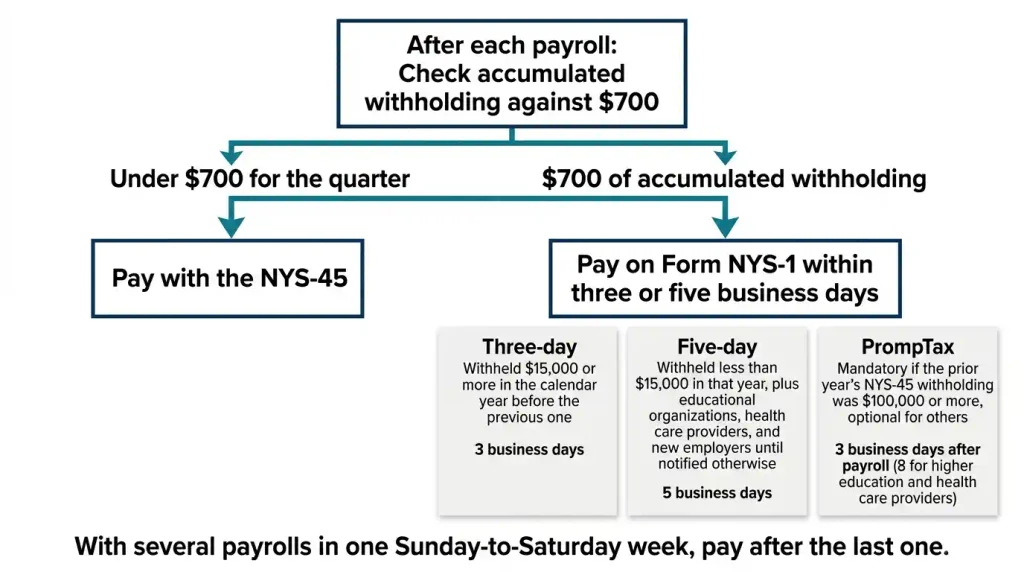
At $700 of accumulated withholding, you cannot wait for the quarterly return. Pay on Form NYS-1 within three or five business days after the payroll that pushes you over. With several payrolls in one Sunday-to-Saturday week, pay after the last one. Under $700 for the quarter, pay with the NYS-45. These New York withholding tax due dates depend on your filer type.
| Filer type | Who | Payment deadline |
|---|---|---|
| Three-day | Withheld $15,000 or more in the calendar year before the previous one | 3 business days |
| Five-day | Withheld less than $15,000 in that year, plus educational organizations, health care providers, and new employers until notified otherwise | 5 business days |
| PrompTax | The state’s electronic payment program. Mandatory if the prior year’s NYS-45 withholding was $100,000 or more, optional for others | 3 business days after payroll (8 for higher education and health care providers). Your electronic payment replaces the NYS-1, but certified-check payers still file a paper NYS-1 |
What happens when a filing deadline falls on a weekend or holiday?
When a due date falls on a weekend or legal holiday, you can file the NYS-45 on the next business day. That is why the third and fourth quarters shift this year. Payment deadlines work differently. The NYS-1 clock runs in business days from the payroll that reaches $700, so a weekend can stretch it but never stops it. No extensions are allowed for regular NYS-45 filing or payment.
Which New York Payroll Tax Forms Do Employers Need?
Three forms do most of the work: the NYS-45 for quarterly reporting, the NYS-1 for withholding payments, and the W-2 at year end. A few others support them.
Form NYS-45 for quarterly reporting
The NYS-45 is the Quarterly Combined Withholding, Wage Reporting, and Unemployment Insurance Return. It covers your withholding totals, each employee’s quarterly wages, and your UI contributions. Since March 2025, all three parts are filed together as one return. The Department of Labor uses the wage data to decide unemployment benefits, so errors can hurt your workers. You file it even with no payroll, with limited exceptions.
Form NYS-1 for withholding tax payments
The NYS-1 is a payment return, not a wage report. Its official name is Return of Tax Withheld, and the instructions are in Form NYS-1-I. Use it when accumulated withholding reaches $700. It is due within three or five business days. Payments made on it during the quarter are counted again on the NYS-45, which is how the state matches what you withheld to what you sent. If they do not agree, expect a notice.
Other forms and records employers should know
Each new employee gives you Form IT-2104, the Employee’s Withholding Allowance Certificate, which sets New York income tax withholding, alongside the federal W-4. Some employees use a variant: IT-2104-E to claim an exemption, IT-2104.1 for nonresidents, or IT-2104-SNY for START-UP NY workers. At year end, you give every employee a Form W-2. Federally, Form 941 is filed quarterly for income tax, Social Security, and Medicare, and Form 940 handles federal unemployment tax once a year.
Who Must File New York Payroll Tax Returns?
Anyone who pays wages to an employee working in New York, whatever the business type. Where your people work matters more than where your business is based.
New employers hiring their first employee
Register before your first payroll. One online filing of Form NYS-100 through New York Business Express covers unemployment insurance, withholding, and wage reporting. Collect each employee’s Social Security number, a completed IT-2104, and a W-4. You start as a five-day filer, so if withholding passes $700 in your first month, payment is due within five business days, not at quarter end.
Small businesses, LLCs, corporations, and nonprofit employers
Having employees decides whether you file, not your business structure. A one-person LLC with no staff may owe nothing. Add a part-time hire and it owes withholding and UI reporting. Corporations that pay owners as employees count too. Section 501(c)(3) nonprofits may elect to reimburse the UI Trust Fund for benefits paid instead of paying contributions. Newly liable ones can request it on Form NYS-100N or NYS-100G, and existing ones by written request to the UI Division by December 31 of the year before it takes effect. Check your account instead of assuming you are exempt. Payroll withholding is also separate from your annual New York State income tax return, sales tax, and corporate income tax, which have their own accounts.
Out-of-state employers and remote employees
An employer based anywhere, such as New Jersey or Connecticut, still has New York duties when an employee works in New York, including nonresidents who owe New York State tax on that income. Paid Family Leave coverage applies to private employers with at least one employee working in the state. For remote employees, withholding depends on where the work is physically done and where the employee lives, so the resident vs nonresident income tax rules matter. If your worker lives in New York City or Yonkers, local tax may apply even if your office is elsewhere. Sort this out before the first paycheck.
Employees versus independent contractors
Employees get withholding and NYS-45 wage reporting. True contractors do not, and you report their pay on a 1099 instead of a W-2. They pay their own self-employment tax, so you never withhold it. A signed contractor agreement does not settle it. New York looks at how the work is done, including who controls the schedule and methods. See how employees differ from independent contractors in New York. Getting it wrong, such as a worker being misclassified as an independent contractor, can mean back taxes. More guides sit under New York worker classification.
How to File New York Payroll Taxes Step by Step
Register, gather accurate payroll data, then file and pay, in that order.
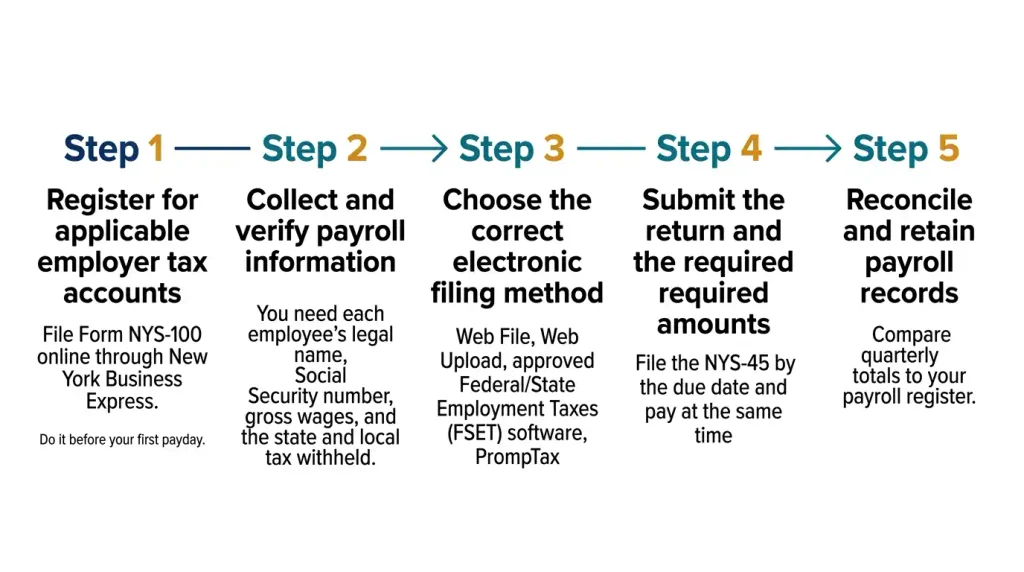
Step 1: Register for applicable employer tax accounts
File Form NYS-100 online through New York Business Express. It registers you for unemployment insurance, withholding tax, and wage reporting in one pass. Then use the Tax Department’s New York Business Online Services to manage your withholding account. Registration gives you the account numbers for every return. Do it before your first payday.
Step 2: Collect and verify payroll information
You need each employee’s legal name, Social Security number, gross wages, and the state and local tax withheld. Pull them from your payroll register. A mistyped Social Security number causes big headaches, since the state matches wage records to individual workers. Confirm each employee’s New York City or Yonkers status. Your Federal Employer Identification Number (EIN) must match on your state accounts and wage records. Wage reporting starts from gross wages subject to withholding, and bonuses, commissions, and tips count. New York has its own method for withholding on supplemental wages, so check the state tables.
Step 3: Choose the correct electronic filing method
Under the New York electronic filing mandate for business taxpayers, the NYS-45 must be filed online. Web File lets any employer with a withholding account key in the return and pay by ACH debit. Web Upload is for tax preparers and payroll providers who file for several employers, and it needs prior approval from the Tax Department. You can also use approved Federal/State Employment Taxes (FSET) software, and the PrompTax program if the state requires it for your NYS-1 payments. These are the New York withholding tax filing methods most employers use.
Step 4: Submit the return and pay the required amounts
File the NYS-45 by the due date and pay at the same time, including withholding under $700 and your UI contributions. Web File and approved software pay by ACH debit, and software makes two debits for the NYS-45, one for withholding and one for UI. ACH credit is only for PrompTax participants. Check that both amounts went out. Save the confirmation number and acceptance record, because a return that shows “submitted” but was never accepted is not filed. If a payment fails, treat it as unpaid and resubmit right away.
Step 5: Reconcile and retain payroll records
Compare quarterly totals to your payroll register. At year end, compare wages on the four NYS-45 returns to your W-2 totals. Mismatches are easy to fix now and painful to explain later. Keep confirmations, registers, and payment records together.
New York State vs. NYC vs. Yonkers Payroll Tax Requirements
Each layer has its own rules, but they travel through the same forms. Calculate each separately, then report them together. Employees see these as the taxes that come out of a New York paycheck.
| Layer | Withhold when | Key detail |
|---|---|---|
| New York State | The employee is subject to state withholding | Based on the employee’s IT-2104 and the 2026 tables |
| New York City | The employee lives in the city, wherever they work | Residence decides, not the office address |
| Yonkers | The employee lives in Yonkers, or works there as a nonresident | Residents have a local tax withheld. Nonresidents may owe a separate earnings tax |
New York State income tax withholding
Withhold New York State income tax based on the employee’s IT-2104 and the state’s 2026 withholding tables, and update payroll when an employee changes withholding. State withholding and wages appear on the NYS-45, and totals must match what you paid. New York’s top marginal rate is 10.9% on income above $25,000,000, but withholding for most workers is far lower. Supplemental wages, such as bonuses, are withheld at a flat 11.70% in 2026.
New York City income tax withholding
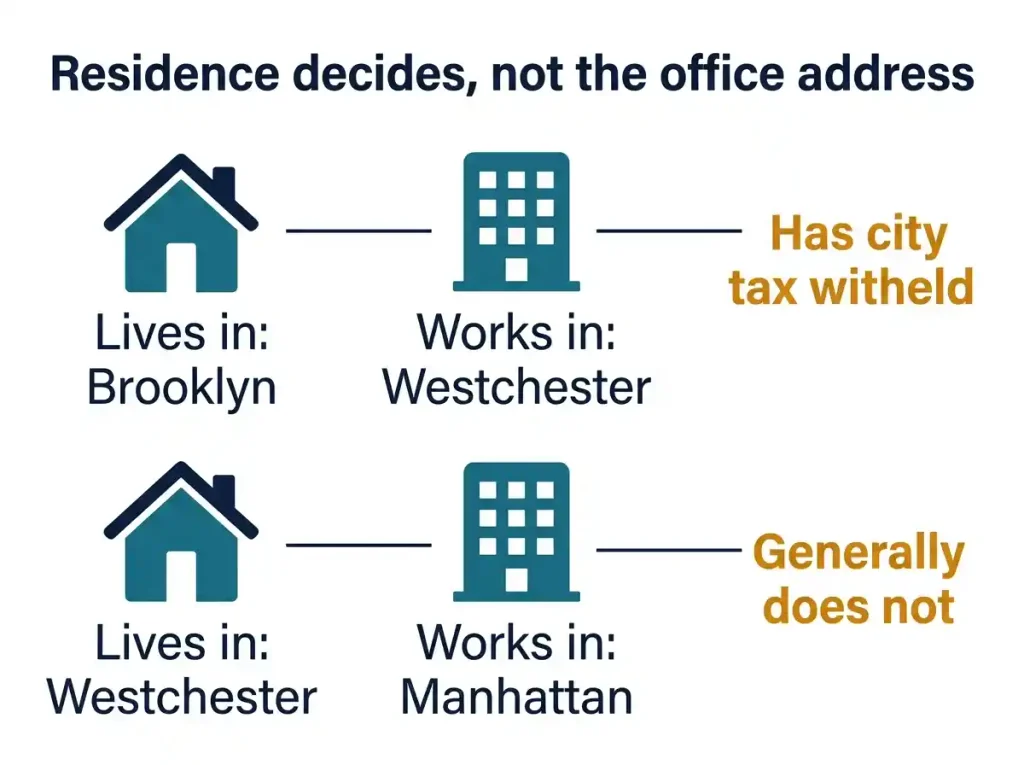
Withhold New York City income tax from employees who live in the city, even if they work elsewhere. A Brooklyn resident working in Westchester has city tax withheld. A Westchester resident working in Manhattan generally does not.
Yonkers resident and nonresident withholding
Residents have a local income tax withheld, and nonresidents who work in Yonkers may owe a separate earnings tax. For 2026, the supplemental wage rate is 1.95975% for residents and 0.50% for nonresidents. For regular wages, use the Tax Department’s current guidance and tables.
Other employer payroll-related taxes
On top of withholding, you pay New York unemployment insurance. The wage base is now set at 18% of the state average annual wage, rounded up to the nearest $100, so it resets every January. Some employers in the New York City region also owe the Metropolitan Commuter Transportation Mobility Tax (MCTMT), which is reported on Form MTA-305, not the NYS-45, with the same quarterly due dates. Federally, you match your employees’ Social Security and Medicare taxes.
| Tax | 2026 figure |
|---|---|
| UI wage base | $17,600 per employee, up from $12,800 in 2025 |
| UI rate, new employers | 4.1% including a 0.075% reemployment fund rate, or $721.60 per employee for the year |
| UI rate, experienced employers | 1.7% to 9.5% |
| MCTMT | Applies once covered payroll passes $312,500 in a calendar quarter. Rates start at 0.055% and rise with payroll size, up to 0.895% in New York City and 0.635% in the surrounding counties |
| Social Security wage base | $184,500 |
How New York Payroll Tax Withholding and Filing Work in Real Scenarios
The $700 line decides the path in each of these four situations.
A small business with less than $700 in quarterly withholding
Say a three-person bakery withholds $450 in the quarter. It files no NYS-1. It reports the wages and the $450 on the NYS-45 and pays with that return, along with any UI contributions owed, in one filing session.
An employer whose accumulated withholding reaches $700
A landscaping company hits $900 in withholding mid-month. The NYS-1 is due within three or five business days, depending on filer type. The quarterly return does not fix a missed NYS-1. At quarter end, list those payments on the NYS-45 and pay only what remains.
An employer with no wages during the quarter
A seasonal business with no payroll from January through March still files the first-quarter NYS-45, with Parts A and B completed and a 0 entered in Part C, line 24. Zero wages does not cancel the requirement, and neither does a quarter with wages but no tax withheld. Seasonal employers can mark the seasonal box on that return. Later no-wage quarters that year need not be filed, but the box must be marked on every return filed that year, and at least one return is required each year. If unsure, call the Department of Labor before the due date.
A business with employees in New York City and elsewhere
Your Albany shop has one employee who lives in the Bronx and one who lives in Troy. The Bronx employee has state and city tax withheld. The Troy employee has state tax only. Both appear on the NYS-45 with their own wage lines. Do not use the work address as the answer for everyone.
What to Do If You Miss a New York Payroll Tax Deadline
File and pay as soon as you can. Delay only makes the bill bigger.
Steps to take after discovering a late filing or payment
First, identify what is missing: a NYS-45, a NYS-1 payment, or a UI contribution. Then file and pay electronically right away. Late UI payments add interest and can raise your UI rate in future years. New York withholding tax penalties and interest also grow the longer a balance sits. Respond to every notice by its due date, in the way it asks. If you cannot pay in full, contact the agency.
Correcting an inaccurate payroll tax return
If you reported the wrong wage, Social Security number, or tax, file an amended NYS-45. Submit the full amended return with corrected employee records, not just the changed line, and update your payroll register. If the error affected a W-2, issue a corrected Form W-2c too.
Closing a business or stopping payroll
When you permanently stop paying wages, file a final NYS-45 within 30 days. Enter the date of your final payroll to mark it as final, and complete the sold or transferred section if you sold the business. File everything up to your last payday and pay what you owe. The state keeps expecting returns until you tell it otherwise. A sale, ownership transfer, or new federal EIN may also require account updates or a new registration, so ask the agencies before the change.
Common New York Payroll Tax Filing Mistakes and Misconceptions
Most problems come from four wrong assumptions.
Assuming quarterly filing means quarterly payment
The NYS-45 is quarterly, but the NYS-1 is a payment tied to how much you withhold. Cross $700 and you owe within days, even if the return is weeks away. Track accumulated withholding after each payroll. Payroll frequency does not change how much you withhold, but more frequent payrolls check the $700 line more often, so NYS-1 payments can come sooner.
Assuming no payroll means no return
Zero wages usually still means a filed return. Exceptions exist, such as seasonal status, so confirm yours with the Department of Labor before the due date.
Assuming payroll software guarantees compliance
Software calculates and often files, but you stay responsible. Confirm each return was accepted, each payment cleared, and the provider covers every account, including withholding and unemployment. A provider that handles only one leaves the other unfiled. If a provider misses a deadline, the penalties still land on you. Update the software yearly so it carries the 2026 withholding tables and the $17,600 UI wage base.
Assuming all New York employees have identical withholding
A New York City resident, a Yonkers resident, and a Buffalo resident all have different withholding, based on where they live and work. Ask employees to update their IT-2104 when they move, and update payroll right away. Workers with more than one job should file an IT-2104 for each employer, as explained in getting New York withholding right with multiple jobs. If an employee asks why a check looks smaller, point them to how to read a New York pay stub or why a New York paycheck is lower than expected.
New York Payroll Tax Filing Checklist for Employers
Check withholding after each payroll, file the NYS-45 each quarter, and reconcile at year end.
Monthly and per-payroll compliance checks
After each payroll:
- Check accumulated withholding against $700 and note any NYS-1 due date.
- Confirm numbers match your registers and employee changes were applied.
- Confirm every payment went through.
Paid Family Leave deductions are 0.432% of wages in 2026, capped at $411.91 per employee for the year. On $1,000 of gross pay, that is $4.32. Our New York paycheck calculator shows the effect on take-home pay.
Quarterly and annual compliance checks
- Each quarter: file the NYS-45, reconcile wage totals to payroll, and review UI contributions.
- At year end: reconcile the four returns to your W-2s and keep every record.
- Calendar: mark the 2026 dates, especially November 2 and February 1.
Official resources for current forms and requirements
- The New York State Department of Taxation and Finance covers withholding, the NYS-1, and PrompTax.
- The New York State Department of Labor covers the NYS-45, unemployment insurance, and your UI rate notice, which usually arrives in mid-February.
- Both post current 2026 forms, instructions, and filing calendars. Start with Publication NYS-50, the Employer’s Guide to Unemployment Insurance, Wage Reporting, and Withholding Tax.
- The Instructions for Form NYS-45 (Form NYS-45-I) explain each line of the return.
- Withholding tables are in Publication NYS-50-T-NYS (New York State Withholding Tax Tables and Methods), Publication NYS-50-T-NYC (New York City Withholding Tax Tables and Methods), and Publication NYS-50-T-Y (Yonkers Withholding Tax Tables and Methods).
- Find the New York wage reporting resources for withholding tax filers on the Tax Department site.
- Use IRS Publication 15, Employer’s Tax Guide, for federal rules.
- This guide’s dates and rates come from the Tax Department, the Department of Labor, the Department of Financial Services (for Paid Family Leave), and the Social Security Administration (for the wage base). Check them before relying on any third-party rate or date. Our calculation methodology shows how our calculator uses them.
- For several locations or past-due returns, an accountant or payroll service is worth the cost.
Frequently Asked Questions About New York Payroll Tax Filing
Most questions come down to two clocks: the quarterly NYS-45 return and the NYS-1 payment that starts at $700.
When are New York payroll tax returns due in 2026?
The NYS-45 is due April 30, July 31, November 2, and February 1, 2027. The last two shift from October 31 and January 31 because those dates fall on a weekend.
Does every New York employer need to file Form NYS-45?
Employers with a withholding or unemployment insurance account file every quarter. Quarters with no wages are covered in the last question below.
What is the $700 threshold for Form NYS-1?
It is the accumulated withholding amount that triggers a payment. Once you reach it, pay on the NYS-1 within three or five business days, based on filer type. Under $700 for the quarter, pay with the NYS-45.
Can New York employers file payroll taxes annually?
No. Reporting is quarterly. The W-2 is an annual statement and does not replace the four quarterly returns.
Must New York payroll tax returns be filed electronically?
Yes. File the NYS-45 online using Web File, Web Upload, or approved software. Check official guidance for any narrow exemption.
What happens if an employer files NYS-45 late?
You can owe penalties and interest, and late UI payments may raise your UI rate in future years. File as soon as possible and answer any notice by its due date.
Do employers need to file NYS-45 when no employees were paid?
Generally yes. A quarter without payroll still needs a return unless your account is closed or you qualify for seasonal status.
Key Takeaways for New York Payroll Tax Compliance in 2026
Keep the NYS-45 and the NYS-1 separate. One is a quarterly report, and the other is a payment that starts at $700. Check each employee’s state and local withholding, file electronically through an approved method, and reconcile registers to returns and W-2s. When rules or your situation change, check official Tax Department and Department of Labor guidance. For more employer guides, browse New York payroll and employer compliance.

Meet Yasin Ali, Founder
Yasin built NY Paycheck Calculator in 2020 after getting fed up with calculators that treated New York like every other state. Most tools ignore the extra local tax NYC and Yonkers workers pay on top of state tax — or skip New York’s Paid Family Leave deduction entirely.
He keeps the numbers current, checking in regularly against the latest IRS, NY Department of Taxation and Finance, and Paid Family Leave rates.
All results here are estimates based on official sources. For advice specific to your situation, talk to a tax professional.