
Yonkers Paycheck Calculator
Accurate net take-home pay for Yonkers residents, commuters, and NY state workers, including official 2026 Federal, New York State, and Yonkers city tax surcharges.
Enter total expected annual salary or earnings before taxes.
Yonkers residents pay a 16.75% surcharge on net NY state tax. Non-residents working in Yonkers pay a flat 0.50% earnings tax.
| Deduction / Component | Paycheck | Annual |
|---|---|---|
| Gross Earnings | $0.00 | $0.00 |
| Pre-Tax Deductions | -$0.00 | -$0.00 |
| Federal Income Tax | -$0.00 | -$0.00 |
| Social Security (6.2%) | -$0.00 | -$0.00 |
| Medicare (1.45%) | -$0.00 | -$0.00 |
| NY State Tax (NYS) | -$0.00 | -$0.00 |
| NY SDI / FLI Payroll Taxes | -$0.00 | -$0.00 |
| Yonkers Local Tax | -$0.00 | -$0.00 |
| Net Take-Home Pay | $0.00 | $0.00 |
Based on the recommended 30% rule for local affordability, your max target monthly rent or housing expense is shown below.
How to Use the Yonkers Paycheck Calculator
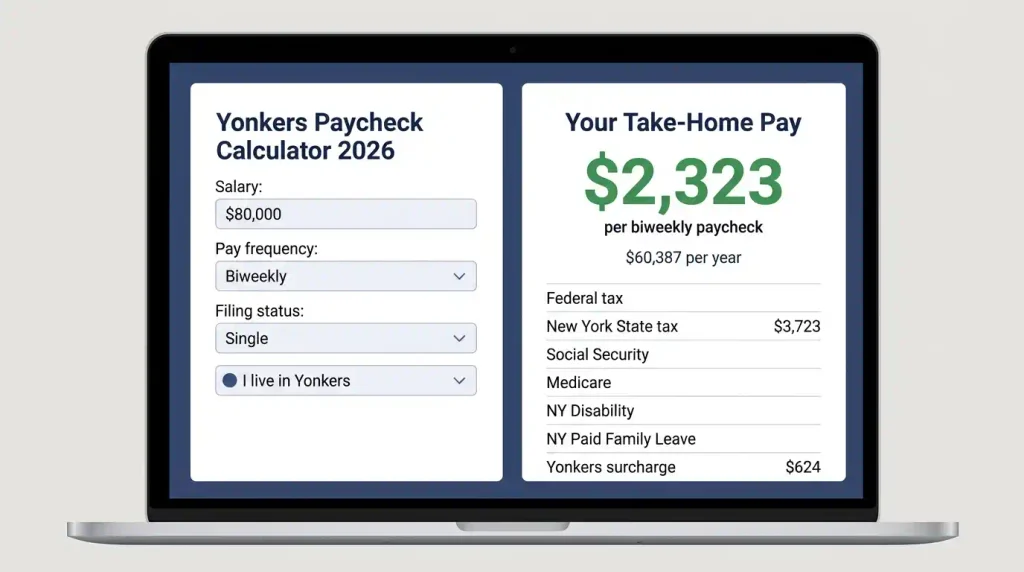
Enter your pay, pick where you live and work, add deductions, then read your take-home.
Step 1: Enter your pay and pay frequency
Choose salary or hourly, enter your pay, and pick your pay frequency: weekly, every two weeks, twice a month or monthly. Overtime is paid at 1.5 times your rate. Count paid hours only, using your average week if hours vary. Bonuses and commissions are supplemental wages, usually withheld at a flat 22% federal and 11.7% New York State rate, plus about 1.96% for Yonkers residents or 0.5% for nonresidents.
Step 2: Pick where you live and work
Select "I live in Yonkers" for the resident surcharge, or "I live outside Yonkers and work in Yonkers" for the 0.5% earnings tax. Choose the third option if you have no Yonkers link. You are a Yonkers resident if Yonkers is your permanent home (your domicile), even if you work remotely. In a mixed case, check the Form IT-201 instructions or our guide to resident vs nonresident tax rules. Then set your W-4 filing status: single, married filing jointly or head of household. Married filing separately uses single.
Step 3: Add pre-tax deductions
Enter your 401(k) percentage, health premiums, HSA or FSA, and commuter benefit. They lower your taxable wages (gross pay minus pre-tax items), so they cost you less than their face value. Use the advanced box for W-4 credits (like the child tax credit), extra withholding and after-tax items like Roth 401(k) and union dues. Unsure of an amount? Check a recent pay stub or leave it at zero.
Step 4: Read your results
You get take-home (net) pay per paycheck, month and year, plus a tax table and chart. The comparison shows the same pay in New York City or a suburb with no local wage tax. Every number is an estimate, and employer payroll tables can differ by a few dollars.
What Is Taken Out of a Yonkers Paycheck in 2026?
Federal tax, Social Security, Medicare, New York tax, disability and Paid Family Leave come out of every New York paycheck, plus a Yonkers tax if you live or work there.
Federal income tax, Social Security and Medicare
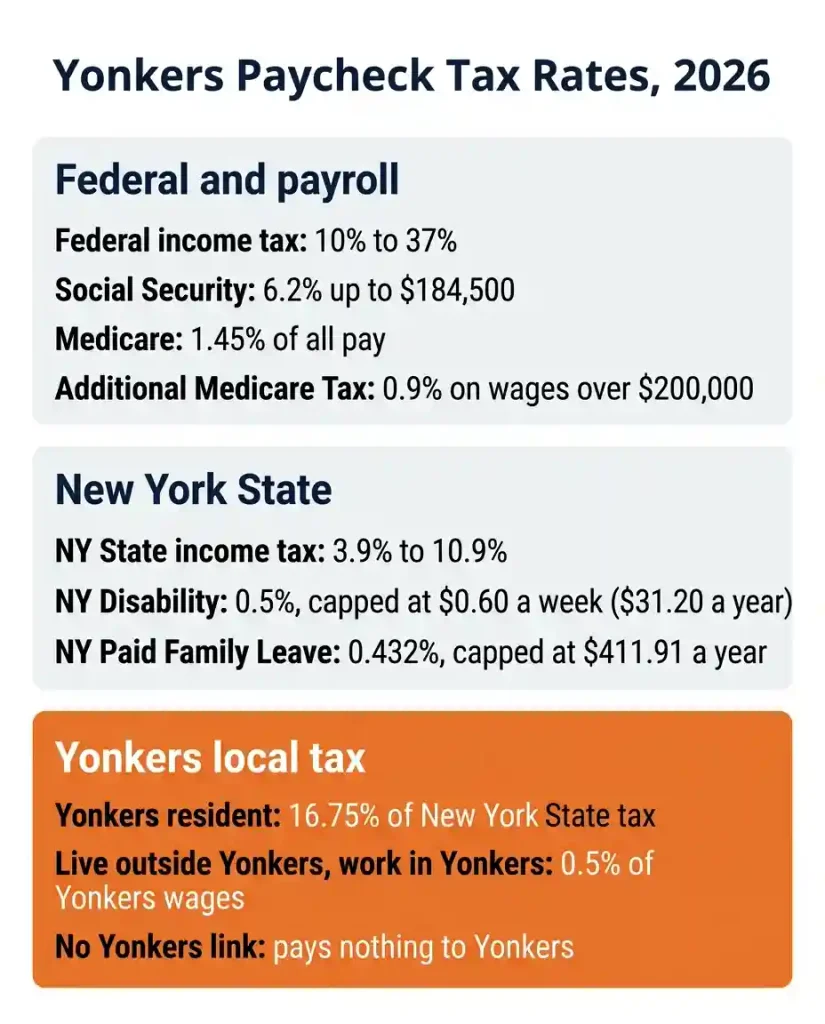
Federal income tax withholding follows your W-4 and the 2026 brackets, which run from 10% to 37%. The 2026 standard deduction is $16,100 for single filers. Only dollars inside a bracket are taxed at its rate, so a raise never moves all your pay into a higher rate. At $80,000, a single filer's marginal federal rate is 22%, but all taxes together take about 24.5% of gross pay. That share is your effective rate. Social Security takes 6.2% of pay up to $184,500. Pay above that is untaxed, so high earners see bigger checks late in the year. Medicare takes 1.45% of all pay, plus the 0.9% Additional Medicare Tax on wages over $200,000. Together they are the Federal Insurance Contributions Act (FICA) taxes.
New York State income tax
New York has nine brackets in 2026, from 3.9% to 10.9%. The five lowest rates dropped about 0.1 percentage point on January 1, 2026, so state withholding is slightly lower than in 2025. Taxable income starts from federal adjusted gross income (AGI), which becomes New York adjusted gross income (NYAGI) after state adjustments. Standard deductions are $8,000 single, $16,050 married filing jointly and $11,200 head of household. A single filer earning $80,000 owes about $3,720 in state tax.
NY disability and Paid Family Leave
Disability insurance takes 0.5% of pay, capped at $0.60 a week ($31.20 a year). Paid Family Leave takes 0.432% of pay, up from 0.388% in 2025, capped at $411.91 a year. You hit that cap at roughly $95,350 in wages.
The Yonkers local tax
Where you live decides which Yonkers tax applies. Residents pay a surcharge of 16.75% of their New York State tax. Nonresidents who work in Yonkers pay 0.5% of their Yonkers wages. Everyone else pays nothing to Yonkers. Residents report the Yonkers resident income tax surcharge on Form IT-201 Resident Income Tax Return.
How Does the Yonkers Resident Surcharge Work?
It is 16.75% of your New York State tax, about $624 a year at $80,000.
Why it is 16.75% of your state tax, not your pay
The surcharge is a share of your state tax, not your salary. New York tax is worked out first, then Yonkers takes 16.75% of it. At $80,000, that is under 1% of your pay. The Yonkers Income Tax Surcharge comes from New York State Tax Law.
Worked example at $80,000 single
A single filer paid $80,000 with no deductions has $72,000 of New York taxable income after the $8,000 standard deduction. State tax is about $3,723. At 16.75%, the Yonkers surcharge is about $624 a year, or $24 per biweekly check. Estimated take-home is about $2,323 every two weeks, or about $60,387 a year. Payroll withholding uses a $7,400 allowance instead of $8,000, so your stub may show about $32 more state tax and $5 more surcharge a year. For the statewide view, see $80,000 after taxes in New York.
Yonkers surcharge at different salaries
| Salary | NY State tax | Yonkers surcharge | Per biweekly check |
|---|---|---|---|
| $50,000 | $2,103 | $352 | $14 |
| $80,000 | $3,723 | $624 | $24 |
| $120,000 | $6,230 | $1,044 | $40 |
Single filer, no pre-tax deductions. The $120,000 row includes New York benefit recapture, estimated from the state's 2026 withholding schedule.
Do You Pay Yonkers Tax If You Only Work There?
Yes, if you live outside Yonkers. You pay 0.5% of your Yonkers wages.
The 0.5% nonresident earnings tax
If you live outside Yonkers and earn wages there, you owe 0.5% of those wages (the Yonkers nonresident tax), less a small exclusion on Form Y-203. On $80,000 that is at most $400 a year, about $15 per biweekly check. It replaces the resident surcharge, so you never pay both. It also covers net earnings from self-employment in Yonkers. If you live in New Jersey or Connecticut, the same 0.5% applies, and you file Form IT-203 Nonresident and Part-Year Resident Income Tax Return for New York State tax as a nonresident. Your home state may credit tax paid to New York.
Form Y-203 and who needs it
Form Y-203 City of Yonkers Nonresident Earnings Tax Return is where you figure the Yonkers nonresident earnings tax. File it with your New York State return if you live outside Yonkers but had Yonkers wages. You can skip it only if all of these apply:
- You do not have to file a New York State return.
- You had only wages in Yonkers.
- You earned $3,000 or less, or had one employer that withheld the correct tax.
Your pay stub should show a Yonkers line. If not, ask payroll before you file. If you live outside New York and split your week between a New York office and home, Form IT-2104.1 Certificate of Nonresidence and Allocation of Withholding Tax lets you ask your employer to withhold only for New York workdays. Remote days can still count as New York workdays in some cases, so check the Tax Department's guidance.
Yonkers vs NYC vs Westchester Suburbs: Who Keeps More?
Yonkers costs less than New York City but more than a suburb with no local tax.
Take-home comparison table at the same salary
| Where you live and work | Local tax per year | Take-home per biweekly check | Versus Yonkers resident, per year |
|---|---|---|---|
| Yonkers resident | $624 | $2,323 | Baseline |
| Live outside, work in Yonkers | $400 | $2,331 | +$224 |
| Suburb with no local tax (White Plains) | $0 | $2,347 | +$624 |
| New York City resident | $2,666 | $2,244 | -$2,042 |
Single filer, $80,000 salary, no deductions, 2026 estimates. The Yonkers work row is the maximum, before the small Form Y-203 exclusion.
A Yonkers resident keeps about $2,040 more a year than a New York City resident, and gives up about $620 compared with a Westchester suburb with no local income tax. New Rochelle matches White Plains, since it has no local income tax either.
Why Yonkers residents do not pay NYC tax
New York City resident income tax applies to people who live in the five boroughs. It is charged on taxable income at 3.078% to 3.876%, while Yonkers adds a surcharge on your state tax. If you live in Yonkers and commute to Manhattan, you pay the Yonkers surcharge, not NYC tax. New York City does not tax the wages of commuters who live outside the city.
Yonkers Take-Home Pay at Common Salaries
A single Yonkers resident earning $80,000 takes home about $2,323 biweekly.
| Salary | Biweekly | Monthly | Yearly |
|---|---|---|---|
| $40,000 | $1,242 | $2,691 | $32,291 |
| $60,000 | $1,808 | $3,918 | $47,014 |
| $80,000 | $2,323 | $5,032 | $60,387 |
| $100,000 | $2,810 | $6,089 | $73,063 |
| $150,000 | $4,009 | $8,686 | $104,230 |
Yonkers resident, single filer, no deductions, 2026 estimates. New York can add benefit recapture at higher incomes, so the $150,000 row may run a bit high.
A $5,000 raise at $80,000 adds about $3,180 a year to take-home pay, and a $10,000 raise adds about $6,350. Compare job offers by take-home pay, not salary, using each offer's home and work location. See more New York paycheck scenarios.
How to Get the Right Yonkers Withholding on Your Pay Stub
Mark Yonkers on Form IT-2104, then check your stub for a Yonkers line.
Filling out Form IT-2104 for Yonkers
Your federal Form W-4 Employee’s Withholding Certificate does not set state or local withholding, as our W-4 vs IT-2104 guide explains. Form IT-2104 Employee’s Withholding Allowance Certificate does. Mark that you live in Yonkers so your employer takes the surcharge, and submit a new one when you move, change jobs or change marital status. If you moved during the year, file Form IT-360.1 Change of City Resident Status with your return to figure Yonkers tax for the time you lived there (see part-year resident tax rules). The calculator assumes one home all year, so treat the numbers as a rough guide after a move. Find every form under New York State income tax forms and instructions on the Tax Department's website, and more guides in our New York tax forms and withholding section.
What to check on your pay stub
Check these lines on your pay stub:
- A Yonkers line next to the New York State line. Residents should see the surcharge, and nonresidents working in Yonkers a 0.5% charge.
- NY SDI and NY PFL lines (see pay stub codes).
If the Yonkers line is missing, wrong or shows up when you live and work elsewhere, ask payroll to fix it. Any overpaid tax is settled when you file. Your year-end Form W-2 Wage and Tax Statement shows the full-year totals withheld.
Fixing over-withholding or under-withholding
Compare the calculator with your stub. A few dollars of difference is normal. A bigger gap usually means a form problem. If your whole check looks too small, read why your New York paycheck is lower. Use a new Form IT-2104 for state and Yonkers withholding, and a new W-4 for federal. If you owed tax last year, add extra withholding. Withholding is a prepayment, not your final bill. You settle the difference on Form 1040 U.S. Individual Income Tax Return and your New York return, so extra withholding becomes a refund and too little becomes a balance due. With a second job, each employer withholds as if it were your only one, so use the multiple jobs step on your W-4 or add extra withholding.
Ways to Raise Your Take-Home Pay in Yonkers
Pre-tax benefits cut your tax bill, so they cost less than their face value.
401(k) and pre-tax health premiums
At $80,000, putting 5% ($4,000) into a traditional 401(k) lowers yearly take-home by only about $2,870, or roughly $110 a paycheck. A traditional 401(k) lowers federal and New York taxable wages, but not Social Security and Medicare wages. 2026 limits:
- $24,500 base limit.
- $32,500 if you are 50 or older.
- $35,750 if you turn 60 to 63 this year (catch-up of $11,250).
If your FICA wages topped $150,000 last year, your catch-up must be Roth. Health premiums paid through work also come out before tax. A Roth 401(k) is paid with after-tax money, so it does not lower your tax bill today. Enter it as an after-tax paycheck deduction.
Commuter benefits for Metro-North and the Bee-Line
A pre-tax commuter benefit helps if you ride Metro-North or Bee-Line buses. The 2026 federal limit is $340 a month. At $80,000, the full amount saves about $1,470 a year in tax.
HSA and FSA
Health Savings Account (HSA) contributions require a high-deductible health plan. The 2026 limits are $4,400 self-only and $8,750 family. Flexible Spending Account (FSA) contributions for health costs top out at $3,400. Both come out before tax, so each $1,000 costs about $640 in take-home at $80,000.
What Does a Yonkers Paycheck Cover?
Keep rent near 30% of gross pay, about $2,000 a month at $80,000.
Rent against take-home pay
A common rule keeps rent under 30% of gross pay, which is $2,000 a month at $80,000. Your take-home is about $5,030 a month, so $2,000 in rent takes roughly 40% of it. Enter your rent in the planner to see your share.
Minimum wage in Westchester in 2026
Yonkers is in Westchester County, New York, where the 2026 New York minimum wage is $17.00 an hour. Full-time work at that rate pays about $35,360 a year before tax. Use hourly mode to see what that leaves you.
How This Calculator Works and Where the Numbers Come From
The tool turns pay into a yearly amount, subtracts pre-tax deductions, then applies each tax, as explained in our calculation methodology. It uses the 2026 federal brackets and standard deduction, the $184,500 Social Security base, the nine brackets in the New York State personal income tax rate schedules, the Yonkers rates and the 2026 disability and Paid Family Leave caps. It leaves out itemized deductions, state credits and New York benefit recapture. Results are estimates, not tax advice (see our disclaimer). It is built for W-2 pay. A 1099 contractor has nothing withheld, so makes estimated tax payments and pays self-employment tax. Check current rates and withholding rules with the New York State Department of Taxation and Finance and the City of Yonkers.
Sources: Internal Revenue Service (IRS) Publication 15-T and IRS Publication 15, Employer’s Tax Guide; IRS 2026 benefit plan limits; Social Security Administration (SSA); NYS-50-T-NYS New York State Withholding Tax Tables and Methods (1/26); NYS-50-T-Y Yonkers Withholding Tax Tables and Methods (1/26); Form Y-203 instructions; the NY Department of Financial Services 2026 Paid Family Leave notice; and the New York State Department of Labor (minimum wage).
Written by Yeasin. Figures checked against the sources above. Last updated October 2026.
Yonkers Paycheck Calculator FAQs
Quick answers to common Yonkers paycheck questions.
How much is Yonkers income tax in 2026?
Yonkers residents pay a surcharge equal to 16.75% of their New York State income tax. People who live elsewhere and work in Yonkers pay 0.5% of their Yonkers wages.
Do I pay Yonkers tax if I only work there?
Yes. If you live outside Yonkers, you owe the 0.5% nonresident earnings tax on wages earned there. File Form Y-203 with your New York State return.
Do Yonkers residents pay New York City tax?
No. NYC income tax applies to people who live in the five boroughs. Yonkers residents pay the Yonkers surcharge instead, even if they commute to Manhattan.
What else is taken out of a New York paycheck?
Federal income tax, Social Security, Medicare and New York State income tax. New York also takes disability insurance (0.5%, up to $0.60 a week) and Paid Family Leave (0.432%, up to $411.91 a year).
How do I make sure my employer withholds the right Yonkers amount?
Fill out Form IT-2104 and mark that you live in Yonkers. Then check your pay stub for a separate Yonkers line.