
With multiple jobs in New York, give each employer its own Form IT-2104, claim allowances at your higher-paying job, and add extra withholding on line 3 once combined wages reach $107,650.
That rule follows the Tax Department’s 2026 Form IT-2104-I instructions and NYS-50-T-NYS (1/26), which this guide’s figures were checked against.
Limit: the charts assume weekly pay, and semimonthly or monthly conversions here are estimates.
How New York Withholding Works When You Have Multiple Jobs
Each employer withholds as if its paycheck is your only income. Tell each one what to do on Form IT-2104, based on your combined wages.
Why multiple jobs can cause withholding problems
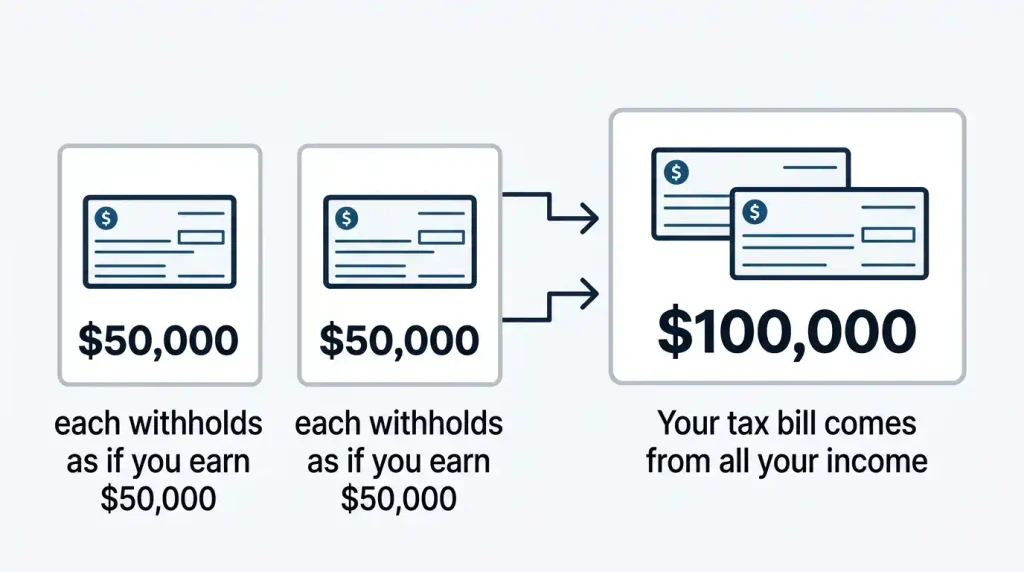
Your tax bill comes from all your income, but each paycheck’s net pay reflects only what that employer withholds. Two $50,000 jobs are taxed like one $100,000 income, yet each withholds as if you earn $50,000.
The two-stub test. My own rough check, not an official method. Multiply the state tax on one recent pay stub from each job by your pay periods per year, then add them. A sum far below your expected New York tax means too little withholding.
Do you need a separate Form IT-2104 for each job?
Yes. In 2026 each employer needs its own certificate, which sets your allowances, filing status, and any extra state, city, or Yonkers dollars. Employers do not compare notes, and a federal W-4 covers federal tax only.
What changes when you add or leave a second job?
File a new IT-2104 whenever you start or leave a job, updating every certificate affected. The instructions were revised for 2026, so if you used the worksheet or the charts on an older form, file a new one. Check your next paycheck after any big income change.
Takeaway: Every job needs its own IT-2104, and every job change means a fresh look.
The 2026 Multiple-Job Withholding Rules at a Glance
Combined wages of $107,650 are the dividing line, and your filing status decides which rule or chart applies.
The key $107,650 combined-wage threshold
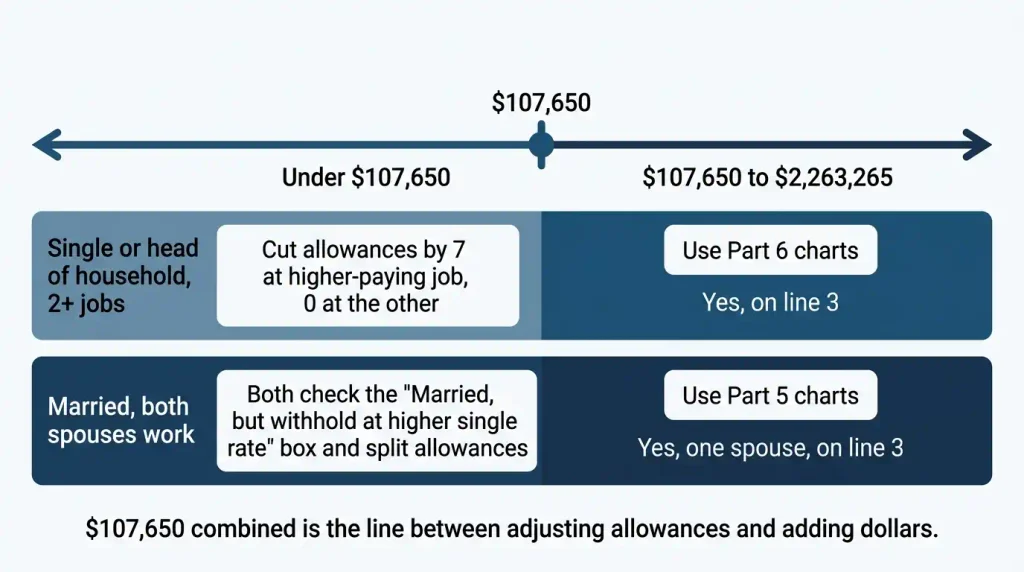
The threshold counts wages from all jobs together. Below it, you adjust allowances. At or above it, you use the charts and enter an extra amount on line 3, because higher combined income reaches higher tax brackets that allowances cannot catch. The 2026 charts cover combined wages up to $2,263,265.
Which rule applies to your situation?
Single and head of household filers with multiple jobs use the Part 6 charts once combined wages hit $107,650. Married filers with multiple jobs use Part 5, and so do couples where both spouses work. Below the threshold, those couples check a special box.
Quick 2026 multiple-job withholding comparison
| Your situation | Combined wages | What to do on IT-2104 | Extra withholding? |
|---|---|---|---|
| Single or head of household, 2+ jobs | Under $107,650 | Cut allowances by 7 at higher-paying job, 0 at the other | Only if the result goes negative |
| Single or head of household, 2+ jobs | $107,650 to $2,263,265 | Use Part 6 charts | Yes, on line 3 |
| Married, one person with 2+ jobs | $107,650 or more | Use Part 5 charts | Yes, on line 3 |
| Married, both spouses work | Under $107,650 | Both check the “Married, but withhold at higher single rate” box and split allowances | Not usually |
| Married, both spouses work | $107,650 to $2,263,265 | Use Part 5 charts | Yes, one spouse, on line 3 |
Takeaway: $107,650 combined is the line between adjusting allowances and adding dollars.
How to Fill Out Form IT-2104 When You Have Multiple Jobs
Allowances go on lines 1 and 2, and extra dollars go on lines 3, 4, and 5.
| Line | What goes there | Applies to |
|---|---|---|
| 1 | Allowances from the worksheet | New York State and Yonkers |
| 2 | Allowances from the worksheet | New York City |
| 3 | Extra dollars each pay period | New York State |
| 4 | Extra dollars each pay period | New York City |
| 5 | Extra dollars each pay period | Yonkers |
Complete a separate IT-2104 for every employer
Gather your filing status, expected 2026 pay from every job, and worksheet result. The higher-paying job carries your allowances, and the lower-paying job usually shows zero. Your total across all jobs cannot exceed the worksheet number, and repeating it on every form is a common cause of under-withholding. Our Form IT-2104 walkthrough covers each line.
Where to enter New York State withholding
Line 1 holds your New York State and Yonkers allowances from the worksheet, and with multiple jobs it may drop, sometimes to zero. For more tax withheld, enter the extra dollar amount on line 3.
Where to enter New York City withholding
Line 2 holds your New York City allowances, and extra NYC dollars go on line 4. NYC withholding applies if you live in the five boroughs, wherever you work. Live in Brooklyn and work in Westchester, and you owe NYC tax. Live in Westchester and work in Manhattan, and you do not. If you live outside New York State but work here, read our guide to New York State tax for nonresidents and Form IT-2104.1.
Where to enter Yonkers withholding
Yonkers residents pay a surcharge equal to 16.75% of their state tax, and your Yonkers allowances share line 1 with the state. Extra Yonkers dollars go on line 5. Your home address decides these lines.
Takeaway: Fill out every form, and never claim more allowances than you are entitled to.
Single or Head of Household With Two or More Jobs
Under $107,650 combined, subtract seven allowances at your higher-paying job. From $107,650 up, use the Part 6 charts and add the dollar amount on line 3.
Combined wages under $107,650
Subtract seven from your worksheet result on lines 1 and 2 at your higher-paying job, and the Tax Department suggests zero allowances at the lower-paying job. If the answer is negative and your employer cannot accept negative allowances, enter zero and ask for extra withholding. A worksheet result of 2 becomes negative 5, so you enter 0 and ask for 5 × $1.85 = $9.25 a week of extra state tax, plus 5 × $0.80 = $4.00 a week of NYC tax if you live in the city. Yonkers residents add 16.75% of the state amount, about $1.55 a week.
Combined wages from $107,650 to $2,263,265
Part 6 applies. Combined wages pick the chart column, higher-paying-job wages pick the row, and the amount where they cross goes on line 3 of Form IT-2104.
How to use the Part 6 chart
- Add up your expected combined annual wages.
- Find your expected annual wages from the higher-paying job.
- Locate the box where those two ranges meet.
- Adjust the weekly amount to match how you get paid.
Chart amounts assume weekly pay. Convert them using the pay-frequency table in the Additional Withholding section.
Example: $60,000 job plus $40,000 job
Combined wages are $100,000, under $107,650. The $60,000 job is higher-paying, so its IT-2104 gets the seven-allowance cut and the $40,000 job gets zero.
Example: $90,000 job plus $50,000 job
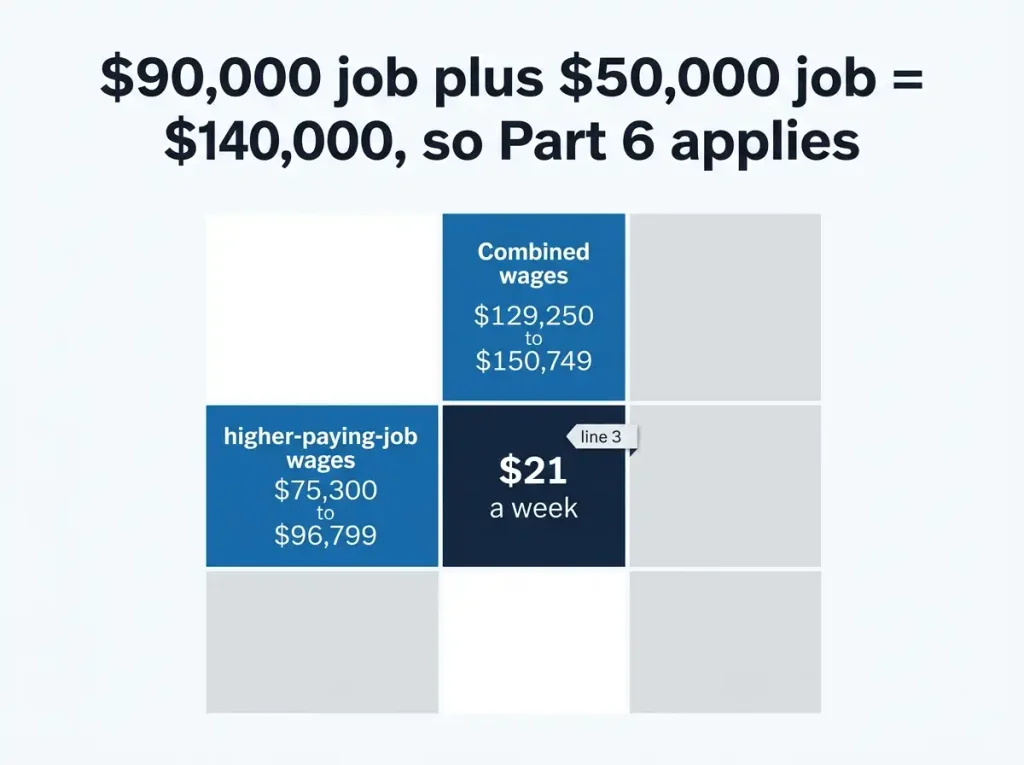
Combined wages are $140,000, so Part 6 applies. The $129,250 to $150,749 column and the $75,300 to $96,799 row cross at $21 a week. Enter that amount, adjusted for your pay schedule, on line 3. Putting it on the higher-paying job is the most accurate choice, per the Part 5 guidance.
Takeaway: Know your combined wages first. They decide between the cut and the chart.
Married Taxpayers With Multiple Jobs
Married filers hit the chart rule at $107,650 combined and use Part 5. Couples with two working spouses have one extra option below that line.
One married taxpayer has two or more jobs
At $107,650 combined wages from all jobs, use the Part 5 charts, reading “higher-paying job” where the chart says “higher earner’s wages.” Enter the amount on line 3 of the higher-paying job’s IT-2104, where it is most accurate.
Married couples where both spouses work
Each spouse files a separate IT-2104 with their own employer, and the higher earner usually claims all allowances while the other claims zero. Under $107,650 combined, use the box option below. At $107,650 or more, use the Part 5 charts, and only one spouse asks for extra withholding.
The “Married, but withhold at higher single rate” option
Both spouses check the Married, but withhold at higher single rate box when combined wages are under $107,650, so the employer withholds at the higher single rate. Divide your total allowances between the two forms, often giving all to the higher earner. The box changes the rate, while line 3 adds a fixed amount.
Example: spouses earning $80,000 and $55,000
Combined wages are $135,000, so Part 5 applies. The higher earner claims the allowances, and the spouse earning $55,000 claims zero. The $129,250 to $150,749 column and the $75,300 to $96,799 row cross at $17 a week, entered only on the $80,000 job’s IT-2104, where withholding is most accurate.
Takeaway: Married couples pick one spouse, usually the higher earner, to carry allowances and extra tax.
How to Calculate Combined Wages for Multiple Jobs
Add expected 2026 wages from every job, not one paycheck. Then compare the jobs to find the higher-paying one.
What counts toward combined wages?
Count wages from every job you expect to work in 2026, including a new job that starts later. Add planned raises, hour changes, and expected overtime pay, bonuses, or commissions, using a fair guess based on last year. Contractor pay is not wages, so check employee vs independent contractor rules if a job’s status is unclear.
How to estimate annual wages from a new job
$22 an hour at 20 hours a week is $440 a week, or $22,880 over a full year. For a July start, count only the months you will work, about half. Refile if real earnings drift far from your guess.
Which job is the higher-paying job?
Compare expected annual wages, not the size of one check. If hours shift and the other job overtakes it, file new forms and swap roles. When two jobs are close, pick the one you expect to keep longest, because it carries your allowances and extra dollars.
Takeaway: Use full-year expected wages from all jobs, and refigure when your hours change.
Additional Withholding: When and How Much?
You need extra withholding when allowance math falls short: combined wages at $107,650 or more, a negative allowance result, or income with no tax withheld.
When additional New York withholding may be necessary
Extra withholding makes sense when combined wages reach the threshold or your allowance count comes out below zero. It also helps with interest, dividends, or freelance or 1099 income that no one withholds on. If that income tops $1,000 and you do not pay estimated tax, cut one allowance for every $1,000, or make quarterly estimated payments. If you owed tax last year or your income jumped, add a buffer.
How the Part 5 and Part 6 charts work
Part 5 is for married taxpayers, and Part 6 is for single and head of household filers. Both cross your combined wages with your higher-paying-job wages, and the number where they meet goes on line 3, the additional New York State withholding line.
Adjusting additional withholding for pay frequency
Only the biweekly rule appears in the instructions, so confirm the semimonthly and monthly estimates with payroll. Never use the weekly figure on a monthly schedule.
| Pay schedule | How to convert | $10 weekly becomes |
|---|---|---|
| Weekly | No change | $10 |
| Biweekly | Double it, per the instructions | $20 |
| Semimonthly | Weekly amount times 52, divided by 24 (estimate) | About $21.67 |
| Monthly | Weekly amount times 52, divided by 12 (estimate) | About $43.33 |
Not sure how often you must be paid? See New York pay frequency laws. Our calculation methodology lists the assumptions behind our estimates.
What if your calculation produces negative allowances?
Negative allowances happen when the seven-allowance cut exceeds your worksheet result. If your employer cannot accept a negative number, enter zero on line 1 and ask for a dollar amount for each negative allowance. The 2026 instructions list $1.85 a week for state tax (line 3) and $0.80 a week for New York City tax (line 4). Yonkers residents add 16.75% of the state amount on line 5.
Takeaway: Convert the weekly chart amount to your pay schedule before you enter it.
New York State vs. NYC vs. Yonkers Withholding With Multiple Jobs
State, city, and Yonkers taxes are separate, each with its own lines. Where you live decides which apply.
New York State withholding
Line 1 controls New York State tax withholding, and line 3 adds extra dollars. The state looks at your total income from all jobs (see our New York State income tax guides), and any shortfall is due when you file.
New York City withholding
New York City income tax withholding applies to NYC residents, with allowances on line 2. If you live in the city and hold two jobs, both employers should withhold city tax, even if one job is outside NYC. A move into or out of the five boroughs means a new IT-2104.
Yonkers withholding
Yonkers income tax withholding applies if you live in Yonkers, and both jobs should show it on your certificates. Extra Yonkers dollars go on line 5. Working in Yonkers while living elsewhere triggers a separate 0.5% earnings tax, withheld under Yonkers nonresident rules (NYS-50-T-Y). If you move in or out, update your forms right away, because employers keep using the old address.
Takeaway: Home address decides NYC and Yonkers resident tax. Yonkers also taxes nonresident wages separately.
Real-World Multiple-Job Withholding Scenarios
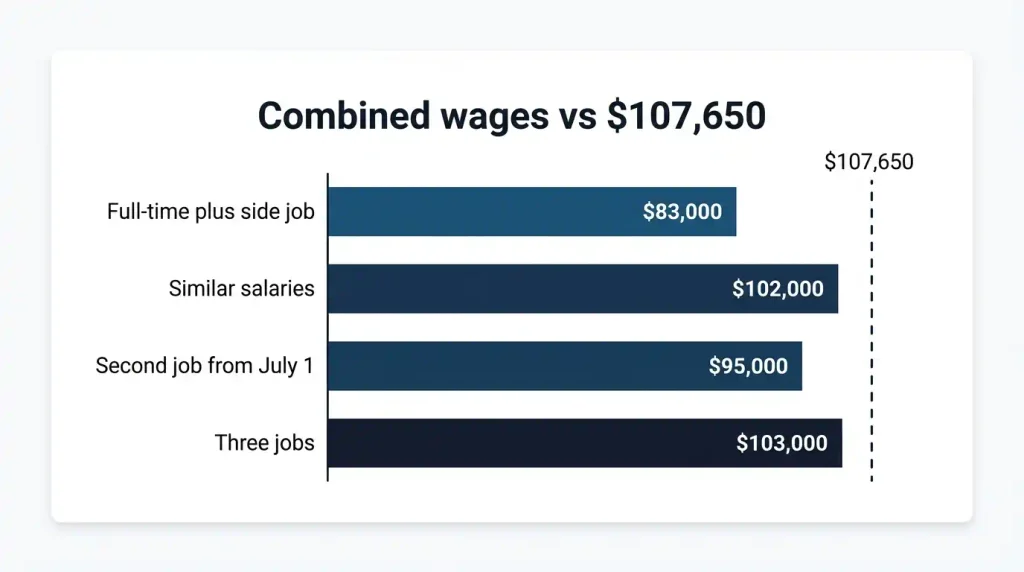
These examples show how the rules apply to a single filer, and all four stay under $107,650.
| Scenario | Jobs | Combined wages | Higher-paying job | Rule |
|---|---|---|---|---|
| Full-time plus side job | $65,000 and $18,000 | $83,000 | $65,000 job | Seven-allowance cut |
| Similar salaries | $52,000 and $50,000 | $102,000 | $52,000 job | Seven-allowance cut |
| Second job from July 1 | $70,000 and about $25,000 | $95,000 | $70,000 job | Seven-allowance cut |
| Three jobs | $45,000, $30,000, and $28,000 | $103,000 | $45,000 job | Seven-allowance cut |
Full-time job plus part-time side job
With $65,000 at your main job and $18,000 at a side job, the main job gets the seven-allowance cut and the side job gets zero. If the side job grows past $42,650, combined wages hit $107,650, and you switch to the Part 6 chart.
Two jobs with similar salaries
The $52,000 job carries the allowances and the seven-allowance cut despite the $2,000 gap to the $50,000 job. If the $50,000 job overtakes it, file new forms on both.
New second job started halfway through 2026
Your main job pays $70,000, and a second job starts July 1 at $50,000 a year, so you expect about $25,000 from it. Update both IT-2104s, then check your first paychecks from the new job.
Three jobs instead of two
Every employer gets its own IT-2104, and with $45,000, $30,000, and $28,000, the seven-allowance cut goes on the $45,000 job while the other two get zero. At $103,000 combined, one raise could push you over $107,650, so recheck often.
Job plus overtime, bonus, or commission income
Add likely overtime, bonuses, and commissions to your annual wages. If a bonus is paid separately and your regular pay already had tax withheld, your employer may use New York’s flat 11.70% rate in 2026, which ignores your allowances. Otherwise the employer adds the bonus to regular pay and figures the tax together. Either way, a bonus does not fix a low base setup, so file a new IT-2104 when pay shifts a lot and consider extra withholding.
More worked examples are in our New York paycheck scenarios.
Takeaway: Recount your combined wages every time your pay changes.
Common Mistakes and Misconceptions About Multiple-Job Withholding
Many withholding mistakes come from one wrong idea. The systems do not talk to each other, and nobody does the math for you.
“Each employer automatically knows about my other job”
They do not. Each payroll team sees only its own paycheck, so your IT-2104 is the only way the second job gets counted. Skip it, and both employers withhold as if you have one job, which sets up a balance due.
“I can claim all my allowances at every job”
You can only claim the total you are entitled to, one pool for all jobs. The Tax Department says claiming them all at the higher-paying job and zero at the others matches your tax best. Duplicate allowances cut withholding at every job, and that means a bill in April. A false statement that lowers withholding can also bring a $500 penalty.
“My federal W-4 handles New York withholding”
It does not. The W-4 sets federal withholding, and New York uses its own certificate (see W-4 vs IT-2104). With only a W-4, your employer may use zero allowances for New York, which can be too much or too little. You need both forms.
“More jobs always means more withholding”
Combined wages and filing status drive withholding, not job count. For a single filer, two $25,000 jobs get only the seven-allowance cut, while an $80,000 salary plus a $40,000 job is $120,000 combined and needs a chart amount too. Withholding is only a down payment, not your final tax.
“A tax refund means my withholding was correct”
A big refund means you gave New York an interest-free loan, and a balance due means you under-withheld. Aim for a small refund or bill, close to zero. If either surprises you, review your IT-2104 forms.
Takeaway: Your forms decide your withholding. Nobody at payroll checks them for you.
What to Do If Your New York Withholding Looks Wrong
Check your stubs against your plan. Then fix the form, not the paycheck.
Your paycheck shows too little New York tax withheld
Compare your stub with what the IT-2104 instructions say you should see, and review what taxes come out of a New York paycheck. Check that your second job was in your combined-wage math and that you did not claim allowances at both jobs. Then file a new IT-2104 with extra withholding on line 3, ideally at your higher-paying job.
Your paycheck shows too much New York tax withheld
You may have claimed too few allowances, or asked for extra dollars on purpose, so check lines 3, 4, and 5. Check city and Yonkers tax on their own lines. If your situation changed, file an updated form. If the whole check feels low, see why your New York paycheck is lower.
How to correct withholding after changing jobs
Fill out a fresh IT-2104 for each job you keep, give each to the right employer, and keep a copy. If the next paycheck does not change, ask payroll to confirm they entered the new form. If you run payroll, see New York payroll tax deadlines for filing dates.
When to get help from the New York Tax Department or a tax professional
Get help with several income sources, unclear worker classification, self-employment income, or wages above the $2,263,265 chart limit. The charts also skip couples where each spouse earns over $1,131,632, and married workers whose jobs each pay under $2,263,265 but combine to more. The Tax Department can help with cases the charts do not cover.
Takeaway: Fix withholding by refiling IT-2104. Then check your next stub.
When You Should Review Form IT-2104 Again
Review your forms once a year, and again any time your life or income changes.
Annual review
Every January, review each IT-2104 on file. Recalculate expected combined wages, recheck filing status and allowances, and confirm your state, NYC, and Yonkers lines match where you live.
Life and income changes that require an update
File a new form after any of these changes.
- Marriage, divorce, or legal separation
- A new dependent, or a change in dependent status
- Starting or ending a job
- Moving into or out of NYC or Yonkers
- Becoming a covered employee of an employer in the Employer Compensation Expense Program
Tax-return results that signal a withholding problem
A balance due means too little was withheld, and a large refund means too much. Big changes in deductions, credits, or nonwage income also call for an update.
Takeaway: Review yearly, and after every big change in life or pay.
Frequently Asked Questions About New York Withholding for Multiple Jobs
One IT-2104 per job is the core rule. These answers cover allowances, the $107,650 threshold, city and Yonkers lines, and underpayment.
Do I need a separate IT-2104 for every job in New York?
Yes. In 2026 each employer needs its own certificate, and the certificates only work together when you plan allowances across all of them.
Which job should I claim my New York withholding allowances on?
Your higher-paying job, with zero at the lower-paying job. When the math calls for more tax, use extra withholding on line 3.
What happens if my combined wages from multiple jobs exceed $107,650?
You move from the allowance cut to the charts: Part 6 for single and head of household filers, Part 5 for married filers. Enter the chart amount on line 3.
How do I calculate New York withholding if I have two jobs?
Add expected wages from both jobs and find the higher-paying job. Then follow the IT-2104 rule for your filing status and wage range.
Does my federal W-4 cover New York withholding for multiple jobs?
No. The W-4 is for federal tax and New York uses the IT-2104, so a W-4 alone may leave your New York withholding wrong.
How does having two jobs affect NYC or Yonkers withholding?
Your home address decides it. NYC residents use lines 2 and 4, and Yonkers residents use line 1 for allowances and line 5 for extra dollars.
What if I start a second job after I already completed Form IT-2104?
Refile at both jobs using your new expected income. Then check your first paychecks from both employers.
What if I have three or more jobs?
Give each employer a separate IT-2104. Add all wages together, find the highest-paying job, and apply the single or married rule to the total.
Can I request extra New York tax withholding from one job?
Yes. Use line 3 for state tax, line 4 for NYC, and line 5 for Yonkers, usually on the highest-paying job for the most accurate result.
What happens if I do not withhold enough New York tax?
You may owe the difference when you file, plus interest and possible penalties. Reviewing your withholding by midyear leaves time to fix it.
Takeaway: One form per job, allowances on your higher-paying job, extra dollars where the chart says.
Key Takeaways for Getting Multiple-Job Withholding Right in 2026
Check four facts first, then confirm your forms line up.
The four things to check first
Check these before you file:
- Number of jobs and employers
- Filing status
- Expected combined annual wages for 2026
- State and local residency, which sets your NYC and Yonkers lines
The final paycheck check
Confirm these on your next stub:
- Each employer has your current IT-2104
- Allowances are not repeated on two forms
- Any extra withholding shows in your paycheck deductions
Keep copies of every form for tax filing, and run your numbers in our New York paycheck calculator. New to stubs? Start with New York paycheck basics.
Takeaway: Right forms, right allowances, right extra dollars, and a stub check.
Official 2026 New York Withholding Resources
Use only current-year New York Tax Department forms, since older versions can carry outdated rules.
Form IT-2104 and IT-2104-I
Form IT-2104 is the 2026 employee withholding certificate, and IT-2104-I holds the instructions, worksheets, and charts. If you filed before January 1, 2026 and used the worksheet or charts, replace it.
New York State Tax Department withholding resources
The Tax Department posts current forms, publications, and tables on its website, including NYS-50-T-NYS for the 2026 state withholding tables. Check the year printed on any form or table before you rely on it. The Tax Department’s withholding tax rate changes page confirms the January 1, 2026 state and Yonkers updates, and that NYC tables did not change. More guides sit in our New York tax forms and withholding category.
When to use Form IT-2104-E instead
IT-2104 cannot claim an exemption. Form IT-2104-E is the main exemption certificate, for people who owed no New York income tax last year and expect none this year, or who are qualifying military spouses, and it must be refiled every year, per the IT-2104-E instructions. IT-2104-IND and IT-2104-MS cover other situations.
Takeaway: Use current-year New York forms. Old versions can hide old rules.
Last updated: September 30, 2026. The IT-2104-I page checked was dated December 16, 2025. Published by the NY Paycheck Calculator team. This guide is general information, not tax advice, so see our disclaimer, or contact us with questions.

Meet Yasin Ali, Founder
Yasin built NY Paycheck Calculator in 2020 after getting fed up with calculators that treated New York like every other state. Most tools ignore the extra local tax NYC and Yonkers workers pay on top of state tax — or skip New York’s Paid Family Leave deduction entirely.
He keeps the numbers current, checking in regularly against the latest IRS, NY Department of Taxation and Finance, and Paid Family Leave rates.
All results here are estimates based on official sources. For advice specific to your situation, talk to a tax professional.