
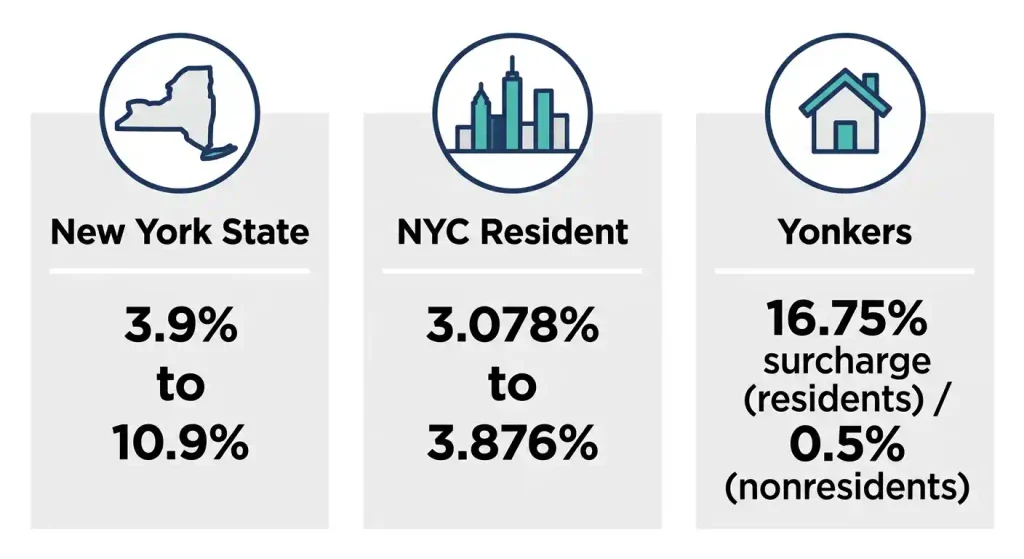
NYC income tax and Yonkers income tax work differently: NYC taxes residents through brackets from 3.078% to 3.876%, while Yonkers residents pay a 16.75% surcharge on state tax, and nonresidents who work there owe 0.5% on those wages.
That surcharge math trips up most filers: Yonkers taxes your state liability, not your paycheck, a detail payroll systems often miss.
Figures here are 2026 estimates; actual bills shift with deductions, credits, and filing status.
NYC vs. Yonkers Income Tax at a Glance
The core difference comes down to mechanics: NYC applies tax directly to your income, Yonkers applies it to your state tax bill. That distinction decides which local tax ends up smaller for you.
NYC Income Tax vs. Yonkers Income Tax
NYC income tax, officially the New York City personal income tax (covered in full in our New York City income tax guide), applies to residents only, regardless of borough: Manhattan, Brooklyn, Queens, Bronx, and Staten Island are taxed the same way. Yonkers works differently: residents owe a surcharge on their state tax, while nonresidents only owe tax on wages earned from work actually performed there.
Which Location Has Lower Local Income Tax?
Yonkers residents usually pay less local tax than NYC residents at the same salary. A single filer earning an $80,000 salary in Yonkers pays about $631 in surcharge tax for 2026, which you can check against your own numbers with our Yonkers paycheck calculator, while a similar NYC resident owes city tax in the thousands, since NYC taxes income directly rather than as a percentage of state tax. Working in Yonkers without living there means just 0.5% of those wages. Yonkers and NYC are the only two cities in New York with local income tax; other Westchester County towns have none.
2026 NYC and Yonkers Income Tax Rates
New York State has nine brackets for 2026, running 3.9% to 10.9%, part of the broader New York state income tax system. NYC’s resident tax runs 3.078% to 3.876%. The state’s five lowest brackets dropped for 2026, which also lowers the Yonkers surcharge.
NYC Resident Income Tax Rates and Brackets
NYC taxes residents across four marginal brackets, 3.078% to 3.876%, with only the income in each bracket taxed at that rate, detailed in our full breakdown of NYC tax brackets for 2026. Filing status shifts the bracket thresholds, and NYC’s earned income tax credit and child and dependent care credit can lower what you owe. The NYC rate schedule for 2026 is unchanged from 2025; this year’s state tax cuts applied to state brackets, not city ones.
Yonkers Resident Income Tax Surcharge
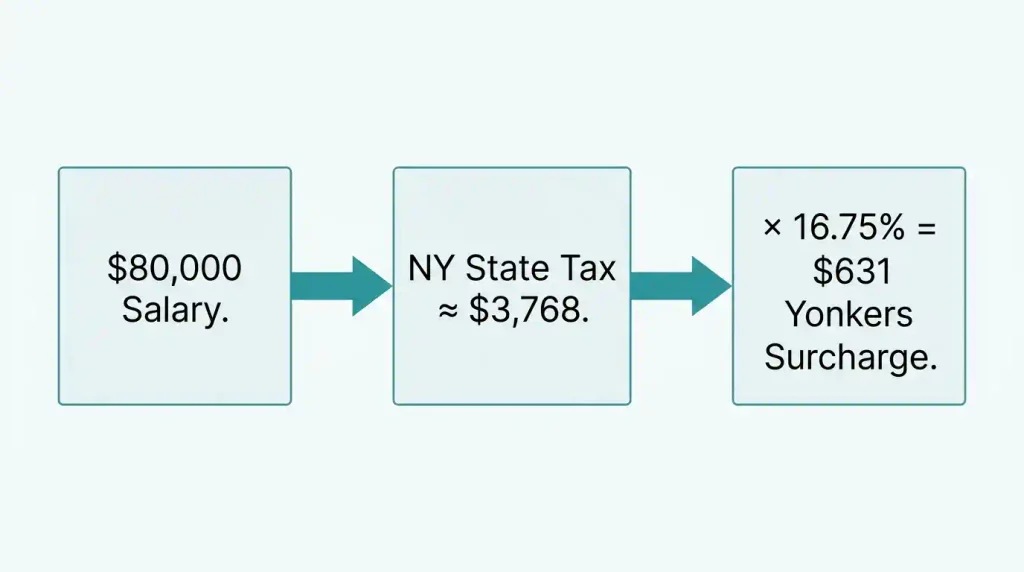
Yonkers taxes your New York State tax bill, not your income, a mechanic we walk through fully in our Yonkers income tax guide. Multiply your state tax liability by 16.75% to get the surcharge. On an $80,000 salary with about $3,768 in state tax, that’s roughly $631. Because the surcharge is pegged to what you owe New York State, not to your salary, big deductions can shrink it even at higher income. New York’s lower 2026 brackets also shrink the surcharge for anyone they apply to.
Yonkers Nonresident Earnings Tax
Nonresidents who work in Yonkers owe a flat 0.5% tax on wages and self-employment earnings from work performed there, a situation covered step by step in our Yonkers nonresident tax rules. This rate is unchanged for 2026. After subtracting an exclusion amount, apply 0.5% to what’s left, reported on Form Y-203; spouses with Yonkers income file separately. You owe nothing if you weren’t a Yonkers nonresident all year, or if your total tax was under $3,000 and fully withheld. Short withholding may require estimated New York tax payments to avoid underpayment penalties.
NYC vs. Yonkers Take-Home Pay by Salary
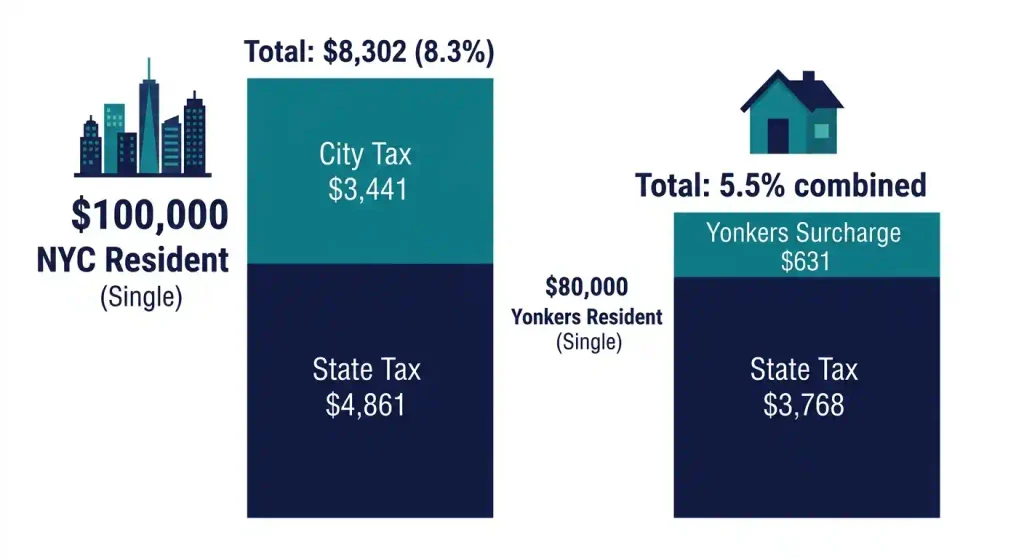
A single NYC resident earning $100,000 pays about $4,861 in state tax and $3,441 in city tax in 2026, totaling $8,302, or 8.3%. A Yonkers resident at $80,000 pays about $3,768 in state tax plus a $631 surcharge, about 5.5% combined. Neither figure includes federal income tax, which usually outweighs both combined. NYC’s local tax generally costs more in dollars than the Yonkers surcharge at the same income. Run your own figures through our New York paycheck calculator to see how deductions and credits affect your actual take-home pay.
| Salary | Area | State Tax | Local Tax | Combined | % of Income |
|---|---|---|---|---|---|
| $100,000 | NYC (single) | $4,861 | $3,441 | $8,302 | 8.3% |
| $80,000 | Yonkers (single) | $3,768 | $631 | $4,399 | 5.5% |
Take-Home Pay at Different Salary Levels
At $50,000, both local taxes stay modest, a few hundred to low thousand dollars. By $75,000, NYC’s tax starts pulling ahead of the Yonkers surcharge. At $100,000, NYC tax runs $3,000 to $3,500, while Yonkers sits near $800. By $150,000 and a $200,000 salary, the gap widens further as NYC’s top 3.876% bracket covers more income. Treat these ranges as ballpark figures; your deductions, credits, and filing status will move the final number.
Single vs. Married Filing Jointly
Married filing jointly raises bracket thresholds for both NYC and state tax, usually lowering the effective rate versus filing single at the same combined income. The Yonkers surcharge tracks the joint state tax. If spouses have different city residency, say one lives in Yonkers and one doesn’t, the nonresident spouse may still need a separate Yonkers nonresident earnings tax return.
Marginal Rate vs. Effective Tax Rate
Marginal rate taxes your last dollar; effective rate is total tax divided by total income, and it’s always lower. Reaching the 3.876% NYC bracket doesn’t tax your whole income at that rate, only the portion inside it. This is also why paycheck withholding rarely matches your final effective rate; bonuses or raises can throw it off until you file.
Does Where You Live or Work Determine Your Local Tax?
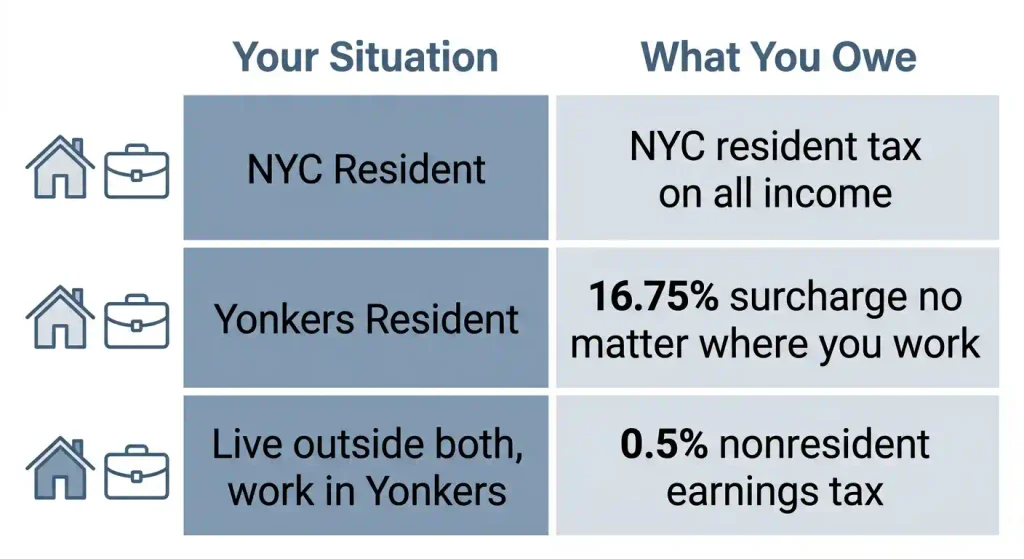
Yes, and NYC and Yonkers work differently. NYC taxes residency, not workplace. Yonkers taxes residency through its surcharge, and workplace through its nonresident earnings tax.
NYC Resident Working in Yonkers
NYC residents owe NYC resident tax on all income, regardless of where they work. Working in Yonkers adds the Yonkers nonresident earnings tax on wages earned there. Commuting out of the city for work doesn’t remove NYC tax; residency decides it.
Yonkers Resident Working in NYC
Yonkers residents owe the 16.75% surcharge no matter where they work, including Manhattan. They don’t owe NYC resident income tax, since that only applies to actual NYC residents. A Yonkers resident commuting into NYC pays only the surcharge, not NYC tax.
Living Outside Both Cities and Working in Either City
Living outside NYC and Yonkers means owing neither city’s resident tax. NYC’s personal income tax doesn’t apply to nonresidents who merely work there. Working in Yonkers is the exception: the 0.5% nonresident earnings tax applies based on where the work happens. New York State tax is separate and applies to New York State source income regardless of city residency, a distinction explained further in our guide to New York resident vs. nonresident tax rules.
How to Calculate Your Actual NYC or Yonkers Tax
Start with salary, filing status, and residency. Apply NYC’s bracket schedule or the Yonkers 16.75% formula depending on where you live.
Information Needed for an Accurate Estimate
You need gross salary, filing status, tax residence, and deductions or credits. Your New York return starts with federal adjusted gross income (AGI), then applies adjustments and your standard deduction, $8,000 for single filers in 2026, or itemized deductions, to get New York taxable income. Our breakdown of New York paycheck deductions covers how each piece reduces what you owe. Yonkers nonresidents also need to know how much income was earned for work performed in Yonkers. Withholding and annual tax liability aren’t the same thing.
Calculate Local Tax and Compare Results
NYC residents apply the 2026 city brackets to taxable income after credits. Yonkers residents multiply state tax by 16.75%. Yonkers nonresidents apply 0.5% to Yonkers-sourced earnings via Form Y-203. Compare NYC and Yonkers tax only with the same salary, filing status, and deductions held constant.
Check Your Paystub for Local Tax Errors
Check your paystub for an NYC or Yonkers tax line and confirm it matches your actual residency and work location, following our guide on how to read a New York pay stub. Your home address, not your mailing address or employer’s location, determines resident status. If something’s off, revisit Form IT-2104 with your employer, or Form IT-2104.1 for a city residency change.
What Happens If You Move Between NYC and Yonkers?
Your local tax changes on the date your residency actually changes. You’ll generally file as a part-year resident for both cities that year.
Moving From NYC to Yonkers
Domicile change depends on where you actually live, your family, and ties like voter registration and your driver’s license. Before the move you owe NYC resident tax; after, the Yonkers surcharge. Form IT-360.1 reports the change and splits income between the two periods, under the same part-year resident tax rules that apply to any mid-year move.
Moving From Yonkers to NYC
This runs in reverse: the Yonkers surcharge stops and NYC resident tax starts once residency shifts. Withholding can lag the move, so check your paystub after. You’ll file as a part-year resident of both cities, splitting income and deductions across the two periods.
Domicile, Permanent Place of Abode, and Day Counts
Domicile is your true, permanent home. A permanent place of abode is a physical home you maintain, a separate legal test. New York’s statutory residency rule can tax you as a resident if you keep a permanent place of abode and spend more than 184 days in the state, even without a domicile change. Multiple homes or lingering ties like a storage unit can become evidence in a residency dispute.
Remote Work, Commuting, and Special Income Situations
Your tax residence, not your employer’s address, decides what you owe when working remotely.
Working Remotely for an NYC or Yonkers Employer
Your employer’s NYC or Yonkers location doesn’t decide your local tax; where you live does. New York’s convenience-of-the-employer rule can treat remote work days as New York workdays for state tax if you work from home by choice, not necessity. An NYC resident working remotely from a second home in Yonkers still owes NYC tax if NYC stays their primary residence. A Yonkers resident working remotely for an NYC employer still owes the Yonkers surcharge, not NYC tax.
Bonuses, Commissions, Overtime, and Multiple Work Locations
Bonuses and commissions withhold at flat supplemental rates for 2026: 11.70% at the state level, plus 4.25% for NYC residents or 1.95975% for Yonkers residents, rates broken down further in our New York supplemental wage tax guide. These are upfront estimates; your real bracket and residency set the final tax. Earnings split between Yonkers and elsewhere must be allocated, since only the Yonkers portion faces the nonresident tax.
Self-Employment and Business Income
Self-employed people working in Yonkers follow the same nonresident earnings tax rules, applied to net self-employment earnings instead of wages, a topic our guide to 1099 taxes in New York covers in more depth. Business owners in the NYC metro area may also owe the Metropolitan Commuter Transportation Mobility Tax (MCTMT), based on net earnings above certain thresholds. Relevant 2026 forms: Y-203 for Yonkers, and standard state forms for MCTMT.
Common NYC vs. Yonkers Income Tax Myths
Most confusion comes from a few repeated misunderstandings.
Common Misconceptions
- Yonkers charges 16.75% of your state tax bill, not your gross salary.
- Working in NYC doesn’t make you liable for NYC resident income tax; residency does.
- Living elsewhere part of the year doesn’t automatically end NYC tax residency if you keep a home there and spend enough days in the city.
- The Yonkers resident surcharge and nonresident earnings tax are different taxes with different rates and triggers.
- Paycheck withholding is an estimate, not your final tax bill.
Which Tax Forms and Official Resources Do You Need?
A handful of forms and withholding resources cover most NYC and Yonkers tax situations.
New York State and Local Tax Forms
- Form IT-201 — full-year New York State residents
- Form IT-203 — nonresidents and part-year residents
- Form IT-360.1 — change in city resident status
- Form Y-203 — Yonkers nonresident earnings tax
Official 2026 Tax Tables and Instructions
The New York State Department of Taxation and Finance publishes NYS-50-T-NYS, NYS-50-T-NYC, and NYS-50-T-Y, the official withholding tables for state, NYC, and Yonkers tax. The New York City Department of Finance handles property, business, and parking-related billing, not personal income tax, which the state collects entirely. The City of Yonkers has no separate filing system either; its surcharge runs through the state return. For 2026, the state revised its New York State personal income tax rate schedules for the bottom five brackets, and state and Yonkers withholding tables updated to match. NYC’s tables stayed the same as 2025.
Frequently Asked Questions
Is NYC or Yonkers income tax higher in 2026?
NYC’s local tax usually costs more in dollars than the Yonkers surcharge, since NYC taxes income directly instead of as a percentage of state tax. The exact gap depends on income, credits, and deductions.
Do I pay NYC income tax if I live in Yonkers and work in Manhattan?
No. NYC resident income tax only applies to NYC residents. You’d still owe New York State income tax and the Yonkers resident surcharge.
Do I pay Yonkers tax if I live in NYC and work in Yonkers?
You may owe the Yonkers nonresident earnings tax, a flat 0.5% on wages earned there. You’d still owe NYC resident income tax on all your income.
Is Yonkers income tax 16.75% of my salary?
No. The surcharge is 16.75% of your New York State income tax liability, not your salary, so it’s far smaller than 16.75% of your paycheck.
Can moving to Yonkers reduce my total taxes?
Often, since the surcharge typically runs lower than NYC’s brackets. But housing costs, commuting, and residency rules also affect whether a move actually saves money.
Which tax return do I file if I move during the year?
Form IT-360.1 reports the city residency change and splits income between periods. You may also file as a part-year or nonresident on your state return.
Final Comparison: Which Tax Rules Apply to Your Situation?
NYC residents owe city tax on all income under NYC’s bracket schedule, regardless of work location. Yonkers residents owe a 16.75% state-tax surcharge, also regardless of work location. Anyone working in Yonkers without living there owes a 0.5% tax on just the Yonkers-sourced portion. Check current forms and withholding tables at tax.ny.gov before making any move or financial decision, since rates and thresholds shift yearly.

Meet Yasin Ali, Founder
Yasin built NY Paycheck Calculator in 2020 after getting fed up with calculators that treated New York like every other state. Most tools ignore the extra local tax NYC and Yonkers workers pay on top of state tax — or skip New York’s Paid Family Leave deduction entirely.
He keeps the numbers current, checking in regularly against the latest IRS, NY Department of Taxation and Finance, and Paid Family Leave rates.
All results here are estimates based on official sources. For advice specific to your situation, talk to a tax professional.