
NYC tax brackets 2026 are the four progressive city income tax rates New York City residents pay on top of state tax, based on taxable income and filing status, not gross salary.
These brackets follow New York’s 2026 rate schedule, updated under Chapter 59 of the Laws of 2025, and confirmed against NYS-50-T-NYC (1/26).
High earners get little relief: the top surcharge, once due to expire in 2027, now runs through 2032.
NYC Tax Brackets 2026: Rates and Income Limits at a Glance
| Tax | Rate Range | Number of Brackets |
|---|---|---|
| NYC resident tax | 3.078% – 3.876% | 4 |
| New York State tax | 3.9% – 10.9% | 9 |
A single NYC resident with $100,000 in taxable income owes roughly $9,100 combined, before federal tax.
NYC Income Tax Rates by Filing Status
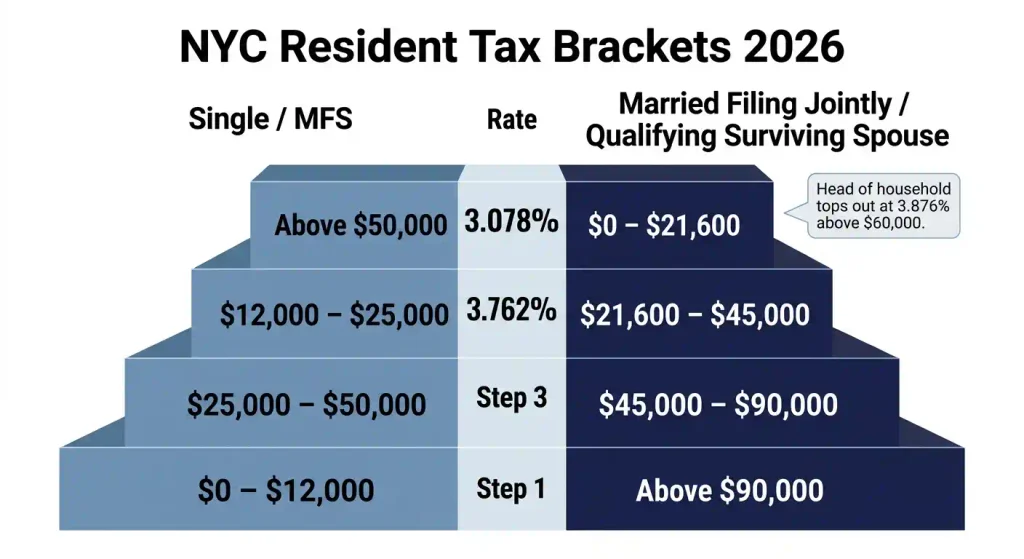
| Rate | Single / MFS | Married Filing Jointly / Qualifying Surviving Spouse |
|---|---|---|
| 3.078% | $0 – $12,000 | $0 – $21,600 |
| 3.762% | $12,000 – $25,000 | $21,600 – $45,000 |
| 3.819% | $25,000 – $50,000 | $45,000 – $90,000 |
| 3.876% | Above $50,000 | Above $90,000 |
Head of household tops out at the 3.876% rate above $60,000. Qualifying surviving spouses use the joint brackets. This is the New York City resident tax rate schedule for 2026, applied to your NYC taxable income, not gross pay.
NYC Tax Rates Compared With 2025
NYC brackets didn’t change. The New York State income tax brackets 2026 cut the five lowest rates by 0.1 point each:
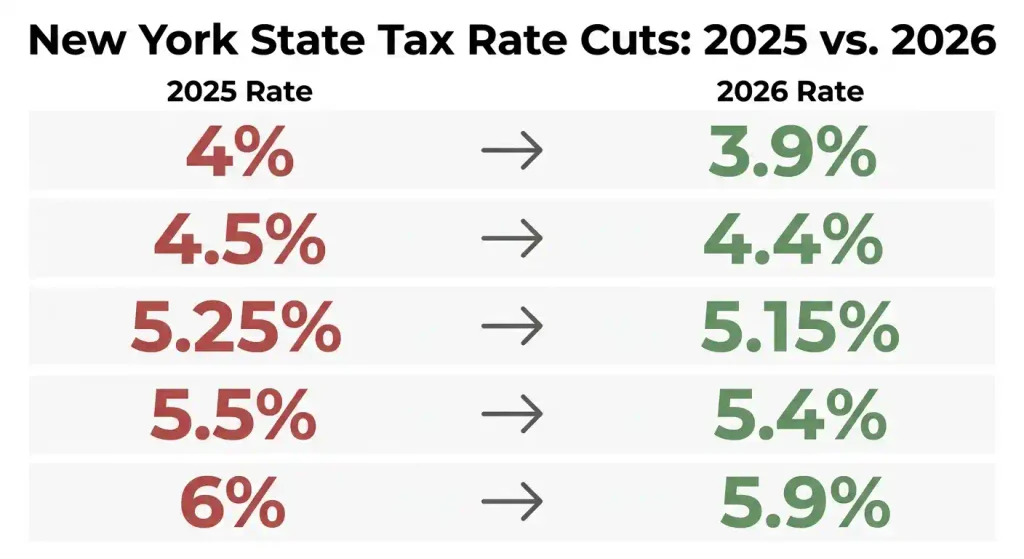
| 2025 Rate | 2026 Rate |
|---|---|
| 4% | 3.9% |
| 4.5% | 4.4% |
| 5.25% | 5.15% |
| 5.5% | 5.4% |
| 6% | 5.9% |
The top four, 6.85%, 9.65%, 10.3%, and 10.9%, stayed the same. Another 0.1-point cut to the lowest five is set for 2027. The temporary high-earner surcharge (9.65%, 10.3%, 10.9%) was set to expire after 2027 but is now extended through 2032.
How NYC Income Tax Brackets Work
NYC tax is progressive: each slice of income is taxed at its own bracket rate, not your top rate applied to everything.
What Is a Marginal Tax Rate?
Your marginal rate taxes only your last dollar earned. A single filer with $60,000 taxable income has a 3.819% top city rate, but the first $12,000 is still taxed at 3.078% and the next slice at 3.762%. Your effective rate, the blended average, is always lower than your marginal rate. A raise that crosses a bracket line still raises take-home pay, just by slightly less on that top slice. Above $107,650 of New York adjusted gross income, a supplemental tax under NY Tax Law §601(d) gradually recaptures the lower-bracket benefit at each bracket threshold, continuing up through the top rate for very high earners.
Salary vs. NYC Taxable Income
Salary isn’t taxable income. Gross income minus adjustments gives adjusted gross income (AGI); New York-specific adjustments to that produce your New York adjusted gross income; subtracting the standard or itemized deduction gives taxable income. New York sets its own standard deduction, separate from the federal one. A $100,000 salary might become $85,000 to $90,000 of taxable income after 401(k) and health premium contributions.
How Much NYC Income Tax Will You Pay at Different Salaries?
Estimates below use 2026 state and city brackets on taxable income after deductions, for a single filer. Official state tax tables may round slightly differently.
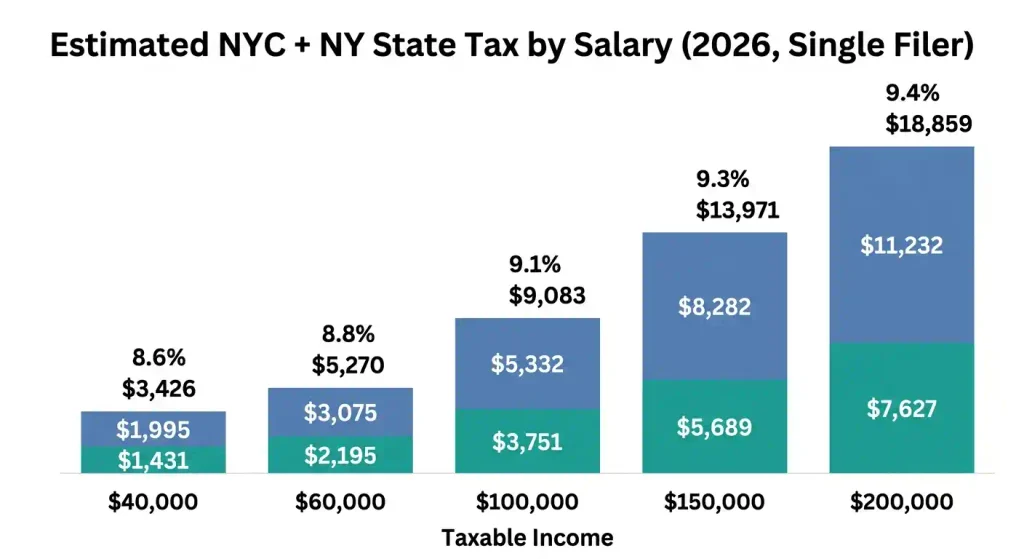
| Taxable Income | NY State Tax | NYC Tax | Combined | Effective Rate |
|---|---|---|---|---|
| $40,000 | ~$1,995 | ~$1,431 | ~$3,426 | 8.6% |
| $60,000 | ~$3,075 | ~$2,195 | ~$5,270 | 8.8% |
| $100,000 | ~$5,332 | ~$3,751 | ~$9,083 | 9.1% |
| $150,000 | ~$8,282 | ~$5,689 | ~$13,971 | 9.3% |
| $200,000 | ~$11,232 | ~$7,627 | ~$18,859 | 9.4% |
NYC Tax Examples for Common Salary Levels
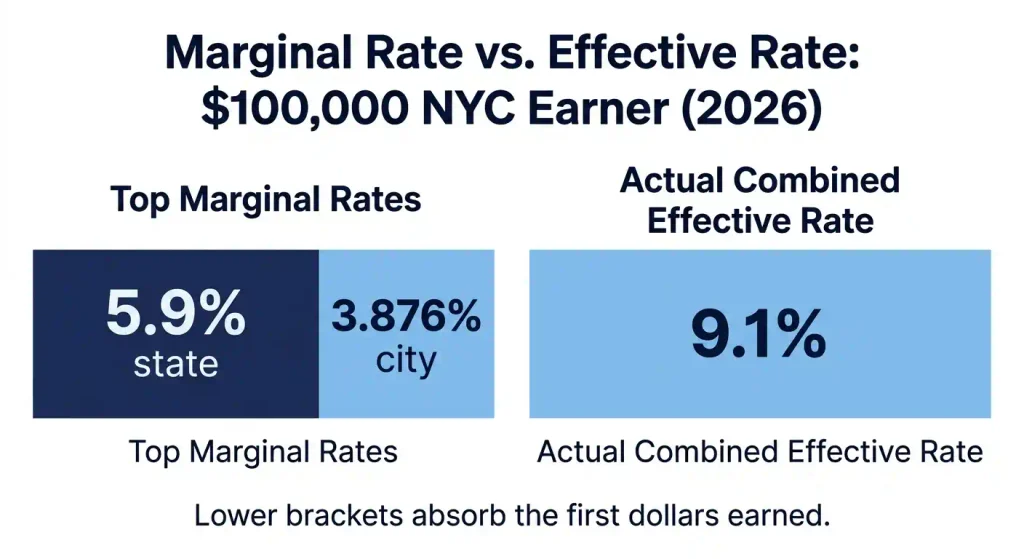
These single-filer estimates use no credits. Because lower brackets absorb the first dollars earned, a $100,000 earner’s 9.1% combined rate sits well under the 5.9% state and 3.876% city top rates. For more income levels, browse our paycheck tax scenarios by salary, including a closer look at a $200,000 salary after taxes in New York. Your actual bill depends on real taxable income and credits.
How Filing Status Changes Your NYC Tax
Joint filers get brackets roughly double the single thresholds. Head of household sits between single and joint. Married filing separately uses the same narrow brackets as single, so joint filing usually wins for NYC couples, except in cases like heavy medical deductions or income-based student loan repayment.
How to Calculate NYC Income Tax Step by Step
Find your NYC taxable income on your New York State return. Apply each bracket rate only to the income within that bracket. Subtract credits like the NYC school tax credit. Compare the result to your withholding; a gap means a refund or a balance due. Your 2026 NYC personal income tax may differ slightly from a calculator’s number due to rounding or extra credits it applies. See our calculation methodology for exactly how we build these estimates.
How NYC Taxes Affect Your Take-Home Pay
Federal, state, and city tax plus FICA all come out of one paycheck, but each is calculated separately.
NYC vs. New York State vs. Federal Income Tax
The federal income tax brackets 2026 run up to 37% and don’t depend on New York. State tax applies to all residents; city tax is extra, for NYC residents only, filed via Form IT-201. Social Security and Medicare taxes are deducted too, as FICA payroll taxes, at 6.2% and 1.45%, regardless of where you live.
Estimated Take-Home Pay on a NYC Salary
Combined federal, state, city tax and FICA typically take 28% to 35% of gross pay for incomes between $60,000 and $150,000, rising with income; that lines up with the roughly 8.8% to 9.3% state-and-city share shown above once federal tax and the 7.65% FICA share are added. Your W-4, IT-2104 elections, retirement contributions, and health premiums shift the real number. Run your own numbers with our New York paycheck calculator for the exact split on your pay. If your check looks smaller than expected, our guide on why your New York paycheck is lower than you thought walks through the usual causes. Comparing the same salary against a nearby suburb or another state shows how much the city layer actually costs, since most skip it entirely.
Why Your NYC Paycheck Tax May Differ From Your Final Tax Bill
Withholding tables estimate your tax; they don’t match it exactly. Marriage, a new child, or freelancing can throw it off. Form IT-2104 lets you adjust withholding. A refund means you overpaid; owing means withholding fell short.
Who Has to Pay NYC Resident Income Tax?
Anyone who lives in the five boroughs and counts as an NYC resident for tax purposes owes the tax.
NYC Residents Who Owe City Income Tax
NYC resident tax applies to Manhattan, Brooklyn, Queens, the Bronx, and Staten Island residents, with identical brackets in every borough. It’s separate from your New York State resident income tax and filed on the same return. Residency hinges on your permanent place of abode or spending 184 days or more in the city, the core of the New York City statutory residency test. State and city residency are related but distinct tests, covered in more detail in our resident vs. nonresident tax rules guide.
Working in NYC but Living Outside the City
Living in NYC triggers the tax; working there doesn’t. Commuters from Westchester, Long Island, or New Jersey owe New York State tax on income earned in-state but nothing to NYC.
Moving Into or Out of NYC During 2026
Part-year residents owe NYC tax only on income earned while living there, reported on Form IT-360.1. For the full breakdown, see our part-year resident tax rules guide. Watch bonus or stock-vesting timing against the move date. Keeping a place of abode in NYC after moving, while still spending significant time there, can still trigger the statutory residency test.
NYC Tax Rules for Remote Workers
Residency, not employer location, decides NYC tax. A Brooklyn-based remote employee owes it regardless of where the employer sits; someone outside the five boroughs working remotely for an NYC company doesn’t. Hybrid workers splitting time between homes should check the statutory residency rules closely.
NYC Tax Credits, Deductions, and Special Situations
Credits like the school tax credit cut your bill directly; deductions only cut the income taxed.
NYC School Tax Credit and Other Applicable Credits
The fixed NYC school tax credit is up to $125 for joint filers and about $62.50 for single filers. NYC also offers its own earned income credit, a percentage of your federal EITC. Credits reduce tax owed; deductions reduce taxable income, so a $1,000 credit saves more than a $1,000 deduction.
Bonuses, Overtime, and Multiple Income Sources
Bonuses, commissions, and overtime count as regular taxable income once the year ends, though employers often withhold on them at a flat supplemental rate that can run below your true bracket, a pattern our guide on how New York taxes bonuses breaks down in full. Multiple jobs or side income all stack together, which can push you into a higher bracket than any single job’s withholding assumed; our guide to getting New York withholding right across multiple jobs explains how to adjust for it.
Self-Employment and Investment Income
Self-employment and investment income face the same NYC rates as wages. If you’re weighing which path fits your work, our 1099 vs. W-2 in New York comparison breaks down the tax difference. Self-employed residents also owe self-employment tax separately, covering the employer’s usual share of Social Security and Medicare. Capital gains, dividends, and rental income get no special lower NYC or state rate.
Common NYC Tax Bracket Myths and Misconceptions
No, your whole income is never taxed at your top bracket rate.
Does Your Entire Salary Get Taxed at Your Highest Bracket?
A single filer with $60,000 taxable income doesn’t pay 3.819% on all of it: $12,000 is taxed at 3.078%, the next slice at 3.762%, and only the amount above $25,000 at 3.819%. Marginal rate is just the rate on your next dollar; effective rate, the blended average across everything you earned, is always lower.
Is NYC Income Tax the Same as New York State Tax?
No, they’re separate taxes filed together. State tax applies to every resident; NYC tax only to the five boroughs. Residents of Yonkers face their own local income tax instead, which you can estimate with our Yonkers paycheck calculator. Sales tax and payroll taxes are different again. It’s also not the Metropolitan Commuter Transportation Mobility Tax, a payroll tax on certain employers and self-employed people in the region, not a personal income tax on residents.
Does Everyone Who Works in NYC Pay NYC Resident Income Tax?
No. Residence, not workplace, creates the obligation. Commuters from outside the five boroughs owe no NYC resident tax, though New York State tax may still apply.
How to Check and Correct NYC Tax Withholding
Compare your pay stub’s city tax line against the bracket math; fix mismatches through payroll or Form IT-2104.
Understanding the 2026 NYC Withholding Tables
The official 2026 NYC withholding tables are in Publication NYS-50-T-NYC (1/26), effective for wages paid from January 1, 2026. They mirror the bracket structure above but format it for payroll. New York State published a separate, parallel update for its own lower five brackets. Small gaps between withholding and your actual bill are normal.
What to Do if Your NYC Tax Withholding Looks Wrong
Check your address and residency status with payroll first. Review Form IT-2104 after any raise, marriage, or new dependent. Use Form IT-2104.1 after a residency change. If your pay stub shows no city tax despite NYC residency, or the number looks far off, contact payroll directly.
Frequently Asked Questions About NYC Tax Brackets 2026
What are the NYC income tax rates for 2026?
Four brackets: 3.078%, 3.762%, 3.819%, 3.876%, based on taxable income and filing status, separate from paycheck withholding rates.
What is the highest NYC income tax rate in 2026?
3.876%, above $50,000 (single), $90,000 (joint), or $60,000 (head of household), applied only to income above that line.
Did NYC tax brackets change for 2026?
No. New York State’s five lowest brackets dropped by 0.1 point each; the city brackets stayed the same.
How much NYC tax do I pay on a $100,000 salary?
Depends on taxable income after deductions, not gross salary. On $100,000 of taxable income, a single filer owes about $3,751 in city tax and $5,332 in state tax.
Do I pay NYC income tax if I work in the city but live elsewhere?
No. Commuters from outside the five boroughs skip NYC resident tax, though New York State tax on in-state earnings still applies, usually filed as a nonresident on Form IT-203.
How do I find NYC tax withheld on my paycheck?
Look for a city tax or NYC tax line below your state tax withholding, labeled using the codes in our pay stub abbreviations guide. Missing despite NYC residency? Flag it to payroll.
Official NYC Tax Resources and 2026 Tax Guidance
Verify rates with the state tax department and the relevant forms before filing.
Official Tax Tables, Forms, and Instructions
The New York State Department of Taxation and Finance publishes official rates and tables. Key forms:
- Form IT-201 (resident return)
- Form IT-360.1 (part-year allocation)
- Form IT-2104 (withholding)
For the full library, browse our New York tax forms and withholding hub. That same 2026 withholding publication, along with residency tools, is on the department’s site. The city tax’s legal basis is NYC Administrative Code § 11-1701. The New York City Department of Finance and the NYC Comptroller publish supplementary city fiscal data, though returns and collection run through the state.
Which 2026 Tax Information Should You Verify Before Filing?
Confirm final 2026 brackets against the Department of Taxation and Finance’s published schedules, since legislative updates can still land. Withholding tables are a planning tool, not your final bill. Check official instructions against your own deductions, credits, and residency timeline.

Meet Yasin Ali, Founder
Yasin built NY Paycheck Calculator in 2020 after getting fed up with calculators that treated New York like every other state. Most tools ignore the extra local tax NYC and Yonkers workers pay on top of state tax — or skip New York’s Paid Family Leave deduction entirely.
He keeps the numbers current, checking in regularly against the latest IRS, NY Department of Taxation and Finance, and Paid Family Leave rates.
All results here are estimates based on official sources. For advice specific to your situation, talk to a tax professional.