
A $120,000 salary in New York City nets roughly $82,500 to $83,500 after taxes each year for a single filer with no pretax deductions, about $6,850 to $6,950 a month in 2026.
This figure applies 2026 federal, New York State, and NYC tax rules directly to a $120,000 salary, not a rounded estimate.
Actual take-home still varies with your benefits, 401(k) contributions, and employer withholding choices.
How Much Is $120,000 After Taxes in NYC in 2026?
Estimated Annual and Monthly Take-Home Pay
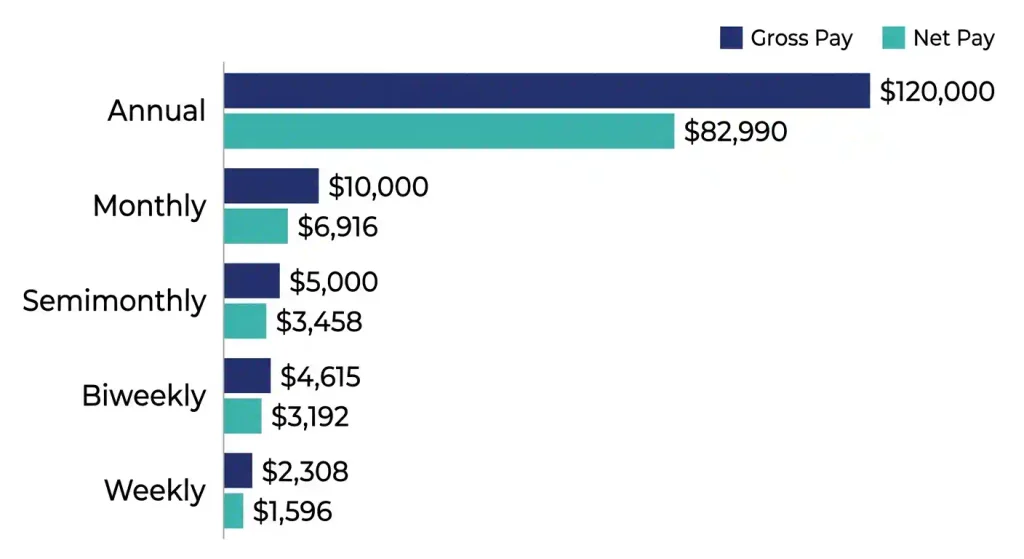
A single NYC resident earning $120,000 with no 401(k), health premiums, or other voluntary deductions keeps around $82,990 a year, or $6,916 a month. This moves gross salary through taxable income to take-home pay, applying Federal income tax 2026 rules on the $16,100 standard deduction, New York State income tax 2026 brackets, New York City resident income tax, and withholding under the Federal Insurance Contributions Act (FICA). It’s an estimate of tax liability, not a guarantee of your deposit, since real paychecks also reflect health insurance, retirement contributions, and employer rounding.
$120,000 NYC Salary Breakdown at a Glance
| Pay Period | Gross Pay | Net Pay (approx.) |
|---|---|---|
| Annual | $120,000 | $82,990 |
| Monthly | $10,000 | $6,916 |
| Semimonthly | $5,000 | $3,458 |
| Biweekly | $4,615 | $3,192 |
| Weekly | $2,308 | $1,596 |
This assumes the standard deduction with nothing out for health insurance or a 401(k). Add those and taxable income drops, but so does the deposit, since the premium or contribution comes from the same check. Total annual taxes run roughly $37,010 against $120,000 gross. Not every online calculator accounts for NYC’s local tax, which is why estimates vary by a few hundred dollars between tools.
How Much Is a $120k NYC Paycheck After Taxes?
Biweekly nets about $3,192; semimonthly nets about $3,458.
Biweekly Paycheck on a $120,000 Salary
Most NYC employers pay biweekly, 26 paychecks a year. Gross is $4,615 per check, netting roughly $3,192 after federal, state, city, and FICA withholding. Two months a year get three paychecks instead of two, since 26 periods don’t divide evenly across 12 months, but it’s still your normal salary, just spread differently. Your actual number shifts with your W-4 elections and benefits.
Semimonthly, Weekly, and Monthly Pay Compared
Semimonthly (1st and 15th, 24 checks) gives $5,000 gross, about $3,458 net, a bit more per check than biweekly. Weekly (52 checks) is $2,308 gross, about $1,596 net. The annual total is identical either way; only cash-flow predictability changes.
What Taxes Come Out of a $120,000 NYC Salary?
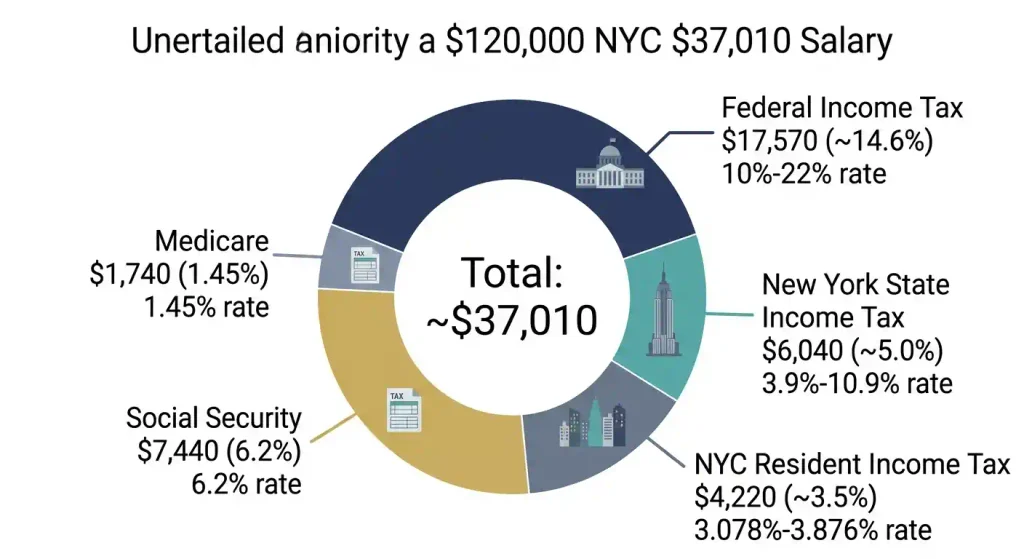
Federal, New York State, NYC, and FICA taxes combine to about $37,010 a year.
| Tax | Rate(s) | Amount on $120,000 |
|---|---|---|
| Federal Income Tax | 10%-22% (marginal) | ~$17,570 |
| New York State Income Tax | 3.9%-10.9% (marginal) | ~$6,040 |
| NYC Resident Income Tax | 3.078%-3.876% | ~$4,220 |
| Social Security | 6.2% | $7,440 |
| Medicare | 1.45% | $1,740 |
| Total | – | ~$37,010 |
Federal Income Tax
The 2026 standard deduction for single filers is $16,100, making taxable income $103,900. Rates run 10% on the first $12,400, 12% up to $50,400, and 22% on the rest up to $105,700, for a federal bill near $17,570, an effective rate of about 14.6% despite a 22% top bracket. These figures reflect tax year 2026, up from a $15,750 standard deduction in tax year 2025, under the One Big Beautiful Bill Act and the earlier Tax Cuts and Jobs Act (TCJA). This assumes the standard deduction rather than itemizing, which only helps if deductions like mortgage interest exceed $16,100. At $103,900 taxable, you’re just under the 24% bracket, which starts at $105,700, so this salary stays within the federal 10%, 12%, 22%, and 24% tax brackets. The Internal Revenue Service (IRS) adjusts these thresholds for inflation yearly.
New York State Income Tax
New York’s 2026 standard deduction for single filers is $8,000, leaving state taxable income near $112,000. New York runs nine brackets from 3.9% to 10.9%; $1,077,550 is where the 9.65% bracket begins, and the true 10.9% top rate doesn’t apply until income passes $25,000,000. State tax at $120,000 lands around $6,040, an effective rate near 5%, based on the bracket-by-bracket math across New York’s nine rates. New York also phases in middle-class tax rate reductions, and at this income the state’s tax benefit recapture provision can claw back part of that benefit above certain thresholds.
NYC Resident Income Tax
NYC residents pay a local resident tax on top of state tax, regardless of employer location, as long as they live in the five boroughs. At $120,000, that’s roughly $4,220 a year, about 3.5% of gross pay. Working in NYC while living outside it, say New Jersey or Westchester, skips this tax. NYC’s resident brackets run through NYC personal income tax rates of 3.078%, 3.762%, 3.819%, and 3.876%, with the top rate applying above $50,000.
Social Security and Medicare Taxes
FICA is flat for W-2 employees: 6.2% Social Security and 1.45% Medicare, 7.65% total. On $120,000, that’s $7,440 Social Security and $1,740 Medicare, $9,180 combined. The 2026 Social Security wage base is $184,500, so the full salary is taxed at 6.2%. The Additional Medicare Tax of 0.9% only starts above $200,000 for a single filer, so it doesn’t apply here. These Social Security tax 2026 and Medicare tax 2026 amounts are withheld under FICA, and the Social Security Administration (SSA) uses the wage reports for future benefits. This assumes W-2 employee wages; self-employed earners at $120,000 pay self-employment tax instead, covering both employee and employer shares, and typically make estimated tax payments rather than relying on withholding.
Other Payroll Deductions That Can Reduce Your Deposit
New York also requires Paid Family Leave, 0.432% of wages in 2026, capped around $412 a year, and disability insurance (DBL), capped at roughly $0.60 a week, both automatic and small. Bigger movers are voluntary: health insurance premiums, 401(k) contributions, Health Savings Account (HSA) deposits, Flexible Spending Account (FSA) elections, and commuter benefits like pretax transit passes. These come out before some taxes apply, which is why two people on the same $120,000 can see very different pay stubs.
Is $120,000 a Good Salary to Live in NYC?
Generally yes for a single person, tighter for a couple or family.
How Much Money Is Left After Essential Expenses?
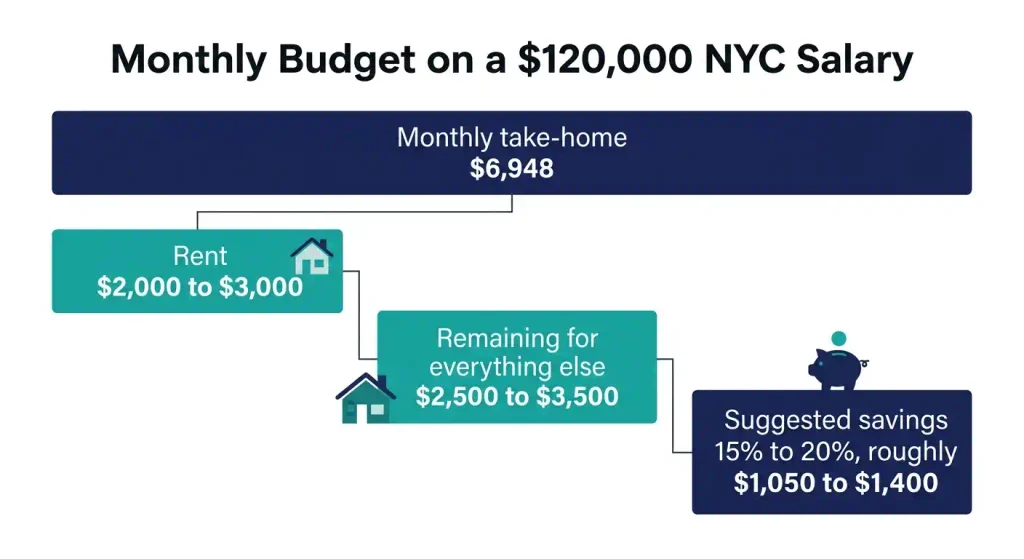
Out of $6,948 a month, rent typically runs $2,000 to $3,000 depending on borough. After rent, utilities, groceries, and transit, you’re usually left with $2,500 to $3,500 a month for everything else. Fixed costs stay constant; groceries, entertainment, and dining out are where choices matter. A common guideline is saving 15% to 20% of monthly disposable income, roughly $1,050 to $1,400 here, toward retirement, an emergency fund, and housing goals. Student loans or credit card debt can eat into that fast, sometimes several hundred dollars a month.
Can You Afford to Live Alone on $120k in NYC?
Solo living is realistic in most outer boroughs and parts of Manhattan. A one-bedroom in outer Brooklyn or Queens often runs $2,000 to $2,800. Moving in alone means covering a deposit and broker fee upfront, often $8,000 to $10,000, so a solid emergency fund matters more than when splitting costs. Most landlords use a rent-to-income ratio of about 40 times monthly rent in annual salary, so $120,000 qualifies for rents up to roughly $3,000 a month.
Can a Couple or Family Live on $120,000?
A single $120,000 income supporting two adults is tighter but workable, more so with a partner’s income. Childcare can run $1,500 to $2,500 a month in NYC, changing the math significantly. Total household income matters more than this one salary alone.
How Does $120,000 After Taxes Compare With Other Salaries?
$100k nets about $70,000 to $72,000; $150k nets about $105,000.
$100k vs. $120k vs. $150k in NYC
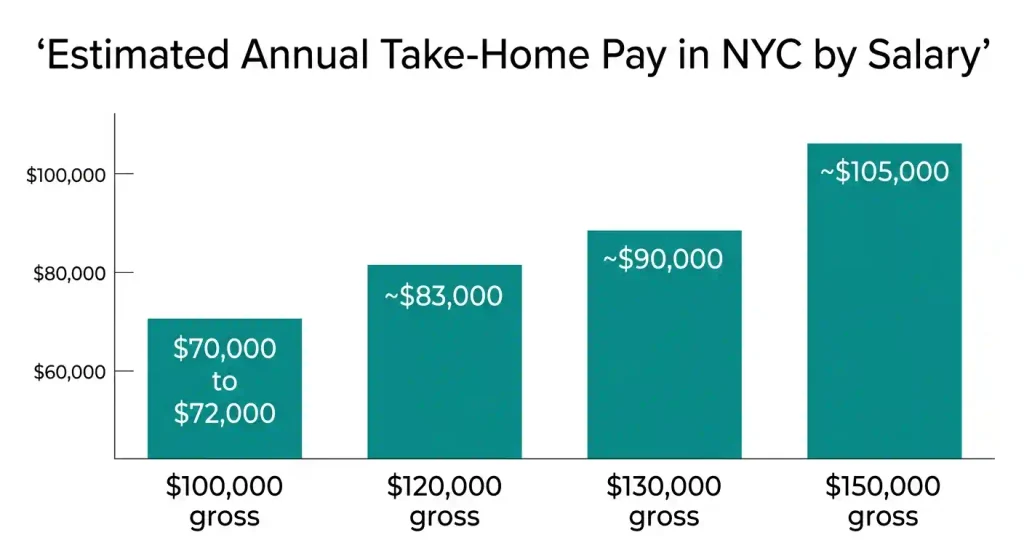
$100,000 nets $70,000 to $72,000 a year, $120,000 nets around $83,000, $130,000 lands around $90,000, and $150,000 climbs to roughly $105,000, as this comparison breakdown shows:
| Gross Salary | Estimated Annual Take-Home |
|---|---|
| $100,000 | $70,000 to $72,000 |
| $120,000 | ~$83,000 |
| $130,000 | ~$90,000 |
| $150,000 | ~$105,000 |
A $20,000 raise from $100k to $120k adds only $11,000 to $13,000 in actual take-home, since more of each dollar hits your marginal rate. More broadly, a $10,000 raise here nets about $6,000 to $6,500 after federal, state, city, and FICA taxes. For a direct look at a higher bracket, see this $200,000 salary breakdown for New York.
$120k in NYC vs. Other Locations
The same salary nets roughly $90,000 to $91,000 in a no-income-tax state like Texas, a $7,000 to $8,000 gap versus NYC. Living in New Jersey and working in the city skips the NYC resident tax (saving roughly $3,000 to $4,000) while still owing New York State nonresident tax. Lower taxes don’t guarantee more purchasing power once rent and cost of living are factored in.
What Gross Salary Would You Need for $8,000 a Month?
Clearing $8,000 a month net as a single NYC filer with no pretax deductions takes a gross salary around $142,000 to $145,000. 401(k) or health insurance contributions push that target higher.
How Filing Status and Benefits Change Your Take-Home Pay
Filing status and pretax benefits can shift your tax bill significantly.
Single vs. Married Filing Jointly
Filing jointly roughly doubles federal brackets and the standard deduction, so a couple with one $120,000 earner usually owes less combined federal tax than two single filers each at $60,000. New York State and NYC use separate joint-filer brackets, so household results depend on combined income. Head of household filing status, for unmarried filers supporting a qualifying dependent, sits between single and joint, with a 2026 standard deduction of $24,150. Married filing jointly brings a 2026 standard deduction of $32,200, roughly double the single amount.
| Filing Status | 2026 Federal Standard Deduction |
|---|---|
| Single | $16,100 |
| Head of Household | $24,150 |
| Married Filing Jointly | $32,200 |
How a 401(k), HSA, and Health Insurance Affect Net Pay
A traditional 401(k) lowers taxable income now; a Roth 401(k) is taxed now for a break later. An HSA, on a qualifying high-deductible plan, reduces taxable income going in and stays tax-free for medical expenses. The catch: a bigger 401(k) contribution lowers your tax bill but still leaves your paycheck, so your deposit can shrink even while you pay less tax. An employer retirement match is free money on top of your $120,000 salary, part of total compensation beyond the base number.
Bonuses, Multiple Jobs, and Tax Withholding
Bonuses, commissions, overtime pay, and stock compensation are withheld as supplemental wages at a flat 22% federal rate, often different from your real effective rate. Two jobs means each employer withholds as if it’s your only income, which can leave you underwithheld. Reviewing Form W-4 for federal withholding and Form IT-2104 for New York helps catch this early. Getting it wrong shows up at filing as a tax refund versus tax owed. After a raise or job change, updating W-4 and IT-2104 keeps withholding current.
Does NYC Income Tax Apply If You Work in NYC but Live Elsewhere?
Only NYC residents pay the resident tax; nonresidents still owe New York State tax.
Living in New Jersey and Commuting to NYC
New York taxes nonresidents on income earned in-state, so a New Jersey resident working in Manhattan still owes New York State tax on it, but not the NYC resident tax, which applies only to five-borough residents. New Jersey generally credits taxes paid to New York through its NJ-COJ process, though not always dollar for dollar. Remote workers should watch the New York convenience of the employer rule, which can tax home-based income if it’s a convenience rather than a necessity.
Moving Into or Out of NYC During 2026
Moving mid-year makes you a part-year resident, with income allocated between resident and nonresident periods. Keep lease dates, utility setup dates, and your move date as proof. New York State and NYC residency are tracked separately, so you could be a full-year state resident but only a part-year NYC resident, filing a New York State part-year resident tax return reflecting both periods.
Remote Work and Other Special Situations
An employer’s Manhattan office doesn’t automatically make all your income NYC or New York taxable if you work remotely from another state; you could owe tax in both. Yonkers is a separate case: it has its own Yonkers resident income tax surcharge for residents and a Yonkers nonresident earnings tax for people who work there but live elsewhere, neither applying to a standard NYC salary. Nonresident status, part-year moves, and multistate remote work are worth a tax professional’s review.
Common Myths About a $120,000 NYC Salary
A $120k salary doesn’t mean $10,000 a month, and the top bracket doesn’t apply to all income.
“A $120k Salary Means $10,000 a Month in My Bank Account”
Gross monthly pay is $10,000, but after federal, NY State, NYC, and FICA taxes, real take-home lands near $6,916 using this guide’s baseline. Health insurance or retirement contributions lower it further.
“My Highest Tax Bracket Applies to All My Income”
At $120,000, the top federal bracket is 22%, but it only applies to income within that bracket, not the whole salary. The effective rate, the real share paid, works out closer to 14.6%.
“Everyone Working in NYC Pays NYC Resident Income Tax”
NYC resident tax applies only to actual city residents. Someone commuting from New Jersey or Long Island still owes New York State tax but not the city’s resident tax. Check which taxes apply if your living situation or work location changes mid-year.
How to Estimate Your Own $120k NYC Take-Home Pay
You need filing status, residency, deductions, and pay frequency for an accurate number.
Information Needed for a More Accurate Estimate
A precise estimate needs a few personal details:
- Filing status, NYC residency or commuter status, dependents, and pay frequency
- Planned 401(k) percentage, health insurance premium, and other pretax deductions
- Other income or credits like the Child Tax Credit (high earners here generally don’t qualify for the Earned Income Tax Credit, since it phases out well below $120,000)
- For job offers, whether the $120,000 includes bonus or equity pay, plus 401(k) matching and health premiums
- Your start date within 2026, since deduction and bracket thresholds apply to the full year regardless
Official Tax Resources for Checking Your Estimate
Several official sources can verify these numbers:
- IRS: updated withholding guidance each year, plus the IRS Tax Withholding Estimator, IRS Publication 15 (Circular E), and IRS Publication 505 for official 2026 withholding tables and worksheets
- New York State: withholding tables for state and NYC tax, published by the New York State Department of Taxation and Finance, including New York State tax rate schedules, Publication NYS-50-T-NYS, and Publication NYS-50-T-NYC under the New York State Tax Law
- New York City: filing questions handled by the New York City Department of Finance
- Your own return: adjusted gross income (AGI) or modified adjusted gross income (MAGI) from last year, reported via Form W-2 and Form IT-201 if you owe New York tax beyond withholding
For the exact formulas and rounding rules behind these numbers, see our calculation methodology.
Frequently Asked Questions
How much is $120,000 a year per month after taxes in NYC?
Roughly $6,916 a month for a single filer with no pretax deductions, using 2026 rates, covering federal, state, city, and FICA taxes only.
What is the biweekly paycheck for $120k in NYC?
About $3,192 net across 26 annual pay periods. Semimonthly (24 a year) runs slightly higher per check, around $3,458.
What is the tax rate on $120,000 in New York City?
The federal marginal rate tops out at 22%, but the combined effective rate, federal, state, city, and FICA together, lands around 30% of gross pay.
Is $120k enough to live comfortably in NYC?
For a single person without major debt, generally yes, with room for savings. A family, high debt, or aggressive savings goals make comfort depend more on your specific budget.
Do I pay NYC income tax if I work in the city but live in New Jersey?
No. NYC resident tax applies only to five-borough residents. You still owe New York State nonresident tax, but New Jersey typically credits it.
How much does a 401(k) contribution reduce my NYC paycheck?
A traditional 401(k) lowers taxable income and your tax bill, but the full contribution still leaves your paycheck. A Roth 401(k) doesn’t reduce taxable income now, so the savings show up later.
Why is my actual paycheck different from an online salary calculator?
Calculators use baseline assumptions: single filer, standard deduction, no extra benefits. Your real paycheck reflects your actual W-4 and IT-2104 elections, premiums, contributions, and pay frequency. For a closer look at why two tools can disagree, see why your New York paycheck might look lower than expected, or run your own numbers through our NY Paycheck Calculator.

Meet Yasin Ali, Founder
Yasin built NY Paycheck Calculator in 2020 after getting fed up with calculators that treated New York like every other state. Most tools ignore the extra local tax NYC and Yonkers workers pay on top of state tax — or skip New York’s Paid Family Leave deduction entirely.
He keeps the numbers current, checking in regularly against the latest IRS, NY Department of Taxation and Finance, and Paid Family Leave rates.
All results here are estimates based on official sources. For advice specific to your situation, talk to a tax professional.