
A $200K salary after taxes in New York State leaves a single filer about $138,200 a year, or $11,514 a month, outside New York City, under 2026 rules.
That figure uses New York’s 2026 brackets, the $16,100 federal standard deduction (IRS), and the $184,500 Social Security wage base (SSA).
It excludes New York’s supplemental tax, which can trim take-home by a few hundred dollars.
How Much Is a $200K Salary After Taxes in New York?
Working out $200,000 after taxes in New York State means stacking four taxes: federal income tax, New York State tax, Social Security, and Medicare. NYC and Yonkers residents pay local tax on top, which lowers take-home further. Start with our New York paycheck basics category if any of these terms are new.
2026 Take-Home Pay at a Glance
For a single filer with the standard deduction, no bonuses, and no extra withholding, federal income tax is about $36,730. New York State income tax is about $10,760 before its supplemental tax. Social Security takes $11,439, since the 2026 wage base caps at $184,500, and Medicare takes $2,900.
You keep about $138,200 a year, $11,514 a month, or $5,314 every two weeks. On a 40-hour week, that is about $96 an hour before tax and $66 after. These numbers assume no NYC or Yonkers residency and no pre-tax deductions. For the underlying concept, see our explainer on gross pay vs. net pay in New York.
$200K Salary After Taxes by Pay Frequency
| Pay schedule | Paychecks per year | Gross per check | Net per check |
|---|---|---|---|
| Weekly | 52 | $3,846 | about $2,657 |
| Biweekly | 26 | $7,692 | $5,314 |
| Semimonthly | 24 | $8,333 | $5,757 |
| Monthly | 12 | $16,667 | $11,514 |
Semimonthly means twice a month on set dates like the 15th and the last day. The annual total never changes, but biweekly workers get two months a year with three paychecks, which throws off many budgets. New York’s pay frequency laws set which schedule your employer can actually use, part of our wages and wage laws hub.
$200K After Taxes in New York by Filing Status
A single filer keeps about $138,200, while a married couple with $200,000 household income keeps about $148,000 to $150,000. Filing status can move your take-home by thousands of dollars.
Single Filer Earning $200,000
The 2026 federal standard deduction of $16,100 brings a single filer’s taxable income to $183,900. With New York’s standard deduction and the Social Security wage base cap, take-home is about $138,200 a year, or about $5,314 per biweekly check. A $200,000 salary is easy to mistake for a $150,000 net figure. It is not.
Married Filing Jointly With $200,000 Household Income
Married filing jointly uses a larger federal standard deduction, about $32,200 for 2026, which drops taxable income to $167,800. With wider New York joint brackets, a couple earning $200,000 together nets about $148,000 to $150,000 a year, roughly $10,000 more than a single filer. This is household income, so it may be one spouse’s pay or two incomes combined.
Head of Household and Other Filing Situations
Head of household status gives a bigger standard deduction than single filing. It applies to unmarried taxpayers who pay more than half the cost of a home for a qualifying dependent, and usually means somewhat lower taxes. Married filing separately usually gives the worst result, with fewer credits and a smaller deduction than joint filing.
Qualifying dependents can unlock the Child Tax Credit or Credit for Other Dependents. Qualifying surviving spouse status, for someone with a dependent child, allows joint-return tax rates for a limited number of years after a spouse’s death.
How Filing Status Changes Your Take-Home Pay
The gap between single and married filing jointly on $200,000 is usually the widest. Brackets set the rate on each layer of income, while deductions and credits reduce taxable income or the bill itself. New York State tax credits, separate from federal ones, can lower your state bill further. Your status depends on your marital status on December 31 and who qualifies as your dependent, both IRS rules.
How New York State, Federal, and Payroll Taxes Affect $200K
Federal, New York State, and payroll taxes take about $61,800 of $200,000, leaving about $138,200. Stacking these systems, plus local tax where it applies, is where most estimates go wrong.
Federal Income Tax on a $200,000 Salary
The Federal income tax brackets 2026 schedule taxes income in layers, and the 2026 federal income tax rates run from 10% to 37%. After the $16,100 standard deduction, a single filer’s taxable income of $183,900 sits mostly in the 22% and 24% brackets, for a federal bill of roughly $36,730. The Internal Revenue Service (IRS) taxes this figure, not your offer-letter salary, on your Form 1040 each spring.
New York State Income Tax on $200,000
New York State personal income tax has nine brackets. The New York State tax brackets 2026 schedule sets the New York State income tax rates 2026 from 3.9% to 10.9%, but a $200,000 salary only reaches the 5.9% bracket. After the state’s standard deduction, a single filer owes around $10,760 under New York State income tax 2026 rules before the supplemental tax, an effective rate of about 5.4% against a 5.9% marginal rate.
Above $107,650 of Adjusted gross income (AGI), New York adds a New York State supplemental tax that removes part of the lower-bracket benefit. A $200,000 filer therefore pays somewhat more than plain bracket math suggests, a nuance covered further in our New York State income tax category.
Social Security and Medicare Taxes
Social Security and Medicare make up the Federal Insurance Contributions Act (FICA) tax. Social Security takes 6.2% of wages up to the Social Security wage base 2026 limit of $184,500, then stops for the year, often in October or November. Medicare has no cap: it takes 1.45% of every dollar, plus an Additional Medicare Tax of 0.9% on wages above $200,000. Payroll taxes fund specific programs, unlike income tax.
New York State Taxes Versus Local Taxes
New York State income tax, also called the New York State resident tax, applies to every New York resident. New York City adds its own New York City income tax, often called the New York City resident tax, and Yonkers adds a smaller Yonkers income tax. Someone in Albany or Rochester pays state tax only, while a Manhattan resident pays both state and city tax.
Nonresidents still owe New York nonresident income tax on wages earned from work performed inside the state. Local tax is the biggest variable in any take-home question.
Total Estimated Tax Burden on $200K
| Tax | Annual amount |
|---|---|
| Federal income tax | about $36,730 |
| New York State income tax | about $10,760 |
| Social Security | $11,439 |
| Medicare | $2,900 |
| Total tax | about $61,800 |
| Take-home pay | about $138,200 |
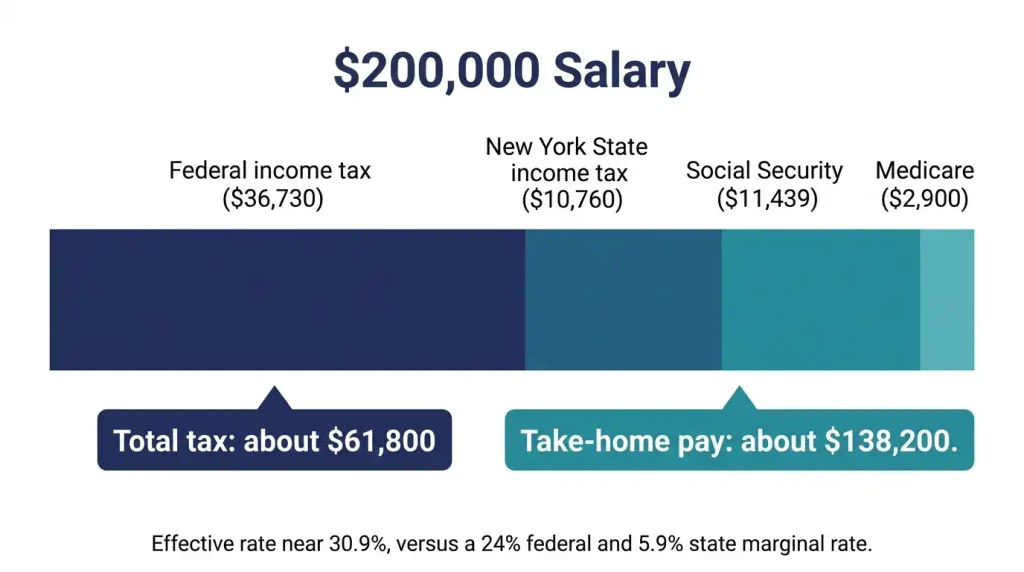
For a non-NYC resident, that is an effective rate near 30.9%. The rate averages every bracket you pass through, so it is lower than your top marginal rates of 24% federally and 5.9% at the state level. See the full picture in our guide to what taxes come out of a New York paycheck.
$200K After Taxes in NYC, Yonkers, and Other New York Locations
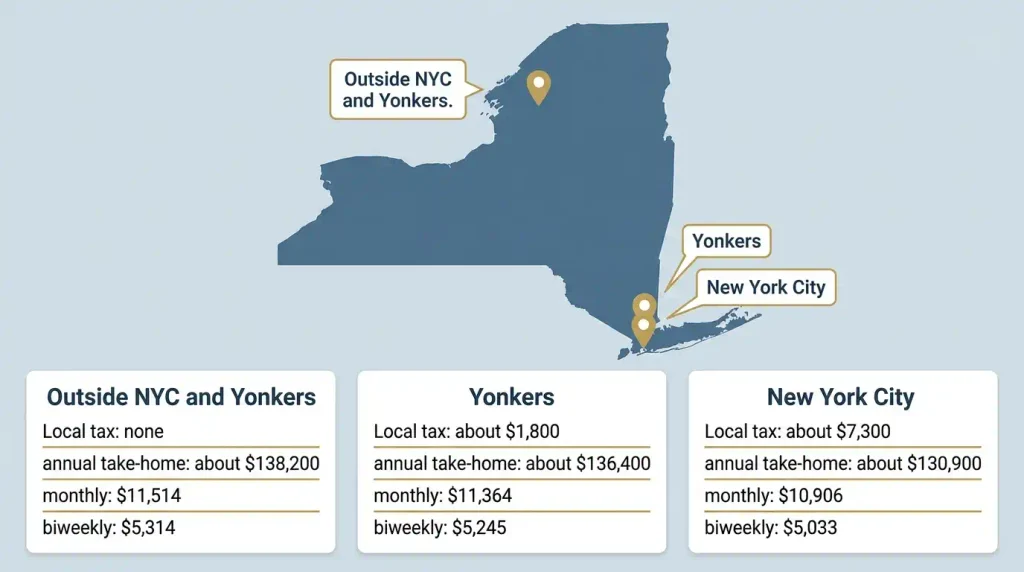
You keep about $138,200 outside NYC and Yonkers, and about $130,900 in NYC. Where you live in New York changes net pay more than almost any other factor.
| Where you live | Local tax | Annual take-home | Monthly | Biweekly |
|---|---|---|---|---|
| Outside NYC and Yonkers | none | about $138,200 | $11,514 | $5,314 |
| Yonkers | about $1,800 | about $136,400 | $11,364 | $5,245 |
| New York City | about $7,300 | about $130,900 | $10,906 | $5,033 |
$200K Salary After Taxes in New York City
New York City’s resident income tax adds about $7,300 a year at this salary. That is roughly $600 less per month than the same salary outside the five boroughs, a gap explored further in our NYC worker pay rules category.
$200K Salary After Taxes in Yonkers
Yonkers residents pay a surcharge of 16.75% of their New York State tax, roughly $1,800 for this salary. If you work in Yonkers but live elsewhere in New York, a nonresident earnings tax of 0.5% of wages applies instead, about $1,000 a year.
$200K Salary Outside NYC and Yonkers
Outside NYC and Yonkers, in places like Buffalo, Syracuse, or Long Island, no local tax applies, so you keep the full amount in the table above. A Brooklyn resident and a Nassau County resident with identical offers can end up over $7,000 apart in annual take-home.
Working in NYC While Living Outside the City
New York City resident tax depends on where you live, not where you work. Commuting into Manhattan from New Jersey or Westchester means zero NYC resident tax. Yonkers is the exception, taxing commuters who work there through its nonresident earnings tax. Nonresident and part-year employees allocate income across New York workdays using Form IT-2104.1.
New York Resident Versus Nonresident
Your New York State tax residency decides which rules apply. New York taxes full-year residents on all income, wherever earned. Nonresidents owe tax only on New York-sourced income, such as wages for work performed in the state, a topic covered in depth in our guide to how New York taxes nonresidents. Someone who moves mid-year is a part-year resident, split by move date.
Residents file the New York State resident income tax return, Form IT-201. Nonresidents and part-year residents file the New York State nonresident and part-year resident income tax return, Form IT-203. If you are unsure whether an address is in NYC or Yonkers, the New York State tax jurisdiction lookup tool settles it. Wrong residency means overpaying or getting a notice.
$200K Take-Home Pay With 401(k), Insurance, and Other Deductions
Pre-tax deductions cut your deposit by less than their cost, because they also cut taxable income.
How a Traditional 401(k) Changes Take-Home Pay
A traditional 401(k) contribution skips federal and New York State income tax now, though it still counts as Social Security and Medicare wages. Contributing $15,000 on a $200,000 salary means you are taxed as if you earned $185,000 for income tax, saving a few thousand dollars. Run the numbers with and without the contribution, since the tax savings alone can be worth a few thousand dollars a year. The 401(k) contribution limits 2026 cap your own deferrals at $24,500 ($32,500 if you are 50 or older), confirmed each year by the IRS.
Roth 401(k) Versus Traditional 401(k)
A Roth 401(k) uses after-tax money, so it does nothing for your current paycheck or tax bill. A traditional 401(k) lowers taxable income today and is taxed at withdrawal. At the same contribution, Roth leaves you lower take-home now.
Health Insurance, HSA, and FSA Deductions
Employee health insurance premiums usually come out pre-tax, lowering both your paycheck and taxable income. A Health Savings Account (HSA) gets the same treatment and requires a qualifying high-deductible health plan. A health Flexible Spending Account (FSA) covers your own medical costs and usually has a use-it-or-lose-it rule. A dependent care FSA is a separate account for childcare or elder care.
Other Common Payroll Deductions
Dental and vision coverage usually come out pre-tax like medical insurance. Commuter benefits set aside pre-tax dollars for transit or parking, common for subway and Metro-North riders. Some benefits, such as certain supplemental life insurance, come out after tax. New York also requires State Disability Insurance and Paid Family Leave deductions, small New York State payroll taxes on every check. Only tax withholding and these state programs are required. Everything else is your open enrollment choice, broken down further in our guide to New York paycheck deductions.
Example $200K Paycheck With Employee Benefits
Say you contribute $10,000 to a traditional 401(k) and pay $4,800 a year for health insurance. That lowers federal and state taxable income to $185,200. The 401(k) portion still counts as payroll-tax wages, but the health insurance premium is exempt from FICA too. Social Security is already capped at this income either way, so the extra FICA savings shows up only in the Medicare piece. After the tax savings and the $14,800 in deductions, take-home is close to $127,860 a year. Change either choice and the number moves.
$200K Salary in New York Compared With Other Salaries
Each extra dollar keeps less than the last: $200,000 nets about $138,200 outside NYC.
$150K, $175K, $200K, and $250K After Taxes
| Gross salary | Take-home per year | Take-home per month |
|---|---|---|
| $150,000 | roughly $106,000 | $8,833 |
| $175,000 | $121,500 | $10,125 |
| $200,000 | $138,200 | $11,514 |
| $250,000 | around $169,200 | $14,100 |
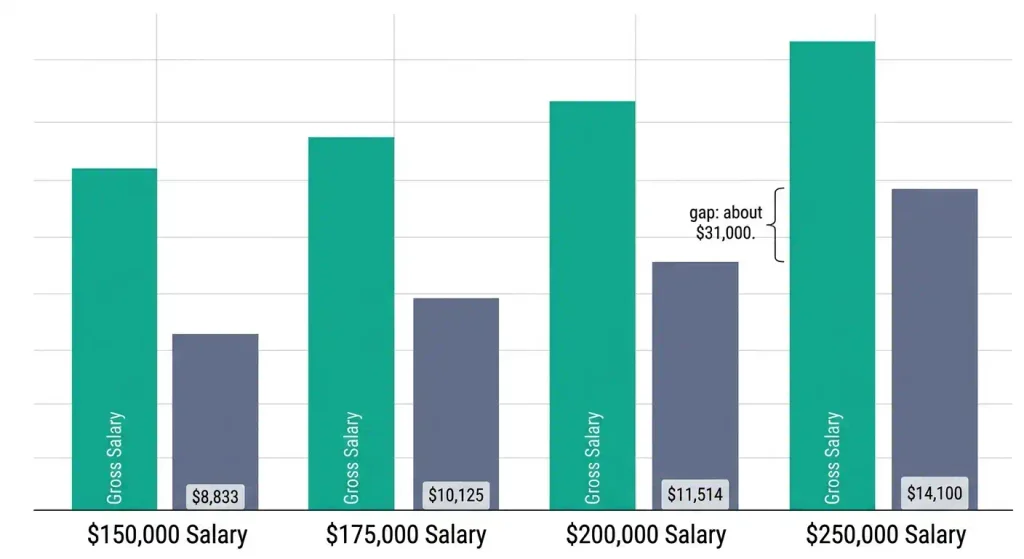
The take-home gap between $200,000 and $250,000, about $31,000, is smaller than the $50,000 gross gap because more income lands in higher brackets. Every figure assumes the same filing status, a non-NYC residence, and no pre-tax deductions. For a full breakdown at a lower income, see $80K after taxes in New York.
How Much More Do You Keep From a $10K Raise?
A $10,000 raise from $200,000 to $210,000 is taxed at marginal rates. The federal 24% plus New York’s 5.9% plus 2.35% in Medicare taxes (Social Security has already maxed out) takes roughly 32%, so you keep about $6,800 of the $10,000. That is why a raise never feels as big as its offer-letter number.
$200K in New York Versus a No-Income-Tax State
Moving the same $200,000 job to Florida, Texas, or Nevada skips state income tax, keeping roughly $11,000 more per year. Massachusetts nets slightly more than New York at this income, while Vermont nets slightly less. Income tax alone is not the full picture, since property taxes, sales taxes, and other costs differ by state.
$200K Salary Versus Cost of Living
A Manhattan one-bedroom can run $3,500 to $4,500 a month, a huge share of the $130,900 NYC take-home. In Rochester or Syracuse, the same salary stretches much further. Retirement savings and student loan payments come on top and can shrink monthly disposable income as much as taxes do. Whether $200,000 feels comfortable depends on your rent, family size, and spending.
Real-World $200K Salary and Paycheck Scenarios
Expect about $138,200 a year outside NYC or $130,900 in NYC, before benefit deductions. Browse more real-world New York paycheck scenarios in this category.
You Just Received a $200K Job Offer
Start with $138,200 a year outside the five boroughs or $130,900 inside NYC, then subtract 401(k) and health insurance contributions. Compare that number, not $200,000, to your monthly budget. Confirm the base salary, any signing bonus, and how equity or bonus pay is paid out. If comparing offers, run both through the same residence and benefit assumptions, since a higher gross salary with weaker benefits can net out lower.
You Live in NYC and Earn $200K
Your monthly deposit is around $10,906 after federal, state, city, and payroll tax. Adding a $10,000 401(k) contribution and $400 a month in health insurance drops it closer to $10,100. NYC rent for a decent one-bedroom often takes 35% to 45% of that deposit. Budgeting off the $200,000 headline number, rather than this real deposit, is the most common early mistake for new NYC hires.
You Earn $200K Outside New York City
Without NYC resident tax, your monthly number is about $11,514 before benefit deductions, roughly $608 more per month than the identical NYC salary. Housing is usually cheaper outside the city too, which widens the gap.
Your First Paycheck Is Lower Than Expected
A first paycheck often covers a partial pay period if you started mid-cycle. If you started partway through 2026, your taxable income for the year is prorated below the full annual figure, so total tax is lower than a full twelve months would trigger. Health insurance may deduct a double or catch-up amount in the first check. Check your federal W-4 and New York IT-2104 elections, since a default setting can withhold more than you expect. Most of these are one-time issues.
Your Bonus or Raise Did Not Increase Net Pay as Expected
Bonuses are withheld at a flat supplemental rate, often above regular withholding, so the deposit looks smaller than the bonus. That rate is not your final tax rate, and overwithholding evens out when you file. A raise can also push more income into a higher bracket or increase a percentage-based 401(k) contribution. Check year-to-date totals on your pay stub before assuming an error.
You Are Relocating to New York for a $200K Job
Compare your current state’s tax bill with New York’s, especially if you are leaving a no-income-tax state. A mid-year move splits your return between two states by move date. Housing costs usually change more than taxes do, and your new employer’s benefits also shape take-home pay.
How Bonuses, Raises, and Stock Compensation Affect $200K
Bonuses, raises, and stock are withheld differently from base salary, so a $200,000 offer rarely means identical paychecks all year.
$200K Base Salary Versus $200K Total Compensation
Base salary is the steady amount on each regular check. Total compensation adds bonus, commissions, or equity, which do not arrive evenly. A $170,000 base plus a $30,000 bonus pays very differently through the year than a flat $200,000 salary. Only wages paid in a period are taxable for that period.
How a $20,000 Bonus Changes Take-Home Pay
Employers commonly withhold bonuses at a flat 22% federal supplemental rate plus New York’s supplemental withholding, so a $20,000 bonus lands around $12,800. Overtime is taxed as ordinary wages within your regular check, though a big overtime check can raise withholding for that pay period. Whether your role even qualifies for overtime in the first place is its own question, covered in our guide to overtime pay for salaried employees in New York. Withholding is not your final tax, since liability depends on total annual income at filing. The bonus can push some regular pay into a higher bracket, and a smaller-than-expected deposit is usually the flat rate at work, not an error.
What Happens After a Raise From $180K to $200K?
Take-home on $180,000 is close to $124,700 a year outside NYC, versus $138,200 on $200,000. That is a gain of about $13,450 on a $20,000 raise, or roughly 67%. Only the portion crossing into a higher bracket is taxed at the higher rate. A midyear raise affects only the remaining months, so annual taxable income lands between your old and new salary.
Restricted Stock Units and Equity Compensation
Restricted stock units (RSUs) count as ordinary taxable wages when they vest, valued on the vesting date, and employers typically withhold shares or cash for the tax. Selling vested shares later can create a separate capital gain or loss. This two-step treatment makes equity harder to estimate than salary, so a $200,000 base plus an RSU grant needs its own calculation.
Multiple Jobs and Additional Income
Holding two jobs, working as an employee vs. independent contractor, or switching employers midyear, can leave you underwithheld on federal and state tax, since each employer sees only its own pay. Combined wages above the 2026 wage base across two employers can cause excess Social Security withholding, claimable as a credit on your return. Freelance, interest, dividends, and rental income add to your taxable income, and our comparison of 1099 vs. W-2 in New York covers how that income gets classified, part of our worker classification category. Estimated tax payments, made quarterly, may be needed once outside income grows large, to avoid an underpayment penalty.
How to Calculate Your $200K New York Take-Home Pay
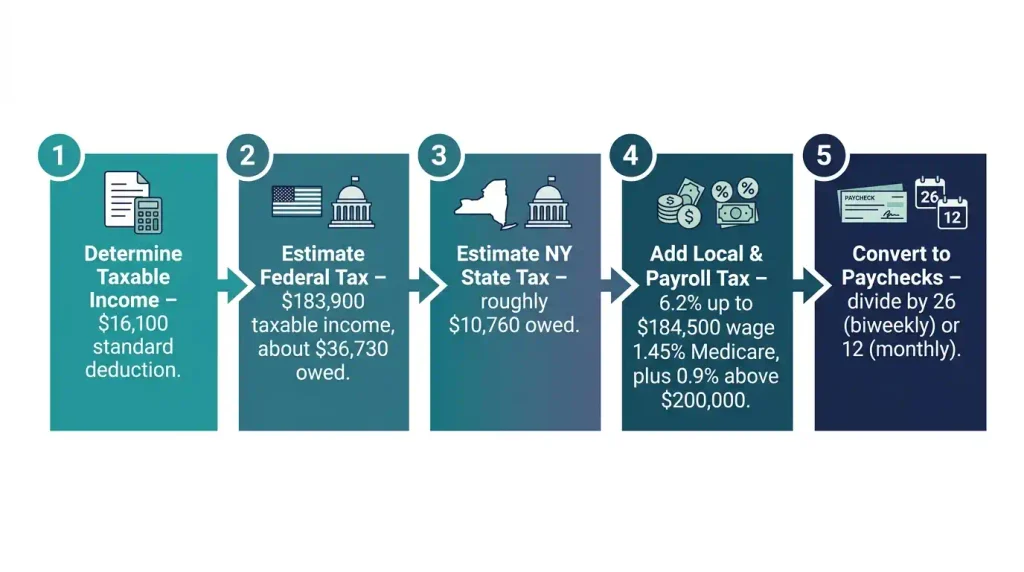
Subtract federal, state, local, and payroll tax from $200,000, then divide by your pay periods, the same approach detailed on our calculation methodology page. Five steps follow.
Step 1 — Determine Your Taxable Income
Start with $200,000 and subtract pre-tax deductions such as 401(k) contributions and health insurance premiums. Apply the Federal standard deduction 2026 amount for your filing status, $16,100 for a single filer. This guide assumes the standard deduction.
If you itemize, the State and local tax (SALT) deduction, capped by the SALT deduction limit 2026 of $40,400 (which shrinks for modified adjusted gross income above $505,000), and any New York State itemized deductions can shift taxable income either way. Federal and New York taxable income use different deductions, so calculate them separately.
Some credits and phaseouts use Modified adjusted gross income (MAGI), which starts from Adjusted gross income (AGI) and adds a few items back.
Step 2 — Estimate Federal Income Tax
Apply the 2026 IRS brackets in layers, taxing each portion at its own rate. A single filer with $183,900 taxable income owes around $36,730 in federal tax before credits. This is an estimate; your employer’s actual withholding may land a little differently.
Step 3 — Estimate New York State Income Tax
Use New York’s 2026 bracket schedule and standard deduction. A single filer at $200,000 owes roughly $10,760 in state tax for the New York State tax year 2026, after the New York State tax rate reduction 2026 lowered several lower and middle brackets. This arrived as a New York State tax rate phase-in 2026: a 0.1 percentage point cut for 2026, with a second 0.1 point cut scheduled for 2027. The estimate assumes no New York-specific credits or adjustments.
Step 4 — Include Local and Payroll Taxes
Add NYC or Yonkers tax only if you live there. Calculate Social Security at 6.2% up to the $184,500 wage base and Medicare at 1.45% on every dollar, adding the 0.9% Additional Medicare Tax on wages above $200,000. Do not double count anything already in your federal or state estimate.
Step 5 — Convert Annual Net Pay Into Paychecks
Subtract total annual taxes and benefit deductions from gross salary, then divide by your pay periods, 26 for biweekly or 12 for monthly. Actual withholding may run slightly higher or lower depending on your W-4 elections, which are reconciled at filing time.
Information Needed for a Personalized Calculation
You need:
- Filing status and full expected household income
- Residence, meaning whether you live in NYC or Yonkers
- Your 401(k), HSA, and insurance contributions
- Bonuses and side income
- Your withholding elections
Common $200K Salary After-Tax Myths and Mistakes
Most myths confuse gross pay with take-home pay, or marginal rates with effective rates.
Myth — A $200K Salary Means $200K of Spendable Income
Gross salary is the number on your offer letter. Net income is what lands in your account after mandatory taxes, and benefit deductions and retirement contributions lower your discretionary income further. Budgeting off $200,000 instead of the roughly $131,000 to $138,000 you take home is the most common planning mistake at this salary.
Myth — Your Highest Tax Rate Applies to All Your Income
Progressive brackets tax each layer of income at its own rate. With a top bracket of 24%, you do not pay 24% on the full $200,000, only on the portion inside that bracket. Your effective rate is the average across brackets and is lower than your marginal rate. This misunderstanding leads some people to turn down raises for fear of a smaller paycheck.
Myth — A Bonus Is Always Taxed at a Higher Final Rate
A bonus deposit often looks smaller than expected because employers withhold it at a flat supplemental rate, higher than regular paycheck withholding. That withholding is not your final tax liability: your actual tax depends on total annual income at filing, and any overwithholding returns as a refund. A smaller bonus deposit means higher withholding now, not a permanently higher tax rate on that money.
Myth — Working in NYC Means Paying NYC Resident Income Tax
This is one of the most common mix-ups about NYC taxes. Residence decides NYC resident tax, not your commute or office address, so working in the city while living in Long Island or New Jersey means zero NYC resident tax. Yonkers remains the one exception, taxing people who work there through its nonresident earnings tax.
Mistake — Using Outdated 2025 Tax Tables
Withholding tables and standard deductions update every year, so 2025 figures do not match 2026 rules. New York updated its New York State tax withholding tables 2026, published as NYS-50-T-NYS, and the Yonkers withholding tax tables in NYS-50-T-Y, for payrolls beginning January 1, 2026. The New York City withholding tax tables in NYS-50-T-NYC stayed unchanged.
These New York State withholding tax publications update on their own schedule, so check current New York State tax forms and publications from the New York State Department of Taxation and Finance. Our own New York State tax withholding breakdown tracks these changes each year. Withholding tables and annual return brackets are different things, and an old calculator can quietly give a wrong answer.
Mistake — Treating Paycheck Withholding as Your Final Tax Bill
Withholding is your employer’s advance estimate of what you will owe. Extra income, side jobs, or a spouse’s earnings can cause underwithholding and a surprise bill at filing. Overwithholding produces a refund, which is your own money returned without interest. Review withholding midyear, especially after a raise or bonus.
How to Check Your $200K Paycheck and Avoid Tax Surprises
Compare your pay stub and withholding forms against the estimates here to catch problems early.
Review Your Pay Stub
Find gross pay, taxable wages, and net pay. Check that federal, state, local, and payroll tax lines match this guide’s estimates, and that retirement and insurance deductions match your open enrollment elections. Compare the current period with year-to-date totals. At year end, reconcile them against your Form W-2, since W-2 wages should match your pay stubs’ annual total, and flag any mismatch to payroll before filing. Our step-by-step guide on how to read a New York pay stub walks through each line.
Verify Your 2026 Withholding Information
Review your federal Form W-4 for filing status and extra withholding. Do the same with New York’s Form IT-2104, the Employee’s Withholding Allowance Certificate, which sets your New York State withholding allowances and any additional dollar amount withheld per check. Our side-by-side Form W-4 vs. IT-2104 comparison walks through both forms line by line. Confirm your employer uses 2026 withholding tables. This takes ten minutes and prevents most tax-time surprises.
Estimate Whether You May Owe Additional Tax
Compare your projected annual tax liability with what has been withheld so far. A second job, large bonus, or outside income can leave you underwithheld without warning, and underpayment can bring a penalty. A quick midyear check avoids it. The IRS publishes Official IRS tax tables 2026 for this check, and New York State offers its own free calculator.
What to Do When Your Actual Paycheck Is Different
Confirm the pay period covers a full two weeks or month, since a partial period pays less. Check for a benefit enrollment change or catch-up deduction, and verify your withholding elections and wage information. If it still does not add up, payroll or a tax professional can usually spot the issue quickly.
Frequently Asked Questions About $200K After Taxes in New York
A single filer keeps about $138,200 a year outside NYC and about $130,900 inside NYC.
How much is $200,000 after taxes in New York State in 2026?
A single filer outside NYC keeps about $138,200 a year, or roughly $130,900 inside New York City, assuming the 2026 standard deduction and no pre-tax deductions. Filing status, local residency, and benefit contributions shift the number.
How much is $200K a month after taxes in New York?
About $11,514 outside NYC and $10,906 inside the city, based on the annual estimate divided by 12. Your specific deposit can shift slightly depending on how paycheck timing falls in the month.
How much is a $200K paycheck every two weeks in New York?
Using 26 pay periods, about $5,314 outside NYC and $5,033 inside the city, before benefit deductions. Actual paychecks vary with your withholding.
How much tax do you pay on a $200K salary in New York?
For a non-NYC resident, federal income tax is about $36,730, New York State tax about $10,760, and combined FICA about $14,300. The effective rate is near 30.9%, below the 24% federal marginal rate that applies only to your top slice. NYC residents add roughly $7,300 in local tax.
Is $200K a good salary in New York after taxes?
It depends on where you live in New York and your household size. In Manhattan, rent can eat a large share of take-home, while the same salary stretches further upstate. A salary alone does not tell the full story without your budget.
Do you pay NYC income tax if you work in NYC but live elsewhere?
No. NYC resident income tax applies only to people who live in the city. New York State tax still applies to your NYC-sourced wages wherever you live. Yonkers is the local exception, taxing commuters who work there through its nonresident earnings tax.
Does contributing to a 401(k) reduce take-home pay?
Yes, the contribution comes out of your paycheck. A traditional 401(k) softens the hit by lowering federal and state taxable income, while a Roth 401(k) reduces your paycheck by the full contribution with no tax savings now. The 2026 employee contribution limit of $24,500 is the ceiling either way.
Why is my $200K paycheck lower than the online estimate?
Your filing status or withholding elections may differ from the estimate’s assumptions. Insurance premiums, retirement contributions, bonus supplemental withholding, or a partial pay period can lower your check. Compare your pay stub line by line to find the difference, or see our full breakdown of why your New York paycheck might be lower than expected.
Will I owe more tax if I get a $200K salary raise?
Yes, but only the portion of a raise that reaches a new bracket is taxed at the higher rate. Payroll and possibly local tax also apply, so take-home rises by less than the gross raise. The result depends on your full annual income.
How do I calculate my actual New York take-home pay?
Gather your filing status, expected income, NYC or Yonkers status, and 401(k), HSA, and insurance elections. Use current IRS and New York State schedules, not last year’s. Official calculators from the IRS and New York State Department of Taxation and Finance give the most accurate personalized result.
Key Takeaways for a $200K New York Salary
A $200,000 salary nets about $138,200 outside NYC and about $130,900 inside NYC.
What to Know Before Making a Salary Decision
A $200,000 New York salary nets roughly $138,200 outside NYC or $130,900 inside the city, under 2026 standard deduction assumptions. Location matters more than almost any other factor. Filing status, 401(k) contributions, and benefit elections move the real number, so treat this as a starting point and confirm with your pay stub.
What to Check Before Accepting a $200K Offer
Before you sign:
- Confirm the base salary separate from any bonus or equity.
- Review retirement and insurance benefit costs.
- Run your paycheck through the residence-specific numbers here, not the $200,000 headline.
- Compare that net number to your monthly budget.
Run your own numbers through our New York paycheck calculator for a personalized figure, or learn more about how we build these estimates on our About Us page.

Meet Yasin Ali, Founder
Yasin built NY Paycheck Calculator in 2020 after getting fed up with calculators that treated New York like every other state. Most tools ignore the extra local tax NYC and Yonkers workers pay on top of state tax — or skip New York’s Paid Family Leave deduction entirely.
He keeps the numbers current, checking in regularly against the latest IRS, NY Department of Taxation and Finance, and Paid Family Leave rates.
All results here are estimates based on official sources. For advice specific to your situation, talk to a tax professional.