
New York resident vs nonresident income tax comes down to one split: residents pay on all income, nonresidents only on New York-source income. Status turns on domicile, or a nearly year-round New York home plus more than 183 days.
That split comes from the Tax Department’s IT-201 and IT-203 instructions, with 2026 rates checked in October 2026.
Two-home and remote-work cases need review, and the 2026 IT-201 and IT-203 are not yet posted.
This guide is general information, not tax advice. Estimate your own pay with our New York paycheck calculator.
New York Resident vs. Nonresident Tax: The Difference at a Glance
Take a New Jersey resident working in Manhattan. New York taxes only the wages earned here, and New Jersey usually credits that tax. Move the same person into New York and every dollar of income becomes taxable.
How New York Taxes Residents vs. Nonresidents
Living elsewhere does not erase the tax if you earn money here. A nonresident’s New York-source income includes wages for work done in the state, so commuters owe tax here even with an out-of-state home. A resident’s out-of-state income is taxable too, so the same job can cost more or less depending on status.
Resident vs. Nonresident vs. Part-Year Resident
A resident is domiciled in New York or meets the day-count test below. A nonresident meets neither test. A part-year resident moves in or out during the year, so status changes on a set date.
Resident vs. Nonresident Tax Comparison Table
This table compares all three statuses.
| Full-Year Resident | Nonresident | Part-Year Resident | |
|---|---|---|---|
| Residency test | Domiciled in NY, or a NY home kept nearly all year plus more than 183 days | Passes neither test | Status changes during the year |
| Income taxed by NY | All income, everywhere | Only NY-source income | All income while resident, NY-source income otherwise |
| Main return | IT-201 | IT-203 | IT-203 |
| NY-source allocation | Rarely needed | IT-203-B for wages and other items | IT-203-B for the nonresident period |
| NYC and Yonkers | NYC tax if you live in NYC. Yonkers surcharge if you live in Yonkers. | No NYC resident tax. Yonkers earnings tax if you earn there. | Local resident tax only for the resident period |
Residents are taxed on everything. Nonresidents are taxed on New York-source income only.
Are You a New York Resident for Tax Purposes?
Two separate tests apply, and passing either one makes you a resident. Domicile asks where your permanent home is. The home-and-days test asks whether you kept a New York home nearly all year and spent more than 183 days here.
What Counts as a New York Domicile
Your domicile is your permanent home, the place you plan to return to. You can have only one. A move counts only when you truly leave and settle elsewhere, shown by your home, job, family, and treasured belongings. A new mailing address alone proves little.
College students from other states usually keep their home-state domicile, and a school-year dorm rarely changes that. Military orders to a New York post do not change a service member’s domicile, and federal law lets many military spouses keep the same home state.
What Is a Permanent Place of Abode?
A permanent place of abode is a home you keep all year, owned or rented. It must work in winter, so an unheated summer cabin usually fails. A home your employer keeps mainly for you or your family can count, and so can one your spouse owns or leases. A hotel stay does not.
A suitable home counts even if you rarely stay there, as long as you can use it whenever you want. An apartment taken only for a fixed, limited work assignment does not count.
How the 184-Day Rule Works
The rule means more than 183 days in New York, so 184 or more. Any part of a day counts. It applies only if you also keep a permanent place of abode here, and it is separate from the domicile test.
Fewer than 184 days does not make you a nonresident by itself, since a New York domicile still makes you a resident. Section 605 of the New York Tax Law sets both tests.
When You Can Be a Resident Even if Your Domicile Is Outside New York
Say your domicile is Connecticut, but you keep a New York apartment all year and spend 190 days in the city. New York treats you as a resident, and your out-of-state home does not protect you. Be ready to prove your day count.
An out-of-state home does not shield you if you meet the home-plus-days test.
What Income Does New York Tax for Residents and Nonresidents?
New York taxes residents on all income and nonresidents only on New York-source income. Part-year residents get both, split by the move date.
Income Taxed When You Are a New York Resident
As a resident, you report wages, interest, dividends, business income, and gains from anywhere. An Albany resident working for a Texas company still owes New York tax on that pay, since your home matters, not your employer’s location. A credit can offset tax another state charges on the same income.
Income Taxed When You Are a New York Nonresident
New York-source income is money tied to the state: wages for work done in New York, income from a New York business or profession, and income from New York real or tangible property. A New Jersey resident who rents out a Brooklyn apartment owes New York tax on that rent. Bank interest and most pensions usually stay outside New York’s reach for nonresidents.
How Part-Year Residents Split Income
Split your year at the move date. While a resident, all income counts. Before you arrive or after you leave, only New York-source income counts. Form IT-203 shows your federal amount and New York source income in separate columns.
Income That Can Be Easy to Misclassify
Wages earned partly out of state and business income earned in several states often trip people up. Investment and retirement income for nonresidents is generally not New York-source, but income from New York real property always is. The W-2 state wage box often misleads.
Where you earned the money matters most for nonresidents. Where you live matters most for residents.
How to Determine Your New York Residency Status in 2026
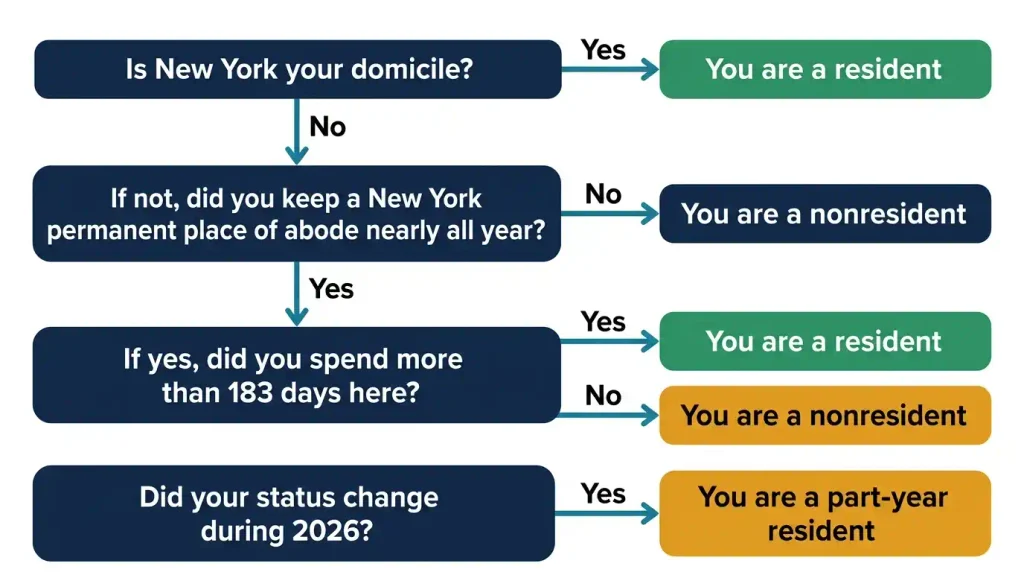
Check four things in order: domicile, permanent place of abode, day count, and move dates. They show whether you were a resident all year or part of it.
- Is New York your domicile? If yes, you are a resident.
- If not, did you keep a New York permanent place of abode nearly all year? If no, you are a nonresident.
- If yes, did you spend more than 183 days here? If yes, you are a resident. If no, you are a nonresident.
- Did your status change during 2026? If yes, you are a part-year resident.
Step 1: Identify Your Domicile
Ask where your permanent home was in 2026, judging by your home, family, job, and treasured belongings. If you moved, note the date you truly settled, not the day you rented the truck. Keep a lease, license, voter registration, and bills as proof.
Step 2: Check for a New York Permanent Place of Abode
Ask whether you kept a home in New York in 2026. The test needs nearly the whole year, generally more than 11 months. A place you cannot use, or one for short stays only, usually does not count. A home your employer maintains mainly for you or your family can count, and so can one your spouse owns or leases.
Tax Bulletin IT-690 sets that rule. The New York nonresident audit guidelines use more than 10 months, but only in a year you buy or sell the home.
Step 3: Count Your New York Days
Count every day in New York, even a few hours. You need more than 183 to meet the day test. Tip: Keep a one-line calendar log and update it every Friday. Audits lean on credit card, phone, and toll records, so your log should match them.
Step 4: Determine Whether You Were a Full-Year or Part-Year Resident
If your status never changed, you were a full-year resident or a nonresident. If it changed, write down the exact date. Full-year residents use Form IT-201. Part-year residents and nonresidents use Form IT-203, and special accrual rules may apply if income was deferred across the move.
Run the checks in order, and mark the exact date if your status changed.
Which New York Tax Form Should You File in 2026?
Full-year residents file Form IT-201. Nonresidents and part-year residents file Form IT-203. The form controls how your New York State income tax is figured.
| Form | Who uses it | What it does |
|---|---|---|
| IT-201 | Full-year residents | Reports all income |
| IT-203 | Nonresidents and part-year residents | Shows New York-source income and the income percentage |
| IT-203-B | Nonresidents and part-year residents with out-of-state work | Allocates income, with Schedule A for wages |
| IT-203-A | Nonresidents with multi-state business income | Allocates business income |
| IT-2104.1 | Nonresident employees | Tells your employer to match withholding to New York work |
| IT-196 | Itemizers | Reports itemized deductions |
| IT-203-ATT | Nonresident and part-year filers | Adds other taxes and credits |
| IT-112-R | Residents taxed by another state | Claims the resident credit |
| IT-360.1 | NYC or Yonkers status changes | Reports a change in city resident status |
| Y-203 | Yonkers nonresidents earning there | Calculates the Yonkers earnings tax |
Form IT-201 for Full-Year Residents
Form IT-201 is for people who lived in New York all year. You start with federal income, make New York changes, and subtract the standard or itemized deduction. The New York standard deduction is $8,000 for single filers and $16,050 for married couples filing jointly, per the 2025 forms and unchanged in current 2026 guidance. Itemizers add Form IT-196.
Residents must file if they must file a federal return. Otherwise they file when federal adjusted gross income plus New York additions tops $4,000 ($3,100 for a single dependent), or to get back withheld tax or claim refundable credits.
Form IT-203 for Nonresidents and Part-Year Residents
Form IT-203 shows your federal income beside your New York-source income, then figures tax with an income percentage. Moving during the year puts you on this form, even if you lived here most of it.
You generally must file once you have New York-source income and your New York AGI tops your New York standard deduction. Below that line, you can still file to get a refund or credits.
Form IT-203-B for Nonresident Income Allocation
Form IT-203-B splits income between New York and everywhere else, mainly for wages earned partly out of state. Your W-2 can show New York wages that do not match the days you worked here. Schedule A fixes that and can lower the New York wages you report.
Form IT-2104.1 and Nonresident Withholding
Form IT-2104.1 tells your employer you are a nonresident and lets you ask for withholding that matches your New York share of work. It changes your paycheck, not your final tax, which you settle on your return.
Form IT-2104 is the regular withholding allowance form, and Form IT-2104.1 goes with it for nonresidents. A New Jersey resident’s paycheck can look lower than expected because New York withholding shows up until the employer has the form. If payroll set it up wrong, hand in a corrected form and settle any difference when you file. Compare Form W-4 vs Form IT-2104 if you are unsure which one your employer needs.
Other Forms That May Apply
The table above lists each of these forms. Form IT-196 is the itemized-deduction schedule for residents, nonresidents, and part-year residents. Form IT-203-ATT carries other tax credits and taxes, and Form IT-360.1 computes city tax for a part-year NYC or Yonkers resident. Form Y-203 goes in with your New York return.
Form IT-201-I gives line-by-line help for the New York resident income tax return. Form IT-203-I does the same for the New York nonresident income tax return, which a New York part-year resident files too.
Residents use IT-201. Nonresidents and part-year residents use IT-203.
New York City and Yonkers: Does Local Residency Change the Answer?
State residency and local residency are separate tests. NYC residents pay city income tax, Yonkers residents pay a surcharge, and nonresidents earning in Yonkers pay an earnings tax.
| Tax | Who pays | Rate or threshold |
|---|---|---|
| NYC resident income tax | NYC residents | 3.078% to 3.876% |
| Yonkers resident surcharge | Yonkers residents | 16.75% of net New York State tax |
| Yonkers nonresident earnings tax | Nonresidents earning in Yonkers | 0.50%, filed on Form Y-203 |
| MCTMT | Self-employed people in the 12-county area | 0.60% in Zone 1 (NYC) and 0.34% in Zone 2, once net self-employment earnings in one zone pass $150,000 for 2026 |
New York State Resident vs. New York City Resident
A New York State resident is not automatically a New York City resident. Only a New York City resident owes the New York City personal income tax.
New York City covers five boroughs: Manhattan, Brooklyn, Queens, the Bronx, and Staten Island. If you are domiciled there, or keep a home there and spend more than 183 days, you owe city income tax at 3.078% to 3.876%. Live in Buffalo and you owe state tax only. A midyear move in or out splits your city tax, and Form IT-360.1 handles it.
A separate pied-à-terre tax took effect July 1, 2026 on non-primary NYC homes. It covers one- to three-family homes with a city Department of Finance market value of $5 million or more, and co-ops and condos valued at $1 million or more in the first phase, which runs through June 30, 2028. It is a property surcharge, not an income tax.
New York City Nonresidents Working in NYC
Working in New York City does not make you a city resident. A New York City nonresident owes no city income tax on wages or investment income, even with a Midtown job, though state tax may still apply to those wages. If your New York pay stub shows city tax, ask payroll to check it, since wrong withholding is a common reason a paycheck looks lower than expected.
Running a business in the city is different, since NYC’s unincorporated business tax can apply to nonresidents. At the state level, a New York State nonresident owes nothing on income earned entirely outside New York.
Yonkers Residents and Nonresidents
Yonkers residents pay a surcharge of 16.75% of their net New York State tax. Nonresidents who earn wages or self-employment income in Yonkers pay a 0.50% earnings tax and file Form Y-203. You can skip Form Y-203 only if you do not have to file a New York return, were a Yonkers nonresident all year, and had only wages there. Those wages must total $3,000 or less, or come from one employer that withheld the correct tax.
The Yonkers nonresident earnings tax follows where you work. The resident surcharge follows where you live. Form IT-2104.1 can fix Yonkers withholding that does not match where you live and work.
MCTMT for Self-Employed Taxpayers
The MCTMT is a transit tax covering 12 counties around New York City. Self-employed people owe it when net earnings from self-employment in one zone of that area pass $150,000 for 2026. The rate is 0.60% in Zone 1 (the five boroughs) and 0.34% in Zone 2 (the other seven counties), and the threshold is figured per person even on a joint return. It is separate from regular income tax and has its own calculation.
State residency and city residency are separate tests with separate taxes.
How New York Nonresident Income Allocation Works
Allocation splits your income between New York and elsewhere. New York taxes the part earned in New York, based on where you physically worked, with a major exception for remote work.
Wages Earned Partly Inside and Outside New York
Divide your New York workdays by total workdays. That share of your pay is New York-source. Schedule A of Form IT-203-B walks you through it, and your day log beats your W-2 if they differ.
A New York employer does not make all your wages New York-source. Where you did the work does.
Remote Work for a New York Employer
New York uses the convenience-of-the-employer rule. If you work from home outside New York for a New York employer because you prefer it, those days count as New York days. Your employer must truly need you out of state, for example through a bona fide office there. Permission to work from home is not enough.
Under the convenience of the employer rule, the telecommuting guidance applies to employees, not independent contractors. Self-employed people follow the business allocation rules instead.
Commuting Into New York From Another State
New Jersey, Connecticut, and Pennsylvania residents who work in New York owe New York tax on those wages. Your home state usually gives a credit, so you avoid paying twice. Residence decides who taxes your total income, and source decides who gets first claim on the wages.
Business Income Earned in Multiple States
If your business operates in several states, you must split its income between them using Form IT-203-A. Wages follow where you worked, while business income follows the business allocation rules. Self-employed people with 1099 income from New York clients should check this before filing.
Wages follow the workday. Business income follows its own allocation rules.
How to Calculate the New York Taxable Portion of Your Income
Start with federal income, adjust for New York rules, subtract deductions, and apply the rate table. Nonresidents and part-year residents multiply the tax by their New York income percentage. Everyone uses the same New York personal income tax rate table, so status changes how much income counts, not the rates.
Resident Income Calculation
Start with federal adjusted gross income. Add or subtract New York changes, such as the subtraction for U.S. government bond interest. Take the standard or itemized deduction, then apply the 2026 New York tax brackets, a rate table that runs from 3.9% to 10.9%. Credits come last.
Nonresident Income Calculation
Figure your tax as if you lived in New York and earned everything. Divide your New York-source income by your total federal income to get your nonresident income percentage, then multiply the tax by it. If $60,000 of your $100,000 is New York-source, you owe 60% of the full-year tax. See our calculation methodology for how our calculator applies these steps.
Part-Year Resident Calculation
Split income into resident and nonresident periods. The resident period counts in full, plus any New York-source income from the rest of the year. New York figures tax on the full year, then applies the income percentage, so a part-year bill is not simply days divided by 365.
Resident Credit and Multi-State Taxation
A New York resident can owe tax to New York and another state on the same income. Form IT-112-R gives a credit for tax paid to the other state on income earned there, capped at the New York tax on that income. States do not all credit each other the same way, so check the other state’s rules. File the other state’s return first to get the tax figure for the IT-112-R resident credit.
Tax the full amount, then keep only the New York share if you are not a resident.
2026 Real-Life New York Resident vs. Nonresident Examples
These seven cases show how status, income, and form fit together. For salary-based scenarios, see our New York paycheck scenarios.
Example 1: New Jersey Resident Working in Manhattan
You live in Jersey City and earn $120,000 working in Manhattan. Your domicile is New Jersey, so you owe no NYC resident tax. All $120,000 is New York-source, so you file Form IT-203. New York tax is roughly $6,000 to $6,300 as an estimate, and New Jersey gives you a credit.
Example 2: New York Resident Working Remotely for an Out-of-State Employer
You live in Albany and work from home for a Texas company. Your domicile and home are in New York, so you are a full-year resident reporting all pay on Form IT-201. Your employer’s address does not change that.
Example 3: Moving From New York to Florida Midyear
You move to Florida on June 30 and settle there for good. From January 1 to June 30 you are a resident, so all income counts. After that, only New York-source income counts, like rent from a New York apartment you kept. You file Form IT-203.
Example 4: Moving From Florida to New York Midyear
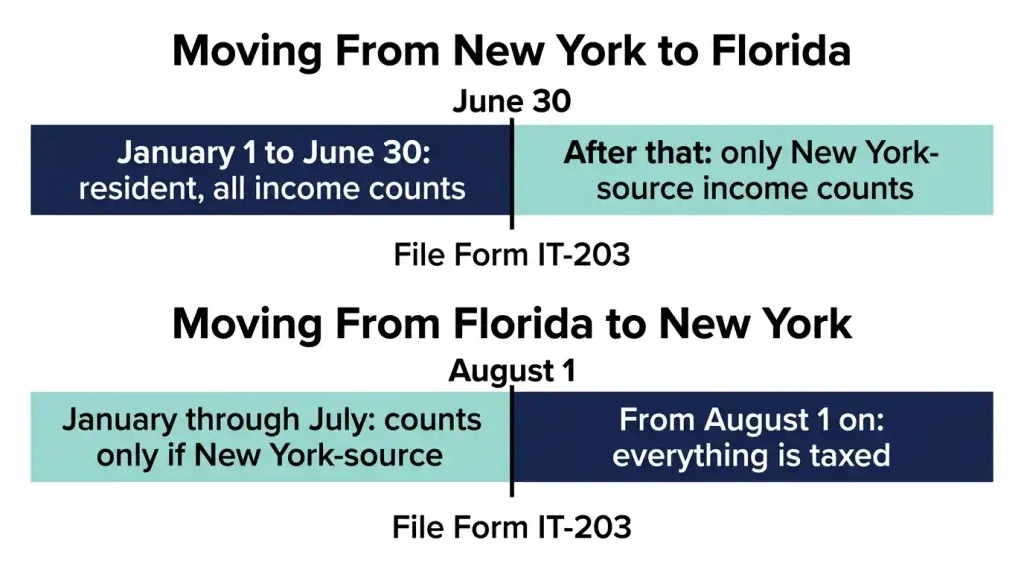
You move to Buffalo on August 1. Income from January through July counts only if it is New York-source, and everything from August 1 on is taxed. You file Form IT-203 and split the two periods.
Example 5: New York Home Plus an Out-of-State Domicile
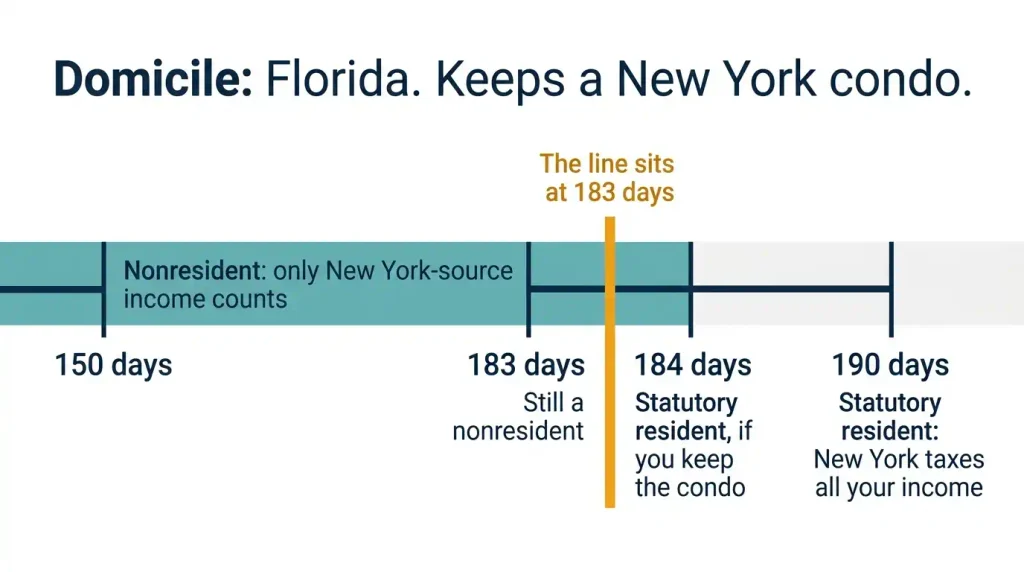
Your domicile is Florida, but you keep a New York condo you can use all year. At 190 days in New York, you are a statutory resident and New York taxes all your income. At 150 days, you are a nonresident and only New York-source income counts. Keep a day log, your lease, and travel records as proof.
The line sits at 183 days. At 183 you are still a nonresident, but at 184 you become a statutory resident if you keep the condo.
Example 6: Working 3 Days in New York and 2 Days Outside New York
You live in New Jersey and earn $100,000, working three days in New York and two days at home. If your employer truly requires the home days, 60% of your pay, or $60,000, is New York-source. If you just prefer home days, all $100,000 can be New York-source. File Form IT-203 and keep workday records for Schedule A of Form IT-203-B.
Example 7: Married Couple With Different Residency Statuses
You live in New York, and your spouse lives and works in New Jersey. You file Form IT-201, and your spouse files Form IT-203 if there is New York-source income. You must either file separate New York returns or elect to file jointly as if you were both residents, which puts your spouse’s income under New York tax too. Run both versions to see which costs less.
Status first, then source of income, then the form. The examples all follow that order.
What Happens If You Move Into or Out of New York During 2026?
A midyear move makes you a part-year resident for 2026, and you generally file Form IT-203. Resident-period income counts in full, and only New York-source income counts for the rest.
Moving Into New York During 2026
Residency begins the day New York becomes your permanent home. Pay earned before then is taxed only if it is New York-source. Income around the move follows when you earned it, not when it hit your bank account. You file Form IT-203 and report both periods.
Moving Out of New York During 2026
Residency ends when you truly settle somewhere else. Income earned up to that date is taxed, and after it only New York-source income counts. Keeping a New York home can pull you back in if you spend more than 183 days there.
Changing Domicile Without Physically Moving
You change domicile through actions, not announcements. New York weighs where you spend time, where your family lives, which home holds your belongings, and where you work. A signed declaration helps but does not decide it, so keep proof like a new license, voter registration, and utility bills.
Special Accrual Rules When Changing Residency
Special accrual rules stop people from skipping tax on income earned as a resident but paid after the move, such as deferred pay, installment sale gains, and unpaid bonuses. Such income may need to appear on your last resident-period return. Form IT-260 or IT-260.1 may apply.
You can often postpone the accrual by posting security. Form IT-260 uses a surety bond, and Form IT-260.1 uses collateral.
Moving does not reset everything. Income earned as a resident can follow you out.
Common Mistakes and Myths About New York Residency
Five common beliefs sound true but fail under New York’s rules. Each is fixable if you catch it before filing.
“If I Live Outside New York, I Do Not Owe New York Tax”
False. New York taxes income earned in New York, wherever you live. A New Jersey commuter earning $90,000 in Manhattan owes tax on all of it, and may need to file even if nothing was withheld. Working here makes wages taxable but does not make you a resident, which depends on your home and days.
“184 Days Automatically Makes Me a Resident”
False. The 184-day count works only with a permanent place of abode in New York. If your domicile is elsewhere, spending 200 days in hotels does not make you a statutory resident.
“Owning a New York Home Automatically Makes Me a Resident”
False. Ownership alone is not the test. You also need a year-round usable home kept nearly all year and more than 183 days, unless your domicile is already New York. A vacation house used two weekends a month may still be a permanent place of abode, but those few days keep you under the day count.
“My W-2 Tells Me Exactly How Much New York Income I Owe Tax On”
False. Your W-2 shows wages reported to New York, not your final taxable share. If you worked in other states, your New York-source wages may be lower, and Schedule A of Form IT-203-B finds the real number. Withholding is only a prepayment.
“Changing My Address Changes My Tax Residency”
False. Your mailing address is one clue among many. New York also reviews your home, time, business ties, family, and cherished items. Changing a license or voter registration helps, but one change will not carry your claim.
Source, days, and domicile decide your tax. Addresses and W-2 boxes do not.
What to Check Before Filing Your 2026 New York Return
Gather residency records, income documents, and forms, and confirm your status before matching income to a return.
Residency Documentation Checklist
Gather these before you file:
- Addresses: your New York and non-New York addresses, with dates
- Day total: your New York days, from your log
- Move dates: the exact dates you moved
- Proof: leases, utility bills, your license, voter registration, and travel records, kept at least three years after you file
The New York State Tax Department can open a residency audit after you file and will ask for proof of where you lived and worked.
Income and Wage Documents
Collect these documents:
- W-2s: compare state wages with state tax withholding, and check Boxes 15 through 17 for state wages and tax and Boxes 18 through 20 for local tax like NYC or Yonkers
- Forms 1099, K-1s, and business records: mark which income is New York-source
- Move-year income: separate resident-period and nonresident-period income
- Form IT-2: attach it if you file on paper, since it summarizes your W-2 information
Forms and Schedules to Review
Confirm IT-201 versus IT-203, whether IT-203-B allocation applies, and your IT-2104.1 withholding records. Add NYC or Yonkers forms if you lived or worked in either place. For more form walkthroughs, browse our New York tax forms and withholding guides.
The New York State Department of Taxation and Finance posts every current form and its instructions online. Its New York income tax publications include Publication 88, general tax information for nonresidents and part-year residents (last full edition 2010), and Tax Bulletin IT-690 on the permanent place of abode. For current-year rules, rely on the Form IT-201-I and IT-203-I instructions. Check each document’s date, since older editions may be outdated.
Official sources: nonresident forms, IT-203-I instructions, NYC, Yonkers, and MCTMT, Y-203-I instructions, and 2026 estimated tax instructions.
When Your Situation Needs Extra Review
Get a tax professional if you keep two homes, have a hazy move date, work remotely a lot, or have complex business, stock, retirement, or real estate income.
When one fact points to New York and another points away, no single fact settles it. Weigh domicile, home, and days together, and get help if they still disagree.
Gather your records first. Most filing errors start with missing day counts or move dates.
Frequently Asked Questions About New York Resident vs. Nonresident Income Tax
These are the most common questions, answered directly. Together they clear up most New York resident vs nonresident income tax confusion. For payroll-side questions, start with our New York paycheck basics.
Can I be a New York tax resident if I live in another state?
Yes. If you keep a permanent place of abode in New York nearly all year and spend more than 183 days here, New York treats you as a resident. This is statutory residency, and it is separate from domicile.
If I work in New York but live in another state, do I pay New York income tax?
Yes, on wages for work done in New York. You file as a nonresident and pay only on that income. Your home state usually gives a credit so you are not taxed twice.
What is the 184-day rule for New York taxes?
You are a statutory resident if you keep a New York home and spend more than 183 days here. Any part of a day counts, so keep daily records. If your domicile is elsewhere, spending 184 days here without a permanent place of abode does not make you a resident.
Which form should a New York nonresident file?
Form IT-203. Add Form IT-203-B to allocate wages or other income. If New York withheld tax from your pay, file to claim a refund even when you owe nothing.
What form does a part-year New York resident use?
Form IT-203, which shows your resident and nonresident periods side by side. Report all income for the resident period and only New York-source income for the rest.
Does New York tax remote workers who live outside the state?
Often yes, when the employer is in New York. Remote days for your own convenience count as New York days. If your employer needs you out of state or you work from a bona fide employer office, allocation may help.
Does owning property in New York make me a resident?
Not by itself. You also need a permanent place of abode kept nearly all year plus more than 183 days, or a New York domicile. A suitable home counts even if you rarely use it, so the day count usually decides. Rent from New York property is still New York-source income.
Can married spouses have different New York residency statuses?
Yes. One spouse can be a resident and the other a nonresident. You must either file separately or elect to file jointly as residents, so compare both.
How do New York City and Yonkers taxes differ from New York State tax?
State tax follows state residency, and city tax follows city residency at 3.078% to 3.876% for NYC residents. Yonkers adds a 16.75% resident surcharge on state tax and a 0.50% nonresident earnings tax. Forms IT-360.1 and Y-203 handle the local details.
Most answers come down to the same three checks: domicile, home, and days.
Final 2026 New York Residency Decision Checklist
Work through four steps: status, taxable income, return, and final review.
Determine Your Status
Identify your domicile, check for a New York permanent place of abode, and count your New York days. Those answers show whether you were a full-year resident, nonresident, or part-year resident.
Determine What New York Can Tax
Residents are taxed on all income during the resident period, and nonresidents on New York-source income. Allocate wages and business income where needed and check your NYC and Yonkers exposure.
Determine Which Return to File
Use Form IT-201 as a full-year resident and Form IT-203 as a nonresident or part-year resident. Add allocation and local forms when they apply, and confirm you are using the 2026 version of every form.
Confirm Before You Submit
Match your income to your W-2s and 1099s, and compare paycheck deductions and withholding to your New York tax. Review which taxes come out of a New York paycheck if a line looks wrong. Verify your residency dates and day count, review your allocation numbers, and keep your records.
Settle your status first, and the right return follows.

Meet Yasin Ali, Founder
Yasin built NY Paycheck Calculator in 2020 after getting fed up with calculators that treated New York like every other state. Most tools ignore the extra local tax NYC and Yonkers workers pay on top of state tax — or skip New York’s Paid Family Leave deduction entirely.
He keeps the numbers current, checking in regularly against the latest IRS, NY Department of Taxation and Finance, and Paid Family Leave rates.
All results here are estimates based on official sources. For advice specific to your situation, talk to a tax professional.