
A W-2 worker in New York has taxes withheld and payroll costs split with an employer, while a 1099 worker gets full pay but owes income tax plus 15.3% self-employment tax, with job control, not the form, deciding the status.
That 15.3% self-employment tax gap is why contractor pay must run higher than an equivalent salary to break even.
Even so, New York enforces worker status strictly, and a 1099 label alone never settles it.
1099 vs W-2 in New York: The Quick Answer
| Factor | W-2 Employee | 1099 Contractor |
|---|---|---|
| Tax withholding | Employer withholds automatically | None, contractor pays it all |
| Social Security and Medicare | Split 7.65% with employer | Full 15.3% self-employment tax |
Either way, actual job control decides your status, not the form. To see the real take-home difference, run your numbers through a New York paycheck calculator.
1099 vs W-2 at a Glance
Beyond taxes, W-2 work usually comes with benefits and legal protections, like unemployment insurance and workers’ compensation, that 1099 work does not.
The Main Difference Between 1099 and W-2 Work
A W-2 employee works under the company’s direction, using its tools and schedule. A 1099 contractor runs their own small business and gets paid for a result, not for showing up. Form W-2 reports wages with taxes already taken out. Form 1099-NEC reports what you were paid with nothing taken out, so the full tax bill lands on you later.
What Does 1099 Mean for a New York Worker?
Getting a 1099 means a company paid you as a business, not as staff. That changes how you file, how much you owe, and when you owe it.
What a 1099-NEC Usually Means
Form 1099-NEC reports nonemployee compensation. For 2026, businesses send it to anyone they paid $2,000 or more for services, up from the old $600 threshold. It tells the IRS what you earned, not what you get to keep. Getting one does not make the money tax-free.
How Taxes Usually Work on 1099 Income
You owe federal income tax on your net profit, plus self-employment tax covering your own Social Security and Medicare, plus New York state income tax. None of these three come out automatically, so tracking and paying all of them is on you.
What a 1099 Worker Handles Personally
Track every dollar earned and every expense that offsets it. Set aside a portion of each payment for taxes. If your bill will be sizable, send quarterly estimated payments instead of waiting until April. Keep your own records, since nobody files anything for you.
What Does W-2 Mean for a New York Worker?
A W-2 means someone else handles the tax math before your paycheck lands, which is often why your take-home pay looks lower than your salary.
What Form W-2 Reports
Your W-2 shows total wages plus every tax already withheld: federal income tax, Social Security, and Medicare, listed separately. Your employer sends a copy to the IRS and to New York State, so those numbers are already on file before you file. Your pay stub shows the same items each pay period, and this guide on how to read a New York pay stub walks through each line.
How Taxes Are Handled From a W-2 Paycheck
Your employer withholds federal income tax based on your W-4, plus 6.2% for Social Security and 1.45% for Medicare, and matches that same amount itself. That match, along with other paycheck deductions, is why your paycheck is smaller than your salary implies. At tax time, that withholding either covers what you owe or gets refunded.
What Employees May Receive Beyond Wages
Many W-2 jobs include health insurance, a 401(k) match, or paid time off. None of it is cash in your pocket, but it has real dollar value. W-2 status usually also means unemployment insurance and workers’ compensation coverage, which a 1099 contract almost never includes.
1099 vs W-2 Taxes in New York: Side-by-Side Comparison
Same state, same IRS, two very different New York income tax experiences depending on which box you fall into.
Federal Income Tax
Both W-2 employees and 1099 contractors pay federal income tax using the same brackets. A W-2 worker has it withheld each paycheck, while a 1099 worker pays through estimated payments or a lump sum at filing. Contractors also deduct business expenses first, shrinking the income that gets taxed.
Social Security and Medicare Taxes
A W-2 employee pays 7.65% in FICA tax, and the employer quietly matches another 7.65%. A 1099 worker pays both halves alone, 15.3% combined self-employment tax. On $50,000 of net earnings, that gap alone runs well over $3,000 more than a W-2 employee’s FICA share.
New York State Income Tax
New York taxes both income types the same way on your return: nine brackets from 3.9% up to 10.9% for 2026, with the top bracket starting well above $1 million. The 6.85% bracket starts at $215,400 of taxable income for single filers. A W-2 employee has this withheld automatically; a 1099 worker gets no state withholding and must plan for it separately.
New York City and Yonkers Taxes
NYC residents owe an additional city income tax on top of state tax, topping out at 3.876%. Yonkers residents pay a surcharge equal to 16.75% of their net state tax instead. Neither applies just because you work in New York, they apply based on where you live, so a Buffalo contractor and a Manhattan contractor can owe very different totals on the same income.
How Much More Tax Does a 1099 Worker Pay?
Dollar for dollar, a 1099 worker almost always owes more total tax than a W-2 employee earning the same gross amount.
Why 1099 Income Can Create a Larger Tax Bill
Self-employment tax is the main culprit: no employer covers half of it, so you carry the full 15.3% alone. Nothing gets withheld along the way either, so a contractor can face a bill in April that a W-2 worker never sees. The total owed can be higher, and it lands all at once.
The Self-Employment Tax Calculation
Self-employment tax is calculated on 92.35% of net earnings, using Schedule SE. For 2026, the 12.4% Social Security portion applies up to $184,500 of combined earnings, up from $176,100 in 2025. The 2.9% Medicare portion has no cap. Business expenses reduce net earnings first, lowering this number.
When Estimated Taxes May Be Required
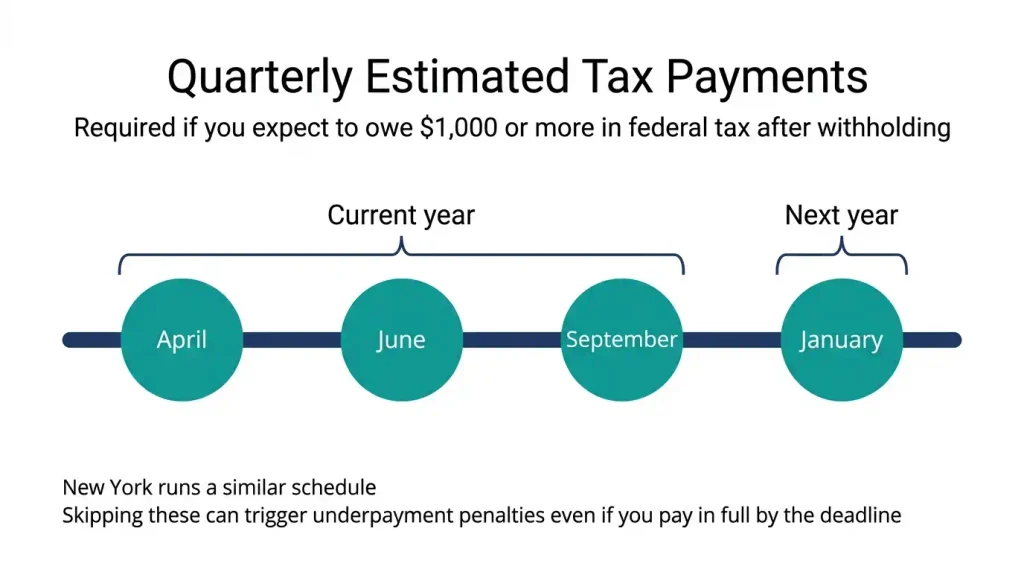
If you expect to owe $1,000 or more in federal tax after withholding, the IRS requires quarterly estimated payments, due in April, June, and September of the current year, then January of the next. New York runs a similar schedule. Skipping these can trigger underpayment penalties even if you pay in full by the deadline.
What Happens If You Spend the Full 1099 Payment
No withholding does not mean no tax, it just arrives later, all at once. Spend every dollar of a $6,000 payment and you can end up owing $1,500 or more back to the IRS and New York. If you also hold a W-2 job, ask that employer to withhold extra to help cover the gap.
New York 2026 Tax Rules 1099 Workers Need to Know
New York updates its tax rules almost every year, and 2026 brought real changes worth knowing before you file.
2026 New York State Withholding Changes
New York adjusted its 2026 personal income tax rate schedules and withholding tables. These mainly affect W-2 employees, since they control paycheck withholding, and employees set their state withholding with Form IT-2104. A 1099 worker has no withholding tables applied, but the same underlying brackets still set your final bill.
2026 MCTMT for Self-Employed Individuals
The Metropolitan Commuter Transportation Mobility Tax applies to self-employed people doing business inside the Metropolitan Commuter Transportation District. Net self-employment earnings over $50,000 allocated to the district owe this tax. The rate depends on which part of the district the income comes from.
Who Is Affected by the MCTD Rules
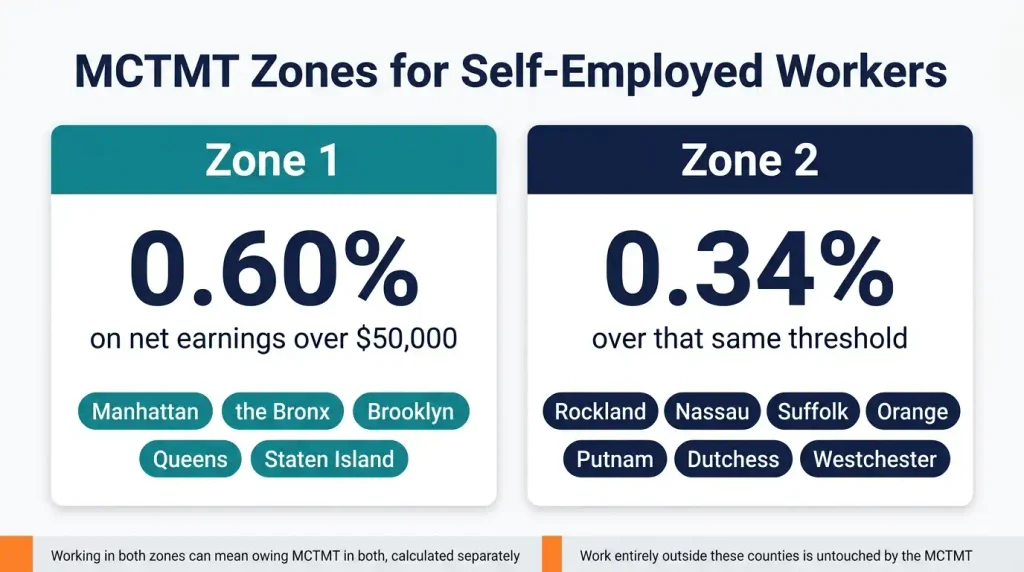
Zone 1, Manhattan, the Bronx, Brooklyn, Queens, and Staten Island, is taxed at 0.60% on net earnings over $50,000. Zone 2, Rockland, Nassau, Suffolk, Orange, Putnam, Dutchess, and Westchester, is taxed at 0.34% over that same threshold. Working in both zones can mean owing MCTMT in both, calculated separately. Work entirely outside these counties is untouched by the MCTMT.
NYC, Yonkers, and Other New York Locations
NYC’s city tax, Yonkers’ surcharge, and the MCTMT are three separate rules that do not automatically stack for every worker. A Rochester contractor deals with none of them. A Manhattan contractor working across the five boroughs can owe city tax and MCTMT together. Where you live and where you perform the work both matter, not just your mailing address.
1099 vs W-2 Take-Home Pay: What Actually Changes?
A bigger number on the offer letter does not always mean more money in your pocket, since gross pay and net pay can sit far apart.
Why a Higher 1099 Rate May Not Mean More Take-Home Pay
A 1099 rate has to cover self-employment tax, your own benefits, and unpaid time off, costs a W-2 salary never absorbs. Subtract all of that and a rate that looks 20% or 30% higher can land close to even, or worse. The comparison only works once every cost is on the table.
$30 W-2 vs $40 1099 Example
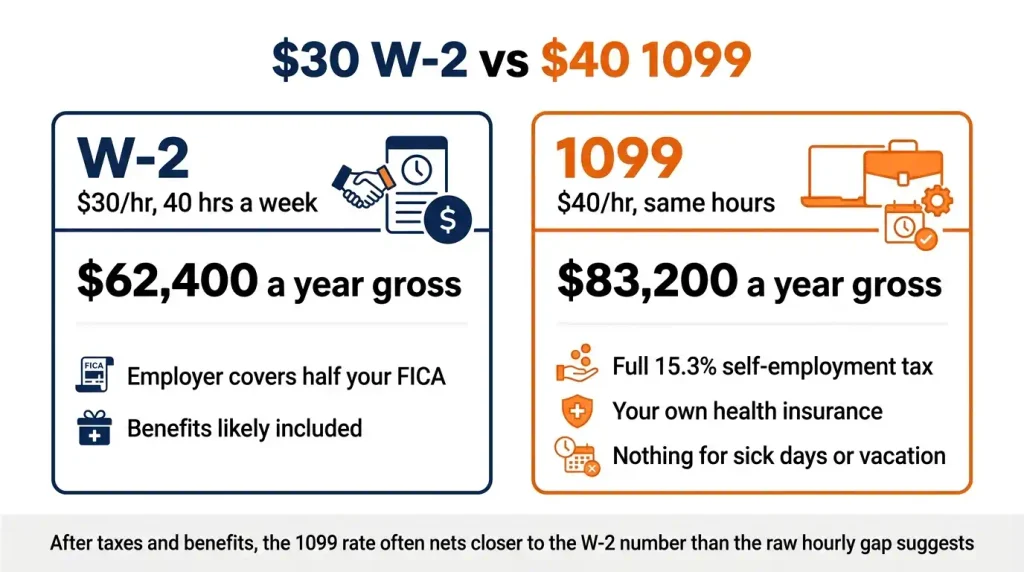
- $30/hr W-2, 40 hrs a week: $62,400 a year gross, employer covers half your FICA, benefits likely included
- $40/hr 1099, same hours: $83,200 a year gross, but you owe the full 15.3% self-employment tax, your own health insurance, and nothing for sick days or vacation
- After taxes and benefits, the 1099 rate often nets closer to the W-2 number than the raw hourly gap suggests
$50,000 W-2 vs $50,000 1099 Example
- W-2: income tax and 7.65% FICA withheld, nothing extra owed at filing
- 1099: same income tax plus 15.3% self-employment tax on net earnings, none of it withheld, so a large payment can be due in April
- Business deductions offset some of this, but identical gross pay never means identical cash in hand
$75,000 W-2 vs $75,000 1099 Example
- The self-employment tax gap adds several thousand dollars beyond what a W-2 employee pays in FICA
- Add New York State tax, and a contractor here usually needs to set aside 25% to 30% of every payment for taxes
- A W-2 employee at the same salary also gets health coverage and possibly a retirement match, benefits the contractor buys out of what is left
$100,000 W-2 vs $100,000 1099 Example
- The Social Security portion of self-employment tax is still fully in play, since it applies up to $184,500 for 2026
- A contractor inside the MCTD may also owe the MCTMT on top of federal and state tax
- The qualified business income deduction, worth up to 20% of qualified business income, softens the blow but rarely erases the full gap
How to Compare a 1099 Offer With a W-2 Offer
Never compare the two by the headline number alone. Break it down piece by piece.
Compare the Hourly or Salary Rate First
Turn a salary into an hourly rate by dividing it by expected annual hours. Turn a 1099 rate into an annual number, then subtract the weeks you expect unpaid between projects. Now both numbers are built the same way.
Add the Value of W-2 Benefits
Health insurance alone is often worth several thousand dollars a year. A 401(k) match, paid vacation, and sick time add more on top. Add up what your employer covers and add that total to the W-2 side.
Subtract Contractor Costs
From the 1099 side, subtract self-employment tax, your own health insurance, and retirement savings, then equipment, software, and business insurance. What is left is your real contractor take-home.
Compare the Total Compensation Package
Once both sides reflect real take-home cash, benefits, taxes, and expenses, you have an honest comparison. Add how much you personally value stability versus flexibility. The right choice depends on your numbers, not which offer sounds better on paper.
Does Your New York Job Actually Qualify as 1099 Work?
Getting a 1099 form does not automatically make you a legitimate independent contractor.
Why the 1099 Label Does Not Decide Worker Status
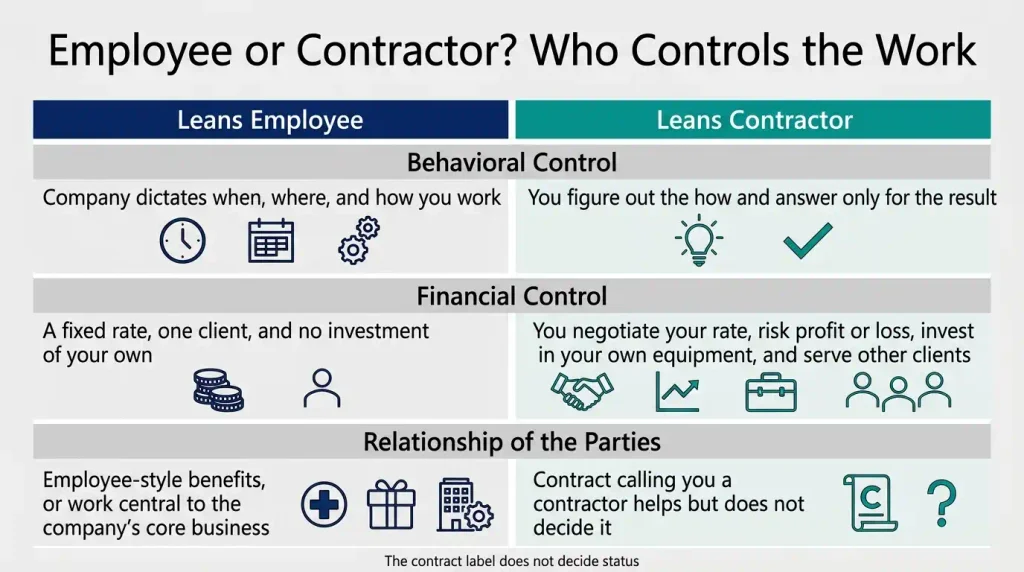
The IRS and New York both look past the paperwork to the real working relationship. A company cannot make someone an employee in practice and a contractor on paper by handing them a 1099 instead of a W-2. What matters is who controls the work.
Behavioral Control
If the company dictates when, where, and how you work, that points toward employee status. Training and ongoing supervision point the same way. A genuine contractor figures out the how alone and answers only for the result.
Financial Control
Can you negotiate your rate? Do you risk losing money or profit from efficiency? Do you invest in your own equipment and serve other clients? That independence supports contractor status. A fixed rate, one client, and no investment of your own leans toward employee.
Relationship of the Parties
A contract calling someone a contractor helps but does not decide it. An ongoing, indefinite relationship looks more like employment than a short, defined project. Employee-style benefits, or work central to the company’s core business, both push toward employee status regardless of the contract.
New York-Specific Indicators
New York leans harder toward employee status than federal rules do, especially for unemployment insurance. Authorities look at whether the business supervises the work, whether the worker runs an actual independent business, and whether that worker advertises to the public. Accepting or declining assignments freely, and carrying your own business risk, both matter under New York’s approach.
1099 vs W-2 Benefits and Worker Protections
Pay is only half the comparison. Protections and benefits make up the other half.
Health Insurance and Retirement Benefits
Employers often cover a large share of health premiums for W-2 staff and may match retirement contributions. A 1099 contractor buys coverage at full price and funds their own SEP-IRA or Solo 401(k) with no match. Factor both costs into any offer comparison.
Paid Time Off and Unpaid Time
A W-2 job usually includes paid vacation, sick days, and holidays. A 1099 arrangement pays for work delivered, so every day off is unpaid. Convert lost time into a dollar figure, ten unpaid days a year is a real cost.
Unemployment Insurance
W-2 employees are generally covered by unemployment insurance if they lose a job through no fault of their own. Genuine 1099 contractors typically are not. If a company treated you like an employee day to day despite the label, New York’s Department of Labor may still find you eligible.
Workers’ Compensation and Employment Protections
W-2 employees are usually covered by workers’ compensation if hurt on the job. Independent contractors typically are not, unless industry-specific rules say otherwise. A company cannot erase these protections just by writing “independent contractor” into a contract if the real relationship looks like employment.
Business Expenses and Deductions for 1099 Workers
Every legitimate business expense you can document lowers the profit you get taxed on.
What Counts as a Business Expense
The IRS standard is ordinary and necessary for your line of work: equipment, supplies, software, and professional services like a bookkeeper typically qualify. Keep receipts, an undocumented deduction is one you cannot defend.
Home Office and Work-From-Home Costs
If you use part of your home regularly and exclusively for business, you may deduct a portion of rent, utilities, or mortgage interest tied to that space. A kitchen table used for meals too does not qualify. Keep clear records of square footage and use, this deduction draws extra scrutiny.
Mileage and Transportation
Commuting from home to a regular workplace is never deductible. Driving between client sites or for supplies is business mileage, and the 2026 IRS rate is 72.5 cents per mile. Log dates, destinations, and purpose for every trip you deduct.
Why Deductions Do Not Make 1099 Work “Tax-Free”
A deduction lowers taxable income, it does not erase the tax. Even after every write-off, you still owe income tax and the full 15.3% self-employment tax on what remains. Documentation is what separates a legitimate deduction from an audit flag.
What Forms Do You File With 1099 Income in New York?
A 1099 job usually means more forms, not fewer, and New York adds its own tax forms and withholding rules.
Federal Forms
- Form 1099-NEC: shows what you were paid
- Form 1040: your overall tax return
- Schedule C: business income and expenses
- Schedule SE: self-employment tax
Each feeds into the next, so an error on Schedule C carries through.
New York State Forms
New York residents file Form IT-201; nonresidents or part-year residents use Form IT-203. Estimated tax during the year uses New York’s own payment forms. Income earned partly inside and outside New York may need allocation between the two.
What If You Never Receive a 1099?
The income is still reportable even without a form. Businesses only issue a 1099-NEC for payments of $2,000 or more in 2026, so smaller jobs often generate none. Keep your own records, the IRS expects the income reported regardless.
What If the 1099 Is Wrong?
Check the number against your own payment records first. If it does not match, contact the issuer for a corrected form. Keep your own invoices and bank records as backup, since you can report the correct amount even before a correction arrives.
Common New York 1099 Scenarios
Real New York paycheck scenarios that workers run into constantly, and how to think through each one.
You Were Offered $40 per Hour as a 1099 Contractor
Figure out what that rate becomes after self-employment tax, your own health insurance, and unpaid downtime between projects. Compare it to an equivalent W-2 role with benefits. If the company controls your schedule and methods, ask whether this should really be a 1099 relationship.
Your Employer Wants to Change You From W-2 to 1099
Look at what disappears: health coverage, unemployment eligibility, any retirement match. If your duties and daily supervision stay the same, the switch may be about the employer avoiding payroll taxes, not a real change in the relationship. That mismatch is exactly what labor agencies look at when misclassification gets reported.
You Have a W-2 Job and a 1099 Side Hustle
Both incomes land on the same tax return but are taxed differently. The 1099 side owes self-employment tax on top of income tax, while your W-2 wages already had FICA withheld. Estimated payments or extra W-2 withholding can cover the gap.
You Work Remotely in New York for an Out-of-State Company
Where you physically work usually sets your New York tax obligation, not your client’s office location. Working from an Albany apartment for a Texas company still generally means New York wants its share. Run complex, multi-state situations by a tax professional.
You Live Outside New York but Perform Work for a New York Business
Your client’s location alone does not create a New York tax obligation. What matters is where you perform the services. Work done entirely from another state is typically not New York-source, though every situation depends on its facts.
What If You Are Misclassified as a 1099 Contractor?
A 1099 form alone settles nothing if the actual job looks like employment under New York’s worker classification rules.
Signs That a “1099 Job” May Look Like Employment
Red flags: the company sets your hours, dictates exactly how tasks get done, and your work is core to what the business sells. No real independence, no other clients, no financial risk of your own point the same way. One or two alone is not proof, but several together build a strong case.
What a Misclassified Worker May Be Missing
Misclassified workers can miss unemployment insurance, workers’ compensation, and the employer half of payroll taxes owed on their behalf. Overtime pay and other New York wage protections may also apply. These add up to real money owed, not small technicalities.
Where to Get a Worker-Status Determination
The IRS offers Form SS-8 to formally determine your status. New York’s Department of Labor handles state unemployment insurance classification separately. For anything complicated or high-value, a tax or employment attorney is worth the cost.
What Records to Keep
- Your contract and onboarding paperwork
- Emails showing who controlled your schedule and methods
- Timesheets and work logs
- Every invoice or payment record
This documentation proves what your working relationship actually looked like.
Common Myths About 1099 vs W-2 in New York
A few beliefs about this topic are simply wrong, and they cost people money when they go unchallenged.
“My Employer Gives Me a 1099, So I Am Automatically a Contractor”
Not true. The IRS and New York evaluate the real relationship using behavioral control, financial control, and how the parties interact. A 1099 does not override those facts, you may legally be an employee no matter what form you received.
“1099 Workers Pay a Completely Different Income-Tax Rate”
Income tax brackets are the same for everyone. What differs is self-employment tax, which W-2 employees never pay since their employer covers half automatically. Contractor deductions shrink taxable income, that is separate from the rate itself.
“W-2 Workers Do Not Pay Social Security or Medicare Tax”
They do, just at half the rate. The 7.65% comes out of every paycheck, and the employer matches it. A 1099 worker pays the full 15.3% alone.
“If I Do Not Receive a 1099, I Do Not Report the Income”
The reporting requirement is on you regardless. Businesses only send a 1099-NEC for payments of $2,000 or more in 2026, so plenty of legitimate income never generates one. Track payments through invoices and bank deposits and report everything.
“An LLC Automatically Makes Me a 1099 Contractor”
An LLC changes your business structure, not your worker classification. You can still be found an employee of a company that controls your work like an employer would, even through an LLC. Entity formation and classification are separate legal questions.
“Every 1099 Expense Is Tax Deductible”
Only ordinary and necessary business expenses qualify. Personal expenses do not become deductible just because you work from home or in your car. Every deduction needs a business purpose and documentation.
Questions to Ask Before Accepting a 1099 Offer
A short list of questions that can save you from a bad surprise later.
Questions About Pay and Taxes
- Is the rate hourly, per project, or annual?
- Will any taxes be withheld?
- Are you handling every estimated payment yourself?
- What expenses come out of your own pocket?
Questions About Benefits
- Any health insurance contribution?
- Any paid time off, even informally?
- Access to a retirement plan?
- Are equipment or software costs reimbursed?
Questions About the Working Relationship
- Who decides your schedule?
- Who controls how the work gets done?
- Can you take on other clients?
- Can you decline an assignment without consequence?
Questions About the Contract
- How does either side end the arrangement, and with what notice?
- What happens if the work volume changes?
- Who owns the equipment and final work product?
- Does the work need insurance or licensing you would carry yourself?
1099 vs W-2 Decision Checklist for New York Workers
A simple order of operations before you sign anything.
Before Comparing the Dollar Amounts
- Confirm the arrangement is genuinely contractor work, not employment with a 1099 label
- Nail down the exact gross compensation
- Estimate real hours worked, including unpaid gaps
- Note any NYC, Yonkers, or MCTD rules that apply to you
Before Signing a 1099 Contract
- Estimate your federal tax bill, including the full 15.3% self-employment tax
- Add New York State tax
- Factor in your own health insurance and retirement costs
- Confirm the number left still works for you
Before Accepting the W-2 Job
- Look at gross salary or hourly wage first
- Check what will actually be withheld each paycheck
- Add up the real value of benefits offered
- Confirm any retirement match and paid time off
Final Numbers to Compare
- Line up gross annual pay for both sides
- Estimate realistic after-tax cash for each
- Add the dollar value of W-2 benefits
- Subtract contractor expenses and unpaid time from the 1099 side before deciding
1099 vs W-2 in New York FAQ
Is It Better to Be 1099 or W-2 in New York?
It depends on your specific numbers and priorities. A 1099 arrangement can pay more per hour and offer flexibility but carries higher total tax and no built-in benefits. A W-2 job trades flexibility for stability and simpler taxes. Neither is universally better, and correct legal classification matters more than preference.
Do 1099 Workers Pay More Taxes Than W-2 Employees?
Usually, mainly due to self-employment tax. Income tax uses the same brackets for both, but a 1099 worker covers both halves of Social Security and Medicare alone. Contractor-only deductions narrow the gap somewhat, results vary by person.
How Much Should a 1099 Worker Set Aside for Taxes?
There is no universal number, it depends on income, deductions, and where in New York you live. Many contractors start at 25% to 30% of each payment, higher inside NYC or the MCTD. Running your actual numbers through a calculator beats any flat rule.
Can a W-2 Employee Also Have 1099 Income?
Yes, and it is common. The 1099 income is reported on Schedule C and owes self-employment tax, separate from W-2 wages. Cover the extra tax through estimated payments or extra W-2 withholding.
Do 1099 Workers Get Unemployment in New York?
Generally not, since genuine contractors have no employer paying into the system. If the relationship actually looked like employment despite the label, New York’s Department of Labor may still find the worker eligible. Do not assume automatic exclusion.
Can My Employer Force Me to Be 1099?
An employer cannot make you a contractor by label alone if the relationship functions like employment. Classification depends on who controls schedule, methods, and financial risk. If nothing changes but the form, raise it with New York’s Department of Labor or a tax professional.
Does a 1099 Worker Need to Pay Quarterly Taxes?
Yes, if you expect to owe $1,000 or more in federal tax after withholding. New York runs its own similar quarterly schedule. Skipping payments can trigger underpayment penalties even if you pay in full by the deadline.
What Happens If I Get Both a W-2 and a 1099?
Both incomes are reported separately on the same return. The W-2 portion already had taxes withheld; the 1099 portion owes self-employment tax on top of income tax. Extra W-2 withholding is often the simplest way to cover what the 1099 side owes.
Key Takeaways for Comparing 1099 and W-2 Work in New York
The Three Numbers to Compare
Gross compensation is the starting point. Estimated after-tax cash shows what you actually keep. Total benefits and contractor costs fill in the rest.
The Three Classification Questions to Check
Who controls how and when the work gets done? Who carries the financial risk? Is this a genuine independent business relationship, or employment with different paperwork?
The Three New York Factors to Verify
Confirm how New York State income tax applies to you. Check whether NYC or Yonkers rules apply based on where you live. Verify MCTMT exposure based on where the work is performed.

Meet Yasin Ali, Founder
Yasin built NY Paycheck Calculator in 2020 after getting fed up with calculators that treated New York like every other state. Most tools ignore the extra local tax NYC and Yonkers workers pay on top of state tax — or skip New York’s Paid Family Leave deduction entirely.
He keeps the numbers current, checking in regularly against the latest IRS, NY Department of Taxation and Finance, and Paid Family Leave rates.
All results here are estimates based on official sources. For advice specific to your situation, talk to a tax professional.