
New York City income tax is a resident-only tax charged on top of federal and state tax. For 2026, rates run from 3.078% to 3.876% across four brackets, and only residents of the five boroughs owe it.
Having built payroll calculators covering these brackets, the $50,000 single-filer threshold is the detail most take-home pay estimates miss.
These figures are estimates only; actual liability depends on credits, deductions, and filing status.
New York City Income Tax at a Glance
| Filing Status | Top Rate (3.876%) Starts At |
|---|---|
| Single / Married Filing Separately | $50,000 |
| Head of Household | $60,000 |
| Married Filing Jointly | $90,000 |
What NYC income tax is and who pays it
NYC personal income tax, also called New York City personal income tax, is separate from New York State and federal tax. It applies only to residents of the five boroughs of New York City: Manhattan, Brooklyn, Queens, the Bronx, and Staten Island. Live there full year, and you owe it on your income, no matter where your paycheck comes from. It is different from sales tax, property tax, or the old commuter tax.
2026 NYC income tax rates at a glance
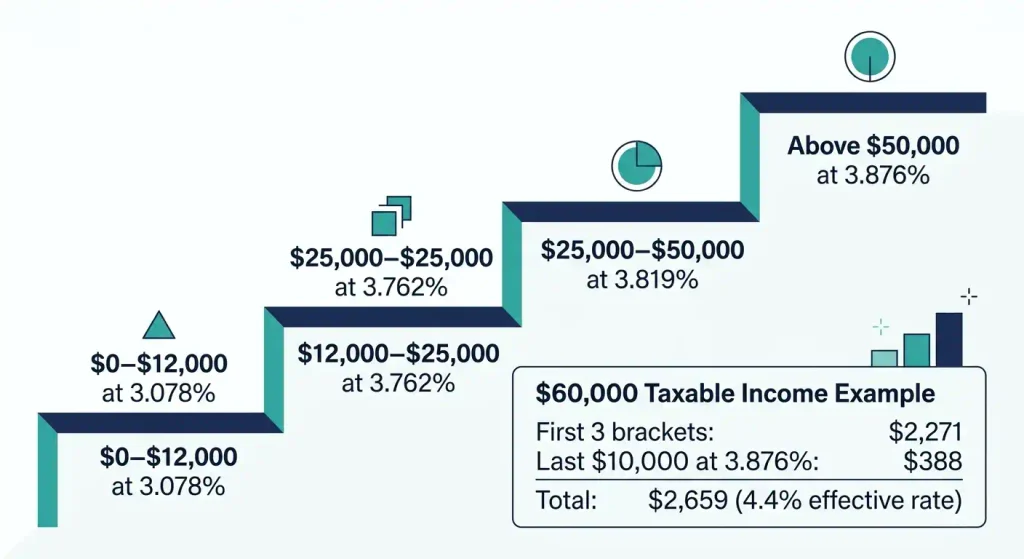
NYC uses four brackets in 2026: 3.078%, 3.762%, 3.819%, and 3.876%. Single filers hit 3.876% at $50,000 of taxable income; married filing jointly hits it at $90,000. These are marginal rates: each rate applies only to its own slice of income, so your effective rate stays below the top marginal number. The New York City tax rate schedule breaks all four brackets down by filing status.
NYC income tax vs. New York State and federal tax
Three layers hit a New York City paycheck: federal, New York State, and NYC. Federal tax uses seven brackets topping out at 37% in 2026. New York State tax uses nine brackets from 3.9% to 10.9%, a schedule maintained by the New York State Department of Taxation and Finance. NYC tax adds up to 3.876% on top. Each shows up as its own withholding line, but withholding is only an estimate; your real bill settles when you file your New York State return, since NYC tax is calculated on that same form.
2026 New York City Income Tax Rates and Brackets
Here are the 2026 NYC brackets by filing status, and why nobody pays the top rate on their whole income.
| Bracket Rate | Single / Married Filing Separately | Married Filing Jointly |
|---|---|---|
| 3.078% | $0 – $12,000 | $0 – $21,600 |
| 3.762% | $12,000 – $25,000 | $21,600 – $45,000 |
| 3.819% | $25,000 – $50,000 | $45,000 – $90,000 |
| 3.876% | Above $50,000 | Above $90,000 |
NYC tax brackets for single and married filing separately
Single filers and married filing separately pay 3.078% up to $12,000 of taxable income, 3.762% from $12,000 to $25,000, 3.819% from $25,000 to $50,000, and 3.876% above $50,000. Each rate only taxes its own slice, staircase style, never your whole income at once.
NYC tax brackets for married filing jointly
Married filing jointly and qualifying surviving spouses get wider brackets: 3.078% up to $21,600, 3.762% from $21,600 to $45,000, 3.819% from $45,000 to $90,000, and 3.876% above $90,000, nearly double the single filer cutoff.
NYC tax brackets for head of household
Head of household brackets sit in between: the top 3.876% rate starts at $60,000 of taxable income. This status applies to unmarried taxpayers who pay over half the cost of a home for a qualifying dependent.
Why your entire salary is not taxed at one NYC rate
A single filer earning $80,000 does not pay 3.876% on all of it. Take $60,000 taxable income: the first three brackets owe roughly $2,271, plus 3.876% on the last $10,000, about $388. Total tax lands near $2,659, an effective rate around 4.4%, well below 3.876% times $60,000.
Who Has to Pay NYC Income Tax?
Residency decides it. Live in the five boroughs and you generally owe city tax; live elsewhere and you generally do not, with a few exceptions.
NYC residents
You are a New York City resident for tax purposes if the city is your domicile, or if you keep a permanent place there and spend 184 days or more in the city each year. Full year residents owe NYC resident tax on all taxable income, including New York City source income and income earned entirely outside New York state, regardless of where they work; a resident commuting daily to New Jersey still owes it. Your NYC domicile, the home you intend to return to, differs from a temporary residence for work or school, which is exactly what the 184-day rule exists to catch when your New York City domicile is unclear.
People who work in NYC but live outside the city
Working in Manhattan does not make you a city taxpayer. NYC nonresidents owe New York State tax on their New York source income, not NYC tax, even if their employer is headquartered in Manhattan. Commuters from Long Island, Westchester, New Jersey, or Connecticut skip city tax entirely. The one exception: certain New York City government employees can owe NYC tax regardless of residence.
Part-year NYC residents
Move into or out of the city mid-year, and you owe NYC tax only for the months you actually lived there. As an NYC part-year resident, you report that split on Form IT-360.1, the schedule New York uses for this allocation. Your move date determines the split.
Remote workers and NYC income tax
Residency decides this too, not your job location. A Brooklyn resident working remotely for a Texas company still owes full NYC tax. Move out of the city and work remotely from Westchester, and your new residency is what matters. Remote work is not a loophole.
How NYC Income Tax Is Calculated
Your NYC bill starts from gross pay and works down through deductions before the brackets apply, following the same calculation methodology used across this site.
From gross pay to NYC taxable income
Start with wages or self-employment income. New York’s 2026 standard deduction is $8,000 single, $16,050 married filing jointly, both lower than the federal standard deduction, confirmed on the official IRS site, of $16,100 single and $32,200 married filing jointly. The federal SALT deduction cap rises to $40,000 for married filing jointly for 2026 through 2029; New York’s own itemized deductions are uncapped. Subtract deductions and adjustments to get NYC taxable income, the same gross pay versus net pay gap this site covers for every New York paycheck, which shares its base with New York State taxable income and starts from federal adjusted gross income before New York’s own adjustments produce New York adjusted gross income. Freelancers and self-employed workers, including anyone weighing employee versus independent contractor status, follow the same path from net self-employment income, usually via quarterly estimated payments. Investment income, capital gains, and rental income all count too; unlike federal rules, New York taxes capital gains as ordinary income, with no reduced rate.
How filing status changes the calculation
The same income owes different city tax depending on filing status, since bracket thresholds differ by status. Married filing separately generally shares single filer brackets. If one spouse lives in NYC and the other does not, only the resident spouse’s income is subject to NYC tax, even on a joint federal return, which can make filing separately for New York the cleaner move.
How NYC tax credits reduce your final liability
Credits cut your bill dollar for dollar, unlike deductions. NYC offers the Income Tax Elimination Credit and its own Earned Income Tax Credit, both claimed at filing, not reflected in withholding. Dependents often decide eligibility, since a qualifying child or relative frequently unlocks the Income Tax Elimination Credit.
NYC Income Tax and Your Paycheck
That NYC line on your pay stub is your employer’s estimate, not your final bill.
Why NYC income tax appears as a paycheck deduction
Your pay stub shows three separate withholding lines: federal, New York State, and New York City, each calculated with its own tables. For a full breakdown of every line, see what taxes come out of a New York paycheck. A change to your W-4 or state withholding form can move one line without touching the other.
NYC withholding vs. the tax you actually owe
Withholding is your employer’s year-round estimate. Your real liability is calculated once, at filing, using your full year income, deductions, and credits. Withheld too much, get a refund; too little, owe the difference. A mismatch is normal.
How 2026 NYC withholding is calculated
New York publishes Publication NYS-50-T-NYC (1/26), part of the broader Publication NYS-50 series, as the official 2026 NYC withholding guide, covering the wage bracket method and the exact calculation method. Employers outside the boroughs use Publication NYS-50-T-NYS instead. See this site’s guide to New York State tax withholding for how the three layers stack on a single paycheck. Your annual tax rate schedule, used at filing, is the real source of truth.
What can change your NYC paycheck withholding
Four things move it most: filing status, your New York withholding certificate, pay frequency and wage amount, and pre-tax deductions. Form W-4 sets your federal W-4 withholding only; Form IT-2104 is what actually drives your New York withholding tax, a distinction covered in full in Form W-4 vs Form IT-2104. Working two jobs often leaves you under-withheld, since each employer withholds as if it is your only income, a common payroll withholding pitfall.
How Much NYC Income Tax Would You Pay on Different Salaries?
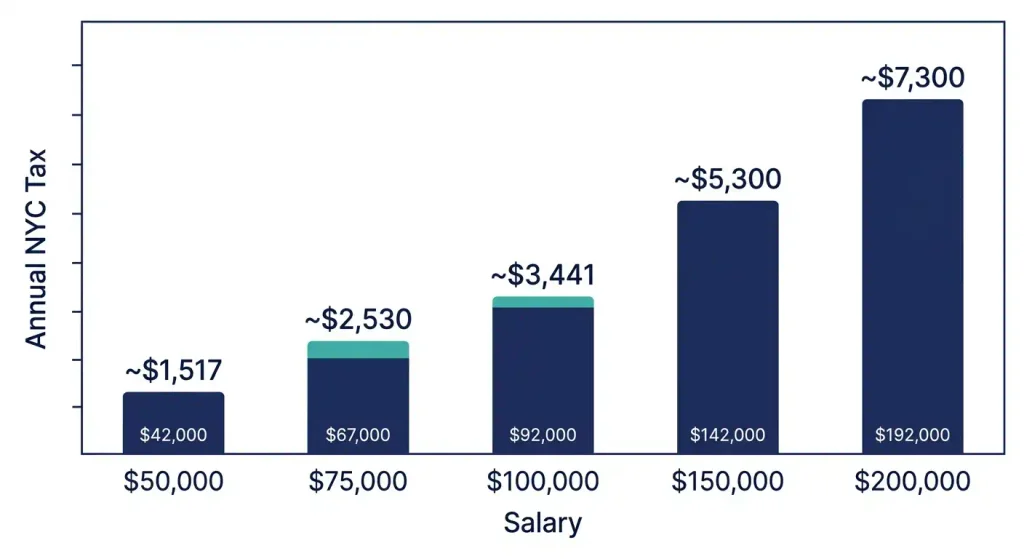
Examples below assume a single filer, full year NYC resident, standard deduction only.
| Salary | Taxable Income | NYC Tax (Annual) |
|---|---|---|
| $50,000 | $42,000 | ~$1,517 |
| $75,000 | $67,000 | ~$2,530 |
| $100,000 | $92,000 | ~$3,441 |
| $150,000 | $142,000 | ~$5,300 |
| $200,000 | $192,000 | ~$7,300 |
NYC tax on a $50,000 salary
Taxable income after the $8,000 deduction is $42,000, giving roughly $1,517 in NYC tax, an effective rate near 3.6%.
NYC tax on a $75,000 salary
Taxable income comes to $67,000. Total NYC tax lands around $2,530 a year, about $211 a month or $97 biweekly.
NYC tax on a $100,000 salary
Taxable income is about $92,000. NYC tax comes to approximately $3,441, an effective rate near 3.4%. Add New York State tax, and the combined state and city bill runs close to $8,300.
NYC tax on a $150,000 salary
Taxable income runs about $142,000, mostly above the top bracket threshold. Annual NYC tax comes to close to $5,300, about $442 a month.
NYC tax on a $200,000 salary
Taxable income lands around $192,000. NYC tax runs close to $7,300 a year, not 3.876% of the full $200,000, since the first $50,000 still gets the lower rates.
Hourly pay works the same once annualized: $20 an hour is about $41,600 a year, near $1,187 in NYC tax; $30 an hour is about $62,400, near $1,984; $40 an hour is about $83,200, near $2,790. Check the current New York minimum wage for your region before annualizing an hourly rate.
NYC Income Tax by Pay Frequency
Pay frequency changes how your annual tax gets spread across checks, not the total you owe.
Weekly pay
Weekly payroll annualizes your wage by multiplying it by 52, applies withholding tables, then divides the tax back down. Bonus or overtime weeks get annualized differently, spiking that check’s withholding; see New York overtime laws for how those hours get calculated in the first place.
Biweekly pay
Biweekly pay multiplies your check by 26 to estimate annual income. A bonus or overtime check can get taxed at a higher effective rate that period, though your annual total does not change.
Semi-monthly and monthly pay
Semi-monthly runs 24 pay periods, monthly runs 12. Fewer, larger checks under monthly pay can push more income into a higher withholding bracket per period than biweekly would. Commissions create the widest swings.
How NYC Tax Changes Your Take-Home Pay
Stack every layer, and the gap between salary and take-home pay in NYC can look brutal on your first pay stub.
Federal tax vs. NYS tax vs. NYC tax on one paycheck
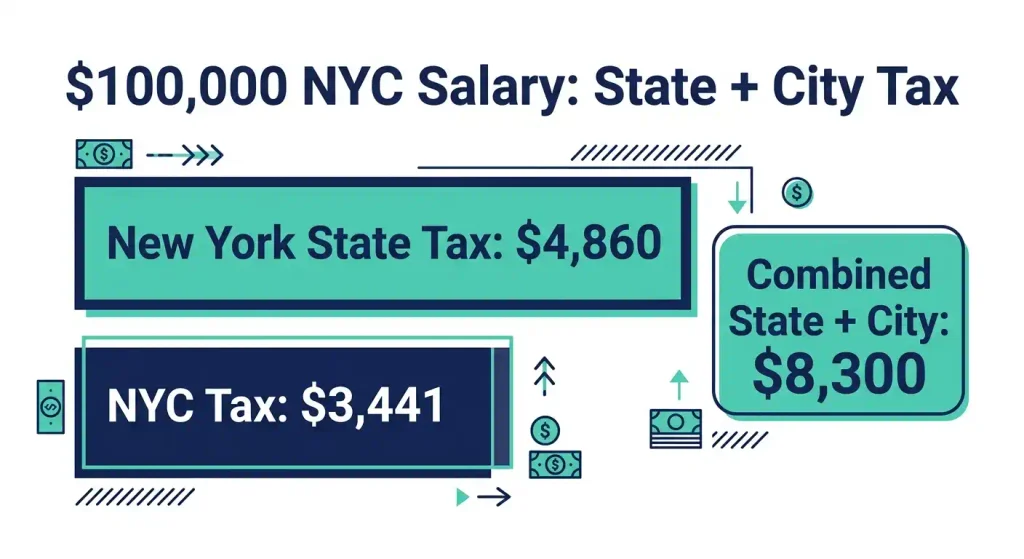
Your paycheck carries federal, New York State, and NYC income tax, plus Social Security and Medicare, which are payroll taxes, not income taxes. On a $100,000 salary, combined state and city tax alone runs close to $8,300, before federal and payroll taxes. A total deduction above 30% of gross pay is normal at moderate incomes, not a red flag, and it is worth factoring into any job offer comparison against a state with no local income tax.
How raises affect NYC income tax
A raise only pushes the new income into a higher bracket; it never retaxes money you already earned at the higher rate. Go from $95,000 to $110,000, and only the amount above your old threshold gets the new rate. Take-home pay still rises, though if it looks smaller than expected, why is my New York paycheck lower walks through the other usual suspects.
How 401(k), HSA, FSA, and health deductions can affect pay
Traditional 401k, HSA, and FSA contributions reduce your federal taxable wages, and New York generally follows the same treatment for state and city tax. Not every pre-tax deduction works identically across all three layers though; see the full list of New York paycheck deductions for the exceptions.
NYC Tax Credits That Can Reduce What You Owe
These credits can meaningfully cut your NYC bill, and many filers never claim them.
New York City Income Tax Elimination Credit
This credit can reduce or eliminate NYC tax for lower income filers with a qualifying dependent, phasing out as income rises. Claim it on Form IT-270 with your state return.
NYC Earned Income Tax Credit
NYC runs its own EITC on top of the federal Earned Income Tax Credit, so eligible families can claim both. The NYC earned income credit is refundable, putting money in your pocket even at zero city tax owed.
Other NYC tax credits and relief
Also check the NYC household credit, based on income and household size, and the NYC school tax credit, a small flat credit most full year residents get regardless of income, plus an income-based portion that phases out above roughly $250,000 in New York adjusted gross income. Both trace to the New York Tax Law, specifically Tax Law § 606.
Real-Life NYC Income Tax Scenarios
Six situations that come up constantly.
NYC employee who lives and works in Manhattan
A full year Manhattan resident earning $100,000 owes federal tax, roughly $4,860 in New York State tax, and roughly $3,441 in NYC tax, about $8,300 combined state and city. It all reconciles on one combined return.
Brooklyn resident who works remotely
A Brooklyn resident working remotely for a California company still owes full NYC tax, since residency, not employer location, decides it.
New Jersey resident commuting to Manhattan
This commuter owes New York State tax as a nonresident on New York source income, but zero NYC personal income tax.
Employee who moves into NYC during 2026
Move from Nassau County to Queens on July 1, and you owe NYC tax only from that date forward, using New York’s part year resident allocation.
Employee who moves out of NYC during 2026
The same allocation runs in reverse: income before the move is taxed by NYC, income after is not. Take-home pay typically rises once the NYC portion of withholding disappears.
Low-income NYC family with dependents
A family with modest income and qualifying dependents can see the Income Tax Elimination Credit and NYC EITC wipe out most or all of their gross NYC tax. Part-time student workers often land in the same spot.
NYC Income Tax vs. Other New York Local Taxes
NYC is not the only local income tax in New York, and mixing it up with others causes real withholding mistakes.
NYC income tax vs. Yonkers income tax
Yonkers runs its own local system: residents pay a 16.75% surcharge on their New York State tax liability, and nonresidents who work there pay a smaller earnings tax. NYC and Yonkers residency are mutually exclusive.
NYC income tax vs. New York State income tax
New York State personal income tax uses nine brackets on all state residents; NYC adds its own four bracket system only for the five boroughs, part of the broader New York State income tax picture. Both withhold from the same paycheck and report on one return. The New York State Department of Taxation and Finance administers both; the New York City Department of Finance handles property tax instead, with no separate New York City Department of Finance income tax division. Check the New York City tax table each filing season.
NYC income tax vs. payroll taxes
Social Security and Medicare are payroll taxes, not income taxes, and follow different rules entirely. Health insurance premiums and retirement contributions are not taxes at all.
Common NYC Income Tax Mistakes and Misconceptions
Six misunderstandings I correct constantly.
“I work in NYC, so I automatically owe NYC income tax”
Not true. NYC tax is based on residency, not workplace. A Manhattan commuter owes New York State tax, not NYC tax, apart from certain NYC government employees. The reverse also holds: someone in Albany or Buffalo owes New York State tax but nothing extra to the city.
“My NYC tax is simply my salary multiplied by the top rate”
NYC uses progressive brackets. A single filer at $60,000 pays a blend of 3.078%, 3.762%, 3.819%, and 3.876% across slices of income, for an effective rate well below 3.876%.
“My paycheck withholding is exactly what I owe”
Withholding is an estimate; your real liability depends on full year income, deductions, and credits, settled at filing. That is why refunds and balances due happen even at identical salaries.
“NYC tax and New York State tax are the same thing”
They are two separate taxes with separate rate schedules, though both withhold from the same paycheck and report on one return. Seeing state tax withheld does not mean your city obligation is covered.
“A raise puts my whole salary into a higher tax bracket”
Marginal taxation means only the new income above your old threshold gets the higher rate. Take-home pay from a raise always goes up.
“The 2026 NYC withholding changes are the same as NYS changes”
New York State cut its bottom five bracket rates by a tenth of a point for 2026, but that is a state-schedule change, not a city one. Employers need the current Publication NYS-50-T-NYC (1/26), not an outdated table.
How to Estimate Your NYC Income Tax Yourself
Yes, you can run this math by hand with five pieces of information.
Information you need before calculating
Gather your annual salary or wages, NYC residency status, filing status, dependents and deductions, and any other taxable income like freelance work.
Step-by-step NYC tax estimate
Subtract the New York standard deduction to get taxable income. Confirm filing status. Run taxable income through the correct brackets. Subtract eligible credits, like the Income Tax Elimination Credit, for your final liability.
How to estimate NYC tax from a paycheck
Multiply your per-paycheck NYC withholding by your total pay periods for the year, then compare against your expected annual liability. Bonuses and overtime annualize differently, so factor them separately. Hourly workers should multiply rate by weekly hours, then by 52.
When to use a paycheck calculator instead
Multiple deductions, several income sources, irregular pay, or bonus and overtime pay make hand calculations messy. A combined federal, New York State, and NYC paycheck calculator avoids the errors that stack up.
How to Check Whether Your NYC Tax Withholding Looks Right
A quick pay stub review twice a year catches most withholding problems early.
What to look for on your pay stub
Check four lines: NYC withheld, New York State withheld, federal withheld, and gross versus taxable wages. Compare them period over period, or use how to read a New York pay stub as a line-by-line guide.
Compare your withholding with your expected annual tax
Multiply your current per-paycheck NYC withholding across remaining pay periods, factor in coming raises or bonuses, then include expected credits. It will not match your return exactly, but a big gap is worth investigating.
When your withholding may need attention
Update your withholding after a major salary change, marriage or divorce, a new dependent, or a move into or out of NYC.
NYC Income Tax Forms and Official 2026 Resources
Four forms cover almost every NYC income tax situation, part of the broader New York tax forms and withholding topic.
| Form | Purpose |
|---|---|
| NYS-50-T-NYC | 2026 employer withholding guide for NYC payroll |
| IT-201 (+ IT-201-I) | Full year resident state return; NYC tax calculated here |
| IT-2104 (+ IT-2104-I) | Employee withholding certificate for New York |
| IT-2104.1 | Nonresidence and income allocation certificate |
NYS-50-T-NYC
The official 2026 employer withholding guide for NYC payroll, covering the wage bracket method and exact calculation method.
Form IT-201
Full year New York State residents, including NYC residents, file Form IT-201, with NYC tax calculated in its own section of the same form. The deadline matches the federal one, April 15, 2027, for 2026 tax year returns. Form IT-201-I is the instruction booklet.
Form IT-2104
Your New York employee withholding certificate, similar to the federal W-4 but state specific. It sets up withholding, not your final tax bill. Form IT-2104-I walks through the worksheet.
Form IT-2104.1
Handles nonresidence and income allocation for employees whose income spans multiple jurisdictions or partial year NYC residency. See this site’s Form IT-2104.1 guide for line-by-line allocation examples.
Frequently Asked Questions About NYC Income Tax
How much is NYC income tax in 2026?
NYC income tax runs from 3.078% to 3.876% across four marginal brackets. Final liability depends on taxable income and filing status.
Do I pay NYC income tax if I work in NYC but live elsewhere?
Generally no. NYC tax is based on residency, not workplace, aside from certain NYC government employees.
What is the NYC income tax rate for $100,000?
There is no single flat rate. A single filer at $100,000 owes roughly $3,441 in city tax, an effective rate near 3.4%, below the 3.876% top marginal rate.
Does NYC have a local income tax?
Yes, a resident personal income tax on top of state and federal tax, separate from Yonkers’ own local tax.
Is NYC income tax included in NY State tax?
No. They are separate taxes, though both withhold from the same paycheck and report on one return.
Why is NYC income tax coming out of my paycheck?
Your employer withholds it as a resident estimate toward your final annual liability, settled at filing.
Does NYC tax apply to remote workers?
Yes, if you are an NYC resident; your obligation follows residency, not your employer’s location.
Can NYC income tax be eliminated or reduced?
Yes, through credits like the NYC Income Tax Elimination Credit and the NYC Earned Income Tax Credit, depending on income and household size.
What form shows NYC income tax withholding?
Your W-2 reports the NYC tax withheld for the year, matching what you report on your New York State return.
Before You Estimate Your 2026 NYC Income Tax
It comes down to four numbers and some honesty about your situation.
The four numbers that matter most
NYC residency status, filing status, NYC taxable income after deductions, and eligible credits. Get these right, and your estimate lands close to your real liability.
What can make a calculator estimate differ from your tax return
Withholding is an estimate, not liability. Unclaimed deductions and credits, multiple income sources, and part year residency can all shift your actual return.
When professional tax advice may be appropriate
Complex residency, multi-state income, business or investment income, or anything beyond a standard paycheck are good reasons to bring in a professional.

Meet Yasin Ali, Founder
Yasin built NY Paycheck Calculator in 2020 after getting fed up with calculators that treated New York like every other state. Most tools ignore the extra local tax NYC and Yonkers workers pay on top of state tax — or skip New York’s Paid Family Leave deduction entirely.
He keeps the numbers current, checking in regularly against the latest IRS, NY Department of Taxation and Finance, and Paid Family Leave rates.
All results here are estimates based on official sources. For advice specific to your situation, talk to a tax professional.