
In New York, you are an employee if your boss controls how, when, and where you work, and an independent contractor if you run your own business. That status, not paperwork, sets your taxes and protections.
That control test comes from IRS and New York labor guidance. 2026 figures were checked against official sources in September 2026.
Each law uses its own test, so results can differ. This is not legal or tax advice.
Employee vs Independent Contractor in New York: The Quick Answer
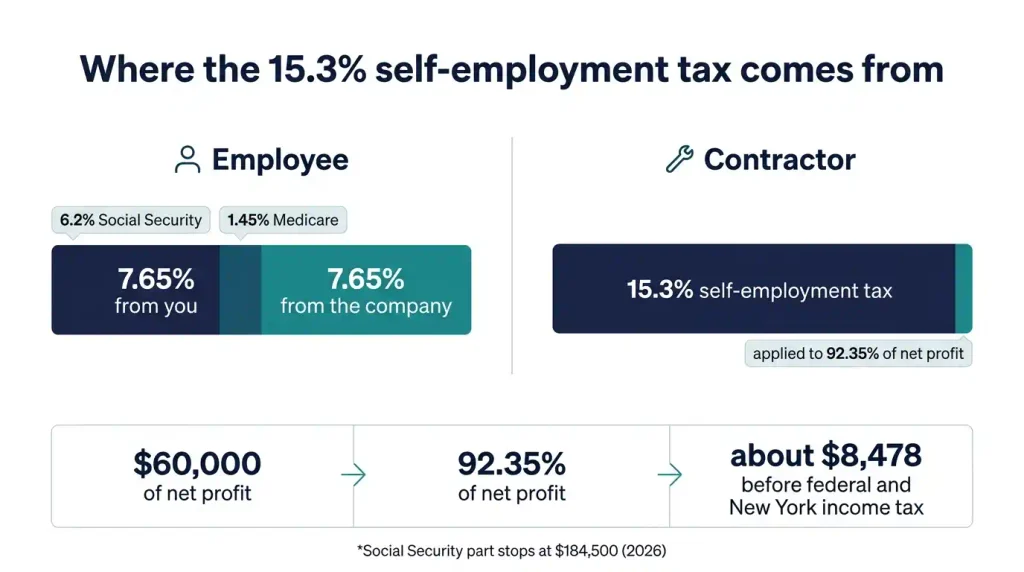
Money is at stake. Employees pay 7.65% payroll tax, and the company matches it. Contractors pay the full 15.3% self-employment tax on 92.35% of net profit. Use the table and questions below to check your own job.
The difference in one minute
Ask who runs the job and who runs the business. An employee gets a W-2, with taxes already withheld. A contractor gets a 1099-NEC and owes the taxes. A 1099 alone proves nothing. Mix-ups often start when a company gives one to someone who takes orders all day.
Employee vs independent contractor comparison table
| Question | Employee | Independent contractor |
|---|---|---|
| Who controls the work? | Company sets tasks, hours, and methods | You choose methods and usually your schedule |
| How are you paid? | Hourly wage or salary | Project fee or agreed rate, by invoice |
| Who buys tools and pays costs? | Usually the company | You do |
| How many clients? | Usually one boss | Usually several |
| Tax form | W-2 | 1099-NEC |
| Payroll taxes | Company withholds and matches 7.65% | You pay self-employment tax of 15.3% |
| Benefits and protections | Unemployment insurance, workers’ comp, overtime, minimum wage | Generally none |
| Business risk | Company carries it | You can make or lose money |
Most answers in the Employee column mean you look like an employee.
The fastest questions to ask about your own job
Ask four things. Who decides when and where you work? Who decides how? Who buys the tools? Can you refuse jobs and take other clients? If the company holds most answers, you are probably an employee.
How New York Decides Whether You Are an Employee or Contractor
New York asks who controls the work. The more a company directs how you do your job, the more likely you are an employee.
Supervision, direction, and control
The New York State Department of Labor (NYSDOL) asks whether the company controls only the result or also how you do the work. Control over the “how” matters most, such as set steps, fixed hours, and manager approvals. Required training, detailed instructions, and performance reviews also point toward employee status. New York employee classification leans on this daily direction.
Signs that point toward employee status
Set hours, set pay, company equipment, and hourly or salary pay point toward employee. So does a company running the key parts of your job. A Buffalo delivery driver with a route, a company van, and a start time is likely an employee.
Signs that point toward independent contractor status
Real contractors advertise to the public, set or negotiate rates, choose their schedule, pay their own costs, and can lose money on a job. A Rochester photographer who owns her gear, sets her prices, and shoots for a dozen clients fits.
Why there is no single magic factor
No one fact decides it. Control over how you work weighs more than who owns the laptop. Daily reality usually beats contract wording.
New York Rules vs Federal IRS Rules
New York and the IRS both weigh control, but they use different tests. The Internal Revenue Service follows the common-law rules, and a worker who fits them is a common-law employee.
How New York looks at worker classification
Misclassification means calling an employee a contractor. To spot it, New York mainly uses a control test, though the exact test depends on the law. The New York worker classification test has no score sheet, so NYSDOL weighs each job’s facts. Construction and commercial goods transportation, which covers drivers with a commercial driver’s license, have stricter rules. Wage claims in court are often judged under an economic-reality test, and the New York State Department of Taxation and Finance uses its own tax standards.
How the IRS determines employee vs independent contractor status
The IRS sorts the facts into three groups. Behavioral control asks whether the company tells you how to work. Financial control asks who pays costs and who can profit or lose. The type of relationship covers contracts, benefits, and job length. The IRS weighs all three together. IRS Publication 15-A covers worker status, and Publication 15 explains employer withholding.
Why a worker can encounter different classification questions
Your tax status and your New York labor-law status are separate questions, decided by different agencies. A February 2026 proposal from the U.S. Department of Labor leans toward contractors under federal wage and leave laws. As of September 2026, it is not final and does not rewrite New York law.
What Form SS-8 does
Form SS-8 asks the IRS to rule on your status for federal employment taxes. Either the worker or the company can file. The IRS says to expect at least six months.
Employee vs Independent Contractor: Taxes and Pay
Employees have taxes withheld. Contractors get paid in full and owe the taxes themselves.
How employees are generally taxed
Your employer withholds federal and New York income tax, plus 6.2% for Social Security and 1.45% for Medicare, and matches both. That is 7.65% from you and 7.65% from the company. Federal withholding follows the W-4 form you fill out at hire, and New York withholding follows Form IT-2104. For more on these forms, see our New York tax forms and withholding guides. You get a W-2 at year end.
How independent contractors are generally taxed
Contractors report income and costs on Schedule C. Self-employment tax is 15.3% in 2026, applied to 92.35% of net profit, and the Social Security part stops at $184,500, the 2026 limit set by the Social Security Administration. As a self-employed worker, you pay both halves of Social Security tax and Medicare tax. On $60,000 of net profit, that is about $8,478 before federal and New York income tax. Nobody withholds it, so you pay quarterly estimates.
W-2 vs 1099-NEC
A W-2 reports wages and withholding. A 1099-NEC reports payments to a non-employee, and for 2026 payments the reporting threshold rises to $2,000, up from $600, under the One Big Beautiful Bill Act. You owe tax either way. Neither form proves your status.
A Form W-2 points to employee reporting, but check it against your real job and keep records if they do not match. When your first Form 1099-NEC arrives, check the total against your invoices, then report the income on Schedule C with your Form 1040.
Why contractor pay can look higher
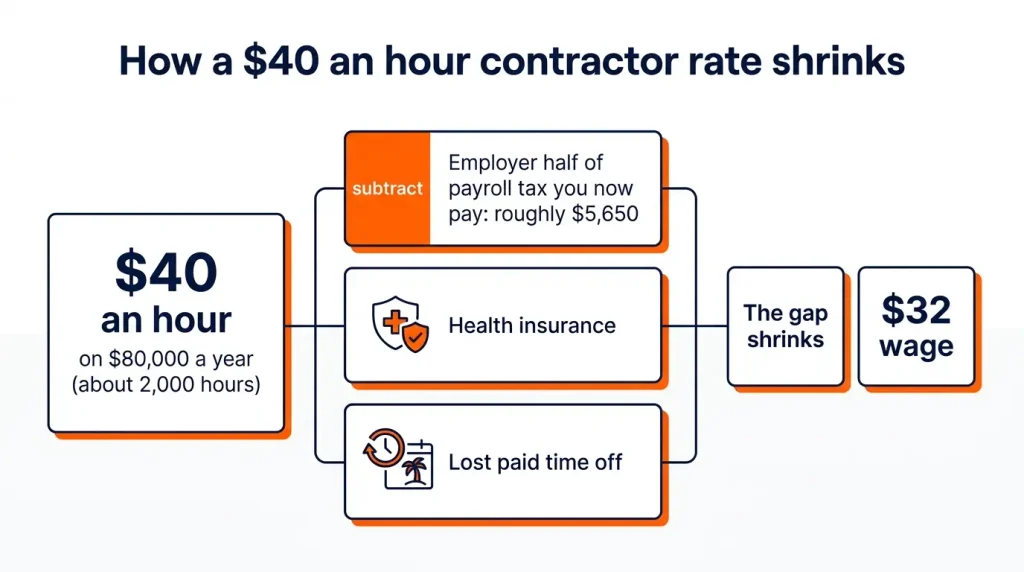
A contractor rate of $40 an hour looks better than a $32 wage. But on $80,000 a year (about 2,000 hours), the employer half of payroll tax you now pay is roughly $5,650. Add health insurance and lost paid time off, and the gap shrinks. To check the W-2 side of an offer, run it through a New York paycheck calculator and compare gross pay vs net pay.
Employee vs Independent Contractor: Benefits and Legal Protections
Employee status brings protections contractors usually lack: unemployment insurance, workers’ compensation, minimum wage, overtime, and paid leave.
Unemployment insurance
Employees who lose a job may qualify for New York unemployment benefits. Contractors usually do not, but a 1099 does not end the question. Under New York unemployment insurance law, NYSDOL looks at the actual relationship, and if you were an employee, your company owes unemployment contributions.
Workers’ compensation
New York employers must carry workers’ compensation for employees. It pays medical bills and part of your lost pay after a work injury, and it is not health insurance. The New York Workers’ Compensation Board handles these claims and can decide whether you count as an employee.
Minimum wage and overtime protections
In 2026, the New York minimum wage is $17.00 an hour in New York City, Long Island, and Westchester, and $16.00 elsewhere, according to NYSDOL. Most employees also get time and a half after 40 hours, unless an exemption applies. Real contractors get neither, but a misclassified worker can claim both.
Other employment benefits and protections
Employees may get paid sick leave, Paid Family Leave, and disability benefits under New York law. Health plans, 401(k) matches, and vacation are different, because employers offer them by choice.
Real-World Examples: Who Is More Likely to Be an Employee?
The clearest employees take orders and use company gear. The clearest contractors run their own shops. These five cases show where people land.
The 1099 worker treated like a regular employee
A warehouse packer in Albany gets a 1099, but the company sets her eight-hour shifts, hands her the tools, and tells her how to pack. She does the company’s core work, so she looks like an employee.
The genuine independent consultant
A Manhattan consultant has an LLC, a website, and six clients. She quotes project rates, picks her methods, pays for her own software, and can lose money on a bad job. That is a real independent business.
The remote worker called a contractor
A Syracuse support agent works from home, but the company sets her login hours, scripts, and quality scores. Location is not control, so home does not make her a contractor.
The part-time or temporary worker
A retail helper working 15 hours a week can be an employee, and so can someone hired for three months. A short project is contractor work only if the worker controls the job.
The professional worker
Skill and a professional license do not make you a contractor. A nurse, designer, or software engineer can be an employee. What counts is business independence and who controls the work.
Special New York Cases That Can Change the Analysis
Construction has its own law, the New York Construction Industry Fair Play Act. Business paperwork, contracts, and single-client work do not settle status alone.
Construction workers and the Construction Industry Fair Play Act
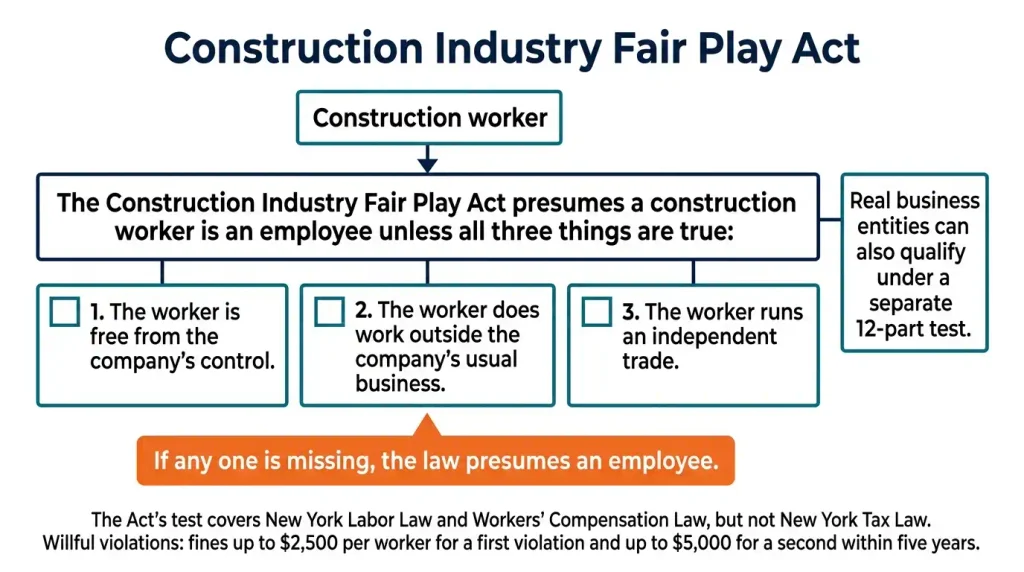
New York construction worker classification is stricter than the control test used for most jobs. The Construction Industry Fair Play Act presumes a construction worker is an employee unless all three things are true:
- The worker is free from the company’s control.
- The worker does work outside the company’s usual business.
- The worker runs an independent trade.
Real business entities can also qualify under a separate 12-part test.
The Act’s test covers New York Labor Law and Workers’ Compensation Law, but not New York Tax Law. For willful violations, fines run up to $2,500 per worker for a first violation and up to $5,000 for a second within five years. Willful violations can also bring criminal charges, with up to 30 days in jail or a $25,000 fine for a first offense, plus a bar of up to one year from public work.
Workers required to obtain a DBA
A DBA is only a registered business name, and filing one does not make you a contractor. Some companies push workers to get one, then still set their hours and methods. Many real contractors are sole proprietors, but that label says nothing about control.
Workers who sign independent-contractor agreements
A contract is one piece of evidence, and New York agencies compare it with what happens on the job. A line giving up employee rights may not hold up. For true freelancers, the statewide Freelance Isn’t Free Act requires a written contract for work worth $800 or more. New York employers must also report independent contractor contracts over $2,500 through the state’s new hire reporting site.
Workers serving only one company
Working for one company does not automatically make you an employee, but it is a red flag, especially if the company bans other clients. NYSDOL asks whether you advertise, have other clients, and run an independent business.
Common Myths About New York Employees and Independent Contractors
Five ideas cause most of the confusion, and each mixes up a label with the real job.
“If I receive a 1099, I am automatically a contractor”
No. A 1099 only shows how a company reported your pay. New York treats misclassification as illegal when a worker really acts like an employee.
“If I signed a contractor agreement, I gave up employee rights”
No. Working conditions matter more than contract words, and signing does not automatically erase rights the law gives you. Keep copies of everything.
“Working from home means I am an independent contractor”
No. Where you work is not who controls the work. If the company sets your tasks, hours, and methods, you may still be an employee, whether remote or hybrid.
“Being paid hourly means I am an employee”
Not always. Some real contractors bill by the hour. A consultant charging $90 an hour to five clients is still a contractor.
“Being paid per project means I am a contractor”
Not always. Employees can be paid per project or by commission too. Ask who controls the methods and schedule, and whether you run an independent business.
What to Do If You Think You Are Misclassified
Start with proof, then compare your job to the factors, then choose a government route.
Document the working relationship
- Save your contract, onboarding papers, invoices, pay records, and any 1099 forms.
- Write down your schedule, who instructs and supervises you, and who supplies the tools.
- Keep a log of your hours and business expenses.
- Check any pay stub against a guide on how to read a New York pay stub. A stub with no withholding is a warning sign.
- Keep texts and emails from your manager. They are gold.
Compare your actual work with the classification factors
Sort your facts into the IRS’s three groups: behavioral control, financial independence, and the relationship. Mark each fact employee or contractor, noting where they clash. Bring the list to any agency or lawyer.
Understand available government processes
NYSDOL takes misclassification complaints, and you can stay anonymous. Pick the route that fits your problem:
| Your problem | Where to go |
|---|---|
| Unpaid wages, overtime, or minimum wage | NYSDOL complaint |
| Unemployment eligibility | File an unemployment claim, and NYSDOL reviews your status |
| Federal tax status | Form SS-8 (a federal tax status ruling from the IRS) |
| Paid full self-employment tax while misclassified | Form 8919 may let you pay only the employee share of Social Security and Medicare tax, if an IRS reason code applies, such as an SS-8 ruling that you were an employee |
| Workers’ comp coverage | New York Workers’ Compensation Board |
| State tax questions | New York State Department of Taxation and Finance |
Government answers are not legal advice, so a New York employment lawyer can help.
A New York Department of Labor complaint is stronger with dates, pay records, and names of the people who directed your work. Any New York labor complaint should say who set your hours, supplied your tools, and paid you.
Understand potential consequences of misclassification
If you were an employee, your company may owe unemployment contributions, workers’ comp coverage, and back payroll taxes, and may owe you unpaid overtime and minimum wage. New York gives you six years to bring a wage claim. Courts can add an equal amount in damages, unless the company shows good faith, plus 9% interest.
New York worker misclassification becomes fraud when a company does it on purpose. New York Labor Law also protects you from punishment for filing a complaint.
If you are reclassified, expect a W-2, withholding on every paycheck, and coverage for unemployment and workers’ comp. Your checks may look smaller, but you stop paying the employer half of payroll tax.
Employee vs Independent Contractor Decision Checklist
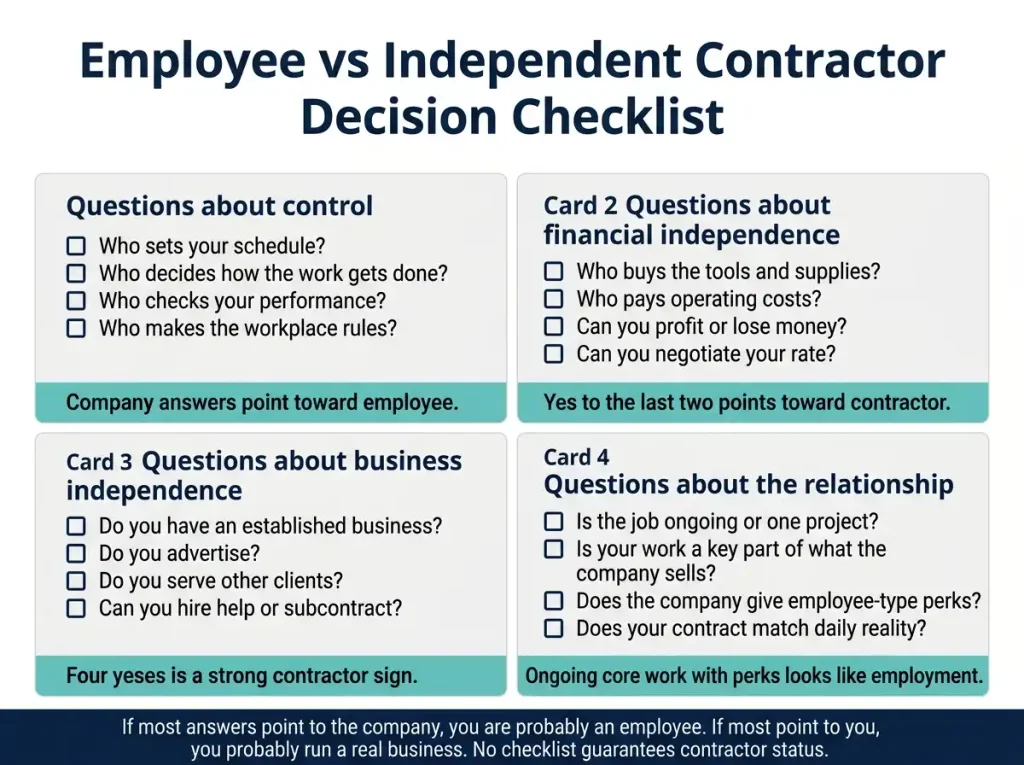
Use these four groups of questions. If most answers point to the company, you are probably an employee. If most point to you, you probably run a real business. No checklist guarantees contractor status.
Questions about control
- Who sets your schedule?
- Who decides how the work gets done?
- Who checks your performance?
- Who makes the workplace rules?
Company answers point toward employee.
Questions about financial independence
- Who buys the tools and supplies?
- Who pays operating costs?
- Can you profit or lose money?
- Can you negotiate your rate?
Yes to the last two points toward contractor.
Questions about business independence
- Do you have an established business?
- Do you advertise?
- Do you serve other clients?
- Can you hire help or subcontract?
Four yeses is a strong contractor sign.
Questions about the relationship
- Is the job ongoing or one project?
- Is your work a key part of what the company sells?
- Does the company give employee-type perks?
- Does your contract match daily reality?
Ongoing core work with perks looks like employment.
Frequently Asked Questions About New York Employee vs Independent Contractor
The real working relationship decides every answer below.
Can my employer call me an independent contractor if I work like an employee?
They can call you anything, but the label does not control. New York looks at who directs your work in real life.
Does getting a 1099 instead of a W-2 make me an independent contractor?
No. A 1099-NEC only reports what a company paid you, and if the job looks like employment, that is misclassification.
Can an independent contractor qualify for New York unemployment benefits?
A true contractor usually cannot. But if NYSDOL finds an employer-employee relationship, you can qualify.
Does working remotely make me an independent contractor?
No. Where you work does not decide status, so remote work is still employment if the company sets your tasks, hours, and methods.
What happens if I signed an independent contractor agreement?
The agreement is one piece of evidence. Agencies compare it with real working conditions, and a clause waiving employee rights may not hold up.
How does New York classify construction workers?
Under the Construction Industry Fair Play Act, a worker must meet three conditions: free from the company’s control, work outside its usual business, and an independent trade. If any one is missing, the law presumes an employee. The test does not apply to New York Tax Law.
What is Form SS-8 and when would I use it?
It is a request for an IRS ruling on your status for federal employment taxes. Use it when your tax reporting does not match the real job, but expect six months or more for the IRS to answer in writing. What you file may be shared with the company, and the IRS will not rule while classification litigation is pending.
Can I be a contractor for one company and an employee somewhere else?
Yes. Status depends on each relationship, so you can freelance for one client and hold a W-2 job elsewhere. Track each income source separately, since the taxes differ.
What should I do if my tax form does not match my actual work situation?
Save your documents and write down how the job really works. Contact NYSDOL about employment issues and consider Form SS-8 for taxes. A wrong form can mean paying self-employment tax you should not owe, so a tax pro or New York employment lawyer can help.
Key Takeaways: Employee vs Independent Contractor in New York
Your real working life decides your status, not the form or the label.
The classification principles to remember
Remember four things: actual work beats labels, control and independence are the core tests, a 1099 or W-2 does not settle legal status, and some industries, like construction, have extra rules. For more on employer duties, browse our New York payroll and employer compliance section.
What to check before accepting a contractor arrangement
Ask who controls the work, how you will be taxed, and which protections you give up. Then ask whether the deal describes a real independent business, and if not, push back or ask for employee status. Before you sign, read the agreement for set hours, required company tools, bans on other clients, and lines giving up employee rights.

Meet Yasin Ali, Founder
Yasin built NY Paycheck Calculator in 2020 after getting fed up with calculators that treated New York like every other state. Most tools ignore the extra local tax NYC and Yonkers workers pay on top of state tax — or skip New York’s Paid Family Leave deduction entirely.
He keeps the numbers current, checking in regularly against the latest IRS, NY Department of Taxation and Finance, and Paid Family Leave rates.
All results here are estimates based on official sources. For advice specific to your situation, talk to a tax professional.