
New York tax brackets 2025 run from 4% to 10.9% across nine levels, based on taxable income and filing status, for returns filed by April 15, 2026.
These 2025 New York State personal income tax figures reflect the official rate schedule and standard deduction amounts, cross-checked against the Department of Taxation and Finance, and feed directly into our New York paycheck calculator.
Brackets alone don’t set your final bill; NYC, Yonkers, and the high-income recapture can change it.
What Are the New York Tax Brackets for 2025?
Each bracket’s exact dollar range depends on your filing status, covered next, along with which 2025 table or schedule actually applies to your return.
2025 New York State Income Tax Rates at a Glance
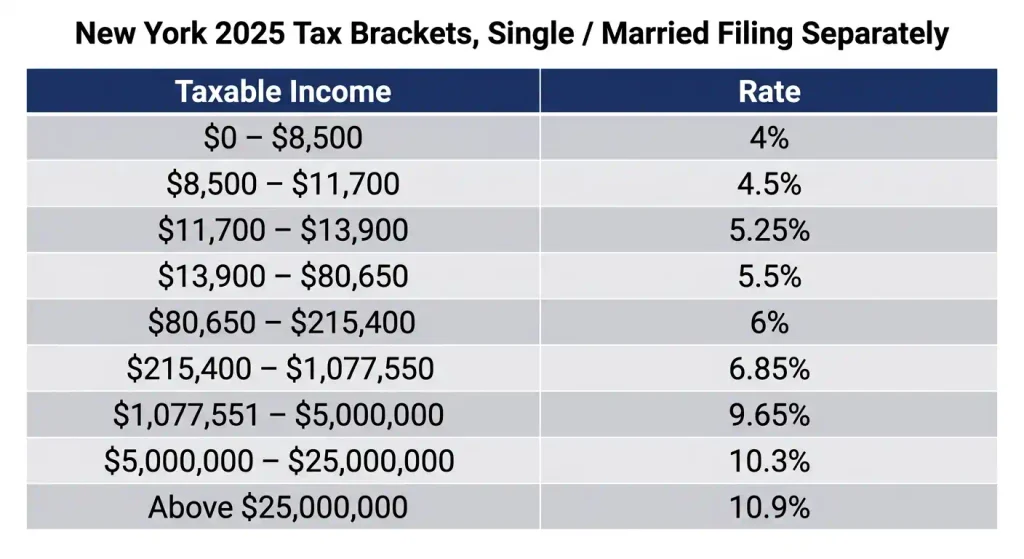
For single filers and those married filing separately, the 2025 rate schedule looks like this:
| Taxable Income | Rate |
|---|---|
| $0 – $8,500 | 4% |
| $8,500 – $11,700 | 4.5% |
| $11,700 – $13,900 | 5.25% |
| $13,900 – $80,650 | 5.5% |
| $80,650 – $215,400 | 6% |
| $215,400 – $1,077,550 | 6.85% |
| $1,077,551 – $5,000,000 | 9.65% |
| $5,000,000 – $25,000,000 | 10.3% |
| Above $25,000,000 | 10.9% |
These apply to taxable income, already after deductions. The top three brackets started as temporary high-earner rates in 2021 and run through 2027. People sometimes call them New York’s tax brackets for millionaires, since none kick in until $1,077,550.
New York Tax Brackets by Filing Status
Married filing jointly brackets run roughly double the single thresholds through the lower and middle ranges. A couple earning $150,000 combined pays a different effective rate than two singles earning $75,000 each, purely from where the brackets fall. Head of household sits between single and joint brackets. Qualifying surviving spouses use the joint schedule. Status follows your situation on December 31, so marriage, divorce, or a new dependent during 2025 can shift your bracket schedule.
Which 2025 Tax Table or Rate Schedule Should You Use?
Under $65,000 in New York taxable income, use the state’s tax tables. Above $65,000, use the New York State tax rate schedule and calculate it yourself. Full-year residents use Form IT-201’s instructions, which include the New York State tax table for Form IT-201. Part-year residents and nonresidents use Form IT-203, with its own New York State tax table for Form IT-203. Both New York State tax table 2025 versions apply only under $65,000. Above that, a New York State tax calculation worksheet walks through each bracket.
How Do New York State Tax Brackets Work?
New York’s system is progressive. Income gets sliced into pieces, and each piece is taxed at a different rate. Nobody pays one flat rate on their whole paycheck.
What Is a Marginal Tax Rate?
Your marginal rate taxes your last dollar earned, not your whole income. A single filer with $90,000 in taxable income pays 6% only on the portion above $80,650. Crossing into a new bracket never re-taxes past earnings at the higher rate. Bonuses and overtime get no separate New York bonus withholding tax or New York overtime income tax rate. They’re taxed through the same bracket system as regular wages, though employers sometimes withhold them at a flat rate upfront, a method explained in our New York supplemental wage tax guide.
Marginal Tax Rate vs. Effective Tax Rate
Effective rate is your total tax divided by taxable income. A single filer earning $100,000 has a 6% top marginal rate but an effective rate around 5.4%, since most income was taxed at lower brackets first. Effective rate is what actually shows how much of your income New York kept.
Gross Income vs. Adjusted Gross Income vs. Taxable Income
Gross income is everything earned before subtractions. Federal adjusted gross income (AGI) subtracts federal adjustments. New York adjusted gross income (NYAGI) starts from federal AGI, then applies New York’s own additions and subtractions. Taxable income is what’s left after your standard or itemized deduction comes off NYAGI, and that number runs through the bracket schedule. For how these subtractions show up on an actual pay stub, see our New York paycheck deductions guide.
What Deductions and Credits Affect Your 2025 New York Tax Bill?
Deductions lower the income that gets taxed. Credits lower the tax bill directly, dollar for dollar, so they’re usually worth more.
New York Standard Deduction by Filing Status
The New York standard deduction 2025 amounts by filing status:
| Filing Status | 2025 Standard Deduction |
|---|---|
| Single (not a dependent) | $8,000 |
| Single (claimed as a dependent) | $3,100 |
| Married filing jointly / surviving spouse | $16,050 |
| Married filing separately | $8,000 |
| Head of household | $11,200 |
These differ from the federal standard deduction.
New York Itemized Deductions and Income Adjustments
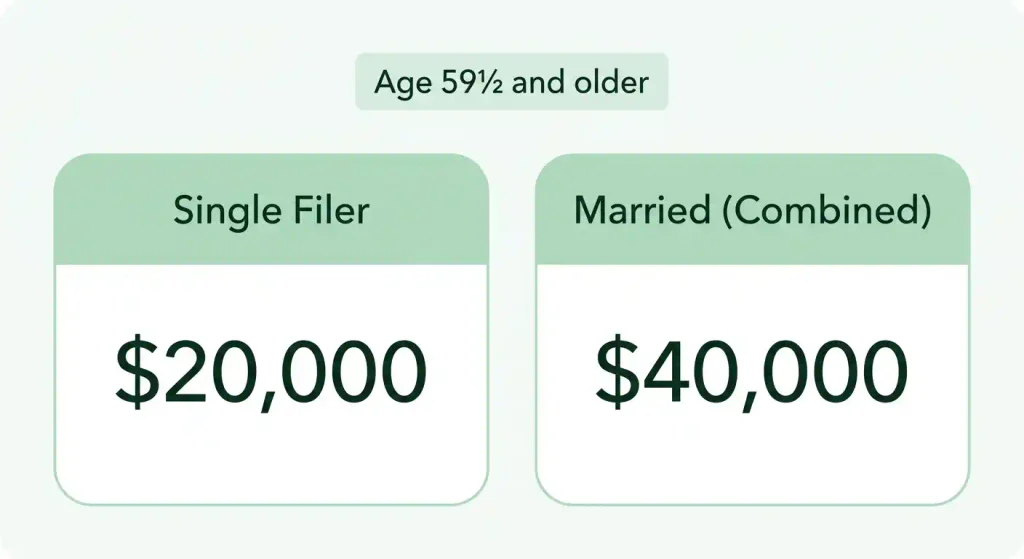
New York lets you itemize if that beats the standard deduction, under its own rules, which don’t always match federal itemizing. Certain income gets added back or subtracted differently than on your federal return, which is why federal AGI and New York AGI can differ. New York doesn’t tax Social Security benefits at all, a full New York Social Security benefits tax exemption. It also offers a New York State pension exclusion for filers 59½ and older: up to $20,000 of pension or annuity income if single, up to $40,000 combined if married, part of the broader New York retirement income exclusion. Capital gains get no special lower rate; New York capital gains income tax treats investment profit as ordinary income. Self-employment income works the same way for New York self-employment income tax purposes, though federal self-employment tax still applies on top. See our guide on employee vs. independent contractor status in New York if you’re not sure which category applies to you.
New York Tax Credits That May Reduce Your Bill
New York offers its own New York earned income credit, New York household credit, and New York child and dependent care credit, among others. These cut the tax bill directly, unlike a deduction. A $1,000 credit saves $1,000; a $1,000 deduction saves only a fraction of that.
How Much New York State Income Tax Would You Pay in 2025?
Here’s what the brackets mean with real numbers.
Example: A Single Filer Earning $50,000
A single filer with $50,000 in taxable income isn’t taxed at a flat 5.5%. They pay 4% on the first $8,500, 4.5% up to $11,700, 5.25% up to $13,900, and 5.5% on the rest up to $50,000. This is state tax only, before withholding, credits, or NYC tax.
Example: A Single Filer Earning $100,000
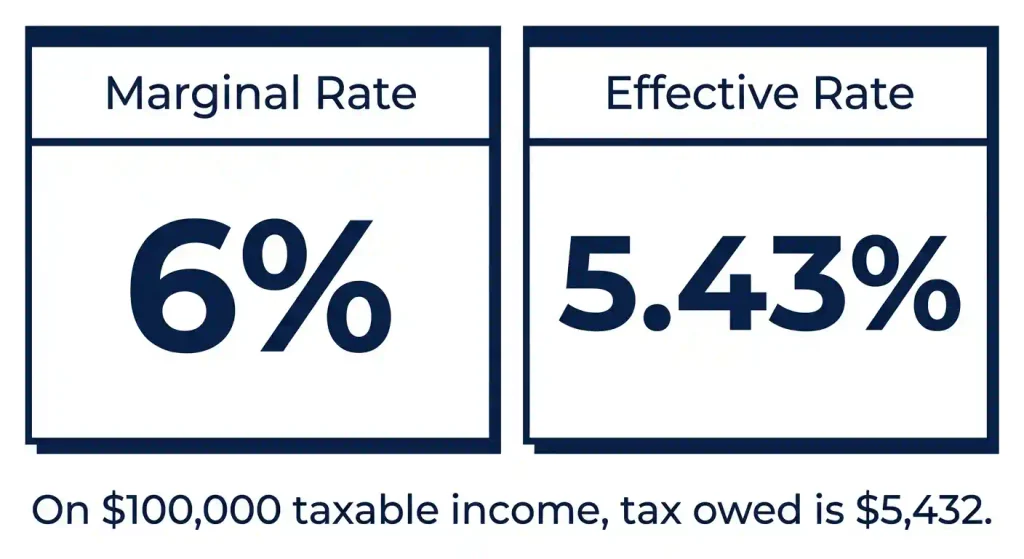
At $100,000 taxable income, a single filer owes roughly $5,432 in New York State tax, about a 5.43% effective rate, even with a 6% top marginal rate. That gap holds at nearly every income level; see a full breakdown at a nearby salary in our 80k after taxes in New York guide.
Example: A Married Couple Earning $150,000 Jointly
A married couple filing jointly with $150,000 in taxable income lands in a lower bracket than a single filer with the same $150,000, since joint brackets run roughly double the single thresholds. Deductions apply before any bracket math happens.
What Happens When Your Income Crosses a Tax Bracket?
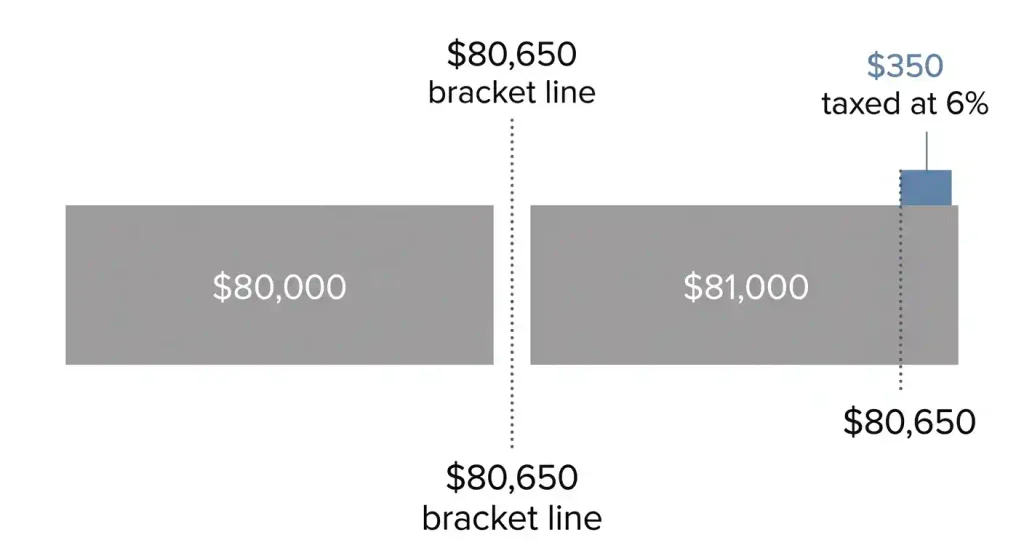
Compare two single filers: one at $80,000, one at $81,000. The second crosses into the 6% bracket, but only the extra $350 above $80,650 gets taxed at 6%. Tax on the first $80,650 stays identical for both. Crossing a bracket never spikes the whole bill, only the income above the line.
New York State vs. New York City and Yonkers Taxes
State tax is only part of the picture in certain parts of New York.
New York State Income Tax vs. New York City Income Tax
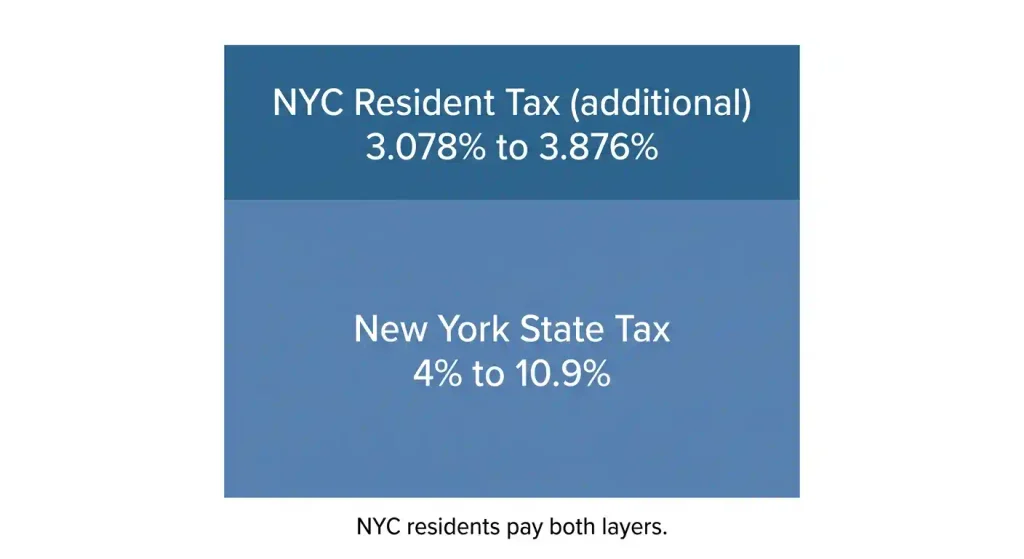
New York City residents pay state tax plus city tax. NYC uses its own four-bracket 2025 schedule, from about 3.078% to 3.876%. That New York City resident tax is a real add-on, which is why a Manhattan resident and an Albany resident on identical salaries take home different amounts. Our New York City income tax guide breaks down the full NYC bracket schedule.
Yonkers Resident and Nonresident Taxes
Yonkers has no separate bracket schedule. Residents pay the Yonkers resident income tax surcharge, a percentage of their New York State tax, covered in our Yonkers income tax guide. Nonresidents earning income in Yonkers owe the Yonkers nonresident earnings tax on that income, explained further in our Yonkers nonresident tax guide.
Do Long Island and Upstate New York Residents Pay Local Income Tax?
No, not like NYC or Yonkers residents. Nassau County, Westchester outside Yonkers, and upstate areas only deal with state brackets. The exception is the Metropolitan Commuter Transportation Mobility Tax (MCTMT), which hits certain self-employed people and employers in the MTA region, not every resident’s paycheck.
How Does Your New York Residency Affect Your 2025 Taxes?
New York residency for income tax purposes comes down to where you actually lived and how many days you spent in the state, which determines your form and what income gets taxed. Our New York resident vs. nonresident income tax rules guide covers the residency tests in full.
Full-Year New York State Residents
Lived in New York all year? Report all income to the state, regardless of where earned, on Form IT-201.
Part-Year Residents Who Moved Into or Out of New York
Moved in or out of New York mid-2025? File Form IT-203 and allocate income between resident and nonresident periods. Only income from your resident period, plus New York-source income from your nonresident period, gets taxed.
Nonresidents Earning Income From New York
Never lived in New York but earned New York-source income, like wages from work physically performed there? You owe tax on that portion, filed through Form IT-203. Work performed entirely outside New York generally stays untaxed. See our New York State tax for nonresidents guide for allocation examples.
Remote Workers and the Convenience-of-the-Employer Rule
If your employer is in New York but you work remotely elsewhere by choice rather than necessity, New York can still tax those wages as if you worked in-state. This is New York’s convenience of the employer rule, and it hinges on whether the remote setup was required or chosen.
Why Is Your New York Tax Refund or Amount Owed Different From Your Estimate?
The bracket table shows your liability, not your refund.
Tax Liability vs. Withholding and Estimated Payments
Total tax liability is what the brackets calculate for the year. Your refund or balance due depends on withholding and estimated payments already made. Over-withhold, get a refund; under-withhold, write a check. This New York State tax liability is separate from federal income tax, Social Security, and Medicare taxes; our what taxes come out of a New York paycheck guide breaks down each line.
Why a Tax Calculator May Show a Different Result
Calculators can miss: wrong filing status, income figures not matching your W-2, missed deductions, the wrong tax year (2024 and 2025 brackets differ, and the 2026 New York tax brackets are different again), or NYC and Yonkers tax left out. A bracket table alone is a starting point, not a final answer. If your take-home itself looks off, our why is my New York paycheck lower guide walks through common causes.
Special Tax Computation for Higher-Income Filers
Once New York AGI crosses $107,650, the simple tax table and basic rate schedule no longer apply. Use the New York State tax computation worksheet instead, which applies a supplemental income tax recapture that phases out the benefit of lower brackets as income rises, pushing higher earners closer to a flat rate. This same $107,650 threshold also affects paycheck withholding when you hold multiple jobs, covered in our New York multiple jobs withholding guide.
Common Myths About New York Tax Brackets 2025
A few misunderstandings repeat every filing season.
Myth: Your Entire Income Is Taxed at Your Highest Bracket
False. A single filer earning $90,000 doesn’t pay 6% on all of it, only on the portion above $80,650.
Myth: Federal and New York State Tax Brackets Are the Same
They’re separate systems with different rates, thresholds, and rules for taxable income. Both get calculated independently, and you owe both.
Myth: Everyone in New York Pays New York City Income Tax
Only NYC residents owe it. Live in Buffalo, Syracuse, or Nassau County, and only state brackets apply.
Myth: Your Tax Bracket Tells You Exactly How Much You Owe
Your bracket is just your marginal rate. Deductions, credits, withholding, and special computations all shift the final number.
Check Your 2025 New York Tax Calculation Before Filing
Run through this before you file.
Official New York Tax Resources
The New York State Department of Taxation and Finance publishes the official 2025 tax tables, rate schedules, and instructions for Forms IT-201 and IT-203, found in the Form IT-201-I and Form IT-203-I booklets, on tax.ny.gov. For more on how these figures apply to your paycheck, browse our New York state income tax category or see our calculation methodology.
Final Tax Calculation Checklist
Before filing, confirm:
- Tax year 2025 figures
- Correct filing status
- Your New York taxable income
- Credits you qualify for
- Residency situation and whether NYC or Yonkers tax applies
- Withholding or estimated payments made
- Whether the special computation above $107,650 applies
A complicated multi-state or remote-work year is worth a tax professional’s review before filing.
Frequently Asked Questions About New York Tax Brackets 2025
What are the New York State income tax rates for 2025?
4% to 10.9%, depending on filing status. The marginal rate schedule is a starting point, not the final number.
What is the highest New York State income tax rate in 2025?
10.9%, applying only above $25 million in taxable income. Higher earners may also face the special computation rules.
How do I find my New York tax bracket?
Match your New York taxable income and filing status against the official 2025 rate schedule on tax.ny.gov.
Are New York tax brackets based on gross income or taxable income?
Taxable income. Gross pay adjusts down to New York AGI, then the deduction comes off to produce taxable income.
Do I pay both New York State and New York City income tax?
Only if you’re an NYC resident. State tax applies to everyone who owes New York tax; city tax is additional.
Which New York tax form should I use for 2025?
Full-year residents: Form IT-201. Part-year residents and nonresidents: Form IT-203.
Are the 2025 New York tax brackets used for returns filed in 2026?
Yes. The 2025 brackets apply to income earned in 2025, filed by April 15, 2026. Can’t meet the April 15, 2026 New York tax filing deadline? Request a New York automatic filing extension using Form IT-370, which extends the filing date but not the payment date.

Meet Yasin Ali, Founder
Yasin built NY Paycheck Calculator in 2020 after getting fed up with calculators that treated New York like every other state. Most tools ignore the extra local tax NYC and Yonkers workers pay on top of state tax — or skip New York’s Paid Family Leave deduction entirely.
He keeps the numbers current, checking in regularly against the latest IRS, NY Department of Taxation and Finance, and Paid Family Leave rates.
All results here are estimates based on official sources. For advice specific to your situation, talk to a tax professional.