
New York overtime for salaried employees applies when a worker is non-exempt: hours past 40 in a workweek earn 1.5 times the regular rate. Exempt salaried staff, meeting both a salary and duties test, receive no extra pay.
That threshold isn’t arbitrary: New York’s 2026 salary minimums, $1,275 and $1,199.10 weekly by region, come from NYSDOL wage orders.
Clearing the salary bar alone doesn’t guarantee exemption; the duties test still decides the final classification.
Do Salaried Employees Get Overtime in New York in 2026?
Three factors decide your case: weekly pay, actual job duties, and work location within New York. This applies to employees only; if you’re classified as an independent contractor in New York, overtime rules don’t apply at all.
Being Salaried Does Not Automatically Mean Being Exempt
“Salaried” is a payment method. “Exempt” is a legal overtime status. Two separate things, often confused as one.
The 2026 Rule in One Quick Example
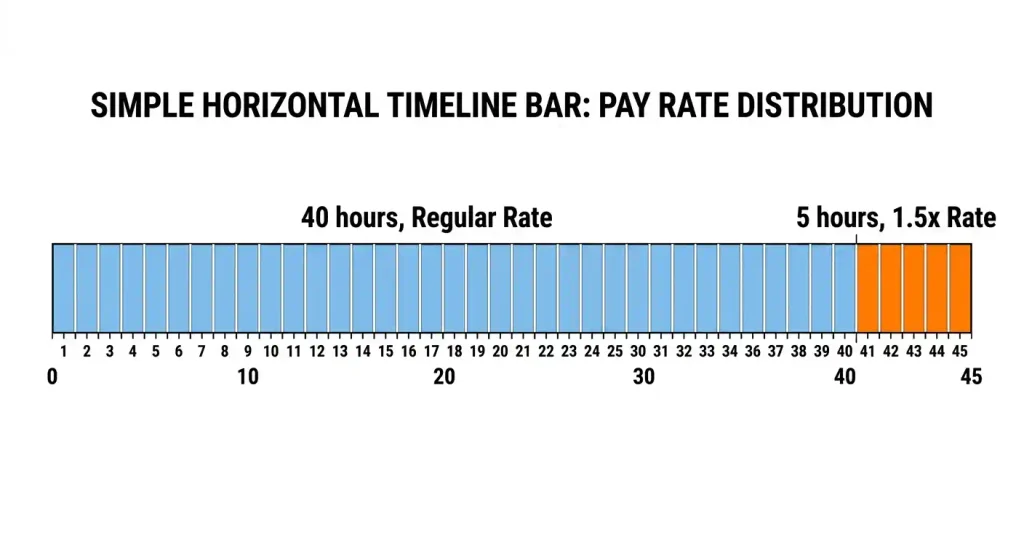
Work 45 hours as a non-exempt salaried employee, and the first 40 hours pay your regular rate, the last 5 pay 1.5 times that rate. Exempt employees get their set salary and nothing extra. Classification decides the outcome, not your title.
Quick Eligibility Check for Your Situation
Check these four things:
- Exact weekly salary
- Actual daily duties
- Work location: NYC, Long Island, Westchester, or elsewhere in the state
- Total hours worked that week
New York Salaried Overtime Rules at a Glance
These are the mechanics behind New York overtime laws: when it kicks in, and what exempt versus non-exempt actually means.
When Overtime Starts
Cross 40 hours in one workweek and every extra hour pays time and a half, weekend, holiday, or overnight shift included. New York defines a workweek as a fixed, recurring seven-day period. Each one stands alone.
What “Exempt” Means
Exempt means your employer doesn’t have to pay overtime, even past 40 hours. It only applies if you pass New York and federal salary and duties tests. Being salaried alone doesn’t make you exempt.
What “Non-Exempt” Means
Non-exempt means you’re owed overtime no matter how you’re paid. Your employer must track your hours and pay for every hour worked over 40. This is the core of New York State overtime protection for salaried workers.
2026 New York Salary Thresholds for Overtime Exemptions
New York’s exempt salary minimums are higher than the federal floor, and they rose again on January 1, 2026. These figures come from New York’s Miscellaneous Industries Wage Order, one of several New York wage orders that set pay rules by industry. The New York salary threshold 2026 is roughly tied to 75 times the minimum wage, using the 2026 New York minimum wage rate, as confirmed by the NYSDOL: $1,275 per week in the highest-wage counties, $1,199.10 per week everywhere else.
NYC, Nassau, Suffolk, and Westchester Salary Threshold
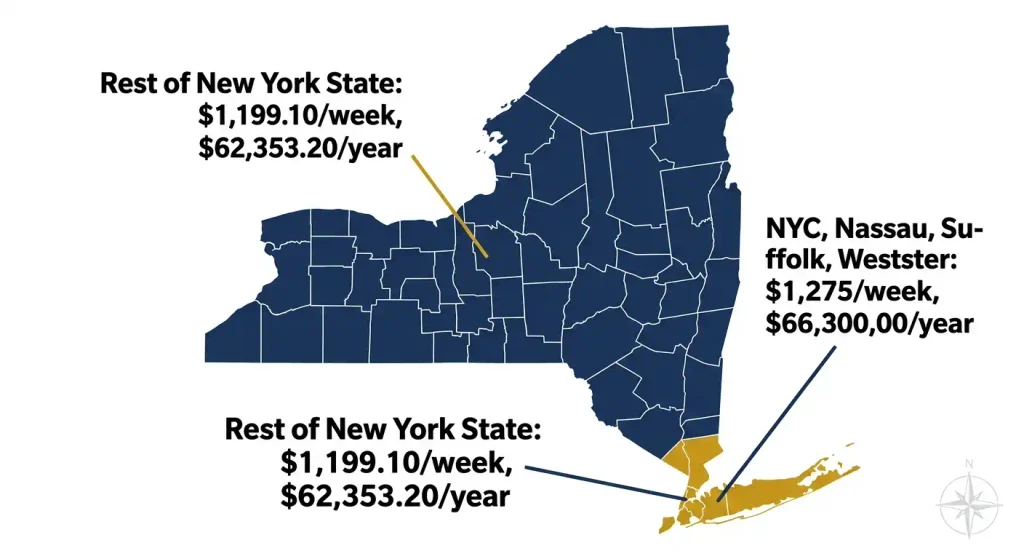
Working in New York City, Nassau County, Suffolk County, or Westchester County means your employer must pay at least $1,275 a week, or $66,300 a year, for the executive or administrative exemptions. Divide your annual salary by 52 to check your own pay: a $70,000 salary works out to about $1,346 a week, above the threshold. Employer size doesn’t change the number.
Salary Threshold Outside NYC and Downstate Counties
Everywhere else in New York, the 2026 threshold is $1,199.10 a week, or $62,353.20 a year, up from $1,161.65 a week in 2025.
What Happens if Your Salary Falls Below the Threshold?
Pay below your region’s threshold means you can’t be classified exempt under the executive or administrative rules, no matter how the duties look. Some employers respond by switching an employee from salary to hourly instead of raising pay. That’s legal, as long as the hourly rate and overtime reflect actual hours worked.
Salary Basis vs Salary Amount vs Exempt Status
These three ideas get mixed up constantly, and separating them clears up most confusion.
What “Paid on a Salary Basis” Means
Salary basis means a fixed, predetermined amount each pay period, regardless of hours worked. Employers generally can’t dock it for quality or quantity of work, a distinction covered further in our guide to New York paycheck deductions. The salary basis requirement is strict: improper salary deductions, like docking pay for a partial-day absence, can void an employee’s exempt status entirely.
Why Annual Salary Alone Does Not Decide Overtime
A big annual number doesn’t settle anything alone. Weekly salary must clear the threshold, and duties must match an exemption category. This is the salary level test plus the duties test, not the paycheck alone. A title or agreement calling you “exempt” carries no legal weight without the underlying facts.
Why Your Job Title Does Not Automatically Make You Exempt
Titles like manager or coordinator don’t decide exemption. Regulators look past the label to your primary duty. What you actually do matters more than your business card.
Which Salaried Employees Can Be Exempt From Overtime?
New York recognizes a handful of exemption categories, each with its own test under New York wage laws, tracing back to New York Labor Law Section 651.
Executive Employee Exemption
Your primary duty must be managing the business or a department. You must regularly direct at least two other full-time employees, with real input on hiring or firing. You also need to clear the applicable salary threshold.
Administrative Employee Exemption
This covers office or non-manual work tied to running the business, like finance or HR, requiring real discretion and independent judgment. The salary threshold still applies here too.
Professional Employee Exemption
Learned professionals need advanced knowledge from specialized education, like law, medicine, or accounting. Creative professionals qualify through original, talent-driven work. Lawyers and doctors, and teachers at a recognized educational establishment, are generally exempt without clearing the standard salary threshold.
Other Exempt Categories
Outside sales employees, government workers, and specialized occupations follow separate rules. A computer employee exemption covers qualifying systems analysts, programmers, and software engineers. The outside sales exemption has no salary threshold federally. Restaurant and hotel employees fall under a separate minimum wage order, the Hospitality Industry Wage Order. Check the specific rule for your occupation instead of guessing.
How to Tell if Your Job Duties Make You Exempt
Your paycheck alone won’t answer this. Your day-to-day work will.
Start With Your Actual Primary Duties
Your primary duty is whatever takes up most of your time and matters most, not what an old job description says. Mixed exempt and non-exempt work is decided by which side takes up more time.
Questions to Ask About a Manager Role
Do you manage an enterprise or department, direct at least two employees, influence hiring and firing, and exercise real discretion? Mostly no answers mean the executive exemption likely doesn’t apply.
Questions to Ask About an Administrative Role
Is your work office-based or non-manual, tied to running the business rather than producing its product, and does it involve real independent judgment? That’s different from production or routine clerical work.
Questions to Ask About a Professional Role
Does your job need specialized intellectual knowledge from advanced education, with consistent judgment rather than a fixed procedure? That’s professional work, not routine tasks.
New York vs Federal Overtime Rules for Salaried Employees
Two sets of rules apply at once: New York State law and the federal FLSA overtime rules, and the stricter one wins.
How New York Law and the FLSA Work Together
New York State law and the federal Fair Labor Standards Act both apply. Employees get whichever protection is stronger, and New York’s higher thresholds usually control.
The Federal Salary Threshold and New York Employees
New York’s 2026 thresholds are far higher than the federal floor, though New York sets no separate threshold for the professional exemption:
| Standard | Weekly | Annual |
|---|---|---|
| Federal FLSA (standard) | $684 | $35,568 |
| NY: NYC, Nassau, Suffolk, Westchester | $1,275 | $66,300 |
| NY: Rest of state | $1,199.10 | $62,353.20 |
| Federal HCE (highly compensated employee) | — | $107,432 |
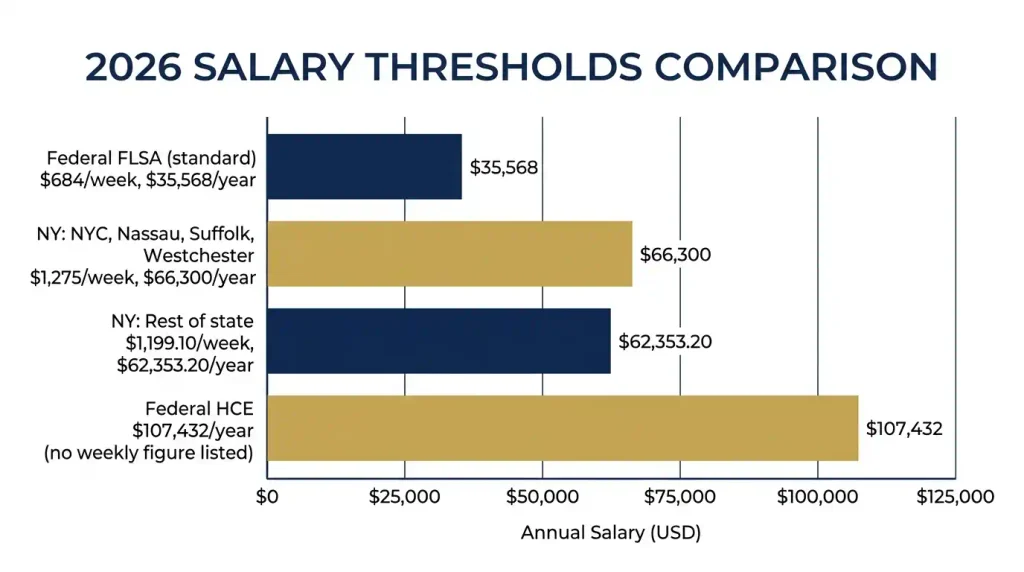
Even the federal highly compensated employee bar sits below what many downstate New Yorkers already need to clear. These are FLSA overtime minimums; New York’s own numbers control whenever they’re higher.
What If State and Federal Rules Point in Different Directions?
If federal law would exempt you but New York’s higher threshold wouldn’t, New York’s rule wins and you keep overtime protection. The reverse almost never happens.
How to Calculate Overtime for a Salaried Non-Exempt Employee
Salaried non-exempt overtime follows a specific formula. For what happens to that pay after taxes and deductions, see our gross pay vs net pay in New York breakdown.
Find the Regular Rate of Pay
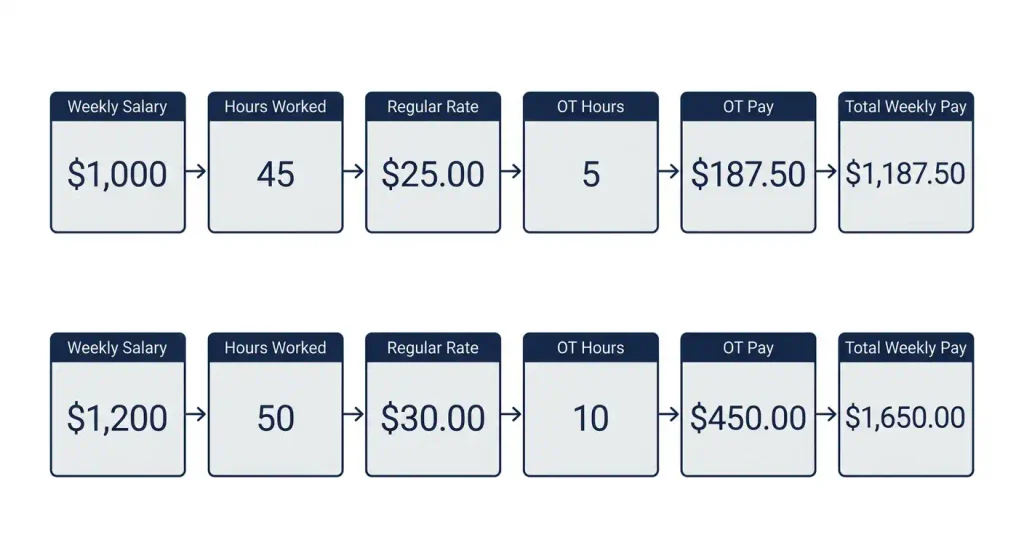
Divide your weekly salary by the hours it’s meant to cover, usually 40, for your regular hourly rate. Our paycheck calculator methodology uses this same divisor. A fixed salary can’t be labeled as covering unlimited hours; even a salary for a workweek exceeding 40 hours still owes overtime for every hour past 40.
Calculate the Overtime Rate
Multiply your regular rate by 1.5, also called one and one-half times regular rate, for your overtime rate. It applies to every hour past 40, on top of your salary for the first 40.
Salary and Overtime Examples
| Weekly Salary | Hours Worked | Regular Rate | OT Hours | OT Pay | Total Weekly Pay |
|---|---|---|---|---|---|
| $1,000 | 45 | $25.00 | 5 | $187.50 | $1,187.50 |
| $1,200 | 50 | $30.00 | 10 | $450.00 | $1,650.00 |
Bonuses, Commissions, and Multiple Pay Rates
Nondiscretionary bonuses and commissions get folded into your regular rate first, raising your overtime pay. Multiple pay rates need a weighted average, and two jobs for the same employer in one workweek generally get combined for overtime purposes.
What Hours Count Toward New York Overtime?
Overtime counts actual time worked, not just your scheduled shift.
Work Performed Before or After Scheduled Hours
Early setup, staying late, or required closing duties count as work time if your employer knows and allows it.
Off-the-Clock Work
Emails after hours, remote tasks, or unrecorded admin work count if your employer knew or should have known. Being told not to record hours doesn’t erase them legally; if the work happened and the employer knew, it still counts.
Meetings, Training, and Required Activities
Mandatory meetings, required training, and work prep count as hours worked if attendance isn’t optional.
Meal Breaks, Travel, and Other Time
Working through a meal break counts as hours worked, a point covered in more detail in our New York meal break rules. Commuting doesn’t count; travel between job sites usually does. Paid time off, vacation, sick time, and paid holidays don’t count toward the 40-hour threshold, since it’s based on hours actually worked.
Can Your Employer Require a Salaried Employee to Work 50 or 60 Hours?
Being salaried affects overtime eligibility, not how many hours you can be required to work.
Salary Does Not Automatically Create Unlimited Working Hours
Employers can generally require long hours regardless of exempt status; what changes is whether extra hours get extra pay. New York sets no cap on required weekly hours for adults, aside from mandated meal and rest breaks.
Can an Employer Require Overtime Without Approval?
Employers can require prior approval as policy, but that affects discipline, not pay. Hours worked without approval are still owed.
Can an Employer Say “No Overtime” but Still Owe Overtime?
Yes, if the employer knew the hours were worked. Private-sector employers generally can’t swap overtime pay for comp time, also called compensatory time; only public-sector employers have that option.
Common Salaried Overtime Situations in New York
These scenarios come up constantly, with concrete answers.
“My Manager Says I Am Salaried, So I Get No Overtime”
Check your salary against the threshold and your duties against the exemption categories. If either falls short, that statement is wrong.
“I Work 45 Hours Every Week but Receive the Same Pay”
Confirm exempt or non-exempt status first. If non-exempt, calculate what those 5 extra hours are worth and keep your timesheets and pay stubs.
“I Am Called a Manager but Mostly Do Regular Staff Work”
Compare your title to your actual workday. Little real authority over hiring or discipline means your title likely doesn’t match your legal classification.
“I Am Paid Above the Threshold but Still Think I Am Non-Exempt”
Clearing the salary threshold is only half the test. Duties that don’t meet the executive or administrative standard mean a high salary alone doesn’t make you exempt.
Special Cases That Can Change the Overtime Answer
A handful of situations shift the standard analysis.
Employees Working in NYC vs Other New York Locations
The threshold depends on where you physically work, not company headquarters. Employees who split locations should confirm which threshold applied each pay period, and NYC-specific workers should also check our New York City worker pay and labor rules hub.
Remote Employees Working From New York
Work physically performed from New York is generally governed by New York’s wage laws. The reverse applies too: working remotely from another state shifts you to that state’s wage laws for that time.
Employees Working for Schools and Nonprofits
Private schools, charter schools, and nonprofits are generally covered like other private employers. Certain government employers are excluded from parts of this framework.
Farm, Live-In, Government, and Other Specialized Workers
Farm workers have their own overtime threshold. Live-in and residential employees follow separate hour-counting rules, and certain government positions have their own statutory treatment.
Unionized Employees and Employment Contracts
A collective bargaining agreement can offer more than the statutory minimum, but contracts generally can’t take away protections state and federal law already guarantee.
Common Salaried Overtime Myths in New York
A few persistent myths cause most confusion here.
Myth: Every Salaried Employee Is Exempt
Salary and exemption are separate concepts. Plenty of salaried New York workers are legally entitled to overtime.
Myth: A Manager Title Automatically Means No Overtime
The executive exemption needs real managerial authority, not just a title.
Myth: Signing an Employment Agreement Waives Overtime
Statutory overtime rights generally can’t be signed away. A contract can offer more, never less, than the law requires.
Myth: You Can Average 45 Hours One Week With 35 the Next
New York calculates overtime workweek by workweek. 45 hours one week and 35 the next still owes 5 hours of overtime for the first week.
Myth: Unauthorized Overtime Never Has to Be Paid
Approval affects discipline, not pay. Hours the employer knew about are compensable regardless of sign-off.
What If Your Employer Pays No Overtime?
There’s a clear process for checking a missing overtime payment, starting with understanding why your New York paycheck is lower than you expected.
Check Your Paycheck Against Your Timesheet
Compare total hours worked against payroll records. Learn how to read a New York pay stub so you can spot the overtime line item. Look for hours above 40 and confirm the overtime rate matches 1.5 times your regular rate.
Gather Evidence of Hours Worked
Keep timesheets, pay stubs, schedules, and messages showing when you worked. New York’s recordkeeping requirements obligate employers to keep accurate time records and payroll records for years, and employees can generally request their own records. Under New York Labor Law Section 195, most employers must give new hires a written Notice of Pay Rate, called an LS 59 form for salaried and exempt employees.
Ask HR or Payroll for Your Overtime Classification
Ask directly for your classification and exemption category, and how your salary was measured against the threshold. Get the response in writing.
What to Do if the Employer Refuses to Correct the Pay
File a complaint with the New York State Department of Labor, called NYSDOL, or the U.S. Department of Labor’s Wage and Hour Division. The New York Attorney General’s office also pursues wage violations. New York law allows liquidated damages of up to 100% of unpaid wages on top of back pay. Retaliation for a good-faith wage complaint is prohibited.
Frequently Asked Questions About New York Salaried Overtime
Do salaried employees get overtime after 40 hours in New York?
Non-exempt salaried employees do. Exempt employees who meet both the salary and duties tests generally don’t.
How much does a salaried employee have to make to be exempt in New York in 2026?
$1,275 a week ($66,300 a year) in NYC, Nassau, Suffolk, and Westchester, and $1,199.10 a week ($62,353.20 a year) everywhere else, for the executive and administrative exemptions. Duties still have to match too.
Can I be salaried and still be entitled to overtime?
Yes. Salaried non-exempt overtime is calculated using your regular hourly rate, your salary divided by your standard hours.
Does being called a manager make me exempt from overtime?
No, not by itself. Real supervision of at least two employees and genuine hiring or firing input are required.
Can my employer make me work more than 40 hours without overtime?
Employers can generally require long hours regardless of exempt status. Extra pay depends on classification, not hours requested.
Does New York overtime apply if I work from home?
Generally yes, if performed physically from New York. Remote work can raise multi-state questions depending on your employer’s operations.
Can I recover unpaid overtime from a previous job?
New York Labor Law gives six years to bring a wage claim, versus the federal FLSA’s two or three-year window. This statute of limitations applies whether you’re still employed there or not.
Can my employer retaliate because I ask about overtime?
No. That protection covers more than firing: cutting hours, changing schedules, or reducing pay after a complaint can also count as retaliation.
What to Check Before You Accept or Challenge Your Paycheck
Your 2026 Salaried Overtime Checklist
Revisit the four data points from the eligibility check above, now with your current pay stub in hand: weekly salary, work location, primary duties, and hours worked. Then move to the four questions below.
The Four Questions That Usually Resolve the Issue
- Am I salaried or legally exempt?
- Does my salary clear the threshold?
- Do my duties satisfy an exemption category?
- Did I work more than 40 hours?
These four answers resolve most disputes.
When to Get Individual Legal Help
Get individual legal advice for a disputed classification, significant unpaid overtime, retaliation or termination concerns, or multi-state and specialized occupations.
New York Overtime for Salaried Employees: Key Takeaways
Salary Is Only One Part of the Analysis
Salaried and exempt are two different legal questions, and confusing them causes most unpaid overtime in New York. Duties matter as much as pay, and thresholds keep climbing. New York’s stronger protection applies whenever state and federal rules differ. Run your own numbers with our New York paycheck calculator to see how overtime hours change your take-home pay. These New York overtime laws 2026 updates are worth checking against your own classification yearly, and our worker classification hub covers related exempt and non-exempt questions in more depth.
What to Do After Finding Possible Unpaid Overtime
Preserve every timesheet, schedule, and pay stub. Confirm your classification with HR or payroll in writing, raise the issue internally first, then turn to the New York Department of Labor or legal counsel if unresolved.

Meet Yasin Ali, Founder
Yasin built NY Paycheck Calculator in 2020 after getting fed up with calculators that treated New York like every other state. Most tools ignore the extra local tax NYC and Yonkers workers pay on top of state tax — or skip New York’s Paid Family Leave deduction entirely.
He keeps the numbers current, checking in regularly against the latest IRS, NY Department of Taxation and Finance, and Paid Family Leave rates.
All results here are estimates based on official sources. For advice specific to your situation, talk to a tax professional.