
New York’s ABC test decides whether a construction worker is an employee or an independent contractor. A hiring company must prove all three conditions, and failing even one makes the worker an employee.
That three-part standard comes from New York’s construction law, shaped by actual Department of Labor enforcement cases and appeal rulings, not guesswork.
The catch: federal and state agencies can reach different answers on the same facts, so no single test settles everything.
Does New York Use the ABC Test for Independent Contractors?
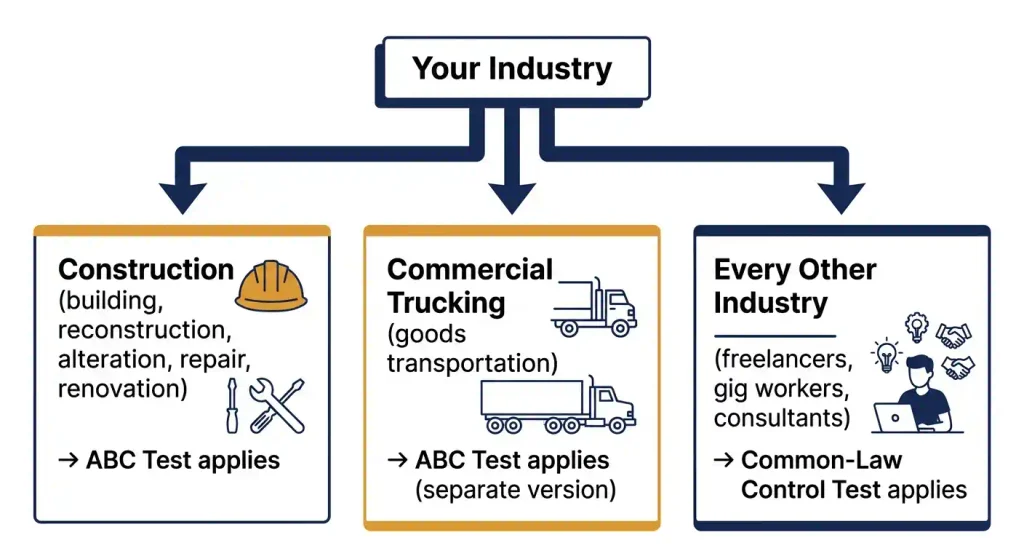
Yes, but only in construction and commercial trucking. Every other industry uses the common-law control test instead. California and New Jersey apply the ABC test broadly, New York does not, and that difference changes what rights apply to you.
What the New York ABC Test Actually Determines
The ABC test decides if you are an employee or an independent contractor under New York’s Construction Industry Fair Play Act, which controls your minimum wage, overtime, unemployment insurance, and workers’ compensation rights. This comes from New York State Labor Law, which presumes every construction worker is an employee until the contractor proves otherwise. Job title and pay method don’t matter. What matters is how the work actually happens, no matter what the contract calls you.
Who Must Follow the ABC Test?
The ABC test covers construction workers, contractors, and subcontractors doing construction, reconstruction, alteration, repair, or renovation work in New York. Codified as New York Labor Law Article 25-B at New York Labor Law § 861-c, it reaches residential and commercial construction, renovation, repair, maintenance, demolition, and excavation. It also covers staffing agency workers, and a subcontractor can legally hire another subcontractor, though each layer must pass the test on its own facts. A separate version covers commercial truck drivers under the Commercial Goods Transportation Industry Fair Play Act. Freelancers and gig workers outside these two industries fall under New York’s broader worker classification rules instead, using the common-law control test. A pending NYC bill, Intro 1926, would extend an ABC-style test to gig workers under the city’s sick leave law.
Does the ABC Test Apply to Every New York Independent Contractor?
No. It applies only to construction and commercial goods transportation. Everyone else is judged under the common-law control test or, for wage claims, a federal standard, and different tests can reach different results for the same worker depending on what benefit is at stake.
Construction Workers vs. Freelancers and Consultants
The Construction Industry Fair Play Act covers hands-on construction work: building, repairing, altering, or renovating structures. A 1099 designer, consultant, or developer falls outside it and is judged under the common-law test instead, which weighs the whole relationship. These workers face different concerns, like how 1099 taxes work in New York, rather than the ABC test itself. The type of work decides which test applies, not the job title.
The New York Common-Law Classification Test
Outside construction and trucking, New York asks whether the hiring company supervises, directs, and controls the worker, sometimes called the supervision, direction, and control test. It weighs who sets the schedule, who supplies tools, how pay is structured, and how closely the company oversees the work. No single factor decides it; a worker with flexible hours but company equipment and daily supervision can still count as an employee. If this sounds like your situation, our guide on the employee versus independent contractor rules in New York walks through the rest of those factors.
New York vs. Federal Independent Contractor Rules
A worker correctly classified for New York unemployment insurance can still have a federal wage claim, since New York’s test and the federal Fair Labor Standards Act (FLSA) run separately. The FLSA currently uses a six-factor test for economic dependence, though the Department of Labor proposed replacing it with a narrower economic reality standard in early 2026. The Internal Revenue Service (IRS) applies its own separate common-law test for payroll taxes and can reach a different answer on the same facts. A worker can also be a contractor for one company and an employee of another at the same time, and New York’s overtime laws still apply separately to the employee side of that relationship.
What Are the 3 Rules of New York’s ABC Test?
A construction worker is an independent contractor only if the hiring company proves all three conditions below. Fail one, and the law treats the worker as an employee.
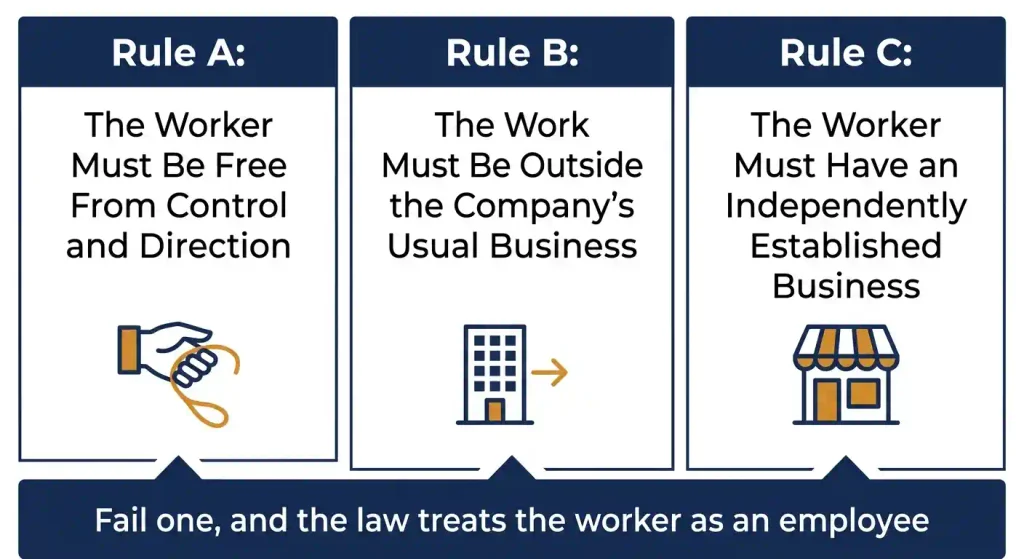
Rule A: The Worker Must Be Free From Control and Direction
The company can control the result it wants, not how the work gets done: no dictated schedule, no required company tools, no direct supervision over methods. New York courts and the Department of Labor call this the freedom from control and direction requirement. Working at the client’s job site does not defeat it, and following required safety rules is not the kind of control the test cares about. A worker who can turn down assignments, set his own hours, and work for other contractors looks more independent. If the contract says “independent” but daily supervision says otherwise, the reality wins.
Rule B: The Work Must Be Outside the Company’s Usual Business
If a roofing company hires someone to install roofs, that is its core business, and the ABC test fails right there. This rule stops companies from calling regular staff “independent contractors” just to pay by invoice. A worker doing the same job as the company’s own employees, on the same projects, is working inside its usual course of business. Independent contractor status is for a specialized task the company doesn’t normally do itself.
Rule C: The Worker Must Have an Independently Established Business
The worker needs a real independently established trade, occupation, profession, or business that existed before the contract and offers services to others, not just paperwork around one client. Real factors include capital investment, business insurance, multiple clients, and genuine profit-or-loss risk. An LLC or business card alone is not enough. Advertising to the public helps show the business is real. A worker who depends on one company for all his income is not independent, even with his own tools and an LLC.
What Happens If a Worker Fails One ABC Test Requirement?
All three rules must be satisfied. Miss one, and New York classifies the worker as an employee by default, since the law presumes employment and the burden is on the hiring company to rebut it. Signing an independent contractor agreement doesn’t change this; the actual facts control, not the label.
ABC Test Examples: When Is a Construction Worker an Employee?
These three examples show how the same ABC test produces different outcomes based on real facts, not contracts.
Example 1: A Construction Worker Who Fails the ABC Test
A drywall company gives a worker a daily schedule, requires company-owned tools, and assigns a foreman to check his work, while drywall installation is the company’s main business. He fails Rule A (controlled schedule and methods) and Rule B (the company’s usual business). Failing even one rule makes him an employee, regardless of his contract.
Example 2: A Contractor With an Independent Business
A licensed electrician carries his own liability insurance, owns his equipment, and works for six different general contractors in a given month, setting his own hours and bidding competitively. He likely satisfies all three rules: independent methods, work outside a general contractor’s usual business, and a genuinely independent company. All three conditions still have to hold up, but this pattern supports contractor status.
Example 3: A Worker With an LLC and a 1099
A worker formed an LLC two years ago and receives a 1099 instead of a W-2, but reports to the same job site daily and follows a supervisor’s instructions on every task. The LLC and the 1099 are paperwork; they don’t override actual working conditions. He fails Rule A because he lacks real control over his work, so New York looks past the business entity to the facts.
What Is New York’s 12-Part Separate Business Entity Test?
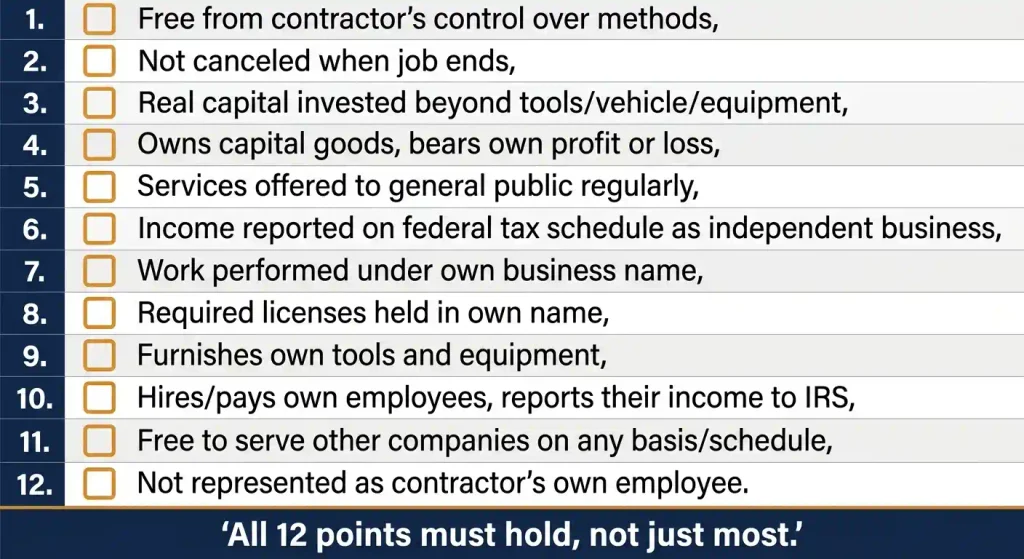
If a worker fails the ABC test, meeting all 12 of these separate criteria is the only other way to avoid employee status.
When the Separate Business Entity Test Applies
If a worker doesn’t meet the three-part ABC test, the hiring company can instead try to show the worker is a separate business entity under Labor Law Section 861-c(2). This applies to sole proprietorships, partnerships, corporations, and other structures. The entity must satisfy every one of the 12 criteria; failing even one means the employment presumption stands.
The 12 Requirements for a Separate Business Entity
The entity must work free from the contractor’s control over its methods, with the contractor only able to specify the result. It cannot simply be canceled when the job ends. It must invest real capital beyond ordinary tools, a personal vehicle, and basic equipment, own its capital goods, and bear its own profit or loss.
It must offer its services to the general public or business community regularly, report its income on a federal tax schedule as an independent business, perform work under its own business name, and hold any required licenses in that name. It must furnish its own tools and equipment, hire and pay its own employees without the contractor’s approval or reimbursement and report their income to the IRS, and be free to serve other companies on any basis and schedule it chooses. The contractor also cannot represent the entity or its workers as its own employees. All 12 points must hold, not just most.
What Rights Can a Misclassified New York Worker Lose?
Misclassification can cost a worker wage protections, unemployment insurance, and workers’ compensation coverage, while exposing the employer to real penalties.
Minimum Wage and Overtime Protections
Misclassified workers often miss New York’s minimum wage and overtime pay. New York law requires overtime at one and a half times the regular rate after 40 hours a week, which applies to employees, not contractors. Federal FLSA protections run alongside New York’s wage laws, so a misclassified worker may have unpaid wage claims under both. A “1099 contractor” working 50-hour weeks doing the same job as the W-2 crew may be owed years of unpaid overtime. Our guide on New York overtime laws covers how that unpaid overtime gets calculated, and seeing the gap between gross pay and net pay in New York makes it easier to spot what you’re actually missing.
Unemployment Insurance and Workers’ Compensation
A misclassified worker who loses a construction job may be wrongly denied unemployment benefits. Construction workers are entitled to workers’ compensation coverage under the Fair Play Act for any accident after October 26, 2010, when the Act took effect, and the New York Workers’ Compensation Board applies that same employee presumption. Disability benefits and Paid Family Leave (PFL) coverage can apply too, depending on actual employment status.
What Employers Risk by Misclassifying Workers
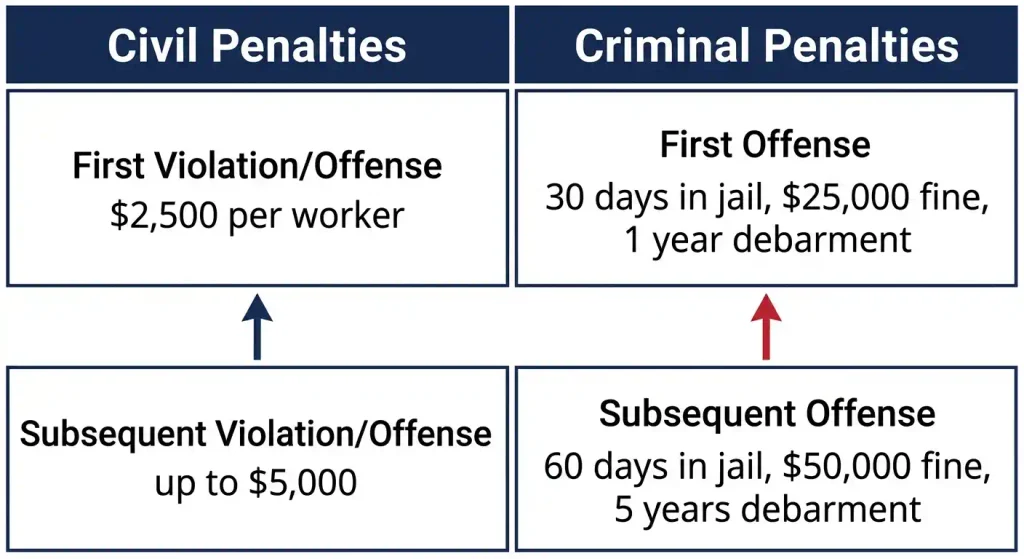
Employers face unpaid unemployment insurance contributions plus interest, back wage claims, and workers’ compensation liability for injuries during the misclassified period, on top of their regular New York payroll tax filing requirements. Willful violations of the Fair Play Act carry civil penalties of up to $2,500 per worker for a first violation, rising to up to $5,000 for a second violation within five years. Criminal penalties apply too: up to 30 days in jail, a $25,000 fine, and one year of debarment from public work for a first offense; up to 60 days in jail, a $50,000 fine, and five years of debarment for a subsequent offense.
Common Myths About New York Independent Contractor Classification
A 1099, a signed contract, or an LLC alone does not make someone a legal independent contractor in New York.
Does Receiving a 1099 Automatically Make You an Independent Contractor?
No. A 1099 is a tax form, not a legal classification. Companies sometimes issue a Form 1099-NEC to workers who should legally get a Form W-2, and which form a company issues doesn’t decide the legal question. See our breakdown of 1099 vs. W-2 in New York for how the two actually differ. What decides your status is how much control the company has over your schedule, tools, and work methods.
Does Signing an Independent Contractor Agreement Make the Classification Legal?
No. A contract can’t override the law. Courts and state agencies look at how the work actually functions, not what the agreement calls it. You also can’t sign away your right to minimum wage, overtime, or unemployment insurance.
Does Having an LLC or Multiple Clients Guarantee Independent Contractor Status?
No. Both are relevant facts, but neither guarantees contractor status alone. A worker with an LLC who takes daily direction from one dominant client still looks like that client’s employee. Classification always comes back to the facts and the test that applies to your industry, and the warning signs are the same ones covered in our guide on being misclassified as an independent contractor.
How Can You Challenge or Confirm Your Worker Classification?
Workers and employers can confirm classification by reviewing the facts, or by requesting an official determination from the Department of Labor.
What Workers Should Review Before Taking Action
Gather your contracts, pay records, work schedules, and any written instructions from the company, and note who controls your tools, hours, and task assignments day to day. A classification that was accurate at the start can become wrong over time as control grows or the worker’s business fades, so reassess rather than assume an old agreement still fits. Owning equipment but taking detailed daily instructions is a common edge case, and the instructions usually matter more than who owns the tools. Compare the facts against the test for your industry, whether that’s the ABC test, the common-law test, or the FLSA standard, and remember the IRS common-law test can still apply separately for federal payroll taxes. If an employer refuses to reconsider, the next step is a report to the Department of Labor.
How to Request an Official New York Classification Determination
Contact the New York State Department of Labor (NYSDOL) to request a formal classification determination; filing a report doesn’t require a lawsuit, and most workers start there before an attorney. Describe your working relationship in detail: who sets your schedule, supplies your equipment, supervises you, and whether you work for other clients.
After a complaint, the department typically reviews the employer’s records and can issue a determination, order back payments, or refer the case for further enforcement. The agency’s Construction Industry Fair Play Act fact sheet and other New York State Department of Labor official guidance cover the same criteria. An official determination carries legal weight that general information doesn’t.
What Employers Should Do if Classification Is Uncertain
Audit every contractor relationship against the test that actually governs it rather than assuming the common-law test applies to construction or trucking work, and fold that review into your broader New York payroll and employer compliance checklist. Keep records showing investment, licensing, insurance, and independent operation for any worker claimed as a separate business entity. When facts are close, a formal determination from the Department of Labor or advice from an employment attorney costs less than getting it wrong.
New York Independent Contractor ABC Test FAQs
Quick answers to the most common questions about New York’s ABC test.
Does New York use the ABC test for all independent contractors?
No. It applies only to construction and commercial goods transportation. Every other industry uses the common-law control test or a federal wage standard.
Can a construction worker be an independent contractor with a 1099?
Yes, but only if the actual working relationship satisfies the ABC test. The 1099 form alone doesn’t establish classification.
Does an independent contractor need multiple clients in New York?
Multiple clients support Rule C’s independently established business requirement, but they don’t guarantee contractor status alone.
Can an LLC owner be considered an employee?
Yes. Business registration doesn’t override the facts. An LLC owner taking daily direction from one company can still be that company’s employee.
What happens if a construction worker fails one part of the ABC test?
The worker is presumed an employee. All three rules must be satisfied together to establish independent contractor status.
How can I report suspected worker misclassification in New York?
The New York State Department of Labor is the official resource for reporting misclassification and requesting an investigation.
Can I qualify for unemployment benefits if I received a 1099?
Possibly. The Department of Labor evaluates the actual employment relationship, not the tax form issued.
Does New York’s ABC test apply to federal minimum wage and overtime?
No. Federal wage claims run through the FLSA’s test, separate from New York’s ABC test, and can produce a different result on the same facts. New York also sets its own minimum wage floor, and you can see exactly how we calculate these figures on our calculation methodology page.
For more New York payroll and worker classification guides, browse our full post library, page library, or category library.

Meet Yasin Ali, Founder
Yasin built NY Paycheck Calculator in 2020 after getting fed up with calculators that treated New York like every other state. Most tools ignore the extra local tax NYC and Yonkers workers pay on top of state tax — or skip New York’s Paid Family Leave deduction entirely.
He keeps the numbers current, checking in regularly against the latest IRS, NY Department of Taxation and Finance, and Paid Family Leave rates.
All results here are estimates based on official sources. For advice specific to your situation, talk to a tax professional.