
NY spread of hours pay is an extra hour of wages at minimum wage, owed when a workday’s full span, from first clock-in to last clock-out, exceeds 10 hours, guaranteed for hospitality workers regardless of pay rate.
That threshold trips up both workers and payroll teams, since it tracks the clock, not time cards or job titles.
Coverage isn’t universal though: most non-hospitality workers rarely qualify once the wage offset test applies.
What Is New York Spread of Hours Pay? (Quick Answer)
Here’s exactly how that 10-hour threshold is measured, who’s guaranteed the payment, and what it’s worth in 2026, region by region.
The Basic 10-Hour Rule Explained
Your workday’s “spread” is the total elapsed time from when it begins to when it ends, including breaks and gaps between shifts. You don’t need 10 actual worked hours to qualify, a 6-hour shift stretched across a 10.5-hour span still counts. When the spread exceeds 10 hours, your employer owes one additional hour at the basic minimum hourly rate, on top of your regular pay.
Who Is Entitled to Spread of Hours Pay?
Restaurant and all-year hotel employees get the strongest protection, under the Hospitality Industry Wage Order (also called the Minimum Wage Order for the Hospitality Industry), codified at 12 NYCRR Part 146, specifically 12 NYCRR §146-1.6. They get the extra hour whenever the spread passes 10 hours, no matter their pay, even a $25-an-hour server. Employees outside hospitality fall under the Miscellaneous Industries and Occupations Wage Order (officially the Minimum Wage Order for Miscellaneous Industries and Occupations), at 12 NYCRR Part 142. The payment rule there is 12 NYCRR §142-2.4; §142-2.18 just defines “spread of hours.” Their employer only owes it if daily earnings fall below minimum wage plus the extra hour. Both orders come from the New York State Department of Labor (NYSDOL), part of its New York State Department of Labor Wage Orders, so identify which one covers your job first.
2026 Spread of Hours Pay at a Glance
Based on the New York minimum wage 2026 schedule, confirmed by New York State’s 2026 minimum wage increase announcement. Guaranteed for hospitality workers; others only if they fail the offset test above.
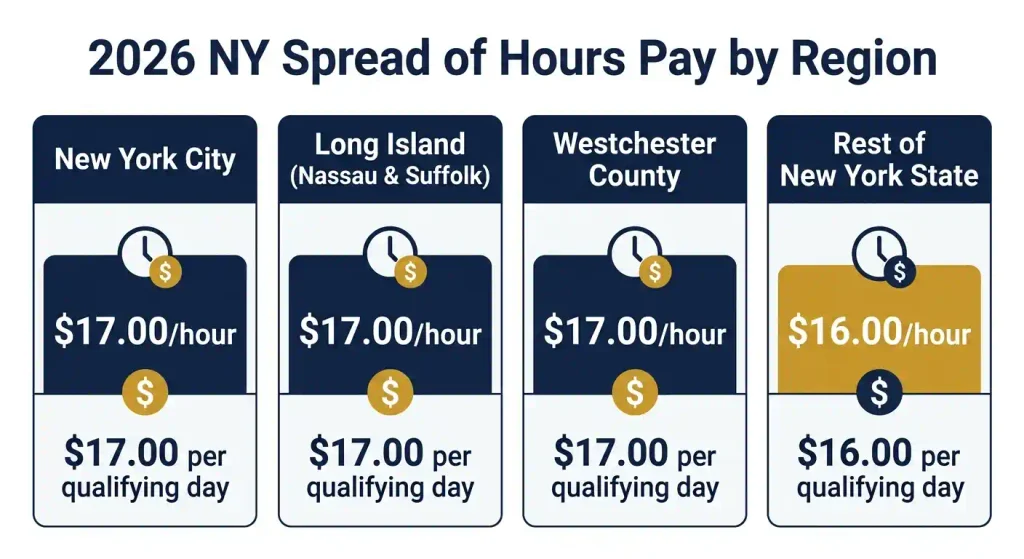
| Region | 2026 Minimum Wage | Spread of Hours Pay |
|---|---|---|
| New York City | $17.00/hour | $17.00 per qualifying day |
| Long Island (Nassau & Suffolk) | $17.00/hour | $17.00 per qualifying day |
| Westchester County | $17.00/hour | $17.00 per qualifying day |
| Rest of New York State | $16.00/hour | $16.00 per qualifying day |
This sits on top of your regular wages as its own line item, whether you earned $150 or $400 that day. Your regular hourly rate, including a tipped cash wage, doesn’t set it. The basic minimum wage for your region does, whether NYC, Long Island, Westchester, or upstate New York.
How the 10-Hour Spread of Hours Rule Works
With the basic rule defined, here’s how to apply it: subtract your start time from your end time. Over 10, you’re owed the extra hour. Everything inside that window, paid or not, counts.
How to Calculate Your Total Workday Spread
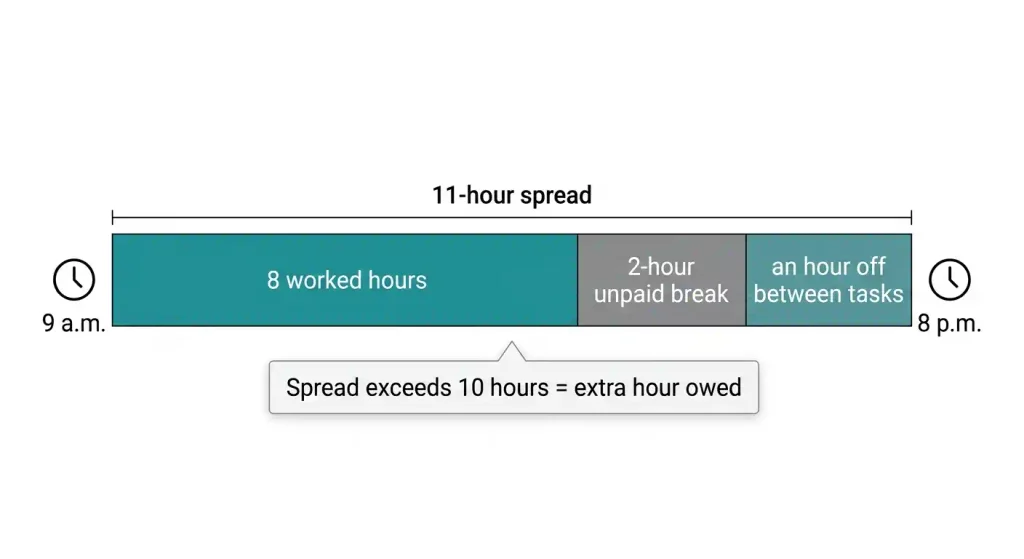
Take your first clock-in and last clock-out of the day. Count every hour between, working time, meal breaks, and off-the-clock gaps. That’s your spread, a different number than hours worked. Someone working 9 a.m. to 8 p.m. has an 11-hour spread, even with only 8 worked hours due to a 2-hour unpaid break and an hour off between tasks.
Does Exactly 10 Hours Qualify?
No. The spread must exceed 10 hours, not just reach it. 7 a.m. to 5 p.m. is exactly 10 hours and doesn’t qualify. Push it to 5:01 p.m. (10 hours, 1 minute) and it does. NYSDOL’s general guidance sometimes says “10 or more hours,” but the regulation says “exceeds.” You need a spread of hours greater than 10 hours, not one that simply reaches it.
Why Working Fewer Than 10 Hours Can Still Qualify
A long unpaid break stretches the spread without adding worked hours. Example: a lunch shift 11 a.m. to 2 p.m., then a dinner shift 6 p.m. to 10 p.m., is only 7 working hours, but an 11-hour spread, which qualifies. The rule cares about the clock span, not effort inside it.
Do Meal Breaks, Unpaid Breaks, and Time Between Shifts Count?
Yes, almost all of it. Unpaid time still counts toward the spread.
Do Unpaid Lunch Breaks Count?
Yes. An unpaid lunch break is still part of the spread, separate from New York’s meal break laws that set when and how long breaks must be; the calculation only cares about first clock-in to last clock-out, not whether every minute was paid. Clocking in at 8 a.m., taking an unpaid hour for lunch, and clocking out at 6:30 p.m. is a 10.5-hour spread. The break itself still isn’t paid as work time, it just counts toward triggering the rule.
Do Paid Rest Breaks and Short Breaks Count?
Yes. A 10- or 15-minute paid rest break already sits inside the spread, between your first clock-in and last clock-out. The calculation doesn’t distinguish paid break time, unpaid break time, or working time, only the two bookends of the day.
Does Time Between Two Separate Shifts Count?
Yes, the entire gap counts, even if you leave the building. A dishwasher working 10 a.m. to 1 p.m., then 7 p.m. to 10 p.m., has a 12-hour spread (10 a.m. to 10 p.m.), regardless of the 6 hours away from work. The law only looks at the first start time and last end time of the day.
How Much Is Spread of Hours Pay in New York in 2026?
It’s fixed to the basic minimum wage for your region, not your paycheck.
Is the Extra Hour Based on Minimum Wage or Your Regular Pay?
The basic minimum hourly rate, not your actual rate of pay. A $30-an-hour line cook and a $17-an-hour dishwasher at the same Manhattan restaurant both get the same $17.00 spread payment. Under the Hospitality Industry Wage Order, meal and lodging credits can’t reduce or cancel it. That’s the same protection that applies against illegal paycheck deductions generally. It’s a flat, guaranteed amount on top of everything else.
How Much Do Tipped Employees Receive?
The full basic minimum hourly rate, not the lower cash wage tipped staff receive under New York’s tipped minimum wage rules and tip credit system. A server in Albany earning a $10.70 cash wage (the 2026 rest-of-state food service worker rate after the tip credit) still gets the full $16.00 spread payment. The tip credit affects regular wages only, not this separate payment.
How to Calculate Multiple Qualifying Workdays
These add up fast. Five qualifying 11-hour shifts a week in NYC means an extra $85 a week ($17 x 5), roughly $340 a month, from this rule alone, run your own numbers through a free NY paycheck calculator to see the full impact. Use the rate in effect on each specific date and location, since rates differ by region and change over time.
Real-World Spread of Hours Pay Examples
Numbers make this easier than definitions alone.
Example 1: Working 7 AM to 10 PM With a Long Break
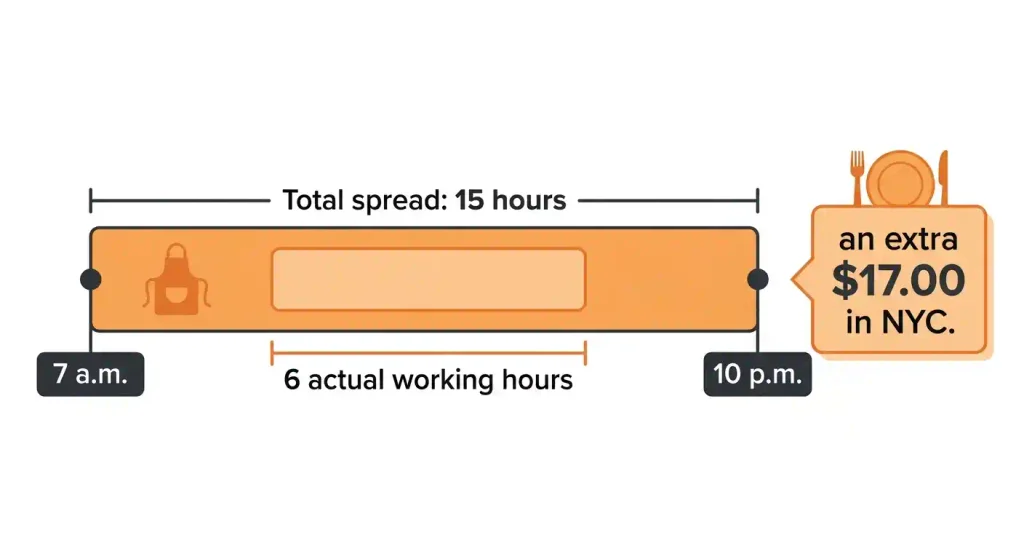
Clock in 7 a.m., out 10 p.m., with only 6 actual working hours. Total spread: 15 hours. As a restaurant job, spread pay applies regardless of hourly rate: an extra $17.00 in NYC.
Example 2: Working Two Separate Restaurant Shifts
Brunch 10 a.m. to 2 p.m., dinner 5 p.m. to 9 p.m.: 8 actual hours worked, but an 11-hour spread (10 a.m. to 9 p.m.). The server is owed the extra hour.
Example 3: Working 11:30 AM to 10 PM With a Meal Break
In at 11:30 a.m., out at 10 p.m., with a 30-minute unpaid meal break: a 10.5-hour spread. The break doesn’t get excluded, so the cook qualifies.
Example 4: Working Exactly 10 Hours
7 a.m. to 5 p.m. (exactly 10 hours) doesn’t trigger pay. 7 a.m. to 5:30 p.m. (10.5 hours) does. That half-hour is worth checking on your pay stub.
Example 5: A Higher-Paid Employee Working a Long Day
A $24-an-hour hotel front desk worker with an 11-hour spread still qualifies, since the hospitality rule applies regardless of pay rate: $17.00 (NYC rate) on top of regular wages.
Example 6: Spread of Hours and Overtime on the Same Day
10 actual hours within an 11-hour spread, in a week over 40 total hours: both overtime (for hours past 40) and spread of hours pay apply. The extra spread hour isn’t treated as hours worked and isn’t folded into the overtime calculation.
Who Qualifies for New York Spread of Hours Pay?
Coverage depends on industry, not just day length.
- Guaranteed, any pay rate: restaurants, all-year non-resort hotels
- Conditional, offset test applies: fast food, retail, building service, healthcare, security, office work
- Not covered: genuine independent contractors
Restaurant Workers, Servers, and Bartenders
Covered under the Hospitality Industry Wage Order regardless of pay: tipped servers and bartenders, service staff like bussers and hosts, and non-tipped kitchen staff and dishwashers. Restaurant managers qualify too unless their duties meet the exempt-employee test. Always paid at the basic minimum hourly rate.
Hotel Employees and Hospitality Workers
Qualifying all-year, non-resort hotel employees get the same protection as restaurant workers. Resort hotels are treated differently, so a hotel’s legal classification matters.
Fast Food, Retail, and Other Industry Employees
Fast food is regulated separately from general restaurants. Retail, building service, healthcare, security, and office employees generally fall under the Miscellaneous Wage Order, with the offset test. Check the specific wage order for your industry.
Do Salaried and Higher-Paid Employees Qualify?
Being salaried doesn’t disqualify a restaurant or hotel employee; this is industry-based, not a pay-rate test. It’s generally reserved for non-exempt employees, so what matters is whether the role clears New York’s overtime salary threshold for exempt status and whether the wage order covers those duties.
Do Part-Time, Temporary, and Independent Workers Qualify?
Part-time, seasonal, and on-call employees qualify the same as full-time, no minimum hours threshold, since it’s a daily rule. Genuine independent contractors aren’t covered; if you’ve been misclassified as an independent contractor, that label alone doesn’t settle the question. Shifts at different locations for the same employer in one day combine into a single spread. Shifts for two separate employers are measured separately.
What Happens When a Shift Crosses Midnight?
This raises questions about whether the shift is one workday or two, based on the employer’s established workday definition, especially for late-night schedules. An overnight shift can still qualify if the elapsed time within that defined workday passes 10 hours, even across two calendar dates. Unclear cases are worth checking with NYSDOL or the applicable wage order.
Spread of Hours Pay vs. Overtime, Split Shifts, and Call-In Pay
These test different things and get confused often.
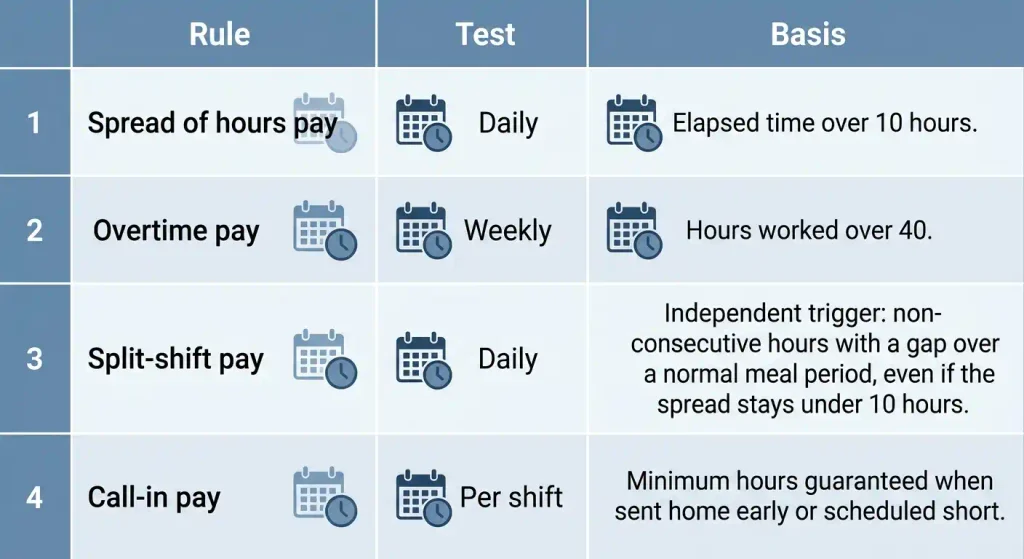
| Rule | Test | Basis |
|---|---|---|
| Spread of hours pay | Daily | Elapsed time over 10 hours |
| Overtime pay | Weekly | Hours worked over 40 |
| Split-shift pay | Daily | Independent trigger: non-consecutive hours with a gap over a normal meal period, even if the spread stays under 10 hours |
| Call-in pay | Per shift | Minimum hours guaranteed when sent home early or scheduled short |
Spread of Hours Pay vs. Overtime Pay
Overtime is a weekly test under New York’s overtime laws: time and a half of your regular rate of pay after 40 hours. Spread of hours pay is a daily test: elapsed time over 10 hours. Both can apply to the same employee in the same week.
Spread of Hours Pay vs. Split-Shift Pay
A split shift is actually a separate trigger from the 10-hour spread test, not the same one. Under 12 NYCRR §142-2.4(b) and §142-2.17, Miscellaneous Wage Order employees are owed the extra hour for a qualifying split shift, meaning non-consecutive working hours with a gap longer than a normal meal period, even if the total spread stays under 10 hours. The Hospitality Industry Wage Order has no separate split-shift provision, so hospitality employees rely on the spread test alone. When both triggers hit on the same day, only one extra hour is owed, not two. An employer can’t avoid it just because the employee agreed to the split shift.
Spread of Hours Pay vs. Call-In Pay
Call-in pay guarantees minimum paid hours when you’re sent home early or scheduled for a short shift. That’s a different scheduling protection than New York’s day of rest rules, which guarantee time off rather than pay. Spread of hours pay is about the length of the whole workday. Both can apply on the same day.
Common Spread of Hours Pay Myths and Mistakes
A few recurring misunderstandings.
Myth 1: You Must Actually Work More Than 10 Hours
False. It’s about elapsed time. Breaks and shift gaps can push the spread past 10 hours on a day with only 6 or 7 worked hours.
Myth 2: Unpaid Lunch Breaks Do Not Count
False. Unpaid meal periods are included in the elapsed time.
Myth 3: Only Minimum-Wage Employees Qualify
False for hospitality. Restaurant and qualifying hotel employees are covered regardless of pay.
Myth 4: Tipped Employees Only Receive Their Cash Wage
False. The payment uses the full basic minimum hourly rate; tip credits and meal or lodging credits don’t reduce it under the hospitality rule.
Myth 5: Every New York Employee Automatically Qualifies
False. Coverage depends on the wage order. Hospitality is guaranteed; Miscellaneous Wage Order employees qualify only if they fail the offset test.
Myth 6: Spread of Hours Pay Is the Same as Overtime
False. Different tests, daily span versus weekly hours, and the spread hour isn’t counted as worked time for overtime.
What to Do If Your Employer Did Not Pay Spread of Hours Wages
A clear path to figuring out how much and what to do, the same steps apply if your whole paycheck wasn’t received at all.
How to Check Your Pay Stub for Missing Payments
Compare recorded hours, pay rate, and gross wages against days with long spreads. It often doesn’t show as a labeled line item, so check your pay stub codes and do the math yourself. For official backup, your employer must give a wage statement each paycheck showing hours and rates under the New York Wage Theft Prevention Act, covered under New York’s wage statement requirements. Start there.
How to Calculate Your Unpaid Wages
Use schedules, timecards, or clock-in records to find days with a spread over 10 hours. Apply the basic minimum wage in effect for your region on each date, then add it all up.
What Evidence Should You Collect?
Gather these before filing a claim:
- Pay stubs
- Posted schedules
- Timecards and clock-in/out records
- Texts or emails about shift changes or breaks
- Dates, locations, and times for each qualifying day
If your employer’s records don’t match what you actually worked, keep your own notes anyway.
How to Ask Your Employer for Missing Pay
Raise it directly with payroll or your manager, specific on days and amounts, citing New York’s spread of hours regulation. If they say your wage already covers it or that it’s minimum-wage-only, that may hold for Miscellaneous Wage Order employees under the offset test, but not for hospitality employees. Keep a written record of the response.
How to File a New York Wage Complaint
File with the New York State Division of Labor Standards, the division of the New York State Department of Labor that handles these claims, submitting an unpaid wage complaint form with your documentation. NYSDOL can investigate and help recover unpaid wages. Repeated failures draw closer scrutiny and larger penalties; widespread cases can also fall under New York State Attorney General wage enforcement. Spread of hours pay is just one piece of New York’s broader wages and wage laws, worth reviewing if you suspect other violations too.
Can Your Employer Retaliate for Requesting Unpaid Wages?
No. New York Labor Law Section 215 protects employees from retaliation, including reduced hours, demotion, or termination, for asking about unpaid wages. Report retaliation directly to NYSDOL.
Frequently Asked Questions About New York Spread of Hours Pay
Is spread of hours pay mandatory in New York?
Mandatory for hospitality employees whenever the spread exceeds 10 hours. For Miscellaneous Wage Order employees, only if daily earnings fail the offset test.
Do I get an extra hour of pay for working more than 10 hours?
Only if your total spread, not actual hours worked, exceeds 10 hours.
Do unpaid lunch breaks count toward spread of hours?
Yes, they’re included in the elapsed time even though unpaid.
Do two shifts in one day qualify for spread of hours pay?
Yes, if the span from first shift start to last shift end exceeds 10 hours total.
Do tipped restaurant workers receive spread of hours pay?
Yes, calculated at the full basic minimum hourly rate, not the cash wage.
Can employees earning more than minimum wage receive spread of hours pay?
Yes, in hospitality roles, regardless of pay rate. Other industries may lose eligibility under the offset test.
Does spread of hours pay count toward overtime?
No, it’s separate and not treated as hours worked for overtime.
How far back can I claim unpaid spread of hours pay?
Depends on the claim type: administrative NYSDOL complaints and private court claims have different timeframes. For guidance:
- NYSDOL Hospitality Wage Order FAQ
- NYSDOL Minimum Wage FAQ
- NYSDOL Wage Orders
- NYSDOL Minimum Wage Lookup Tool
- NYSDOL Wage and Hour Division (handles complaints)

Meet Yasin Ali, Founder
Yasin built NY Paycheck Calculator in 2020 after getting fed up with calculators that treated New York like every other state. Most tools ignore the extra local tax NYC and Yonkers workers pay on top of state tax — or skip New York’s Paid Family Leave deduction entirely.
He keeps the numbers current, checking in regularly against the latest IRS, NY Department of Taxation and Finance, and Paid Family Leave rates.
All results here are estimates based on official sources. For advice specific to your situation, talk to a tax professional.