
New York’s 2026 income tax uses nine progressive brackets, from 3.9% to 10.9%, based on your filing status and New York taxable income, not gross salary; only income inside each bracket is taxed at that bracket’s rate.
That progressive structure came from New York’s 2026 rate cut, which lowered the bottom five brackets by 0.1 percentage points each.
These brackets cover state tax only; NYC and Yonkers residents owe additional local tax on top.
New York Tax Brackets 2026 at a Glance
These New York State income tax brackets, set under New York Tax Law, determine your New York State personal income tax. New York has no single flat rate, so your spot on the New York income tax rates 2026 table matters more than most expect.
2026 New York tax rates and income limits by filing status
| Rate | Single / MFS | Married Filing Jointly |
|---|---|---|
| 3.9% | $0 – $8,500 | $0 – $17,150 |
| 4.4% | $8,501 – $11,700 | $17,151 – $23,600 |
| 5.15% | $11,701 – $13,900 | $23,601 – $27,900 |
| 5.4% | $13,901 – $80,650 | $27,901 – $161,550 |
| 5.9% | $80,651 – $215,400 | $161,551 – $323,200 |
| 6.85% | $215,401 – $1,077,550 | $323,201 – $2,155,350 |
| 9.65% | $1,077,551 – $5,000,000 | $2,155,351 – $5,000,000 |
| 10.30% | $5,000,001 – $25,000,000 | $5,000,001 – $25,000,000 |
| 10.90% | Over $25,000,000 | Over $25,000,000 |
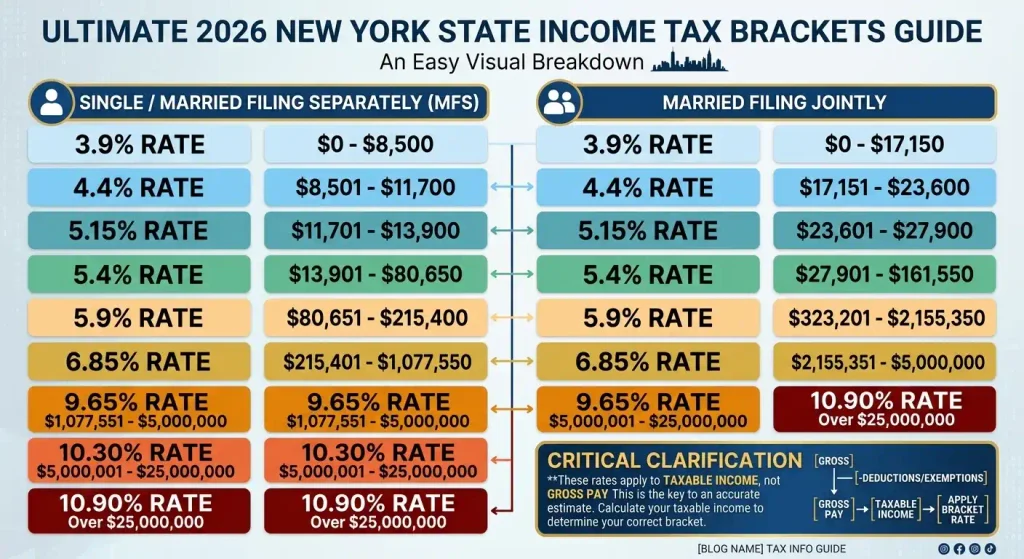
This is the full New York State tax rates 2026 schedule. It applies to New York taxable income, not gross pay, the distinction that trips up most readers.
What bracket applies to your taxable income?
Your bracket is set by New York taxable income, income after deductions, not salary or W-2 box 1. Someone earning $90,000 in gross wages usually has taxable income near $80,000 after the standard deduction, and that $80,000 is what you match to the table. A raise only taxes the portion above each threshold at the next rate. A New York paycheck calculator can confirm that number for you in seconds.
How New York Tax Brackets Work in 2026
New York uses marginal brackets: not every dollar is taxed the same way. It’s the most misunderstood part of state tax.
New York uses a progressive income tax system
Income gets sliced into pieces, each taxed at its own bracket rate. A single filer with $50,000 in taxable income pays 3.9% on the first $8,500, 4.4% up to $11,700, and so on. Crossing into a new bracket taxes only the income inside it, not your whole income. Federal brackets work the same way, with their own rates and thresholds, calculated separately.
Marginal tax rate vs effective tax rate
Marginal rate is the rate on your last dollar earned. Effective rate is total tax divided by total income, and it’s almost always lower. A single filer at $100,000 sits in the 5.9% marginal bracket but has an effective rate near 5.1%. The marginal rate is what matters for deciding if a raise or bonus is worth it.
Taxable income is not the same as salary
Salary is the number on your offer letter. New York taxable income starts from federal AGI, adds New York-specific adjustments, then subtracts your deduction. Two people earning $75,000 can land differently if one contributes to a 401(k). Salary alone tells you almost nothing about your final bill. For a full breakdown, see our guide to gross pay versus net pay in New York.
What Changed in the New York Tax Brackets for 2026?
New York cut rates for most workers in 2026, easy to miss on an old table.
The 2026 rate reduction and phase-in
The bottom five brackets each dropped 0.1 percentage point for 2026: 4% to 3.9%, 4.5% to 4.4%, 5.25% to 5.15%, 5.5% to 5.4%, and 6% to 5.9%. This is half of a larger 0.2-point cut, with the rest landing in 2027. Anyone under about $215,400 in taxable income as a single filer benefits.
2025 vs 2026 New York tax brackets
Thresholds stayed largely the same from 2025 to 2026, but the first six brackets got a bit friendlier. A single filer with $80,000 in taxable income saves roughly $50 to $80 a year from the rate cut alone. The top three brackets, 6.85%, 9.65%, and 10.3%, plus the top rate of 10.9%, did not move.
What remains different for high-income taxpayers
The 9.65% bracket starts at $1,077,551 for single filers, 10.30% at $5,000,001, and 10.90% past $25,000,000. None of these three brackets changed in 2026. Near seven figures, the relief most workers got does not apply to you.
New York Tax Brackets by Filing Status
Your New York filing status decides which thresholds apply, and the gap between statuses is bigger than most expect.
Single filer tax brackets
Single filers use the base table: 3.9% on the first $8,500, up to 10.9% past $25 million. Most single earners in New York City and the suburbs use this schedule. The 5.9% bracket, $80,651 to $215,400, covers a large share of mid-career New Yorkers.
Married filing jointly tax brackets
Joint thresholds run roughly double the single brackets at the lower end, though not a clean doubling higher up. A couple with $200,000 combined taxable income stays in the 5.4% bracket, while a single filer hits 5.9% at that income. Joint filing usually keeps married couples in lower brackets longer than filing separately.
Married filing separately tax brackets
Married filing separately uses the same thresholds as single filers, not a scaled-down joint table. This surprises people expecting a middle ground. It usually pushes couples into higher brackets faster than joint filing, so it is mainly for specific cases like student loan plans or liability concerns.
Head of household tax brackets
Head of household sits between single and joint. The 5.4% bracket runs to $107,650, then 5.9% covers $107,651 to $269,300. Qualifying requires being unmarried and paying more than half a home’s cost for a qualifying dependent.
Qualifying surviving spouse filing status
This status uses the same bracket table as married filing jointly. It applies for up to two years after a spouse’s death, with a dependent child and no remarriage. If you qualify, using these brackets instead of single or head of household can meaningfully lower your bill.
How to Calculate New York State Income Tax From the Brackets
Once you know your taxable income and filing status, the math is mechanical, shown here with real numbers.
Calculate tax using the marginal-bracket method
Work down the bracket table, multiplying the income in each bracket by its rate, then add the pieces together. New York publishes a base tax amount per bracket so you skip the manual math, but knowing it shows exactly where your money goes. This mirrors the calculation methodology behind our own paycheck calculator.
Example: $50,000 of taxable income
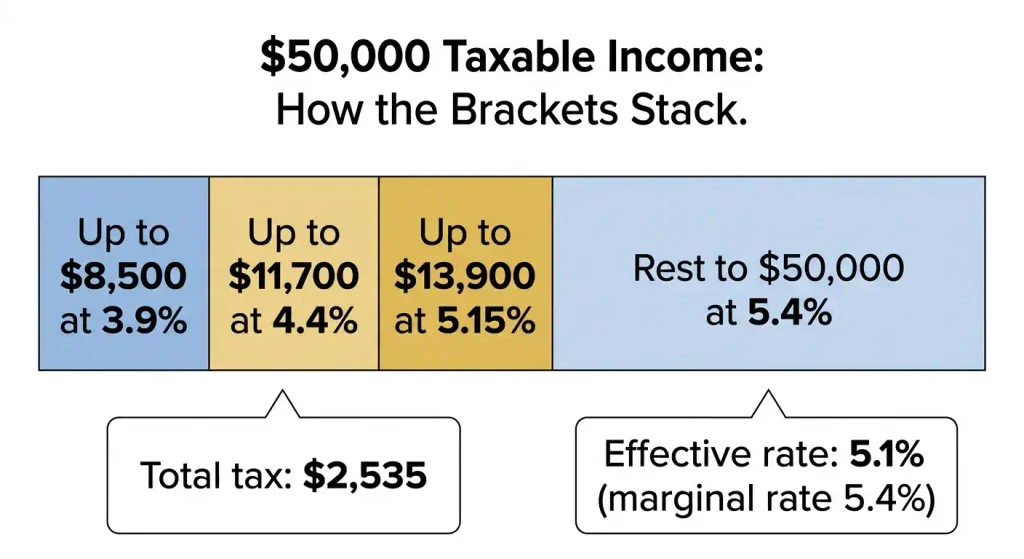
A single filer at $50,000 pays 3.9% up to $8,500, 4.4% up to $11,700, 5.15% up to $13,900, and 5.4% on the rest. Total tax: roughly $2,535, an effective rate of about 5.1%, well below the 5.4% marginal rate.
Example: $100,000 of taxable income
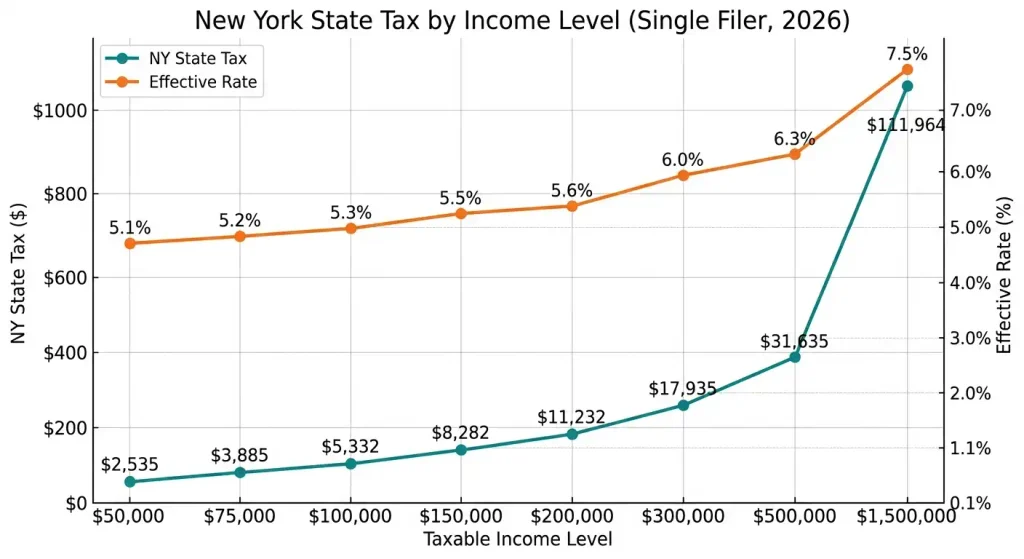
At $100,000, a single filer enters the 5.9% bracket above $80,650. Total New York State tax: about $5,332, an effective rate near 5.3%. Federal tax and FICA add more on top. At $75,000, just under that threshold, tax runs about $3,885, an effective rate near 5.2%.
Example: $150,000 of taxable income
At $150,000, still inside the 5.9% bracket (up to $215,400), tax comes to roughly $8,282, an effective rate near 5.5%. Effective and marginal rates keep converging as income rises.
Example: $200,000 of taxable income
At $200,000, still in the 5.9% bracket, tax is about $11,232, an effective rate near 5.6%. The 2026 cuts to all six lower brackets help here too.
Example: $300,000 of taxable income
At $300,000, a single filer enters the 6.85% bracket above $215,401. Tax comes to roughly $17,935, an effective rate near 6%. This is where higher brackets start to bite, especially for NYC residents stacking city tax on top.
At $500,000, still in the 6.85% bracket (up to $1,077,550), tax runs about $31,635, an effective rate near 6.3%.
Example: $1 million or more of taxable income
At $1,077,551, a single filer enters the 9.65% bracket. At $1.5 million, tax runs close to $111,964 before recapture, an effective rate near 7.5%. A supplemental tax calculation claws back lower-bracket savings above this level, so simple math understates what high earners owe.
Quick recap, single filer:
| Taxable Income | New York State Tax | Effective Rate |
|---|---|---|
| $50,000 | $2,535 | 5.1% |
| $75,000 | $3,885 | 5.2% |
| $100,000 | $5,332 | 5.3% |
| $150,000 | $8,282 | 5.5% |
| $200,000 | $11,232 | 5.6% |
| $300,000 | $17,935 | 6.0% |
| $500,000 | $31,635 | 6.3% |
| $1,500,000 | $111,964 | 7.5% |
Why New York Adjusted Gross Income Can Change the Calculation
Taxable income isn’t the only number that matters. New York AGI plays its own role at higher incomes.
New York adjusted gross income vs New York taxable income
New York AGI is federal AGI adjusted for state additions and subtractions, reported on Form IT-225, before your deduction. Taxable income is what’s left after that deduction, and it sets your bracket. AGI still matters, since it triggers phase-outs and supplemental calculations at higher incomes.
The $107,650 AGI threshold
$107,650 is the New York AGI line where every filing status must stop using the simple tax table and switch to the tax computation worksheet. Crossing it means part of your lower-bracket benefit starts getting recaptured, whatever your filing status.
Supplemental tax for higher-income taxpayers
Once New York AGI passes $107,650, a supplemental tax recaptures lower-bracket savings, growing larger as income climbs toward a near-flat rate at the top. It’s a formula, not a separate rate, worked out on the Tax Computation Worksheet in the Form IT-201-I instructions. High earners should not just multiply income by one percentage.
New York State Tax Brackets vs Your Paycheck
The bracket table sets your annual liability. Paycheck withholding is a separate calculation, and the two rarely match exactly.
Why paycheck withholding may not equal your final tax
Your employer withholds based on your Form IT-2104 and New York’s updated 2026 withholding tables, not your final annual numbers. Deductions, credits, and filing status get reconciled only when you file your Form IT-201 return, which is why some people get refunds and others owe. Our comparison of Form W-4 versus Form IT-2104 breaks down exactly what goes on that form.
How a raise affects your New York tax
A raise is only taxed at the new marginal rate on income above your old bracket ceiling, not your whole salary. A single filer going from $90,000 to $95,000 pays 5.9% only on that extra $5,000. A raise never shrinks your take-home pay overall.
How bonuses and overtime affect your tax
Bonuses often get withheld at a flat supplemental rate that looks harsh on the paycheck, but that isn’t your real tax rate. Once added to annual taxable income at filing time, the true tax is usually lower, which is why bonuses often mean bigger refunds. Overtime is taxed as regular wages, but enough of it can still push your yearly income into a higher bracket.
New York State Tax vs New York City and Yonkers Taxes
State tax is one layer. NYC and Yonkers can add more, and a fourth, the metropolitan commuter transportation mobility tax (MCTMT), applies if you’re self-employed in the metro area with net earnings above $150,000. For the full rundown, see what taxes come out of a New York paycheck.
New York State income tax vs New York City income tax
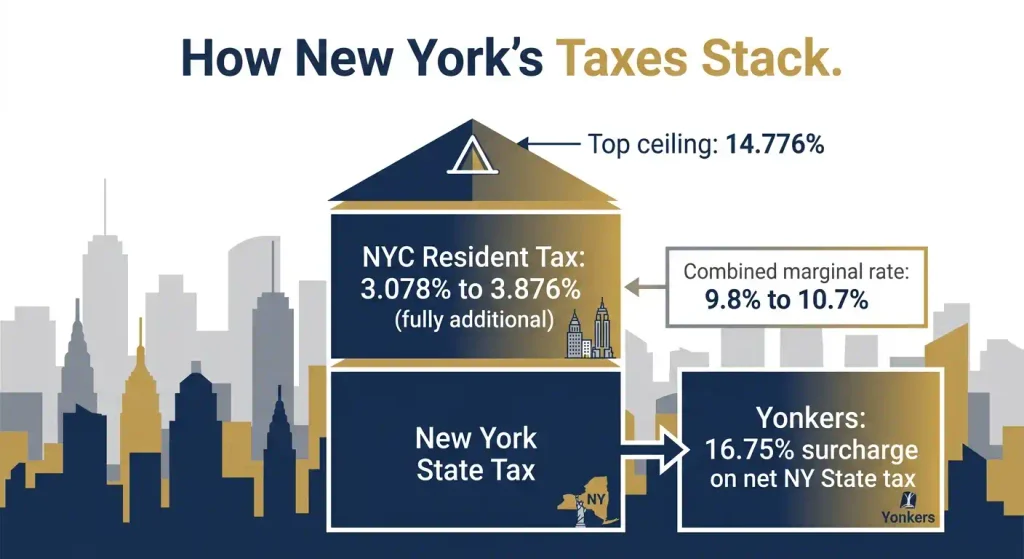
NYC residents pay state tax plus a separate New York City resident tax, from about 3.078% to 3.876%, fully additional, not a credit. A Manhattan resident in the top city bracket but a mid-range state bracket faces a combined marginal rate around 9.8% to 10.7%; only someone in the top state bracket above $25 million approaches the 14.776% ceiling.
New York State tax vs Yonkers resident tax
Yonkers has no bracket table for Yonkers income tax; residents pay a 16.75% surcharge on net New York State tax. Nonresidents working in Yonkers pay a separate Yonkers nonresident tax through its own form, layered on top either way.
Do New York residents outside NYC pay city income tax?
No. New York City income tax applies only to residents of the five boroughs. Living elsewhere in New York, except Yonkers with its own surcharge, means state tax alone.
Deductions, Credits, and Other Factors That Can Lower Your Tax
Your bracket is the starting point. Deductions and credits underneath it lower your actual bill.
How deductions affect taxable income
Deductions reduce taxable income before the bracket table applies; credits reduce your bill directly. New York’s 2026 standard deduction is $8,000 single, $16,050 married filing jointly. Some filers itemize instead, using Form IT-196 for things like mortgage interest, but not both methods at once. A large enough deduction can drop you into a lower bracket than salary alone suggests. See our full guide to New York paycheck deductions for how each one is applied.
New York State tax credits
New York offers credits like the Empire State Child Credit and the Earned Income Credit, applied after the bracket math. Some are refundable, meaning money back even if you owe nothing; others just reduce what you owe to zero. Credits don’t change your bracket, only your final payment.
Filing status and deduction differences
Filing status sets both your bracket thresholds and standard deduction, so a status change hits your bill twice. New York generally requires the same filing status on your New York State tax return as federally, with narrow exceptions for same-sex couples and some nonresident cases.
New York Tax Brackets for Part-Year Residents and Nonresidents
Not everyone reading this lived in New York for the full year, and the rules shift depending on your situation.
How part-year residency changes the calculation
Part-year residents use the same bracket table but pay New York tax only on income earned as a resident, plus any New York-source income earned as a nonresident that year. The state prorates your deduction, calculates an effective rate on total income, and applies it to the New York-sourced portion. This applies whether you moved into or out of New York mid-year.
How nonresidents are taxed on New York-source income
Nonresidents owe New York tax only on New York-source income, like wages earned physically in the state, reported on Form IT-203. Living elsewhere doesn’t automatically avoid tax on income earned here.
Remote workers and New York income tax
New York’s “convenience of the employer” rule can tax remote workers on New York income even if they physically worked elsewhere, unless the remote work was a genuine employer necessity, not a personal choice. This catches many remote employees of New York-based companies off guard.
Real-World 2026 New York Tax Scenarios
Here is how all of this plays out in situations people actually face.
You received a raise and want to know your new tax rate
Compare taxable income before and after the raise. Only new income above your old ceiling is taxed at the higher rate, so going from $80,000 to $90,000 as a single filer taxes just the extra $10,000 at 5.9%. Your after-tax raise is smaller than the gross raise, but never negative. Run this check before you accept the offer, not after your first new paycheck lands.
You received a large annual bonus
Your bonus gets added to income at filing time, even though it was withheld separately on the paycheck. Bonus withholding tends to run higher than what you actually owe once combined at filing. Don’t judge your real bonus tax rate off that one paycheck. Set the bonus aside until you file rather than treating the withheld amount as your final cost.
You are comparing two New York job offers
Compare estimated take-home pay, not headline salary. A $110,000 NYC offer and a $105,000 suburban offer can land close once city tax applies to the first. Run both through the state table, add city tax where relevant, then compare. If the numbers feel off, our guide on why your New York paycheck might run lower than expected walks through the usual culprits.
You are a high earner above $1 million
Past the 9.65% bracket, the supplemental tax calculation phases out your lower-bracket benefit, so simple percentage math underestimates your real liability. A tax professional familiar with New York’s high-income rules is worth it here. Bring your New York AGI and Tax Computation Worksheet inputs to that review, not just your taxable income figure.
Common New York Tax Bracket Mistakes and Myths
A few misunderstandings keep leading people to bad decisions.
“If I enter a higher bracket, all my income is taxed at that rate”
False. Only income within a bracket is taxed at that rate. A single filer with $220,000 in taxable income pays 6.85% only on the sliver above $215,400, not the whole amount.
“My salary tells me my tax bracket”
Salary is a starting point, not the final number. Deductions bring taxable income down before it touches the bracket table, so identical salaries can land differently. Some people also skip New York’s own additions and subtractions and use federal taxable income instead, which throws off the estimate.
“My paycheck withholding is my actual tax rate”
Withholding is an estimate based on your IT-2104, not your real annual liability. Your actual rate only shows up when income, deductions, and credits combine on your Form IT-201 return.
“New York State tax and NYC tax are the same thing”
They’re two separate taxes that both apply if you live in the five boroughs. State-only estimates understate an NYC resident’s real bill. Yonkers adds its own separate surcharge on top of state tax too.
“2025 tax brackets are still correct for 2026”
The bottom five brackets dropped 0.1 percentage point for 2026, so an old table overstates what most people owe. The 2026 tax year is also reported on a return filed in early 2027, not in 2026 itself. Always check you’re using current-year figures.
How to Check Your 2026 New York Tax Bracket
Here’s the fastest way to confirm where you stand.
Use your New York taxable income
Subtract pre-tax contributions and your standard or itemized deduction from salary, then confirm filing status. A pay stub, last year’s W-2, and your current Form IT-2104 are enough for a solid estimate. Match the result to the table, not your gross salary. If you are not sure where to find these figures, see how to read a New York pay stub.
Check your 2026 withholding
Check the New York State withholding line on a recent pay stub or last year’s W-2 against your expected annual tax. An outdated or incorrect Form IT-2104 usually shows up here as a large gap. Our guide to New York State tax withholding walks through how to read that line correctly.
Verify current figures with New York State
The New York State Department of Taxation and Finance publishes official New York State tax tables, New York State tax forms, and New York State tax instructions, including Form IT-201-I, plus withholding tables NYS-50-T-NYS, NYS-50-T-NYC, and NYS-50-T-Y. Third-party tables, including this one, help with planning, but New York Department of Taxation and Finance publications are the final word, confirmed directly on the New York Department of Taxation and Finance site. This guide is checked against those publications and maintained by our team.
Frequently Asked Questions About New York Tax Brackets 2026
What are the New York tax brackets for 2026?
New York has nine brackets for 2026, from 3.9% up to 10.9% above $25 million. Thresholds differ by filing status, and NYC or Yonkers taxes apply on top.
What is the highest New York State tax rate in 2026?
10.9%, applying only to taxable income above $25,000,000, not to income below that threshold.
What income is taxed at 6.85% in New York?
For single filers, $215,401 to $1,077,550. For married filing jointly, $323,201 to $2,155,350. This bracket wasn’t touched by the 2026 cut.
Does New York tax my entire income at the highest bracket?
No. New York taxes each portion of income at its own bracket rate. Someone earning $300,000 pays several different rates, not one flat 6.85% on everything.
Are New York tax brackets changing in 2026?
Yes, the bottom five brackets dropped 0.1 percentage point each for 2026, with more coming in 2027. The top four brackets stayed the same.
Do NYC residents pay both New York State and New York City income tax?
Yes. NYC residents pay the standard state brackets plus a separate city tax from about 3.078% to 3.876%, fully additional.
What is the difference between New York AGI and taxable income?
New York AGI is federal AGI adjusted for state items, before your deduction. Taxable income is what’s left after that deduction and sets your bracket. AGI can still trigger supplemental calculations for higher earners.
How does a raise affect my New York tax bracket?
Only the portion of a raise above your old bracket ceiling is taxed at the higher rate. The rest stays at prior rates, so take-home pay always rises with a raise, just by less than the gross amount.
Key Takeaways for Your 2026 New York Tax Bracket
What actually changes what you owe, and what to double check first.
The numbers to remember
- Nine brackets, 3.9% to 10.9%
- Bottom five brackets cut 0.1 point each for 2026
- NYC adds up to 3.876% on top
- Yonkers adds a 16.75% surcharge
- 9.65% bracket starts at $1,077,551 for single filers
What to check before making a salary or tax decision
Confirm filing status, calculate real New York taxable income instead of gross salary, and factor in NYC or Yonkers tax if either applies. Check deductions and credits before trusting the bracket table alone, and verify final numbers against New York State’s current published figures. For related topics, browse more New York payroll and tax guides.

Meet Yasin Ali, Founder
Yasin built NY Paycheck Calculator in 2020 after getting fed up with calculators that treated New York like every other state. Most tools ignore the extra local tax NYC and Yonkers workers pay on top of state tax — or skip New York’s Paid Family Leave deduction entirely.
He keeps the numbers current, checking in regularly against the latest IRS, NY Department of Taxation and Finance, and Paid Family Leave rates.
All results here are estimates based on official 2026 sources. For advice specific to your situation, talk to a tax professional.