
NYC Fair Workweek Law requires retail, fast food, and utility safety employers in New York City to give workers advance written schedules and limits last-minute changes, though coverage depends on employer size and industry.
That requirement, drawn from DCWP’s official notice periods and 2025 enforcement data, shapes every scheduling decision these employers make.
Coverage has real limits: smaller employers, exempt roles, and some industries fall outside these protections.
NYC Fair Workweek Law at a Glance: What Are Your Rights?
If your schedule changes with little notice, you may be owed money, and a New York paycheck calculator can show how a premium payment changes your take-home pay. Retail and utility safety workers get 72 hours’ notice. Fast food workers get 14 days’ notice plus $10 to $75 in premiums per change. DCWP enforces it all, and since 2017 has collected tens of millions, including a $20 million Chipotle settlement and a $35.5 million Starbucks settlement in December 2025.
Who Does NYC’s Fair Workweek Law Protect?
The law covers retail, fast food, and utility safety workers, those who locate and mark underground gas and utility lines, in New York City. Coverage depends on employer size and, for fast food, chain size: a 15-person boutique isn’t covered, but a chain with 30 or more locations nationally is. A collective bargaining agreement that waives these rights and addresses scheduling on its own can exclude workers.
New York City Fair Workweek Law protections apply automatically, with no opt-in, and can cover work across more than one NYC location for the same employer. These rules live in the NYC Administrative Code, including § 20-1222.
NYC Fair Workweek Law Rules Compared
The three groups don’t get identical protections, part of the broader NYC worker pay and labor rules that cover scheduling, wages, and premiums together. Retail and utility safety workers share the same rules: 72 hours’ advance notice, no on-call shifts, no call-in requirement within 72 hours. Fast food workers get 14 days’ notice plus cash premiums of $10 to $75 for late changes.
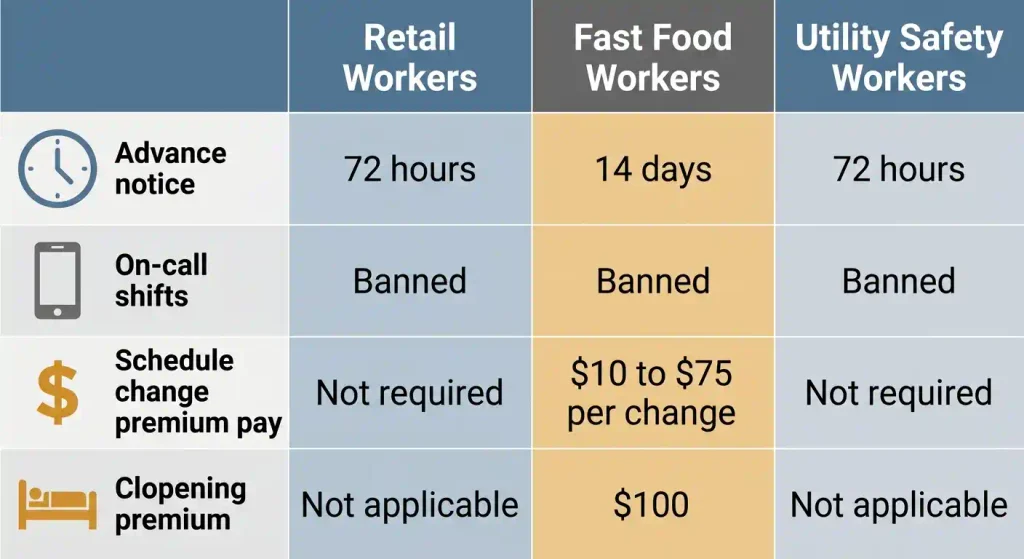
| Rule | Retail Workers | Fast Food Workers | Utility Safety Workers |
|---|---|---|---|
| Advance notice | 72 hours | 14 days | 72 hours |
| On-call shifts | Banned | Banned | Banned |
| Call-in shift within notice window | Banned | Banned | Banned |
| Schedule change premium pay | Not required | $10 to $75 per change | Not required |
| Clopening premium | Not applicable | $100 | Not applicable |
| Written consent for extra hours | Required | Required | Required |
Does NYC’s Fair Workweek Law Apply to Your Job?
Most likely yes, if you work a set schedule in NYC retail, fast food, or utility locating work. Coverage depends on your employer’s size and type, covered below.
This law adds scheduling protections on top of broader wage rules: overtime and New York’s minimum wage still fall under New York State Labor Law and the federal Fair Labor Standards Act (FLSA), enforced by the New York State Department of Labor (NYSDOL), while scheduling and premium pay go to DCWP.
Which Retail Workers and Employers Are Covered?
A retail employer sells consumer goods and has 20 or more employees citywide. Fewer than 20, and the retail rules likely don’t apply. A retail employer with 20 or more NYC employees must cover part-time and temporary staff on the regular schedule too.
Workers under a collective bargaining agreement that waives these rights are excluded. Otherwise, every retail worker at a covered location is protected, regardless of immigration status or tenure.
Which Fast-Food Workers and Employers Are Covered?
A fast food establishment is a limited-service restaurant in a chain of 30 or more locations nationally, including franchises, where customers order and pay before eating. Coverage follows job duties: cooks, cashiers, delivery workers, and cleaning staff at a covered location all qualify, franchise or not. A franchisee with just three NYC locations is still covered, since the 30-location count is national.
Part-time, temporary, and staffing-agency-placed workers are covered too, with both parties jointly responsible under New York worker classification rules. A worker placed through an agency who’s treated as a contractor instead of an employee may have been misclassified as an independent contractor. Salaried employees exempt from overtime rules for salaried employees are the main exception.
Are Utility Safety Workers Covered?
Utility safety workers locate and mark underground gas lines and inspect gas pipe fusions and joints. These protections took effect January 14, 2022, with DCWP enforcement starting July 18, 2022. The rules mirror retail: 72 hours’ notice, no on-call scheduling, no cancellations under 72 hours.
Coverage applies regardless of where the employer is based, as long as the work is in NYC, with an exception for a pre-existing CBA that waives these rights.
NYC Retail Fair Workweek Law: Schedule Changes and Notice
Retail employers must give a written schedule at least 72 hours before your first shift. Changing it afterward generally needs your written okay.
How Much Advance Notice Must Retail Employers Give?
Your employer must give you a written schedule 72 hours before your first shift, every time a new one posts, similar in spirit to the written wage notice requirements that apply elsewhere in New York labor law. This is the 72-hour advance scheduling notice requirement. Any later change needs an updated written copy, not just a verbal heads-up.
Can a Retail Employer Change or Cancel Your Shift?
Not without your okay, in most cases. Once posted, your employer can’t cancel a shift, add hours, or change your time with less than 72 hours’ notice unless you agree. A change made with more than 72 hours’ notice needs no consent.
Are On-Call and Call-In Shifts Legal?
No. Retail employers can’t put you on call or call you in within 72 hours of an unscheduled shift. Both on-call scheduling and call-in shifts are banned outright, and you can say no without consequences.
What Happens When a Retail Worker Agrees to a Schedule Change?
If you agree to a last-minute change, your employer still needs written consent, documented through a signed form, email, or app. You still get an updated written schedule, and that consent covers only that one instance.
NYC Fast-Food Fair Workweek Law: Scheduling Requirements
Fast food workers get a predictable regular schedule, 14 days’ notice before each work week, and pay when employers break that notice.
What Is a Regular Schedule Versus a Work Schedule?
Your regular schedule is your recurring pattern of days and hours. Your work schedule is the specific dated version posted for an upcoming week. Premium pay and the 15% reduction protection measure against your regular schedule; notice violations measure against your posted work schedule.
How Much Advance Notice Must Fast-Food Employers Give?
Fourteen days. Your schedule must post at least two weeks ahead. New hires get a good faith estimate of days, times, and weekly hours by their first day. A late-posted schedule triggers premium pay, since it was created with less than 14 days’ notice. This is the 14-day advance scheduling notice requirement.
Can Fast-Food Employers Add Hours or Change Shifts?
Yes, but you can say no, and they usually have to pay for asking late. You can decline additional hours not on your original schedule. Any employer-initiated change with less than 14 days’ notice triggers a premium, even if you agree to work it.
Before hiring a new worker, your employer must offer open shifts to existing employees first under the access-to-hours rule, whether the shift is posted on paper or through a scheduling app.
NYC Fair Workweek Schedule Change Premiums: How Much Extra Pay Can You Get?
Between $10 and $75 per change, based on notice given and whether hours were added, shifted, or cut. These $10 to $75 schedule change premiums apply per violation and can stack, and our calculation methodology page explains how premium amounts like these factor into a full paycheck estimate.
Fast-Food Schedule Change Premium Pay Table
DCWP publishes an exact table.
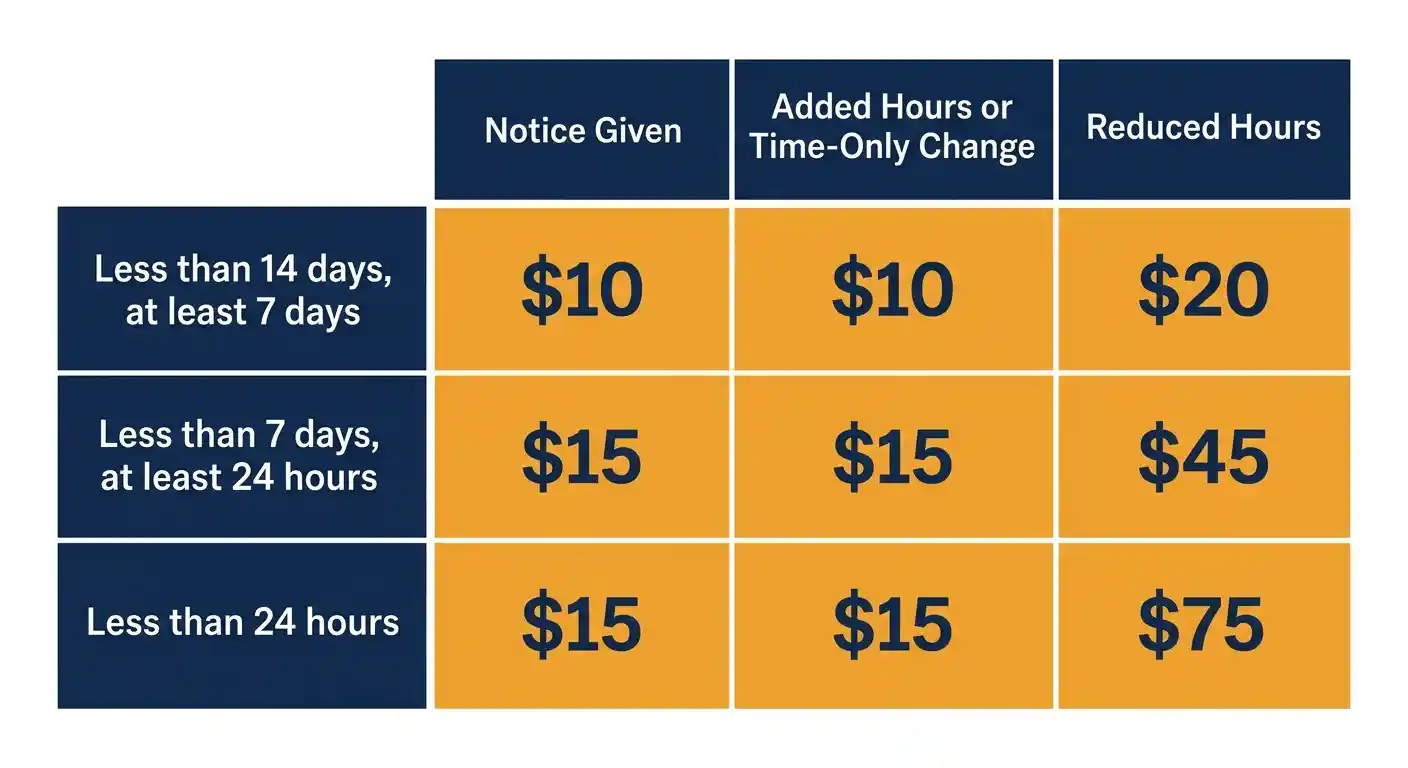
| Notice Given | Added Hours or Time-Only Change | Reduced Hours |
|---|---|---|
| Less than 14 days, at least 7 days | $10 per change | $20 per change |
| Less than 7 days, at least 24 hours | $15 per change | $45 per change |
| Less than 24 hours | $15 per change | $75 per change |
These amounts must appear separately on your pay stub, labeled as premium pay, and part of the wage statement requirements New York employers already follow. If you want to see exactly where that line item should sit, how to read a New York pay stub breaks down each section. Your employer must keep records for at least three years, a three-year record retention requirement covering schedules and consent forms too.
How Much Is the Premium for Adding a Shift?
Added hours with 7 to 13 days’ notice: $10. Under 7 days but at least 24 hours: $15. Under 24 hours: still $15. You’re owed the premium even if you’re glad for the extra hours, since it compensates for short notice.
How Much Is the Premium for Reducing or Canceling a Shift?
A cut or canceled shift with 7 to 13 days’ notice: $20. Under 7 days but at least 24 hours: $45. Under 24 hours, including same-day cancellations: $75, whether notice comes hours before or mid-shift.
NYC Clopening Shift Rules: Can Your Employer Require You to Work?
A clopening is closing one shift and opening the next with less than 11 hours between them. For fast food workers, your employer needs your consent and must pay extra if you agree.
What Is a Clopening Shift?
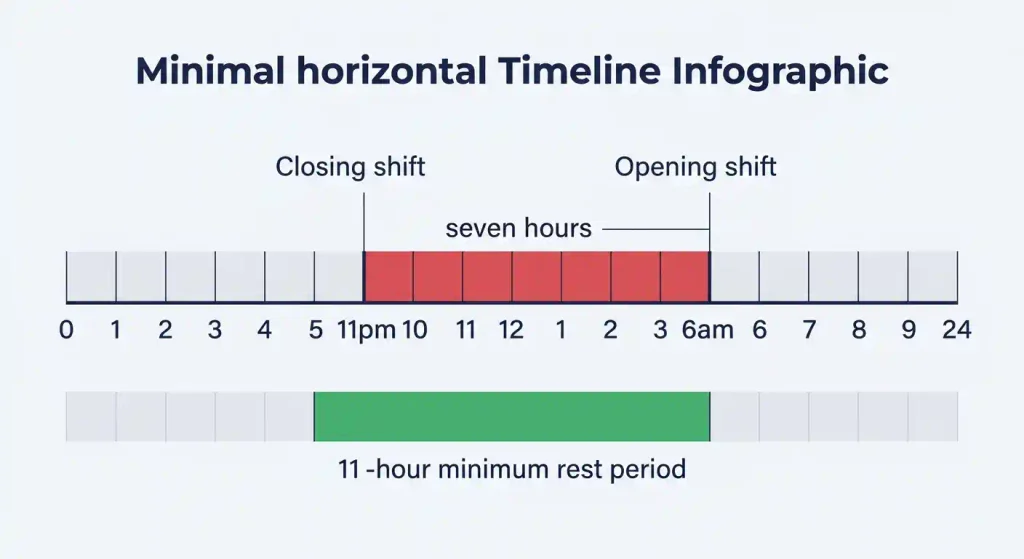
Closing at 11pm and opening at 6am the next day leaves seven hours, well under the 11-hour minimum rest period. A fast-food clopening shift is any pairing that falls short of the required 11-hour rest period between shifts, whether or not it crosses midnight.
Can You Refuse a Clopening Shift?
Yes, with no penalty, and your employer needs written consent before scheduling one. If you agree, you’re owed a $100 clopening premium on top of your regular pay for both shifts, shown separately on your pay stub.
Real-World Schedule Change Examples
Here’s how the numbers play out in a real paycheck.
Schedule Change Premium Examples
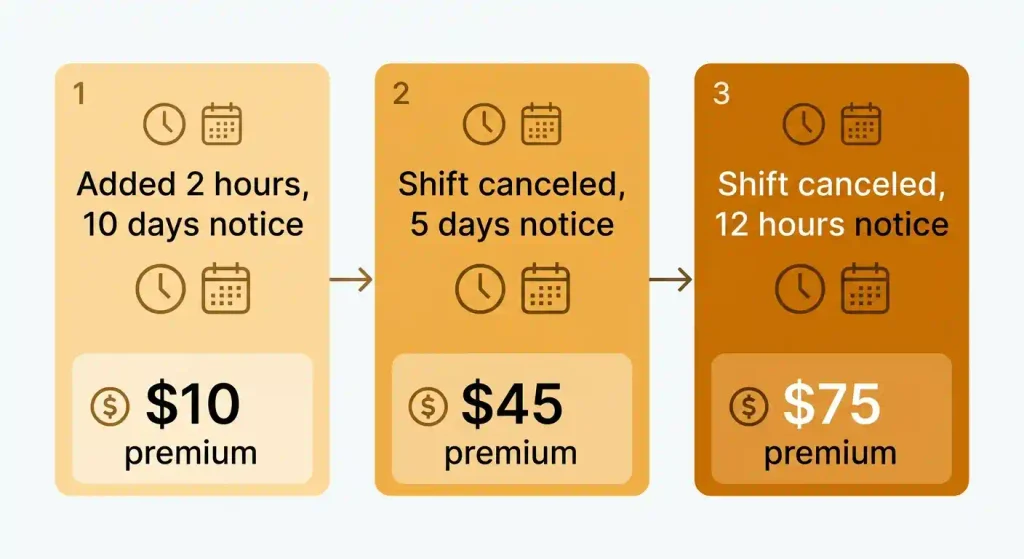
A fast food manager adds two hours 10 days before a shift: $10 premium. Cancels a Saturday shift five days out: $45. Cancels it with 12 hours’ notice: $75. Moving a 9am-to-5pm shift to 11am-to-7pm without cutting hours counts as a time-only change, falling under the $10-to-$15 column, not the $20-to-$75 reduced-hours column.
Clopening Shift Examples
Closing at 11pm Thursday and opening at 11am Friday gives 12 hours of rest, clearing the 11-hour minimum, so no premium applies. Moving that opening to 8am leaves only 9 hours, triggering the rule: the employer needs written consent, and the worker is owed the $100 premium plus regular pay for both shifts.
When Is Schedule Change Premium Pay Not Required?
Premium pay has limits. It doesn’t apply to every late change.
Employee-Requested Changes and Voluntary Shift Trades
No premium is owed when you request the change yourself, including requesting a day off, or for genuine written shift trades between coworkers. A manager-pushed “request” doesn’t count, and DCWP treats that as a violation.
Emergency and Operational Disruption Exceptions
No premium applies for closures tied to threats to safety, a government-declared state of emergency, a public utility failure, a transportation shutdown, or a natural disaster. An ordinary slow day doesn’t qualify, only a real, documented disruption.
Overtime-Related Exceptions
No premium or additional-shift offer is required if it would push you into overtime, such as over 40 hours for the week, under New York’s state overtime laws. This exception covers only that overtime scenario.
Can a Fast-Food Employer Cut Your Hours or Fire You?
Not without a real reason and paperwork. NYC ended at-will employment for fast food workers in 2021.
When Can an Employer Reduce Your Hours?
After a 30-day probation period, your employer can’t cut your regular schedule by 15 percent or more without just cause or a bona fide economic reason, sometimes called the 15% reduction in average hours rule, though it’s measured against your regular schedule, not a rolling average.
A bona fide economic reason means a real closure, production drop, or sales decline. A 15 percent or greater cut without your written consent requires written notice within five days.
Can a Fast-Food Employer Fire You Without Just Cause?
No, not after the 30-day probation period. Just cause requires demonstrated poor performance or misconduct that harmed the business, plus progressive discipline: documented warnings used within the past year. Older write-ups can’t justify a termination, and skipping straight to firing for a first, non-egregious issue typically violates the law.
What Happens When a Fast-Food Worker Is Laid Off?
If laid off for a bona fide economic reason, your employer must offer your job or hours back before hiring anyone new for 12 months, in order of seniority. Skipping a laid-off worker to hire someone new is a violation that can lead to reinstatement, and the same layoff can also raise questions covered under New York’s final paycheck laws.
Can Your Employer Retaliate Against You?
No. Punishing you for exercising Fair Workweek rights, an hour cut, a bad assignment, a sudden write-up, or termination, is illegal and separate from an ordinary scheduling dispute. DCWP takes retaliation seriously, as in the 2022 case where the city sued Starbucks over a fired worker and won reinstatement.
NYC Fair Workweek Law Myths and Misconceptions
Confusion mostly comes from assuming one rule set covers everyone, or that agreeing once gives up every right.
Common Scheduling Misconceptions
Retail and utility safety workers get 72-hour notice but no cash premiums; fast food workers get both. Agreeing to one change doesn’t waive future rights, each change still needs documented consent and an updated schedule. And a time shift of 15 minutes or less generally falls under a de minimis exception, with no premium owed.
Common Fast-Food Worker Misconceptions
Agreeing to a clopening doesn’t mean no extra pay, the $100 premium is separate from regular wages. The 15 percent hours-reduction rule doesn’t guarantee hours never dip, it only blocks unjustified cuts of that size. And a regular schedule isn’t the same as a weekly work schedule, the first is the pattern, the second is the specific posted week.
Common Employer Compliance Mistakes
The violations DCWP sees most often:
- A late or missing written schedule
- Undocumented consent for schedule changes
- Miscalculated or skipped premiums, especially on the reduced-hours side
- Hiring a new worker before offering hours to laid-off staff in seniority order, the mistake behind the city’s largest settlements
How to File a NYC Fair Workweek Law Complaint
Collect proof as soon as you notice a problem, then file with DCWP. It’s free, and no lawyer is required to start.
What Evidence Should You Collect?
Keep these records as soon as a problem shows up:
- Every version of your posted schedule, including app screenshots showing when changes were made
- Pay stubs, with or without premium payments listed
- Texts, emails, or app messages about unscheduled shifts or changes
- Dates and times, noted while they’re still fresh
How to File a Complaint With DCWP
The New York City Department of Consumer and Worker Protection (DCWP) handles this, through its DCWP Office of Labor Policy and Standards (OLPS) division. The agency was formerly the NYC Department of Consumer Affairs (DCA) before a 2019 rebrand. File online through DCWP’s complaint portal, call 311 and say “Fair Workweek Law,” or email OLPS@dcwp.nyc.gov.
Have your employer’s name, address, violation dates, and documentation ready. You can file anonymously, with retaliation protection, regardless of immigration status. A refused premium or a missing schedule is exactly what a complaint addresses.
DCWP publishes NYC Fair Workweek Law official FAQs by industry, including a NYC Retail Fair Workweek Law FAQ and a NYC Fast Food Fair Workweek Law FAQ, plus the NYC Fair Workweek Law Notice of Rights every covered workplace must post. For current thresholds and forms, NYC Department of Consumer and Worker Protection official guidance is the final word.
What Happens After You File a Complaint?
DCWP reviews your employer’s records and gives them a chance to respond. As of a 2024 City Council hearing, DCWP had fielded over 900 complaints and opened more than 400 investigations since 2017, including 134 new ones in that year’s first quarter. Cases can take over a year to close, but outcomes have included multimillion-dollar restitution, including the $35.5 million Starbucks settlement in December 2025.
Can You Recover Unpaid Premiums or Other Compensation?
Yes, DCWP can order back pay for owed premiums, plus civil penalties, and reinstatement or restored hours for wrongful termination or hours cuts. Workers can also sue in court for additional damages. If your regular paycheck already looks smaller than expected for unrelated reasons, why your paycheck looks lower than expected can help you separate a scheduling issue from a withholding one. You can file with DCWP first and move to court if it stalls, though fast food just-cause disputes may go through binding arbitration instead.
What to Do If Your Employer Violates NYC’s Fair Workweek Law
Whether you’re affected or responsible for compliance, start by identifying which rule applies.
A Practical Checklist for Workers
- Identify your category: retail, fast food, or utility safety, since that sets your notice period and remedies
- Save every schedule, message, and pay stub as it happens
- Decide whether DCWP alone is enough or an employment attorney is needed too
A Practical Checklist for Employers
- Confirm coverage: 20 or more retail employees, or 30 or more fast food locations nationally
- Audit scheduling practices against the premium chart and consent requirements
- Keep notices posted, three years of records, and premiums itemized on pay stubs
- Fix any past violation voluntarily, back pay, process correction, documentation, before DCWP finds it
This falls under the same payroll employer compliance work covered by New York’s payroll tax filing requirements, and DCWP’s free NYC Fair Workweek Law employer tools, including templates and a premium calculator, help with all four.
NYC Fair Workweek Law FAQ
Can My NYC Employer Change My Schedule Without Notice?
Technically, but it usually costs them. Retail and utility safety employers need 72 hours’ notice or written consent. Fast food employers need 14 days’ notice, or a premium of $10 to $75 applies.
Do Retail Workers Get Premium Pay for Last-Minute Changes?
No. Retail workers get 72 hours’ notice and the right to refuse a change made without it, but no cash premium.
Can I Refuse an Extra Shift in NYC?
Yes, in both retail and fast food, you can decline additional hours not on your original schedule. Fast food workers who agree to short-notice extra hours still get the premium.
How Much Is NYC Fair Workweek Premium Pay?
$10 to $75 per change for fast food, based on notice and type of change. Clopening shifts carry a separate flat $100 premium.
Can My Employer Fire Me for Filing a Fair Workweek Complaint?
No. Retaliation for filing a complaint or asserting your rights is illegal and treated as its own violation.
How Do I Report a Fair Workweek Violation in NYC?
DCWP enforces the law citywide. File online, call 311 and ask for “Fair Workweek Law,” or email OLPS@dcwp.nyc.gov, with your schedules, pay stubs, and written proof.

Meet Yasin Ali, Founder
Yasin built NY Paycheck Calculator in 2020 after getting fed up with calculators that treated New York like every other state. Most tools ignore the extra local tax NYC and Yonkers workers pay on top of state tax — or skip New York’s Paid Family Leave deduction entirely.
He keeps the numbers current, checking in regularly against the latest IRS, NY Department of Taxation and Finance, and Paid Family Leave rates.
All results here are estimates based on official sources. For advice specific to your situation, talk to a tax professional.