
A missing New York paycheck usually means a payroll error, a bank delay, or an employer paying past the regular payday, since state law allows no grace period. Notify payroll in writing, then file a wage complaint if still unpaid.
That no-grace-period rule comes straight from Labor Law Section 191’s payday rules, which NYSDOL enforces through its wage complaint process.
Still, NYSDOL resolution speed varies case to case, and it will not take commission or court-pending claims.
What to Do Immediately When Your New York Paycheck Is Missing
Check your bank and payroll portal today, then message payroll in writing and ask where the payment is. Most cases are simple, like a wrong account number or a late payroll file. If payroll stays vague, file a wage complaint with the New York State Department of Labor (NYSDOL).
Check Your Payday, Payroll Records, and Bank Account
Your hiring notice, required under New York Labor Law Section 195, lists your pay rate, overtime rate, and regular payday. Every wage statement must show your rate and deductions, and your hours too if you qualify for overtime. If the codes on your stub do not make sense, this guide on how to read a New York pay stub walks through each line. Check your payroll portal, pay stub, and bank app, and sort the problem: pending, rejected, missing, or wrong amount. A late paycheck arrives after payday, a wrong one arrives short, a bounced check is not real payment, and unpaid wages never arrive at all.
Contact Payroll or Your Employer in Writing
Email or message payroll with the pay period, payday, and amount expected, and ask for the payment status and a date. If payroll says it sent the money, ask for the transaction reference. Save every reply and screenshot.
When Should You Stop Waiting and Take Further Action?
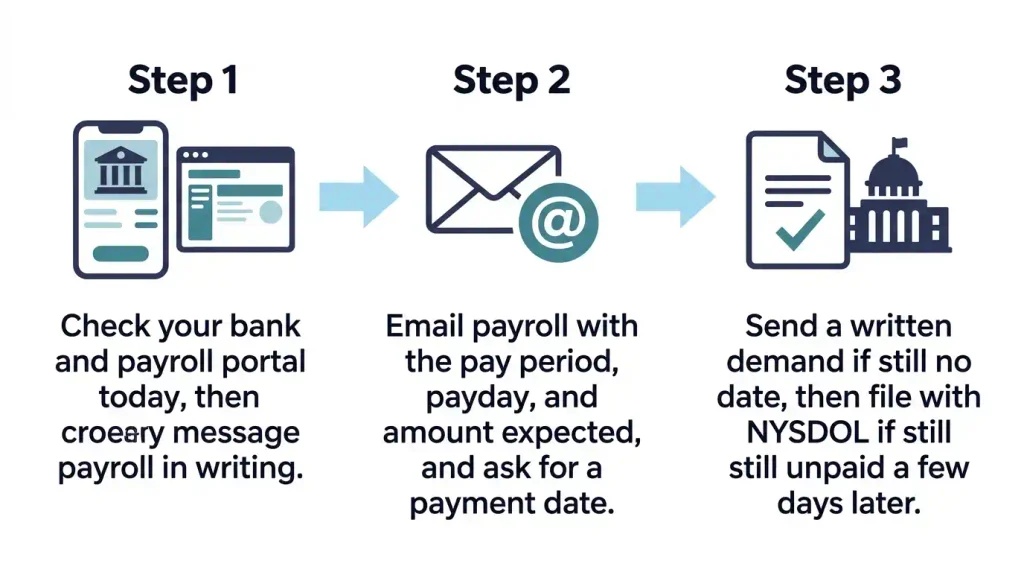
Stop waiting once payroll gives no date, a date that passes, or says it cannot pay. A one day bank delay is not overdue wages, but a missed regular payday is. Example: paid every Friday, nothing arrives. Message payroll that morning, send a written demand Monday if still no date, and file with NYSDOL if still unpaid a few days later.
Can Your Employer Legally Delay Your Paycheck in New York?
Not without a legal reason. Under New York Labor Law § 191, employers must pay earned wages on regular paydays set in advance, and the law gives no extra waiting period after payday.
New York’s Regular Payday and Wage Payment Rules
New York Labor Law Section 191, covered in more depth in this breakdown of New York pay frequency laws, sets how often you must be paid and when the money is due; it says nothing about bank transfers, so a direct deposit delay comes down to who caused it. New York Labor Law Section 190 defines wages and employee. These rules cover hourly, salaried, part-time, temporary, and seasonal workers alike.
How Often Must Different Workers Be Paid?
Courts and NYSDOL generally treat a manual worker as someone spending more than 25% of their time on physical labor, like a cook or a construction laborer, a distinction explained further in our New York paycheck basics hub. Qualifying nonprofits can pay manual workers semi-monthly instead of weekly, and large employers with 1,000 or more New York workers can apply for the same, with union consent if the workers are unionized.
| Worker Type | Minimum Pay Frequency |
|---|---|
| Manual worker | Weekly, within 7 calendar days after the workweek ends |
| Clerical / other worker | At least twice a month, on fixed paydays (e.g. 15th and last day) |
| Commission salesperson | Under written agreement, by the last day of the following month at the latest |
| Qualifying nonprofit (manual workers) | Semi-monthly |
| Large employer (1,000+ NY workers, DOL-authorized) | Semi-monthly, with union consent if unionized |
Is There a Legal Grace Period for a Late Paycheck?
No. If your employer sent the payment on time and the bank held it, that is a bank issue, not a violation. If payroll sent it late, the delay is the employer’s. Example: a warehouse worker’s payday is Friday but pay arrives Monday, missing the designated payday even if still inside the seven day limit. Payroll errors, cash-flow problems, and holidays are not legal excuses.
What to Do If Your Direct Deposit or Paycheck Has a Problem
Most direct deposit problems trace to a wrong account number, a bank holiday, or a late payroll file. Check your bank for a pending or returned deposit, then ask payroll to trace the payment and give a clear date.
Direct Deposit Is Missing, Pending, or Rejected
Check your bank app for pending or returned deposits, and compare the account and routing numbers on file. Ask payroll to trace the payment. If a wrong account caused it, your employer can usually reissue pay within a day or more. Ask for a firm written date, and if a bill is due, ask your landlord or lender for a short extension.
Your Paycheck Bounced or Was Issued for the Wrong Amount
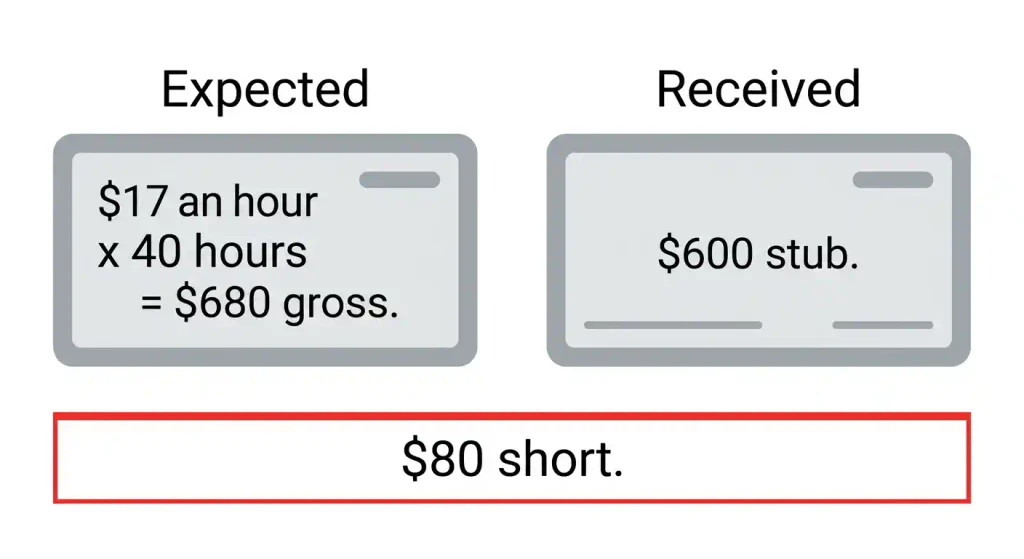
A bounced paycheck means you have not been paid. Ask your employer to replace it with cash, a certified check, or a transfer, and to cover any bank fees. If the amount is wrong, compare your stub to your own hours. Example: a New York City worker at $17 an hour (the 2026 minimum wage there, Long Island, and Westchester; $16 elsewhere) works 40 hours for $680 gross. A $600 stub is $80 short. Running your hours and rate through a New York paycheck calculator can confirm the gap fast. Keep a daily hours log as proof.
Payroll Says the Money Was Sent but Your Bank Cannot Find It
Ask payroll for the send date, transaction reference, and last four digits of the destination account, then take those to your bank to search for the deposit. Example: payroll says it sent $1,100 Thursday, but your bank shows nothing Friday; the trace details reveal whether it went to the wrong account or was never sent.
Special Situations That Change Your Next Steps
Your next move depends on your situation: a final paycheck, a short paycheck, contractor or union status, or staying employed while you complain.
You Quit or Were Fired and Your Final Paycheck Is Missing
Under New York Labor Law Section 191(3), covered in full in our guide to New York final paycheck laws, final wages are due by the regular payday for the pay period in which you quit or were fired, no matter why you left. Example: you leave on the 10th, your payday for that period is the 15th; if nothing arrives, send a written request on the 16th and file a complaint if still unpaid. Unused vacation pay depends on your employer’s written policy.
You Received Your Paycheck but Some Wages Are Missing
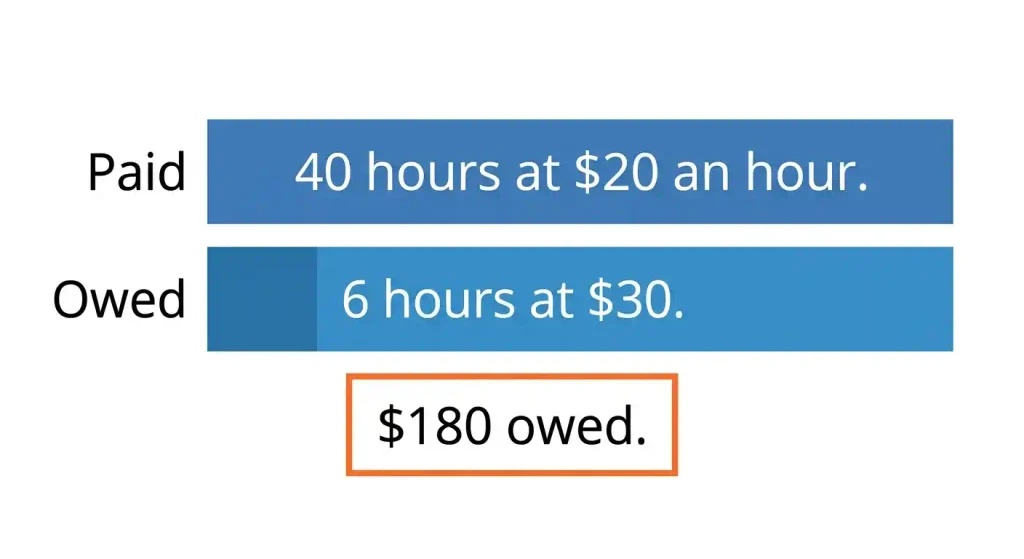
A short check can mean unpaid overtime, tips, bonuses, or illegal paycheck deductions. Overtime is one and a half times your regular rate after 40 hours a week, under the New York overtime laws that apply statewide. Example: 46 hours at $20 an hour, paid for only 40, means 6 hours owed at $30, or $180. An employer generally cannot dock pay for broken equipment, shortages, or alleged misconduct, and Section 196-d bars keeping any part of your tips; the main exceptions are fixing a genuine payroll error or recovering a salary advance. A bonus is a wage claim only if it was promised. Unpaid commissions are different: NYSDOL will not accept a commission claim, so that goes to court or a private attorney instead, under the written agreement Section 191 requires.
You Work in NYC, Work as a Contractor, or Have a Union Agreement
NYC’s Department of Consumer and Worker Protection (DCWP) handles some matters NYSDOL does not, including the Freelance Isn’t Free Act. A true independent contractor has a contract dispute, not a wage claim, but a misclassified independent contractor may still have wage rights under New York’s worker classification rules. Freelance work worth $800 or more over any 120 day period needs a written contract and payment by its date, or within 30 days of finished work if undated; the statewide law is enforced by the New York Attorney General, NYC claims go to DCWP. Union pay disputes generally go through the union grievance process instead of NYSDOL. Public works or prevailing wage workers can contact the NYC Comptroller’s Bureau of Labor Law.
You Are Still Employed and Fear Losing Your Job
You can raise a pay problem and keep your job. Put it in writing and keep copies. New York Labor Law Section 215 bars firing, threatening, or penalizing you for complaining about pay, and you do not have to quit to file.
How to Recover Your Missing Paycheck in New York
Ask in writing, file with NYSDOL if still unpaid, and keep your proof organized. No lawyer is required to file, and you can file while still employed.
Send a Written Request for the Unpaid Wages
Email or write stating the pay period, amount expected, and scheduled payday, and ask for payment by a set date. Example: “My pay for the period ending [date] was due on [payday] and I have not received it.” Keep a copy. Do not rely on a verbal promise; confirm it in writing.
File an Unpaid Wage Complaint With NYSDOL
File Labor Standards Complaint Form LS223 with NYSDOL, after reading the instructions (LS223.2), either online through NYSDOL’s upload link or by mail to the Albany address on the form. Call 888-525-2267 for help. No written contract is required to file, and immigration status does not bar protection.
NYSDOL will not take:
- Wages already in a court case
- Wages owed by a government agency or city
- Wages over three years old
- Union grievance claims
- Work performed outside New York
- A wage supplement claim under 30 days past due
- Executive, administrative, or professional employees earning over $900 a week
- Public work claims (use form PW4 instead)
What Documents Do You Need to Prove Your Claim?
Gather these, send copies not originals, and keep them in one dated folder. Employers must keep payroll records for six years, so proof exists even if yours is thin.
- Pay stubs and time records
- Work schedules
- Bank statements showing no deposit
- Payroll texts or emails
- Pay notice or employment agreement
- Any returned check
How Long Does a New York Wage Claim Take?
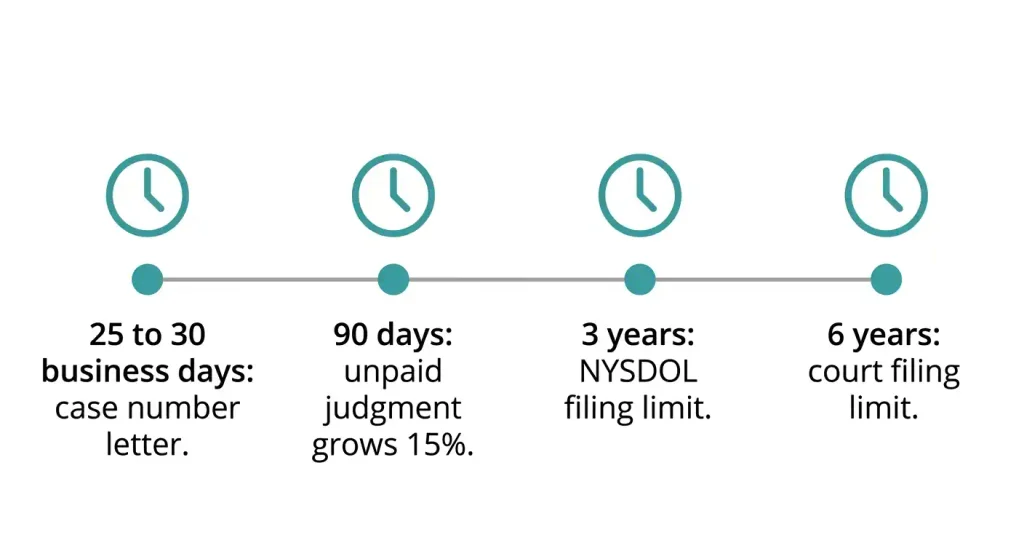
There is no fixed timeline. You should get a letter with your case number within 25 to 30 business days of filing. After that, NYSDOL reviews the complaint, contacts the employer, and may order payment with damages of up to 100% of wages owed; a dispute adds time. NYSDOL’s limit is three years, and the separate six year court deadline pauses while your NYSDOL complaint is open, so filing does not cost you court time.
What If Your Employer Still Refuses to Pay?
You generally have two tracks, a NYSDOL complaint or a court claim, usually not both. Retaliation for asking to be paid is illegal, and recovery is still possible even if the business closes.
When to Consider a Court Claim or Legal Assistance
A lawsuit may fit a large or complicated claim, or one NYSDOL ignores. Under New York Labor Law Section 198, a court can award unpaid wages, liquidated damages equal to 100% unless the employer proves good faith, prejudgment interest, and attorney’s fees; an unpaid judgment grows 15% after 90 days. Missing wage statements or pay notices add $250 or $50 a day, up to $5,000. Smaller claims can go to small claims court. For a late manual worker paycheck specifically, a 2025 update to Section 198 limits a first violation to lost interest, reserving full 100% damages for repeat violators. Filing in court means NYSDOL cannot also take the claim.
Can Your Employer Retaliate for Reporting Unpaid Wages?
No. Section 215 bars retaliation, including threatening to report immigration status. NYSDOL can fine an employer $1,000 to $10,000 for a first violation, or up to $20,000 for a repeat one within six years, and you have two years to sue over retaliation yourself. Document any threats, cut hours, or firing, and report retaliation to NYSDOL as a separate violation.
What If Your Employer Closes or Files for Bankruptcy?
File your complaint anyway and keep your records. In bankruptcy, file a proof of claim; federal law gives some recently earned wages priority up to a cap. New York law also lets workers pursue the ten largest shareholders of some private corporations, and some LLC members, for unpaid wages.
Common Misconceptions About Missing Paychecks in New York
Three myths: every late deposit is a violation, you have years to wait, and NYSDOL handles every dispute. None is true, and these New York wage and hour laws explain why.
Does Every Late Deposit Mean Your Employer Broke the Law?
No. A bank holiday, wrong routing number, or bank hold is usually a bank problem, not the employer’s fault. What matters is when payroll sent the file versus your regular payday.
Can You Wait Three Years Before Taking Action?
Technically, but it is a bad idea. NYSDOL will not take claims for wages over three years old, and that cutoff moves forward daily. Court claims generally allow six years. Evidence gets harder to find over time, so act now.
Can NYSDOL Handle Every Unpaid Wage Dispute?
No. NYSDOL excludes wages already in court, wages owed by government agencies, wages over three years old, union grievance claims, work outside New York, commission disputes, and public work claims (form PW4). New York treats wage theft as larceny, so serious cases can mean criminal referral, and since 2025 NYSDOL can place liens, issue warrants, and seize assets. Federal minimum wage and overtime issues under the FLSA go to the U.S. Department of Labor Wage and Hour Division, and the New York Attorney General’s Labor Bureau also takes wage theft complaints.
Frequently Asked Questions About a Missing New York Paycheck
Short answers: no grace period, you can file while still employed, and you generally have three years with NYSDOL or six in court.
How Many Days Can an Employer Be Late Paying You in New York?
None. Pay is due on your regular payday: weekly within seven days for manual workers, at least twice a month for clerical and other workers. Once payday passes, wages are late.
Can I Report My Employer for Not Paying Me on Payday?
Yes. If payroll ignores your written request, file an LS223 with NYSDOL. Pay stubs, time records, bank statements, and messages make the strongest claim.
Can I File an Unpaid Wage Claim While Still Working?
Yes. You do not have to quit, and Labor Law § 215 protects you from retaliation.
What If My Employer Ignores My Messages About Missing Pay?
Send one more written request with a clear deadline, copying a manager or HR. If still unpaid, file with NYSDOL; your unanswered messages become proof.
How Long Do I Have to File a Wage Claim in New York?
Generally three years with NYSDOL, six years in court. Do not wait on the longer window.
What If My Final Paycheck Never Arrives After I Quit?
Final wages are due by the regular payday for the pay period you quit. Send a written request right away, then file an LS223.
Official New York Wage Complaint Resources
New York State Department of Labor
Start with the New York Department of Labor (NYSDOL) page on unpaid and withheld wages and wage supplements. File with the Labor Standards Complaint Form LS223 and read the Instructions for Filing a Claim LS223.2 first. Call 888-525-2267 for help.
New York Wage Payment Laws and Federal Resources
Read New York Labor Law § 191 on the New York State Senate Open Legislation site for pay frequency and final pay rules. NYSDOL also keeps a pay frequency page for authorized exceptions. For federal minimum wage or overtime issues, contact the U.S. Department of Labor Wage and Hour Division at 1-866-487-9243. This article is general information, not legal advice.

Meet Yasin Ali, Founder
Yasin built NY Paycheck Calculator in 2020 after getting fed up with calculators that treated New York like every other state. Most tools ignore the extra local tax NYC and Yonkers workers pay on top of state tax — or skip New York’s Paid Family Leave deduction entirely.
He keeps the numbers current, checking in regularly against the latest IRS, NY Department of Taxation and Finance, and Paid Family Leave rates.
All results here are estimates based on official sources. For advice specific to your situation, talk to a tax professional.