
In New York, paycheck deductions are illegal unless they cover taxes, court orders, or benefits you authorized in writing. Charges tied to your employer’s own costs or mistakes are not allowed, regardless of the label on your pay stub.
That line comes straight from Section 193 and the state’s wage-deduction regulations, which spell out exactly what employers can take.
Gray areas like wage advances and overpayments still depend heavily on paperwork and timing.
Which Paycheck Deductions Are Illegal in New York?
Section 193 limits legal deductions to a specific list: income tax withholding, court-ordered garnishments, and benefits you authorized in writing, like insurance or retirement plans. Anything outside that list violates the statute, even a small charge tied to a business loss or a mistake.
Common Illegal Paycheck Deductions
Common violations include:
- Cash register shortages, broken equipment, or damaged merchandise
- Losses from theft or customer walkouts
- Fines for lateness or workplace rule violations
- Check replacement fees and similar administrative charges
- Deductions for customer complaints, refunds, or bounced checks
- Overcharges on New York Paid Family Leave, capped in 2026 at 0.432% of gross wages ($411.91 a year)
Anything withheld above the PFL cap is illegal, the same as every other item on this list.
Legal vs. Illegal Paycheck Deductions at a Glance
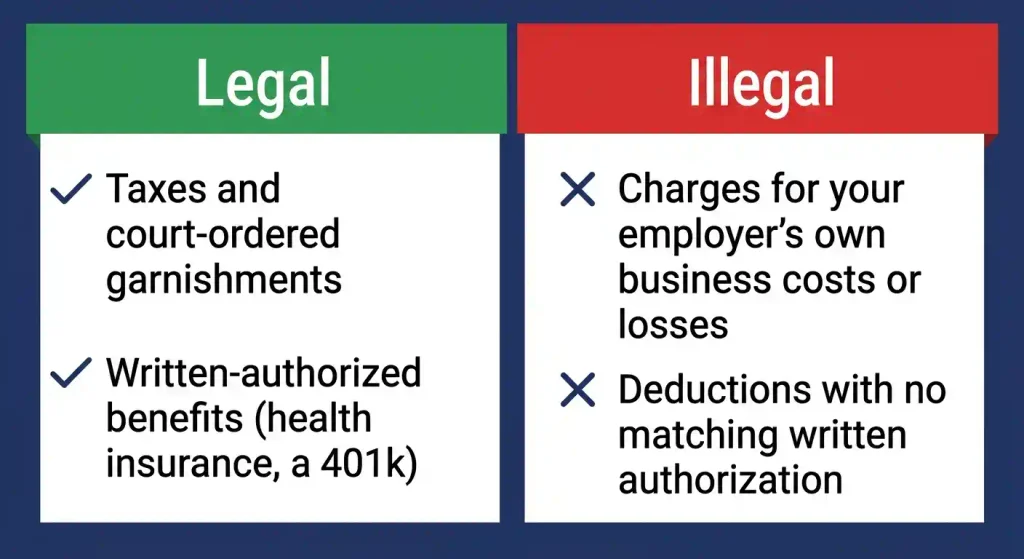
| Legal | Illegal |
|---|---|
| Taxes and court-ordered garnishments | Charges for your employer’s own business costs or losses |
| Written-authorized benefits (health insurance, a 401k) | Deductions with no matching written authorization |
A deduction on your pay stub only proves your employer made it, not that it was allowed. The New York State Department of Labor (NYSDOL) enforces wage-deduction law statewide, including New York City. The New York City Department of Consumer and Worker Protection handles separate city protections, like paid safe and sick leave, not Section 193 claims.
What Does New York Labor Law Section 193 Prohibit?
Structurally, Section 193 operates as a closed list: it recognizes only two legal doors, deductions required by law, like taxes or court-ordered garnishments, and deductions you authorize in writing for your own benefit, such as insurance, retirement, or transit. Any charge outside those two doors breaks the statute, signature or not. The law also blocks a common workaround: employers cannot charge you separately, outside payroll, for something they could not legally deduct, whether they call it a fee, a reimbursement, or a side cash payment.
When Can an Employer Legally Deduct Money?
Employers can legally deduct wages for:
- Income tax, Social Security, Medicare, and court-ordered garnishments
- Genuine employee benefits with written authorization, like health coverage, retirement, or commuter benefits
- Wage advances and overpayment recovery, under separate state rules with strict limits on timing and amount
Does Signing a Deduction Agreement Make It Legal?
A signature does not make an illegal deduction legal. Written authorization only works for real employee benefits, like gym memberships, parking, or daycare. Signing a form to pay for broken inventory or a cash shortage does not make that deduction valid. A union contract can authorize dues deductions without each worker’s signature, but that exception does not cover business losses or fines.
Which Specific Paycheck Deductions May Be Illegal?
Most deduction disputes in New York fall into a few recurring patterns, worth knowing even for small amounts.
Cash Shortages, Broken Equipment, and Damaged Merchandise
Register shortages, walkouts, and accidental damage are business losses, not your debt. Section 193 does not let employers pass these costs to you through payroll.
Uniforms, Tools, Training, and Work Expenses
Charges for required uniforms, cleaning, tools, or training often fall outside what Section 193 allows. Even when technically allowed, a charge cannot push pay below minimum wage or cut into overtime. A $15 uniform charge on a minimum wage check can trigger a violation. Check the current New York minimum wage rates to see how much room your paycheck actually has. The same applies to salaried employees exempt from overtime: a deduction that cuts into their guaranteed salary can jeopardize that exempt status.
Fines, Lateness, Absences, and Workplace Penalties
Docking pay for lateness, an absence, a dress-code slip, or any policy violation is illegal, whether your employer calls it an “administrative fee” or a flat penalty. Not paying for hours not worked is legal. Subtracting extra money as punishment is not.
Tips, Commissions, Bonuses, and Final Paychecks
Tips belong to the employee, and employers cannot dip into them for business costs. For tipped workers, an illegal deduction can also push pay below minimum wage once the tipped employee minimum wage tip credit applies, adding a separate violation. The same protections cover earned commissions and bonuses. A final paycheck cannot be used to recover disputed charges or cash shortages, and the payout rules are covered in our guide to New York final paycheck laws.
Which Paycheck Deductions Are Usually Legal?
Most paycheck deductions are legal. Knowing the normal categories makes it easier to spot what doesn’t belong.
Taxes, Social Security, Medicare, and Court-Ordered Deductions
Federal income tax, New York State income tax, Social Security, and Medicare come out automatically. New York City income tax withholding applies only if you live in the city, not just work there (see our New York City income tax breakdown for current rates). Court-ordered garnishments, like child support or tax levies, are legal because a government authority directs them.
Insurance, Retirement Contributions, and Other Employee Benefits
Health insurance and retirement contributions are legal with written authorization. Union dues can be deducted under a collective bargaining agreement without individual sign-off. Transit and similar benefit deductions need real, documented authorization too. This benefit-deduction law has a sunset date, most recently extended in 2026 to November 6, 2028.
Wage Advances and Employer Payroll Overpayments
Employers can recover an advance or overpayment through payroll deductions, but only by following 12 NYCRR Part 195: proper notice, a cap of generally no more than 12.5% of gross wages per pay period (unless it fits within net pay), and a way to dispute it. Skipping notice or taking too much violates the regulation, even if the overpayment was real. Our related guide on New York payroll overpayment recovery rules walks through more real-world scenarios.
Real Examples of Potentially Illegal New York Paycheck Deductions
Real scenarios make the legal line easier to spot on your own pay stub.
Example: An Employer Deducts $75 for a Cash Shortage
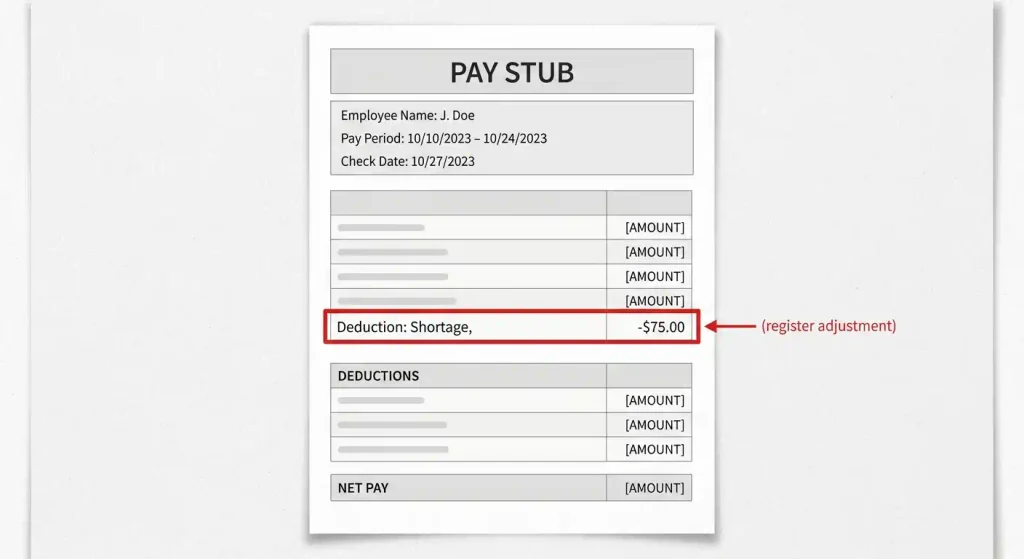
A $75 register shortage deducted from your check is a textbook Section 193 violation, since a cash shortage is a business loss, not an authorized deduction. Check your stub for vague labels like “shortage” or “register adjustment,” and keep your shift schedule, register reports, and pay stub.
Example: A Restaurant Worker Pays for a Customer Walkout
Charging a server for a customer walkout is illegal, no matter how the employer explains it. A walkout is a cost of doing business, not the worker’s debt. Save receipts, the point-of-sale report, and any manager messages about the charge.
Example: An Employer Recovers an Alleged Overpayment
A $200 overpayment taken out in one lump sum, even if real, still must follow Part 195’s notice and per-period caps. A lump sum deduction without notice is a procedural violation you can dispute, separate from whether the overpayment happened.
How to Tell Whether Your Paycheck Deduction Is Illegal
A quick records check usually tells you within minutes if a deduction is worth challenging.
Review Your Pay Stub and Payroll Records
Compare gross pay, net pay, and each deduction line against past pay periods. If you’re unsure what a line item means, our guide on how to read your New York pay stub breaks down every section. Vague labels like “miscellaneous deduction” or “adjustment” deserve a written, itemized explanation from payroll, which employers must provide under New York wage statement requirements. Keep every pay stub and time record as evidence.
Check Your Authorization and the Employer’s Explanation
Ask for a copy of anything you supposedly signed. Compare the stated reason against New York’s permitted categories: taxes, court orders, or benefits you agreed to in writing. Write down any explanation that conflicts with your agreement or company policy, since it matters if you file a complaint.
How to Get Your Money Back for an Illegal Deduction
Recovering an illegal deduction follows a predictable path: inside the company first, then the state if needed.
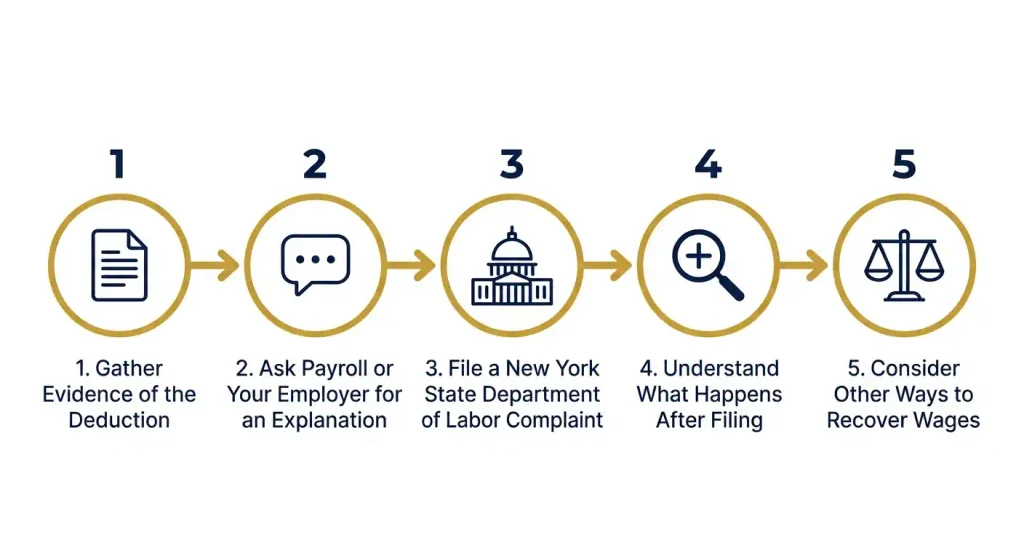
Step 1: Gather Evidence of the Deduction
Collect every pay stub, time record, bank deposit, deduction notice, employment agreement, receipt, and relevant message. Add up the total across all affected pay periods; a New York paycheck calculator can help you confirm what each period should have totaled. Without pay stubs, especially after leaving a job, bank deposits and employer-provided payroll records can fill the gap.
Step 2: Ask Payroll or Your Employer for an Explanation
Request the reason, legal basis, and supporting documents in writing. State exactly which deduction you’re disputing and what correction you want. Keep copies of all communications, including any repayment offer.
Step 3: File a New York State Department of Labor Complaint
If your employer won’t fix it, file with the New York State Department of Labor (NYSDOL) using Labor Standards Complaint Form LS223, through the Division of Labor Standards. This is the same process covered in our guide on what to do if your paycheck is late or missing. Bring your pay records, dates, amounts, and employer information. The agency generally accepts claims covering the past three years; a private lawsuit can reach back six.
Step 4: Understand What Happens After Filing
NYSDOL’s Division of Labor Standards reviews eligibility, investigates your claim, and usually contacts your employer. A violation can lead to a repayment order, though collection still depends on the employer. A private lawsuit can go further: Labor Law Section 198 allows liquidated damages equal to 100% of unpaid wages, plus 9% statutory interest, and civil penalties up to 200% can apply under Section 218, with a six-year deadline instead of the agency’s three. Respond fully to agency requests, since incomplete answers slow or weaken your claim.
Step 5: Consider Other Ways to Recover Wages
Small claims court often works faster for smaller amounts. Larger or pattern claims usually need an employment attorney. Union members may need to file a grievance first, and filing in court before that can limit other options.
Can Your Employer Retaliate Against You for Challenging a Deduction?
New York Labor Law Section 215 protects you from retaliation for raising a wage complaint, with your employer, the state, or a lawyer.
Examples of Possible Workplace Retaliation
Retaliation can look like a sudden schedule cut, a surprise write-up, or termination right after you complain. Not every negative change counts. Timing and reason matter; something already planned before your complaint is different.
What to Do If Your Employer Threatens or Punishes You
Save every message, schedule change, and performance note tied to the timeline, with dates and witnesses. Report retaliation to the Department of Labor alongside your wage complaint, or consult an employment attorney.
Common Myths About Illegal Paycheck Deductions
A few myths lead workers to accept deductions they shouldn’t.
“My Employer Can Deduct Anything If I Signed a Form”
Signing a form doesn’t expand what Section 193 allows. Written authorization only covers genuine benefit deductions, not business losses or penalties. A signed form for broken equipment is still invalid.
“Small Deductions Are Always Legal”
A $10 deduction follows the same rules as a $1,000 one. A weekly $15 “shortage fee” adds up to nearly $800 a year. Amount has nothing to do with legality.
“I Cannot Complain After Leaving My Job”
Leaving a job doesn’t erase your right to recover illegally deducted wages. Former employees can still file with the Department of Labor or pursue a private claim, under the same general deadlines.
Frequently Asked Questions
Can my employer deduct money for a broken item in New York?
Generally no. Broken-item charges are business losses, and New York law doesn’t let employers shift that cost to a worker’s paycheck.
Can my employer deduct money without my permission?
Yes, for some things. Taxes, Social Security, Medicare, and court-ordered garnishments don’t need your consent. Benefit deductions do need written authorization.
How far back can I claim illegal paycheck deductions in New York?
The Department of Labor generally accepts claims covering the past three years. A private lawsuit can sometimes reach back further.
Can I get fired for reporting an illegal paycheck deduction?
No. New York law prohibits retaliation for reporting a wage violation. Document any punishment and report it alongside your wage claim.
What form do I use to report illegal paycheck deductions?
Labor Standards Complaint Form LS223, with instructions in Information About Filing a Claim LS223.2, both available through the Department of Labor.
What if my employer refuses to return the money?
You still have options: a Department of Labor investigation, small claims court, or a private lawsuit, depending on the amount and your evidence.
Official New York Resources for Paycheck Deduction Disputes
New York Labor Law and Wage-Deduction Regulations
New York State Senate Open Legislation publishes the full text of New York State Labor Law § 193. NYSDOL illegal deductions guidance, on the Department of Labor’s Illegal Deductions page, explains how it applies in practice. 12 NYCRR Part 195, part of the New York Codes, Rules and Regulations, covers wage advance and overpayment procedure. The New York Paid Family Leave program also publishes current 2026 rates directly at paidfamilyleave.ny.gov.
Wage Complaint Forms and Recovery Assistance
Labor Standards Complaint Form LS223, with instructions in Information About Filing a Claim LS223.2, is the official starting point. NYSDOL also publishes general guidance on unpaid and withheld wages, the right place for advice specific to your situation. For more related topics, browse our New York wage law guides.

Meet Yasin Ali, Founder
Yasin built NY Paycheck Calculator in 2020 after getting fed up with calculators that treated New York like every other state. Most tools ignore the extra local tax NYC and Yonkers workers pay on top of state tax — or skip New York’s Paid Family Leave deduction entirely.
He keeps the numbers current, checking in regularly against the latest IRS, NY Department of Taxation and Finance, and Paid Family Leave rates.
All results here are estimates based on official sources. For advice specific to your situation, talk to a tax professional.